



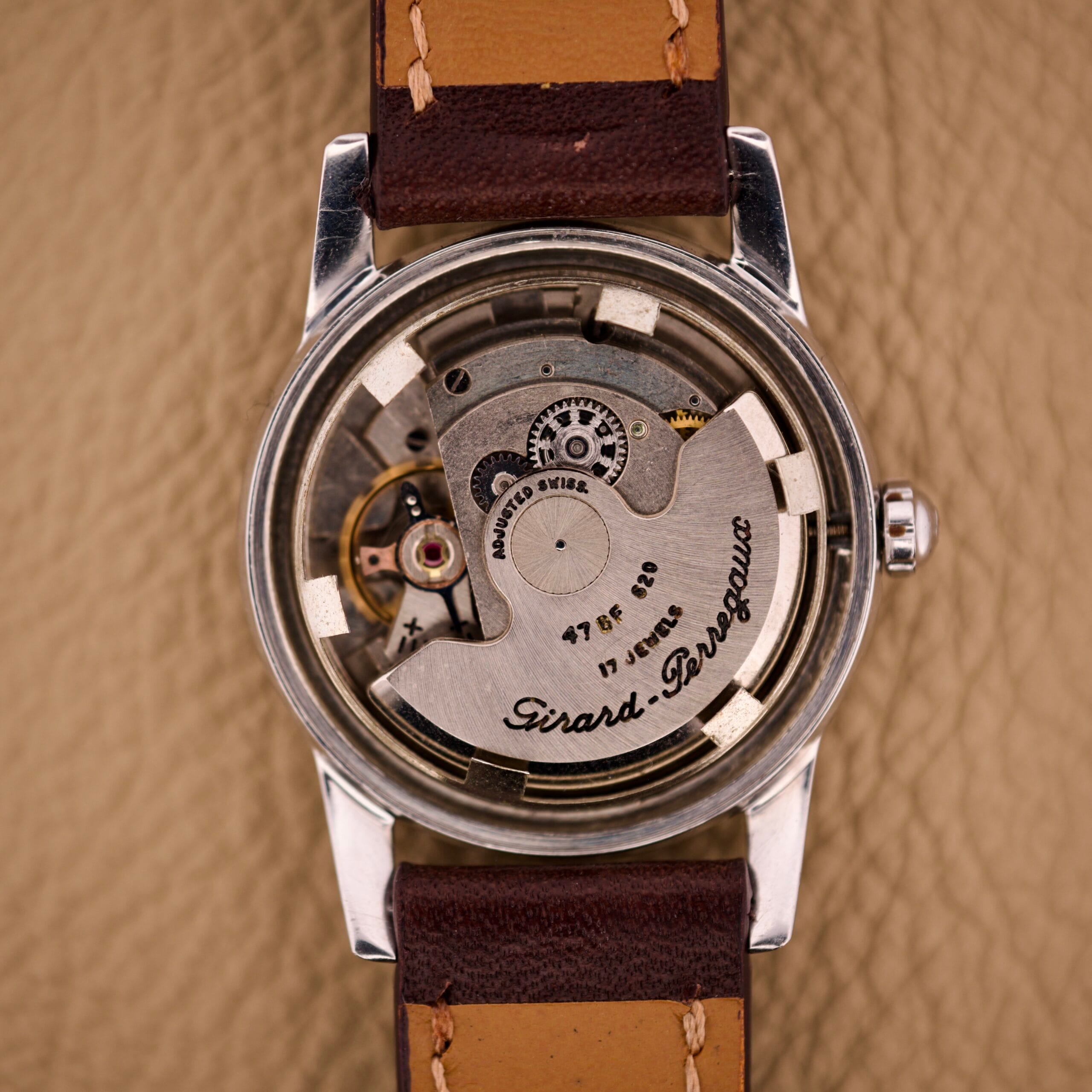

Pop the caseback off this Girard Perregaux Gyromatic and the story tells itself in two engravings. The inner caseback carries “BREVET + DEPOSE”, “STAINLESS STEEL”, the Girard-Perregaux fleur emblem with “SWISS” curved beneath it, and the reference “6678” stamped clean and centered. The movement bridge underneath reads “ADJUSTED SWISS”, “47 BF 620”, “17 JEWELS”, and “Girard-Perregaux” in the cursive house script. In our opinion, the late-1950s Gyromatic references like this 6678 are quietly some of the most undervalued vintage automatics on the market, and this particular example wears every year of its history on the dial in a way that no museum-grade survivor ever can.
Girard-Perregaux trademarked the “Gyromatic” name in 1957 to identify their new generation of automatic-winding movements, and the trade name became a fixture on dials across the brand’s catalog for the next decade. The La Chaux-de-Fonds maison was already well past its centennial by that point, having been formed in 1856 from the marriage of Constant Girard and Marie Perregaux and tracing its watchmaking lineage back to Jean-Francois Bautte in 1791. By the late 1950s, GP was producing in-house automatics in volume and the Gyromatic line was the brand’s mainstream architecture. The 47-series specifically uses a sector swinging-rotor design rather than a full central rotor, which is the construction you can see clearly through the back when this watch is open.
The caliber inside is the Girard Perregaux 47 BF 620, a seventeen-jewel sector-rotor automatic from the heart of the Gyromatic era. The “BF” prefix in the GP catalog system marks the base movement family, and the 620 designation denotes the central-seconds variant within the 47 platform. Looking through the open back on this example, the sector rotor takes up roughly half the movement diameter and carries the “Girard-Perregaux” script along its curved edge. The bridge below reads “ADJUSTED SWISS / 47 BF 620 / 17 JEWELS” in a clean four-line stack, with the ratchet wheel, balance wheel, and main gear train all visible in their period-correct positions. The finish is the warm matte rhodium that GP used across the BF family. These calibers were the workhorse of the brand’s late-1950s automatic output and they remain serviceable today through any competent vintage watchmaker.
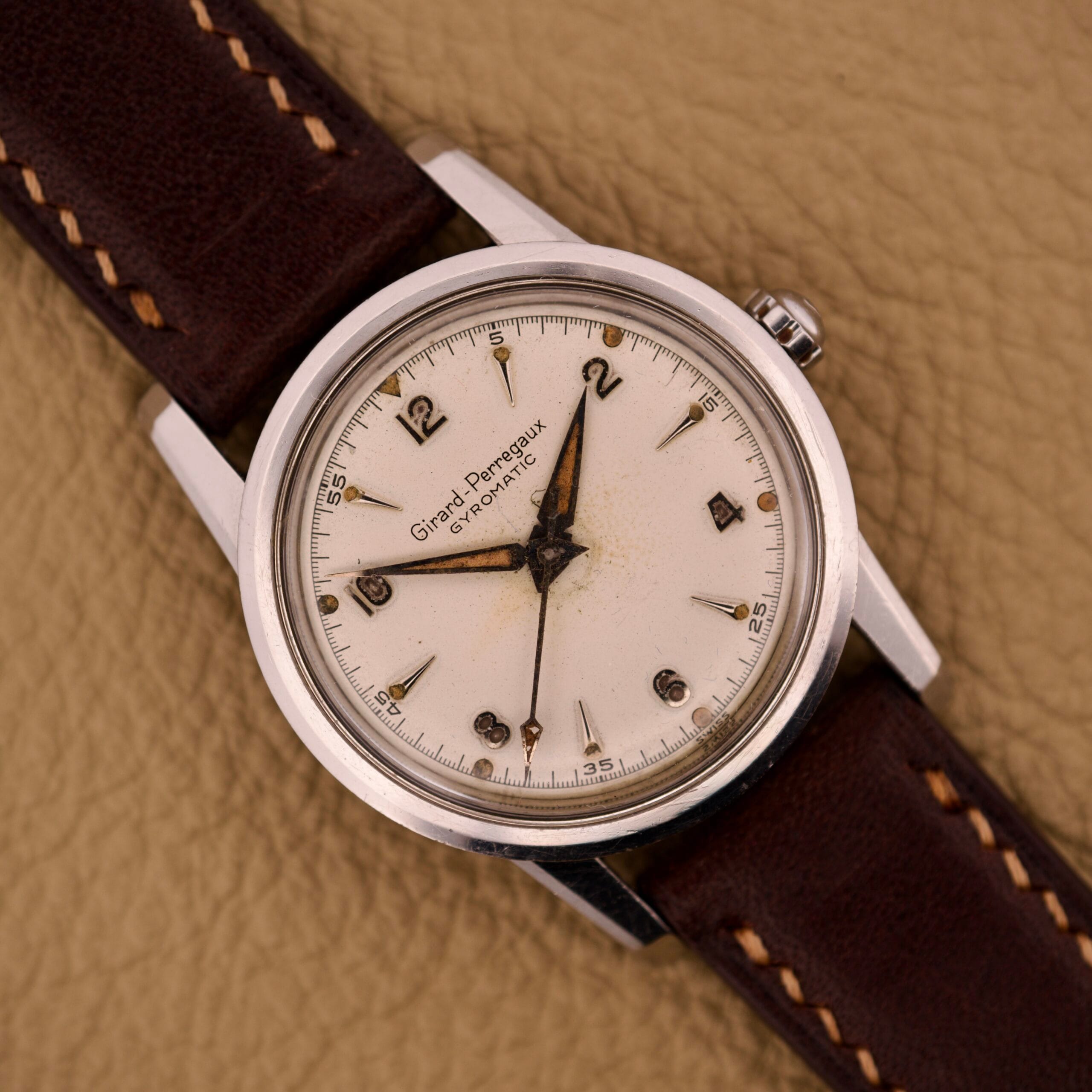
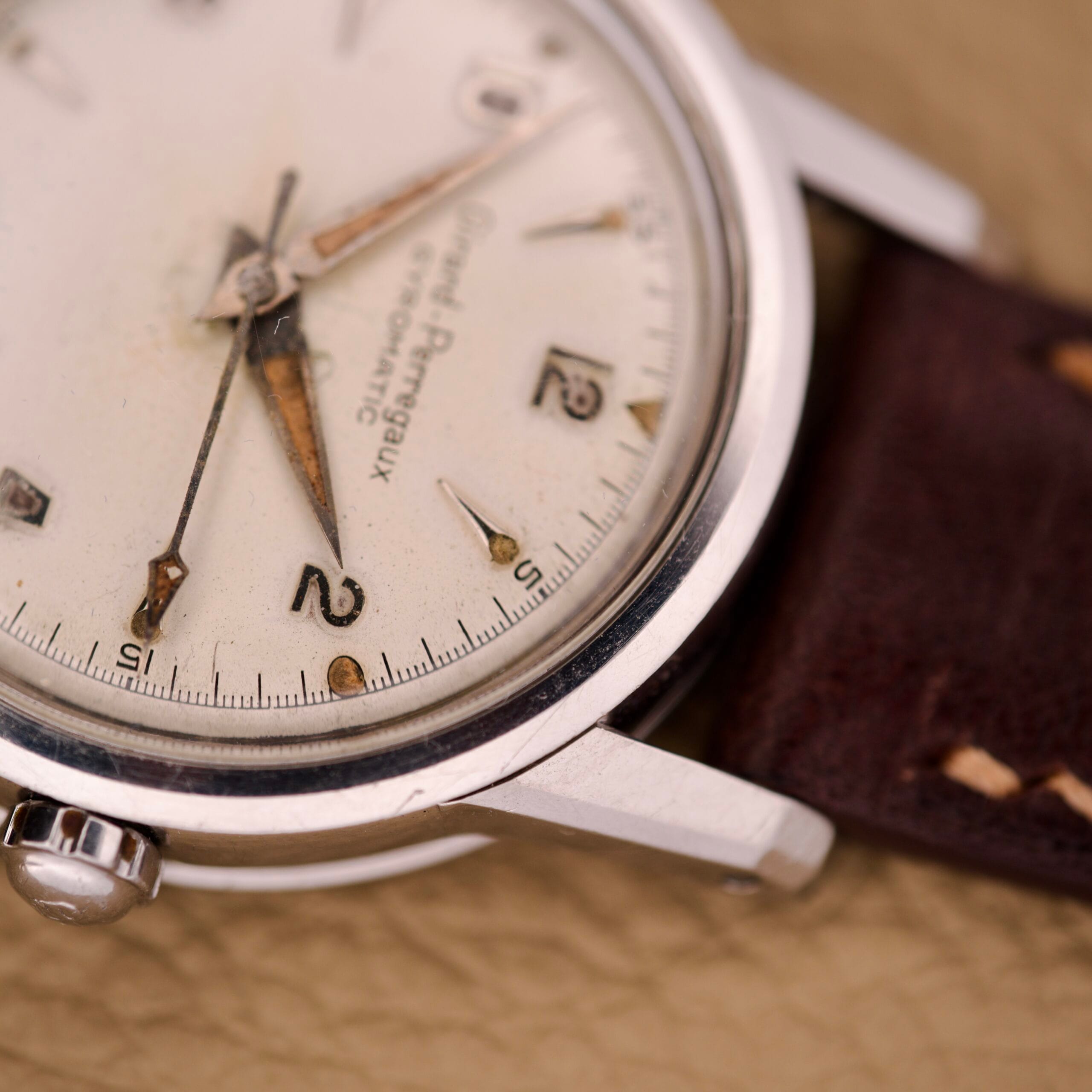
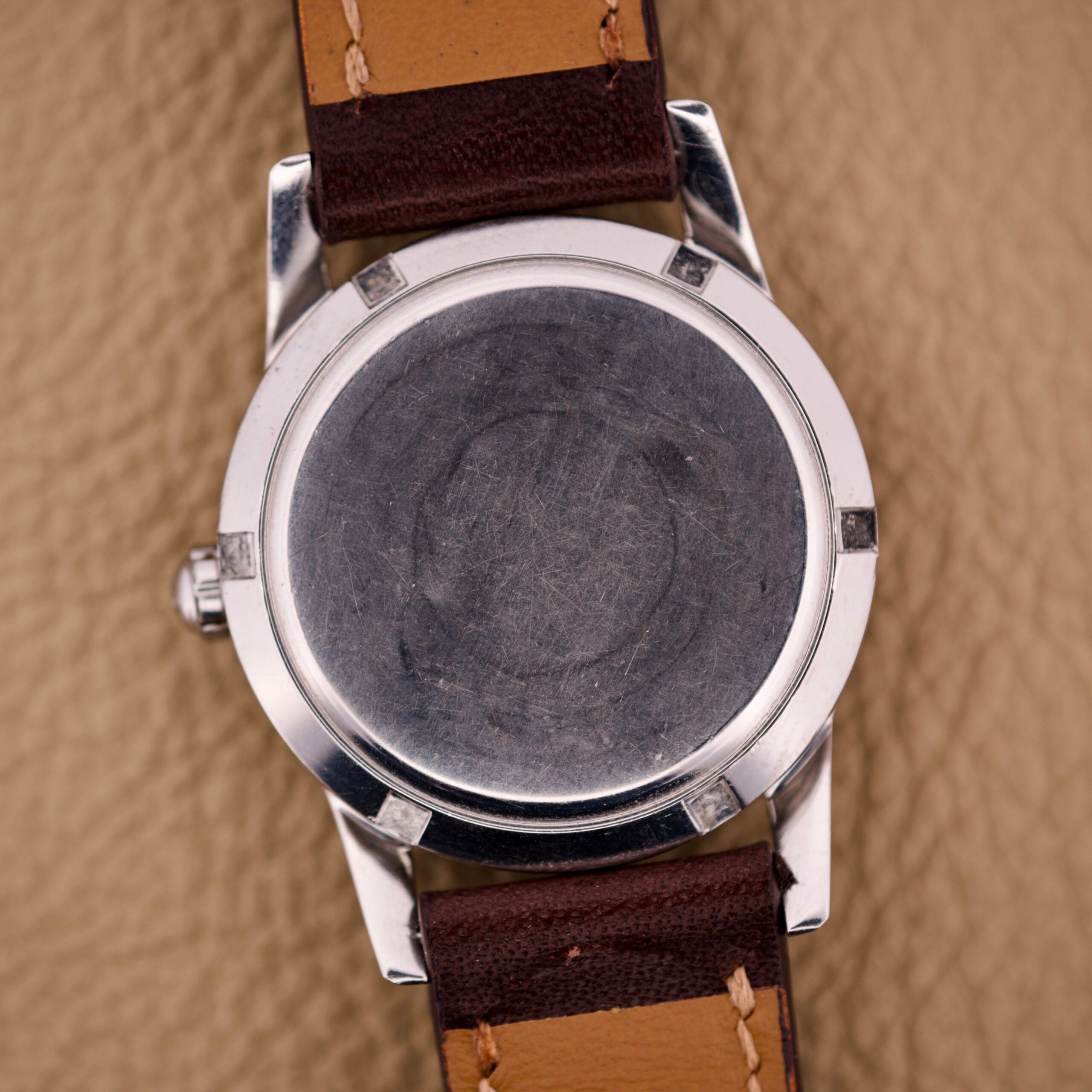
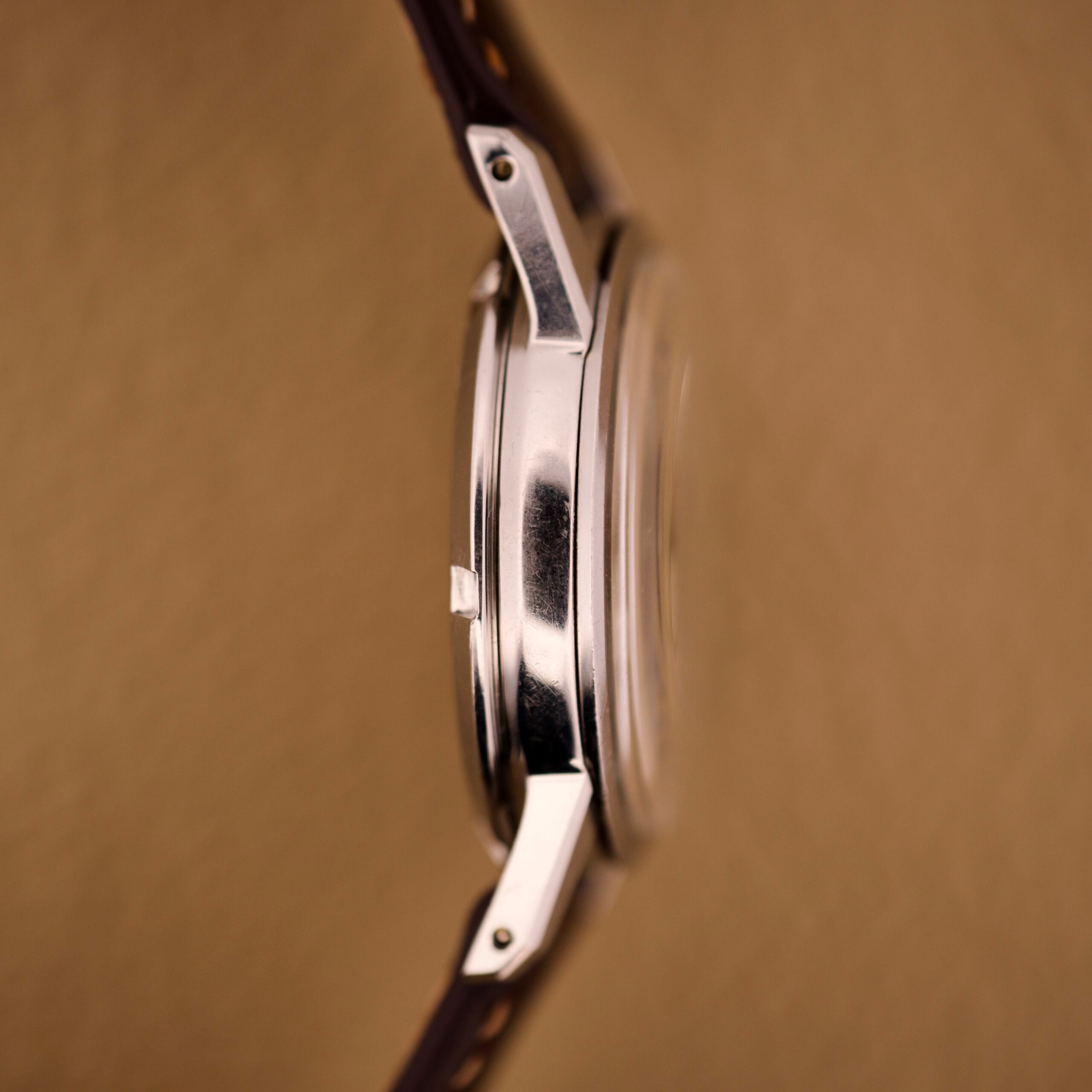
The case is solid stainless steel measuring 33.2mm across the bezel with a 41mm lug-to-lug and an 18mm strap fitting. The lugs are sharp and angular with the polished facets still showing strong definition through honest decades of wear, and the bezel is a thin smooth step around the plexi crystal. The crown sits at three o’clock and carries what reads as the GP fleur emblem stamped on its end face. The outer caseback is plain polished steel with no engraving, showing the soft circular wipe pattern of seventy years of honest contact wear against shirt cuffs and wrists. Open it up and the inner caseback opens the full identification, with the brand emblem and “6678” stamping rendered crisply enough that no question hangs over the reference.
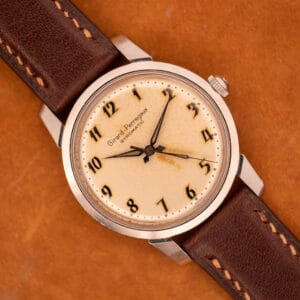
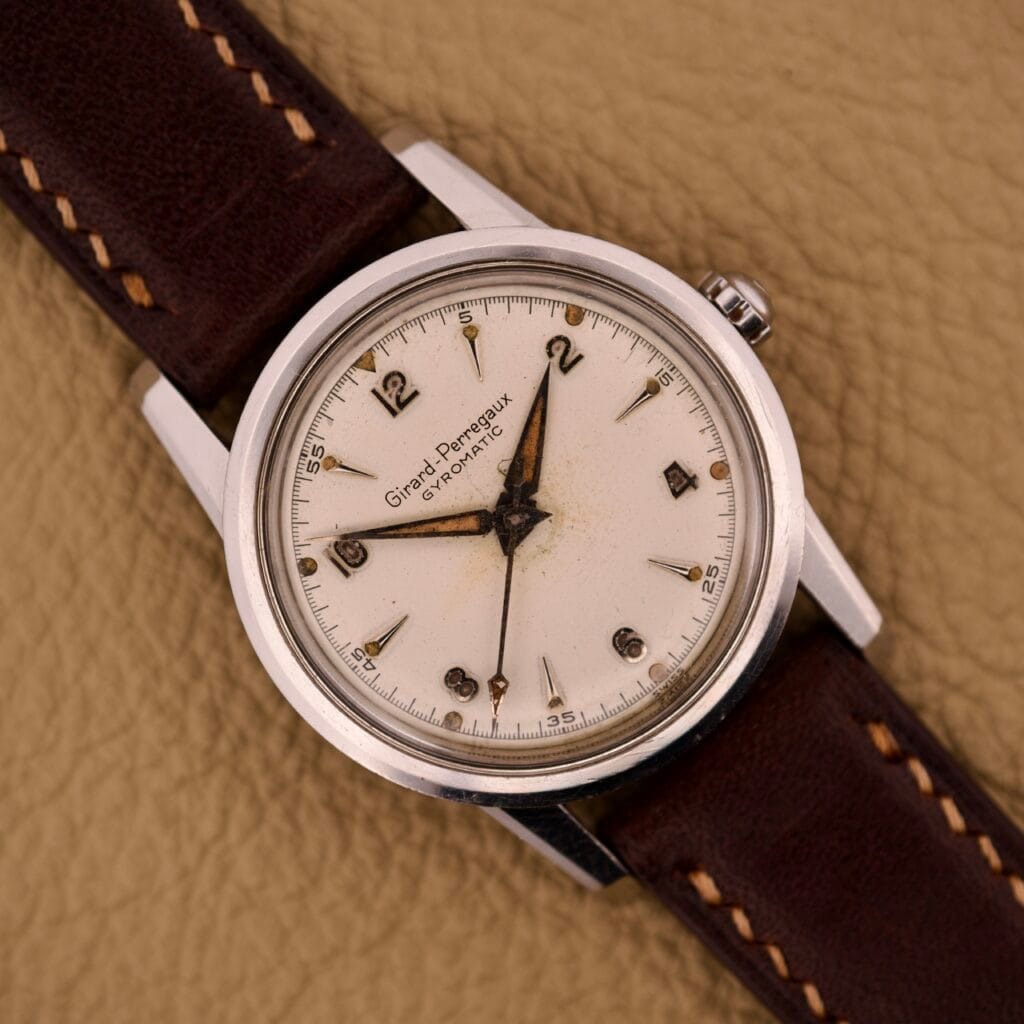
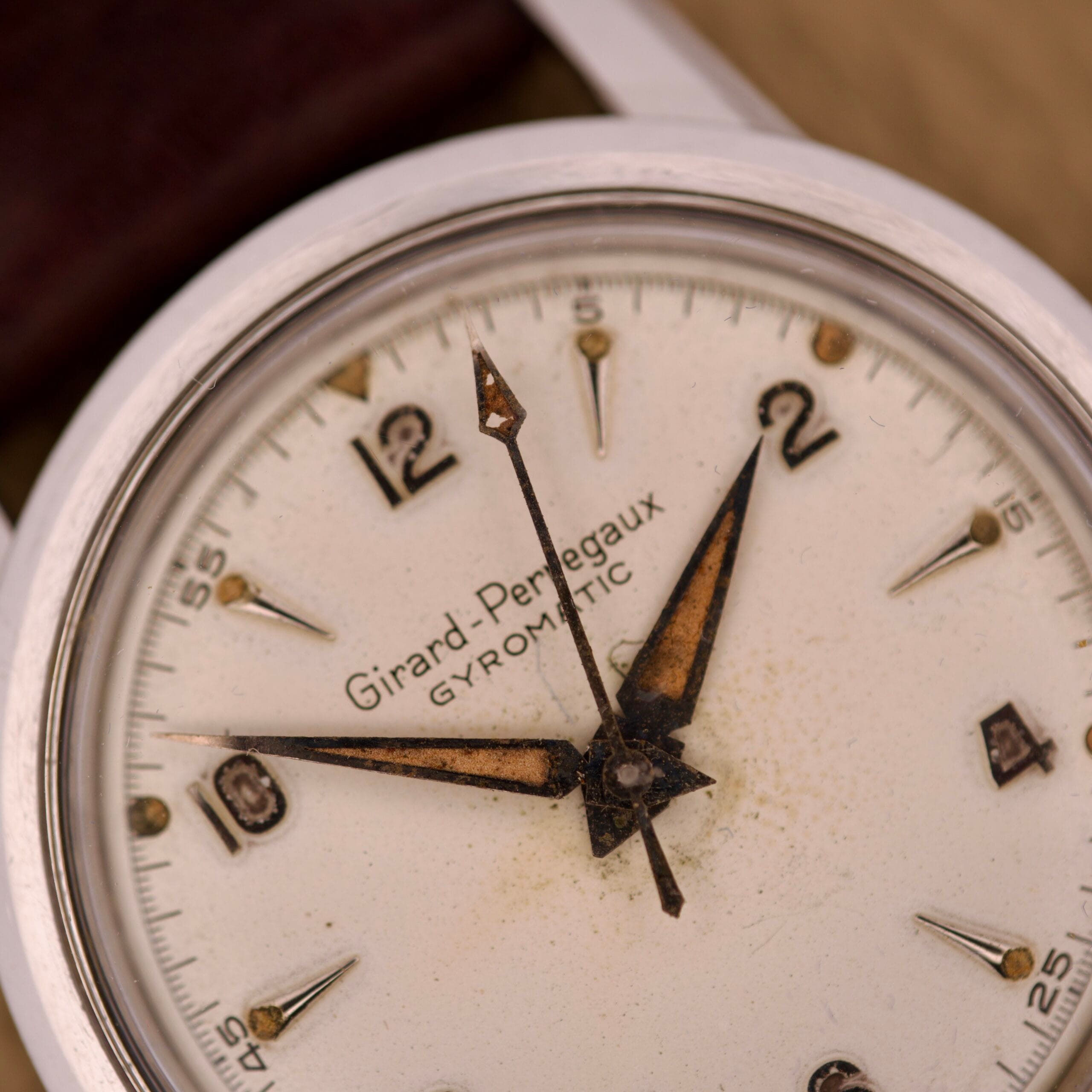
The dial is where this Girard Perregaux Gyromatic earns its character. The base finish is a matte cream that started life as a clean white and has aged unevenly into a warm, freckled patina with darker oxidation concentrated near the center pinion and across the cardinal-hour positions. The layout is the period-correct GP even-Arabic configuration: outlined block Arabic numerals at twelve, two, four, six, eight, and ten, each rendered as a thin polished steel outline with a darker patinated fill inside, alternating with applied steel dagger markers at one, three, five, seven, nine, and eleven. A small luminous plot sits adjacent to each marker, all of them aged to a deep ochre and amber that matches the dial’s overall warmth. The dauphine hour and minute hands are polished steel outlines with central lume fills that have aged to the same dark amber, and a thin straight central seconds hand sweeps across the dial in untreated steel.
Look more closely and the dial reveals its full text geography. The “Girard-Perregaux” cursive signature sits just below twelve with “GYROMATIC” printed in clean small caps directly beneath it. A “SWISS / MADE” stack anchors the dial at six in the tiny script reserved for the bottom edge. Outside the hour ring runs a minute and seconds chapter with raised hash marks, and a second inner band carries the printed five-minute Arabic markers (5, 10, 15, 20, 25, 30, 35, 40, 45, 50, 55) in a small black font that gives the dial a second analog reference. There is no date window, no sub-seconds register, and no extra complication. Just a quietly considered late-1950s automatic layout that has spent seventy years wearing in honestly.
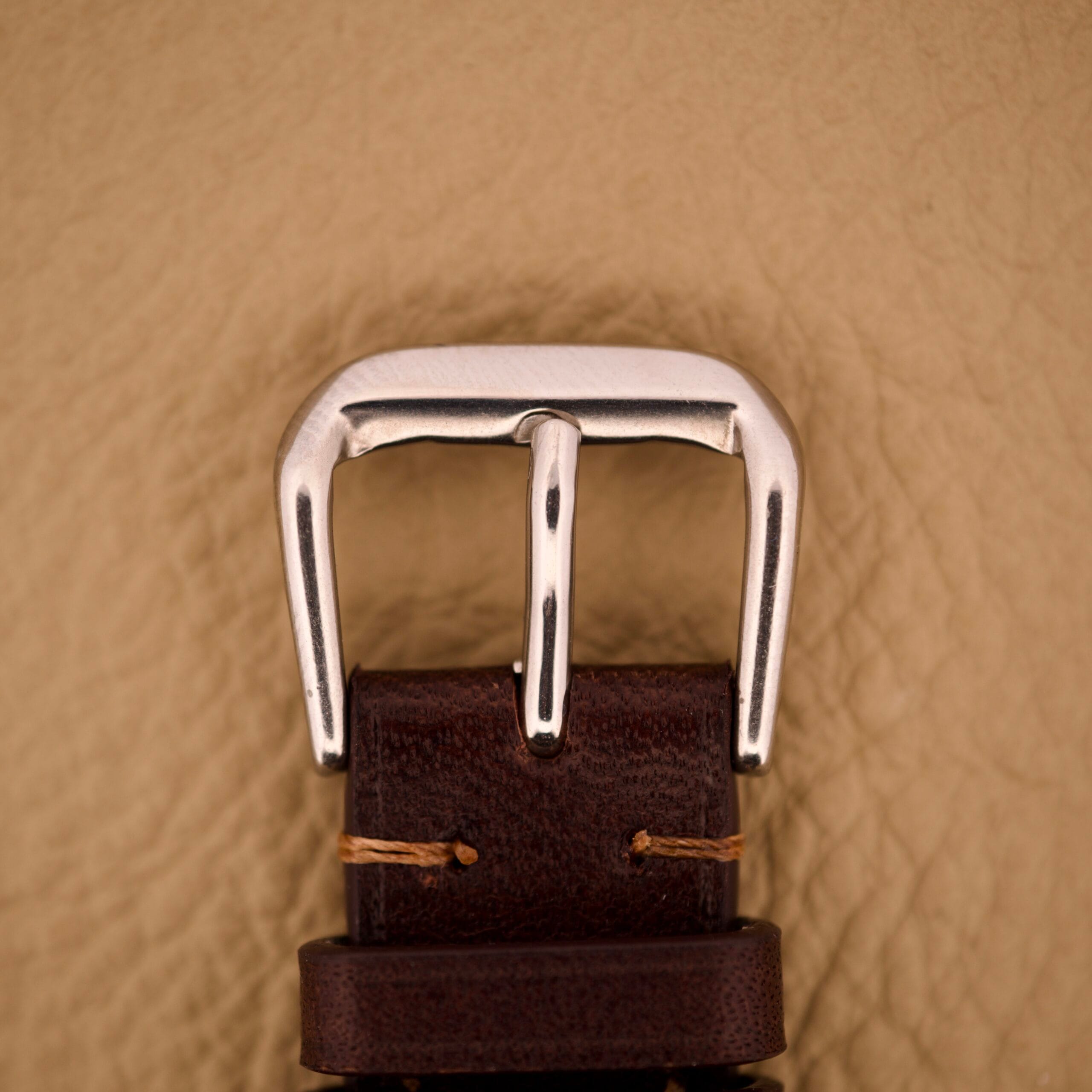
We have paired it on a brown Horween leather strap with tan contrast stitching and a polished stainless steel pin buckle, an 18mm pairing that lets the cream dial carry the visual story without competing with it. The warm tobacco and cream palette would also sit beautifully on a chocolate suede, a darker oxblood, or a honey calfskin if a future owner wants to push the warm-on-warm pairing harder. Anything cool or stark would fight the patina, so we would lean warm here.
Serviced in-house at OTTUHR and backed by our 2-year mechanical warranty, this Girard Perregaux Gyromatic ref. 6678 is for the collector who values a defensible Swiss automatic caliber and a genuinely earned cream dial over a perfect museum-grade survivor. To us, the Gyromatic line of the late 1950s sits quietly among the most rewarding entry points into Girard-Perregaux’s mid-century output, and this 47 BF 620 example wears its years with the kind of honest confidence that no restored dial can ever fake.