

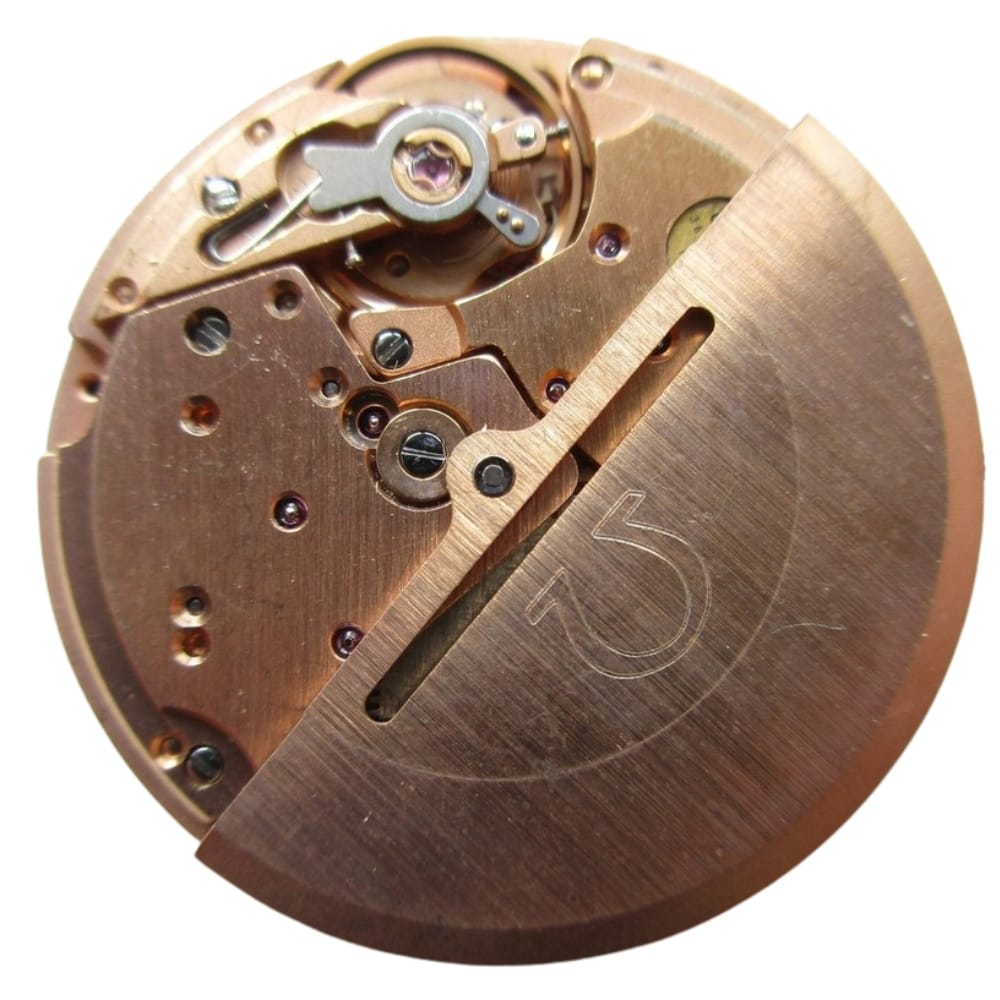
The Omega 1012 sits at an inflection point in horological history: launched in 1972 as Omega’s answer to declining mechanical watch demand during the quartz crisis, this high-beat automatic movement represented both ambitious engineering and commercial pragmatism. The caliber 1012 powered thousands of Omega Geneve, De Ville, and Seamaster references through the 1970s and early 1980s, establishing itself as a workhorse movement in the brand’s transitional era. While overshadowed by its chronometer-certified sibling, the caliber 1011, the 1012 delivered 28,800 vph performance, quickset date, and hacking functionality at a price point accessible to a broader market.
The caliber 1012 belongs to the completely redesigned caliber 1010 family, developed using mathematical modeling techniques that Omega claimed achieved “timekeeping results which have as yet never been achieved by movements of the same category”. Despite sharing visual similarities with the earlier caliber 1000 series, the 1010/1012 movements represent a ground-up redesign with mostly incompatible parts. The movement’s distinctive features include a unique “wig-wag” winding pinion, an integrated cannon pinion on the center wheel, and a modular automatic mechanism that sits flat against the mainplate rather than stacking vertically.
Production estimates place total caliber 1012 output at approximately 126,000 units between 1972 and 1984, making it uncommon but not rare in today’s market. The caliber 1010 base movement, which shares most components with the 1012, produced an additional 178,000 units over the same period. This positions the 1012 as less common than the ubiquitous caliber 550/560 series (which saw production exceeding 5.8 million units) but far more available than limited-production complications. Scarcity varies by case reference, with standard Geneve models readily available while specific De Ville and Seamaster variants command moderate premiums.
Collector interest in caliber 1012 watches remains moderate and stable. The movement’s association with the “troubled” caliber 1000 series has unfairly damaged its reputation, despite being a fundamentally different design. Well-maintained examples demonstrate reliability and accuracy comparable to contemporary ETA-based movements, with properly serviced 1012 calibers routinely achieving ±2 to ±10 seconds per day. Demand centers on original-dial examples in desirable case styles, particularly oversized Geneve models, integrated-bracelet designs, and the uncommon Seamaster 1000 references powered by the 1012. Prices remain accessible, typically ranging from $300 to $800 depending on condition and reference, making these watches attractive entry points for Omega collectors.
Historical Context, Provenance, and Manufacturing Details
Omega developed the caliber 1010 family between 1970 and 1972 as a successor to the aging caliber 550/560 series, which had dominated Omega’s three-hand automatic production since 1958. The 550 family achieved remarkable commercial success (over 5.8 million units produced), but by the late 1960s, competitive pressure demanded higher beat rates, thinner profiles, and modern complications like quickset date and hacking. Omega’s engineering team applied mathematical modeling techniques to optimize gear ratios, bearing loads, and power distribution, producing what the company claimed were movements with unprecedented timekeeping capability in their category.
The caliber 1010 debuted in 1972 as the 17-jewel base model, with the 1011 (23-jewel chronometer) and 1012 (23-jewel non-chronometer) following immediately. The distinction between 1011 and 1012 is critical: both movements share identical architecture and jewel count, but only the 1011 received chronometer certification through official testing. The additional jewels in both 1011 and 1012 models appear in the automatic winding mechanism rather than the gear train, meaning the extra jeweling does not directly improve basic timekeeping. Functionally, a well-regulated 1012 can achieve chronometer-grade performance without the certification premium.
The 1010 family replaced the 550 series but did not directly evolve from it. The architecture differs fundamentally: the 1012 measures 27.90mm diameter and 4.25mm height versus the 550’s 27.90mm diameter and 5.5mm height. The 1012 operates at 28,800 vph (4 Hz) compared to the 550’s 19,800 vph (2.75 Hz), providing finer time division and improved positional stability. The 550’s proven bi-directional rotor winding gave way to the 1012’s modular automatic mechanism with unidirectional winding through the distinctive wig-wag pinion system.
Omega manufactured the caliber 1012 entirely in-house at its Biel/Bienne facility on Rue Jakob-Stämpfli, where the company has maintained operations since 1882. This represents true manufacture production, with Omega designing, engineering, and assembling the complete movement without reliance on ébauche suppliers like ETA or Peseux. Component manufacturing likely involved Omega’s sister companies within SSIH (Société Suisse pour l’Industrie Horlogère), particularly Nivarox-FAR for balance springs and specialized parts.
Production continued until 1984, when Omega discontinued the entire 1010 series following SSIH’s near-bankruptcy during the quartz crisis. The company’s financial restructuring and subsequent absorption into the Swatch Group led Omega to abandon in-house three-hand movement development, instead adopting ETA-based calibers through the mid-2000s. The 1010/1012 family represents Omega’s last truly in-house standard automatic movement before the brand’s modern renaissance with co-axial calibers in the 2000s.
The caliber 1012’s historical significance lies in its position as a transition point: sophisticated enough to compete with the best contemporary movements, yet produced during a period when mechanical watchmaking faced existential threat from quartz technology. Omega’s decision to invest in high-beat mechanical development while simultaneously launching quartz calibers reflects the industry’s uncertainty about the future. The 1012 was neither groundbreaking innovation nor mere cost-cutting measure, but rather a competent, well-engineered workhorse that served Omega through its most turbulent decade.
Construction and Architecture
Plate and Bridge Layout: The caliber 1012 employs a three-bridge construction with the mainplate, wheel train bridge (part 1003), and barrel bridge (part 1001). The architecture follows traditional Swiss principles with separate bridges for the going train and barrel, allowing independent access to these assemblies during service. The mainplate material is brass, likely gilded or rhodium-plated depending on production era and grade. A distinctive feature is the modular automatic mechanism that mounts to the mainplate surface rather than building vertically, contributing to the movement’s 4.25mm height. The bridges feature Geneva stripes (Côtes de Genève) on visible surfaces, with perlage circular graining on the mainplate visible through the rotor cutout.

Balance Wheel: The caliber 1012 utilizes a Glucydur balance wheel (part 1327), an alloy of beryllium, copper, and other metals that provides temperature compensation and corrosion resistance. The balance is anular (ring-shaped) without timing screws, making adjustment via the index regulator rather than screw manipulation. Balance diameter is not explicitly documented but typical for 27.90mm movements falls between 9-10mm. The balance features two arms connecting the rim to the central hub, with the double roller assembly mounted to the balance staff. The Glucydur material’s temperature coefficient closely matches the Nivarox hairspring, contributing to the movement’s chronometric potential across temperature ranges.
Balance Spring (Hairspring): The movement employs a Nivarox hairspring, the industry-standard beryllium-cobalt-nickel-titanium alloy developed in the 1930s. The spring configuration is a flat spiral with an overcoil (Breguet curve) at the outer terminal to improve isochronism and concentricity during oscillation. The inner terminal attaches to a collet on the balance staff, while the outer terminal fixes to a stud held by the stud-holder (part 1363), which allows fine adjustment of the active length. The stud-holder is not moveable (fixed position), with all adjustment occurring through the regulator pointer. Nivarox provides superior magnetic resistance, thermal stability, and elasticity compared to traditional steel hairsprings, contributing to the 1012’s timekeeping performance.
Escapement Type: The caliber 1012 uses the Swiss lever escapement, the dominant design in Swiss watchmaking for over 150 years. The pallet fork (part 1316) features two jeweled pallet stones, ruby cylinders that alternately lock and release the escape wheel teeth. The escape wheel (part 1305) is steel with 15 teeth, typical for Swiss lever escapements. The escapement angle (total angular impulse delivered to the balance) is 52 degrees, a standard value for Swiss lever escapements that balances efficiency with security. The pallet cock (part 1005) secures the pallet fork arbor with two screws (part 2441), allowing pallet depth adjustment during assembly.
Shock Protection System: Incabloc is the anti-shock system employed throughout the caliber 1012. The balance jewels (both upper and lower) feature Incabloc units consisting of a conical jewel held by a lyre-shaped spring within a metal setting. The upper Incabloc unit (part 1347) mounts to the balance cock, while the lower unit (part 1346) sits in the mainplate. Under impact, the balance staff pivots compress the spring-loaded jewel settings, absorbing shock energy and preventing pivot fracture. The pallet fork pivots also receive jeweled bearings but without shock protection. The Incabloc system became nearly universal in Swiss watches by the 1960s, representing a significant improvement over earlier fixed jewel bearings.
Regulator Type: The caliber 1012 employs an index regulator with a regulator pointer (part 1332) that moves along a circular scale (part 1331) to adjust effective hairspring length. Moving the pointer toward “+” shortens the active hairspring length, increasing frequency and causing the watch to gain time; moving toward “-” lengthens the spring, causing the watch to lose time. The regulator includes a micrometric adjustment screw (part 2832) with a friction gasket (part 1349) to maintain position. The system does not qualify as free-sprung (which requires no regulator), nor does it feature the swan-neck fine adjustment found in higher-grade movements. The index regulator represents standard construction for non-chronometer-grade movements of this era, though well-adjusted examples can achieve chronometer-level performance.
Mainspring Material and Type: The caliber 1012 uses a self-lubricating Neotal mainspring (dimensions: 0.95mm height, 0.12mm thickness, 500mm length, 11.7mm barrel diameter). Neotal is a proprietary alloy whose composition remains trade secret but likely consists of cobalt-nickel-chromium similar to Nivaflex formulations. The “self-lubricating” designation indicates the alloy’s molecular structure reduces internal friction during coiling and uncoiling, eliminating the need for mainspring grease. The mainspring attaches to the barrel wall with a slipping bridle rather than a fixed hook, allowing the spring to slip when fully wound to prevent mainspring or wheel train damage from overwinding. The 500mm length and 11.7mm barrel diameter provide the movement’s 42-48 hour power reserve.
Gear Train Details: The caliber 1012 gear train consists of four wheels plus the center wheel: barrel, center wheel, third wheel (part 210), fourth wheel (second wheel, part 220), and escape wheel. The center wheel features an unusual integrated design with the cannon pinion assembled as a friction-fit unit on the dial side (part 210), requiring careful disassembly during service due to high tension. The third wheel includes a unique drive pinion on its upper surface. Specific gear ratios are not documented in available sources, but the 28,800 vph frequency dictates the overall train ratio. The fourth wheel (seconds wheel) drives the sweep seconds hand directly from the center of the movement, with its lower pivot bearing unusually positioned above the escape wheel due to space constraints in the compact 27.90mm diameter.
Finishing Quality and Techniques: The caliber 1012 represents standard commercial-grade finishing appropriate for a non-chronometer movement. Bridges display Geneva stripes (Côtes de Genève) applied parallel to the bridge edges, visible through the display caseback on some models. The mainplate features circular perlage (circular graining) in areas visible through the rotor cutout. Screw heads are polished but not black polished. Edges lack hand beveling (anglage), instead showing machine-chamfered angles. Steel components (screws, springs, levers) display a bright finish without bluing. The overall presentation suggests efficient industrial production optimized for reliability rather than haute horlogerie aesthetics. Higher-grade finishing appears on the chronometer-certified caliber 1011, though even these differences remain subtle. Finishing consistency decreased through the production run as Omega faced financial pressure during the quartz crisis, with later examples showing less attention to decorative details.
Cross-Reference Data
The caliber Omega 1012 was not rebadged or sold to other manufacturers. Omega retained exclusive use of the 1010 family calibers for its own watch production.
Base Caliber vs. Elaborated Versions
| Variant | Differences | Jewel Count |
|---|---|---|
| 1010 | Base automatic | 17 |
| 1011 | Chronometer certified | 23 |
| 1012 | Non-chronometer | 23 |
| 1020 | Base automatic | 17 |
| 1021 | Chronometer certified | 23 |
| 1022 | Non-chronometer | 23 |
| 1030 | Manual wind | 17 |
Compatible Case References by Brand
| Brand | Reference Numbers | Production Years |
|---|---|---|
| Omega Geneve | 166.0163 | 1972-1978 |
| Omega Geneve | 166.0168 | 1973-1975 |
| Omega Geneve | 166.0190 | 1975-1978 |
| Omega Geneve | 166.0191 | 1975-1978 |
| Omega Geneve | 166.0164 | 1972-1976 |
| Omega Geneve | 166.0117 | 1972-1975 |
| Omega De Ville | 162.0063 | 1976-1980 |
| Omega De Ville | 166.061 | 1973-1978 |
| Omega De Ville Dynamic | ST 106.0146 | 1973-1976 |
| Omega Constellation | ST 166.0234 | 1975-1979 |
| Omega Constellation | 198.0062 | 1975-1980 |
| Omega Seamaster | 166.0172 | 1975-1979 |
| Omega Seamaster 1000 | Various | 1976 |
Dial Compatibility Note
The caliber 1012 uses dial feet positioned at 12:00-6:00 orientation with the date window at 3:00. Date disc options include silver with black numerals (parts 1580A, 1589) and white with black numerals (part 1580BL). The date window can accommodate both framed and unframed dial apertures depending on case reference. Dial height from movement varies by case design, requiring proper hands and cannon pinion height selection. Most 1012 dials feature applied indices, though printed dial variants exist on later production and lower-tier references.
Crown and Stem Specifications
| Component | Specification |
|---|---|
| Stem Thread | TAP 10 (0.90mm diameter) |
| Stem Part Number | 1106 |
| Crown Thread | 0.90mm |
| Setting Mechanism | Clutch lever (yoke) type |
| Setting Lever | Part 1109 |
| Setting Lever Spring | Part 1110 |
Identification Marks
Caliber Number Location: The caliber number “1012” appears engraved on the mainplate, typically visible from the dial side near the stem hole or on the bridges visible from the caseback side. On movements with display casebacks, the caliber number may be visible through the rotor cutout. Serial numbers appear on the mainplate, usually requiring caseback removal to view.
Logo and Brand Marks: Authentic caliber 1012 movements display “OMEGA WATCH CO” engraved on the rotor, along with “SWISS” or “SWISS MADE” markings. The balance cock may feature the Omega logo. Movements should not display any third-party manufacturer marks like ETA or AS, as the 1012 is an in-house Omega caliber. Quality stamps indicating adjustment positions (if chronometer-grade) would appear on the caliber 1011 but are absent on the 1012.
Date Codes: Omega did not use letter date codes on the caliber 1012. Production dating relies on the watch’s serial number, engraved on the movement. Serial numbers provide approximate production years: 34,000,000-35,999,999 (1972), 36,000,000-37,999,999 (1973), 38,000,000-38,999,999 (1974), 39,000,000-39,999,999 (1975), 40,000,000-40,999,999 (1977), 41,000,000-41,999,999 (1978), continuing through 1984.
Finishing Marks: Authentic caliber 1012 movements display Geneva stripes (parallel straight-line graining) on the bridges, visible through display casebacks. The mainplate shows circular perlage where visible. The rotor features radial brushing or sunburst finishing. The quality and consistency of finishing declined through the production period, with earlier examples (1972-1975) showing more careful decoration than later units produced during Omega’s financial difficulties.
Jewel Markings: The 23 jewels in the caliber 1012 consist of rubies set in brass chatons (raised settings) for the balance and pallet fork jewels, with pressed jewels (flush-mounted) for the automatic mechanism jewels. The jewels should appear deep red (ruby) with high transparency. Synthetic rubies were standard by the 1970s. Higher-grade examples may feature gold chatons, though this is more common on the chronometer-certified 1011. The jewel count “23 JEWELS” or “23 RUBIS” may appear engraved on the movement.
Adjustment Markings: The caliber 1012 is not chronometer-certified and should not display adjustment markings like “ADJUSTED 5 POSITIONS” or “TESTED” that appear on the caliber 1011. Any movement marked as chronometer or officially certified is a caliber 1011, not 1012, despite their visual similarity. The 1012’s non-chronometer status represents a price positioning decision rather than inferior capability, as properly regulated 1012 movements can achieve chronometer-level accuracy.
Correct Serial Number Formats and Locations: Omega serial numbers on caliber 1012 movements consist of eight digits stamped on the mainplate, visible with caseback removal. The serial number range spans approximately 34,000,000 through 46,000,000 for the 1972-1984 production period. Serial numbers should be clearly engraved with consistent depth and character spacing. The serial number appears on the movement, not the case (though case serial numbers exist separately). Be cautious of movements with altered, restamped, or unusually shallow serial numbers, which may indicate refinishing or franken-watch assembly.
Expected Engravings and Stampings: Legitimate caliber 1012 movements display several standard engravings: caliber number “1012” on the mainplate or bridge; “OMEGA WATCH CO” on the rotor; “SWISS” or “SWISS MADE” on rotor or mainplate; jewel count “23 JEWELS” or “23 RUBIS”; serial number (eight digits) on mainplate. Engravings should show consistent depth, font style, and alignment. Machine engraving produces precise, uniform characters, while hand engraving may show slight variation but should remain professional in execution. Watch for signs of re-engraving, over-polishing that removes detail, or font inconsistencies that suggest aftermarket modification.
Font and Marking Style by Production Era: Early production caliber 1012 movements (1972-1976) typically feature crisper, more deeply engraved markings with serif fonts for text. The Geneva stripes and perlage show more consistent execution. Mid-production examples (1976-1980) maintain quality but with slight reduction in finishing depth as cost pressures increased. Later examples (1980-1984) may show thinner engravings, less prominent finishing, and occasional quality variation as Omega struggled financially during the quartz crisis. The Omega logo style remained consistent throughout production, featuring the Greek letter Ω prominently. Rotor engravings maintained consistency across all production years, as these remained highly visible components.
Part Information

Major Components
Calendar Mechanism Components
Automatic Mechanism Components
Shock Protection Components
Winding and Setting Components
Regulator Assembly
Wheel Train Components
Sourcing Notes
Readily Available Parts: Common wear items remain available through watch parts suppliers: mainspring (GR23781X), date jumper spring (1529), Incabloc complete units (1346/1347), oscillating weight (1026), basic screws, and gaskets. Generic Swiss parts like Incabloc components often substitute successfully.
Commonly Failed Parts Requiring Replacement: The date indicator driving wheel (part 1562) is the most notorious failure point, with the original plastic version degrading over time. Omega released a metal replacement (also numbered 1562) that solves this issue. The Incabloc springs (particularly upper) break with surprising frequency and must be replaced during service. The integrated cannon pinion/center wheel assembly can lose tension, causing hour hand slippage. The wig-wag pinion spring (1153) may weaken with age, reducing winding efficiency.
Difficult to Source Parts: The balance complete (1327) with hairspring becomes increasingly rare and expensive ($200-300 when available). The integrated cannon pinion/third wheel assembly (part 210) requires careful sourcing as improper tension causes malfunction. Complete pallet forks (1316) are available but costly ($50+). Case clamps vary by reference and prove difficult to match correctly.
Generic Replacements: Basic Incabloc components (springs, jewels, settings) accept generic Swiss substitutes from suppliers like Bergeon or Seitz. Standard screws, springs, and basic calendar parts often interchange with other Omega calibers or accept generic Swiss parts. The mainspring accepts high-quality generic Nivaflex automatic mainsprings cut to specification (0.95 x 0.12 x 500 x 11.7mm).
Service Considerations: Full service requires access to Omega-specific parts, particularly for the automatic mechanism and calendar. Independent watchmakers often struggle with parts availability, making Omega-authorized service advantageous despite higher cost. The plastic date indicator driving wheel should be replaced preventively with the metal version during any service to avoid future failure. Budget $500-800 for professional service including parts.
Performance Data
Manufacturer Specifications
Observed Performance (Field Data)
Typical Accuracy Range for Well-Maintained Examples: Properly serviced caliber 1012 movements routinely achieve +5 to +15 seconds per day in normal wearing conditions. Exceptional examples with careful regulation reach ±2 to ±5 seconds per day, matching or exceeding COSC chronometer standards. Average examples without recent service typically run +10 to +20 seconds per day, occasionally reaching +30 seconds if mainspring weakens or lubrication dries. The non-chronometer designation reflects Omega’s price positioning rather than inherent performance limitations, as the 1012 shares the 1011’s mechanical capability.
Common Performance Issues and Their Causes:
Date mechanism failure represents the most frequent problem, caused by the plastic date indicator driving wheel (part 1562) degrading and breaking. Symptoms include date not advancing, date stuck between numerals, or date jumping erratically. Solution requires replacement with the metal version of part 1562.
Timekeeping degradation typically results from dried lubrication, worn balance jewels, or weakened mainspring. Movements showing significant rate loss (losing more than 30 seconds per day) or stopping prematurely before expected power reserve indicate service necessity. The self-lubricating mainspring reduces but does not eliminate lubrication requirements for other components.
Inconsistent winding efficiency points to problems in the wig-wag mechanism or automatic system. The wig-wag pinion spring (1153) may weaken, the rotor bearing may wear, or the automatic reversing wheels may lose teeth. Symptoms include the watch stopping despite regular wear or requiring excessive wrist motion to maintain power.
Cannon pinion tension loss causes hour hand slippage, where the hour hand can be moved independently of the movement. The integrated cannon pinion design complicates repair, as the entire third wheel/cannon pinion assembly requires careful tension adjustment or replacement.
Expected Amplitude: When fully wound, healthy caliber 1012 movements typically show 270-290 degrees amplitude on a timegrapher in the dial-up position. Horizontal positions (crown up, crown down, crown left, crown right) typically measure 10-30 degrees lower than dial-up. As power reserve depletes, amplitude gradually decreases, falling to approximately 200-220 degrees near the end of the 42-hour reserve. Amplitude below 220 degrees when fully wound indicates service necessity (weak mainspring, excessive friction, or worn components). The high 28,800 vph frequency helps maintain amplitude across positions better than lower-beat movements.
Performance Degradation Patterns: The caliber 1012 typically demonstrates robust initial performance but requires attentive maintenance to sustain accuracy. The first 5-7 years after service usually produce excellent results, with accuracy remaining within 10-15 seconds per day. Years 8-12 see gradual degradation as lubricants dry, particularly affecting amplitude and rate consistency. By year 15, most movements require service to maintain reliable performance. The date mechanism often fails before the timekeeping degrades, with plastic part breakage occurring unpredictably between 20-50 years of age.
Watchmaker consensus indicates the 1012 performs significantly better than its reputation suggests, with proper service producing reliability and accuracy comparable to contemporary ETA movements. The caliber’s association with the problematic earlier caliber 1000/1001/1002 series has unfairly damaged its collector standing, despite being a fundamentally different and superior design. Collectors and watchmakers familiar with the caliber generally regard it as undervalued, offering strong performance at attractive prices compared to the more celebrated caliber 550/560 series