

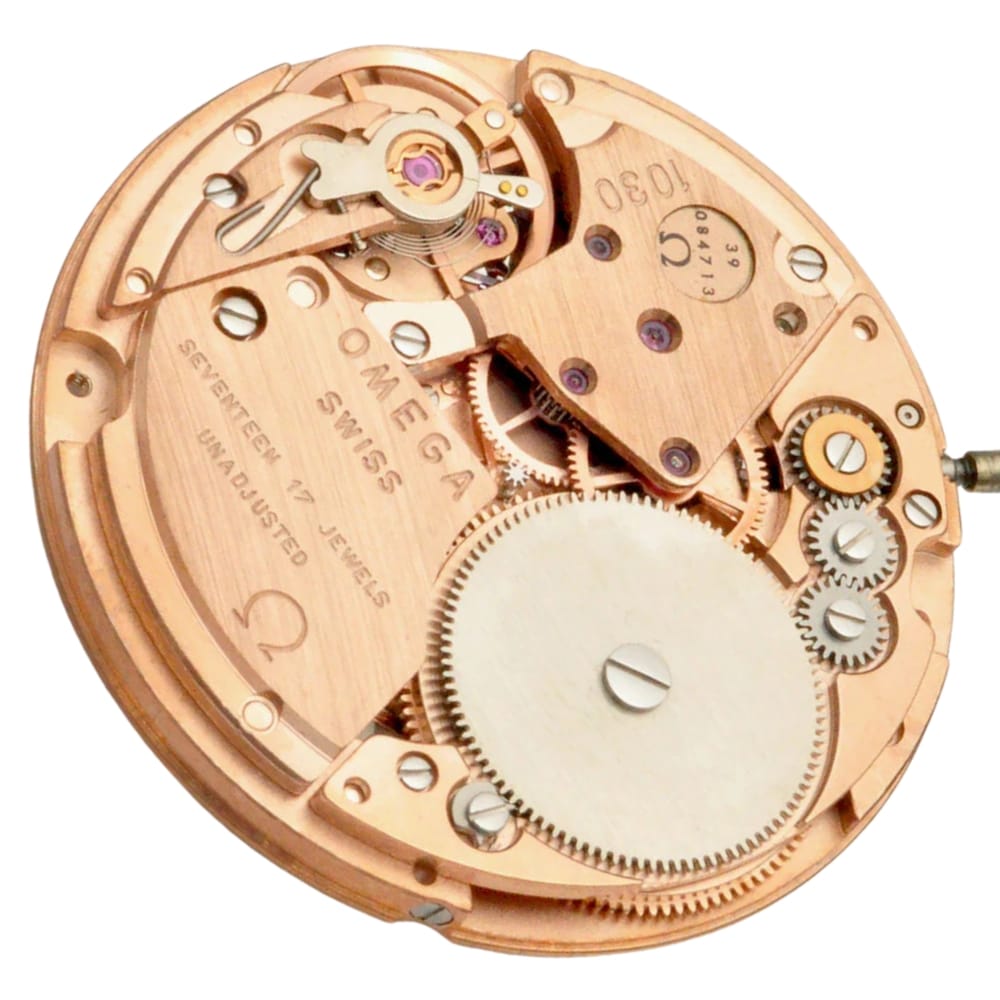
The Caliber 1030 represents Omega’s strategic response to the quartz crisis: a simplified, cost-rationalized manual-wind movement that preserved essential Swiss quality while cutting production costs to compete in the challenging market of the mid-1970s. Introduced in 1973 as the manual-wind derivative of the automatic Caliber 1010, the 1030 powered thousands of Omega Genève dress watches during an era when the brand fought for survival against electronic competition.
The 1030 is effectively the manual-wind version of the 1010 automatic, sharing the same 27.9mm base plate, gear train architecture, and date mechanism but eliminating the automatic winding system to reduce both complexity and thickness. This transformation yielded a competent 17-jewel movement measuring just 3.65mm in height, ideal for slim dress watch cases where automatic winding was less critical than elegance. The caliber beats at the modern standard of 28,800 vph, matching contemporary high-beat movements from competitors while delivering respectable 45-hour power reserve from a single barrel.
Total production reached approximately 314,000 units between 1973 and 1984, making the 1030 relatively common in the vintage market. The movement appears most frequently in Omega Genève models wearing reference numbers 136.0102 (steel or gold-capped cases), 136.0104 (steel cases with various dial configurations), and 132.5017 (9-carat gold cases for the UK market). Scarcity classification: common. The 1030 remains readily available through vintage dealers, watchmakers, and online marketplaces, with complete movements typically priced between $150-$400 depending on condition and service status.
Collector standing is modest but stable. The 1030 occupies the affordable entry tier of vintage Omega collecting, valued primarily as wearable dress watches rather than investment pieces. Market demand centers on examples with original dials in excellent condition paired with gold or gold-capped cases, particularly those retaining original Omega-signed crowns and crystals. The movement’s reputation among watchmakers is generally positive: reliable, serviceable, and adequately finished for its price point, though the cost-cutting measures (plastic date components, simplified finishing) prevent it from achieving the reverence accorded to earlier hand-wind calibers like the 601 or 613.

Development History
Omega introduced the Caliber 1030 in 1973 as part of the 1010 series redesign, a comprehensive engineering effort to create modern, cost-effective movements capable of withstanding the economic pressure from quartz technology. The 1030 specifically addressed the dress watch segment where manual winding remained acceptable and case thickness mattered more than automatic convenience. By removing the rotor assembly, reversing wheels, and automatic bridge from the 1010 base caliber, Omega achieved a movement nearly 1mm thinner while maintaining the quickset date feature that had become expected in the early 1970s.
The development philosophy prioritized manufacturing efficiency and parts interchangeability across the entire 1010 series. The 1030 shares its main plate (part 1000), barrel assembly (part 1200), gear train components, escapement, balance assembly (part 1327), and keyless works with its automatic siblings, allowing Omega to achieve economies of scale in production. Only the barrel bridge differs slightly to accommodate the absence of automatic winding components.
The Caliber 1030 directly replaced the Caliber 613, Omega’s previous manual-wind date movement that had served since the late 1960s. The 613, itself derived from the highly regarded 550 series automatics, featured superior finishing, a beryllium-bronze balance beating at 19,800 vph, and metal date wheels. Watchmakers and collectors generally consider the 613 the superior movement from a quality and longevity perspective, while the 1030 represents a more economical, higher-frequency alternative designed for volume production in a different economic climate.
The switch from 613 to 1030 in 1973 marked a clear transition in Omega’s manufacturing philosophy. The 613 employed traditional construction with metal date components and more elaborate finishing appropriate to its 1960s origins. The 1030, by contrast, incorporated plastic date wheels and cam components, simplified rhodium plating in place of Geneva stripes on bridges, and cost-reduced manufacturing processes including stamped rather than traditionally finished wheels in some locations.
No direct successor replaced the 1030 when production ended around 1984. Omega had by that point largely transitioned to quartz movements for entry-level dress watches and ETA-based calibers for mechanical offerings. The 1030’s role in the lineup simply disappeared as the brand repositioned toward higher-end mechanical complications and quartz precision.
Manufacturing Context
The Caliber 1030 is an in-house Omega manufacture movement, designed and produced at Omega’s facilities in Biel/Bienne, Switzerland. Despite the cost rationalization evident in its construction, the 1030 remains a genuine manufacture caliber rather than an ébauche sourced from ETA, AS Schild, or other movement suppliers. Omega maintained full control over the design, tooling, and production processes throughout the 1030’s manufacturing run.
The 1010 series movements, including the 1030, represented a complete reconception of Omega’s manufacturing approach rather than an incremental evolution. The technical manual specifically notes that although obvious similarities exist with the earlier Caliber 1000 series, the 1010 series “has nevertheless been entirely reconceived and can in no way be compared with it”. This redesign addressed reliability issues and parts availability problems that plagued the 1000 series, creating a more robust platform with better parts interchangeability.
Factory production remained in Biel throughout the caliber’s entire production run from 1973 to 1984. No evidence suggests production shifts to other facilities or outsourcing of major components beyond standard industry practices for items like mainsprings, jewels, and hairsprings from Swiss suppliers.
Historical Context
The Caliber 1030 exists as a product of the quartz crisis, introduced at the precise moment when Swiss mechanical watchmaking faced its greatest existential threat. The year 1973 saw quartz technology moving from novelty to mainstream, with Japanese and American manufacturers flooding markets with accurate, affordable electronic watches that threatened to obsolete mechanical timekeeping entirely. Omega’s response included this rationalized movement series designed to reduce manufacturing costs while maintaining acceptable quality and the higher beat rate (28,800 vph) that had become the Swiss industry’s answer to quartz accuracy claims.
The 1030 is neither groundbreaking nor particularly distinguished in horological history. It represents competent engineering in service of commercial survival rather than innovation or prestige. The movement’s significance lies primarily in its role as a workhorse caliber that kept Omega’s dress watch production economically viable during a difficult transition period, powering thousands of Genève models that maintained the brand’s presence in jewelry stores when more prestigious models faced declining sales.
Construction and Architecture

Plate and Bridge Layout
The Caliber 1030 employs a traditional multi-bridge architecture with a brass main plate (part 1000) supporting three primary bridges: barrel bridge (part 1001), train wheel bridge (part 1003), and balance cock (part 1030). The architecture derives directly from the automatic Caliber 1010, with the main plate featuring mounting points for automatic winding components that remain unused in the manual-wind configuration. This design choice prioritized manufacturing efficiency over optimized manual-wind architecture, allowing Omega to produce both automatic and manual variants from substantially identical main plates.
The brass plates and bridges receive rhodium plating for corrosion resistance and a bright, silvery finish. This rhodium plating replaced the traditional nickel plating and decorative finishing found on higher-grade Omega calibers, offering cost savings while providing adequate protection. The bridges feature functional, utilitarian finishing rather than decorative Geneva stripes or elaborate perlage, reflecting the movement’s positioning as a cost-effective caliber rather than a prestige product.
The barrel bridge includes an oblong hole accommodating the intermediate wheel for the indirect center seconds drive, a design element inherited from the 550-series automatic calibers that formed the architectural basis for the 1010 series. The train wheel bridge mounts in sandwich configuration between the main plate and bridge, maintaining precise gear mesh through properly jeweled pivot points. The balance cock features an eccentric regulator rather than the swan-neck or micrometric regulators found on higher-grade movements.
Balance Wheel
The Caliber 1030 utilizes a four-arm annular balance constructed from beryllium-bronze alloy, measuring approximately 10-11mm in diameter. This smooth balance configuration, without timing screws, prioritizes manufacturing economy over adjustment flexibility. The beryllium-bronze composition provides temperature stability and anti-magnetic properties superior to traditional bimetallic balance designs while maintaining consistent oscillation characteristics across normal operating temperature ranges.
The balance complete assembly (part 1327) fits interchangeably across the entire 1010/1020/1030 series, simplifying parts stocking for watchmakers and service centers. The four-arm configuration with annular construction (weight distributed at the rim) maximizes inertia relative to mass, supporting stable oscillation and improved isochronism. The balance beats at 28,800 vph (4 Hz), the high-beat standard that became dominant in Swiss watchmaking during the 1970s.
The balance staff pivots run in shock-protected jewel settings, with Incabloc protection at both upper and lower pivots providing impact resistance. The Incabloc system employs the characteristic lyre-shaped spring retaining cap jewels that yield under shock, allowing the balance staff to deflect without breaking pivots.
Balance Spring (Hairspring)
The movement employs a Nivarox hairspring, the industry-standard beryllium-bronze alloy hairspring that became universal in Swiss watchmaking from the 1930s onward. The hairspring features a flat configuration rather than a Breguet overcoil, representing another cost-saving measure compared to higher-grade calibers where overcoils improve isochronism and positional performance.
The hairspring attaches to the collet at the inner terminal and the stud at the outer terminal, with the stud mounted in a movable stud carrier allowing hairspring length adjustment during regulation. The eccentric regulator acts on the regulator pins rather than moving the stud itself, providing adequate regulation range for service adjustments while simplifying manufacturing.
Escapement Type
The Caliber 1030 utilizes a Swiss lever escapement with conventional design and jeweling. The escape wheel (part 1305) features the standard club-tooth profile common to Swiss lever escapements, driving the pallet fork (part 1316) through alternating impulses as the balance oscillates. The pallet fork mounts on a jeweled pivot and includes two pallet stones (entry and exit pallets) that interact with the escape wheel teeth.
The escapement parts are shared across the 1010/1020/1030 series, with the escape wheel and pallet fork being identical across all variants. This interchangeability simplified manufacturing and service parts stocking, though it means the escapement offers no unique characteristics distinguishing the 1030 from its automatic siblings.
Shock Protection System
The movement employs Incabloc shock protection at the balance staff pivots (both upper and lower jewels). The Incabloc system uses part number 270.03 lyre springs, common across many Swiss calibers of the era. The system consists of a cone-shaped jewel setting held in place by the characteristic lyre-shaped spring, allowing the balance staff pivot to deflect under impact while maintaining proper jewel positioning under normal operating conditions.
The balance cock features the upper Incabloc assembly (part 1347), accessible when the balance cock is removed. The lower balance jewel setting mounts in the main plate, requiring complete movement disassembly for service or replacement. The Incabloc springs are consumable components that can fatigue or break over decades of service, requiring replacement during complete overhauls.
Regulator Type
The Caliber 1030 uses an eccentric index regulator rather than more sophisticated regulation systems found on higher-grade movements. The eccentric design allows rate adjustment by turning the regulator eccentric, which moves the regulator pins along the hairspring and thus changes the effective active length of the hairspring. This system provides adequate adjustment range for service regulation while simplifying manufacturing compared to swan-neck or micrometric regulators.
The regulator includes two pins (banking pins) that bracket the outer coil of the hairspring, with the position of these pins determining the effective length and thus the rate of the balance. Fine adjustment requires careful manipulation of the eccentric with a regulator key, with the movement running to observe the effect of adjustments on rate.
Mainspring Material and Type
The Caliber 1030 employs a white alloy mainspring measuring 0.95mm height x 0.12mm thickness x 500mm length, with barrel diameter of 11.5mm. This specification (part 1208 or equivalent from aftermarket suppliers like Flume 770/771) represents a manual-wind mainspring with higher torque output than automatic mainsprings, designed to deliver the 45-hour power reserve from a single barrel without supplementary rotor winding.
The mainspring features a slipping bridle attachment at the barrel wall rather than a fixed hook, providing overwinding protection. This bridle can detach over time, a common failure mode that manifests as premature power reserve depletion when the mainspring slips on the barrel wall before reaching full tension. Mainspring replacement during service typically uses modern synthetic mainsprings offering improved elasticity and longer service life compared to original steel alloys.
The barrel complete assembly (part 1200) includes the barrel, arbor (part 1204), and mainspring. The barrel drives the great wheel (center wheel, part 1216) to power the gear train.
Gear Train Details
The Caliber 1030 employs a four-wheel gear train with indirect center seconds drive inherited from the automatic Caliber 550 architecture. The gear train consists of barrel wheel (great wheel/center wheel, part 1216), third wheel (part 1240, which also serves as intermediate wheel for center seconds), fourth wheel (seconds wheel, part 1243), and escape wheel (part 1305).
The indirect center seconds configuration places the fourth wheel (carrying the seconds hand) at the traditional center position via an intermediate wheel, allowing the center wheel to drive both the hour/minute motion works and the seconds display. This architecture increases movement height slightly compared to direct center seconds designs but improves reliability and simplifies manufacturing by allowing the center wheel to be press-fit rather than friction-fit.
All wheels mount on jeweled pivots, with jewels at upper and lower bearing points for center wheel, third wheel, fourth wheel, and escape wheel. The two-piece center wheel and cannon pinion assembly (a characteristic of this caliber) consists of a riveted-together unit where the cannon pinion (carrying the minute hand) friction-fits to the center wheel arbor. This cannon pinion can become too loose or too tight over decades of service, requiring careful adjustment during overhaul.
Gear ratios follow standard Swiss lever escapement conventions optimized for 28,800 vph frequency, though specific numerical ratios are not documented in available technical literature. The gear train provides the standard reduction from barrel rotation (several hours per revolution) through the escape wheel (approximately 600 revolutions per hour at 28,800 vph).
Finishing Quality and Techniques
The Caliber 1030 receives basic-grade finishing appropriate to its positioning as an economical movement. The rhodium plating provides bright, corrosion-resistant surfaces on brass plates and bridges, replacing the more elaborate finishing techniques (Geneva stripes, anglage, polishing) found on higher-grade Omega calibers.
The movement features circular graining (perlage) on the main plate visible through the display side, providing functional debris resistance and adequate appearance. The bridges show machining marks consistent with economical production rather than hand finishing. No evidence of traditional Geneva stripes (Côtes de Genève) appears on bridges, and chamfering (anglage) of edges is minimal or absent.
Jewel settings use pressed jewels rather than gold chatons, another cost-saving measure distinguishing the 1030 from higher-grade movements where gold chatons add both functional benefits and decorative appeal. The visible jewels show adequate polishing but lack the decorative beveling found on prestige movements.
The gear train components show machine finishing rather than hand polishing, with spoke cutouts in wheels providing weight reduction and debris escape routes but lacking the refinement of traditionally finished gear trains. Screw heads receive basic slotting without decorative polishing or bluing.
Cross-Reference Data
Alternative Caliber Names (Rebranded Versions)
The Caliber 1030 was not rebranded or sold under alternative designations to other watch manufacturers. Omega maintained exclusive use of this caliber for their own watch production.
Base Caliber vs. Elaborated Versions
| Variant | Differences | Jewel Count | Functions |
|---|---|---|---|
| 1030 | Base manual-wind version | 17 | Time, date, sweep seconds |
| 1035 | 1030 with stop-seconds mechanism | 17 | Time, date, sweep seconds, hack feature |
| 1010 | Automatic winding version with date | 17 | Time, date, sweep seconds, automatic winding |
| 1011 | Automatic with chronometer certification | 23 | Time, date, sweep seconds, automatic winding |
| 1012 | Automatic with additional jeweling, no chronometer | 23 | Time, date, sweep seconds, automatic winding |
| 1020 | Automatic with day-date | 17 | Time, day, date, sweep seconds, automatic winding |
| 1021 | Automatic day-date with chronometer certification | 23 | Time, day, date, sweep seconds, automatic winding |
| 1022 | Automatic day-date with additional jeweling | 23 | Time, day, date, sweep seconds, automatic winding |
All variants share the same 27.9mm base plate and core architecture, with differences limited to automatic winding components (1010/1020 series) and day mechanism (1020 series).

Compatible Case References by Brand
Dial Compatibility
The Caliber 1030 uses dial feet positioned for compatibility with Omega Genève case designs of the 1970s. Date window location is fixed at 3 o’clock position, with date wheel (part 1580) available in plastic with black print on white background, white print on black background, or metal with various finishes. Dial feet spacing matches standard Omega Genève specifications for approximately 27-28mm dial diameter.
Date disc variants include plastic discs (most common, parts 1580 and 1580N for different color schemes) and metal discs (less common, more durable). The plastic date wheel represents one of the cost-reduction measures in the 1030’s design and is a common failure point requiring replacement during service.
Crown and Stem Specifications
The setting lever (part 1109, tirette) uses a push-release mechanism to remove the stem rather than a screw-retained system. The yoke (part 1111) provides the mechanical connection between setting lever and clutch mechanism, allowing switching between winding and time-setting positions. The clutch wheel (part 1107) engages the winding pinion for winding and disengages for time setting.
Identification Marks
Caliber Number Location
The caliber designation “1030” appears engraved on the main plate visible when the balance cock is removed or when viewing the movement from the dial side. The engraving typically appears near the balance cock mounting position or along the edge of the plate. Some examples also show “OMEGA” and “SWISS” text engraved on the main plate or bridges.
Logo and Brand Marks
Authentic Omega Caliber 1030 movements display the Omega logo (Ω symbol) engraved on the main plate or balance cock. The movements are marked “OMEGA” and “SWISS” indicating manufacture origin. Higher-grade variants within the 1010 series (chronometer-certified 1011/1021) include additional markings indicating adjustment (ADJUSTED or CHRONOMETER certification marks), but the base 1030 typically shows only manufacturer identification.
The caliber number “1030” appears stamped into the plate, with some examples showing additional production codes or date codes whose precise system is not publicly documented. Serial numbers on the movement correspond to Omega’s production serial numbering system, allowing approximate dating.
Date Codes
Omega movements use production serial numbers rather than date codes for production dating. The serial number appears engraved on the movement and can be cross-referenced against known serial number ranges to determine approximate production year:
- 1973: 36,000,000 – 37,999,999
- 1974: 38,000,000 – 38,999,999
- 1975: 39,000,000 – 39,999,999
- 1976-1977: 40,000,000 – 40,999,999
- 1978: 41,000,000 – 41,999,999
- 1979: 42,000,000 – 43,999,999
- 1980: 44,000,000 – 44,999,999
- 1982: 44,000,000 – 44,999,999
- 1984: 46,000,000 – 47,999,999
These ranges provide approximate dating only, as production batches and serial number assignment did not follow perfectly linear patterns.
Finishing Marks
Authentic Caliber 1030 movements show rhodium plating on bridges and plates, creating a bright silvery appearance. The main plate features circular graining (perlage) visible from the dial side, with consistent machine-applied texture. Bridges show machined surfaces without elaborate Geneva stripes or extensive hand finishing.
The balance cock typically displays more refined finishing than other bridges, with polished surfaces around the regulator mechanism. Screw heads show basic slotting without decorative polishing. The overall finishing quality appears functional and adequate rather than decorative, consistent with the movement’s positioning as an economical caliber.
Jewel Markings
The Caliber 1030 uses pressed jewel settings rather than gold chatons. Jewels should appear properly seated in their settings without cracks or chips visible under magnification. The movement is marked “17 JEWELS” or “17 p” (17 pierres in French) on the plate or bridge.
Jewel configuration includes:
- Balance staff: upper and lower jewels with Incabloc shock protection
- Pallet fork pivot: single jewel
- Escape wheel: upper and lower jewels
- Fourth wheel: upper and lower jewels
- Third wheel: upper and lower jewels
- Center wheel: upper and lower jewels
- Pallet stones: two jewels (entry and exit pallets)
- Impulse jewel: one jewel on balance wheel
Adjustment Markings
The base Caliber 1030 is not chronometer-certified and lacks adjustment markings beyond basic manufacturer identification. The movement receives factory regulation but not chronometer testing or certification. No markings indicating positions tested or temperature compensation should appear on standard 1030 examples.
Higher-grade variants in the 1010 series (specifically 1011 and 1021 with chronometer certification) would display “CHRONOMETER” or “CHRONOMETRE” markings along with adjustment indicators, but these do not apply to the base 1030.
Correct Serial Number Formats and Locations
Movement serial numbers appear engraved on the main plate, typically visible when viewing the movement from the dial side or accessible after removing the balance cock. Serial numbers consist of 8 digits for movements produced during the 1030’s production run (1973-1984).
Serial number ranges for Caliber 1030 production:
- 1973-1974 introduction: 36,000,000 – 38,999,999
- Mid-production 1975-1979: 39,000,000 – 43,999,999
- Late production 1980-1984: 44,000,000 – 47,999,999
Expected Engravings and Stampings
Legitimate Omega Caliber 1030 movements should display:
- Caliber number “1030” engraved on main plate
- “OMEGA” manufacturer marking
- “SWISS” or “SWISS MADE” country of origin
- Jewel count “17 JEWELS” or “17 p”
- Production serial number (8 digits)
- Omega logo (Ω symbol)
Engravings should show consistent depth and professional execution typical of factory application. Hand-engraved or crudely stamped markings suggest aftermarket modification or counterfeit components.
Font and Marking Style by Production Era
The Caliber 1030’s production run (1973-1984) shows consistent engraving style and font throughout its manufacturing period, with no significant transitions in marking style documented. The “OMEGA” text and caliber designation use standard industrial engraving fonts typical of Swiss watchmaking in the 1970s-1980s.
Earlier production (1973-1975) and later production (1982-1984) show identical marking styles, suggesting Omega maintained consistent engraving equipment and practices throughout the caliber’s production run. Any significant variation in font style, engraving depth, or marking placement from the standard format described above warrants scrutiny for authenticity.
Part Information
Part Numbers and Interchangeability
Primary Movement Components
Keyless Works Components
Gear Train Components
Date Mechanism Components
Incabloc Components
Sourcing Notes
Many parts for the Caliber 1030 remain available through vintage watch parts suppliers, Omega service centers, and aftermarket sources due to the movement’s production in substantial quantities and parts interchangeability with the more common automatic 1010 series.
Readily Available Parts:
- Mainspring (part 1208): Available from Cousins UK, Perrin Watch Parts, and other Swiss suppliers; aftermarket mainsprings offer improved materials over original specifications
- Date disc: Both plastic and metal versions available, though color/finish matching to original may vary
- Incabloc components: Standard parts readily available as generic Incabloc components
- Stems: Generic compatible stems available, though trimming to proper length required
- Balance complete: Available as genuine Omega part through suppliers; expensive (typically $200-270)
- Escape wheel, pallet fork: Available through parts suppliers specializing in Omega components
Commonly Failing Parts:
- Date disc (plastic): Cracks, discoloration, or binding from decades of use; replacement frequently needed during service
- Cannon pinion: Two-piece center wheel/cannon pinion assembly can become too loose or too tight, requiring adjustment or replacement
- Mainspring: Loses elasticity over time; bridle attachment can detach, causing premature power reserve loss
- Setting lever: Can break at engagement point with stem, particularly if stem is forced or watch is dropped
- Yoke: Wear at pivot points can cause unreliable position switching
Parts with Limited Availability:
- Complete main plate (part 1000): Available but expensive; plate damage typically makes movement economically unrepairable
- Train wheel bridge: Limited availability; usually requires salvage from donor movements
- Jewels: While Incabloc jewels are standard, replacing pressed jewels in the plate requires specialized equipment and is often uneconomical on this grade of movement
Acceptable Generic Replacements:
- Mainsprings: Modern Swiss-made alloy mainsprings provide superior performance to original steel mainsprings
- Incabloc components: Generic Incabloc parts (springs, cap jewels, settings) function identically to original Omega-branded components
- Balance spring (hairspring): Generic Nivarox hairsprings of proper dimensions can be fitted, though requires expert watchmaking skills for proper attachment and adjustment
- Stems: Generic Swiss-made stems in TAP 10 thread can be trimmed to length for proper fit
Performance Data
Manufacturer Specifications
The Caliber 1030 is not chronometer-certified and receives basic factory regulation rather than chronometer-level adjustment across multiple positions and temperatures. Omega does not publish official accuracy specifications for this grade of movement, though watchmakers typically aim for ±20 seconds per day or better when servicing examples in good condition.
Observed Performance (Field Data)
Typical Accuracy Range (Well-Maintained Examples):
Properly serviced Caliber 1030 movements routinely achieve accuracy in the range of +10 to -20 seconds per day, with best examples maintaining ±5-10 seconds per day in normal wearing conditions. This performance falls within acceptable standards for vintage manual-wind movements but does not approach chronometer accuracy or modern COSC specifications. Position-dependent rate variation is common, with typical examples showing 10-30 seconds per day variation between dial-up, dial-down, and crown-up positions.
The high beat rate (28,800 vph) provides theoretical accuracy advantage over lower-frequency movements, though in practice the lack of adjustment across multiple positions limits this benefit. Well-maintained examples with recent service typically perform better than chronometer-certified movements from earlier eras that are running on aged lubrication.
Common Performance Issues and Causes:
- Excessive rate loss (-60 to -120 seconds per day or worse): Indicates contaminated pivots, dried lubrication, worn balance staff pivots, or magnetization. These conditions increase friction and reduce amplitude, causing severe timekeeping degradation. Magnetization is particularly common in modern environments and can be corrected with demagnetization without disassembly.
- Low amplitude (below 220 degrees horizontal): Suggests weak mainspring, excessive friction in gear train, improper lubrication, or escapement problems. The quickset date mechanism can also cause amplitude issues if binding or improperly lubricated.
- Date mechanism problems: Quickset date sticking, failing to advance, or advancing at wrong times indicates worn date components (particularly plastic parts), improper lubrication, or date mechanism damage from quickset operation during the danger zone (8 PM to 2 AM). The plastic date disc and cam represent common failure points requiring replacement.
- Inconsistent running or stopping: Often indicates mainspring bridle detachment, allowing mainspring to slip before delivering full power reserve. Can also indicate severe wear in keyless works or gear train, or contamination preventing proper engagement.
- Position-dependent rate changes exceeding 30 seconds per day: Normal for unadjusted movements but excessive variation suggests balance pivot wear, improper balance poise, or hairspring issues. Position variation increases as movement ages and pivot wear progresses.
Expected Amplitude:
- Fully wound, horizontal: 260-280 degrees typical for well-maintained example
- Fully wound, dial up: 240-260 degrees
- Fully wound, crown up: 230-250 degrees
- After 24 hours running: 240-260 degrees horizontal (should maintain reasonable amplitude through most of power reserve)
- Near end of power reserve (40+ hours): 180-220 degrees, with increasing rate loss
Amplitude below 220 degrees when fully wound indicates service needs or component wear requiring attention. Amplitude loss exceeding 60 degrees between fully wound and 24 hours running suggests excessive friction or weak mainspring.
Power Reserve Field Performance:
Well-maintained 1030 movements routinely deliver 45-48 hours of running time from full wind to stop, with some examples exceeding 50 hours under optimal conditions. This matches or slightly exceeds manufacturer specifications, demonstrating efficient gear train design and effective mainspring specifications. Power reserve performance degrades as mainsprings age, with 20-year-old unmaintained examples sometimes delivering only 30-35 hours due to mainspring fatigue or bridle slipping.
Rate Stability Observations:
The 1030 exhibits moderate isochronism (rate consistency across different mainspring tension states) when properly serviced. Rate should remain relatively stable from full wind through approximately 36 hours of running, with gradual rate loss (typically increasing negative rate) as the mainspring approaches full depletion. Erratic rate changes or inconsistent timekeeping across the power reserve indicate service needs, worn components, or mainspring problems.
Temperature effects on rate are modest in normal wearing conditions (15-30°C range), though the non-compensated design shows increased rate variation in extreme temperatures. Cold temperatures (below 10°C) typically cause rate loss, while warm temperatures (above 30°C) tend to increase rate.
Service Frequency and Longevity:
Omega recommends complete service every 4-5 years for mechanical movements in regular use, a guideline applicable to the Caliber 1030. Watchmakers specializing in vintage Omega service report the 1030 as reliable and straightforward to service when maintained on appropriate schedules.
The plastic date components (disc and cam) represent the primary longevity concern, often requiring replacement during service even when other components remain serviceable. The cannon pinion assembly may require adjustment or replacement after 20-30 years due to friction fit changes. Otherwise, properly maintained examples can provide decades of reliable service with routine maintenance