

Last updated ~ February 2, 2026
Brand
Production Period
1948–1955
Model Line
Case Shape
Round
Diameter
34mm
Lug to Lug
43mm
Lug Width
18mm
Case Thickness
11mm
Case Back
Snap-On
Caliber
Crystal
Bezel
Smooth
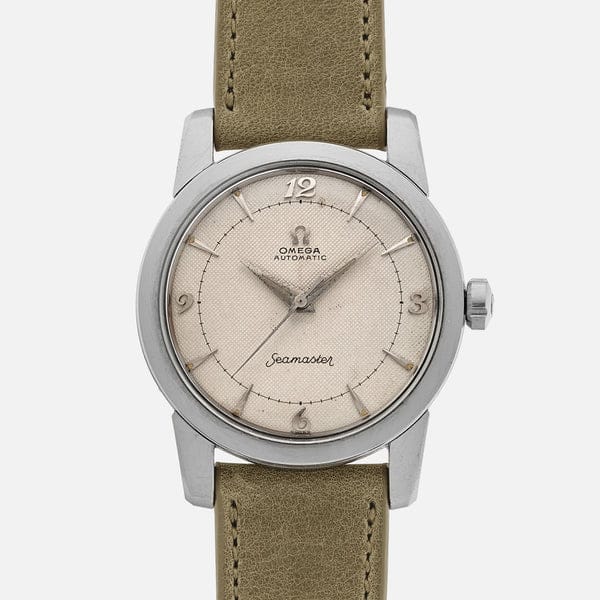
The Omega Seamaster 2577 stands as one of the most historically significant and widely produced dress watches of the early 1950s. Introduced in 1948 to commemorate Omega’s 100th anniversary, this reference defined the nascent Seamaster line and remained in continuous production through 1955. With an estimated production run exceeding 2.5 million serial numbers (serials 11.5M to 14M), the 2577 is both accessible to collectors and remarkably diverse in its specifications, making it an ideal entry point into vintage Omega collecting. However, this very popularity and longevity, combined with the prevalence of component swaps and replacements over seven decades, demands careful authentication and understanding of period-specific variations.
Reference Overview and Historical Context
Production Timeline: Approximately 1948–1955, with peak production 1952–1953
Official Designation: CK 2577 (stainless steel); OJ/OT 2577 (solid gold); KO 2577 (gold-cap); PK 2577 (gold-filled)
Introduction Purpose: Launched for Omega’s centennial in 1948, the Seamaster line was marketed as a modern gentleman’s watch combining water resistance, shock protection, and antimagnetic properties—innovations that had been refined through Omega’s military supply work during WWII. The 2577, with its center seconds hand configuration (denoted “SC” in the reference), became the flagship of this new collection.
The reference was produced in vast quantities during the early 1950s, making it one of the most commonly encountered vintage Seamasters today. This prolific production, while beneficial for accessibility, has led to considerable mixing of components over the decades as watches were serviced, restored, or cannibalized for parts.
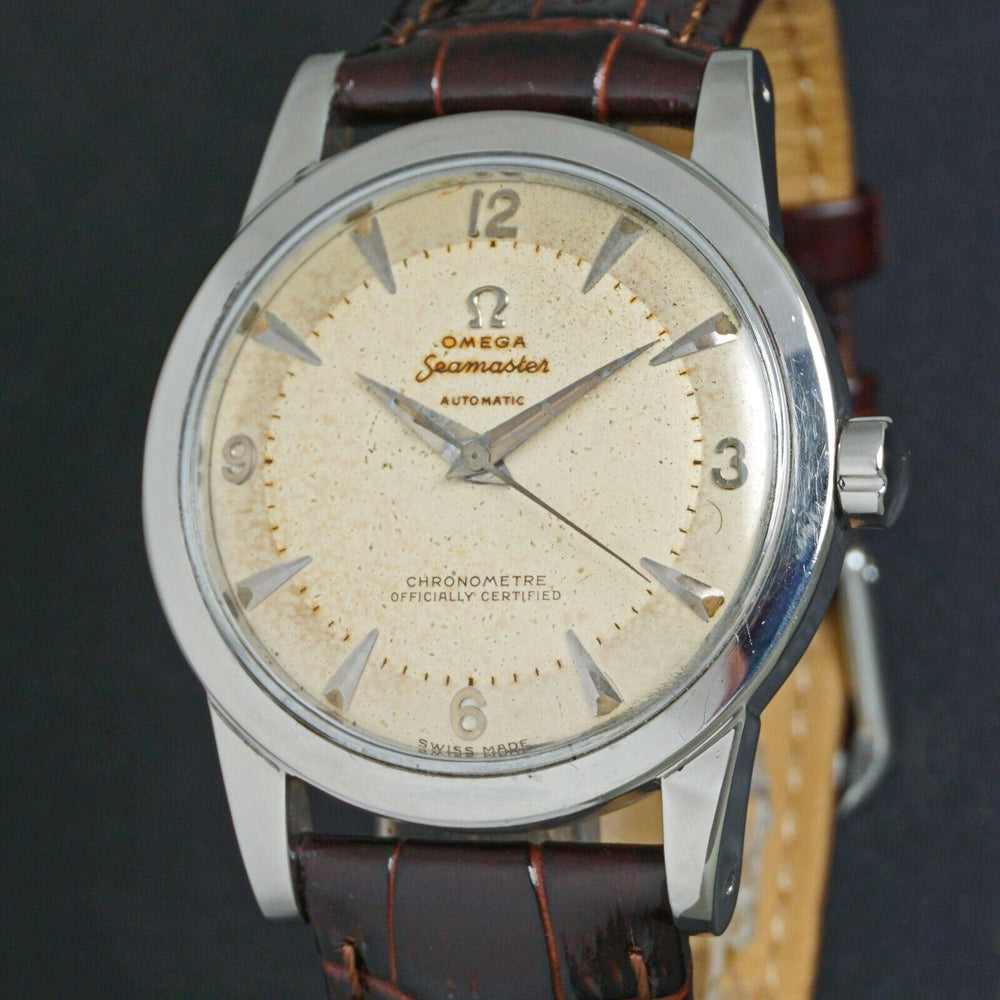
Stunning 1951 Omega 2577 Seamaster Automatic Stainless Steel Man’s Watch
Physical Specifications
| Specification | Measurement | Notes |
|---|---|---|
| Case Diameter | 34–34.5mm (excluding crown) | Generous for the 1950s era |
| Lug-to-Lug | ~43–43.5mm | Allows comfortable fit on varied wrist sizes |
| Case Thickness | ~11mm | Relatively slim for the era |
| Lug Width | 18mm | Standard for strap attachment |
| Water Resistance | 30m (3 ATM) | Novel for 1948; modest by modern standards |
| Crystal | Plexiglass (acrylic) | Domed; original Armourglass examples highly prized |
| Caseback | Screw-in with O-ring gasket | Threaded design ensures watertightness |
| Crown | 5.3mm clover/Naiad crown | Scalloped; push-in (not screw-down) |
| Power Reserve | ~40 hours | Typical for bumper automatics |
Movement Specifications and Evolution
The Seamaster 2577 experienced three distinct movement iterations across its production run, each marking a significant point in Omega’s horological evolution:
The caliber 351 was Omega’s benchmark bumper automatic, representing the pinnacle of the early oscillating-weight automatic systems. It features 17 jewels, beats at 19,800 vibrations per hour, and incorporates Incabloc shock protection and non-magnetic balance springs. The bumper rotor—often called “oscillating weight”—pivots back and forth against shock-absorbing springs rather than rotating a full 360 degrees as in modern automatics. Early examples had a more limited rotor range (approximately 300 degrees), later expanded.
The Cal. 351 was produced from 1949 onward (initially as the 28.10T1 RA SC PC before the new designation system in 1949). Serial numbers in the 11.5M–13.7M range typically house a cal. 351. These movements, despite their simplicity, are regarded as exceptionally durable and continue to function reliably in surviving examples.
Caliber 352 RG (Early 1950s, Rare)
Omega produced a chronometer-adjusted version of the bumper automatic designated Cal. 352 RG, where the “RG” suffix denotes réglage général (general adjustment to chronometer standard). This movement appears less frequently in Seamaster 2577s than in other contemporary Omega references, as chronometer certification was typically reserved for higher-tier models. When encountered, a 2577 with Cal. 352 will display chronometer-related text on its dial (“Chronomètre” or “Officially Certified”).
The caliber 354 entered the 2577 lineup around mid-1952 (serial range ~13.7M onward) and remained until production ceased in 1955. Designed by Charles Perregaux, Cal. 354 represents the refinement of Omega’s bumper automatic philosophy. Mechanically comparable to the 351 (17–19 jewels, 19,800 vph), the 354 introduced internal refinements and could be offered in both standard and chronometer grades.
Critically, the 354 was not accompanied by significant external case modifications, which means a watch’s appearance does not necessarily indicate which caliber it houses—however, bezel type and caseback design can serve as reliable proxy indicators.
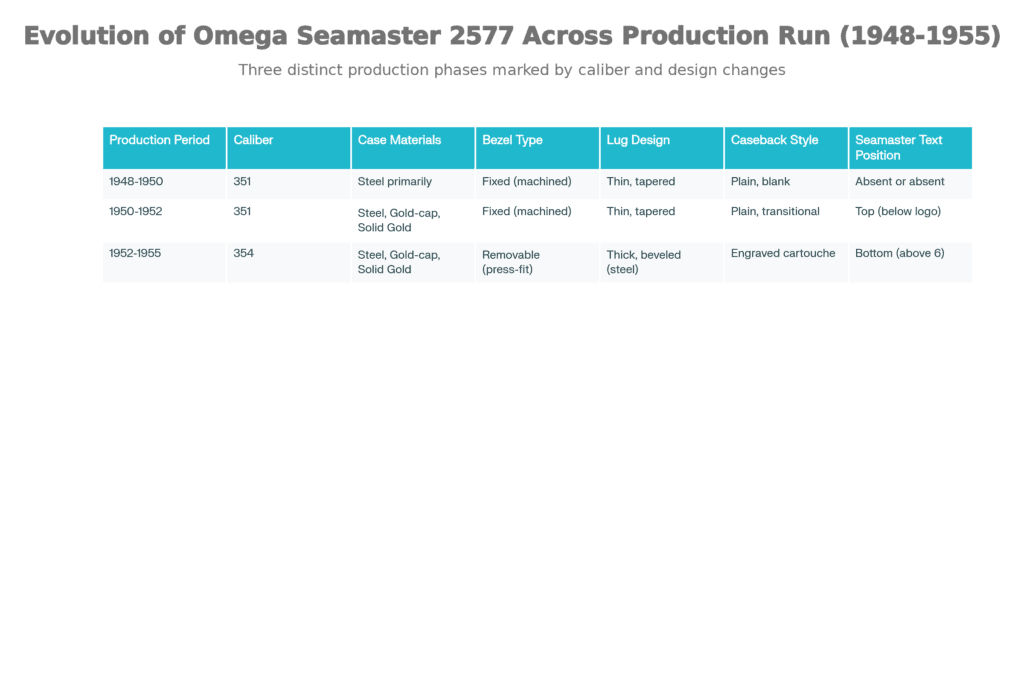
Evolution of Omega Seamaster 2577 Design Features by Production Period
Case Materials and Construction
The 2577 was offered in multiple material configurations to appeal to different market segments:
The standard steel version was by far the most common production variant. Omega employed robust Staybrite stainless steel (or similar high-grade alloy) for the case, which exhibits the classic brushed finish visible in period examples. Steel 2577s command lower prices today than precious metal variants, making them accessible entry points for collectors.
Gold capping represents a mechanically bonded thick layer of gold affixed to a steel base—fundamentally different from gold plating. A typical gold-cap 2577 features 14K or 18K gold layering (usually 14K externally), which is durable enough that it rarely wears through under normal use. These cases were marketed as more luxurious and commanded a premium: roughly 280 Swiss francs for steel versus 320 francs for gold-cap in 1950s pricing.
The aesthetic appeal of gold-cap is significant, blending warmth and affordability; however, collectors should verify that the gold layer remains intact and that the underlying steel shows appropriate aging patterns (not pristine, but not excessively corroded).
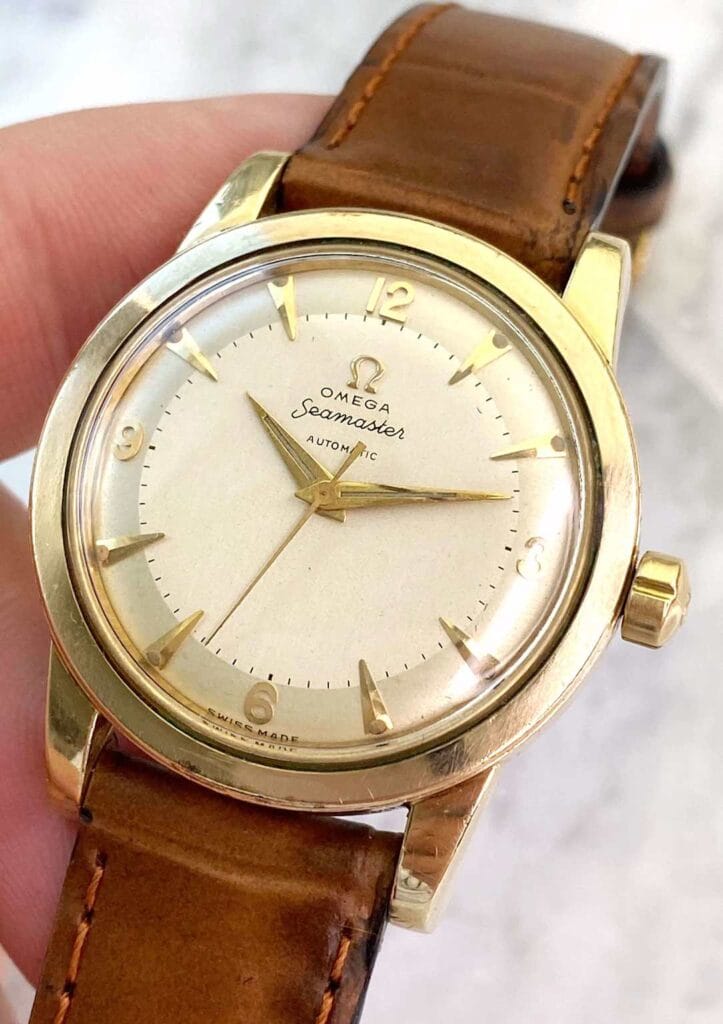
Omega Seamaster Vintage Automatik ref 2577 Bumper | Vintage
Solid gold Seamaster 2577s were produced in 14K and 18K yellow gold, and occasionally rose gold. These represent the pinnacle of contemporary luxury and are correspondingly rare and valuable today. Notably, solid gold cases followed a slightly different lug geometry compared to steel versions: they never adopted the later “beefy, beveled lug” style of the late-production steel cases, instead maintaining a more elegant, slender profile throughout the 2577’s production run. This distinction is critical for authentication—a 1954 solid gold 2577 with thin lugs is entirely correct, whereas a steel example from the same year should have thick beveled lugs.
Case Design Evolution and Bezel Variations
The 2577 underwent significant case refinements during its production, with two primary architectural stages:
Early Style (circa 1948–1951)
Early cases featured:
- Thin, tapered lugs without beveled edges or chamfers
- Fixed bezel machined integral to the case middle (non-removable)
- Visible spring bar holes on the lug sides, a design hallmark of the era
- Plain caseback with subtle circular groove pattern and circular brushed finish; no external engraving
- Less visually “robust” appearance overall
These early cases paired with Caliber 351 movements and are identifiable by serial numbers in the 11.5M–13.2M range.
Late Style (circa 1952–1955)
Later examples introduced:
- Thick “beefy” lugs with pronounced beveled/chamfered edges along the outer profile
- Removable bezel (press-fit design) that requires careful removal but is distinctly loose-fitting
- Hidden spring bar holes integrated into the lug geometry
- Engraved caseback featuring “SEAMASTER” in block capitals within a small cartouche; polished finish (no circular brushing pattern)
- Robust, purposeful visual presence
These later cases typically house Caliber 354 movements and correspond to serial ranges 13.7M–14M.
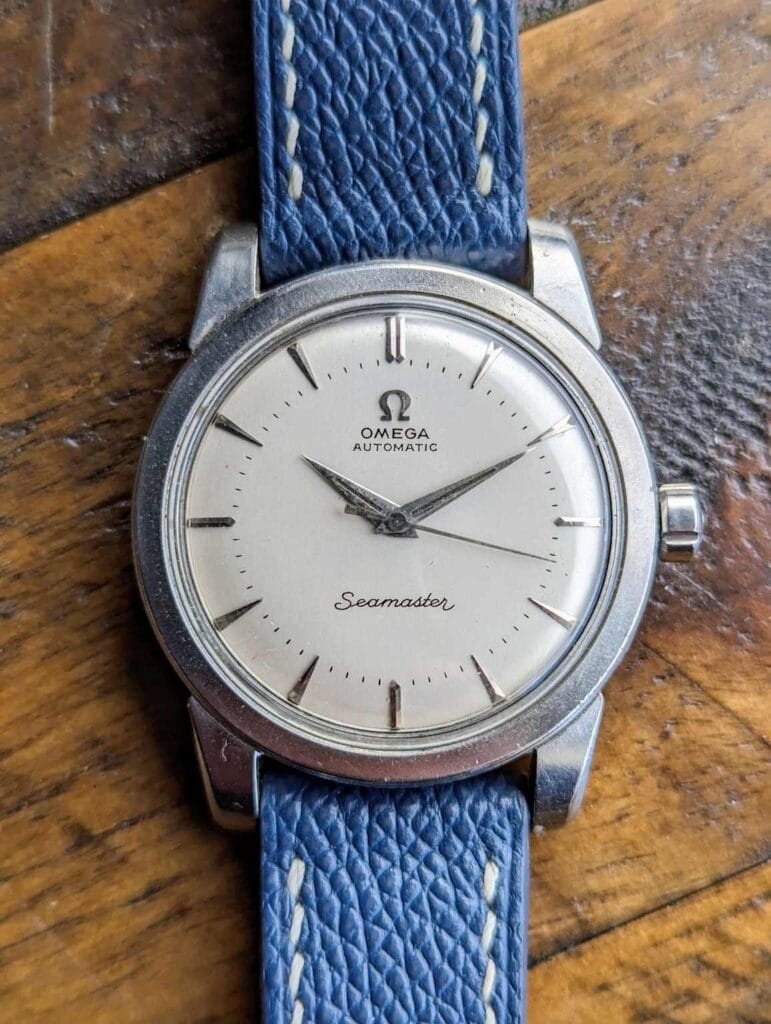
Vintage Omega Seamaster 2577 – Beefy Lug – SCVW
Critical Authentication Note: A watch presenting a Caliber 354 movement paired with a fixed (non-removable) bezel and thin lugs is a strong indicator of case swapping or frankenswatch assembly. Such a combination is mechanically impossible in correct original watches, as the bezel and lug style progressed in tandem with the movement upgrade.
Solid gold cases present a different pattern: they began production with slightly thicker lugs than steel versions but never transitioned to the heavily beveled “fat lug” style of the late-steel cases. Thus, a solid 18K 2577 from 1954 with smooth lugs is entirely correct.
Dial Variations: An Extensive Taxonomy
Perhaps no single reference in Omega’s early production exhibits the dial diversity of the 2577. Collectors have documented over 100 distinct dial variations, encompassing changes in text positioning, marker styles, finishes, and color combinations. The reference number suffix (e.g., 2577-6, 2577-11) theoretically encodes dial configuration information, though the encoding system is not fully transparent to modern collectors.
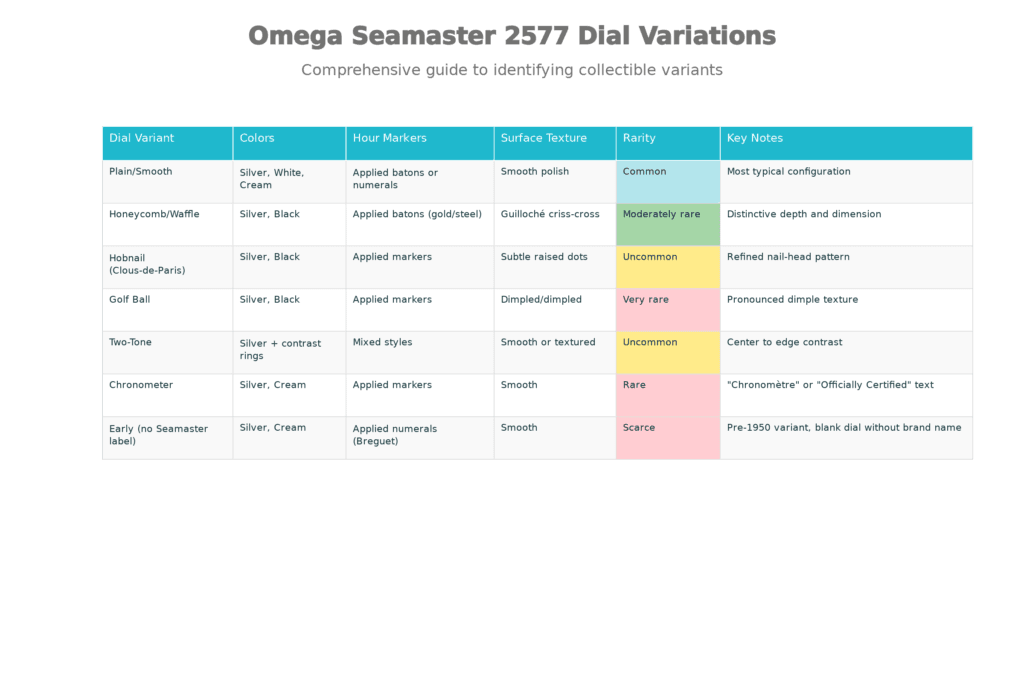
Major Dial Variations Found on Omega Seamaster 2577
Dial Text Positioning Evolution
An underappreciated but important indicator of production era is the position of “Seamaster” text on the dial:
- Pre-1950 / Early Variants: No “Seamaster” inscription at all; dials carry only the Omega logo and basic information. These are scarce and highly prized by historians.
- 1950–1952 (Mid-Production): “Seamaster” appears in the upper half of the dial, typically beneath the Omega logo at 12 o’clock. This layout was gradually phased out around serial 13.2M.
- 1952–1955 (Late Production): “Seamaster” relocated to the lower half of the dial, positioned above the 6 o’clock position. This became the standard configuration for the remainder of the reference’s production.
This evolution reflects Omega’s redesign of dial layouts, particularly to accommodate chronometer-related text on certified examples.
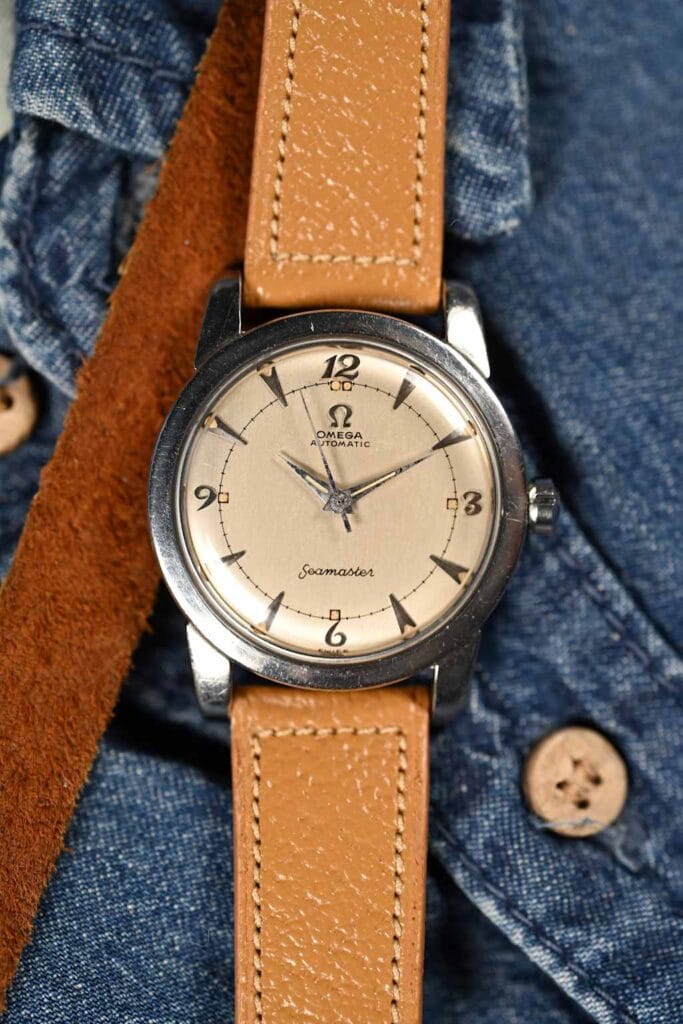
Vintage Omega Seamaster 2577 – Breguet – SCVW
Marker and Numeral Variations
Hour markers on the 2577 come in several configurations:
- Applied Faceted Batons or Triangular Markers: The most typical arrangement, featuring applied metal indices (gold on gold models, steel on steel) with radium lume inserted in grooves.
- Applied Arabic Numerals: Some dials feature applied numerals at the 3, 6, 9, and 12 positions, either in simple fonts or the elegant Breguet style with characteristic curled serifs.
- Mixed Layouts: Many dials combine triangular markers with numerals at the cardinal positions, creating visual balance.
- No Hour Markers: Rare on 2577s, though some minimal dress variants exist with no visible index markers.
The 2577 came in a striking array of colors and textures:
- Silver/White Dials: The most common by far, ranging from pale cream to bright silver. Often exhibited a subtle two-tone effect from curvature and aging.
- Black Dials: Considerably rarer and highly sought by collectors. These are often found on chronometer variants.
- Champagne/Cream: Less common than silver, imparting a warmer vintage aesthetic.
A hallmark of 1950s design is the availability of guilloché (engine-turned) textured dials:
- Honeycomb/Waffle: A criss-cross pattern creating small waffle-like squares. This texture is moderately common and adds significant visual depth and character.
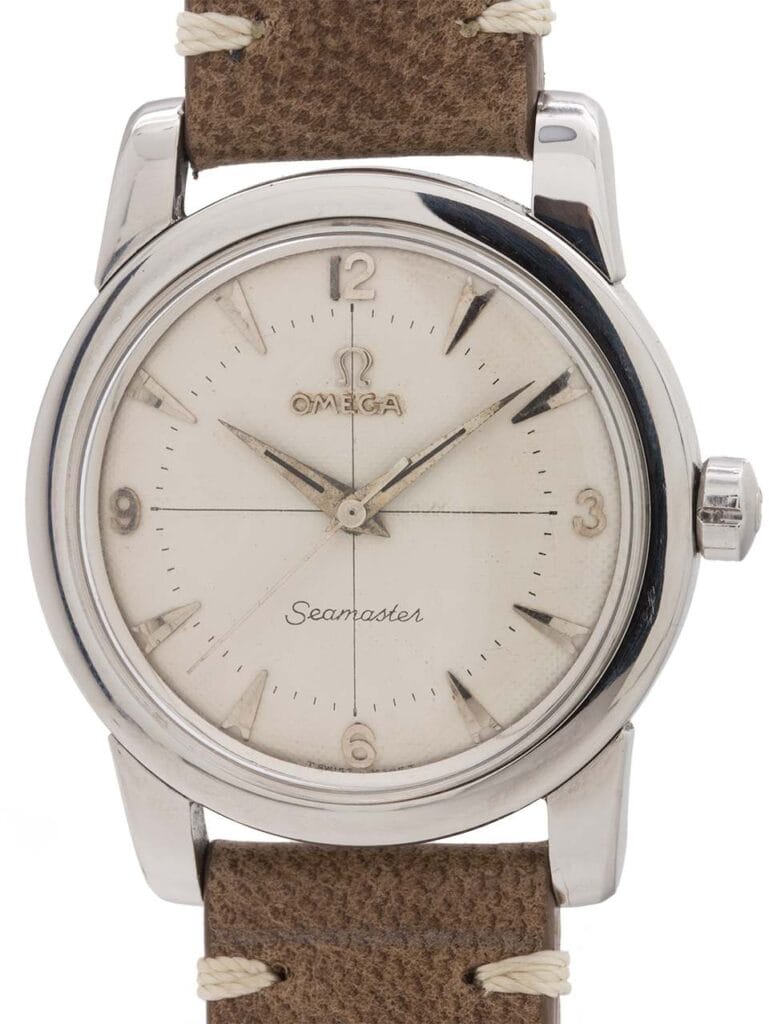
Omega SS Seamaster ref# 2577 Waffle Dial circa 1952
- Hobnail (Clous-de-Paris): A subtler nail-head pattern that creates a refined, dimensional surface without the bold contrast of honeycomb.
- Golf Ball: A rare dimpled texture evoking a golf ball’s surface. Examples with this dial are scarce and distinctive.
- Plain/Smooth: The standard configuration, polished or brushed without texture.
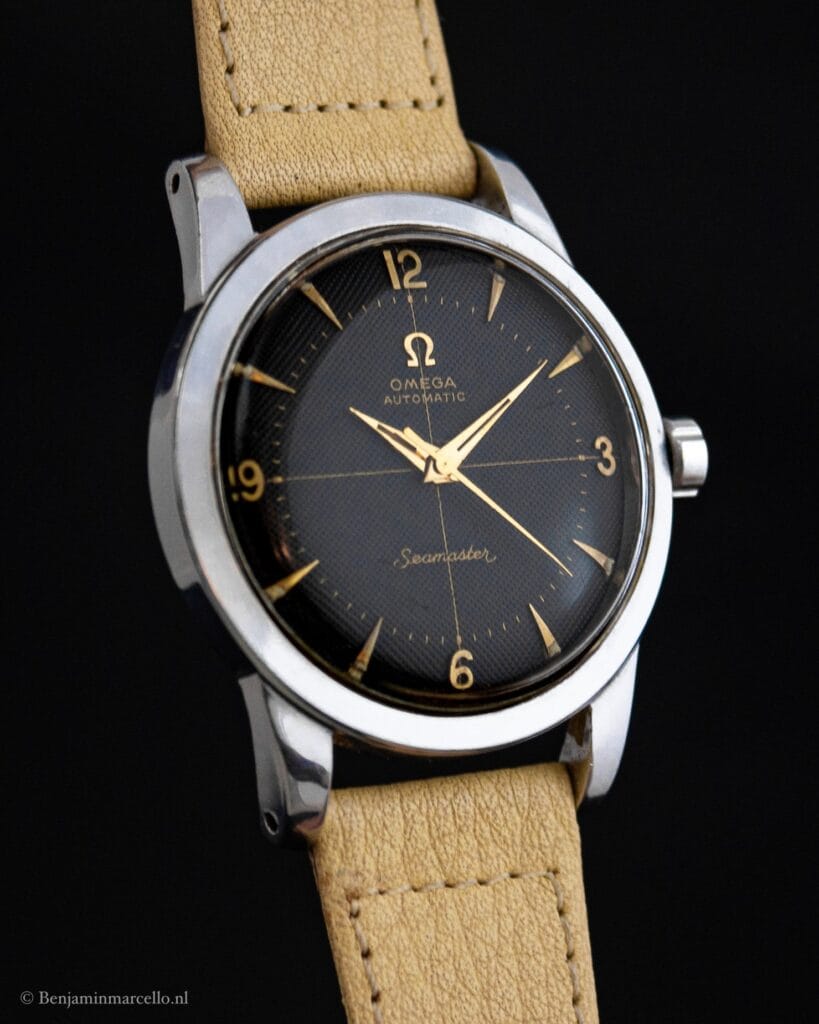
Omega Seamaster 2577 Black Waffle (Honeycomb) Dial
The honeycomb pattern is particularly striking when observed in natural light, as the guilloché creates depth and movement across the dial surface that photographs often struggle to capture fully. Black dials with honeycomb represent some of the most visually dramatic 2577 variants.
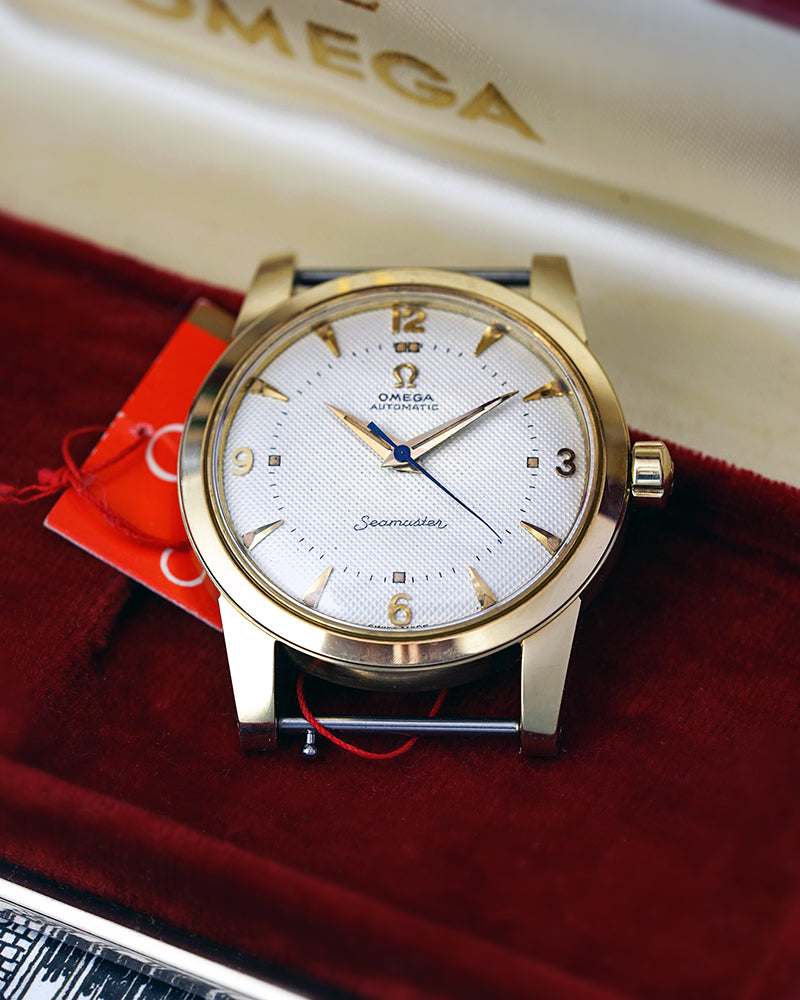
NOS* 1951 Omega Seamaster | ‘Honeycomb Dial’ | Ref. 2577 SC
Chronometer and Special Editions
Watchmakers at Omega occasionally produced Seamaster 2577s with chronometer-grade movements, typically Cal. 352 RG or adjusted Cal. 354. These dials carry additional inscriptions:
- “Chronomètre”: French spelling, found on earlier chronometer variants
- “Omega Automatic Chronometer Officially Certified”: Multi-line text, common on later certified examples
- Text Positioning: Chronometer dials often position “Seamaster” at the 6 o’clock position to accommodate chronometer text above, creating a visually distinct layout.
Chronometer 2577s are uncommon and usually appear in solid gold or gold-capped cases. They command significant premiums in the collector market.
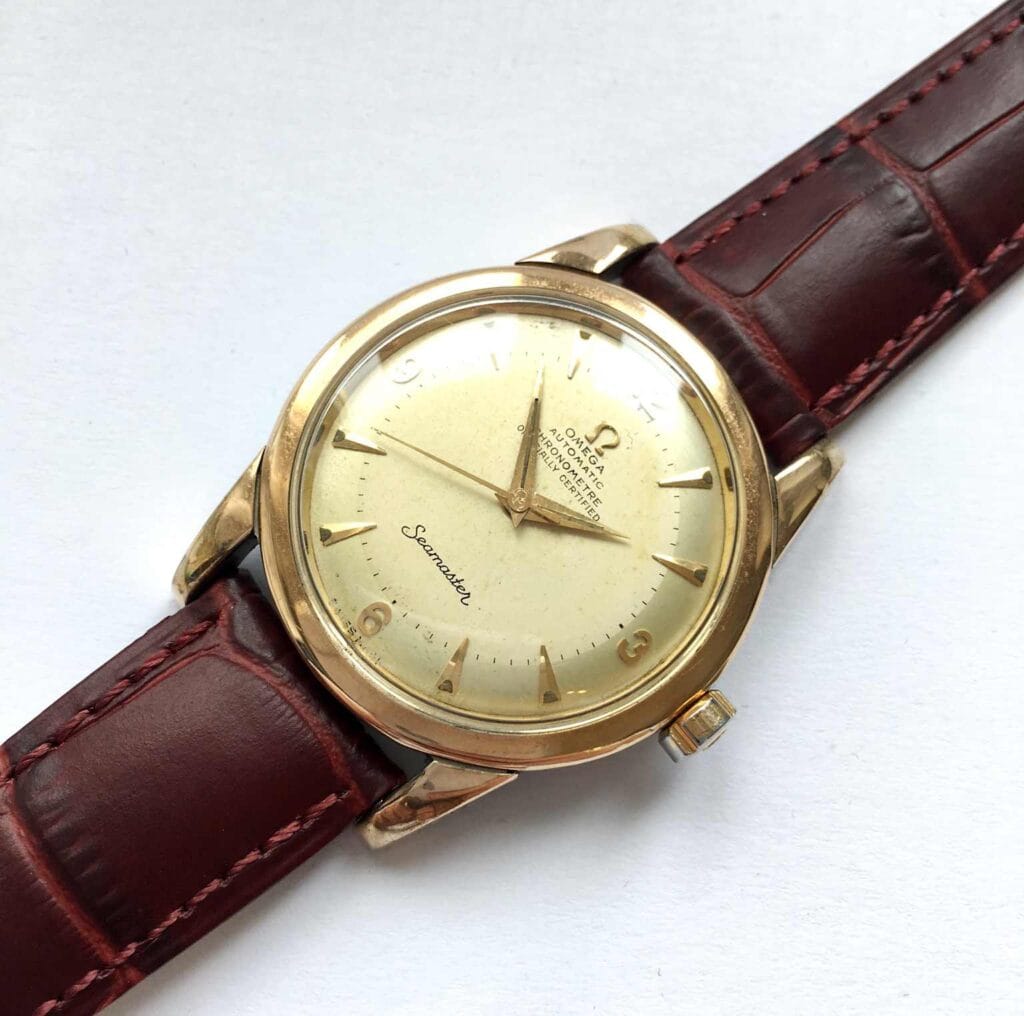
Extremely Rare Omega Seamaster Chronometer Ref 2577 Vintage
A phenomenon collectors call “tropical” patina—where original silvered dials fade to warm gold, brown, or champagne tones over decades—occurs in many 2577s exposed to significant sunlight. This aging is entirely natural and often prized as evidence of authentic aging. However, not all dials developed this patina; many maintained silver tones when stored away from light.
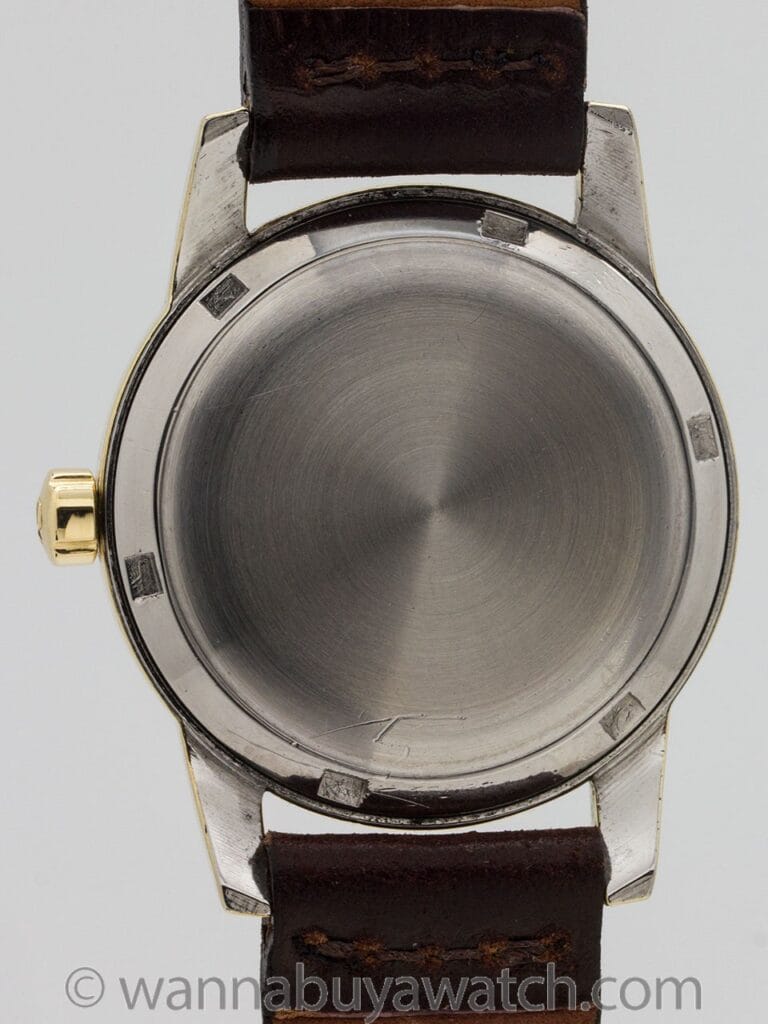
Omega Seamaster ref# 2577 Tropical Chocolate Dial circa 1951
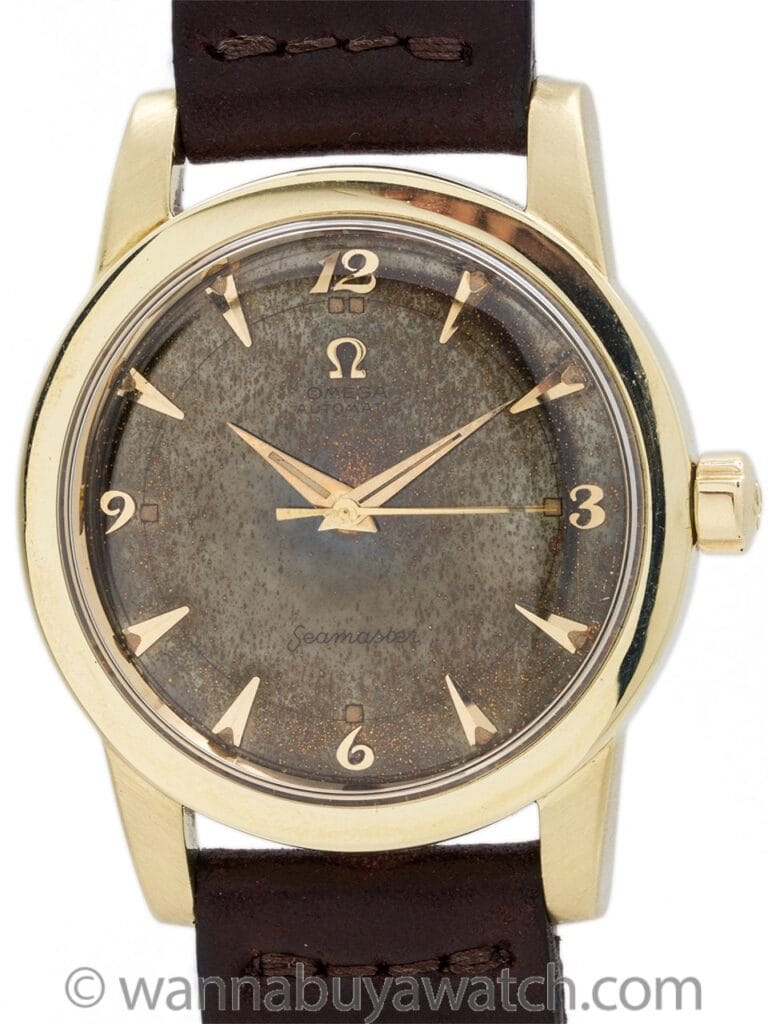
Omega Seamaster ref# 2577 Tropical Chocolate Dial circa 1951
Hands and Luminous Materials
The standard hand configuration for the Seamaster 2577 is the Dauphine (or “Dolphin”) style—a faceted, lance-shaped design that widens from base to tip and features a subtle central crease for reflectivity. Dauphines are found on the vast majority of 2577 examples and come in matching metal tones:
- Gold-colored on gold and gold-capped cases (typically gilt or gold-plated steel)
- Rhodium-plated steel on all-steel cases
The center seconds hand is typically a slim sweep design, sometimes with a small lume “pip” or tail for visibility, though entirely polished (non-luminous) seconds hands also appear on some variants.
Alternative hand styles (leaf-shaped or Mercedes-style) are rare on the 2577 and should raise questions about dial authenticity or period-appropriate originality.
Radium Luminous Material and Aging
All original Seamaster 2577 examples contain radium-based luminous material, applied to both the dial indices and the hands. Understanding radium aging is essential for authentication:
Normal Aging Patterns:
- Radium lume naturally darkens over decades, typically turning grey, brown, tan, or yellowish depending on exposure and environmental conditions.
- Lume applied to hands (filled into grooves) and lume applied to dial indices (painted or brushed on after applied markers are pressed to the dial) often come from different manufacturing batches and thus age differently in color. This variation is entirely normal and expected on original watches.
- Exposure to sunlight tends to cause more pronounced browning, while storage in dark conditions yields greyish or yellow tones.
- Even on a single watch, the seconds hand might display different lume color than the hour/minute hands—a sign of period-correct originality.
Red Flags:
- Uniform lume color across all hands and indices suggests recent relume, as original batches rarely aged identically.
- Bright, glossy luminous material indicates modern tritium or superluminova application rather than aged radium.
- Excessive brightness under UV light is inconsistent with aged radium.
Safety Note: Radium watches pose minimal health risk when sealed in a case. The alpha radiation is blocked by the crystal; gamma radiation decays over distance; and radon buildup is negligible in a single watch in normal ventilation.
Crown Design and Original Specifications
The Clover Crown (Naiad Crown)
The 2577 is equipped exclusively with the distinctive clover-shaped crown, sometimes referred to as a Naiad crown in Omega marketing literature. This crown has a scalloped, four-leafed flower appearance and was designed to improve water resistance through a tighter seal mechanism. The crown features:
- Flat-foot Omega Ω symbol on its domed outer surface (correct original style)
- Diameter: Approximately 5.3mm, relatively small for the case size
- Material: Stainless steel or gold to match the case
- Function: Push-in (not screw-down), limiting water resistance but improving ergonomics
- Period Use: Standard across Omega’s early 1950s lineup
Authentication Consideration: Any Seamaster 2577 without a clover crown or sporting a different crown style (e.g., 10-sided Constellation crown, later helium escape valve crowns) has been modified. While replacements may be functionally equivalent, they are not original to the reference.
Caseback Design and Evolution
Like the cases themselves, casebacks evolved during the 2577’s production run:
Early Caseback (Cal. 351 Era, ~1948–1951)
Early casebacks exhibit:
- Plain, blank exterior surface
- Subtle circular groove pattern (decorative brushed finish)
- No engraving or text visible on the outside
- Simple screw-in design with O-ring gasket
- Internally stamped with reference number and material codes
The plainness of early casebacks reflects Omega’s minimalist design philosophy before the seahorse logo became a brand icon.
Mid-to-Late Caseback (Cal. 354 Era, ~1952–1955)
Later casebacks feature:
- “SEAMASTER” engraved in block capitals within a small framed cartouche
- Polished (not brushed) finish
- Circular grooving discontinued
- Thicker construction overall
- Internal markings same as early versions
The introduction of external “Seamaster” engraving coincides with the transition to Cal. 354 and is a reliable marker of late-production examples.
A subset of very late 2577 variants (reference suffixes -22, -23, -24) feature a domed or “bubble” caseback that protrudes convexly without any groove or inscription. These are less common and may have been introduced as a space-saving measure or aesthetic refinement in the final production years.
Solid gold 2577s do not follow the same caseback progression as steel examples. Many gold versions never received the “Seamaster” engraving on the outside, instead relying on hallmarks and internal stampings for identification. This distinction is normal and does not indicate a problem.
Visual Aspects and Aesthetic Characteristics
The 2577 presents a distinctly mid-century modern appearance that has endured well:
- Case Profile: The round, unadorned case with a clean, shallow bezel reflects 1950s restraint. The wide, flat bezel is typical of dress watches from this era, contrasting sharply with the more pronounced bezels of later dive watches.
- Lug Presence: Early examples with thin, tapered lugs read as elegant and refined; later “beefy lug” versions convey a more robust, purposeful demeanor. Both interpretations are historically accurate.
- Dial Simplicity: Even with variations, the dial design remains fundamentally clean and legible. Applied markers catch light beautifully, and the two-tone dials create subtle visual interest without clutter.
- Hand-Dial Synergy: The dauphine hands complement the applied marker aesthetic, creating visual cohesion.
- Crown Prominence: The small clover crown is somewhat undersized relative to modern watches, reflecting the era’s different design priorities and the watch’s push-in (not screw-down) sealing mechanism.
- Presence on Wrist: At 34mm with thin proportions, the 2577 reads as a sophisticated dress watch, not a sports instrument. Lug-to-lug measurements of ~43–43.5mm ensure comfortable wear on varied wrist sizes.
Authentication and Identification Guide
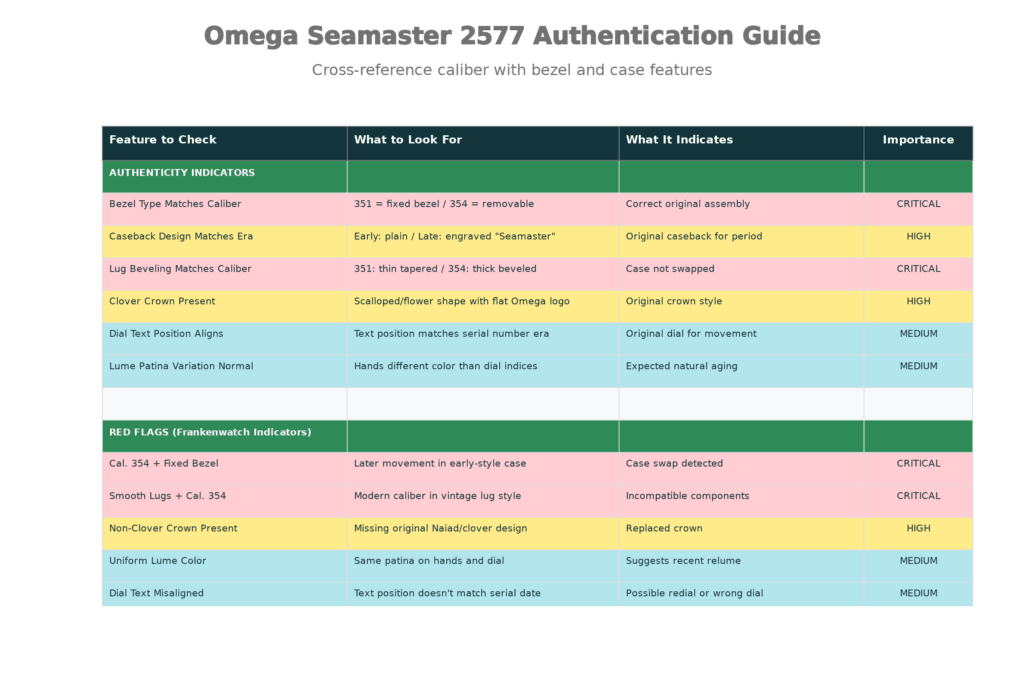
Omega Seamaster 2577 Authentication Guide: Original Indicators and Red Flags
Critical Authenticity Checks
- Bezel Type Consistency: Verify that the bezel type (fixed vs. removable) aligns with the movement. Cal. 351 should have a fixed, machined bezel; Cal. 354 should have a removable, press-fit bezel. A mismatch is the most reliable indicator of case swapping.
- Caseback Engraving Era: Early casebacks (plain, circular grooved) should correlate with Cal. 351 serial ranges (11.5M–13.7M). Late casebacks (engraved “Seamaster”) should appear on Cal. 354 examples (13.7M–14M). Mismatches suggest component mixing.
- Lug Beveling Alignment: Early steel cases have smooth, non-beveled lugs. Later steel cases (1952+) have prominent beveled edges. A Cal. 354 with smooth lugs is a red flag. Solid gold cases never have heavy beveling, so this test applies only to steel examples.
- Crown Authenticity: The clover crown should bear a flat-foot Omega Ω symbol. Non-original crowns are relatively common replacement parts and, while functional, indicate modification.
- Dial Text Position Correlation: Match the “Seamaster” text position to known serial ranges. If a dial reads “Seamaster” at the top and the movement serial is from 1953 (13.7M+), the dial may be original to a different watch.
- Lume Patina Asymmetry: Original watches exhibit differing lume colors between hands and dial indices due to separate manufacturing and aging. Uniform, bright lume throughout is suspect.
- Reference Number Suffix Coherence: Research the specific sub-reference (-1, -4, -6, -11, etc.) to determine expected dial configuration. While the suffix encoding is not fully transparent, collector databases and forum research can clarify expectations.
Common Red Flags Indicating Non-Original or Swapped Components
- Cal. 354 movement in a case with a fixed bezel and thin lugs
- Smooth (non-beveled) lugs with a Cal. 354 movement and 1953+ serial
- Non-clover crown style
- Dial text position inconsistent with movement serial number
- Entirely reluminated dial (uniform bright lume throughout)
- Snap-on caseback (indicates reference 2767, not 2577)
- Later Constellation or other model crowns fitted to the 2577
- Caseback engraving on early serial numbers (pre-13M)
Case Material Identification
| Material Code | Description | Durability | Cost Considerations |
|---|---|---|---|
| CK / MI | Stainless steel (most common) | Excellent; resists corrosion | Most accessible; lower collector value than gold |
| KO | Gold-capped (14K or 18K gold over steel) | Very good; gold layer durable under normal wear | Premium over steel; rarer than all-steel |
| OJ / OT | Solid 14K or 18K gold (yellow or rose) | Excellent; gold won’t wear through | Highest value; significantly rarer; priced accordingly |
| PK | Gold-filled (rare on 2577) | Moderate; thinner gold layer than cap | Very uncommon on this reference |
Production Variants and Suffix Reference
While Omega’s suffix encoding system for the pre-1962 era is not exhaustively documented in publicly available resources, the following sub-references are documented in the collector community:
| Sub-Reference | Documented Variants | Approximate Years |
|---|---|---|
| 2577-1 | Two-tone dial variants, early markers | 1949–1950 |
| 2577-4 | Smooth dial, applied batons | 1950–1951 |
| 2577-6 | Waffle/honeycomb dial (white or black) | 1951–1953 |
| 2577-9 | Applied numerals, champagne dial | 1950–1952 |
| 2577-11 | Honeycomb dial, white or black | 1950–1953 |
| 2577-12 | Honeycomb dial variants | 1952–1954 |
| 2577-17 | Gold-cap variants, varied dials | 1951–1954 |
| 2577-20 | Late production, Seamaster at bottom | 1952–1955 |
| 2577-22 to -24 | Late production with bubble back | 1953–1955 |
The suffix “-SC” (seen as, e.g., “2577-6 SC”) denotes “Seconde au Centre” (center seconds), confirming the hand configuration.
Pricing and Market Context
Prices for Seamaster 2577s vary dramatically based on condition, originality, and rarity:
- Steel, standard dial, good condition: $900–$1,500 (2024 market)
- Steel, textured dial (honeycomb), excellent condition: $1,200–$2,000
- Gold-cap, original dial, excellent condition: $1,500–$2,500
- Solid 14K gold, any dial, excellent condition: $2,500–$4,500
- Chronometer certified variants, any material: $2,000–$5,000+
- Rare early examples (pre-1950), excellent condition: $2,000–$3,500
Premiums apply for:
- Unpolished, original cases
- Factory-original dials with strong patina
- Chronometer certification
- Solid precious metal cases
- Rare dial variants (golf ball, early unmarked)
- Complete boxes and papers (extremely rare)
Servicing, Restoration, and Preservation Considerations
Movement Servicing: The Cal. 351 and 354 bumper automatics are straightforward to service and parts are available from specialized Omega watchmakers. A full service typically costs $400–$800 in 2024. These movements continue to function reliably for decades if properly maintained.
Radium Handling: Sealed casebacks containing radium lume present negligible health risk in normal use. However, if caseback removal is needed for service, handling should be minimized and parts stored in ventilated containers. Many watchmakers leave sealed casebacks undisturbed during service.
Dial Restoration: Original dials, even heavily patinated, are preferable to redials from a collector standpoint. The cost of a professional redial ($500–$1,000) is substantial, and any redial reduces the historical authenticity of the watch, even if executed excellently.
Crystal Replacement: Plexiglass crystals are softer and scratch more easily than modern sapphire, but replacement with period-correct domed acrylic is straightforward and maintains originality better than sapphire upgrades.
Case Polishing: Original unpolished cases are increasingly valued by collectors for their patina and aging character. Excessive polishing removes material and erases manufacturing details. Conservative restoration is preferable to aggressive polishing.
Related References and Variant Models
Seamaster 2576 (Sub-Seconds Variant)
The sister reference 2576 is mechanically identical to the 2577 but features a sub-seconds dial(running seconds at 6 o’clock) rather than center seconds. It typically houses the Cal. 342 or 344 movements. The 2576 is somewhat rarer than the 2577 and commands a slight premium.
Seamaster 2767 (Snap-On Caseback)
The reference 2767 is essentially a 2577 with a snap-on (rather than screw-in) caseback. It is sometimes confused with the 2577 in online listings. The snap-on design offers slightly quicker access but compromises water tightness. Mechanically identical otherwise.
Reference 2518 (Earlier Seamaster)
The 2518 is an earlier Seamaster variant from the late 1940s, occasionally cited as the “first” Seamaster, though the 2577 is more universally recognized as the flagship reference of the early line.
Conclusion
The Omega Seamaster reference 2577 represents a watershed moment in wristwatch design—the transition of the watch from a functional tool to an aspirational dress instrument. Its extensive production run, remarkable diversity of dial and case configurations, and enduring design legacy make it a compelling subject for collectors and historians alike.
Authentication requires attention to subtle details: bezel type consistency, caseback engraving patterns, lug geometry, dial text positioning, and lume patina asymmetry. While the reference is common enough to be accessible, the prevalence of component swaps and period restorations demands careful examination.
For those seeking an authentic, unpolished example with original dial and movement, the 2577 offers superb value and a direct connection to Omega’s mid-century innovation. Whether in steel or precious metal, with honeycomb dial or simple markers, a carefully selected Seamaster 2577 remains a sophisticated, reliable, and historically significant timepiece worthy of a place in any serious vintage watch collection.