


Last updated ~ February 2, 2026
Brand
Production Period
1965–1975
Model Line
Case Shape
Tonneau
Diameter
43mm
Lug to Lug
50mm
Lug Width
19mm
Case Thickness
14mm
Case Back
Screw-Down
Caliber
Crystal
Bezel
Dive
The Zodiac Super Sea Wolf 872-843 stands as one of the most technically accomplished dive chronographs produced during the golden age of Swiss tool watch manufacturing. Housing the Valjoux caliber 72, the same legendary column-wheel chronograph movement that powered the Rolex Daytona references 6239 through 6265, the Heuer Carrera, and the Breitling Navitimer, this reference delivered professional-grade timing capabilities within a case engineered to withstand depths of 200 meters. The combination of elite movement architecture, innovative case construction developed in partnership with EPSA (Ervin Piquerez SA), and documented adoption by United States Navy special warfare personnel establishes the 872-843 as a legitimate professional instrument rather than a marketing exercise. For collectors seeking Valjoux 72 heritage without the six-figure expenditure required for vintage Daytona acquisition, the Super Sea Wolf chronograph represents perhaps the most compelling value proposition in the current market.
The 872-843 occupies a specific niche within the broader Sea Wolf lineage as a chronograph variant of Zodiac’s flagship diving instrument. Where standard Sea Wolf references prioritized underwater timing through rotating bezels and luminous dial configurations optimized for low-light legibility, the 872-843 expanded functional capability to include elapsed-time measurement, tachymetric speed calculation via an internal crystal scale, and the tri-compax subdial arrangement characteristic of professional chronograph design. The tonneau-shaped case distinguishes this reference immediately from the round-cased time-only Sea Wolf models, creating a visual identity that collectors recognize at a glance. The watch was marketed toward serious recreational divers, competitive sailors requiring precise timing for race starts, and military personnel whose operational requirements demanded both water resistance and stopwatch functionality.
Production volume for the 872-843 remains undocumented due to the loss of Zodiac’s historical archives. However, reasonable estimation can be derived from known Valjoux 72 output constraints. Valjoux produced approximately 15,000 examples of the caliber 72 annually across all manufacturer clients during peak production years, with Rolex, Heuer, Breitling, and numerous smaller brands competing for allocation. Zodiac’s share of this limited supply would have been modest relative to larger purchasers, suggesting annual 872-843 production measured in hundreds rather than thousands of units. The reference should be classified as scarce within the broader vintage chronograph market, though not rare in the sense that examples seldom appear for sale. Collector forums and dealer inventories typically offer multiple examples at any given time, but finding specimens in excellent original condition with complete documentation requires patience and selectivity.
Current collector standing for the 872-843 reflects accelerating appreciation after years of relative undervaluation. Market analysis indicates that vintage Sea Wolf prices plateaued through the 2000s and early 2010s before entering a sustained upward trajectory coinciding with broader interest in vintage tool watches and the modern Super Sea Wolf relaunch under Fossil Group ownership. Pricing for the 872-843 currently ranges from approximately $3,000 for examples requiring service or displaying condition issues to $6,500 or higher for exceptional specimens with tropical dial development, original box and papers, and unpolished cases. Tropical dial variants, where the original black dial surface has naturally aged to chocolate brown tones through decades of UV exposure, command the most significant premiums and represent the primary driver of value differentiation within the reference. The 872-843 carries no widely recognized collector nickname, though it is sometimes referenced simply as the “Super Sea Wolf Chrono” or “Sea Wolf Valjoux 72” to distinguish it from time-only models and later quartz-era chronograph references.
Historical Context and Manufacturing Details
The Zodiac Super Sea Wolf reference 872-843 emerged during a transformative period for both the brand and the Swiss watch industry. The late 1960s witnessed the culmination of mechanical chronograph development before the quartz crisis fundamentally restructured horological manufacturing. Zodiac, having established credible professional diving credentials through the original Sea Wolf line introduced in the late 1950s, sought to expand its tool watch portfolio with chronograph variants capable of serving both underwater and timing applications. The 872-843 represented the brand’s most ambitious technical achievement within the Sea Wolf family, combining the movement prestige of Valjoux’s finest caliber with case engineering that matched or exceeded the water resistance capabilities of dedicated dive watches from larger competitors.
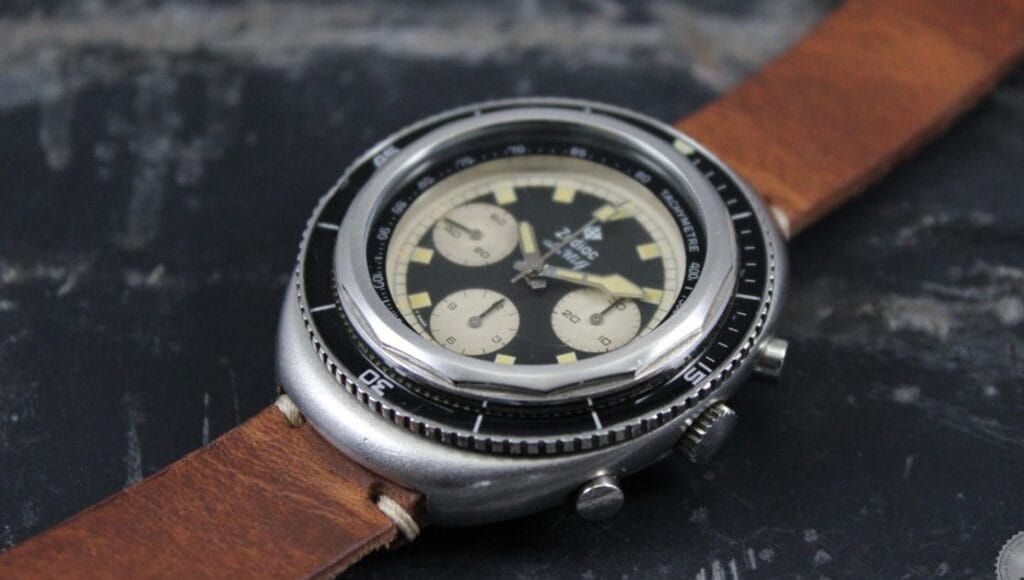
The broader context of 1960s dive watch development positioned Zodiac as a legitimate participant in an increasingly competitive market. Rolex had established the Submariner as the benchmark diving instrument, Omega was developing the Seamaster 300 and Ploprof for professional applications, and Blancpain’s Fifty Fathoms served military clients worldwide. Zodiac differentiated through aggressive pricing, innovative case construction, and targeted marketing toward American military and recreational diving markets. The Super Sea Wolf designation, introduced in 1968, marked a deliberate effort to elevate the model’s positioning through enhanced water resistance specifications and refined case architecture. The 872-843 chronograph variant extended this strategy by adding timing complications that expanded utility beyond pure diving applications.
Development History
The development of the 872-843 followed logically from Zodiac’s established Sea Wolf platform and the availability of suitable chronograph movements from Valjoux. The base Sea Wolf design had proven its water resistance capabilities through years of production and real-world use by divers, military personnel, and recreational enthusiasts. Adding chronograph functionality required sourcing an appropriate movement, engineering a case capable of housing the larger caliber while maintaining water integrity, and integrating pushers that would not compromise sealing under pressure.
Zodiac’s selection of the Valjoux 72 reflected both practical and marketing considerations. The caliber’s reputation as the finest manual-wind chronograph movement available provided credibility that transcended Zodiac’s mid-market brand positioning. The same movement powered watches retailing at substantially higher price points, allowing Zodiac to advertise Valjoux 72 heritage while maintaining accessible pricing. From a technical standpoint, the caliber’s 29.5mm diameter and proven reliability made it suitable for integration into a robust tool watch case without requiring extensive modification or proprietary development.
The reference number 872-843 encodes specific information about the watch’s configuration within Zodiac’s cataloging system. The “87” prefix designates the movement family, corresponding to the Valjoux 72/726 calibers that Zodiac designated internally as Caliber 87. The subsequent digits identify case configuration and finish specifications. Related references within the Sea Wolf chronograph family include the 692-843 Sea-Chron and 872-841 Zodiac-Chron “First Series,” which share case architecture but differ in dial configuration, movement variants, or marketing designation.
Production of the 872-843 commenced approximately 1969 and continued through the mid-1970s, with the preponderance of documented examples dating from 1970 to 1974. The reference’s discontinuation coincided with the broader disruption of the quartz crisis, which rendered expensive mechanical chronograph production economically challenging for mid-market brands. Valjoux ceased caliber 72 production in 1974, eliminating the movement supply that the 872-843 required. Zodiac, like many Swiss manufacturers, pivoted toward quartz technology and eventually discontinued its traditional mechanical chronograph offerings.
Manufacturing Context: Zodiac
Within Zodiac’s broader catalog of the early 1970s, the 872-843 represented the flagship chronograph offering and commanded pricing at the upper end of the brand’s range. The combination of Valjoux movement costs, specialized case construction, and the additional complexity of chronograph assembly positioned this reference as a premium product rather than a volume seller. Zodiac’s marketing emphasized the watch’s professional capabilities and movement pedigree, targeting consumers who recognized Valjoux heritage and sought its benefits without Rolex expenditure.
The 872-843 introduced no specific firsts for the brand, as Zodiac had previously offered Sea Wolf chronograph variants and the Super Sea Wolf platform was already established when this reference entered production. However, the specific combination of the mature Valjoux 72 caliber, refined tonneau case design, and 200-meter water resistance rating represented the most complete expression of Zodiac’s chronograph diving watch concept. The reference consolidated lessons learned from earlier chronograph Sea Wolf models and benefited from incremental improvements in case sealing technology and component quality.
Zodiac’s catalog positioning placed the 872-843 alongside time-only Super Sea Wolf references, dress watches from the Astrographic and Olympos lines, and various calendar and automatic models. The brand maintained a diverse portfolio spanning entry-level to premium price points, with the Sea Wolf family serving as the primary sport watch offering. Competition from larger Swiss manufacturers intensified throughout the reference’s production period, with Rolex, Omega, and Heuer all expanding chronograph offerings and commanding increasing market share among serious collectors and professional users.
Factory and Production Location
Zodiac maintained its primary manufacturing operations in Le Locle, Switzerland, within the traditional watchmaking region of the Jura mountains. The company’s facilities handled movement finishing, casing, quality control, and final assembly. However, the 872-843’s construction involved multiple external suppliers whose contributions were essential to the finished product.
The Valjoux caliber 72 and 726 movements originated from Valjoux’s facilities in Les Bioux, in the Vallée de Joux region that served as the center of Swiss ebauche and movement production. Valjoux supplied movements in varying states of completion to numerous clients, with Zodiac receiving calibers that were then finished, regulated, and cased according to the brand’s specifications. The movement bore Zodiac markings and caliber designations (Caliber 87) upon installation, though the underlying Valjoux architecture remained visible to anyone examining the mechanism.
Case production for the Super Sea Wolf line involved collaboration with EPSA (Ervin Piquerez SA), the pioneering case manufacturer responsible for the Super Compressor case design that defined high-performance diving watches of the era. EPSA’s patented sealing systems, which used internal case back compression activated by increasing water pressure, enabled water resistance ratings that exceeded conventional gasket-sealed designs. The tonneau chronograph case of the 872-843 incorporated EPSA engineering principles, though the specific case back design differs from the classic Super Compressor configuration used in time-only models.
Dial production likely involved specialized dial manufacturers within the Swiss supply network, as was standard practice for the era. Bracelet manufacturing was outsourced to J.B. Champion, the American bracelet specialist that supplied approximately 20 different bracelet designs across the Sea Wolf family. This distributed manufacturing model, common among Swiss watch brands of all sizes during this period, enabled Zodiac to access specialized expertise and production capacity that would have been impractical to maintain in-house.
Horological Significance
The Zodiac Super Sea Wolf 872-843 occupies a position of genuine horological significance, though its reputation has developed more slowly than that of comparable chronographs from higher-profile brands. The reference should be classified as a professional-grade workhorse that delivered legitimate tool watch capability to consumers who could not afford or chose not to purchase equivalent offerings from Rolex or Heuer. The Valjoux 72 movement elevates the 872-843 above typical mid-market chronographs of its era, as the caliber’s column-wheel construction, proven reliability, and industry-wide adoption by prestigious manufacturers distinguish it from cheaper cam-actuated alternatives.
Within the broader context of dive watch history, the Sea Wolf family holds a defensible claim to pioneer status. Zodiac’s introduction of the original Sea Wolf in the late 1950s placed the model among the earliest purpose-built diving watches available to consumers, contemporaneous with the Rolex Submariner, Blancpain Fifty Fathoms, and Omega Seamaster 300. The Super Sea Wolf designation and enhanced water resistance of the late 1960s models maintained competitive positioning as the dive watch market matured and consumer expectations escalated. The 872-843 chronograph variant extended this legacy into timing applications while preserving the water resistance that defined the model line.
The reference’s military connections, while sometimes overstated in marketing materials, contribute meaningfully to its historical significance. Documented adoption by U.S. Navy SEALs, purchases through military PX stores by Vietnam War servicemen, and the watch’s presence in underwater demolition team contexts establish genuine professional use beyond recreational diving. The distinction between private association endorsements (such as the UDT/SEAL Association) and official military procurement matters for historical accuracy, but both categories confirm that the Super Sea Wolf served in demanding operational environments.
For contemporary collectors, the 872-843 functions as an accessible entry point into vintage Valjoux 72 chronograph ownership. The caliber’s presence in the Rolex Daytona has driven values for that reference into six-figure territory, pricing out collectors of moderate means. The Heuer Carrera and Breitling Navitimer similarly command substantial premiums reflecting brand prestige and collector demand. The Zodiac Super Sea Wolf offers the same fundamental movement architecture, with its column-wheel mechanism, 17-jewel construction, and proven durability, at a fraction of the cost. This value proposition has attracted increasing collector attention as awareness of the 872-843’s specifications has spread through enthusiast communities and publications.
Construction and Architecture
The Zodiac Super Sea Wolf 872-843 presents a distinctive visual identity defined by its tonneau-shaped case, integrated bracelet attachment, and purposeful chronograph dial layout. The design philosophy balances professional tool watch requirements with aesthetic considerations that enabled the watch to serve dress occasions as well as diving or timing applications. The cushion case shape, unusual among dive chronographs, distinguishes the 872-843 immediately from round-cased competitors and creates a wrist presence that many collectors find more interesting than conventional designs. Construction quality reflects the professional positioning Zodiac intended, with case finishing, component fit, and overall execution meeting the standards expected of a premium sport chronograph.
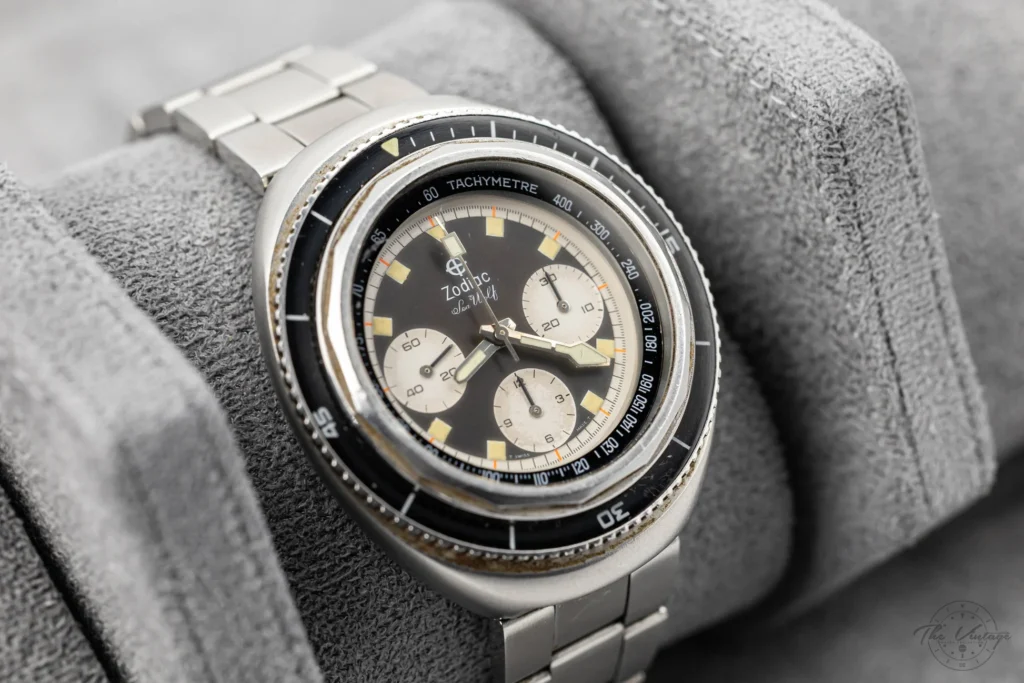
The overall architecture follows the tri-compax chronograph layout established by earlier Valjoux 72 applications, with subdials at 3, 6, and 9 o’clock surrounding a central chronograph seconds hand. The rotating bezel provides elapsed-time measurement capability for diving applications, while the internal tachymeter scale printed on the crystal adds speed calculation functionality. This combination of features positions the 872-843 as a versatile timing instrument suitable for underwater, automotive, and general-purpose chronograph use. Water resistance engineering, pusher sealing, and crown construction all reflect the enhanced specifications associated with the Super Sea Wolf designation.
Case Design
The 872-843 case represents a tonneau or cushion-shaped interpretation of the diving chronograph concept, distinguishing it from the round cases typical of both the standard Sea Wolf line and most competing chronographs. Case dimensions vary slightly across sources, with measurements of 41mm to 43.5mm diameter reported by different dealers and auction houses. This variation likely reflects different measurement methodologies (bezel included versus excluded, maximum width versus dial aperture) rather than actual dimensional inconsistency across production. The case measures approximately 14mm thick, accommodating the Valjoux 72 movement and maintaining the robust construction necessary for 200-meter water resistance. Lug-to-lug length falls in the 44-46mm range, and lug width measures 19mm.
The case is constructed entirely of stainless steel, with no documented gold, gold-plated, or two-tone variants for this specific reference. Surface finishing combines polished and brushed elements in a manner consistent with sport watch conventions of the era. The cushion shape creates softened corners that reduce sharp edges while maintaining the substantial visual presence appropriate for a professional diving instrument. The case flanks are gently curved, contributing to comfortable wrist wear despite the considerable thickness.
The case back is secured via screw-down threading, essential for maintaining water integrity at rated depths. External engravings include the Zodiac emblem, “ZODIAC SEAWOLF” text, water resistance certification (“WATER-TESTED 20 ATM” or equivalent), and “ESPECIALLY” designation indicating enhanced testing protocols. Internal caseback stampings include the reference number 872-843 and case serial number, providing essential authentication information for collectors evaluating prospective purchases.
The chronograph pushers are positioned at 2 o’clock (start/stop) and 4 o’clock (reset), following standard chronograph convention. Pusher design follows the pump style appropriate for water-resistant chronographs, with sealing accomplished through internal gaskets and compression fittings. The pushers are not screw-locking, which limits operational water resistance during chronograph use but provides the quick access necessary for timing applications. Period documentation suggests the chronograph function should not be operated underwater, consistent with industry practice for non-screw-down pusher designs.
Case manufacturing involved collaboration with EPSA, the Swiss case specialist whose Super Compressor designs defined high-performance diving watches of the 1960s and 1970s. While the 872-843 does not utilize the classic Super Compressor case back configuration with its internal compression mechanism, EPSA’s expertise in water-resistant case construction informed the engineering approach. The partnership enabled Zodiac to achieve professional-grade water resistance without maintaining the specialized case manufacturing capabilities in-house.
Dial Variations
The standard dial configuration for the 872-843 features a matte black surface with applied luminous indices and the tri-compax subdial arrangement mandated by the Valjoux 72 movement architecture. The running seconds subdial is positioned at 9 o’clock, the 30-minute chronograph counter at 3 o’clock, and the 12-hour totalizer at 6 o’clock. A date aperture is present at 3 o’clock, integrated within or adjacent to the 30-minute subdial, providing calendar functionality in addition to chronograph timing.
The dial text hierarchy presents “Zodiac” in applied script or printed form near 12 o’clock, with “Super Sea Wolf” designation below. Water resistance notation (“20 ATM” or equivalent) appears on the dial, and the “T SWISS MADE T” marking at 6 o’clock confirms tritium luminous material application, dating the dial to the tritium era before industry transition to non-radioactive Super-LumiNova compounds.
Hour markers utilize applied baton indices with luminous fill, providing legibility under low-light conditions essential for diving applications. The day-glo orange accent coloring on the seconds track represents a distinctive visual signature of the reference, creating contrast that aids timing readability and contributes to the dial’s aesthetic appeal. This orange highlighting appears on the minute/seconds track surrounding the dial periphery, marking five-second intervals or providing general visual interest depending on specific dial execution.
Tropical dial variants represent the most significant variation within the 872-843 reference and command substantial collector premiums. Tropical aging occurs when the original black dial pigments chemically transform through UV exposure, humidity, and time, producing brown tones ranging from light chocolate to deep espresso depending on specific aging conditions. This transformation is unintentional from a manufacturing perspective but highly prized by collectors who value the unique patina that develops on individual examples. No two tropical dials age identically, making each specimen visually distinct. Tropical 872-843 examples have sold for premiums of $1,000 to $2,000 or more above comparable black-dial specimens, with exceptional examples reaching toward the upper end of the reference’s price range.
Service replacement dials present authentication challenges that collectors must navigate carefully. Zodiac provided service dials for watches requiring dial replacement during maintenance, and these service dials may differ in subtle details from original production dials. Indicators of service dials include different font weights or styles, modified text layouts, replacement of tritium indices with later luminous compounds, and overall appearance that seems too pristine for the watch’s stated age. Service dials reduce collector value relative to original examples, though they do not necessarily indicate fraudulent intent if the service was performed by authorized channels using genuine Zodiac parts.
Hands
The 872-843 utilizes a hand set designed for chronograph functionality and diving legibility. The hour and minute hands follow a baton or sword configuration with luminous fill matching the dial indices. These hands are proportioned to reach the hour markers while maintaining clearance from subdials and the date aperture. The central chronograph seconds hand extends to the outer minute/seconds track, with an orange or red tip providing contrast for precise timing readings against the day-glo accent markings.
Subdial hands are shorter and proportioned appropriately for their respective registers. The running seconds hand at 9 o’clock, 30-minute counter hand at 3 o’clock, and 12-hour totalizer hand at 6 o’clock all feature designs consistent with Valjoux 72 chronograph conventions, typically in polished or brushed steel without luminous application.
Original hands should display luminous aging consistent with the dial indices. Tritium-based lume oxidizes over decades, shifting from white or pale green to cream, yellow, or light tan tones. The specific patina varies based on storage conditions, UV exposure, and original lume formulation, but hands and dial should match reasonably closely on original examples. Mismatched aging, where hands display significantly different patina coloration than dial indices, indicates replacement parts and reduces authenticity.
Hand replacement during service represents a common source of inconsistency on vintage examples. Watchmakers may have substituted available hands when originals were damaged or when service parts differed from original specifications. Collectors should examine hand style, proportions, and lume aging carefully when authenticating prospective purchases.
Crown
The crown of the 872-843 follows the oversized, signed design characteristic of Super Sea Wolf models. The crown diameter is substantial relative to typical dress watch crowns, facilitating grip with wet hands or diving gloves. The Zodiac logo appears on the crown face, providing brand identification and serving as an authentication point.
Crown operation utilizes push-pull design rather than screw-down locking. While screw-down crowns provide superior water resistance, the push-pull configuration simplified construction and reduced manufacturing cost. Water sealing is accomplished through internal gaskets and compression fittings within the crown tube assembly. This design was considered adequate for the recreational diving applications Zodiac targeted, though it would not meet standards for professional saturation diving.
The crown tube is integrated into the case construction, with the crown screwing onto threads within the tube. Crown replacement should utilize correct Zodiac parts to maintain water resistance and authentic appearance. Aftermarket or generic crowns may fit physically but typically display incorrect proportions, unsigned faces, or improper threading that compromises sealing.
Crown condition significantly affects both functionality and collector value. Worn crowns with stripped threads, damaged logos, or compromised sealing require replacement and indicate watches that have seen heavy use or improper service. Original crowns in good condition contribute to overall authenticity and support premium valuations.
Crystal
The 872-843 utilizes a mineral glass crystal that screws directly into the case bezel, an unusual construction method that enhances water resistance and provides secure retention. The crystal is slightly domed, following conventions for diving watches of the era while providing the clearance necessary for hand sweep and chronograph function.
The internal tachymeter scale represents a distinctive feature of this reference. Rather than printing tachymeter markings on the dial or an external bezel, Zodiac placed the scale on the crystal itself. This positioning allows speed calculations using the chronograph function while preserving the external bezel for elapsed-time measurement during diving. The dual-function design demonstrates thoughtful engineering that maximizes utility within the available case architecture.
Crystal replacement on vintage examples is common due to the susceptibility of mineral glass to scratching and the general wear accumulated over decades of use. Replacement crystals should match original specifications for proper fit and authentic appearance. The tachymeter scale must be present and correctly executed for the crystal to be considered correct for the reference. Crystals lacking the tachymeter printing or displaying incorrect scale markings indicate non-original parts.
The crystal gasket seals against the case bezel, and gasket condition directly affects water resistance. Vintage watches frequently require gasket replacement during service to restore sealing capability. Collectors should not assume that any vintage example maintains its original water resistance rating without recent service verification.
Bezel
The rotating bezel of the 872-843 incorporates Zodiac’s most distinctive innovation: a spring-loaded safety mechanism requiring the bezel to be depressed before rotation can occur. This feature prevents accidental bezel movement during diving, ensuring that elapsed-time readings remain accurate even if the bezel contacts equipment, dive partners, or underwater obstacles. Few competing dive watches offered comparable safety mechanisms during this period, establishing the feature as a genuine competitive advantage rather than marketing embellishment.
The bezel rotates bidirectionally rather than implementing the unidirectional-only rotation that became standard for dive watches in subsequent decades. Bidirectional rotation allows adjustment in either direction but carries the theoretical risk that accidental clockwise rotation could indicate less elapsed time than actually passed, potentially creating a safety hazard if divers rely on bezel readings for bottom time management. The spring-loaded depression requirement mitigates this risk by preventing any unintended rotation.
The bezel insert is constructed of acrylic material with elapsed-time markings for the first 15 or 20 minutes, following dive watch conventions that emphasize the decompression-critical initial portion of a dive. A luminous triangle or pip at the 12 o’clock position provides the reference point for timing initiation. The acrylic material is more susceptible to scratching than aluminum or ceramic alternatives but can be polished to restore clarity, unlike harder materials that require replacement when damaged.
Bezel click action provides tactile feedback during rotation, with the number of clicks per revolution varying across production examples. The click mechanism utilizes a spring and detent system beneath the bezel ring. Worn or damaged click mechanisms may result in loose, imprecise bezel action that detracts from functionality and indicates service needs.
Bracelet and Strap Options
The 872-843 was supplied on Zodiac-signed stainless steel bracelets featuring solid link construction and integrated end links designed to match the tonneau case profile. The bracelet attachment is partially concealed by the case design, creating a cohesive visual integration between case and bracelet that distinguishes the reference from watches with exposed spring bars and conventional strap attachments.
Original bracelets were manufactured by J.B. Champion, the American bracelet specialist that maintained a long-standing supply relationship with Zodiac. Champion bracelets bear internal markings identifying the manufacturer (“JB Champion Made in USA”) alongside external Zodiac branding. The specific bracelet design supplied with the 872-843 features a style consistent with the watch’s professional positioning, with solid links providing durability for active use.
Bracelet sizing for documented examples typically accommodates wrists of approximately 7 to 7.75 inches (177-197mm) including the watch head. Original links may be available from vintage parts suppliers for collectors seeking to resize bracelets, though finding correct parts can prove challenging.
Period-appropriate alternative configurations include rubber diving straps and leather bands in various colors and textures. The 19mm lug width accommodates standard replacement straps, providing flexibility for collectors who prefer alternatives to the original bracelet. Rubber straps are particularly appropriate for the diving functionality the watch was designed to serve, while leather straps enable dress wear applications.
Original bracelets in good condition with correct markings contribute significantly to collector value and authentication confidence. The bracelet is one of the most frequently replaced components on vintage watches due to wear, loss, and the availability of aftermarket alternatives. Collectors seeking maximum authenticity should prioritize examples retaining original Champion bracelets with proper Zodiac signing.
Sub-Reference Summary Table
| Sub-Reference | Case Material | Dial Variant | Bezel | Bracelet/Strap | Distinguishing Features |
|---|---|---|---|---|---|
| 872-843 | Stainless steel | Black matte, applied indices | Bidirectional rotating, spring-loaded, acrylic insert | Stainless steel (J.B. Champion) or rubber strap | Standard production configuration |
| 872-843 (Tropical) | Stainless steel | Aged brown (tropical) | Bidirectional rotating, spring-loaded, acrylic insert | Stainless steel or rubber strap | Naturally aged dial commanding premium |
Note: The 872-843 does not appear to have been produced in multiple sub-reference variants with different case materials, dial colors, or bezel types. Variation within the reference primarily reflects tropical dial aging on individual examples rather than intentional manufacturing differences. Related references (872-841, 692-843) share case architecture but represent distinct catalog entries rather than 872-843 sub-variants.
Reference Key, Variations, and Sub-References
Understanding Zodiac’s reference numbering system and the variations that exist within the 872-843 production run provides essential knowledge for collectors seeking to authenticate examples and assess relative desirability. The reference number itself encodes information about movement and case configuration, while production variations reflect the minor inconsistencies and changes that accumulated across years of manufacturing. Distinguishing correct original configurations from parts marriages, service replacements, and outright fabrications requires familiarity with these details.
The relative scarcity of 872-843-specific documentation places greater emphasis on comparative analysis with related references and general knowledge of Zodiac manufacturing practices. Unlike extensively documented references from larger manufacturers, the 872-843 lacks official production records, serial number databases, or comprehensive factory documentation. Collectors must rely on accumulated community knowledge, auction records, and examination of known-correct examples to establish authentication standards.
Taxonomy and Nomenclature Decoding
Zodiac’s post-1960 reference numbering system follows a consistent pattern that the 872-843 designation illustrates. The reference number encodes movement caliber and case configuration information, enabling identification of basic specifications from the reference alone.
| Position | Digits | Meaning | 872-843 Interpretation |
|---|---|---|---|
| 1-2 | 87 | Movement family code | Valjoux 72/726 (Zodiac Caliber 87) |
| 3 | 2 | Case finish/variant | Specific finish designation |
| 4-6 | 843 | Case type code | Tonneau chronograph case |
The “87” prefix distinguishes chronograph variants powered by the Valjoux 72 family from the “72” series used for standard Sea Wolf models (references 722-916, 722-946, etc.). The “692” prefix appearing on the related Sea-Chron model may indicate a different movement variant or catalog classification. The “843” case code specifically identifies the tonneau-shaped chronograph case that defines the 872-843’s visual identity.
This coding system enables quick identification of basic specifications but does not capture all relevant variation. Dial configurations, bezel types, bracelet specifications, and production-era details require physical examination or detailed documentation beyond the reference number itself.
Zodiac’s reference numbering evolved over the company’s history, with earlier models using different conventions than the system encoded in the 872-843 designation. Collectors focusing on earlier Sea Wolf references will encounter distinct numbering patterns that require separate interpretation.
The Mark (MK) System
The Mark designation system used by collectors to classify production variations within a reference has limited application to the 872-843 due to the reference’s relatively short production run and the scarcity of documented systematic changes. Unlike references produced over decades with clearly documented dial iterations, bezel generations, and component updates, the 872-843’s approximately six-year production period (c. 1969-1975) did not generate the extensive variation that justifies detailed Mark classification.
However, collectors should recognize that minor production variations likely occurred across the 872-843’s manufacturing span. Potential areas of variation include:
Dial details: Font styles, text positioning, and printing quality may have varied across dial batches. The relationship between dial text layout and production date remains incompletely documented for this reference.
Lume application: Tritium lume plots may display variation in size, shape, and application consistency across production examples. Earlier examples may show different lume characteristics than later production.
Bezel inserts: Acrylic bezel insert markings may display font weight, color, or layout variations across production batches. Replacement inserts from service parts inventory may differ from original production specifications.
Movement variants: The transition from Valjoux 72 (18,000 bph) to Valjoux 726 (21,600 bph) may have occurred during the 872-843’s production run, creating examples with different movement specifications despite identical reference numbers.
Collectors encountering apparent inconsistencies between examples should consider production variation as an explanation alongside parts replacement or fabrication. The absence of comprehensive Mark documentation for the 872-843 means that variation assessment requires case-by-case judgment rather than reference to established standards.
Sub-References and Transitional Models
The 872-843 exists within a family of related Zodiac chronograph references sharing the tonneau case architecture. Understanding these relationships helps collectors identify correct configurations and recognize parts marriages between related but distinct references.
Related references include:
- 872-841: Zodiac-Chron “First Series” with different dial configuration
- 692-843: Sea-Chron variant potentially utilizing different movement designation or marketing classification
Parts interchangeability between related references creates authentication challenges, as components from one reference may physically fit another despite representing incorrect configurations. Dials, hands, bezels, and bracelets from related references may have been substituted during service or when assembling watches from parts inventories.
Transitional considerations for the 872-843 include:
- Movement transition: Examples may exist with either Valjoux 72 or Valjoux 726 calibers, both correct for the reference but representing different production periods
- Parts availability: Late-production examples may incorporate components manufactured earlier in the production run, creating combinations of elements from different production batches
Frankenwatch identification requires assessing whether all components are correct for the 872-843 reference rather than for related Zodiac references or other Valjoux 72 chronographs. Red flags include:
- Caseback stampings indicating a different reference number
- Dial text or layout inconsistent with documented 872-843 examples
- Movement without appropriate Zodiac markings and caliber designation
- Case proportions or details inconsistent with tonneau chronograph design
The distinction between legitimate production variation and problematic parts combinations requires experienced judgment informed by examination of multiple known-correct examples.
Case and Component Codes
Internal markings and component codes provide authentication evidence that collectors should verify when evaluating prospective purchases.
Caseback markings should include:
- Reference number: 872-843
- Serial number: Documented examples fall within the 2288xxx range and similar, though complete serial number records are unavailable
- “Zodiac” and “Sea Wolf” text
- Water resistance certification
- EPSA or case manufacturer markings may be present
Bracelet identification for original J.B. Champion bracelets includes:
- “JB Champion Made in USA” internal marking
- “Zodiac” external branding
- Clasp stampings that may provide production dating
Movement markings should confirm:
- Zodiac caliber designation (Caliber 87)
- Valjoux 72 or 726 base caliber characteristics
- Serial number or production codes
Documentation of correct component pairings for specific production periods remains incomplete for the 872-843. Collectors should compare prospective purchases against multiple confirmed examples to assess consistency.
Material and Production Batches
The 872-843 was produced exclusively in stainless steel, with no documented precious metal variants. The steel composition would have followed Swiss manufacturing standards of the era, likely utilizing 316L stainless steel or equivalent alloys common in water-resistant watch production.
Production batch variations that affect collectibility include tropical dial development. While not a manufacturing variation per se, the chemical and UV-induced aging that produces tropical brown tones occurs with different intensity and character based on the specific dial batch, storage conditions, and environmental exposure. Dials from certain production batches may be more prone to tropical aging than others, creating variation in the prevalence and character of tropical examples.
The absence of documented batch-specific information for the 872-843 limits detailed analysis of production variations. Collectors should assess individual examples on their own merits rather than seeking specific batch characteristics.
Movements and Calibers
The movement defines the 872-843’s value proposition within the vintage chronograph market. The Valjoux caliber 72 and its higher-beat successor, the caliber 726, represent pinnacle achievements in manual-wind chronograph design. These movements simultaneously powered the most prestigious chronograph references of the era, including the Rolex Daytona, Heuer Carrera, and Breitling Navitimer. The 872-843’s utilization of this elite caliber elevates it above typical mid-market chronographs and establishes direct mechanical kinship with watches now valued at many multiples of the Super Sea Wolf’s current market pricing.
Understanding the Valjoux 72 family’s characteristics, the specific variants potentially present in 872-843 examples, and the authentication indicators that confirm correct movement installation provides essential knowledge for collectors evaluating this reference.
Caliber Overview and Production Periods
The 872-843 was equipped with movements from the Valjoux 72 family, designated by Zodiac as Caliber 87. Two specific calibers may appear in production examples:
| Caliber | Zodiac Designation | Production Period | Frequency | Notes |
|---|---|---|---|---|
| Valjoux 72 | Caliber 87 | c. 1969-1974 | 18,000 bph | Original caliber |
| Valjoux 726 | Caliber 87 | c. 1969-1974 | 21,600 bph | Higher-beat variant |
Both calibers share identical architecture and dimensions, differing only in balance wheel frequency. The Valjoux 726 was introduced in the late 1960s as an upgraded variant offering improved timekeeping potential through higher beat rate. Either caliber is correct for the 872-843 reference, with the specific variant present in any example reflecting manufacturing date and parts availability.
Valjoux ceased production of the caliber 72 family in 1974 following the company’s absorption into the ETA group and the broader industry disruption of the quartz crisis. The movement’s discontinuation ended the 872-843’s production run, as no alternative caliber with suitable characteristics was available.
The Valjoux 72 was not a Zodiac in-house movement. Zodiac, like most Swiss watch brands outside the largest vertically integrated manufacturers, sourced movements from specialized ebauche suppliers. This practice was standard throughout the industry and does not diminish the 872-843’s quality or significance. The same Valjoux calibers in Rolex, Heuer, and Breitling chronographs were similarly sourced rather than manufactured by those brands.
Technical Specifications
| Specification | Valjoux 72 | Valjoux 726 |
|---|---|---|
| Type | Manual-wind chronograph | Manual-wind chronograph |
| Diameter | 29.5mm (13 lignes) | 29.5mm (13 lignes) |
| Height | 6.5mm | 6.5mm |
| Jewels | 17 | 17 |
| Frequency | 18,000 bph (2.5 Hz) | 21,600 bph (3 Hz) |
| Power Reserve | Approximately 40 hours | Approximately 40 hours |
| Chronograph Mechanism | Column-wheel | Column-wheel |
| Functions | Hours, minutes, small seconds, chronograph with 30-minute and 12-hour registers, date | Hours, minutes, small seconds, chronograph with 30-minute and 12-hour registers, date |
| Winding | Manual via crown | Manual via crown |
| Hacking | No | No |
The column-wheel chronograph mechanism distinguishes the Valjoux 72 from cheaper cam-actuated alternatives. Column-wheel actuation provides smoother pusher operation and cleaner start/stop/reset action, characteristics that experienced users can perceive during operation. The mechanism’s elegant engineering also contributes to the caliber’s reputation among collectors who appreciate mechanical sophistication.
The 17-jewel count reflects efficient design that places synthetic ruby bearings at high-wear points without the excessive jeweling sometimes added to inflate specifications. The movement’s reliability over decades of service demonstrates that this jewel count is adequate for long-term durability when properly maintained.
Key Features and Complications
The Valjoux 72’s complication set includes:
Tri-compax chronograph layout: The three subdials provide running seconds (9 o’clock), 30-minute elapsed time counter (3 o’clock), and 12-hour elapsed time totalizer (6 o’clock). This configuration enables timing of events up to 12 hours in duration while maintaining continuous timekeeping display.
Date function: The date aperture at 3 o’clock provides calendar functionality integrated with the chronograph layout. Date change occurs instantaneously at midnight rather than through gradual transition.
Manual winding: The caliber requires daily winding to maintain operation, with approximately 40 hours of power reserve providing some buffer if winding is delayed. Winding feel should be smooth with increasing resistance as the mainspring approaches full wind, followed by a definite stop when fully wound.
The caliber does not incorporate hacking (stop-seconds) functionality, meaning the seconds hand continues running when the crown is pulled to the time-setting position. This characteristic was standard for chronograph movements of the era and does not indicate malfunction.
Caliber Evolution and Variants
The Valjoux 72 family originated in 1938 as the successor to earlier Valjoux chronograph calibers. The base caliber 72 remained in production for over three decades, demonstrating the fundamental soundness of its design. The caliber 726, introduced circa 1969, updated the frequency from 18,000 to 21,600 beats per hour, potentially improving rate accuracy while maintaining dimensional compatibility.
Additional Valjoux 72 family variants include:
- Valjoux 72C: Calendar variant with additional complications
- Valjoux 72-4: Four-register variant
- Valjoux 72B: Modified base caliber
The specific variant present in 872-843 examples would be the date-equipped version, whether based on the 72 or 726 caliber.
Visual differences between caliber generations are minimal, as the architecture remained consistent across the production span. Identification of 72 versus 726 calibers requires examination of balance wheel specifications or observation of beat rate, details typically beyond casual inspection.
Movement Markings and Identification
Authenticating the movement in a prospective 872-843 purchase requires visual inspection of several elements:
Zodiac caliber designation: The movement should bear markings indicating “Zodiac” and caliber identification (Caliber 87). The format and location of these markings may vary across production examples.
Valjoux identification: The underlying Valjoux caliber characteristics should be evident, including the column-wheel mechanism, subdial arrangement, and general architecture consistent with caliber 72/726 specifications.
Serial number: Movement serial numbers provide production dating information when cross-referenced against available records. The serial number format and location follow Valjoux conventions.
Condition indicators: Evidence of service or modification may include watchmaker marks, replaced components, or finishes inconsistent with original specifications. Service history is common on movements of this age and does not necessarily diminish value if work was performed competently using appropriate parts.
Red flags include:
- Movements lacking Zodiac markings
- Incorrect caliber type (e.g., cam-actuated mechanism rather than column-wheel)
- Dimensional incompatibility with the 872-843 case
- Evidence of amateur modification or improper service
Movement authentication requires examination by qualified professionals for definitive assessment. Collectors should budget for post-purchase service that includes movement inspection and documentation.
Authentication Guide
The authentication of vintage Zodiac Super Sea Wolf 872-843 examples requires systematic evaluation of multiple components and characteristics. The vintage watch market presents challenges including refinished parts, incorrect replacements, parts marriages between related references, and occasional deliberate misrepresentation. Understanding period-correct specifications and the indicators of originality enables collectors to identify problematic examples before purchase and assess the relative authenticity of watches under consideration.
The 872-843’s mid-market positioning and moderate current values have limited incentive for sophisticated counterfeiting. Unlike Rolex references where potential profits justify elaborate fake production, the Super Sea Wolf more commonly suffers from parts substitution, well-intentioned but incorrect service, and marriages of components from related references. Outright fabrications are relatively uncommon, though they cannot be entirely excluded.
Dial Authentication
The dial represents the primary determinant of collector value for the 872-843 and requires careful authentication assessment. Original dials display characteristics consistent with 1970s Swiss dial manufacturing, including specific printing techniques, material qualities, and aging patterns.
Correct dial characteristics include:
- Matte black (or naturally aged tropical brown) surface finish
- Applied baton indices with luminous fill displaying consistent aging
- Printed text with appropriate font styles and positioning
- “T SWISS MADE T” marking confirming tritium-era production
- Subdial printing with consistent quality and registration
- Day-glo orange accent coloring on seconds track
- Date aperture integrated with 30-minute subdial at 3 o’clock
Signs of refinished or replacement dials include:
- Overly uniform surface finish without natural aging variation
- Text printing that appears too sharp or crisp for stated age
- Luminous material inconsistent with tritium-era characteristics (e.g., bright white or green lume suggesting modern compounds)
- Font styles or text positioning inconsistent with documented examples
- Missing or incorrect dial stampings on the dial back
- Color or finish inconsistent with known 872-843 dials
Tropical dial assessment requires distinguishing natural aging from artificial coloring or damage. Genuine tropical dials display gradual color transition from black through brown tones, often with darker areas remaining where UV exposure was limited. The aging should appear organic rather than uniform. Artificially colored dials may display inconsistent coloration, color present under indices where natural aging would be blocked, or coloration inconsistent with known aging patterns.
Font and Logo Authentication
Typography and branding elements provide authentication evidence that counterfeiters and refinishers frequently execute incorrectly.
Zodiac logo characteristics for the 872-843 period include:
- Script “Zodiac” text with specific letter forms and proportions
- Consistent sizing relative to dial dimensions
- Positioning consistent with documented examples
Text elements to verify include:
- “Super Sea Wolf” model designation with appropriate font
- Water resistance notation (“20 ATM” or equivalent) in correct format
- “T SWISS MADE T” marking with period-appropriate typography
- Subdial text and numerals consistent with Valjoux 72 chronograph conventions
Font analysis requires comparison against known-correct examples, as detailed period documentation of exact typographic specifications is generally unavailable. Collectors should examine multiple confirmed examples to establish baseline expectations for correct text appearance.
Hands Authentication
Original hands should display characteristics consistent with the 872-843’s production period and intended function.
Correct hand characteristics include:
- Baton/sword hour and minute hands with luminous fill
- Central chronograph seconds hand with colored (orange/red) tip
- Proportions appropriate for the dial dimensions
- Luminous material aging consistent with dial indices
- Finish quality consistent with period Swiss manufacturing
Indicators of replacement hands include:
- Luminous material displaying different aging than dial indices
- Proportions inconsistent with documented examples
- Finish inconsistent with period manufacturing standards
- Modern luminous material on tritium-era watch
Hand replacement during service is common on vintage chronographs due to wear, damage, and parts availability. While replacement hands reduce strict originality, competent service using period-appropriate parts may be acceptable to collectors depending on overall watch condition and pricing.
Crown Authentication
Crown examination confirms correct style and provides condition assessment information.
Correct crown characteristics include:
- Oversized diameter appropriate for Super Sea Wolf specification
- Signed face displaying Zodiac logo
- Push-pull operation (not screw-down)
- Proportions consistent with documented examples
Indicators of incorrect or replacement crowns include:
- Unsigned or incorrectly signed crown face
- Incorrect diameter or proportions
- Screw-down threading inconsistent with push-pull specification
- Generic appearance inconsistent with Zodiac styling
Crown condition directly affects water resistance and functionality. Worn crowns with stripped threads, damaged seals, or excessive wear require replacement for proper operation.
Case Authentication
Case assessment confirms correct style, verifies markings, and evaluates condition.
Correct case characteristics include:
- Tonneau/cushion shape with appropriate dimensions
- Stainless steel construction
- Caseback engravings including reference 872-843 and serial number
- Pump-style chronograph pushers at 2 and 4 o’clock
- Overall proportions consistent with documented examples
Case condition indicators:
- Lug thickness indicates polishing history; significantly reduced lugs suggest aggressive refinishing
- Edge sharpness; original cases display crisp edges that polishing softens
- Surface consistency; mixed finishes or inconsistent grain direction suggest improper refinishing
Caseback verification requires:
- Reference 872-843 stamping
- Serial number presence
- Water resistance certification text
- Appropriate external engravings including Zodiac branding
Cases with incorrect caseback stampings, missing reference numbers, or inconsistent markings should be approached with extreme caution.
Bezel Authentication
The rotating bezel with spring-loaded safety mechanism represents a distinctive feature requiring authentication attention.
Correct bezel characteristics include:
- Bidirectional rotation with spring-loaded depression required before turning
- Acrylic insert with elapsed-time markings
- Luminous triangle at 12 o’clock position
- Smooth rotation with positive click action
Indicators of incorrect or damaged bezels include:
- Missing spring-loaded mechanism (bezel rotates freely without depression)
- Insert markings inconsistent with documented examples
- Excessive play or looseness in bezel assembly
- Click mechanism malfunction
Bezel inserts are consumable components that may have been replaced during service. Period-correct replacement inserts are acceptable, though original inserts in good condition contribute to overall authenticity.
Authentication Red Flags Summary
Collectors should exercise particular caution when encountering:
| Red Flag | Significance | Action |
|---|---|---|
| Caseback reference number mismatch | Indicates wrong case or frankenwatch | Reject unless explained |
| Movement without Zodiac markings | Incorrect or replacement movement | Verify movement identity |
| Mismatched lume aging | Replacement hands or dial | Assess extent and value impact |
| Missing spring-loaded bezel function | Damaged or incorrect bezel | Factor repair costs or reject |
| Refinished dial | Significant value reduction | Price accordingly |
| Incorrect crystal (missing tachymeter) | Non-original part | Minor issue if otherwise correct |
| Generic bracelet | Not original equipment | Price accordingly |
| Multiple inconsistencies | Frankenwatch probability high | Strong caution advised |
A single anomaly may be explainable through documented service or production variation. Multiple red flags compounding together significantly increase the probability of a problematic example requiring rejection or substantial price adjustment.
Wearability and Collector Standing
The practical wearability of the 872-843 complements its collector appeal, making this reference suitable for regular rotation rather than safe storage alone. The tonneau case dimensions, robust construction, and versatile styling enable wear across diverse contexts, from diving applications honoring the watch’s original purpose to casual daily wear and occasional dress occasions. Understanding how the 872-843 functions as a wearable watch, in addition to its collector credentials, provides complete perspective for prospective owners.
Contemporary collector sentiment toward the 872-843 reflects growing appreciation for Zodiac’s vintage diving heritage, recognition of the Valjoux 72 movement’s elite status, and increasing awareness that quality vintage chronographs exist beyond the heavily marketed references from larger brands. The watch occupies a compelling position offering genuine professional specifications, documented historical significance, and aesthetic distinctiveness at pricing that remains accessible relative to comparable chronographs from Rolex, Heuer, and Omega.
Case Size and Modern Wearability
The 872-843’s 41-43.5mm case diameter positions it within the contemporary comfort zone for men’s sport watches, avoiding both the diminutive proportions of earlier vintage chronographs and the excessive sizing of some modern releases. The tonneau shape influences perceived size differently than round cases; the cushion form softens the overall impression while maintaining substantial wrist presence.
The approximately 14mm case thickness accommodates the Valjoux 72 movement and represents typical vintage chronograph dimensions. This thickness is substantial enough to require consideration for dress shirt cuffs but not so extreme as to create practical problems. The case back’s screw-down construction creates a smooth profile against the wrist, contributing to wearing comfort.
The lug-to-lug measurement of approximately 44-46mm suits wrists from approximately 6.5 inches upward comfortably. The integrated bracelet attachment and tonneau case shape partially conceal the lug extremities, making the watch wear smaller than the lug-to-lug measurement might suggest.
Collectors accustomed to vintage dress watch proportions (33-36mm) may find the 872-843 considerably larger than their typical wear. Conversely, collectors preferring modern 42mm+ sport watch sizing will find the 872-843 appropriately proportioned. The reference occupies middle ground that satisfies diverse wrist size preferences without requiring extremes of accommodation.
Durability and Practical Considerations
The 872-843’s professional diving heritage translates into robust construction suitable for regular wear.
Positive durability characteristics include:
- Stainless steel case and bracelet resist corrosion and daily wear
- Solid link bracelet construction provides longevity
- Valjoux 72 movement has proven multi-decade reliability with proper service
- 200-meter water resistance specification (when properly serviced)
Practical limitations include:
- Manual-wind movement requires daily winding for continuous operation
- Non-screw-down chronograph pushers limit underwater function
- Mineral crystal is susceptible to scratching (though polishable)
- Water resistance requires service verification; vintage gaskets may have degraded
- 40-hour power reserve provides limited buffer if winding is skipped
The watch functions reliably as a daily wearer when properly serviced, though its vintage status and collector value may discourage the most demanding applications. Collectors choosing to wear their 872-843 regularly should maintain appropriate service intervals and exercise reasonable caution regarding water exposure until seal integrity is confirmed.
Comfort and Ergonomics
Comfort characteristics of the 872-843 support extended wear:
- The tonneau case shape contours to the wrist reasonably well
- Case thickness is within comfortable range for daily wear
- Original bracelet provides balanced weight distribution
- Crown and pushers are positioned to minimize wrist contact
Common ergonomic observations from collector community:
- The oversized crown may contact the back of the hand during certain movements
- Some wearers find the integrated bracelet attachment limiting for strap changes
- The bezel depression mechanism requires familiarization but functions reliably
Individual wrist anatomy and personal preferences influence comfort assessment substantially. Collectors considering the 872-843 should handle examples in person when possible to evaluate fit before committing to purchase.
Collector Sentiment and Reputation
The 872-843’s reputation within the collector community reflects appreciation for its technical specifications and value proposition, tempered by Zodiac’s lower brand profile relative to better-known manufacturers.
Common positive assessments include:
- Genuine Valjoux 72 movement at accessible pricing
- Distinctive tonneau case design unlike competitors
- Legitimate military and diving heritage
- Quality construction meeting professional standards
- Interesting alternative to heavily collected references
Common criticisms include:
- Brand recognition below Rolex, Heuer, Omega level
- Limited documentation and reference materials
- Variable condition of surviving examples
- Parts availability challenges for service
- Less liquid market than higher-profile references
Collector sentiment has trended positively over recent years as awareness of the 872-843’s specifications has spread and vintage tool watch appreciation has broadened beyond the most famous references. Publications including HODINKEE, Worn & Wound, and Fratello have featured Zodiac Sea Wolf content, contributing to collector interest and market activity.
Rarity and Availability
The 872-843 should be classified as scarce rather than rare within the vintage chronograph market.
Availability characteristics include:
- Multiple examples typically available through dealers and auction platforms at any given time
- Condition varies substantially across available examples
- Complete sets with original box and papers are genuinely rare
- Excellent original condition examples require patience to locate
- Tropical dial variants appear less frequently and command premium pricing
Factors affecting survival rate:
- Professional tool watch use subjected many examples to hard wear
- Valjoux 72 movements have been transplanted to other watches
- Parts cannibalization has reduced complete example population
- Collector awareness is increasing, stabilizing the surviving population
The reference is accessible to determined collectors willing to monitor the market and exercise patience. Premium examples command premium prices, while condition-challenged examples appear regularly at lower price points requiring service investment.
Popularity and Collector Following
The 872-843 occupies a position of growing but not yet mainstream collector interest.
Collector demographic characteristics:
- Appeals to Valjoux 72 enthusiasts seeking alternative to Daytona pricing
- Attracts vintage dive watch collectors expanding into chronographs
- Interests military watch collectors appreciating documented heritage
- Serves collectors seeking distinctive designs outside mainstream choices
Market position observations:
- Rising interest driven by vintage tool watch appreciation trends
- Modern Super Sea Wolf relaunch has amplified vintage predecessor interest
- Pricing remains accessible relative to comparable Valjoux 72 chronographs
- Potential for continued appreciation as collector awareness increases
The 872-843 functions as both an accessible entry point into vintage Valjoux 72 chronograph collecting and a destination piece for collectors specifically interested in Zodiac heritage. The reference rewards collector knowledge and attention to condition, making it suitable for enthusiasts willing to invest time in understanding the model rather than simply acquiring a recognized name.
Conclusion
The Zodiac Super Sea Wolf reference 872-843 represents a compelling intersection of elite movement architecture, innovative case engineering, and legitimate professional heritage. The Valjoux caliber 72 provides mechanical kinship with the most celebrated chronographs of its era, while the tonneau case design, spring-loaded rotating bezel, and 200-meter water resistance establish genuine tool watch credentials. Documented adoption by United States Navy special warfare personnel, presence in military PX stores during the Vietnam War era, and association with prominent figures including Apollo astronaut James Lovell contribute historical significance beyond typical mid-market chronograph offerings.
For collectors, the 872-843 offers value that the current market has not yet fully recognized. Pricing between $3,000 and $6,500 positions this reference at a fraction of the cost required for comparable Valjoux 72 chronographs bearing Rolex, Heuer, or Breitling branding. The same fundamental movement architecture, proven through decades of demanding professional use, delivers equivalent mechanical substance regardless of case exterior branding. As collector awareness of this value proposition continues to spread, appreciation potential appears favorable, particularly for examples displaying tropical dial aging, retaining original bracelets and documentation, or presenting exceptional overall condition.
Authentication requires attention to dial originality, component consistency, movement verification, and caseback markings. The relative scarcity of sophisticated counterfeits simplifies authentication compared to heavily faked references, though parts marriages and well-intentioned but incorrect service remain concerns requiring evaluation. Collectors should approach purchases with reasonable diligence, verifying multiple authentication points before committing and pricing condition issues appropriately.
The 872-843 rewards the educated collector who appreciates mechanical merit, historical significance, and distinctive design over brand prestige alone. For those seeking a vintage chronograph that delivers professional specifications, genuine heritage, and individual character at accessible pricing, the Zodiac Super Sea Wolf reference 872-843 merits serious consideration.