

Last updated ~ April 10, 2026
Brand
Production Period
1954–1957
Model Line
Case Shape
Round
Diameter
35mm
Lug to Lug
43mm
Lug Width
18mm
Case Thickness
11mm
Case Back
Snap-On
Crystal
Bezel
Smooth
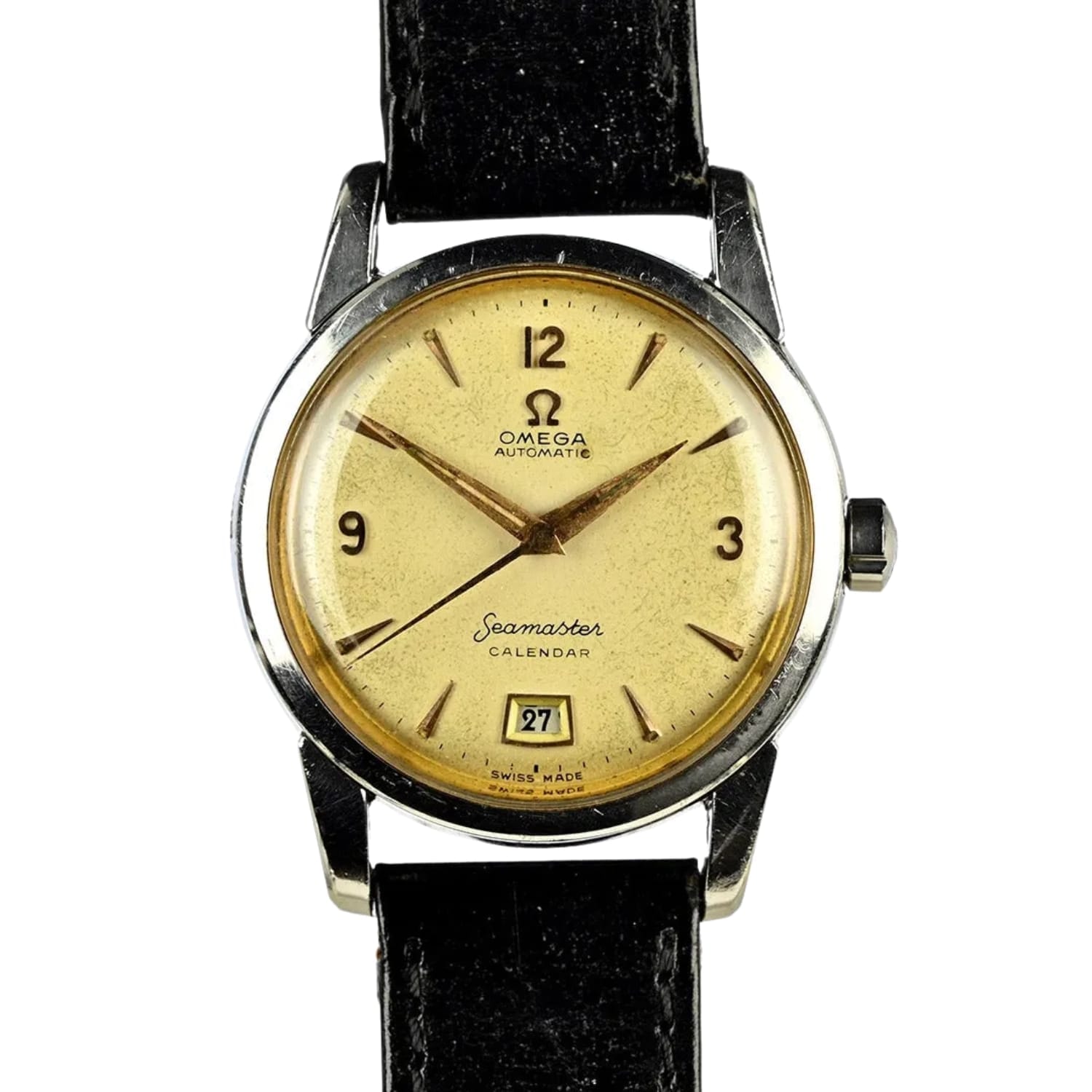
The Omega Seamaster Calendar reference 2757 stands as one of the final expressions of Omega’s celebrated bumper automatic technology, representing a critical juncture in Swiss watchmaking history. Produced during the mid-1950s when Omega was actively transitioning away from semi-rotor winding systems toward full 360-degree rotor movements, the 2757 captures the technical refinement of a mature technology at the moment of its obsolescence. For collectors interested in mid-century Omega production, this reference offers a compelling intersection of proven mechanical engineering, elegant dress watch proportions, and the distinctive tactile character that only bumper automatics can provide.
The 2757 functions primarily as a dress calendar watch, designed for professional men who required both water resistance and date functionality in an elegant package. Omega positioned this reference for what period marketing described as “the captain steering the ship, not the man diving into the water,” distinguishing it from the tool watch applications that would define the Seamaster line following the 1957 Professional Trilogy introduction. The watch combines Omega’s O-ring gasket sealing technology, pioneered for the original 1948 Seamaster, with the increasingly essential date complication that was transforming from luxury novelty to daily necessity throughout the 1950s. Among vintage Omega collectors and independent watchmakers, the 2757 maintains a reputation for mechanical robustness and serviceability, though finding original, unpolished examples requires patience and careful authentication.
Production volume for the 2757 reference remains undocumented by Omega, and no manufacturer-confirmed figures exist. Collector research based on serial number analysis and market observation suggests moderate production numbers compared to non-calendar Seamaster variants of the same era. The broader Caliber 355 bumper family, encompassing related references, saw over 1.3 million movements produced between 1943 and 1955, though the specific allocation to the 2757 case configuration cannot be determined with precision. Within the collector market, the 2757 is generally classified as uncommon rather than rare, with stainless steel examples appearing regularly at auction and through dealer inventory, while solid gold variants and certain dial configurations qualify as genuinely scarce. The reference’s relative availability compared to earlier Seamaster Calendar models like the 2627 reflects both healthy original production and strong survival rates attributable to the watch’s quality construction.
Collector demand for the 2757 remains stable with modest upward pressure on exceptional examples. The reference occupies a value tier below Omega’s more celebrated vintage pieces such as the Speedmaster Professional or Constellation “Pie-Pan” series, yet commands stronger interest than generic 1950s dress watches from secondary Swiss manufacturers. Specific variants attract meaningful premiums: solid 18K gold cases, honeycomb or waffle textured dials, and black dial configurations generate competitive bidding when properly authenticated. The designation “bumper” itself has become a collector touchstone, with enthusiasts specifically seeking this winding technology for its distinctive feel and historical significance. No widely recognized nicknames attach specifically to the 2757, though it is sometimes referenced within the broader “bumper Seamaster” or “Calendar bumper” collector categories.
Historical Context & Manufacturing Details
The Omega Seamaster Calendar reference 2757 arrived during a period of remarkable productivity and transition for the Omega brand. The early-to-mid 1950s represented Omega’s commercial peak relative to competitors including Rolex, with the Bienne manufacturer actually outselling its Geneva rival throughout much of the decade while simultaneously pursuing technical innovations that would reshape the industry. The 2757 emerged as Omega refined its automatic calendar offerings, building upon the foundation established by the preceding 2627 reference while the company’s engineering teams worked to develop the full-rotor movements that would render bumper technology obsolete within just a few years.
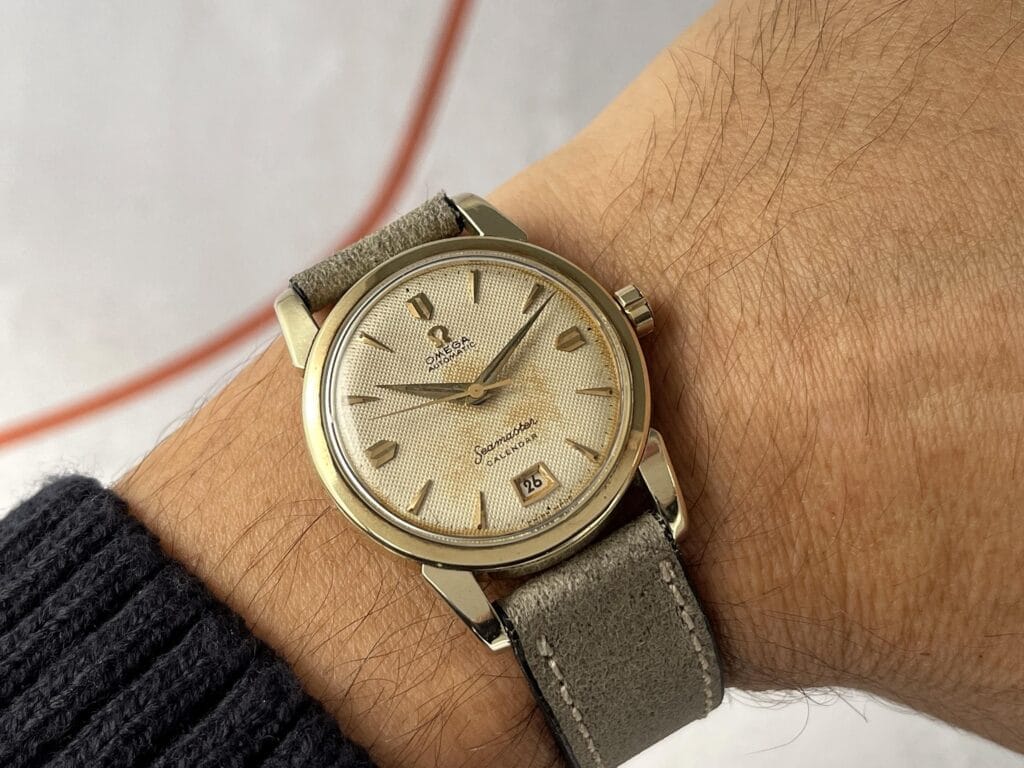
This period holds particular significance in horological history. The bumper automatic mechanism, developed because Rolex held patents on full 360-degree rotor winding until their expiration, created watches with a distinctive character that remains prized today. When the wearer moved, the semicircular rotor would swing approximately 120-130 degrees before striking buffer springs at each end of its travel, creating a subtle “ping-pong” sensation at the wrist. The 2757 represents the mature refinement of this technology, incorporating lessons learned across more than a decade of bumper production while the clock ran down on this entire approach to automatic winding. By 1955, Omega had introduced its Caliber 500 series with bidirectional full-rotor winding, and the 2757 became one of the final Seamaster Calendar references to carry forward the bumper tradition before the technology’s retirement.
Development History
Omega developed the 2757 as a direct evolution of the Seamaster Calendar reference 2627, which had introduced the calendar complication to the Seamaster line in the early 1950s. The 2627 featured a more distinctive case architecture with pronounced, sculptural lugs that gave the watch a substantial wrist presence despite its modest dimensions. The 2757 refined this design toward a more conventional aesthetic, adopting faceted or “lapidated” lugs that would become characteristic of later Seamaster production while maintaining the core proposition of a water-resistant automatic calendar watch suitable for professional wear.
The reference entered production in 1954, based on serial number evidence and period documentation, during a year when Omega also continued development of its revolutionary full-rotor movements. Production appears to have continued through approximately 1956-1957, with the reference discontinued as Omega consolidated its lineup around the new Caliber 500 series automatics and prepared for the landmark 1957 introduction of the Professional Trilogy: the Seamaster 300, Speedmaster, and Railmaster. These three references would fundamentally transform Omega’s identity from a broad-based watchmaker into a brand associated with specific tool watch applications, and the elegant dress-calendar positioning of the 2757 became less central to the company’s strategic direction.
The discontinuation reflected technological rather than commercial factors. The bumper mechanism, while reliable and well-refined by the mid-1950s, simply could not match the winding efficiency of full-rotor designs. Collectors should not interpret the 2757’s short production run as indicating commercial failure; rather, it represents the natural conclusion of a technology cycle that Omega had begun planning to supersede years earlier.
Manufacturing Context
Within Omega’s 1954-1957 product catalog, the Seamaster Calendar occupied a middle position between entry-level time-only Seamasters and the prestigious Constellation line that Omega had introduced in 1952 to showcase its chronometer-grade movements. The 2757 represented neither a flagship release nor a quiet catalog addition, but rather a steady evolution of an established successful product line addressing proven market demand for practical calendar complications combined with water resistance.
The reference introduced no technical firsts for Omega. The bumper automatic mechanism dated to the early 1940s, the calendar complication had appeared in the 2627, and the case construction followed established Seamaster principles. The 2757’s significance lies not in innovation but in refinement, representing the mature expression of accumulated manufacturing expertise applied to a proven formula. This positioning as an evolutionary rather than revolutionary product contributes to its relative accessibility in today’s collector market compared to references associated with specific technical breakthroughs or historical milestone events.
Production volumes, while undocumented precisely, appear to have been substantial enough to ensure reasonable availability today while remaining modest compared to Omega’s highest-volume references. The watch was offered across multiple case materials and dial configurations, indicating Omega’s expectation of broad market appeal rather than niche positioning.
Factory & Production Location
All 2757 production occurred at Omega’s manufacturing facilities in Bienne (Biel), Switzerland, where the company had been headquartered since its founding in the nineteenth century. The Caliber 355 movements were manufactured entirely in-house at Bienne, drawing on Omega’s vertically integrated production capabilities that encompassed everything from raw material processing through final assembly and quality control.
Case manufacturing for 1950s Omega production involved a network of specialized Swiss suppliers working to Omega’s specifications. While specific case manufacturer attribution for individual 2757 examples is not documented in available sources, the cases bear interior markings indicating Omega’s quality control and assembly, with reference numbers and material designations stamped into caseback interiors following standard Omega practice of the era.
Dial production similarly involved external specialist suppliers, with multiple dial contractors providing components to Omega’s specifications. This accounts for legitimate minor variations in dial typography and finishing observed across authenticated examples, as different suppliers produced dials that met Omega’s requirements while reflecting their individual production methods. Collectors should not interpret such minor variations as indicating inauthenticity, provided the overall dial characteristics fall within documented parameters for the reference and production period.
Horological Significance
The Omega Seamaster Calendar 2757 occupies a transitional position in horological history, bridging the bumper automatic era that characterized mid-century Swiss watchmaking with the full-rotor designs that would dominate subsequent decades. The reference cannot be classified as groundbreaking in the manner of the original 1948 Seamaster, which pioneered practical water resistance for dress watches, or the 1957 Speedmaster, which would eventually achieve lunar mission fame. Instead, the 2757 represents a workhorse reference that delivered reliable performance using proven technology during the technology’s final production years.
This transitional status carries specific collector implications. The 2757 offers access to bumper automatic technology, a mechanism many collectors prize for its distinctive tactile character and historical interest, in a package refined by more than a decade of continuous manufacturing improvement. The watch demonstrates what the bumper mechanism could achieve at full maturity before external competitive pressure (the availability of full-rotor alternatives) rendered further development impractical.
Within the Seamaster lineage specifically, the 2757 represents the final generation of calendar Seamasters using the original water-resistance philosophy established in 1948. The 1957 Professional Trilogy would redefine the Seamaster name around tool watch applications, higher water resistance ratings, and sport-oriented aesthetics. The 2757’s dress watch proportions and elegant finishing recall the Seamaster’s origins as a watch for “captains” rather than divers, preserving a character that the model line would largely abandon in subsequent decades.
Construction & Architecture
The Omega Seamaster Calendar 2757 presents a refined mid-century dress watch aesthetic characterized by balanced proportions, restrained elegance, and construction quality appropriate to Omega’s position as a leading Swiss manufacturer. The design language reflects the mature expression of Seamaster styling that had evolved since the line’s 1948 introduction, incorporating faceted lugs and polished surfaces that would influence subsequent Omega production while maintaining dimensions scaled for the smaller wrist preferences of the 1950s.
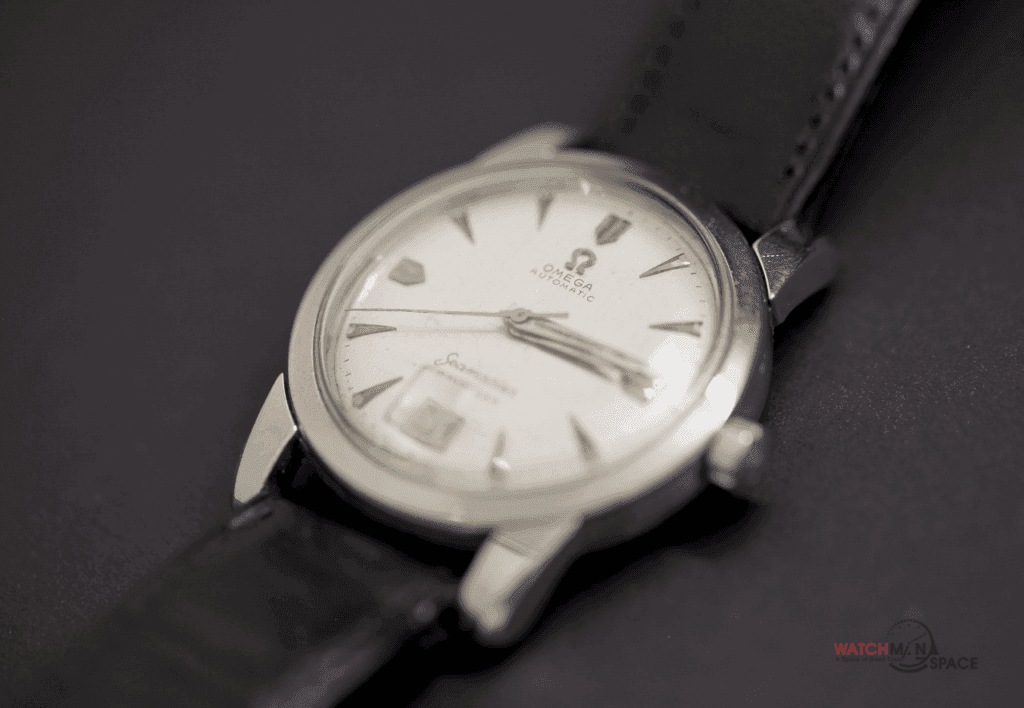
At a glance, the 2757 distinguishes itself through its date window positioned at 6 o’clock, maintaining dial symmetry in contrast to the 3 o’clock date position that Rolex had established with the Datejust. The faceted lugs catch light at multiple angles, providing visual interest that complements the applied hour markers without overwhelming the watch’s fundamentally conservative dress watch character. The overall impression is one of professional competence rather than flashy ostentation, consistent with Omega’s positioning of the Seamaster line for business and formal contexts.
Case Design
The 2757 case follows a three-piece construction typical of quality Swiss production from the era, with separate bezel, case middle, and caseback components assembled to create the complete case assembly. The case style positions firmly within dress watch territory, with dimensions and finishing appropriate for wear beneath shirt cuffs in professional environments rather than the tool watch robustness that would characterize later Seamaster production.
Case shape is round, with the faceted or “lapidated” lugs providing the primary design distinction from generic round cases of the period. These lugs feature angled surfaces that catch light at multiple planes, adding visual sophistication while maintaining the practical curve necessary for comfortable wrist wear. The lugs flow smoothly from the case middle, creating an integrated appearance rather than the bolt-on impression of some contemporary designs.
Case dimensions cluster around 34-35mm diameter excluding the crown, with total lug-to-lug length of 41-43mm. Thickness measures approximately 11mm, reflecting the height requirements of the bumper automatic movement with its date mechanism. Lug width standardizes at 18mm across variants, accommodating period-appropriate strap dimensions. These measurements place the 2757 at the larger end of 1950s dress watch sizing while remaining substantially smaller than modern standards, a consideration for collectors accustomed to contemporary proportions.
Case materials span the complete range of 1950s luxury options:
| Material | Sub-references | Notes |
|---|---|---|
| Stainless steel | 2757-3SC, 2757-6SC, 2757-9SC | Most common; press-fit caseback |
| Gold-capped (steel with gold top) | 2757-4SC, 2757-6SC variants | 80-micron gold plate over steel base |
| 14K solid gold | Various | Yellow and rose gold documented |
| 18K solid gold | Various | Yellow and pink/rose gold; typically screw-down caseback |
| Two-tone | Various | Steel with gold top components |
Case finishing combines polished and brushed surfaces, with the bezel and lug tops typically polished while case sides may show finer brushed finishing. Original finishing should show the hand-applied character of 1950s production rather than the machine uniformity of modern manufacturing, though distinguishing original finish from quality restoration requires experienced examination. Case production was outsourced to specialized Swiss case manufacturers working to Omega specifications, though specific supplier identification for individual pieces is not documented in available sources.
Dial Variations
Dial production for the 2757 encompassed multiple colors, textures, and configurations, creating meaningful variety for collectors seeking specific combinations. Understanding these variations aids both authentication and value assessment, as certain dial types command significant premiums over standard configurations.
Dial colors documented for the 2757 include silver or champagne tones (the most common), cream or eggshell (which develops honey-toned patina with age), white matte, and the rare black variants that attract particular collector interest. Dial materials follow period Omega practice, with lacquered brass bases and applied finishing creating the final appearance.
Dial textures provide important authentication and valuation information:
| Texture Type | Description | Collector Desirability |
|---|---|---|
| Smooth/Plain | Flat lacquered finish without surface texture | Standard; baseline value |
| Honeycomb/Waffle | Recessed geometric pattern creating textured surface | Highly desirable; 20-30% premium |
| Crosshair | Fine intersecting lines creating quadrant divisions | Desirable; moderate premium |
Hour markers on standard dials consist of applied gilt (gold-toned) arrowhead or “dart” indices, attached to the dial via hand-riveted feet visible from the dial’s reverse. These applied markers should show the dimensional presence and light-catching character of three-dimensional construction rather than the flat appearance of printed alternatives. Arabic numerals appear at 3, 9, and 12 o’clock positions on some dial variants, combined with dart indices at remaining hours.
Original dials feature radium-based luminous material applied to the hour marker dots, which has patinated over seven decades to cream, tan, or brown tones depending on environmental exposure. This patina should appear consistent across all lume applications on both dial and hands, with matching tone and aging character. Bright white or green luminous material indicates service replacement using modern compounds.
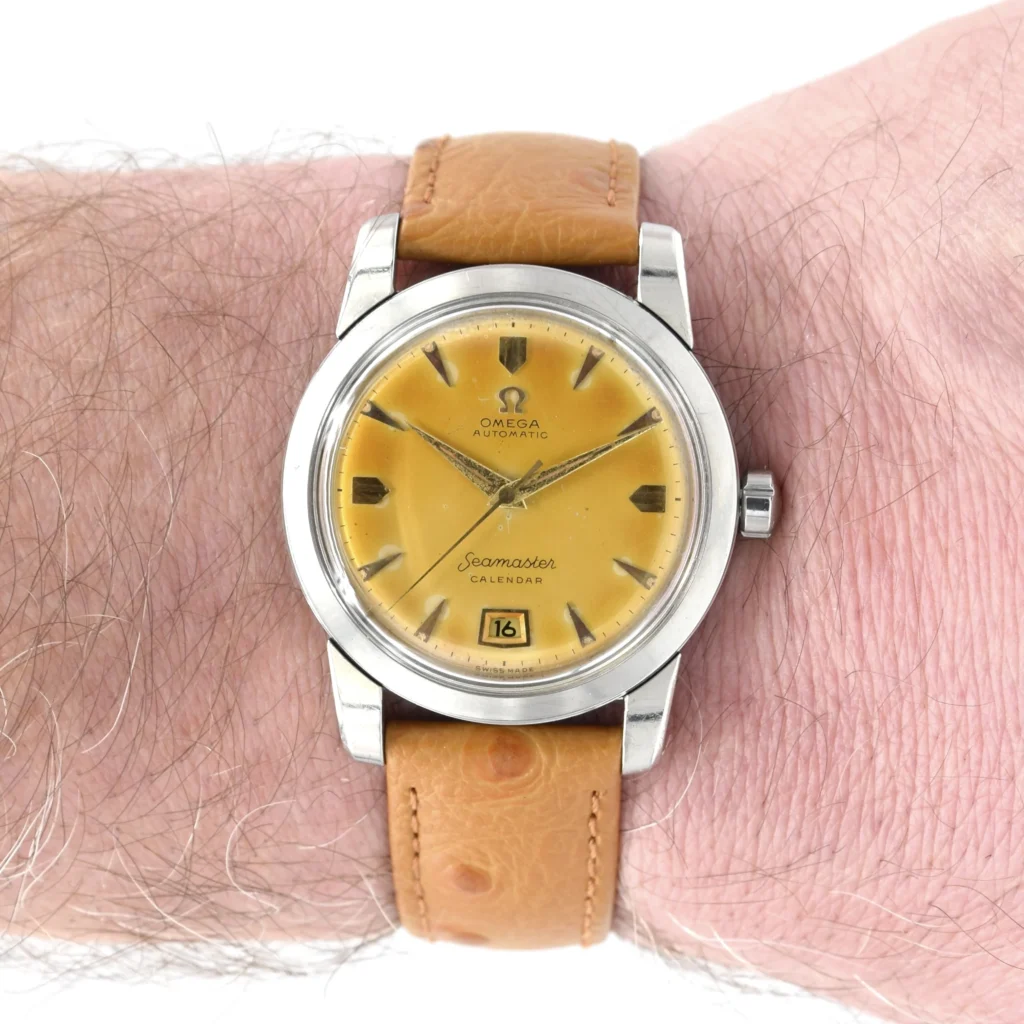
Dial text follows a standard hierarchy reading downward: applied Omega logo (the Greek letter Ω), “OMEGA” in capital letters, “Automatic,” “Seamaster,” and “Calendar,” with “Swiss Made” positioned above the 6 o’clock date window. An extremely rare variant displays “Calendar” text without “Seamaster,” representing one of the scarcest dial configurations known for this reference. Text printing should show the slight irregularities and ink density variations characteristic of period printing technology rather than the perfect uniformity of modern reproduction.
The date window at 6 o’clock maintains dial symmetry, a design choice distinguishing Omega calendar watches from the 3 o’clock Rolex convention. Window shape evolved during Seamaster Calendar production, with earlier examples (primarily the preceding 2627 reference) featuring rectangular four-sided apertures while later production including most 2757 examples adopted a semi-trapezoid shape. Date disc numerals should match the dial’s overall aesthetic, with black numerals on white disc being standard.
Service replacement dials represent a significant authentication concern. Indicators of non-original dials include: stick-style indices rather than shield or arrowhead shapes, brushed sunburst finishing (not used by Omega until later decades), overly uniform coloring lacking natural age patina, excessively crisp text printing inconsistent with stated age, and incorrect font styles or spacing in dial text. The dial back should bear dial maker codes and reference numbers consistent with documented Omega practice.
Hands
Hand configuration on the 2757 standardizes around dauphine-style hour and minute hands, characterized by their triangular profile with sharply tapered points and faceted surfaces that catch light from multiple angles. This hand style epitomizes mid-century dress watch aesthetics and remained standard across much of Omega’s 1950s calendar production.
Hand materials correspond to case and dial furniture metals. Stainless steel cases typically received silver-toned or rhodium-plated hands, gold-capped and solid gold cases received matching gold-toned hands (yellow or pink depending on case metal), and all hands featured polished finishing to maximize light reflection. The faceted dauphine profile creates changing reflections as the hands sweep across the dial, providing visual interest that complements the applied indices.
Luminous material application on hands matches the dial indices, with radium-based compound applied to the hand surfaces and patinated to matching cream or tan tones over decades. Original hands should show lume aging consistent with the dial markers; mismatched patina between hands and dial indicates service replacement of one component.
The seconds hand follows a simple straight design with luminous tip, providing continuous sweep seconds display through the center-mounted fourth wheel of the Caliber 355 movement. Some examples may show tapered or baton-style seconds hands rather than the more common straight configuration, reflecting production variation within Omega’s supply chain.
Hand proportions should match the dial diameter precisely, with the minute hand extending to the minute track and hour hand reaching appropriately toward but not overlapping the hour markers. Incorrect hand length indicates non-original replacement, as does excessive play or wobble in hand mounting.
Crown
Crown configuration on the 2757 follows the push-pull (non-screw-down) convention standard for dress watches of the period. The crown provides two positions: pushed in for normal running and pulled out for time setting, with date advancement requiring rotation of the hands through a full 24-hour cycle as the movement lacks quickset date functionality.
Crown style during the 2757’s production period featured Omega’s “Naiad” design, characterized by a cylindrical profile with the Omega logo applied to the crown face. Period-correct crowns for US market pieces may show the “clover” design as an alternative, while various signed and unsigned styles appeared across different markets and production batches. The crown should be signed with the Omega symbol on authenticated original examples, though unsigned crowns do appear on some period-correct pieces.
Crown material matches case metal on properly configured original watches: steel crowns on steel cases, gold crowns on gold cases. The crown connects to a two-piece stem assembly extending into the movement, with the split stem design allowing crown and case separation without movement removal.
Crown dimensions should appear proportionate to the case, neither oversized nor diminutive relative to the case diameter. Replacement crowns can often be identified by incorrect proportions, wrong logo style for the production period, or material mismatch with the case.
Service replacement crown part number 42023 appears on post-production Omega service replacements; while genuine Omega parts, these indicate the watch has received crown replacement since original manufacture. The “bowler hat” crown style represents another period-correct variant, particularly for certain market-specific configurations.
Crystal
The 2757 specification calls for hesalite (acrylic) crystal in a domed profile appropriate to the era. Hesalite remained the standard crystal material for quality Swiss watches throughout the 1950s and into the 1960s, with sapphire crystal adoption occurring significantly later. The domed profile follows the case curves, creating a smooth transition from bezel to crystal surface.
Hesalite offers specific advantages and limitations relevant to collectors. The material accepts scratches readily but these can be polished out using appropriate compounds, allowing surface restoration without replacement. Hesalite also provides superior shatter resistance compared to mineral or sapphire glass, reducing damage risk from impacts. However, the material lacks the scratch resistance of modern sapphire, requiring acceptance of surface wear as part of the vintage watch experience.
Original crystals from the 1950s production rarely survive seven decades of use without replacement, making crystal originality a low priority for most collectors compared to dial and case components. Replacement with correct-specification hesalite represents acceptable restoration practice, while mineral glass or sapphire replacements would be considered inappropriate modifications for a watch presented as original-specification.
Some original hesalite crystals bear a tiny etched Omega logo visible only under close magnification, typically positioned near the crystal edge. This marking provides one authentication point for original crystal survival, though its absence does not necessarily indicate replacement given the marking’s inconsistent application.
Bracelet & Strap Options
The Omega Seamaster Calendar 2757 was primarily sold with leather straps rather than metal bracelets, reflecting its dress watch positioning and the general scarcity of integrated bracelet designs in 1950s production. Original strap configurations utilized two-piece leather straps in colors including black, brown, and occasionally grey, with 18mm width at the lugs tapering appropriately toward the buckle.
Original buckles bear the Omega signature, with material matching the case metal. Period-correct buckles feature a rectangular profile with “OMEGA” text; the square-logo buckle design familiar from later decades represents 1970s production and would not be period-correct for 1950s pieces. Buckle survival on vintage pieces is uncommon, and many examples now wear non-original or generic buckles.
Metal bracelet options during the 2757’s production period were limited, though some examples may have been fitted with period mesh or beads-of-rice style bracelets, either as original dealer configurations or subsequent owner additions. No integrated bracelet design specific to the 2757 reference has been documented, distinguishing this dress watch from sport-oriented references where bracelet identity carries greater importance.
For collectors seeking to configure a 2757 appropriately, high-quality leather straps in period-appropriate colors with correctly signed Omega buckles represent the most authentic presentation. Modern aftermarket straps of appropriate width and quality provide acceptable alternatives for daily wear, with original buckles (when available) adding authenticity value.
Sub-Reference Summary Table
| Sub-Reference | Case Material | Typical Dial | Caseback | Notes |
|---|---|---|---|---|
| 2757-1SC | Steel or gold shell | Various | Snap or screw | Early production; heavy sloped lugs |
| 2757-3SC | Stainless steel | Silver/champagne | Snap-on (press fit) | Most common variant |
| 2757-4SC | Gold-filled/two-tone | Various | Snap-on | Gold top over steel |
| 2757-5SC | Various | Various | Various | Limited documentation |
| 2757-6SC | Gold-capped (14K/80 micron) | Often waffle/honeycomb | Snap-on | Desirable collector variant |
| 2757-9SC | Stainless steel | Various | Snap-on | Later production |
| Solid gold variants | 14K or 18K yellow/pink | Material-matched | Often screw-down | Premium variants |
Reference Key, Variations & Sub-References
Understanding Omega’s reference numbering system and the variations that occurred across the 2757’s production run provides essential knowledge for collectors evaluating potential acquisitions. The ability to decode reference numbers, recognize legitimate production variations, and identify correct component pairings distinguishes informed collectors from those vulnerable to misrepresented or incorrectly assembled pieces. This section details the systematic approach to 2757 identification and variant classification.
The 2757 reference encompasses multiple sub-variants distinguished by case material, caseback configuration, and other specification differences encoded in the full reference designation. Additionally, the reference’s production period spanning several years creates “Mark” variations where identical sub-references show evolutionary changes in dial, hand, or other component specifications. Collectors must navigate both the official sub-reference system and these production-run variations to accurately identify and authenticate specific examples.
Taxonomy & Nomenclature Decoding
Omega’s reference numbering system during the 1950s followed conventions that encoded specific information within the alphanumeric designation. Understanding this system allows collectors to decode reference numbers and understand what specifications should accompany specific designations.
The base reference “2757” identifies the fundamental case and model configuration, establishing this as a Seamaster Calendar model using the designated case design. The number itself serves as an internal Omega identification code without digit-by-digit encoded meaning in the manner of some later manufacturer systems.
The suffix system carries greater informational content:
| Suffix Component | Meaning |
|---|---|
| Numeric suffix (1, 3, 4, 5, 6, 9) | Case material/configuration variant |
| “SC” | Seconde Centrale (center/sweep seconds) |
The numeric suffix immediately following 2757 designates the specific case variant, with different numbers indicating different materials or construction specifications. Collectors should note that the suffix numbering does not follow a strictly sequential or intuitive pattern; rather, each number represents a specific Omega-assigned designation for a particular configuration.
The “SC” suffix, standing for “Seconde Centrale,” indicates the watch features center-mounted sweep seconds rather than small seconds at a subsidiary dial. Virtually all 2757 examples bear this suffix, as the Caliber 355 movement provided center seconds as standard.
Full reference designations appear stamped on caseback interiors, providing the primary identification point for sub-reference determination. The complete reference number (for example, “2757-3 SC” with space formatting varying) confirms the specific variant, while partial markings or absent reference stamps raise authentication questions.
Omega’s reference numbering conventions evolved over subsequent decades, with later production adopting more systematic encoding of case materials and other specifications directly within the reference number structure. The 2757-era system represents transitional practice between early less-systematic approaches and later more-comprehensive encoding.
The Mark (MK) System
The collector community has developed the “Mark” classification system to distinguish production variations within identical reference numbers. This system acknowledges that watches produced under the same reference designation across multiple years may show evolutionary changes in dial design, hand style, and other components, creating distinct variants that the official reference number does not differentiate.
For the 2757, Mark classifications primarily address dial variations:
| Mark Designation | Period | Distinguishing Characteristics |
|---|---|---|
| MK1 | Early production (1954-1955) | May show characteristics transitional from 2627 |
| MK2 | Mid-production (1955-1956) | Standard production characteristics |
| MK3 | Late production (1956-1957) | May show characteristics prefiguring successor references |
Specific dial characteristics that vary across production include text font weights, logo sizing, text spacing, and date window shape. The semi-trapezoid date window represents later production, while earlier examples may show more rectangular apertures. Applied index design shows subtle variation in arrowhead proportions and attachment methods across the production run.
It is important to note that Mark designations represent collector-developed classification rather than official Omega terminology. Different sources may apply Mark numbers somewhat differently, and the system provides general guidance rather than definitive authentication criteria. Collectors should focus on understanding the underlying component variations rather than treating Mark numbers as absolute categories.
Bezel variations are minimal for the 2757 given its fixed smooth bezel design, eliminating the bezel insert evolution tracking relevant to sport watch references. Hand and index lume plot sizing remained generally consistent, though minor variations in radium application volume occurred within normal production tolerances.
Sub-References & Transitional Models
The boundaries between reference designations and production periods create gray areas where transitional characteristics appear. The 2757’s position as successor to the 2627 and predecessor to later Seamaster Calendar references produces specific transitional considerations.
Some early 2757 cases may house Caliber 353 movements rather than the Caliber 355 normally associated with this reference. The 353 represents the earlier calendar bumper movement typically fitted to the 2627 reference. Such movement/case combinations likely represent either early transitional production before 355 supply ramped fully, or service replacements where available 353 movements were fitted to 2757 cases. These combinations do not inherently indicate “Franken” assembly if the movement is otherwise correct to the production era, though they represent non-standard configurations that may affect value assessment.
The distinction between factory anomalies and aftermarket modifications requires careful evaluation:
Legitimate factory variations include minor dial text variations reflecting different dial suppliers, slightly different hand proportions within tolerance ranges, and non-standard material combinations documented across authenticated examples.
Aftermarket modifications reducing value include: service replacement dials with incorrect specifications, non-original hand sets, case marriages (movement from one watch fitted to case from another), and refinished or modified case components.
Service parts present particular authentication challenges. Omega provided service replacement components throughout the decades following original production, and these genuine Omega parts may differ from original-specification components. A service replacement dial fitted in 1975 might be a genuine Omega part installed by an authorized service center, yet represent different specifications than the original 1955 dial. Collectors must decide their tolerance for period service parts versus insistence on original-specification components.
Case & Component Codes
Internal markings on case components provide critical authentication information beyond the visible exterior. Collectors evaluating 2757 examples should examine these markings carefully when caseback access is possible.
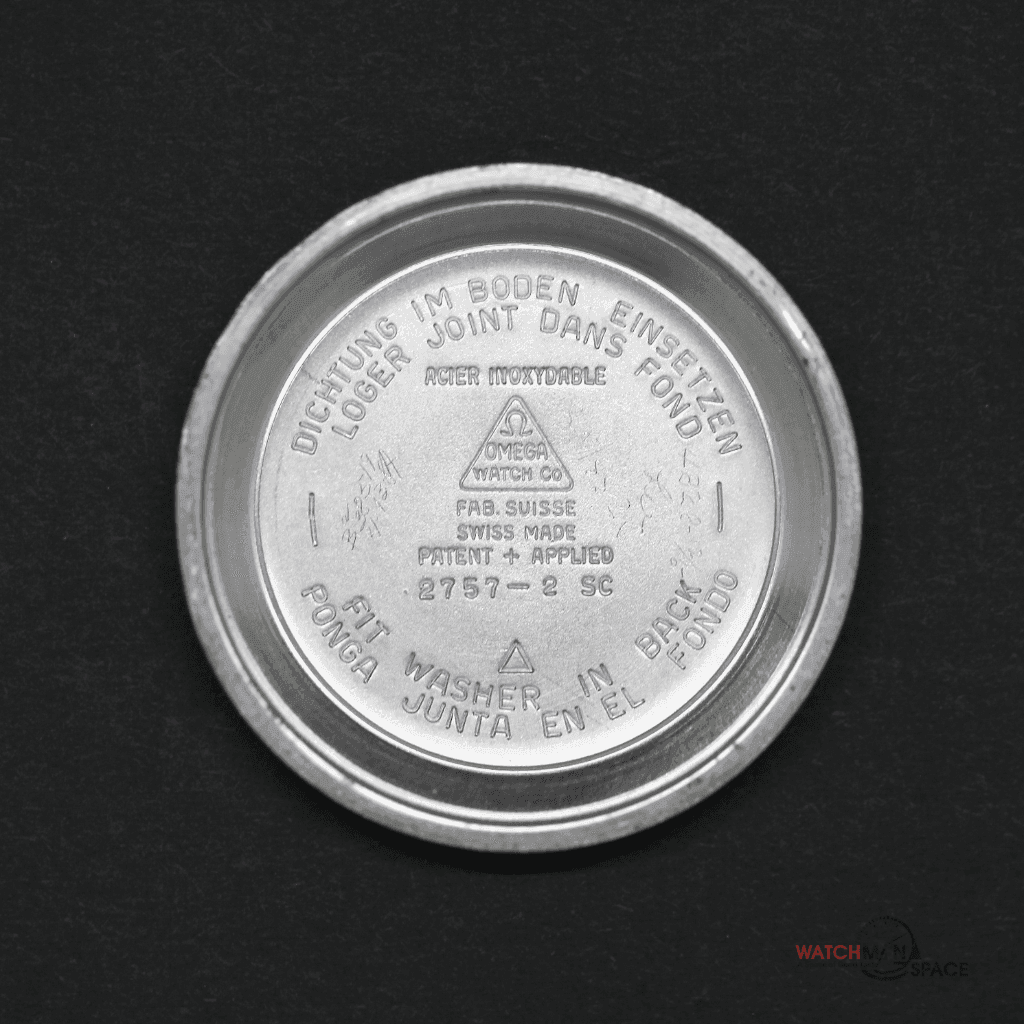
Caseback interior markings on authentic 2757 examples include:
| Marking Type | Content |
|---|---|
| Reference number | Full reference (e.g., “2757-3 SC”) |
| Omega stamps | “OMEGA WATCH CO” in triangle frame |
| Origin marking | “FAB SUISSE” or “SWISS MADE” |
| Material designation | “ACIER INOXYDABLE” (stainless steel) or gold hallmarks |
| Water resistance | “WATERPROOF” on some examples |
| Service instruction | “FIT WASHER IN BACK” on press-fit casebacks |
Caseback exterior markings on the 2757 notably lack the Hippocampus seahorse emblem that became standard Seamaster identification from late 1957 onward. Any 2757 displaying the Hippocampus caseback has received a replacement caseback from later production, indicating the watch is not in original configuration regardless of other component authenticity. This represents one of the clearest authentication markers for the 2757 and related pre-1958 Seamaster references.
Between-the-lugs stampings on case middles provide additional reference confirmation, with the reference number often stamped in this location alongside case serial numbers. These stampings may require cleaning to read clearly on watches with accumulated debris in lug recesses.
Movement serial numbers should correlate appropriately with case serial numbers and stated production period. Omega serial number databases allow approximate dating of both case and movement serials, and significant discrepancies between these dates indicate potential case marriages or other non-original configurations. Matching precision within two to three years of production is generally considered acceptable given manufacturing batch variations and inventory timing.
Material & Production Batches
Material specifications and batch-specific characteristics create additional variation layers within the 2757 production run.
Case materials beyond the basic steel/gold distinction show period-specific characteristics. Stainless steel cases from 1950s production predate the adoption of 904L steel that Rolex would later make famous; Omega utilized standard 316L-type surgical stainless steel appropriate to the era. Gold-capped cases feature 80-micron gold thickness over steel bases, substantial plating that holds up well when unpolished but shows steel breakthrough when aggressively refinished.
Solid gold cases appear in multiple alloy specifications. Rose gold or pink gold (18K and 14K documented) provides the warm-toned appearance prized by collectors, while yellow gold offers the traditional luxury gold aesthetic. White gold examples are not documented for the 2757 reference. Gold purity hallmarks on case interiors confirm specific alloy specifications.
Certain production batches have developed reputations for specific aging characteristics, though documented batch-specific traits are less pronounced for the 2757 than for some other vintage references. “Tropical” dials where the original color has transformed through sun exposure or chemical reaction appear occasionally, with brown or cognac-toned examples attracting collector interest when the transformation appears natural and even. “Spider” dial cracking from lacquer degradation occurs on some examples, with collector reception varying from rejection (when severe) to appreciation (when subtle and aesthetically pleasing).
These aging characteristics result from manufacturing-era material properties, storage conditions, and environmental exposure rather than intentional design, making their prediction or reproduction effectively impossible. Collectors should evaluate aged dials individually based on aesthetic appeal and overall condition rather than assuming any specific patina automatically adds value.
Movements & Calibers
The Omega Seamaster Calendar 2757 draws its mechanical character from the Caliber 355, the final and most refined expression of Omega’s 28.1mm bumper automatic movement family with calendar complication. This movement represents the culmination of over a decade of continuous development in semi-rotor automatic winding technology, achieving a level of reliability and refinement that continues to serve collectors seven decades after production ceased. Understanding the 355’s specifications, characteristics, and identification markers provides essential knowledge for 2757 collectors.
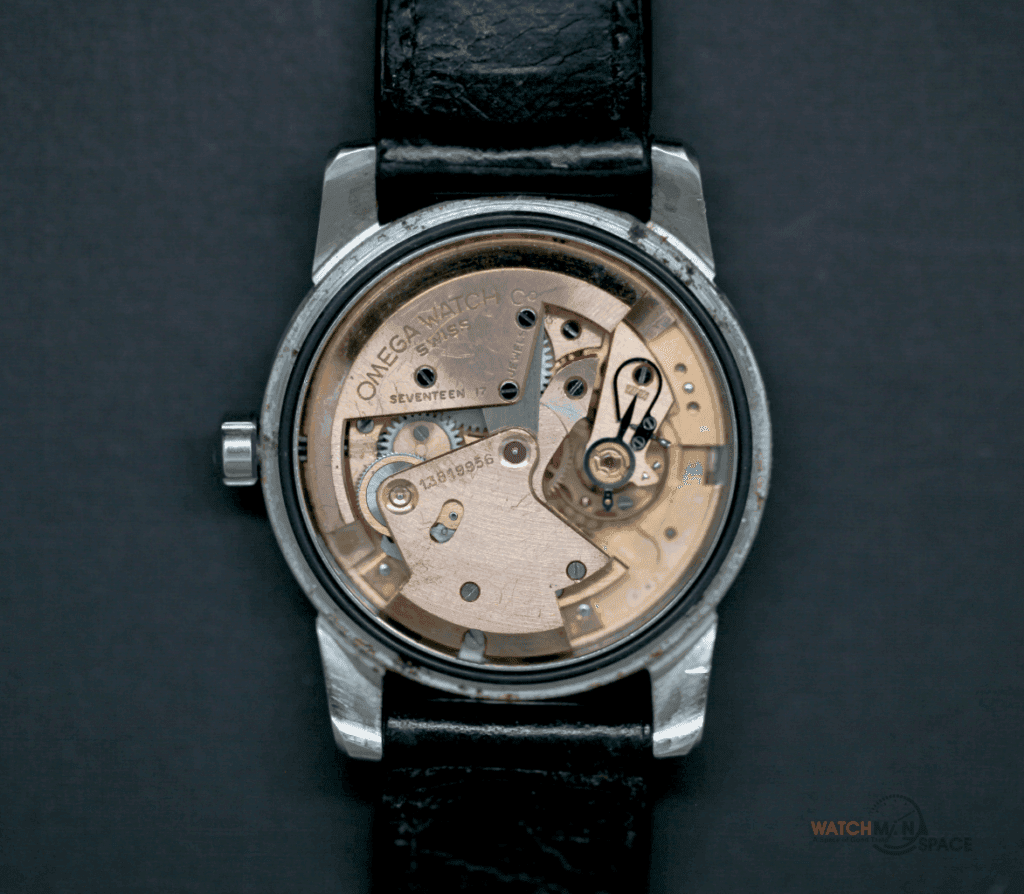
The movement history of the 2757 is relatively straightforward compared to references that underwent multiple caliber changes during production. The Caliber 355 served as the standard movement throughout the 2757’s production run, though early transitional examples may house the preceding Caliber 353 in configurations that likely represent either early production or service replacement.
Caliber Overview & Production Periods
The Caliber 355 powered the 2757 throughout its primary production period from 1954 through approximately 1956-1957. This movement evolved directly from the Caliber 354, adding the calendar mechanism to the time-only base, while the 354 itself derived from earlier 28.1mm bumper movements stretching back to the pioneering Caliber 28.10 introduced in 1943.
| Caliber | Period in 2757 | Origin | Notes |
|---|---|---|---|
| Caliber 355 | 1954-1957 (primary) | Omega in-house, Bienne | Standard specification movement |
| Caliber 353 | Early examples, service | Omega in-house, Bienne | Predecessor caliber; transitional/service use |
Both calibers were manufactured entirely in-house at Omega’s Bienne facilities, representing the brand’s complete vertical integration of movement production during this period. The transition from 353 to 355 occurred during the early 1950s, with the 355 incorporating refinements including the swan-neck micrometer regulator carried over from the 354.
The reason for caliber evolution within the broader bumper family reflected Omega’s continuous improvement philosophy rather than any deficiency in earlier designs. Each successive caliber incorporated manufacturing refinements and minor specification improvements while maintaining fundamental compatibility within the 28.1mm bumper architecture.
Technical Specifications
| Specification | Caliber 355 |
|---|---|
| Movement type | Automatic (bumper/semi-rotor) |
| Winding direction | Unidirectional |
| Diameter | 28.1mm |
| Height | 6.1mm |
| Jewel count | 17 |
| Frequency | 19,800 beats per hour (2.75 Hz) |
| Power reserve | Approximately 42 hours |
| Balance type | Monometallic |
| Balance spring | Self-compensating flat spring |
| Shock protection | Incabloc |
| Regulator | Swan-neck micrometer |
| Winding mechanism | Bumper rotor with buffer springs |
The bumper automatic winding system distinguishes the 355 from both manual-wind calibers and later full-rotor automatics. The oscillating weight (rotor) swings through approximately 120-130 degrees of arc before striking buffer springs at each travel limit, reversing direction to swing back through the arc. This semi-rotational motion winds the mainspring through a ratchet mechanism, with the “bumping” sensation at travel limits creating the tactile character that gives these movements their collector nickname.
The 19,800 beat-per-hour frequency (2.75 Hz) represents the standard rate for the era, providing adequate timekeeping precision while maintaining practical power reserve. Later decades would see frequency increases to 21,600 and 28,800 bph as escapement technology advanced, but 19,800 bph remained the mainstream specification through the 1950s.
Power reserve of approximately 42 hours provided practical all-day reliability with overnight reserve, ensuring the watch would continue running if removed at bedtime and not worn until the following morning. This specification compares favorably with contemporary competitors and remains adequate for practical daily wear today.
Key Features & Complications
The Caliber 355’s primary complication consists of the date display mechanism, showing the date through an aperture at 6 o’clock on the dial. The date advances once daily at midnight, driven by a 24-hour wheel that triggers the date ring advancement.
The date mechanism lacks quickset functionality, meaning date correction requires rotating the hands through a complete 24-hour cycle for each day of advancement needed. This limitation, common to the era, creates practical inconvenience at month-ends requiring date correction but represents period-correct specification rather than deficiency.
| Feature | Caliber 355 Status |
|---|---|
| Hacking (stop-seconds) | Not present |
| Quickset date | Not present |
| Date display | Window at 6 o’clock |
| Manual winding capability | Present |
| Chronometer certification | Not standard; some examples certified |
The 355 does not include hacking functionality, meaning the seconds hand continues running when the crown is pulled to the time-setting position. This prevents precise second-synchronization but was standard practice for the era and should not be considered a deficiency in vintage context.
Manual winding capability supplements the automatic system, allowing wearers to wind the mainspring directly through crown rotation when the watch has stopped or when wrist motion is insufficient for automatic winding. This feature proves practically valuable, as bumper automatics generally achieve lower winding efficiency than full-rotor designs and may benefit from occasional manual supplementation.
While the 355 was not produced as a chronometer-specification movement by default, some examples received chronometer certification through official Swiss testing. These certified examples represent a small minority of production and may command modest premiums when accompanied by original certification documentation.
Caliber Evolution & Variants
The Caliber 355 represents the terminal development of Omega’s 28.1mm bumper calendar movement lineage. Understanding this evolutionary context illuminates the movement’s capabilities and historical significance.
The lineage traces back through:
| Caliber | Introduction | Description |
|---|---|---|
| 28.10 | 1943 | First Omega automatic; base bumper design |
| 330-series | Late 1940s | Refined bumper family |
| 350 | Early 1950s | Enhanced bumper with improvements |
| 353 | Early 1950s | Calendar version of 350-series base |
| 354 | 1952-1953 | Non-calendar with swan-neck regulator |
| 355 | 1953-1957 | Calendar version with swan-neck regulator |
The progression from 353 to 355 primarily incorporated the swan-neck micrometer regulator from the 354, providing finer timing adjustment capability. Other refinements addressed manufacturing efficiency and component durability without fundamentally altering the movement’s architecture or specifications.
Sub-variants of the 355 itself are minimal, with production maintaining consistent specifications throughout the caliber’s manufacturing period. Finishing quality remained constant at the level appropriate to Omega’s positioning, with copper-colored plates, straight-line bridges, and functional decoration executed to consistent standards.
The broader 28.10 bumper family encompassing all related calibers achieved total production exceeding 1.3 million movements between 1943 and 1955, ensuring reasonable parts availability for service and restoration today despite the technology’s long obsolescence. This production volume distinguishes the Omega bumper family from more esoteric automatic mechanisms where parts scarcity creates practical ownership challenges.
Movement Markings & Identification
Proper movement identification requires examination of specific markings stamped or engraved on movement components. These markings provide authentication evidence and dating information essential for evaluating 2757 examples.
| Marking Location | Content | Notes |
|---|---|---|
| Bridge/plate surface | “OMEGA” | Brand identification |
| Bridge/plate surface | Caliber number (355) | Movement identification |
| Bridge/plate surface | Movement serial number | Dating and authentication |
| Under balance cock | Additional caliber stamps | Confirms identification |
| Adjustment markings | Varies | Certification or adjustment history |
The movement serial number appears stamped on the bridge visible when the caseback is removed, typically near the winding mechanism. This serial number allows dating through Omega serial number databases and should correlate appropriately with case serial numbers and stated production period.
Caliber identification stamps appear in multiple locations, with “355” or “Caliber 355” markings confirming the movement type. The caliber stamp position under the balance cock requires partial disassembly to view and is generally verified only during service or detailed inspection.
Service history may be evidenced through additional markings added by watchmakers during past servicing. While such markings indicate the movement has been opened and worked on, they do not necessarily reduce value and may provide useful service history information.
When examining movement authenticity, collectors should verify that all visible components show consistent age, wear patterns, and finishing characteristics. Replaced parts may show different finishing quality, modern materials, or wear inconsistent with other components. Complete movement replacement with units salvaged from other watches represents a more serious authenticity issue, requiring verification that the movement serial number is consistent with the case serial number and reference designation.
Authentication Guide
Evaluating Omega Seamaster Calendar 2757 examples requires systematic examination of multiple components to establish originality and correct specification. The vintage watch market includes refinished parts, service replacements, aftermarket modifications, and deliberate misrepresentation, making informed authentication essential for collectors seeking original or correctly restored examples. This section provides comprehensive guidance for evaluating 2757 authenticity across all major components.
Authentication demands a holistic approach evaluating multiple touchpoints simultaneously. A watch with one incorrect component may still be substantially original with acceptable restoration; a watch with multiple incorrect components likely represents a compromised example regardless of any individual component’s quality. Collectors should assess the totality of evidence rather than accepting or rejecting based on any single authentication marker.
Dial Authentication
Dial evaluation represents the most critical authentication task for 2757 assessment, as the dial most significantly impacts visual presentation and value while being the component most frequently refinished, replaced, or misrepresented.
Correct dial characteristics for the 2757:
Period-correct dials display matte silver, cream, or champagne coloring, with lacquered finish showing appropriate age characteristics. Textured variants include honeycomb/waffle patterns with geometric recessed surfaces and crosshair patterns with intersecting lines. All original dials show the dimensional, hand-applied character of 1950s manufacturing rather than the perfect uniformity of modern production.
The “OMEGA” text and applied Ω logo should appear at 12 o’clock, positioned with spacing consistent across authenticated examples. Subsequent text lines reading “Automatic,” “Seamaster,” and “Calendar” appear in descending order, with “Swiss Made” positioned above the 6 o’clock date window. Text printing should show the subtle irregularities of period silk-screen or pad printing technology.
Applied indices feature arrowhead or dart shapes, attached via hand-riveted feet visible from the dial rear. These indices should show dimensional presence with proper light-catching characteristics, not flat painted or printed appearance. Luminous material (radium-based, patinated to cream or tan) appears in consistent applications across all indices.
Signs of refinished or replacement dials:
| Indicator | Description | Authentication Implication |
|---|---|---|
| Brushed sunburst finish | Radial brushing lines visible | Not period-correct; Omega adopted this later |
| Stick indices | Thin straight markers rather than shields/arrows | Indicates service replacement dial |
| Overly uniform color | Lacking age variation, perfectly even tone | Suggests refinishing or modern production |
| Crisp text printing | Excessively sharp, perfect text | Inconsistent with 70-year age |
| Modern lume | Bright white or green luminous material | Indicates modern replacement material |
| Incorrect fonts | Wrong typeface or spacing | Non-original dial |
The dial back (visible only when dial is removed from case) should bear dial maker codes and Omega reference numbers consistent with the reference and production period. Absence of these markings, or presence of incorrect codes, indicates potential authenticity issues.
Font & Logo Authentication
Typography and logo details provide authentication evidence requiring careful examination, as counterfeits and refinished dials often fail to replicate period-correct fonts precisely.
The Omega logo (Ω symbol) should appear in applied form at 12 o’clock, with three-dimensional presence and appropriate proportion relative to dial diameter. Logo size evolved across Omega production periods; 2757-period logos show specific proportions that differ from earlier and later variants. The logo should show age-appropriate wear and patina consistent with applied indices.
“OMEGA” text beneath the logo should appear in capital letters with correct spacing and font weight. Multiple dial suppliers served Omega during the 2757 production period, creating legitimate minor font variations; however, all authentic variants share fundamental characteristics distinguishing them from modern reproduction attempts.
The “Seamaster” text sometimes appears in a distinctive script font; authentication requires familiarity with the specific typeface characteristics including letter proportions, serifs (if present), and baseline alignment. The letter “t” configuration within “Seamaster” provides one authentication checkpoint noted by experienced collectors.
“Swiss Made” text positioning and font should match documented examples, with the text located above the 6 o’clock date window. Variations in “Swiss Made” terminology (versus “Swiss” alone, or other formulations) carry dating implications, though all standard variations may appear on authentic 2757 dials depending on production batch and market destination.
Hands Authentication
Hand authentication evaluates style correctness, material appropriateness, and luminous material condition. Original hands should match the dial in aging characteristics, material quality, and overall aesthetic.
Correct hands configuration:
Dauphine-style hour and minute hands with triangular profile and faceted surfaces represent the standard 2757 specification. Hand material should match dial furniture: silver-toned for steel cases, gold-toned (yellow or pink) for corresponding gold cases. All hand surfaces should show polished finishing with light-catching faceted profiles.
Luminous material on hands should match dial index lume in patina color and aging characteristics. Original radium-based lume has patinated to cream, tan, or light brown tones over seven decades; this patina should appear consistent between hands and dial. Mismatched lume tones between hands and dial indicate replacement of one component, reducing originality assessment.
The seconds hand follows a straight or slightly tapered design, extending appropriately toward the seconds track without excessive overlap or shortfall.
Signs of replacement hands:
| Indicator | Description |
|---|---|
| Mismatched lume color | Hands and dial show different patina tones |
| Wrong style | Baton, sword, or other non-dauphine styles |
| Incorrect proportions | Length mismatch with dial dimensions |
| Modern lume | Bright white or green material on hands |
| Wrong material | Steel hands on gold case or vice versa |
| Poor finishing | Brushed rather than polished surfaces |
Crown Authentication
Crown evaluation addresses style correctness, logo authenticity, material matching, and functional condition. The crown, being a frequently replaced service item, often represents non-original componentry even on otherwise authentic watches.
Period-correct crown characteristics:
The standard 2757 crown follows Omega’s “Naiad” design with cylindrical profile and applied Omega logo on the crown face. Crown diameter should appear proportionate to the case. Material should match case metal. The crown should function smoothly in both pushed and pulled positions without excessive play or binding.
Alternative period-correct styles include the “clover” design on certain market-specific variants and the “bowler hat” profile noted on some US market pieces. Unsigned crowns (lacking Omega logo) appear on some period-correct examples, though signed crowns represent the standard specification.
Signs of replacement crowns:
Later Omega service replacement crowns (part number 42023 and successors) represent genuine Omega parts but indicate post-production service. While not reducing authenticity to the same degree as aftermarket parts, these service crowns indicate the watch is not in as-delivered original configuration.
Generic unsigned crowns without Omega provenance, crowns with incorrect logo styles for the production period, and crowns with obviously wrong proportions all indicate replacement. Non-Omega crowns do not necessarily indicate broader authenticity issues but should be factored into originality assessment and value determination.
Case Authentication
Case evaluation addresses external styling, dimensional correctness, internal markings, and condition characteristics including evidence of past refinishing.
Correct case characteristics:
Case shape should match documented 2757 specifications with round profile, faceted lugs, and three-piece construction. Dimensions should fall within the 34-35mm diameter range with 18mm lug width. The case should show the hand-finished character of 1950s Swiss production.
Case finishing combines polished and brushed surfaces in patterns consistent across authenticated examples. Importantly, the 2757 predates the Hippocampus seahorse emblem introduced on Seamasters from late 1957; casebacks should display text markings only, without the seahorse medallion. Any 2757 with Hippocampus caseback has received a replacement caseback and is not in original configuration.
Caseback interior markings should include the complete reference number (e.g., “2757-3 SC”), Omega identification stamps (often in triangular frames), material designations, and production codes. The specific format and positioning of these markings should match documented examples.
Between-the-lugs stampings on the case middle should show the reference number and/or case serial number, though these may require cleaning to read clearly.
Signs of case issues:
| Indicator | Description | Implication |
|---|---|---|
| Hippocampus caseback | Seahorse emblem present | Post-1957 replacement caseback |
| Soft edges | Rounded case edges lacking crispness | Evidence of aggressive polishing |
| Thin lugs | Lugs narrower than original specification | Material loss from polishing |
| Missing markings | Absent or illegible interior stamps | Potential authenticity issue |
| Wrong proportions | Dimensions outside specification | Wrong case or significant modification |
Case polishing represents a particular concern for vintage watches. Some polishing during service is normal and acceptable; aggressive polishing that removes significant material, rounds case edges, or thins lugs substantially reduces collector value and may indicate attempts to remove damage or disguise case replacement.
Bezel Authentication
The 2757 features a fixed, smooth polished bezel without rotating function or removable insert. This simplifies bezel authentication compared to sport watch references with rotating bezels and replaceable inserts.
Correct bezel characteristics:
The bezel should present a smooth, polished surface integrated with the case construction. Bezel proportions should match the case, creating a balanced visual relationship with dial and crystal. No functional rotation should be present, as the bezel is fixed in position.
Signs of bezel issues:
| Indicator | Implication |
|---|---|
| Visible seam or insert | Wrong reference or modified bezel |
| Rotating function | Wrong reference; 2757 has fixed bezel |
| Dimension mismatch | Possible replacement or wrong case |
| Surface damage | May indicate abuse or attempted modification |
The fixed bezel design makes bezel authentication relatively straightforward compared to references with rotating bezels, eliminating concerns about insert originality, fade characteristics, and click mechanism condition that complicate authentication for tool watches.
Authentication Red Flags Summary
The following indicators, particularly in combination, suggest significant authenticity concerns requiring careful evaluation before acquisition:
| Red Flag | Severity | Notes |
|---|---|---|
| Hippocampus caseback | High | Definitively incorrect for 2757 |
| Brushed sunburst dial | High | Not period-correct finish |
| Stick indices | High | Indicates service replacement dial |
| Mismatched serial numbers | High | Movement/case date mismatch beyond 3 years |
| Modern luminous material | Medium-High | Indicates replacement components |
| Missing caseback markings | Medium | May indicate replacement or refinish |
| Generic crown | Medium | Service replacement acceptable but noted |
| Inconsistent patina | Medium | Components may be from different watches |
| Soft case edges | Medium | Evidence of aggressive polishing |
| Wrong hand style | Medium | Indicates replacement hands |
Multiple red flags appearing on a single watch compound the likelihood of significant authenticity issues. While some indicators (generic crown, for example) may be acceptable if other components authenticate correctly, the accumulation of multiple concerns should prompt serious evaluation of whether the watch represents a genuine example worth the asking price.
Wearability & Collector Standing
The Omega Seamaster Calendar 2757 presents a particular wearing experience shaped by its 1950s proportions, bumper automatic mechanism, and dress watch design language. Understanding how this reference translates to modern wrist wear, alongside its standing within the collector community, helps prospective owners determine whether the 2757 suits their intended use and collecting goals.
The 34-35mm case diameter places the 2757 substantially smaller than contemporary watch trends favoring 40mm and larger dimensions. This sizing reflects authentic 1950s proportions when men’s watch cases commonly measured 34-36mm, and the 2757 represented relatively substantial sizing for its era. Modern wearers accustomed to larger watches may find the 2757 initially appears small; however, the faceted lugs and overall design create wrist presence somewhat exceeding the nominal diameter.
The bumper automatic mechanism provides a unique tactile experience unavailable from modern watches. The rotor’s semi-rotational motion creates subtle “bumping” sensations during active wear, a characteristic that either delights or distracts depending on personal preference. This mechanical character distinguishes bumper automatics from the smooth rotation of full-rotor designs and contributes significantly to collector interest in the technology.
Case Size & Modern Wearability
The 2757’s 34-35mm case diameter positions it at the smaller end of what most modern collectors consider wearable, while remaining within the range that many find appealing once adjusted to vintage proportions.
| Dimension | 2757 Specification | Modern Context |
|---|---|---|
| Diameter | 34-35mm | Current Datejust 36mm; modern trend 40mm+ |
| Lug-to-lug | 41-43mm | Appropriate for wrists 6.25″-7.5″ |
| Thickness | ~11mm | Moderate; fits under most cuffs |
| Lug width | 18mm | Accommodates dress strap widths |
The lug-to-lug measurement of 41-43mm proves more relevant to wrist fit than diameter alone. This length allows the 2757 to wear comfortably on wrists from approximately 6.25 inches upward without lug overhang, accommodating the majority of male wrist sizes. The case thickness of approximately 11mm reflects the bumper movement’s height requirements and allows the watch to slip beneath shirt cuffs without difficulty.
Collectors primarily attracted to vintage proportions find the 2757 ideally sized for dress and business contexts where an understated presence suits better than contemporary oversized sport watches. Those preferring modern sizing may find the 2757 too small for their aesthetic preferences, making this fundamentally a matter of personal taste rather than objective limitation.
Durability & Practical Considerations
The 2757’s construction provides durability appropriate to its dress watch positioning rather than tool watch robustness. Understanding these characteristics helps set appropriate expectations for daily wear use.
Water resistance: The 3 bar (30 meter) rating provides splash resistance adequate for hand washing and unexpected rain exposure. The watch should not be worn for swimming, showering, or water sports. The O-ring seals that provide this resistance degrade over time and should be replaced during regular servicing to maintain effectiveness.
Case construction: The three-piece case construction with snap-on caseback provides adequate durability for office and social contexts while falling short of the robustness offered by screw-down casebacks. The solid case materials (steel or gold) resist normal wear appropriately, though the polished surfaces show scratches more readily than brushed finishes.
Crystal durability: Hesalite acrylic scratches more easily than sapphire but accepts polishing to remove surface marks. Collectors should expect to polish the crystal periodically or accept accumulated wear as part of the vintage character. Hesalite provides superior shatter resistance compared to mineral or sapphire glass.
Movement reliability: The Caliber 355 has proven mechanically reliable over decades of service, and parts availability remains reasonable given the movement family’s high production volume. The bumper mechanism requires occasional attention to buffer spring condition but otherwise maintains reliability comparable to other quality Swiss movements of the era.
Comfort & Ergonomics
The 2757 provides wearing comfort appropriate to its dress watch design, with curved lugs and modest dimensions contributing to unobtrusive wrist presence.
The curved lugs conform to the wrist radius, distributing case weight without the pressure points that straight lugs can create. The overall weight, varying by case material (lighter in steel, heavier in gold), remains moderate and does not create the wrist fatigue associated with some larger or denser modern watches.
Leather strap configurations allow adjustment for optimal comfort, with the 18mm lug width accommodating straps of appropriate proportion. The watch’s modest thickness allows it to slide beneath shirt cuffs without catching, an important consideration for dress watch use.
No significant ergonomic complaints have been noted in collector discussions beyond the general observation that the bumper mechanism’s tactile “bump” sensation may take some acclimation for wearers unfamiliar with the technology.
Collector Sentiment & Reputation
The Omega Seamaster Calendar 2757 maintains a positive reputation within the collector community as a well-constructed representative of mid-century Omega production. Sentiment acknowledges both the reference’s strengths and its position relative to more celebrated Omega vintage pieces.
Common praise includes:
The bumper automatic mechanism receives consistent appreciation for its distinctive character, mechanical interest, and historical significance as a now-obsolete technology. The elegant dress watch proportions appeal to collectors who prefer vintage sizing over modern trends toward larger cases. Construction quality and long-term durability receive positive commentary based on decades of proven service. Relative affordability compared to comparable Rolex vintage pieces or more hyped Omega references makes the 2757 accessible to collectors at various budget levels.
Common criticisms include:
The lack of quickset date functionality creates practical inconvenience for daily wear, requiring hand rotation through 24-hour cycles for date correction. The absence of hacking prevents precise second-setting. Case sizing may feel small to collectors conditioned by modern proportions. The reference lacks the specific historical associations (space exploration, James Bond, military issue) that drive premium values for certain Omega references.
Overall sentiment positions the 2757 as a solid collector piece offering genuine mechanical interest and historical significance without the hype-driven pricing affecting some vintage references. The watch is neither underrated (suggesting undiscovered value) nor overrated (suggesting inflated values), but rather appropriately recognized for its actual merits.
Rarity & Availability
Market availability for the 2757 ranges from reasonable for common variants to challenging for specific configurations.
| Variant | Availability | Notes |
|---|---|---|
| Stainless steel (standard dial) | Common | Appears regularly through dealers and auctions |
| Gold-capped | Moderate | Available with patience |
| Honeycomb/waffle dial | Uncommon | Commands premium when available |
| Solid gold | Scarce | Infrequent appearance |
| Black dial | Rare | Significant premium when authenticated |
| “Calendar” only dial | Very rare | Among scarcest configurations |
Overall production numbers were sufficient to ensure reasonable availability of standard variants today. Stainless steel examples with conventional silver or champagne dials appear regularly through specialist vintage watch dealers, online marketplaces, and auction houses. Patient searching typically yields acceptable examples within reasonable timeframes.
Rarity increases substantially for specific configurations. Solid gold cases in either yellow or pink gold appear infrequently and attract competitive interest when offered. Honeycomb or waffle textured dials command meaningful premiums over smooth dial equivalents. Black dial examples, when properly authenticated, represent genuinely scarce variants that may take extended searching to locate.
Geographic distribution shows no strong regional concentration, with examples appearing through European, American, and Asian markets. The watch’s original distribution through Omega’s global retail network created broad geographic spread that persists in the secondary market.
Popularity & Collector Following
The 2757 occupies a specific niche within Omega collecting, appealing to enthusiasts interested in mid-century dress watches and bumper automatic technology rather than the broader collector base drawn to Speedmasters or modern Seamaster variants.
The reference attracts several collector demographics:
Bumper enthusiasts: Collectors specifically seeking bumper automatic technology gravitate toward the 2757 and related references for their distinctive winding mechanism unavailable in modern production.
Vintage Omega generalists: Those building comprehensive vintage Omega collections include the 2757 as a representative calendar bumper example.
Dress watch collectors: Enthusiasts focused on elegant dress watches appropriate for formal and business contexts appreciate the 2757’s refined proportions and styling.
Value-oriented collectors: Those seeking quality vintage Swiss watches without premium pricing find the 2757 offers substantial value relative to comparable Rolex or hyped Omega references.
The reference is not widely popular in the manner of the Speedmaster Professional or Seamaster 300, which attract broad collector interest crossing demographic categories. Rather, the 2757 serves collectors with specific interests in its particular combination of characteristics.
No notable celebrity associations or historical provenance events have attached to the 2757 specifically, distinguishing it from references that benefit from such connections. The watch succeeds on its intrinsic merits rather than external association, appealing to collectors who value the object itself over its cultural cachet.
Trend analysis suggests stable rather than rapidly increasing collector interest. The 2757 has not experienced the dramatic price appreciation seen for certain hyped vintage references, maintaining relatively consistent value appreciation aligned with broader vintage watch market trends. This stability may appeal to collectors more interested in ownership enjoyment than investment speculation.