

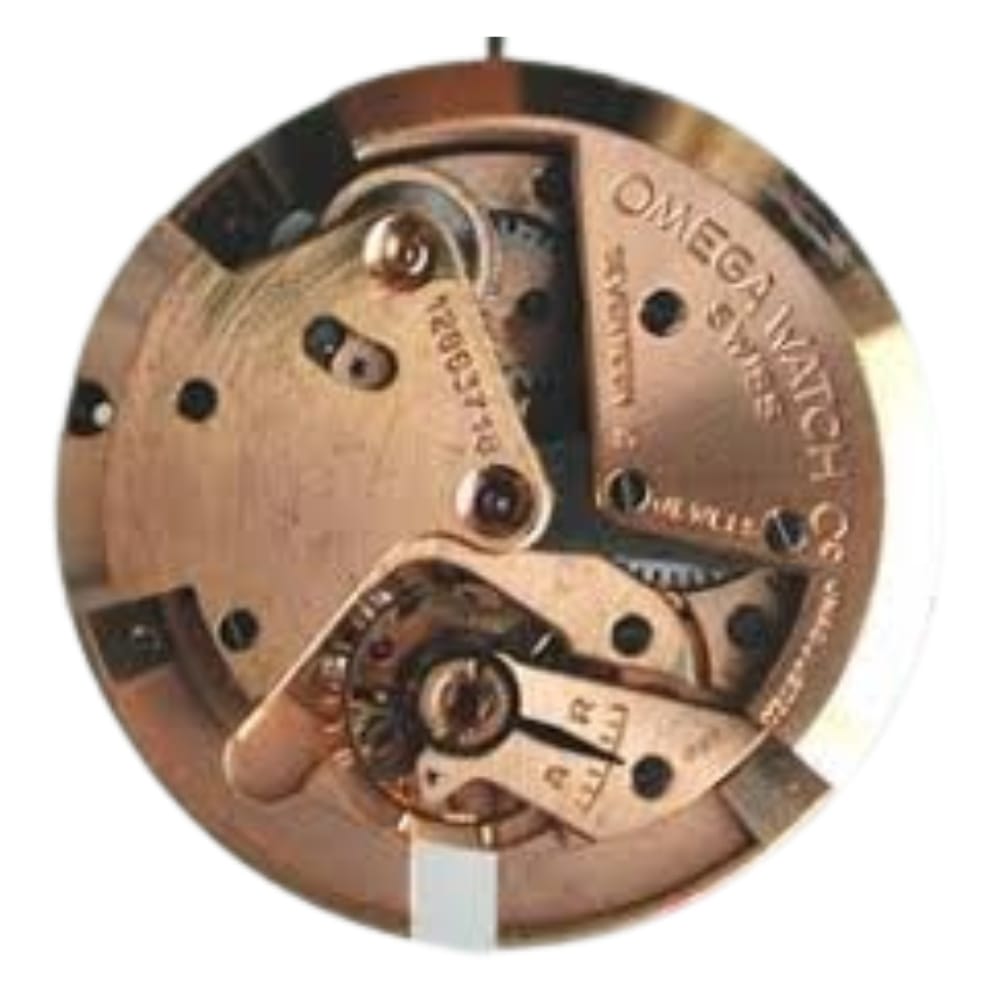
The Omega 353 occupies a pivotal position in horological history as Omega’s first bumper automatic movement equipped with a date complication, introduced in 1951 and powering the groundbreaking Seamaster Calendar reference 2627. This caliber represents the intersection of two significant developments: the maturation of Omega’s bumper automatic technology and the brand’s entry into the date complication market, coming four years after Rolex’s Datejust but establishing Omega’s credentials in practical everyday complications. The movement’s distinctive copper-electroplated finish and audible bumper mechanism made it a tactile reminder of mid-century automatic watchmaking before full-rotor designs became universal.
The caliber 353 served as Omega’s workhorse date movement during a narrow but important production window from 1951 to 1953, bridging the gap between early automatic technology and the more refined full-rotor caliber 500 series that would debut in 1955. Its core identity centers on reliability and accessibility rather than chronometric excellence. The movement employs a simple index regulator rather than the swan neck micrometric system found on higher-grade variants, positioning it as a practical tool for everyday wear rather than a precision instrument. Among collectors and watchmakers, the 353 earned a reputation for robustness and straightforward serviceability, though its bumper winding mechanism requires more arm movement than later full-rotor designs to maintain adequate power reserve.
Production estimates for the caliber 353 specifically are not manufacturer-confirmed, but the movement belongs to the broader 28.10/30.10 bumper family that produced over 1,300,000 units between 1943 and 1955, of which approximately 500,000 achieved chronometer certification (though not the 353 itself). Based on serial number analysis and production records, the 353 was manufactured for only two to three years, suggesting total production likely ranged between 30,000 and 60,000 units. Serial numbers for caliber 353 movements typically fall in the 12,500,000 to 14,000,000 range, corresponding to the 1951-1953 production period. The caliber can be classified as uncommon rather than rare. While examples surface regularly in the vintage market, the short production run and specific application (primarily the Seamaster Calendar 2627) means finding well-preserved specimens requires patience.
Collector standing for the caliber 353 remains modest but stable. Market demand centers on originality and condition rather than the movement itself, with most collector interest focused on complete Seamaster Calendar watches in unmolested condition. The early square date window variants (1951-1953) command slight premiums over later trapezoid window versions, though this reflects dial rarity rather than movement desirability. Pricing for steel Seamaster Calendar 2627 examples typically ranges from $400 to $1,000, with gold-capped versions reaching $1,200 to $1,800 depending on condition and dial preservation. Demand has remained stable over the past decade, with neither significant appreciation nor decline. The 353 benefits from association with the historically significant “first Omega date” designation but lacks the chronometer certification or technical innovation that drives premium pricing for sibling calibers like the 354.
Historical Context, Provenance, and Manufacturing Details
The caliber 353 emerged in 1951 as Omega’s response to market demand for automatic watches with date complications, a feature that had gained traction following Rolex’s introduction of the Datejust in 1945. Development built directly on the proven architecture of the caliber 350 and 351 base movements, introduced in 1950, with Omega’s engineers adding a date mechanism driven from the hour wheel through a 24-hour reduction gear. The caliber addressed a specific market need: providing the convenience of automatic winding and calendar functionality in a robust, serviceable package at a more accessible price point than chronometer-certified alternatives.

The caliber 353 evolved directly from the caliber 350 (center seconds, no date) and caliber 351 (center seconds, no date, different bridge configuration). These predecessors, introduced in 1950, shared the same base plate, gear train, and bumper winding mechanism but lacked calendar complications. The 353 replaced no specific prior caliber but rather expanded the product line to include date functionality. Production of the 353 overlapped with the 350, 351, 352 (chronometer, no date), and 354 (chronometer, no date, swan neck regulator) variants, all sharing common architecture. In 1953, Omega introduced the caliber 355, which superseded the 353 by adding a swan neck regulator for superior adjustment capability while maintaining identical date functionality. The 355 continued production until 1962, long after the 353 had been discontinued. Eventually, the entire bumper automatic family was rendered obsolete by the caliber 500 series full-rotor movements beginning in 1955, which offered superior winding efficiency and thinner case profiles.
The caliber 353 represents an in-house manufacture movement designed, produced, and assembled entirely by Omega at its Biel/Bienne facility in Switzerland. This was not an ebauche-based design sourced from suppliers like ETA, AS (Adolf Schild), Peseux, or FHF, but rather a proprietary Omega development building on the company’s 28.10 RA family architecture first introduced in 1943. Omega maintained complete vertical integration for its core caliber families during this era, manufacturing movement plates, bridges, gear trains, and winding mechanisms internally. Certain commodity components including Nivarox balance springs, Incabloc shock protection units, and mainspring materials were likely sourced from specialized suppliers, as was standard industry practice.
Production took place exclusively at Omega’s main manufacturing facility in Biel/Bienne, Switzerland, where the company had relocated in 1880 and where its headquarters remain today. No changes in production location occurred during the caliber 353’s brief lifespan from 1951 to 1953. The movement was manufactured using semi-industrial methods typical of Swiss manufacture watchmaking in the early 1950s: machine-cut brass plates and bridges, hand-fitted jewel settings, manually adjusted regulators, and individual movement testing before casing.
In the broader horological context, the caliber 353 represents a transitional design. It was neither groundbreaking (the bumper automatic concept dated to the 1940s, and date complications existed since the 1930s) nor a mere workhorse copying competitors. Instead, it exemplifies Omega’s methodical approach to product development: taking proven technology (the 28.10/30.10 bumper platform) and incrementally adding practical complications (date display) to meet market demand. The caliber’s significance lies in its role as Omega’s first serial production automatic date movement, establishing the foundation for subsequent calendar calibers that would become central to the brand’s identity. Within Omega’s lineup, the 353 occupied the middle ground between basic time-only bumpers and chronometer-certified variants, offering practical functionality without premium pricing.
Construction and Architecture

Plate and Bridge Layout
The caliber 353 employs a three-quarter plate construction with four separate bridges: the barrel bridge, train wheel bridge, sweep second cock, and balance cock. The automatic winding mechanism adds three additional bridges: lower oscillating weight bridge (intermediate bridge), upper oscillating weight bridge (center bridge), and a banking stop to limit the rotor’s travel arc. The main plate and all bridges are fabricated from brass with copper electroplating, a finish that served both functional and aesthetic purposes. The copper plating provided modest corrosion resistance and reduced friction on certain pivot points, though over decades this plating oxidizes to a characteristic reddish-brown patina or, where worn through, reveals the brass substrate beneath. This architectural philosophy reflects Omega’s semi-industrial manufacture approach: standardized plate designs across multiple caliber variants (350, 351, 352, 353, 354, 355) with modular complications and adjustment systems to create product differentiation without redesigning base architecture.
Balance Wheel
The caliber 353 uses a bimetallic screwless balance wheel with smooth rim construction, typical of mid-century Swiss movements. The balance diameter measures approximately 10.5-11mm, consistent with other movements in the 28.10/30.10 family. Material composition consists of a bimetallic construction with a beryllium-bronze alloy, providing temperature compensation through differential expansion coefficients between the inner and outer layers. The balance features no timing screws, as adjustment occurs entirely through the index regulator acting on the hairspring’s effective length rather than moment of inertia modification. This design choice simplified manufacturing and reduced cost compared to adjustable screw balances found on chronometer-grade movements.
Balance Spring (Hairspring)
The hairspring is a flat spiral Nivarox spring without a Breguet overcoil, manufactured from Nivarox alloy, a cobalt-nickel-chromium composition developed in the 1930s for superior antimagnetic properties and thermal stability. The flat configuration was standard for consumer-grade Swiss movements of this era and provided adequate isochronism for daily wear accuracy without the complexity of Breguet overcoils. The spring terminates at an outer stud that interfaces with the index regulator, allowing rate adjustment by changing the hairspring’s effective length. The inner terminal is fixed to the collet, which friction-fits to the balance staff. While original Nivarox springs were provided by specialized suppliers, the specific alloy composition and dimensions for the 353 are not publicly documented.
Escapement Type
The caliber 353 employs a standard Swiss lever escapement with club-tooth escape wheel design, the dominant configuration in mid-20th century Swiss watchmaking. The pallet fork is brass with synthetic ruby pallet stones on both locking faces, and the impulse jewel (roller jewel) is similarly synthetic ruby. This three-jewel escapement configuration (two pallet stones plus impulse jewel) provides efficient energy transfer from the escape wheel to the balance while minimizing friction and wear. The escapement operates at 19,800 vph (2.75 Hz, or 5.5 beats per second), a frequency slightly below the era’s emerging standard of 21,600 vph but above older 18,000 vph movements. The club-tooth profile offers improved impulse delivery compared to earlier ratchet-tooth designs and was standard across Omega’s production movements.
Shock Protection System
The caliber 353 incorporates Incabloc shock protection on the balance staff pivots, both upper and lower jewel settings. Incabloc, developed by Porte Echappement Universel SA and widely adopted across the Swiss industry from the 1930s onward, uses spring-loaded jewel assemblies that allow the balance staff to move slightly under impact, then return to centered position. The system consists of a conical jewel bushing containing both hole jewel and cap jewel, held in position by a lyre-shaped spring. Upon shock, the bushing can move in any direction, transferring impact energy to the balance staff’s thicker shank rather than the delicate pivot. The specific Incabloc model used in caliber 353 is compatible with the broader 28.10/30.10 family, with cap jewel part number 122.11 (also designated 122.21 or 122.41) and spring assemblies shared across calibers 330 through 355. No shock protection is provided for the pallet fork or other pivots.
Regulator Type
The caliber 353 employs a simple index regulator with baton-shaped pointer, the most basic adjustment mechanism in Swiss watchmaking. The regulator consists of two components: a regulator (raquette, part 332.1331) and regulator pointer (flèche de raquette, part 332.1332), with some movements using a two-piece regulator design (part 332.1333). Adjustment occurs by moving the index pins along the hairspring’s length, changing the effective active length and thus the balance’s period. This system allows rate adjustment but lacks the micrometric precision of the swan neck regulator found on the superior caliber 355. The index regulator was standard on non-chronometer Omega movements and required skillful watchmaker intervention for precise adjustment.
Mainspring Material and Type
The mainspring is a traditional white alloy automatic-type barrel spring measuring 1.10mm width × 0.100-0.105mm thickness × 240-250mm length, with barrel diameter of 8.5mm. In the Dennison system, this corresponds to Width 2, Strength 11.5, Length 12 inches (approximately 305mm in metric). The spring is manufactured from a proprietary steel alloy treated for consistent elasticity and fatigue resistance, though specific composition details were not published by Omega or the likely supplier, Nivarox. The mainspring features a slipping bridle attachment inside the barrel rather than a fixed hook, allowing the spring to slip once fully wound and preventing over-winding damage to the automatic mechanism. The spring can be manually wound via the crown in addition to automatic winding provided by the oscillating weight. Part number references include 350.1208 in Omega’s official catalog and aftermarket designations MS-26N or GR2622X.
Gear Train Details
The caliber 353 uses a conventional four-wheel gear train: barrel wheel (first wheel), center wheel (second wheel), third wheel, and fourth wheel (escape wheel). The center wheel is directly driven by the barrel arbor and makes one complete rotation per hour, carrying the minute hand via the cannon pinion. The fourth wheel drives the escape wheel and makes one rotation per minute. The center seconds hand is driven indirectly through an intermediate wheel (driving wheel, part 350.1249) that transfers motion from the third wheel to the sweep second pinion (part 353.1250). This indirect drive configuration was typical for automatic movements of this era and allowed the center seconds hand to be added without redesigning the base gear train architecture. Specific gear ratios for each wheel pair are not documented in available technical literature but follow standard Swiss practice for 19,800 vph movements.
Finishing Quality and Techniques
The caliber 353 represents basic adjusted grade finishing, suitable for consumer automatic watches but without the embellishments reserved for chronometer or observatory-grade movements. Finishing techniques include circular graining (perlage) on the main plate visible through the balance cock aperture, though not uniformly applied across all plate surfaces. The bridges feature minimal decoration, typically machine brushing in a linear pattern rather than hand-applied Geneva stripes (Côtes de Genève). Edges (anglage) are deburred but not polished to mirror finish. Screw heads show light polishing but not the mirror finish characteristic of high-grade movements. The copper electroplating served a functional purpose (corrosion resistance, reduced friction) rather than aesthetic intent, though new movements displayed an attractive warm finish. No significant variation in finishing quality occurred across the 353’s production run, as Omega maintained consistent manufacturing standards. The movement represents honest mid-century manufacture finishing: functional, clean, and competently executed without artistic flourish.
Cross-Reference Data
Alternative Caliber Names (Rebranded Versions)
The Omega caliber 353 was not rebranded or sold to other manufacturers. Omega retained exclusive use of this movement for its own watch production, primarily the Seamaster Calendar line.
| Manufacturer | Caliber Designation | Notes |
|---|---|---|
| Omega | 353 | Original designation, no rebrand variants |
Base Caliber vs. Elaborated Versions
The caliber 353 belongs to the 28.10/30.10 bumper family and shares base architecture with several variants differentiated by complications and adjustment systems.
| Variant | Differences | Functions |
|---|---|---|
| Cal. 28.10 RA SC PC | Original designation pre-1949, center seconds | Center seconds |
| Cal. 350 | Base bumper movement, no date, index regulator | Center seconds |
| Cal. 351 | Slightly different bridge layout, no date | Center seconds |
| Cal. 352 | Chronometer certified, excentric regulator, no date | Center seconds |
| Cal. 353 | Date at 6 o’clock, index regulator | Date, center seconds |
| Cal. 354 | Chronometer certified, swan neck regulator, no date | Center seconds |
| Cal. 355 | Date at 6 o’clock, swan neck regulator (successor to 353) | Date, center seconds |
The functional relationship between calibers 353 and 355 is particularly important for collectors: both provide identical date functionality and share complete parts compatibility for the base movement and date mechanism. The sole distinction is the regulator type (index vs. swan neck), allowing Omega to offer two price points within the same case reference. Early caliber 353 movements were fitted with square date windows, while later 353 production and all caliber 355 movements used trapezoid date windows, though this reflects dial evolution rather than caliber difference.
Compatible Case References by Brand
| Brand | Reference Numbers | Production Years |
|---|---|---|
| Omega Seamaster Calendar | 2627 (steel), 2627-1 through 2627-8 | 1951-1955 |
| Omega Seamaster Calendar | 2627 (14k gold-capped) | 1951-1955 |
| Omega Seamaster Calendar | 2627 (18k solid gold) | 1952-1955 |
| Omega (time-only variants) | Various US market references | 1951-1953 |
The caliber 353 was designed specifically for the Seamaster Calendar reference 2627 case, which features a 35mm diameter, screw-down caseback for 30m water resistance, and 18mm lug width. Early production (1951-1952) used square date windows at 6 o’clock, while later examples (1953 onward) transitioned to trapezoid windows. Some US market examples exist in gold-filled cases with non-standard reference numbers, reflecting Omega’s practice of producing market-specific variants.
Dial Compatibility Note
Dials for caliber 353 feature two mounting feet positioned at approximately 2 and 8 o’clock, with a date window aperture at 6 o’clock measuring 2.8mm × 2.0mm for early square windows and 3.5mm × 2.0mm (trapezoid) for later production. The date window is framed by a metal surround matching the dial finish (gilt or rhodium) and hour marker material. Dial compatibility extends to caliber 355 with identical date window configuration, though the calendar mechanism operates identically regardless of movement grade. Collectors should note that square date window dials (1951-1953 production) are not directly interchangeable with trapezoid window dials without modification to the dial or date indicator ring.
Crown and Stem Specifications
The winding stem for caliber 353 is fully compatible with all movements in the 28.10/30.10 bumper family, from caliber 330 through 355. Original Omega stems are increasingly scarce, but Swiss-made generic replacements meeting TAP 10 specifications are readily available. The setting mechanism employs a yoke-type clutch that shifts the sliding pinion between winding and time-setting positions when the crown is pulled.
Identification Marks

Caliber Number Location
The caliber number “353” is engraved on the movement adjacent to the balance wheel on the upper bridge surface. The engraving typically measures 1.5-2mm in height with serif font consistent with Omega’s mid-century style. This location is partially visible with the balance wheel installed but fully readable when the balance is removed. On earlier production examples, the full technical designation “28.10 RA SC PC T1 CAL AM” may appear on the main plate under the automatic winding bridges, though later production simplified this to “353” only.
Logo and Brand Marks
Authentic caliber 353 movements display several identifying marks. The oscillating weight (bumper rotor) is engraved with “OMEGA” in capital letters, positioned prominently on the weight’s surface. The bridge adjacent to the balance wheel is marked “Omega Watch Co” along with “Swiss” designation. The jewel count “17 Jewels” or “17 pierres” appears on the main plate, visible once bridges are removed. Quality stamps and adjustment marks are notably absent on caliber 353, as this movement did not receive chronometer certification or observatory adjustment.
Date Codes
Omega did not employ date codes on caliber 353 movements. Dating relies entirely on movement serial numbers stamped on the main plate or movement bridges.
Finishing Marks
Expected finishing patterns include circular graining (perlage) on the main plate visible through the balance cock aperture, linear brushing on bridge surfaces, and copper electroplating on plates and bridges. The copper plating is diagnostic: authentic 353 movements display a warm reddish-brown tone when oxidized, or bright copper when freshly serviced. Forged movements or incorrect calibers will lack this distinctive plating. The oscillating weight shows characteristic wear patterns where it contacts the banking stop springs, creating polished areas on the weight’s edges.
Jewel Markings
Jewel settings in caliber 353 use pressed jewels rather than gold chatons, consistent with non-chronometer grade movements. The jewels are synthetic ruby, appearing red or pink under magnification. Upper and lower balance staff jewels are held in Incabloc shock settings with characteristic conical bushings and lyre-shaped springs. No special jewel markings or engravings identify jewel quality or origin.
Adjustment Markings
Caliber 353 was not offered in adjusted or chronometer grades, so no adjustment markings appear on authentic examples. Any markings indicating positional adjustment, temperature compensation testing, or chronometer certification should be viewed with suspicion, as these designations were reserved for calibers 352, 354, and other premium variants.
Correct Serial Number Formats and Locations
Movement serial numbers for caliber 353 are seven or eight-digit numbers stamped on the movement plate or bridge. The serial number location varies: some examples show the number on the bridge near the balance wheel, while others have it stamped on the main plate under the automatic winding mechanism. Serial numbers for caliber 353 production typically fall within these ranges:
- 1951 production: 12,500,000 to 12,999,999
- 1952 production: 13,000,000 to 13,999,999
- 1953 production: 14,000,000 to 14,499,999
Serial numbers should be cleanly stamped with consistent depth and legible digits. Hand-engraved or poorly formed numbers indicate fraud or replacement plates.
Expected Engravings and Stampings
Authentic caliber 353 movements display the following engravings in specified locations:
- Main plate: “Omega Watch Co”, “Swiss”, “17 Jewels”, serial number
- Balance cock or adjacent bridge: “353” caliber designation
- Oscillating weight: “OMEGA” in capitals
- Barrel bridge: Occasionally “Swiss Made” or quality control marks
All engravings should show consistent depth (approximately 0.1-0.15mm), sharp edges, and period-appropriate serif or sans-serif fonts. The copper electroplating should extend uniformly across all plates and bridges. Case interior should match the movement serial number within reasonable proximity (±500-1000 units for pre-cased movements).
Font and Marking Style by Production Era
Early production caliber 353 movements (1951-1952) tend to use serif fonts for engravings, particularly on the “OMEGA” rotor marking and caliber designation. Later production (1952-1953) may show slight font variation, with some movements transitioning to sans-serif styles, though this is not a strict rule. The copper electroplating quality remained consistent throughout production, showing no significant variation between early and late examples. No rebranding or logo transitions occurred during the caliber 353’s brief production run, as this preceded Omega’s corporate restructuring of the 1970s-1980s.
Part Information

Part Numbers
Based on the official Omega parts catalog for caliber 353 (dated 1954), the following components are documented:
Core Movement Components
Automatic Winding Mechanism
Date Mechanism (Specific to Cal. 353/355)
Gear Train
Escapement
| Part Name | Part Number | Interchangeability Notes |
|---|---|---|
| Escape wheel | Shared across 330-355 family | Generic Swiss 19,800 vph |
| Pallet fork | Shared across 330-355 family | Standard Swiss lever |
| Pallet stones (set) | Generic replacements available | Synthetic ruby |
| Roller jewel | Generic replacements available | Synthetic ruby |
Shock Protection (Incabloc)
Setting Mechanism
Regulator
| Part Name | Part Number | Interchangeability Notes |
|---|---|---|
| Regulator (index type) | 332.1331 | Shared with Cal. 332-354 |
| Regulator pointer | 332.1332 | Shared with Cal. 332-354 |
| Two-piece regulator | 332.1333 | Alternative design |
Case Components
| Part Name | Part Number | Interchangeability Notes |
|---|---|---|
| Case spring | 350.1910 | Shared with Cal. 350-355 |
| Threaded block for case screw | 342.1023 | Shared with Cal. 342 |
| Case ring | 353.1502 | Specific to 353 |
Jewels
| Part Name | Part Number | Interchangeability Notes |
|---|---|---|
| Third wheel jewel, upper | 4217 | Specific specification |
| Fourth wheel jewel, lower | 4213 | Specific specification |
Sourcing Notes
Parts availability for caliber 353 ranges from excellent to challenging depending on component category:
Readily Available:
- Mainsprings: Swiss-made Nivarox or equivalent (GR2622X, MS-26N) remain in production
- Winding stems: Generic TAP 10 stems compatible with entire 330-355 family
- Incabloc components: Standard Incabloc parts (122.11 cap jewels, 170.03 springs) are current production
- Generic components: Click springs, screws, jewels for common pivots
Limited Availability:
- Balance complete: New old stock (NOS) available from specialist suppliers but becoming scarce
- Oscillating weight: Specific to bumper calibers, must source from donor movements or NOS
- Date mechanism parts: Date jumper (353.1503), date star (353.1509), and related components are challenging to source; often require donor movements
- Hairsprings: Require watchmaker fabrication or donor movement sourcing
Commonly Failed Components:
- Mainsprings: Natural fatigue after decades, always replace during service
- Banking stop springs: Prone to breakage from repeated bumper impact
- Oscillating weight bearing: Wear from constant rotation requires replacement in high-mileage examples
- Date jumper spring: Fatigue leads to weak detent pressure and date advance issues
- Click spring: Common wear item, fortunately still available
Acceptable Generic Replacements:
- Mainsprings: Any automatic mainspring meeting 1.10 × 0.105 × 240mm × 8.5mm barrel specification is acceptable
- Incabloc components: Modern Incabloc 170.03 springs and 122.11 cap jewels are direct replacements
- Screws: Generic Swiss screws matching thread pitch and head diameter work for most applications
- Winding stem: Generic TAP 10 stems from Swiss suppliers are functionally identical to original Omega parts
No acceptable generic replacements exist for the oscillating weight (must be correct weight and balance for proper winding efficiency), date mechanism components (require precise tooth counts and geometry), or balance complete (must match frequency and center of gravity).
Performance Data
Manufacturer Specifications
Omega did not publish comprehensive performance specifications for the caliber 353, as it was not offered in chronometer-certified or officially adjusted grades. Based on contemporary Omega technical documentation and watchmaker service manuals, the following represents expected factory performance parameters:
The caliber 353 was manufactured to reliable timekeeping standards but without the precision adjustment applied to chronometer grades. The simple index regulator allowed watchmakers to achieve reasonable accuracy through careful adjustment, but positional variation and rate stability over the power reserve curve were not controlled to chronometer standards.
Observed Performance (Field Data)
Based on collector reports, watchmaker service records, and timegrapher measurements from well-maintained examples, typical performance characteristics are:
Accuracy Range:
Fully serviced examples with new mainsprings and proper lubrication typically achieve +5 to +15 seconds per day in dial-up position when fully wound. Vertical positions show increased variation, typically +15 to +30 seconds per day depending on position. Examples approaching service intervals (5+ years since last overhaul) commonly run +20 to +40 seconds per day. Accuracy degrades significantly as the movement approaches end of power reserve, with rate loss accelerating in the final 12 hours.
Common Performance Issues:
The most frequent problem affecting accuracy is insufficient winding efficiency from worn banking stop springs or oscillating weight bearing, resulting in the movement never reaching full power reserve and running perpetually in a low-amplitude, fast-rate condition. Dried lubrication on the pallet stones and escape wheel pivots causes excessive friction, manifesting as low amplitude (below 200 degrees) and erratic rate. Magnetization from modern electronics can cause rate gain of 30+ seconds per day, identifiable by consistent fast rate across all positions. Date mechanism interference occurs if the date jumper spring weakens, allowing the date wheel to drag continuously rather than snapping cleanly at midnight.
Expected Amplitude:
Fully wound dial-up position: 250-280 degrees is considered excellent for a serviced caliber 353. Vertical positions: 220-250 degrees is acceptable, with some watchmakers noting that bumper movements show slightly lower vertical amplitude than full-rotor designs due to the additional friction from the oscillating weight mechanism. After 24 hours of running: Minimum 220 degrees dial-up, 200 degrees vertical positions. Below 190 degrees amplitude in any position indicates service requirement, typically dried lubricants or mainspring weakness. Amplitude readings require proper lift angle setting: the caliber 353 uses 50 degrees, and incorrect lift angle input (commonly defaulted to 52 degrees on timegraphers) will show artificially high or low amplitude values.
Performance Degradation Over Time:
As caliber 353 movements age without service, several predictable degradation patterns emerge. Mainspring set (permanent deformation) reduces power reserve from 42 hours to 30-36 hours, with corresponding amplitude loss throughout the reserve period. Pivot wear from dried lubrication increases friction and causes erratic rate behavior, particularly noticeable as the watch transitions between wrist positions. Oxidation of the copper electroplating can create abrasive particles that accelerate gear train wear. The bumper mechanism shows specific wear patterns: banking stop springs weaken or break, allowing excessive rotor travel and inefficient winding. The oscillating weight bearing develops play, causing the rotor to wobble and creating audible rattling distinct from the normal “bump” sound.
Winding Efficiency:
The caliber 353’s bumper mechanism winds only during clockwise rotation (when viewed from the case back), making it inherently less efficient than bi-directional full-rotor movements. Field observations suggest the movement requires approximately 4-6 hours of active wrist wear to achieve full wind from fully unwound state. Stationary desk work or minimal arm movement may prove insufficient to maintain power reserve, requiring supplemental manual winding. The movement benefits from being worn on a more active wrist rather than a dominant writing hand. Watch winders for caliber 353 require single-direction clockwise rotation at 800-1000 turns per day (TPD) to maintain full wind, significantly higher than typical full-rotor movements (650 TPD).