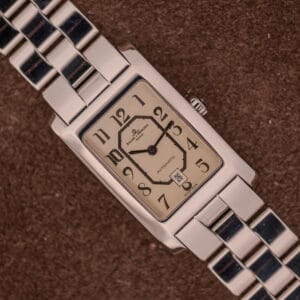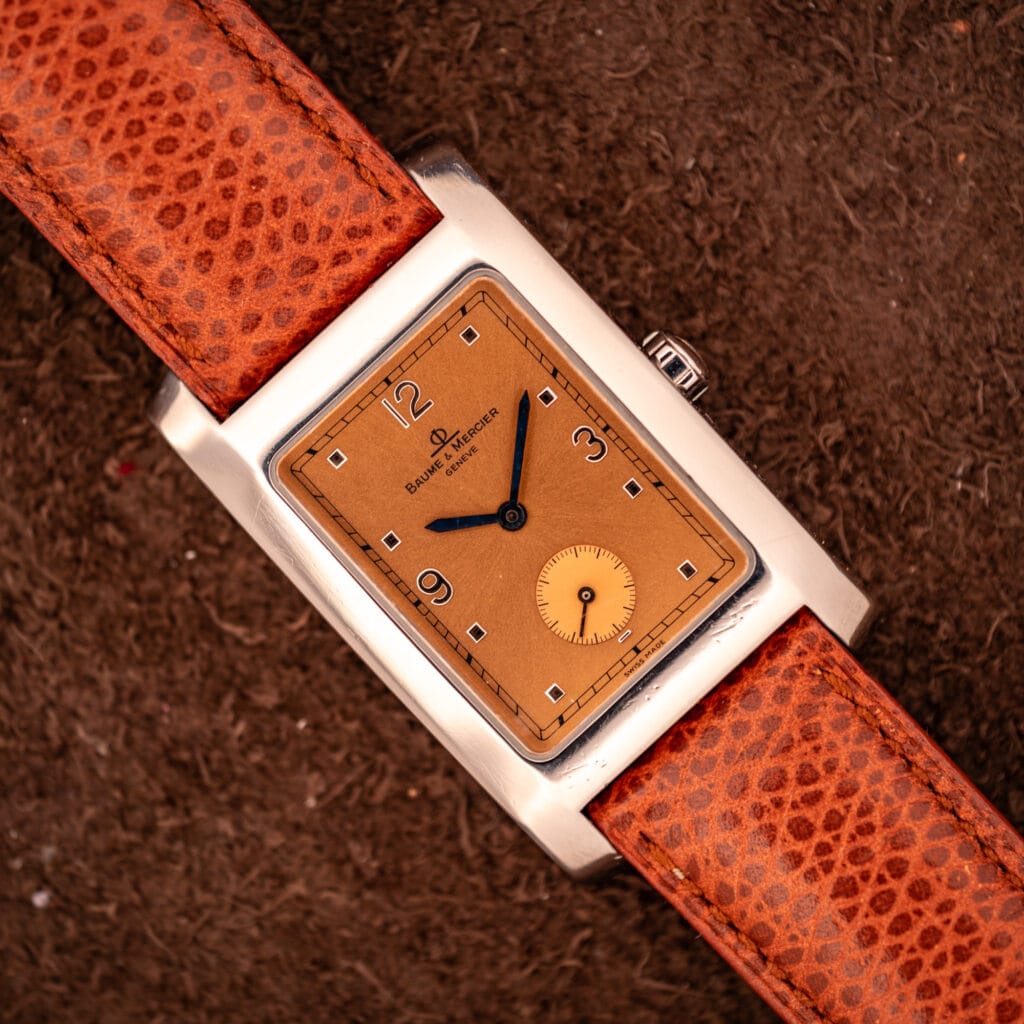
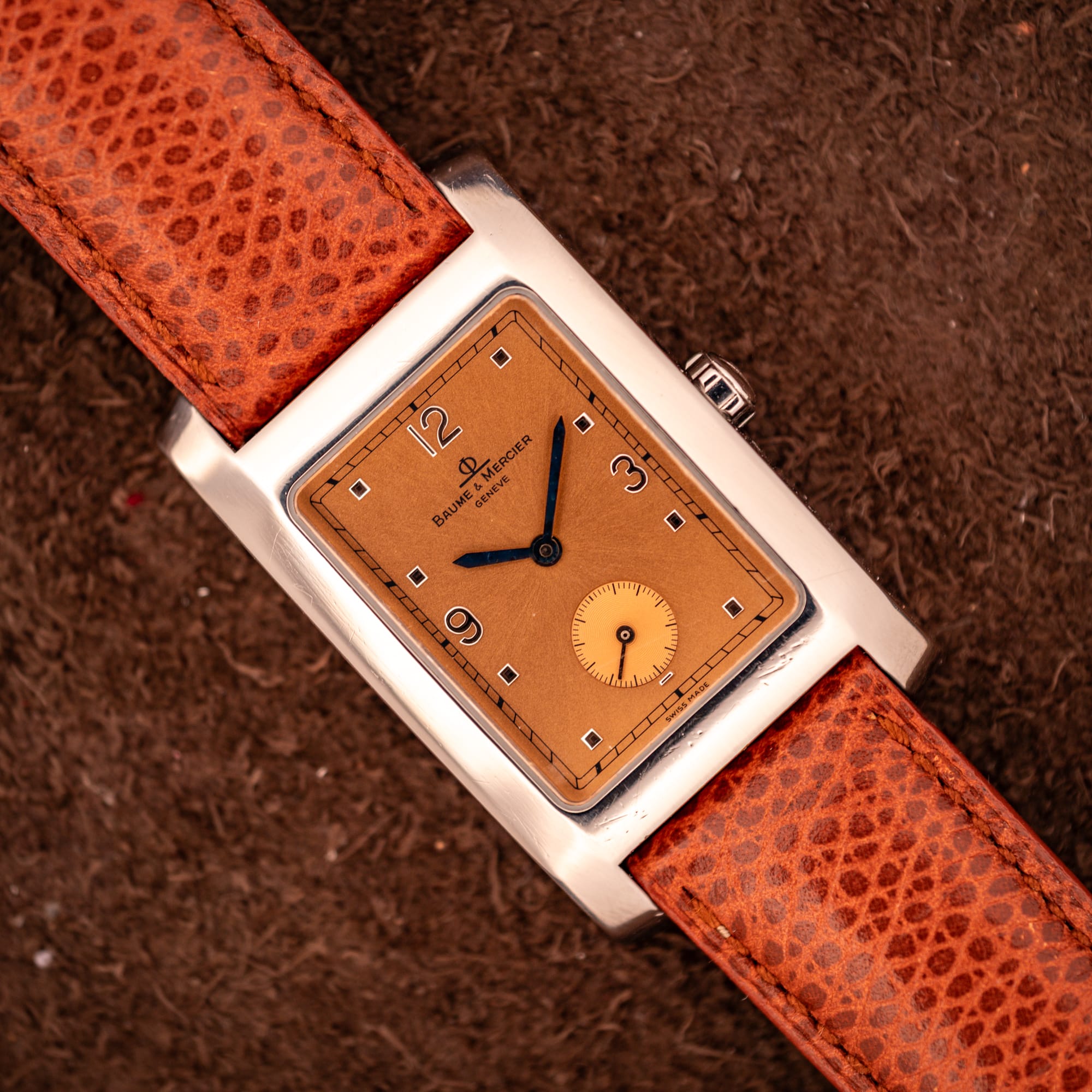
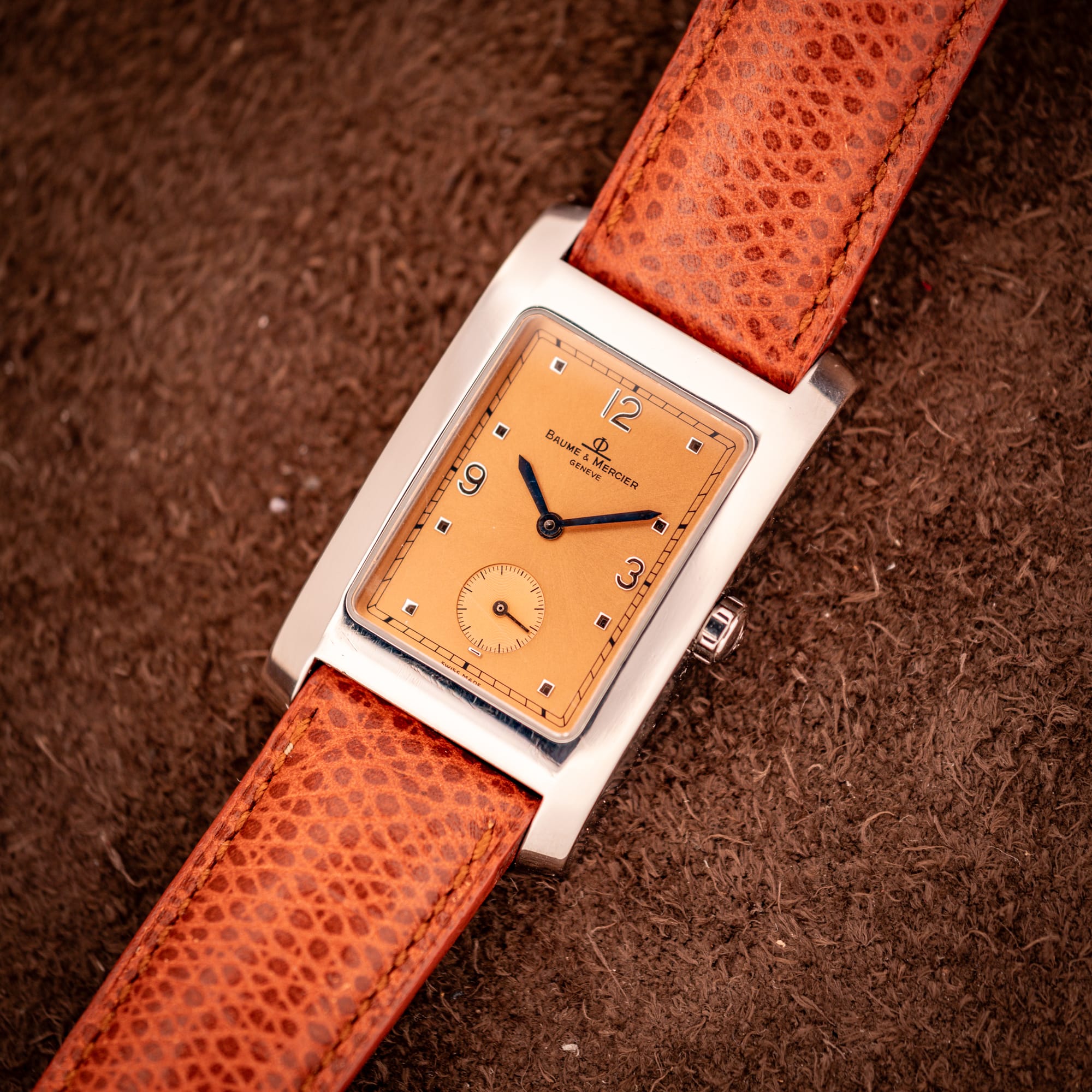
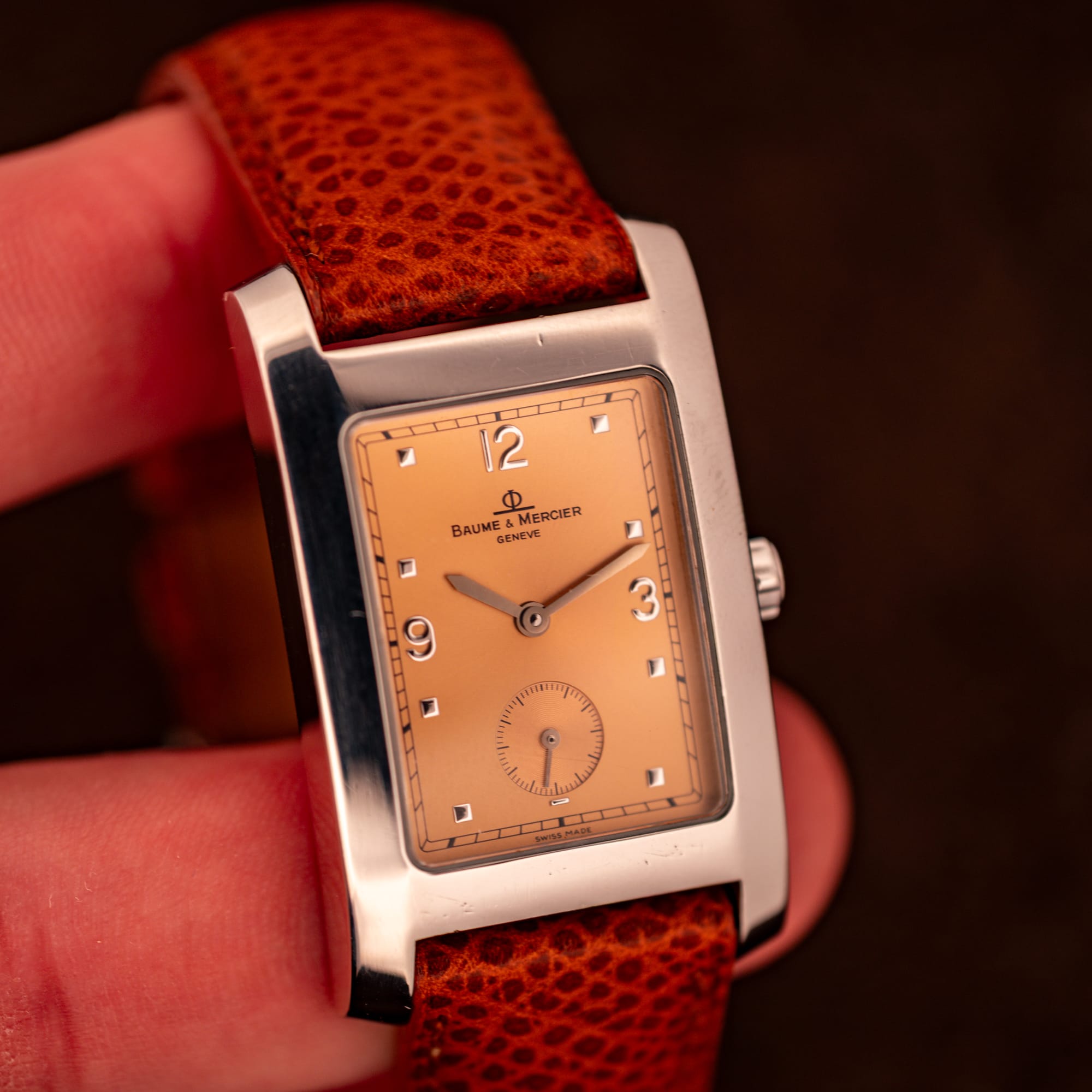
1994 is the year to keep in mind on this one. That is when Baume and Mercier launched the Hampton, a deliberate rectangular flagship at a moment when the Swiss industry was overwhelmingly round, and the early MV045063 references like the example in hand sit in the opening chapter of that production run. In our opinion, the salmon-copper dial variant is the execution to chase within that opening chapter, because the more common silver-white and black configurations of MV045063 read as restrained office-watch propositions where the copper version reads as something altogether more characterful and quietly intentional.
Baume and Mercier was founded in 1830 in the Swiss Jura by the brothers Louis-Victor and Celestin Baume, and the house adopted the Greek letter Phi (the golden ratio) as its formal emblem in 1964, three decades before the Hampton line gave that ratio its most literal architectural expression. The Hampton itself launched in 1994 as the brand’s deliberate rectangular flagship at a moment when the Swiss industry was overwhelmingly round, drawing its formal vocabulary from Baume and Mercier’s own 1960s archive and from the broader Art Deco grammar of the 1920s. The reference MV045063 sits in the early years of the Hampton’s modern production run, and the polished stainless steel case, the convex bezel, and the petite sub-seconds register at six are the design choices that locate this piece in that opening chapter of the line.
Inside is the caliber ETA 980.163, a Swiss-made 15-jewel quartz movement signed for Baume and Mercier and chosen specifically for the early Hampton run because of how cleanly it accommodates a separate small-seconds wheel without thickening the case profile. The 980 family is one of the higher-grade ETA quartz architectures of its era, sitting well above the workhorse 955 series that ran most mid-tier Swiss quartz watches of the 1990s and 2000s, and the petite-seconds variant in this reference is what permits the dial layout that defines the Hampton’s visual character. Most quartz watches of this period default to a center-mounted sweep seconds hand because it is mechanically simpler and cheaper to produce, and seeing a small-seconds quartz from a Geneva-signed maison is genuinely uncommon. We pay attention to it because the dial composition would not work without it.
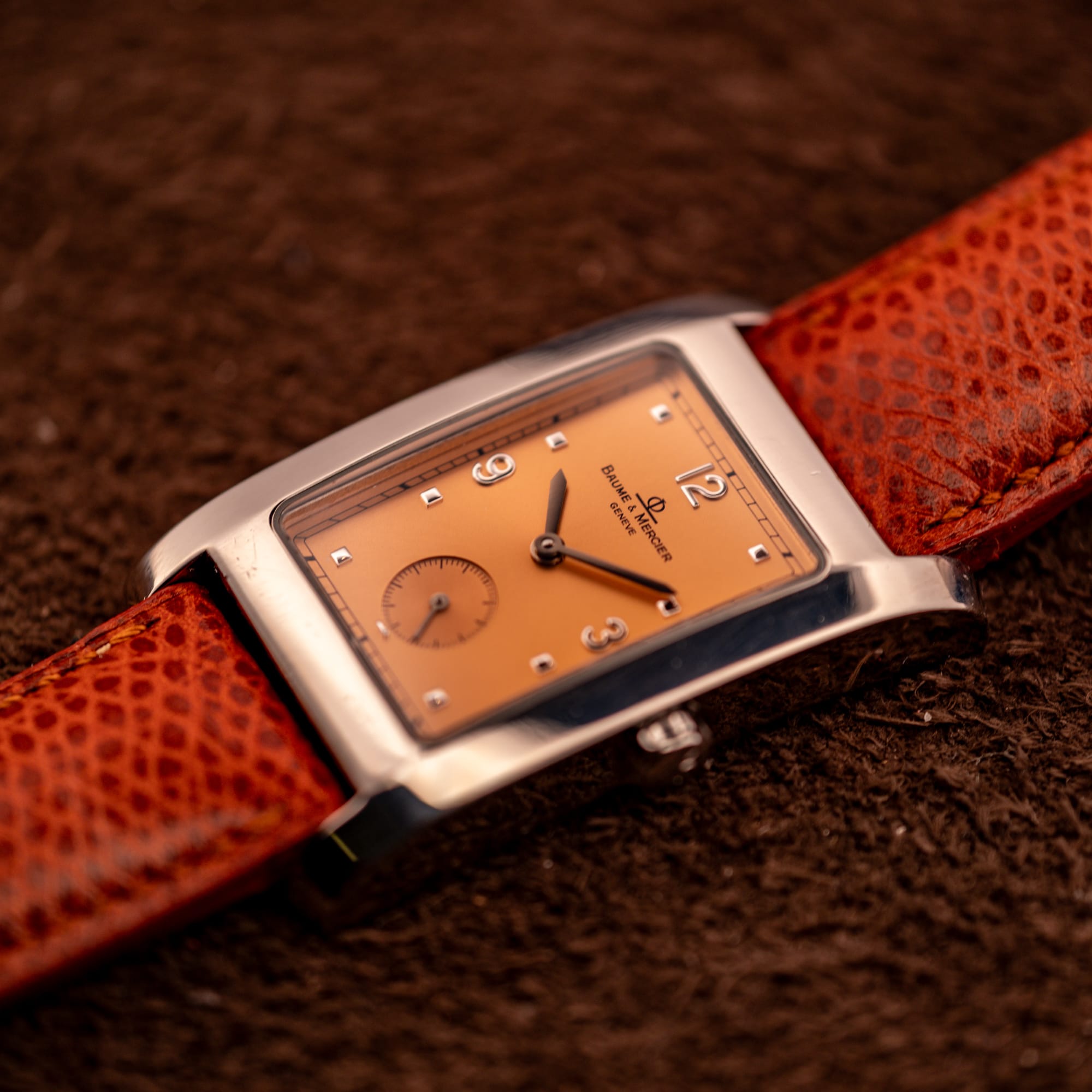
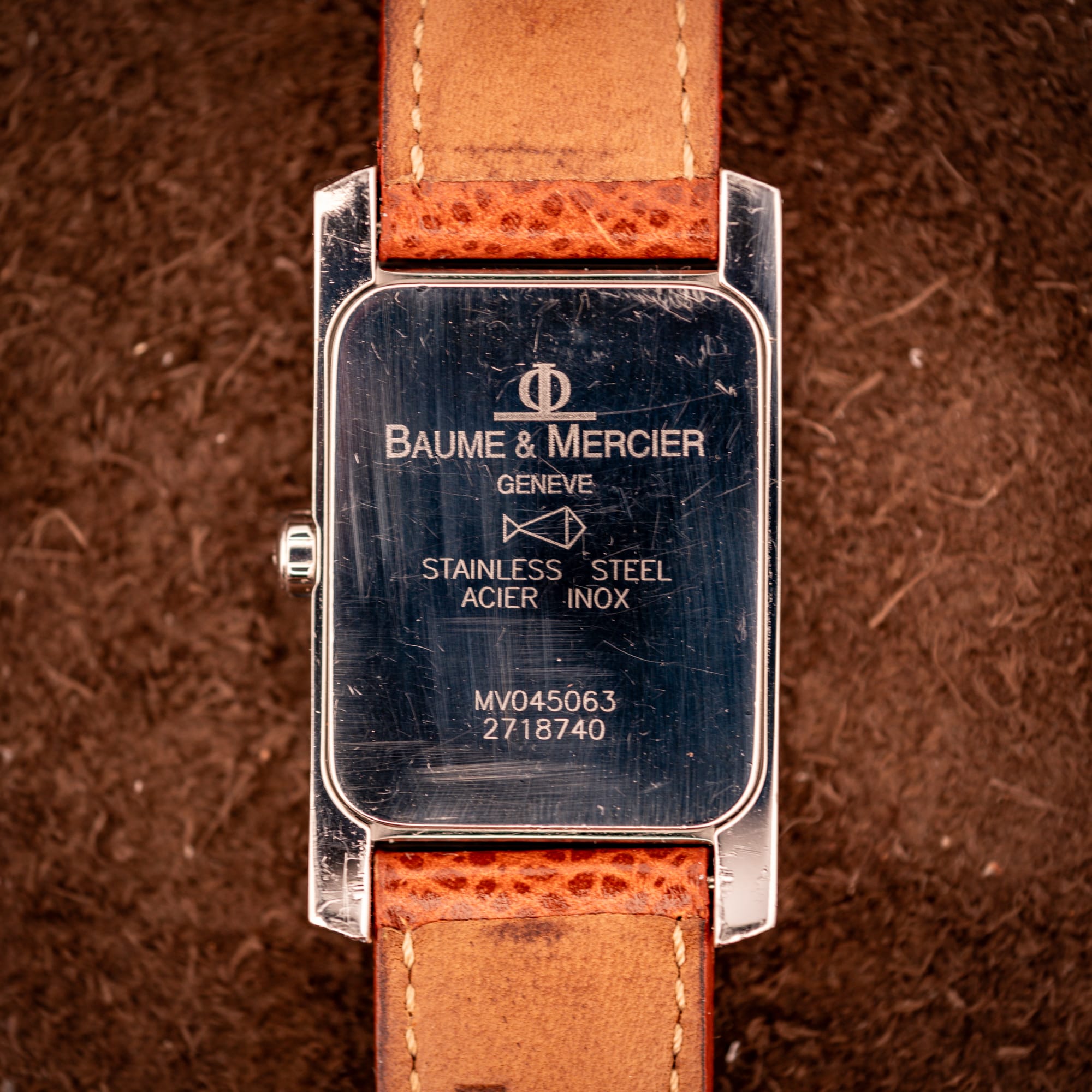
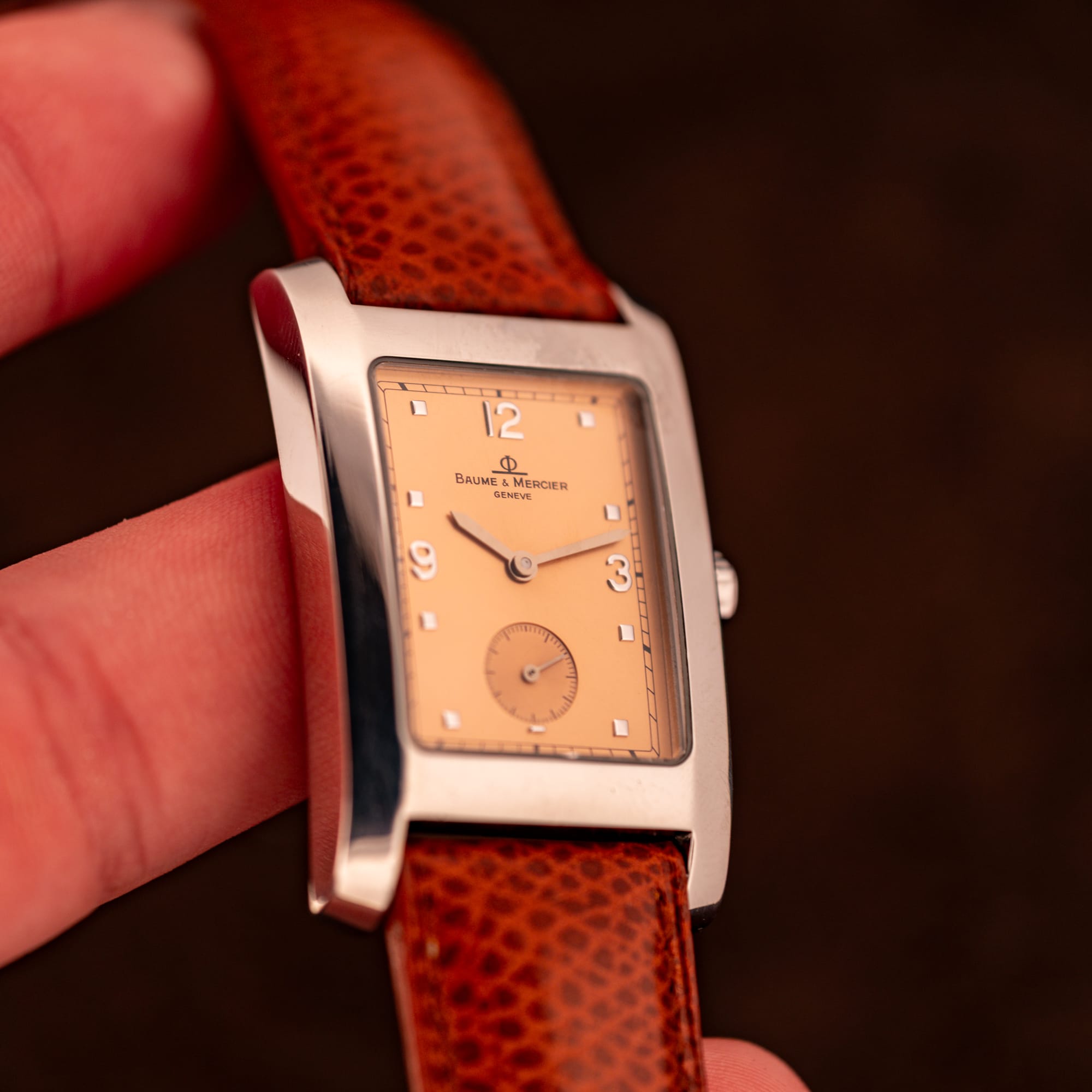
The case is polished stainless steel with a softly convex bezel and the elongated rectangular tank silhouette that defines the Hampton line. Measured across the dial opening the case is 25mm wide with a 40mm lug-to-lug stretch and an 18mm lug width, dimensions that wear with a quiet pre-war elegance on a modern wrist without feeling delicate. The flanks of the case carry the kind of soft polish marks you would expect from a watch that has been worn and looked after but not babied, with the deepest scratches sitting along the case bottom where the watch met desks and cuffs across two-plus decades. The crown is a small polished onion at the three position, unsigned but proportional to the case. The screw-down caseback is stamped clearly: the Phi-and-Greek-key Baume and Mercier emblem above the wordmark “BAUME & MERCIER” with “GENEVE” beneath, followed by the brand’s signature hourglass mark, then “STAINLESS STEEL / ACIER INOX” in two languages, with the reference “MV045063” and the case serial “2718740” stamped along the lower edge in a fine font.
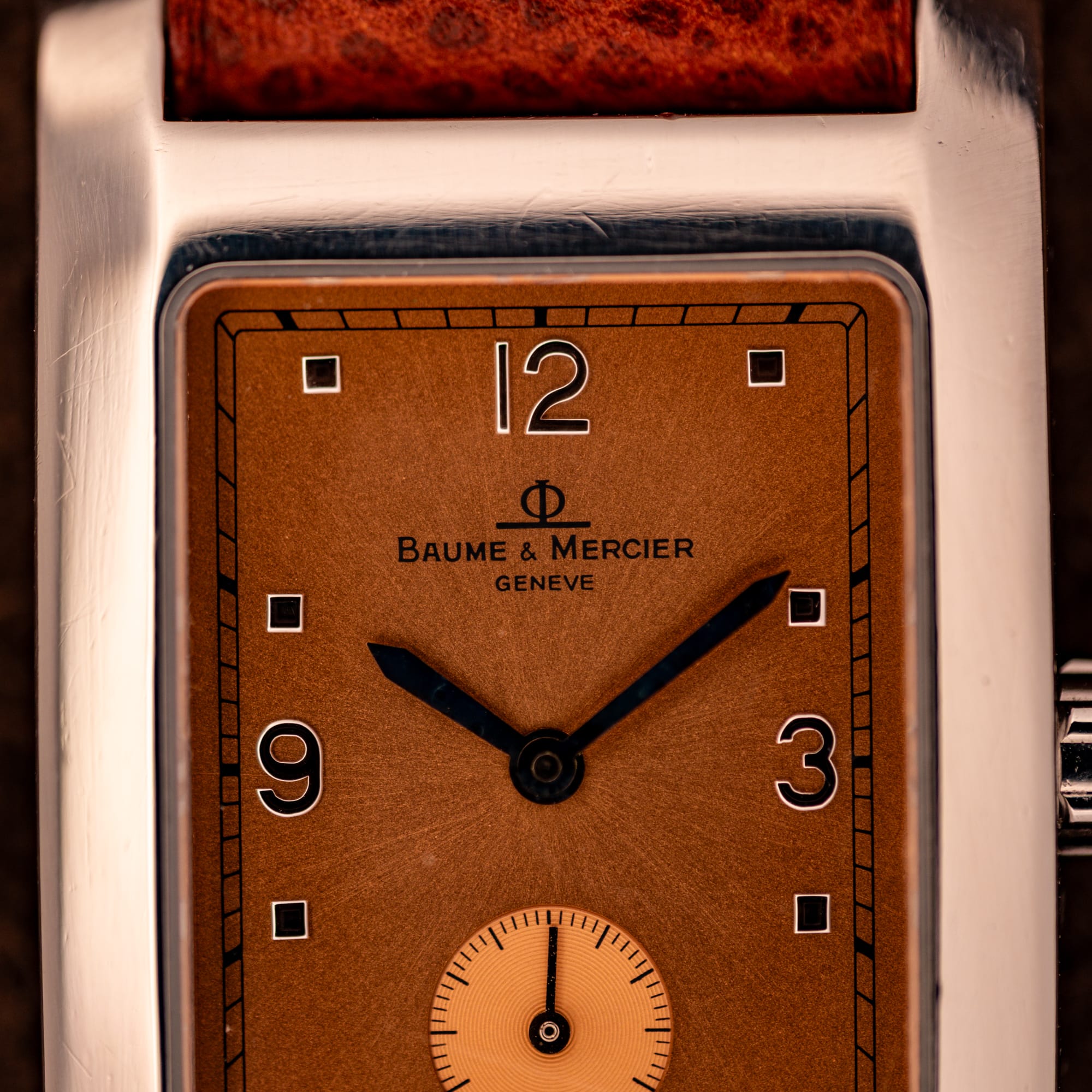
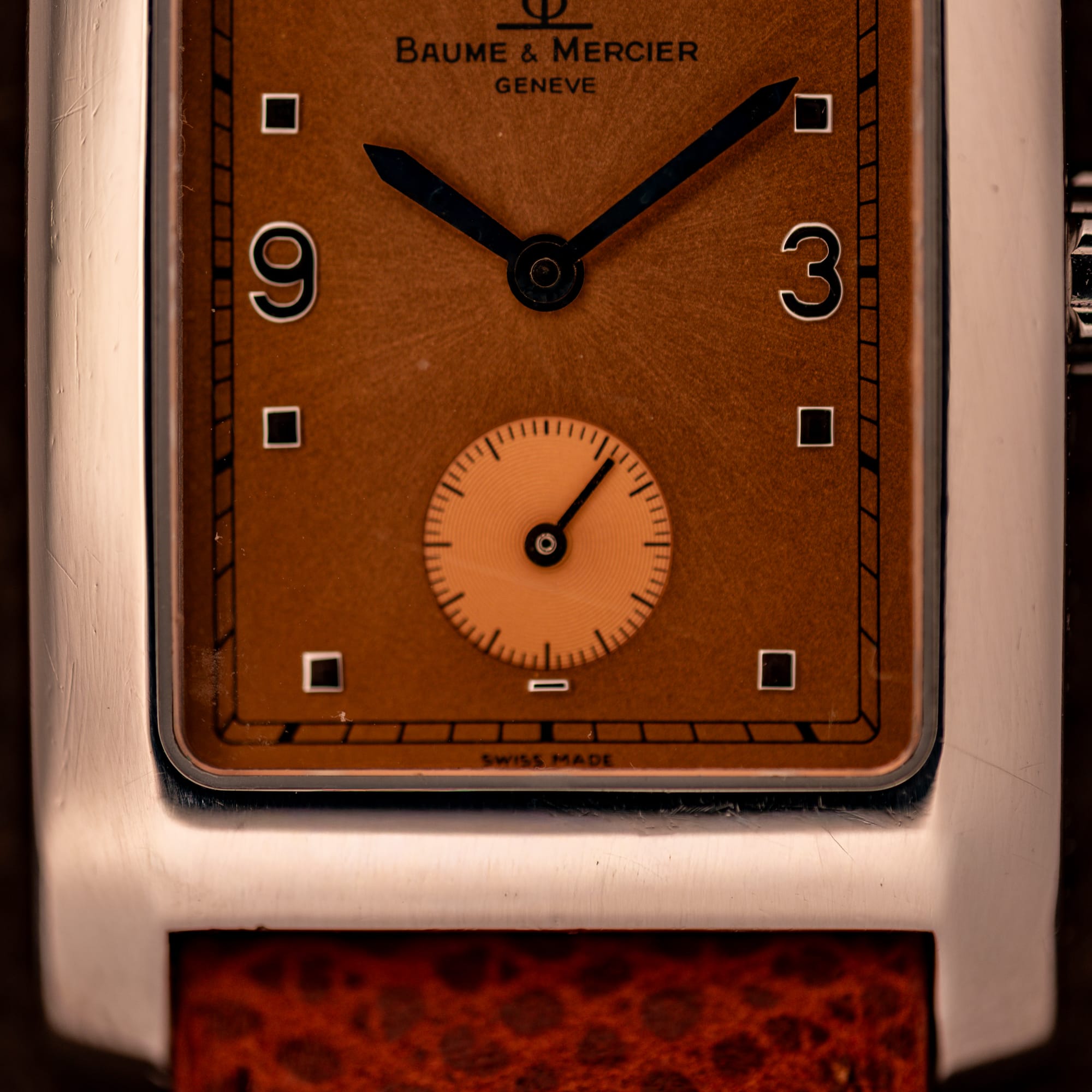
The dial sits behind a sapphire crystal and rewards close looking. The copper field is bounded by a fine printed minute track that follows the case rectangle, and the hour markers are applied silver-tone executions: full Arabic numerals at 12, 3, and 9, with small applied square markers at the remaining hour positions giving the layout its quiet asymmetry. The Baume and Mercier signature prints crisply at the upper third of the dial, the Phi crest centered above “BAUME & MERCIER” and the “GENEVE” wordmark beneath in a smaller weight. A circular sub-seconds register sits in the lower third of the dial just above the SWISS MADE script, sunken slightly into the dial plane with a finely engraved concentric track and its own tiny stick hand. The hour and minute hands are slim blued-steel sword executions that read dark navy against the warm copper field in most light and catch a silver flash when the wrist turns through a strong light source. There is no lume on this dial, which is correct for the quartz-dress remit of the reference.
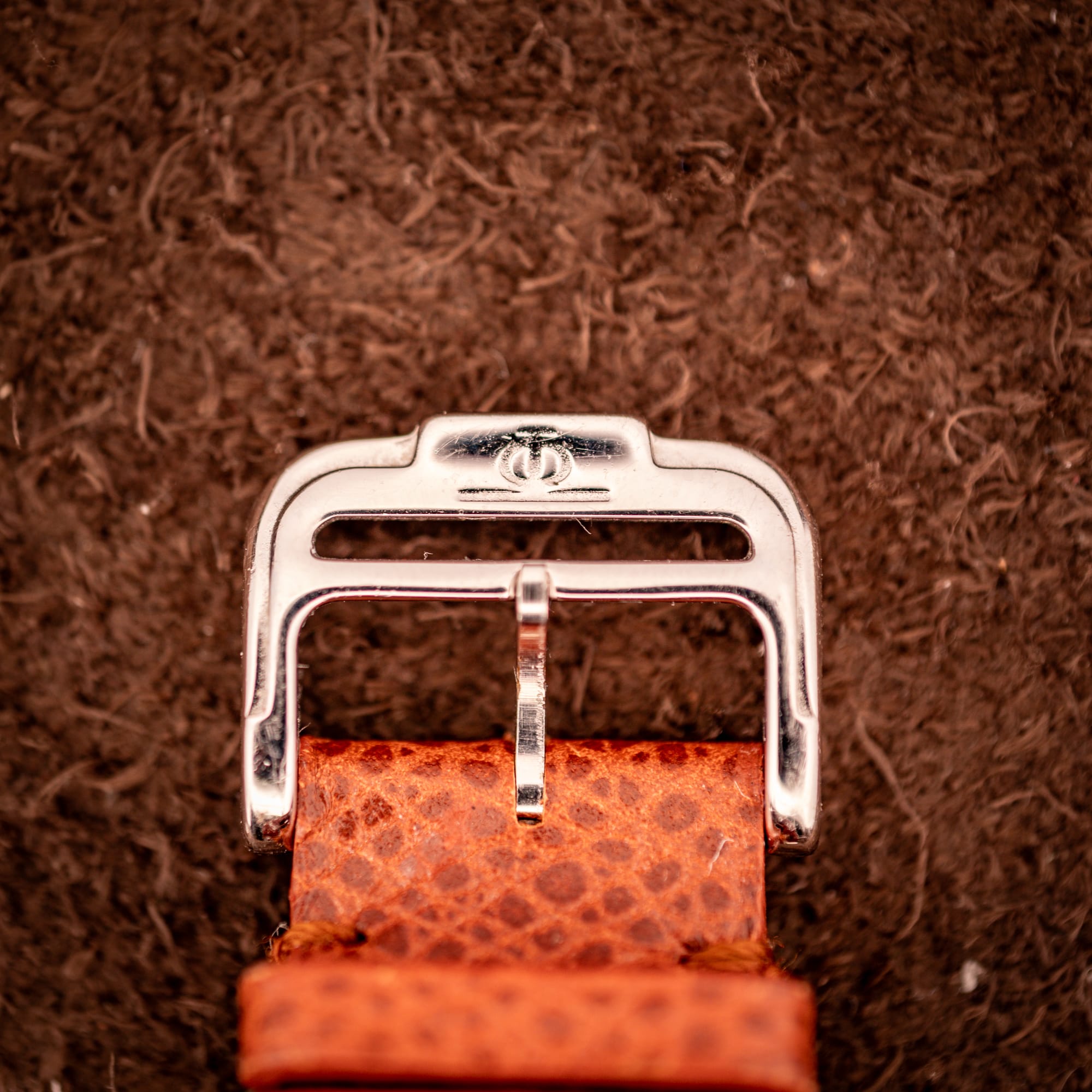
We pair this Baume Mercier Hampton MV045063 on its signed Baume and Mercier brown lizard-grain leather strap, which arrives finished on the original Baume and Mercier signed buckle stamped with the Phi crest. The strap reads as a warm tobacco-cognac against the copper dial and the polished steel case, and the lizard-pattern grain gives the wrist presentation a textured visual interest without competing with the dial’s central role. The strap sizes to a maximum eight-inch wrist and can be re-paired at the buyer’s request if a different leather color reads better for the intended rotation, though the signed buckle is the kind of small originality detail worth carrying forward.
Serviced in-house at OTTUHR and backed by our 2-year warranty, this watch is, for the collector who values Art Deco proportion and dial-as-headline composition over horological complication for its own sake, one of the more genuinely characterful early Hamptons we have had through the door. To us, the combination of the copper dial, the signed Geneva caseback, the petite-seconds layout from a 15-jewel ETA 980.163, and the surviving signed strap and buckle is exactly the kind of quiet, complete vintage Baume and Mercier proposition that disappears from our cases without much warning.