

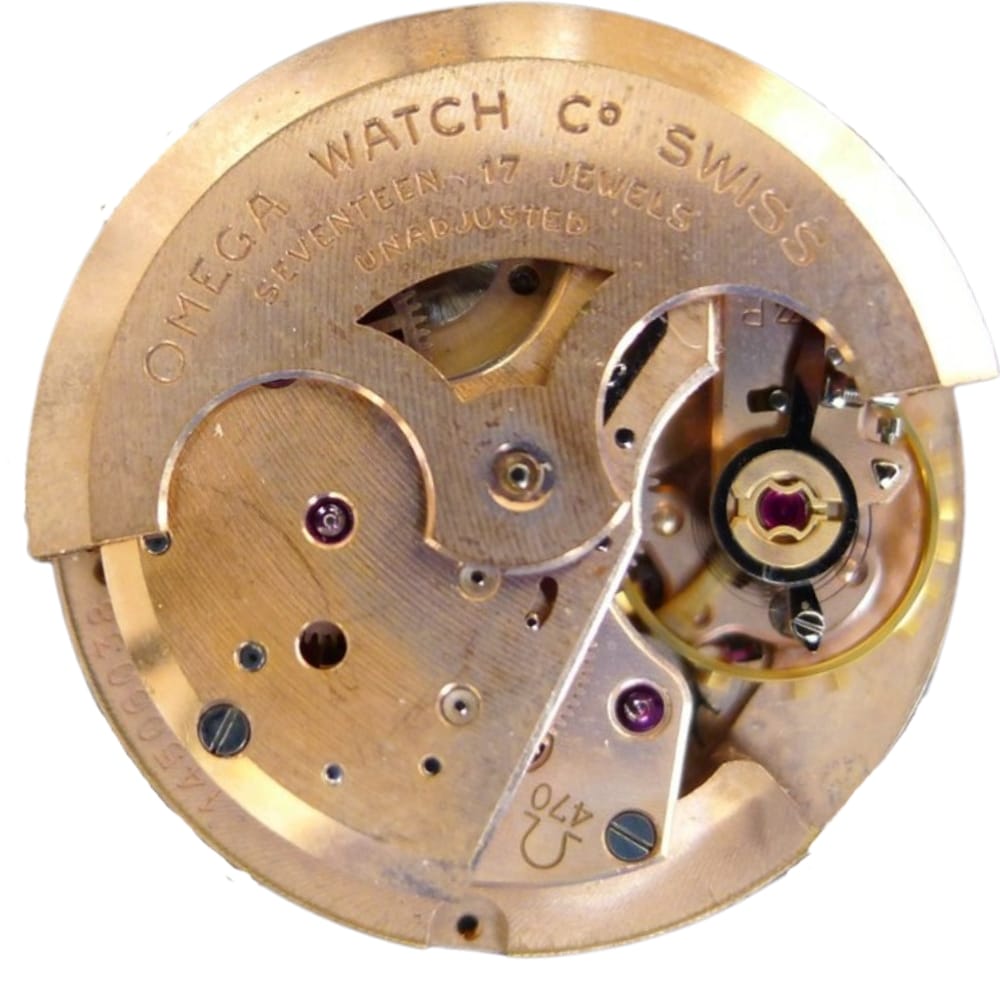
The Omega 470 represents a pivotal moment in Omega’s transition from bumper automatics to modern full-rotor winding systems. Introduced in 1955, this 25mm movement was the first Omega caliber to feature bi-directional automatic winding with a 360-degree oscillating rotor, replacing the inefficient bumper mechanisms that preceded it. While overshadowed by its larger 28mm sibling (the 490) and successor (the 550 series), the 470 laid the technical groundwork for Omega’s dominance in automatic movements through the late 1950s and early 1960s.
The Caliber 470 was developed by Marc Favre, a respected Swiss movement manufacturer, and entered production at precisely the moment when Société Suisse pour l’Industrie Horlogére (SSIH), Omega’s parent company, acquired Marc Favre in 1955. This makes the 470 a semi-in-house movement, designed externally but manufactured under Omega’s direct control. Designer Edouard Schwaar engineered the 470 family with practical considerations in mind: compact dimensions for smaller cases, robust construction for daily wear, and straightforward serviceability. The movement features beryllium bronze (Glucydur) components, Nivarox hairspring technology, and copper-gilt plating over brass plates, delivering chronometer-grade performance in a workmanlike package.
Production data indicates that more than one million units of the 470 family (including the 470, 471, 490, 491, 500, 501, 502, 503, 504, and 505) were manufactured between 1955 and 1960. Based on serial number ranges, the 470 specifically falls within the 14,000,000 to 17,000,000 range, corresponding to production years 1954 through 1960. Assuming proportional distribution across the family and accounting for the 470’s status as the entry-level variant, an estimated 150,000 to 200,000 Caliber 470 movements were produced. This positions the caliber as uncommon rather than rare. Examples surface regularly in the vintage market, though condition varies widely due to the movement’s utilitarian deployment in mid-tier Seamaster references.
Collector interest in the Caliber 470 remains modest compared to chronometer-grade siblings like the 505 or the later 550 series. The 470’s smaller diameter (25mm versus 28mm for the 490/500 family) limits case compatibility, making it less desirable for collectors seeking larger vintage diameters. Market prices for 470-equipped Seamasters typically range from $1,200 to $2,500 depending on condition, with unpolished cases and original dials commanding premiums. Demand is stable but not rising, as collectors prioritize movements with swan-neck regulators, higher jewel counts, or chronometer certification. The 470 serves as an accessible entry point into Omega’s first-generation rotor automatics but rarely achieves collector fervor.
Historical Context, Provenance, and Manufacturing Details
Omega’s transition to full-rotor automatic movements began with a partnership born of necessity and opportunity. By 1953, the limitations of bumper automatics had become apparent: inefficient winding, frequent service requirements, and consumer preference for center-seconds complications that bumpers struggled to accommodate. Omega sought an external solution while developing in-house capabilities, turning to Marc Favre, a Grenchen-based ebauche manufacturer that had successfully supplied Universal Genève with the acclaimed Caliber 260.
Marc Favre delivered the 470 design in 1954, and commercial production began in 1955. Within months, SSIH finalized the complete acquisition of Marc Favre by March 1955, ensuring exclusive access to ongoing development and production capacity. This strategic move positioned the 470 as a transitional caliber: externally designed but manufactured under Omega’s control, bridging the gap between outsourced ebauches and full in-house production.
The Caliber 470 directly replaced Omega’s bumper automatic family, particularly the 330 and 342 calibers that had powered Seamaster production since 1948. The 470 addressed every major shortcoming of its predecessors. The full-rotor design with bi-directional winding required minimal wrist movement to maintain power reserve, making it suitable for sedentary lifestyles. The center-seconds configuration eliminated the need for complex subsidiary dials, aligning with consumer preferences of the mid-1950s. The compact 25mm diameter allowed Omega to produce smaller, more elegant cases while maintaining automatic functionality.
By 1960, the 470 family had proven its worth, but Omega’s engineers had learned enough to refine the design. The successor Caliber 550 series, also developed by Marc Favre under Omega ownership, launched in 1958-1959 with incremental improvements: 1mm thinner profile (4.55mm versus 5.55mm), 4 additional hours of power reserve (50 versus 46), and refined finishing. The 550 effectively replaced the 470 in production by 1960, though service parts continued to be manufactured for years afterward.
Manufacturing took place at Omega’s facilities in Bienne, Switzerland, following the Marc Favre acquisition. The 470 family represented a significant production commitment, with over one million total units manufactured across all variants between 1955 and 1960. This volume placed the 470 among Omega’s most successful automatic calibers of the era, second only to the later 550 and 560 series in total production.
The 470’s place in horological history is that of a foundational workhorse rather than a technical landmark. It did not introduce revolutionary complications or win observatory competitions. Instead, it accomplished something more important for Omega’s commercial success: it provided a reliable, efficient, serviceable automatic movement at a time when automatic winding was transitioning from luxury feature to consumer expectation. The 470 proved the viability of full-rotor designs and established manufacturing processes that Omega would refine throughout the 1960s.
Construction and Architecture
Plate and Bridge Layout: The Caliber 470 employs a traditional three-quarter plate construction with separate cocks for the balance and pallet. The main plate is brass with copper-gilt plating, a decorative treatment that does not contain gold despite its appearance. Four primary bridges secure the gear train: the barrel bridge, train wheel bridge, pallet cock, and balance cock. The automatic winding mechanism mounts on the dial side of the movement in a modular configuration, with upper and lower device bridges securing the rotor assembly. This sandwich construction, common to first-generation rotor automatics, allows the automatic module to be removed independently of the timekeeping train, facilitating service.

Balance Wheel: The 470 utilizes a Glucydur (beryllium bronze alloy) smooth-rim balance wheel approximately 8mm in diameter. The smooth rim lacks adjustment screws, relying instead on factory poising for concentricity. Glucydur’s composition (approximately 98% copper, 2% beryllium) provides high strength when precipitation-hardened, excellent elasticity, and non-magnetic characteristics essential for accuracy in the presence of magnetic fields. The balance features two arms and incorporates the roller jewel for impulse transmission to the escapement.
Balance Spring (Hairspring): A flat Nivarox hairspring provides the oscillating system’s restoring force. The spring terminates at a standard collet friction-fitted to the balance staff, with the outer terminal passing through the regulator pins of an index regulator. The flat spiral configuration (no Breguet overcoil) represents standard mid-grade finishing for the era. Nivarox, a beryllium-nickel alloy, offers temperature compensation when properly paired with a Glucydur balance, maintaining rate stability across typical wearing temperatures of 5°C to 35°C.
Escapement Type: The 470 employs a Swiss lever escapement with jeweled pallet stones. The pallet fork features entry and exit pallet jewels set into the fork, with the pallet staff running in jeweled bearings. The escape wheel is steel, providing the necessary hardness for reliable impulse transmission. This configuration represents standard Swiss practice for the era: proven, reliable, and serviceable with commonly available parts.
Shock Protection System: Incabloc shock protection secures both upper and lower balance staff pivots. The lyre-shaped spring-loaded mounting system allows the jewel settings to deflect under impact, protecting the delicate balance staff pivots from damage during drops or shocks. The Incabloc system employed in the 470 is the standard configuration for mid-grade Swiss movements of the 1950s, using pressed jewel settings rather than gold chatons. Original Omega part numbers for Incabloc components are 1346 (lower complete) and 1347 (upper complete).
Regulator Type: The 470 uses a simple index regulator with micrometric adjustment. Unlike the higher-grade 501, which features a swan-neck (cygne) regulator, the 470 employs a pointer-type regulator with an adjusting screw (part number 1331) and regulator pointer (part number 1332). Some sources reference a two-piece regulator system (part number 1333) with an additional adjusting spring (part number 1356) for fine regulation. This configuration allows watchmakers to adjust rate by moving the regulator pins along the hairspring’s outer coil, effectively changing the spring’s active length. The system provides adequate regulation for adjusted movements but lacks the aesthetic appeal and fine-tuning capability of swan-neck designs.
Mainspring Material and Type: The mainspring is a white alloy automatic mainspring with slipping bridle attachment. Original specifications call for a 1.50mm x 0.060mm x 6.0mm (width x thickness x height) mainspring for the automatic version. The slipping bridle prevents overwinding, allowing the mainspring barrel to slip when fully wound rather than stressing the automatic winding mechanism. This design feature is essential for bi-directional automatic winding systems. Replacement mainsprings are widely available, with Swiss-made Nivaflex versions representing the highest quality option.
Gear Train Details: The 470 employs a four-wheel gear train: barrel, center wheel, third wheel, and fourth wheel (escape wheel). The center wheel drives the cannon pinion (part number 1218 with height 2.56mm or 1219 with height 2.80mm depending on dial thickness). The sweep seconds configuration places the fourth wheel at the center of the movement rather than at a subsidiary position. This required the addition of a sweep second pinion (part number 1250) that rides on top of the center wheel, driven by the sweep second wheel (part number 283). A critical friction spring (part number 1255) provides tension to the sweep second pinion, preventing slack while allowing necessary slip during hand setting. This friction spring is a known weak point: insufficient tension causes jerky seconds hand motion, while excessive tension drains power reserve and reduces amplitude.
Finishing Quality and Techniques: The Caliber 470 represents mid-grade finishing appropriate to its market position. Top surfaces of bridges feature copper-gilt plating with angled edges (anglage), though not polished to mirror finish. The main plate receives circular perlage (circular graining) on the reverse side, a decorative finish that also serves the practical function of trapping dust particles and preventing them from interfering with the gear train. All screws are highly polished with blued heads, demonstrating Omega’s attention to detail even in mid-tier movements. The ratchet wheel and reverser wheel show decent finishing with clear tooth profiles. Jewel settings are pressed rather than chatons, consistent with the movement’s grade. No Geneva stripes (Côtes de Genève) appear on this caliber, as that finish was reserved for higher-grade Omega movements. The overall finishing achieves a 91-104 point rating on a 100-point scale according to independent movement analysis, placing it in the “very good” category for 1950s automatic movements.
Cross-Reference Data
Alternative Caliber Names (Rebranded Versions)
The Caliber 470 was manufactured exclusively for Omega and does not appear under alternative brand designations. Marc Favre produced the movement specifically for SSIH/Omega, and following the 1955 acquisition, no examples were supplied to other manufacturers.
Base Caliber vs. Elaborated Versions
The primary differentiation within the 470 family follows a logical pattern: jewel count indicates grade level, with 17-jewel movements serving as base models and 19-24 jewel versions receiving additional jewels in the automatic winding train and, in some cases, the escapement. The presence or absence of a swan-neck regulator distinguishes adjusted movements (501, 505) from unadjusted versions (470, 471, 490, 491, 500).
Compatible Case References by Brand
The “SC” suffix in Omega case references stands for “Seconde au Centre” (center seconds), distinguishing sweep-second models using the 470 from potential sub-second variants that would have used the 490 or 491. Case interiors typically display the full reference including suffix, case material codes, and case maker marks such as “CB” for Centrale Boîtes.
Dial Compatibility
Dial foot positions for the Caliber 470 follow the 25mm movement standard. The compact diameter limits dial size to approximately 27.4mm, suitable for cases in the 32-34mm range. Dials designed for the 470 feature dial feet positioned at approximately 10 and 4 o’clock when viewing the dial from the front. The center-seconds configuration requires dial foot placement that accommodates the cannon pinion at 2.56-2.80mm height.
Collectors and restorers should note that 470 dials are not interchangeable with the larger 28mm 500-series calibers despite shared design language. The 3mm diameter difference means 500-series dials (typically 30mm) will not fit 470 movements without modification. Original 470 dials frequently feature applied metal indices, printed “Omega Automatic Seamaster” text, and luminous plots at hour positions. The compact dial size often results in tighter spacing of design elements compared to larger siblings.
Crown and Stem Specifications
The TAP 10 stem specification became Omega’s standard through the 1950s and 1960s, ensuring wide parts compatibility across multiple calibers. Generic replacement stems are available, though original Omega stems feature superior finishing and precise hub dimensions that improve setting feel.
Identification Marks
Caliber Number Location
The caliber designation “470” is stamped on the main plate visible through the balance cock cutout. The number typically appears in a recessed area adjacent to the serial number, using a sans-serif font consistent with Omega’s 1950s marking standards. Some movements may show the caliber number on the train wheel bridge rather than the main plate, depending on production period.
Logo and Brand Marks
Authentic Caliber 470 movements display “OMEGA WATCH CO.” on the rotor, along with “Swiss” and the jewel count “Seventeen (17) Jewels”. The rotor bears distinctive pink-gold colored plating, achieved through copper-gilt treatment over the brass base. The Omega logo (Ω) typically appears stamped into the rotor, though early examples may use the full text “OMEGA” without the symbol.
The main plate reverse (dial side) should show “OMEGA” markings, though these are often obscured by the dial during normal viewing. No quality grade stamps (“Adjusted,” “Chronometer,” etc.) should appear on the 470, as this base model did not receive observatory testing or adjustment beyond standard factory regulation.
Date Codes
Omega did not employ date codes on the Caliber 470. Production dates must be determined via movement serial number cross-referenced against Omega’s production records.
Finishing Marks
Expected finishing patterns include circular perlage on the main plate reverse, visible when the movement is removed from the case. Bridge surfaces show copper-gilt plating with brushed or fine-grained texture, not mirror-polished. Screw heads display blued finish with polished slots, though service replacements may show unblued steel.
The absence of Geneva stripes, sunburst patterns on the rotor, or mirror-polished anglage helps confirm the 470’s mid-grade positioning. Higher-grade movements in the same family (particularly the 505) feature swan-neck regulators and additional decorative finishing that the 470 lacks.
Jewel Markings
The 470 employs pressed jewel settings throughout, lacking the gold chatons characteristic of higher-grade movements. Jewel holes should appear clean and circular with minimal play. The Incabloc shock jewel settings display the characteristic lyre-shaped spring, with “Incabloc” typically marked on the spring itself. Jewels are synthetic ruby, standard for Swiss movements of this era.
Adjustment Markings
The base Caliber 470 received no formal adjustment or chronometer certification. Movements should not display adjustment markings such as “Adjusted 5 Positions,” “Chronometer,” or temperature compensation indicators. The presence of such markings would indicate either fraudulent engraving or confusion with higher-grade variants (501, 505) that did receive certification.
Correct Serial Number Formats and Locations
Movement serial numbers appear stamped into the main plate, typically visible beneath the balance cock or on the train wheel bridge. Serial numbers for the 470 fall within the following ranges based on production years:
| Serial Number Range | Production Year |
|---|---|
| 14,000,000 – 14,999,999 | 1954-1955 |
| 15,000,000 – 15,999,999 | 1956 |
| 16,000,000 – 16,999,999 | 1958-1959 |
| 17,000,000 – 17,999,999 | 1959-1960 |
Serial numbers consist of eight digits with no letters or prefixes. The first production 470 movements appeared in late 1954 or early 1955, corresponding to serial numbers in the 14.5 million range. Final production examples from 1959-1960 show serial numbers approaching 17 million.
Expected Engravings and Stampings
Authentic movements display sharp, deeply struck stampings with consistent font style across all markings. The caliber number, serial number, and brand text should show uniform depth and clarity. Weak, shallow, or inconsistent stampings suggest refinishing, replacement plates, or counterfeit components.
Original Omega engravings employ a serif font for numbers and sans-serif capitals for text, consistent across 1950s production. The rotor signature uses a script-style “OMEGA WATCH CO.” marking that differs from the block text used on plates and bridges.
Font and Marking Style by Production Era
The Caliber 470’s five-year production run shows minimal font variation, as Omega maintained consistent marking practices through the late 1950s. Early examples (1955-1956, serial numbers 14.5-15.9 million) may display slightly bolder font strokes compared to later production (1958-1960, serial numbers 16-17 million), reflecting gradual changes in stamping die wear and replacement.
The transition from text “Omega” to the Ω symbol on rotors occurred gradually through the 1950s, with both styles appearing on 470 movements depending on production batch. This variation does not indicate authenticity issues; rather, it reflects parts inventory depletion and replacement at Omega’s facilities.
Part Information

Part Numbers and Interchangeability
The following tables list critical components for the Caliber 470, including original Omega part numbers and interchangeability notes with related calibers in the 470 family.
Movement Structure and Bridges
Automatic Winding Components
Winding and Setting Mechanism
Mainspring and Barrel
Gear Train
Escapement
Balance and Regulator
Shock Protection
Jewels (Press-Fit Type)
Sourcing Notes
Currently Available Parts: Most consumable and high-wear components for the 470 remain available from specialized vintage watch parts suppliers. Mainsprings, balance staffs, Incabloc components, stems, crowns, and general winding mechanism parts are stocked by major distributors including Ofrei, Cousins UK, Watch Material, and Perrin. Original Omega parts command premium prices ($30-60 for mainsprings, $40-90 for balance staffs) but ensure correct specifications and fit.
Commonly Failed Components: The sweep second pinion friction spring (part 1255) ranks as the most frequent failure point. This thin brass spring loses temper over time, causing either insufficient tension (jerky seconds hand) or excessive tension (power loss, reduced amplitude). Replacement springs require careful tension adjustment during installation to avoid recurrence.
Barrel arbor bushings (upper and lower) wear oval due to steel-on-brass contact, particularly in movements that have run extended periods without service. Bushing replacement requires lathe work to precisely fit new brass bushings into the main plate, a task beyond basic watchmaking capabilities but well within the skillset of competent movement restorers.
The sweep second pinion (part 1250) itself is discontinued by Omega but remains available from aftermarket sources. The critical specification is height (5.43mm), which determines proper engagement with the sweep second wheel and clearance beneath the dial.
Generic Replacements: Mainsprings accept Swiss-made Nivaflex replacements from any competent spring supplier, specified by width (1.50mm), thickness (0.060-0.065mm), and length (216mm for automatic, 455mm if converting to manual wind). Balance staffs can use generic Incabloc-compatible replacements if Omega originals are unavailable, though fitting requires precise measurement of pivot diameters and collet dimensions.
Stems and crowns universally accept TAP 10 (0.90mm thread) generic replacements. However, collectors restoring high-value examples should source period-correct Omega signed crowns for authenticity.
Performance Data
Manufacturer Specifications
Accuracy (New): Omega specified no formal accuracy standard for the base Caliber 470, as it received no chronometer certification or observatory adjustment. Factory-fresh examples would have left Omega’s facilities running within ±10-15 seconds per day across positions typically encountered during wearing. This positions the 470 as a standard-grade movement, adequate for commercial timekeeping but not precision instrument status.
Positions Tested: The 470 received basic factory regulation in dial-up and dial-down positions only. Unlike adjusted or chronometer-grade movements that undergo testing in five or six positions (dial up, dial down, crown up, crown down, crown left, crown right), the 470’s regulation consisted of rate adjustment for acceptable timekeeping in normal wearing positions. This simplified regulation process reduced manufacturing cost and cycle time, appropriate for the caliber’s market positioning.
Temperature Compensation: The Glucydur balance and Nivarox hairspring combination provides passive temperature compensation across typical wearing temperatures (5°C to 35°C). The materials’ complementary thermal expansion coefficients naturally offset rate variations that would otherwise occur as temperature changes. However, Omega did not subject the 470 to formal temperature testing at 4°C, 20°C, and 36°C as required for chronometer certification. Individual movements received no temperature adjustment beyond the inherent compensation provided by materials selection.
Isochronism: The 470’s flat hairspring and simple index regulator limit isochronism adjustment capabilities. Watchmakers can achieve acceptable isochronism (minimal rate variation between full wind and depleted power reserve) through careful mainspring selection and regulator positioning, but the movement lacks the fine-tuning capability of swan-neck regulated variants. Amplitude should remain relatively stable across the power reserve, dropping from 280-300 degrees when fully wound to 220-240 degrees at the 36-hour mark, below which accuracy degradation accelerates.
Observed Performance (Field Data)
Typical Accuracy Range: Well-maintained examples serviced with fresh lubricants and properly adjusted regulators typically achieve ±5-10 seconds per day in normal wearing positions. This represents excellent performance for a 70-year-old movement and rivals or exceeds modern ISO chronometer standards for mechanical watches. Examples running ±3-5 seconds per day exist but represent the upper end of performance rather than typical results.
Common Performance Issues: The most frequent complaint involves erratic timekeeping or sudden rate changes traced to improper sweep second pinion friction spring tension. Insufficient tension causes the seconds hand to jump or hesitate rather than sweep smoothly. Excessive tension loads the gear train, reducing amplitude below 200 degrees and causing the watch to gain time significantly or stop entirely. Correct tension adjustment during service is critical for stable performance.
Worn barrel arbor bushings create excessive endshake, allowing the barrel to tilt and rub against the main plate or barrel bridge. This manifests as intermittent running, position-sensitive rate variations, or complete stoppage when the watch is oriented in specific positions. The issue worsens progressively as wear increases, eventually requiring bushing replacement to restore proper operation.
Dried or contaminated lubricants produce the predictable degradation pattern common to all mechanical movements: increasing rate gain as pivot friction increases, reduced amplitude, and eventual stoppage. The 470 uses standard Swiss watch oils (Moebius 9010 for barrel arbor and gear train, 9415 for pallet stones, 9020 for balance cap jewels), and service intervals of 5-8 years maintain performance. Extended service intervals beyond 10 years invite accelerated wear and potential part failure.
Amplitude Characteristics: A properly serviced 470 with fresh mainspring should achieve 280-300 degrees amplitude when fully wound, measured dial-up on a timing machine. This drops to 260-280 degrees during typical wearing (equivalent to half-wind state) and declines to 220-240 degrees as the power reserve depletes toward the 40-hour mark. Amplitude below 200 degrees indicates insufficient mainspring strength, excessive friction from dried lubricants, or mechanical interference requiring diagnosis.
Position-dependent amplitude variations of 30-50 degrees are normal for movements of this grade. Crown-up and crown-down positions typically show lower amplitude than dial-up/dial-down due to increased friction from gravity acting perpendicular to the balance staff pivots. These variations translate to rate changes of 5-15 seconds per day between positions, which average out during normal wearing.
Age-Related Degradation: The 470’s performance degrades predictably with age and wear. Movements approaching or exceeding 10 years since last service display progressively increasing rates (gaining time) as lubricants dry and pivot friction increases. The rate gain accelerates as oil migration concentrates remaining lubricants in the center of pivots rather than at friction surfaces.
Magnetization represents a growing concern for vintage movements as exposure to modern electronic devices (smartphones, tablets, magnetic clasps) accumulates over decades. Magnetized balance springs display erratic rate behavior, usually gaining time significantly and inconsistently. Demagnetization using a dedicated demagnetizer restores normal performance without requiring disassembly.
Shock damage from drops or impacts can bend hairspring coils, distort balance wheel concentricity, or damage balance staff pivots despite Incabloc protection. These issues produce sudden, dramatic rate changes or complete stoppage and require movement disassembly for diagnosis and repair.
Long-Term Reliability: The Caliber 470 demonstrates good long-term reliability when properly maintained. The robust construction, generous pivot sizing, and conservative power density (no high-frequency complications or extreme torque demands) allow properly serviced examples to run reliably for decades. Critical wear points—barrel arbor bushings and sweep second friction spring—can be addressed during routine service before they cause cascading damage to other components.
Collectors and owners should recognize that 70-year-old movements require realistic expectations. Original specifications stated 46 hours power reserve, but aged mainsprings and accumulated wear typically reduce this to 38-42 hours. Accuracy exceeding ±10 seconds per day represents good performance for an unrestored vintage movement; achieving Swiss chronometer standards (±4-6 seconds per day) requires professional regulation and sometimes component replacement.