

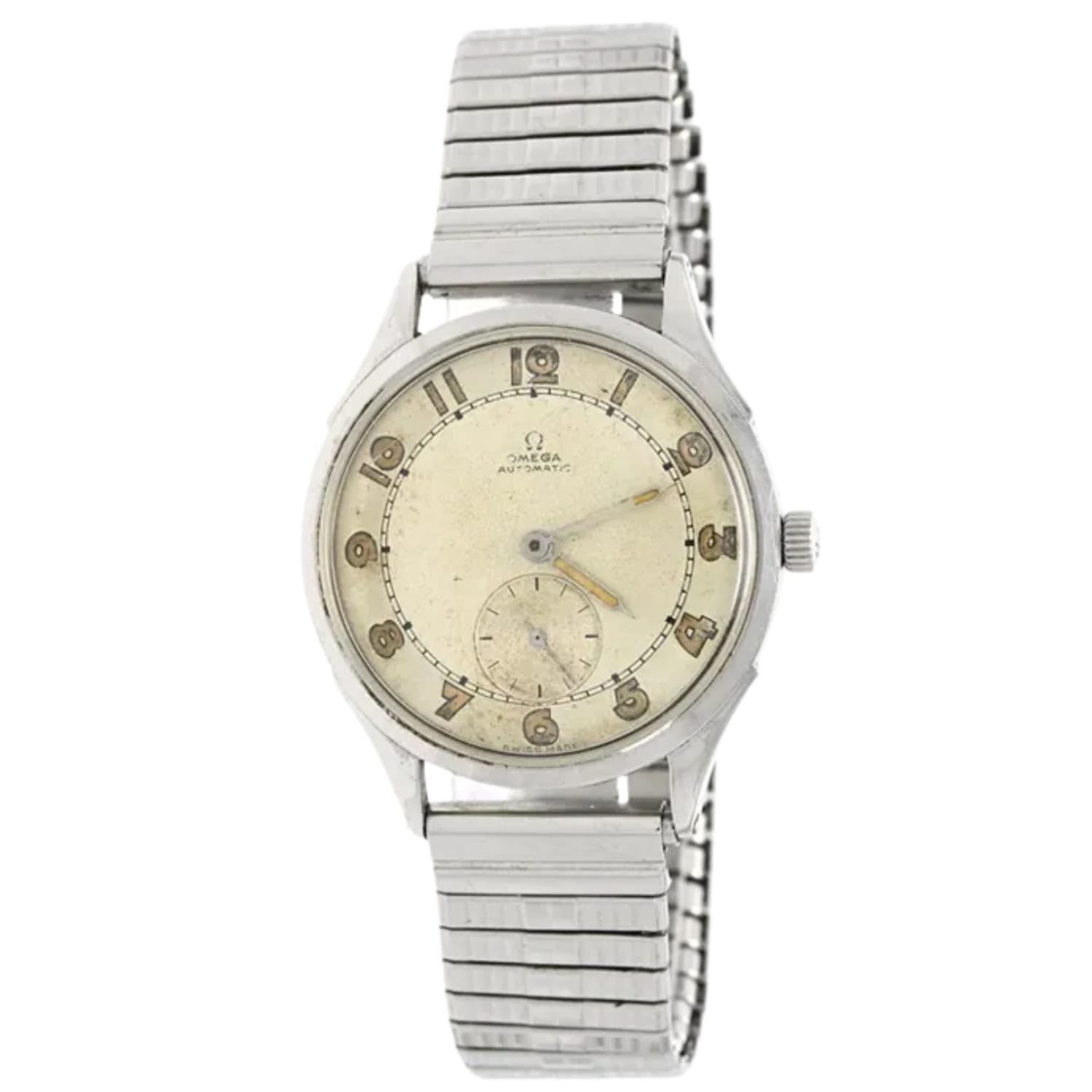
The Omega 2638 represents one of the most significant and influential automatic watch designs from the post-war era, exemplifying Swiss horological innovation during the crucial 1948-1960s period. As a subsecond variant of Omega’s oversized automatic collection, the 2638 occupied a pivotal market position between the brand’s entry-level and premium offerings. This reference enjoyed extended production spanning over a decade with numerous caliber iterations and dial variations, making it both a common sight in vintage collections and a reference point for serious enthusiasts studying 1950s watchmaking standards.
Historical Context and Production Timeline
Omega introduced the reference 2638 in 1948 as part of its expanded automatic watch lineup following the post-World War II economic recovery. The company had pioneered the bumper-style automatic mechanism beginning in 1943 with the caliber 28.10 RA PC, and by the late 1940s possessed the technical maturity to produce reliable, affordable automatics in volume. The 2638 inherited this mechanical legacy while positioning itself as an oversized alternative to Omega’s standard 33-34mm dress watches of the era.
Production continued through the 1950s and extended into the early 1960s, with documented examples dating from 1949 through at least 1958. The reference experienced gradual mechanical refinement during its lifespan, with earlier examples powered by the caliber 332 bumper movement, transitioning through calibers 342 and 344 as manufacturing standards evolved. This extended production run reflected steady market demand for Omega’s reliable, modestly-priced automatics at a time when Swiss watchmaking dominated global markets.
Technical Specifications
Case Dimensions and Construction
The Omega 2638 presents what collectors term an “oversized” or “jumbo” case profile for its era, measuring 35 mm in diameter (excluding crown) and approximately 43 mm from lug tip to lug tip. Case thickness typically ranged from 7-8 mm, presenting a profile that appeared noticeably larger on wrists than conventional 33-34mm dress watches of the period. This dimensional advantage proved instrumental in the watch’s market success, as it provided enhanced dial legibility and a more substantial feel without crossing into sports watch territory.
The case architecture featured downturned lugs with sharp, well-defined edges—a hallmark of 1950s design sensibilities. The lugs measured approximately 18mm in width, accommodating standard leather straps of the era. Most production versions featured an acrylic (plexiglass) crystal with no manufacturer signature, though some higher-grade examples may have retained signed crystals. The caseback employed a screw-down design with a twist-lock mechanism, representing a significant improvement over the earlier friction-fit snap-back cases used on the preceding reference 2584.
The crown received factory-signed “OMEGA” markings on most examples, though examples with worn or replaced crowns exist within the vintage population. The case featured no crown guards—a period-appropriate characteristic reflecting the dress watch classification rather than tool watch design philosophy.
| Specification | Measurement |
|---|---|
| Case Diameter (excl. crown) | 35 mm |
| Lug-to-Lug Distance | 43 mm |
| Case Thickness | ~7-8 mm |
| Lug Width | 18 mm |
| Crystal Material | Acrylic (plexiglass) |
| Caseback Type | Screw-down (twist-lock) |
| Water Resistance | Minimal (non-sealed design) |
Case Materials and Variations
The reference 2638 appeared in multiple case material options, reflecting Omega’s market segmentation strategy:
Stainless Steel represented the most common material, comprising the vast majority of production examples. These cases maintained unpolished finishes on most examples, allowing the original surface texture and sharp lug definitions to age naturally over decades.
14 Karat Gold constituted a significant secondary market offering. Examples in solid 14K yellow gold exist with documented provenance from the 1949-1951 period, commanding considerably higher prices than their steel counterparts. These gold examples typically featured champagne or two-tone dials with applied numerals and displayed different aging characteristics than steel versions.
Gold-Filled Variants appear in the market with varying reliability of attribution. Some examples labeled as gold-filled or gold-cap construction require careful authentication, as gold-filled material from this era can deteriorate, potentially revealing base metal underneath.
18 Karat Gold examples likely exist but remain poorly documented in modern literature, suggesting either limited production or confusion with other references in collections.
Automatic Movements: The Bumper Mechanism
The Omega 2638 stands as a canonical example of the bumper-style automatic mechanism, a technology that dominated Swiss watchmaking from the mid-1940s through the 1950s. Unlike Rolex’s 1931-patented full-rotor system, which rotates continuously in a complete 360-degree circle, the bumper mechanism employed a weighted hammer that oscillated within an arc of approximately 200-270 degrees, bouncing against spring bumpers at either end. This less efficient system nonetheless powered millions of watches and remained surprisingly popular even after competing brands introduced superior full-rotor designs.
Caliber 332 powered the earliest 2638 examples from approximately 1948-1951. This bumper automatic featured 17 jewels (an early-production standard) and delivered approximately 40-45 hours of power reserve under full wind. The movement displayed visible bumper mechanics through appropriate caseback openings on many examples, providing an interesting contrast to modern closed-back designs.
Caliber 342 represented an incremental upgrade introduced around 1949-1952, offering improved reliability through refined gear train designs and optimized spring tension. This 17-jewel bumper movement featured nearly identical specifications to the 332 but proved slightly more durable in long-term service. Examples powered by the 342 represent a significant proportion of surviving 2638 watches in the vintage market.
Caliber 344 succeeded the 342 from approximately 1952 onwards, introducing further refinements to the bumper mechanism and mainspring housing. This movement maintained the 17-jewel standard but reduced wear points through improved manufacturing tolerances.
Caliber 267 appears in documented examples from the late 1950s, representing a different mechanical approach within the same reference family. The presence of this movement in some 2638-4 variants suggests Omega’s flexibility in movement selection during the later production years.
All bumper movements featured hand-winding capability for initial setup and emergency operation, though the automatic mechanism served as the primary power source. The movements operated at 21,600 beats per hour (3 Hz vibration frequency), a standard that allowed acceptable timekeeping accuracy for dress watches of the era. Regulated examples typically achieved ±15-30 seconds per day, acceptable performance for instruments of this class before chronometer standards became universal.
| Caliber | Years | Jewels | Power Reserve | Features |
|---|---|---|---|---|
| 332 | 1948-1951 | 17 | ~40-45 hrs | Early bumper design |
| 342 | 1949-1952 | 17 | ~42 hrs | Refined gear train |
| 344 | 1952-1960s | 17 | ~42 hrs | Improved tolerances |
| 267 | Late 1950s | – | ~40 hrs | Alternative option |
Dial Design and Variations
The Omega 2638 dial represents the company’s pragmatic approach to manufacturing efficiency combined with aesthetic restraint. Rather than employing ornate design elements, Omega embraced minimalist decoration that emphasized legibility while maintaining visual elegance appropriate to the dress watch category.
Dial Color Variations
Champagne and Cream Tones dominated production, appearing on approximately 60-70% of surviving examples. These warm-toned dials displayed consistent radium lume aging that darkened to cream or pale yellow hues over decades, creating a homogeneous, aged patina that collectors find particularly desirable. The cream coloring resulted from a combination of metallic base layer and applied surface finish rather than monolithic material construction.
Two-Tone Dials represent the second-most common variation, featuring contrasting gold-toned and white or silver-toned sections typically separated by the applied indices. These dials created visual interest while maintaining functional legibility. The two-tone construction allowed Omega to utilize the same case across different price points, with two-tone dials appearing on premium examples and steel cases.
Silver or White Dials appeared less frequently but remain documented in period marketing materials and surviving examples. These white-enameled dials provided maximum contrast for legibility while presenting a cooler aesthetic than champagne versions. Examples with uncompromised original white dials command premium prices, as original white enamel resists aging less gracefully than other finishes.
Black Dials appear extremely rarely, likely representing special orders or regional market variants. Genuine original black examples remain highly sought within the vintage community.
Hour Markers and Text
The 2638 employed several marker styles across its production span:
Arabic Numerals at 3, 6, 9, and 12 o’clock positions appeared on many examples, providing maximum legibility and period-appropriate styling. These numerals utilized applied metal construction on premium examples, appearing in the same tone as applied indices. On some champagne dials, numerals displayed radium lume application.
Applied Index Markers in various configurations supplemented or replaced numerals on certain variants. Stick indices, pyramid shapes, and faceted applied elements appeared across the production span, reflecting gradual design refinements.
Baton Indices (simple rectangular markers) appeared on more austere examples, emphasizing utilitarian design philosophy.
The Omega Logo and Text typically appeared in one of two locations: centered below 12 o’clock, or offset to allow space for complications. The logo featured the distinctive Omega symbol with “AUTOMATIC” inscription beneath on all bumper examples. “SWISS MADE” text appeared at 6 o’clock, a legal requirement after Swiss watchmaking regulation standardization.
Subsecond Dial (Small Seconds)
The distinguishing feature of the 2638, differentiating it from the companion 2637 (center-second model), manifested as a small subsecond dial positioned at 6 o’clock. This auxiliary dial measured approximately 6-8mm in diameter and featured its own concentric track for the seconds hand. The subsecond hand typically employed a thin syringe or stick design, contrasting with the broader main hands. Radium lume appeared on subsecond hand tips on many examples, though some austere versions omitted lume on the seconds hand.
The subsecond dial provided aesthetic interest while serving practical purpose—the seconds hand remained visible even when partially obscured by the minute hand, improving practical timekeeping observation.

Omega Reference 2638 Dial Variations
Original Hand Styles
Syringe Hands (barrel-shaped with needle tips) appeared on numerous examples, particularly earlier production circa 1948-1952. These hands provided excellent legibility and remained popular even after Omega transitioned to alternative styles. The syringe configuration proved particularly effective on white dials, where the thin needle tip contrasted sharply against the background.
Dauphine Hands (tapered Delta or diamond-shaped) represented the most common hand style across production, particularly on 1950s examples. These faceted hands captured light elegantly, creating visual depth that enhanced dial perception. Dauphine hands appeared in both steel and applied rose-gold finishes, with the applied gold versions appearing primarily on gold-cased examples.
Baton Hands (simple rectangular elements with slight taper) appeared on later examples and more austere variants.
Original hand configurations remain subject to significant variation based on market segment and production date, making hand authenticity assessment crucial for determining dial originality.
Reference Variations and Sub-Types
The Omega 2638 reference family encompasses numerous numbered variants, each representing subtle changes in movement, dial, or case finish:
2638-1 represents documented early production from approximately 1949, typically featuring two-tone dials and caliber 332 movements. These examples command collector premium prices due to their rarity and documented early-production status.
2638-3 appears in literature referring to specific movement/case combinations, though detailed specifications remain scattered across collector documentation.
2638-4 emerged in mid-1950s production and appears associated with both caliber 342 and caliber 267 movements. Dealer listings reference certain 2638-4 examples as “Sei Tacche” variants, though this term more accurately applies to Longines watches with screw-back notches. Some 1958-dated examples bear this designation.
2638-9 designates specific champagne dial variants dated to the 1952 era, suggesting Omega’s internal classification system for tracking dial variations.
Each numbered variant reflected Omega’s manufacturing flexibility, allowing the company to produce different movement/case/dial combinations from common components while maintaining reference integrity for warranty and service purposes.

Omega 2637 (Center Second) vs. 2638 (Subsecond) Comparison
Companion Reference: The 2637 (Center-Second Model)
The reference 2637 occupied parallel market position to the 2638 with one fundamental distinction: the location of the seconds hand. Whereas the 2638 positioned seconds on a subsecond dial at 6 o’clock, the 2637 featured a center-mounted seconds hand sharing the main hand axis. This design choice reflected market segmentation—some customers preferred the traditional center-seconds configuration despite the partial obscuration by the minute hand.
The 2637 employed identical case dimensions (35 mm diameter, 43 mm lug-to-lug), identical movements (332, 342, 344 bumper automatics), and comparable dial designs to the 2638. Production timelines overlapped, with both references appearing simultaneously on period price lists. Some evidence suggests the 2637 outsold the 2638 in certain markets, though comprehensive production figures remain elusive.
Both references represented Omega’s premium positioning within the automatic lineup—they commanded prices above standard 33-34mm dress watches while remaining accessible to middle-class consumers across Europe and North America. The existence of both variants suggests manufacturers understood that aesthetic preferences (center seconds vs. subseconds) represented significant purchasing criteria even among value-conscious buyers.
Dial Presentation and Original Characteristics

Omega Reference 2638 Technical Specifications Card
Radium Lume: The Luminescence Question
Radium lume appears on most 2638 examples, though application extent varied considerably. Applied to hour marker numerals and hand tips, radium provided luminescence for low-light reading—a significant functional advantage in an era preceding advanced artificial lighting in homes. The luminous material appears as cream or pale yellow coloration on aged examples, the result of decades of radioactive decay converting the original bright white lume to an orange-brown tone that subsequently faded to pale cream.
Contrary to common misconception, radium lume on vintage watches poses negligible health hazard under normal handling conditions. The radioactive emission remains effectively contained within the luminous material and caseback shielding, with no significant exposure during normal wearing or service. However, professional servicing requires appropriate precautions, and modern aftermarket replacements using tritium or Super-LumiNova have become standard practice.
Case Back Markings and Serial Numbers
The screw-back caseback typically displays:
- Movement serial number engraved into the movement baseplate (visible through the caseback), providing the primary method for dating the watch within 1-2 years of production.
- Reference number (2638-variant) printed or stamped on the case back inner surface
- Case material hallmarks (925 stamps for stainless steel, 14K or 18K stamps for gold examples)
- Manufacturing evidence such as assembly technician initials or quality control marks
The reference number marking allows authentication and identification of the specific production variant, crucial information for collectors assessing originality.
Identifying Original and Replacement Parts
The vintage Omega 2638 has survived for 70+ years, and the majority of surviving examples contain some period-appropriate replacement components. Distinguishing original factory components from period-correct replacements represents essential collector knowledge:
Original Features
Original Signed Crown displays “OMEGA” marking and matches period photographs from Omega marketing materials. Early examples (1948-1950) occasionally featured slightly different crown dimensions than later versions.
Original Acrylic Crystal lacks manufacturer signature and displays minimal damage beyond light scratching. Many original crystals remain remarkably clear despite seven decades of wear. Signed crystals (stamped “OMEGA”), while sometimes observed, appear less frequently than unsigned versions.
Original Hands display period-appropriate patina matching lume aging on the dial. Syringe and Dauphine hands showing matched aging across all three hands (hour, minute, seconds) suggest originality. Replaced hand sets often display inconsistent aging or lume discoloration across the set.
Original Dial presents consistent aging and patina across all elements. The radium lume aging should progress consistently from numerals through marker edges. Evidence of overpainting, flaking enamel, or non-uniform patina suggests dial refinishing or replacement.
Original Movements display serial numbers consistent with the reference date and should be mechanically sound. The bumper mechanism visible through the caseback should show appropriate wear patterns rather than recent polishing.
Common Replacements
Replacement Crowns represent the most frequently replaced component due to normal wear and accidental damage. Period-appropriate Omega crowns from the 1950s-1960s remain available, though identification requires comparison with documented originals.
Replacement Crystals occur frequently due to breakage and optical degradation. Modern acrylic replacements visually approximate original materials but may display slightly different refraction properties.
Service-Installed Components including mainspring, hairspring, and bearing assemblies underwent planned replacement during factory service intervals. These replacements should bear factory markings indicating Omega service origin rather than unauthorized aftermarket components.
Dial Refinishing remains the most contentious replacement category. Professional dial restoration has become increasingly sophisticated, making authentication difficult. Characteristics of original versus refinished dials include:
- Original dials typically display uneven patina reflecting natural aging
- Refinished dials often present uniform appearance lacking the subtle degradation of authentically aged examples
- Applied indices and numerals on original dials show wear patterns around edges; refinished examples display pristine uniformity
- Radium lume aging on original dials presents characteristic warm cream coloration; refinished dials with reproduction lume may display different color properties
Market Significance and Collectibility
The reference 2638 occupies an important niche in vintage watch collecting, serving simultaneously as an entry point for newcomers and a refined example for advanced enthusiasts. Its approximately 12-15 year production span generated substantial numbers, ensuring ready availability while the technical soundness of the bumper mechanism ensures that most examples remain functional without catastrophic component failure.
Recent market pricing for 2638 examples varies significantly based on condition, originality, and case material:
Stainless Steel Examples in good condition with original dial typically command $800-1,500 USD depending on dial rarity and movement variant.
Gold-Cased Examples in 14K yellow gold trade at $1,200-2,500 USD, with premium examples featuring exceptional dial condition or documented provenance commanding higher multiples.
Exceptional Examples featuring rare dial variants, documented early production (2638-1), or comprehensive originality may exceed $3,000-4,000 USD.
These price points position the 2638 as accessible to collectors of modest means while remaining sufficiently valuable to justify conservation efforts and professional service for valuable examples.
Conclusion
The Omega reference 2638 stands as a testament to mid-20th century Swiss watchmaking pragmatism and manufacturing sophistication. Operating at the intersection of affordability and technical excellence, it served the practical needs of professional and consumer markets for nearly two decades. Its oversized 35mm case, reliable bumper automatic movements, and elegant dial designs established aesthetic standards that influenced subsequent generations of watch design.
For contemporary collectors, the 2638 offers exceptional value—a fully functional, historically significant timepiece requiring only modest financial investment and readily available for acquisition. Its extended production run and multiple variants provide endless opportunities for focused collection, whether pursuing movement variants, dial rarities, or case material combinations. The reference remains a worthy subject for serious horological study, exemplifying how successful design transcends technological obsolescence through combination of sound engineering, measured aesthetics, and manufacturing reliability.