

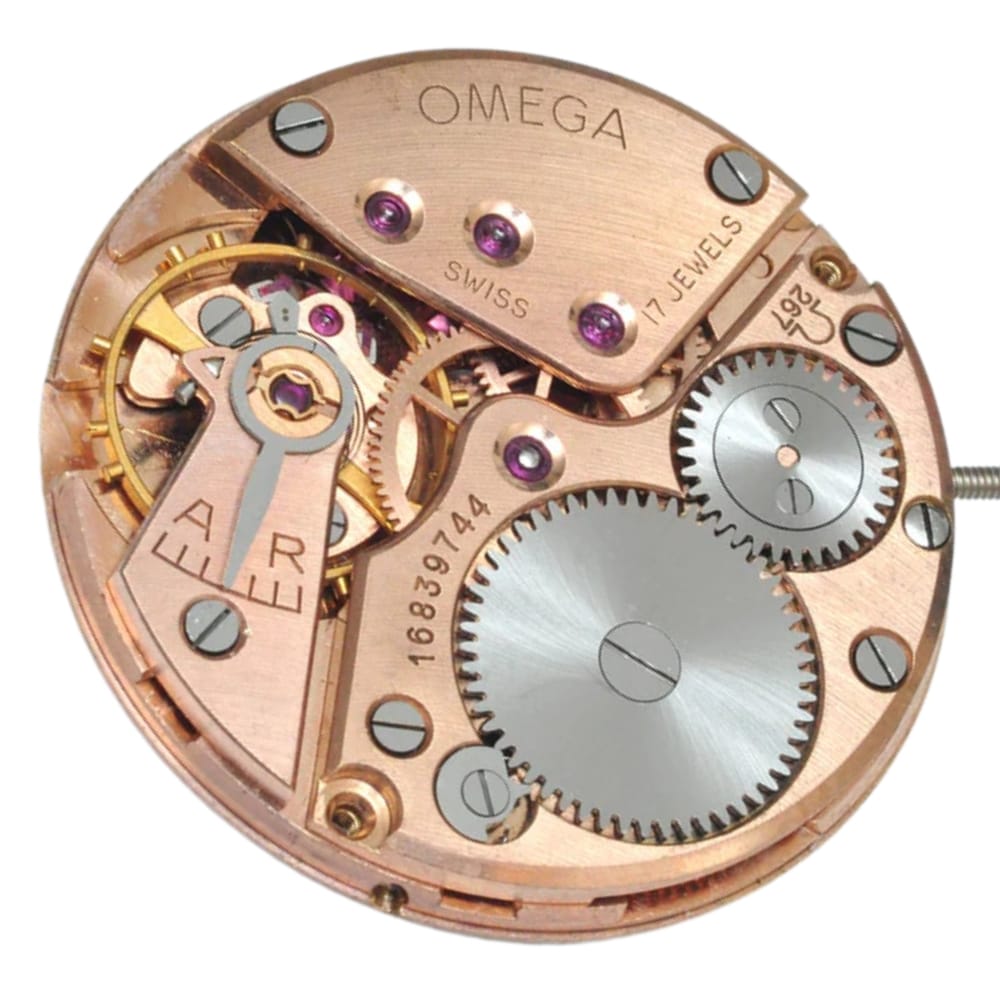
The Omega caliber 267 represents a refined iteration within the legendary 30mm movement family, occupying a specific position as a 17-jewel, antimagnetic, jewelled-center-wheel variant designed for dress watches and early Seamaster models during the peak of mid-century mechanical watchmaking. Introduced after Omega’s 1949 nomenclature reorganization, the 267 shares the proven architecture of the 30T2 platform that dominated observatory chronometry trials throughout the 1940s and early 1950s, while incorporating enhancements that positioned it above the base 15-jewel variants but below the exotic chronometer-grade movements.
As part of the 30mm series that powered everything from military-issued timepieces to elegant gold dress watches, the 267 served Omega’s mid-tier market, the segment requiring more jeweling and antimagnetic properties than basic models but not demanding the micro-regulation systems reserved for chronometer certification. The caliber appeared most frequently in 34-36mm stainless steel and precious metal cases bearing reference numbers in the 2900 series (2903, 2937, 2890, 2933), establishing itself as the workhorse movement for Omega’s expanding Seamaster and Geneve collections during the 1950s.
Production of the 267 accounted for a portion of the approximately 3 million movements manufactured across the entire 30mm family between 1939 and 1963. While Omega’s factory records do not isolate production figures for individual three-digit variants, serial number analysis places 267 examples primarily within the 14,000,000 to 23,000,000 range, corresponding to manufacture dates between approximately 1954 and 1963.The caliber occupies an uncommon but not rare position in the collector market, falling between the ubiquitous 15-jewel variants and the coveted chronometer-grade 30T2Rg movements that command substantial premiums.
Collector interest in the 267 has steadily increased as enthusiasts recognize the caliber’s position within Omega’s golden era of manufacture movements, particularly examples displaying original copper-plated beryllium bronze finishing and factory-correct Incabloc shock protection. Demand remains stable rather than speculative, with well-preserved 267-powered watches trading at price points reflecting overall case condition, dial originality, and service history rather than movement rarity alone. Specific variants in oversized 36mm+ cases or featuring desirable dial configurations (crosshair, sector, tropical patina) command premiums regardless of the specific caliber variant.
Historical Context, Provenance, and Manufacturing Details
Development of the caliber 267 traces directly to the December 1938 debut of Henri Kneuss’s prototype 30mm movement, which entered series production in February 1939 under the technical direction of Henri Gerber, Omega’s chief from 1928 through the 1960s. Kneuss, a self-taught watchmaker without formal horological education, designed the 30mm platform to replace Omega’s aging 26.5mm family while incorporating lessons from the brand’s observatory chronometry program. The original 30T2 designation reflected technical specifications: “30” indicated the 30mm diameter, “T” denoted design iteration, and “2” specified the generation variant, with suffixes like “PC” (pare-chocs, shock-protected) and “AM” (antimagnetic) added as features were incorporated.
In 1949, Omega rationalized its movement nomenclature, converting alphanumeric designations to three-digit caliber numbers. Under this system, the 30T2 subseconds variants became the 260-series: caliber 260 (15 jewels, basic), 261 (17 jewels, antimagnetic), 262 (17 jewels, micro-regulator), 265 (15 jewels, antimagnetic, post-1949 production), 266 (17 jewels, antimagnetic), 267 (17 jewels, antimagnetic, jewelled center wheel), 268 (17 jewels, ring balance), and 269 (17 jewels, flat hairspring). This taxonomy allowed Omega to differentiate variants for different market segments and price points while maintaining parts commonality across the family.
The 267 specifically occupies the position of a jewelled-center-wheel variant within the 17-jewel antimagnetic subfamily. The jewelled center wheel bearing on the main plate distinguishes the 267 from the otherwise-identical caliber 266, reducing friction at a critical pivot point and marginally improving long-term accuracy stability. This modification required minimal retooling since Omega simply substituted a jewel-bearing main plate (part 267.1000) for the standard plate while retaining all other components from the base 260 architecture.
Production of the 267 occurred at Omega’s Bienne (Biel) facilities from approximately 1950 through 1963, with the caliber designated for mid-tier dress watches and early waterproof models marketed under the Seamaster and Geneve brands. The 267 was an entirely in-house Omega manufacture movement, not an ebauche-based design, all components from base plate to escapement were designed, manufactured, and finished at Omega’s Swiss facilities. This vertical integration distinguished Omega from many competitors who relied on movements from suppliers such as ETA, Peseux, or AS Schild.
The 30mm family’s success stemmed from its combination of robust architecture, excellent chronometric potential, and production economies of scale. The platform won first prize at the Kew Observatory trials in 1946 with chronometer-grade 30T2RgSC variants, followed by consecutive victories at Geneva and Neuchatel observatory competitions from 1947 through 1951, often relegating Omega’s own tourbillon movements to second place.While the standard 267 did not receive chronometer certification, the caliber inherited the proven architecture that made such performance possible when properly regulated.
By 1963, changing market preferences toward automatic movements and Omega’s development of more modern caliber families led to the discontinuation of the entire 30mm platform.The 267 was phased out alongside its siblings, replaced by newer manual-wind calibers and increasingly by automatic movements that defined Omega’s 1960s and 1970s production. The 30mm family’s 25-year production span and 3-million-unit output made it one of the longest-lived and most successful movement families in Omega’s history.
Construction and Architecture

Plate and Bridge Layout
The 267 employs a traditional three-quarter plate architecture with separate bridges for the barrel and train wheels. The copper-plated beryllium bronze main plate (part 267.1000) incorporates jewel bearings for the center wheel, distinguishing this variant from the non-jewelled 266. The plate measures 30.0mm in diameter with a height of 4.00mm, optimizing the lignes-to-millimeter ratio at 13.28 lignes. The barrel bridge (part 267.1001) and train wheel bridge (part 261.1003, shared across 260-series variants) feature traditional blued screws securing the assembly to the main plate.
Balance Wheel
The 267 utilizes a screw-adjusted Glucydur balance wheel (part 265.1325), a monometallic beryllium-copper alloy wheel that replaced earlier bimetallic compensation balances during the 1950s production transition. The four-arm balance features adjustable timing screws positioned at the termini of each spoke, allowing watchmakers to regulate rate by altering the effective mass distribution. The Glucydur alloy provides inherent temperature compensation without requiring the differential expansion rates of bimetallic construction, simplifying manufacture while maintaining chronometric stability. Balance diameter and mass are calibrated to achieve the 18,000 vph frequency with the specified hairspring length and mainspring torque.
Balance Spring (Hairspring)
The 267 features a Breguet overcoil hairspring (part 265.1320 when regulated as a complete assembly), a design credited to Abraham-Louis Breguet that elevates the final coil above the plane of the spiral. The overcoil configuration maintains concentric expansion and contraction as the balance oscillates, improving isochronism compared to flat hairsprings. Early production 267 movements likely employed blued steel hairsprings, while later examples transitioned to Nivarox or similar temperature-compensated alloys, though factory documentation does not consistently specify alloy composition for standard-grade movements. The hairspring attaches to the collet on the balance staff via a stud mounted to the balance cock, with regulation accomplished through an index regulator that varies the active length of the spiral.
Escapement Type
The caliber employs a Swiss lever escapement with jeweled pallet stones, the standard high-grade mechanical escapement configuration for mid-century Swiss manufacture movements. The escape wheel (part 265.1305) features 15 teeth engaging alternately with the entry and exit pallet stones as the balance oscillates. The pallet fork arbor pivots in ruby jewels, reducing friction and wear at this high-cycle-count interface. The escapement operates at the 49-degree lift angle characteristic of the 30mm family, affecting amplitude measurements on modern timegraphers.
Shock Protection System
The 267 incorporates Incabloc shock protection at the balance jewels, a critical upgrade from earlier non-protected 30T2 variants. The Incabloc system employs conical jewel settings (Incabloc reference 122.11 = 122.21 = 122.41) that can absorb axial and lateral impacts by allowing controlled vertical displacement of the balance staff pivots. The spring-loaded cap jewels automatically recenter the pivots after impact, preventing staff breakage from drops or shocks. Both upper (part 265.1347) and lower (part 330.1346) Incabloc assemblies protect the delicate balance staff pivots.
Regulator Type
The 267 uses a standard index regulator with two pins (curb pins) that bracket the hairspring, allowing the watchmaker to vary the effective active length of the spiral by repositioning the regulator assembly along a graduated arc. The regulator pointer (part 265.1332, also called “flèche de raquette”) indicates position on the scale typically marked with fast (+) and slow (-) directions. This system allows relatively coarse adjustment suitable for standard-grade movements, lacking the micro-regulator screws or swan-neck configurations reserved for chronometer variants. Adjustment is accomplished by gently moving the regulator arm, with each millimeter of movement corresponding to several seconds per day rate change.
Mainspring Material and Type
The 267 mainspring (part 265.1208, shared with base caliber 260) measures approximately 1.50mm wide by 0.140mm thick by 320mm length, with a height of 11.5mm. The mainspring is a traditional steel alloy designed for manual-wind applications, housed in a barrel with arbor (part 265.1200) that provides approximately 45 hours of power reserve when fully wound. The mainspring likely employs a slipping bridle attachment at the outer end, allowing the spring to slip within the barrel if overwound rather than risking barrel damage. Mainspring dimensions remain consistent across the 30mm family, facilitating parts interchangeability.
Gear Train Details
The 267 employs a standard four-wheel gear train configuration: mainspring barrel driving the center wheel (part 265.1224 with cannon pinion, height 5.61mm), which meshes with the third wheel (part 265.1240), fourth wheel (part 265.1243 for seconds), and finally the escape wheel. The center wheel completes one revolution per hour, driving the cannon pinion that carries the minute hand. The fourth wheel, positioned at 6 o’clock to provide subsidiary seconds display, completes one revolution per minute. Gear ratios follow standard configurations optimized for the 18,000 vph frequency, with the fourth wheel rotating at 60 rpm to drive the seconds hand.
Finishing Quality and Techniques
The 267 exhibits standard manufacture-grade finishing appropriate for its mid-tier market position. The copper-plated beryllium bronze movement displays a warm rose-gold coloration characteristic of period Omega calibers. Bridges receive straight-grained finishing (Cotes de Geneve striping) on visible surfaces, while the main plate shows circular perlage (circular graining) in recessed areas. Screw heads are blued through controlled heat treatment, and edges receive light beveling (anglage), though not to the mirror-polished standard of chronometer grades. The balance cock typically displays the Omega logo and caliber designation “267” along with jewel count markings.
Cross-Reference Data
The caliber 267 was exclusively manufactured and marketed by Omega with no rebranded versions sold to other manufacturers. The 30mm family remained proprietary to Omega throughout its production run.
Base Caliber vs. Elaborated Versions
| Caliber | Jewels | Key Differences |
|---|---|---|
| 260 | 15 | Base version, no shock protection, bi-metallic balance |
| 261 | 17 | Antimagnetic, shock protected |
| 262 | 17 | Antimagnetic, micro-regulator (chronometer potential) |
| 265 | 15 | Antimagnetic (post-1949 designation) |
| 266 | 17 | Antimagnetic, standard center wheel bearing |
| 267 | 17 | Antimagnetic, jewelled center wheel on main plate |
| 268 | 17 | Antimagnetic, ring balance instead of screw balance |
| 269 | 17 | Antimagnetic, flat hairspring instead of Breguet overcoil |
Compatible Case References by Brand
| Brand | Reference Numbers | Production Years |
|---|---|---|
| Omega Seamaster | 2937-1, 2937-2, 2937-3, 2937-4 | 1956-1962 |
| Omega Seamaster | 2903-3, 2903-4, 2903-61 | 1956-1961 |
| Omega | 2890 | 1956-1959 |
| Omega | 2933-3 | 1958 |
| Omega | 2622-2 | 1950s |
| Omega Geneve | Various 2900-series | 1950s-1960s |
Dial Compatibility
The 267 accommodates dial foot positions standardized across the 30mm family, with feet typically located at approximately 1:30 and 7:30 positions. The subsidiary seconds register appears at 6 o’clock, requiring appropriate dial cutout. Date windows are not applicable, the 267 does not include date functionality. Dial feet typically measure standard diameters compatible with 30mm case openings, and dial diameter should match case specifications (typically 27-28mm for 34-36mm cases).
Crown and Stem Specifications

Identification Marks
Caliber Number Location
The caliber number “267” is engraved on the train wheel bridge, visible when the movement is removed from the case. The marking appears in a clear, serif font consistent with Omega’s mid-century engraving standards.
Logo and Brand Marks
The balance cock displays the engraved Omega symbol (Ω) along with the designation “OMEGA”, “Swiss”, “267”, and “17 Jewels”. Movement serial numbers appear on the main plate, typically visible below the balance cock or on the movement edge.
Date Codes
Omega did not employ dedicated date code systems on the 267. Dating is accomplished through movement serial number ranges cross-referenced to factory production records.
Finishing Marks
Authentic 267 movements display copper-plated beryllium bronze finishing with characteristic rose-gold coloration. Bridges show straight-grained Cotes de Geneve striping, main plate exhibits circular perlage, and screw heads are properly blued.
Jewel Markings
The 17 jewels include ruby bearings at critical pivot points. The center wheel features jeweled bearings on both main plate and bridge sides (parts 4011 and 4012), distinguishing the 267 from the non-jewelled 266 variant. Incabloc shock protection jewels appear as spring-loaded cap jewel assemblies at the balance pivots.
Adjustment Markings
Standard-grade 267 movements do not carry chronometer adjustment markings. Movements were tested during manufacture but not subjected to formal multi-position certification typical of chronometer variants.
Correct Serial Number Formats and Locations
Serial numbers appear engraved on the movement, typically on the main plate edge or below the balance cock. Format consists of 8-digit numbers without prefixes. Serial number ranges for 267 production:
| Serial Number Range | Approximate Year |
|---|---|
| 14,000,000-14,999,999 | 1954 |
| 15,000,000-15,999,999 | 1956 |
| 16,000,000-16,999,999 | 1958 |
| 17,000,000-17,999,999 | 1959 |
| 18,000,000-18,999,999 | 1961 |
| 19,000,000-19,999,999 | 1962 |
| 20,000,000-20,999,999 | 1963 |
Expected Engravings and Stampings
Legitimate 267 movements display the following markings: “267” on train wheel bridge, “Omega” logo and text on balance cock, “17 Jewels” designation, “Swiss” origin marking, and 8-digit serial number. Engravings should exhibit consistent depth and clarity characteristic of machine engraving rather than hand-stamping.
Font and Marking Style by Production Era
Early 1950s production exhibits slightly bolder serif fonts on bridge engravings, transitioning to more refined, thinner serif styles by the late 1950s and early 1960s. The Omega logo maintains consistent styling throughout the 267 production period.
Part Information

Part Numbers
Sourcing Notes
Many 267 parts remain available through vintage watch parts suppliers, particularly common wear items such as mainsprings, balance staffs, and Incabloc components. The mainspring (265.1208) is widely stocked by suppliers such as Cousins UK and Watch Material, often listed under generic Omega 30mm family designations. Balance staffs (part 1321) are available as genuine Omega parts or aftermarket equivalents from suppliers such as Perrin Watch Parts and Balance Staffs.
Center wheel jewels (parts 4011 and 4012) may prove more difficult to source, particularly for the jewelled main plate specific to the 267. Watchmakers often source these from donor movements when dedicated parts are unavailable. Incabloc cap jewels (reference 122.11 = 122.21 = 122.41) remain readily available as these shock protection components were used across numerous Omega and other Swiss manufacture calibers.
Stems for the 267 are shared across the entire 30mm family, simplifying sourcing.Both genuine Omega stems and aftermarket Swiss-made replacements with TAP 10 threading (0.90mm diameter) are available from multiple suppliers. Crowns require TAP 10 internal threading (0.90mm), with various original and period-correct replacement options available.
Complete balance assemblies (part 265.1327, balance with hairspring regulated) are among the most challenging components to source, as these require proper regulation after installation. Watchmakers typically prefer to service existing balances rather than source replacements unless the original balance wheel or hairspring is damaged beyond repair.
Performance Data
Manufacturer Specifications
Omega specified the 267 for accuracy of approximately +/- 60 seconds per day in standard grade, adequate for reliable timekeeping but not approaching chronometer standards. The movement was tested during quality control in basic positions (likely dial up and dial down) but not subjected to formal multi-position rating characteristic of chronometer certification.Temperature compensation relied on the Glucydur balance alloy and temperature-compensated hairspring (likely Nivarox in later production), eliminating the need for bi-metallic balance construction. Isochronism benefits from the large balance wheel and substantial mainspring, allowing relatively stable timekeeping as the watch runs down from full wind to depleted power reserve.
Power reserve of 45 hours when fully wound provides adequate running time between daily winds. The mainspring maintains relatively consistent torque delivery across most of this period, with amplitude remaining strong until the final 6-8 hours. Minimum acceptable amplitude at 24 hours after full wind approximates 190 degrees in dial-up position, according to period service documentation standards for similar calibers.
Observed Performance (Field Data)
Well-maintained 267 examples regularly achieve +/- 10-15 seconds per day in normal use, significantly better than manufacturer specifications and typical for movements receiving proper service and regulation. Watchmakers report that the 30mm family’s simple architecture and large balance make achieving good timing results straightforward compared to smaller or more complex movements. Examples serviced by competent watchmakers routinely run at +/- 5-7 seconds per day, and exceptional examples approach +/- 2-3 seconds daily, performance rivaling modern mechanical watches.
Amplitude when fully wound typically measures 260-280 degrees in dial-up position for well-serviced examples, dropping to 220-240 degrees at 24 hours and 190-210 degrees near the end of the 45-hour power reserve. Beat error should measure under 0.8ms for properly adjusted examples, with well-regulated pieces achieving 0.3-0.5ms or better.
Rate consistency across positions (dial up, dial down, crown up, crown down, crown left, crown right) varies with adjustment level, with basic grades showing 15-30 seconds variation and well-adjusted examples achieving under 10 seconds variation. The 267’s performance typically degrades gracefully with age if properly maintained, with examples requiring service showing progressively lower amplitude, increased positional variation, and eventual stopping, but rarely catastrophic failure if not subjected to impact damage.
Collectors report that properly serviced 267 movements continue delivering reliable service 70+ years after manufacture, with many examples functioning as daily wearers.The caliber’s reputation among watchmakers as “part of one of the finest hand-wound movement families ever made” rests primarily on this combination of serviceability, reliability, and achievable accuracy rather than decorative finishing or technical complexity