

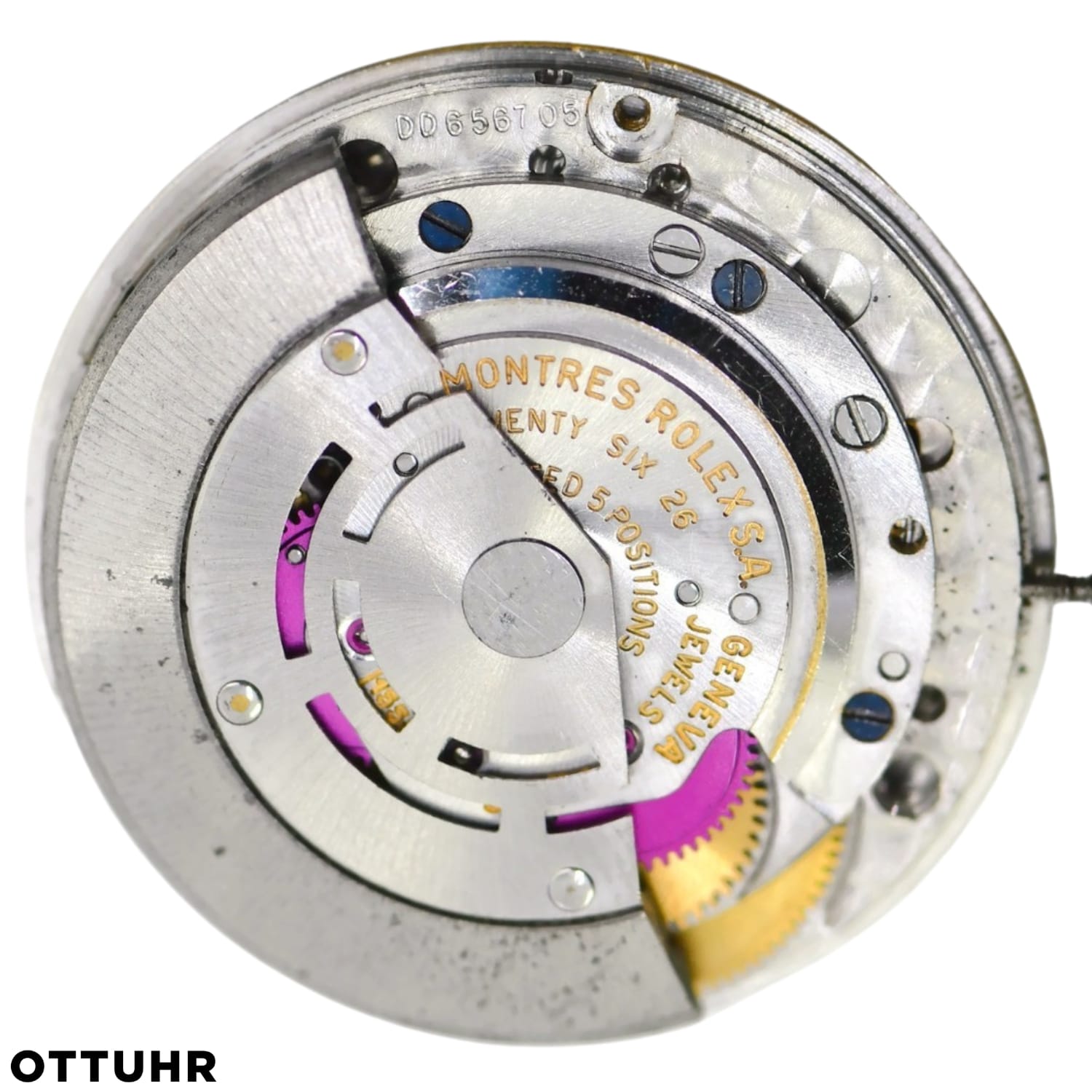
The Rolex 1556 caliber represents the final evolution of Rolex’s non-quickset Day-Date movements, powering the most prestigious watch in the company’s catalog through nearly two decades of production. Introduced in 1965 as the fourth-generation Day-Date caliber, the 1556 brought a higher 19,800 vph beat rate to improve shock resistance and accuracy over its predecessor, the 18,000 vph Caliber 1555. In 1972, Rolex added a hacking feature that stops the seconds hand when the crown is pulled for time setting, making the 1556 one of the first Rolex movements to offer this precision-oriented function. The caliber lived exclusively in solid gold and platinum Day-Date references for 13 years until the higher-beat, quickset-equipped Caliber 3055 replaced it in 1978.
The 1556 epitomizes Rolex’s pre-quartz crisis philosophy: robust, serviceable, COSC-certified chronometer movements prioritizing reliability over decorative finishing or complications. With its free-sprung Microstella balance, Breguet overcoil hairspring, bidirectional automatic winding, and full balance bridge, the 1556 delivered the dependability expected in a watch worn by presidents, business leaders, and collectors who valued mechanical precision. The movement featured Rolex’s characteristic red anodized reversing wheels, rhodium-plated brass plates with perlage finishing, and KIF Flector shock protection.
Production volume for the 1556 is difficult to estimate precisely, as Rolex has never published caliber-specific figures. However, based on Day-Date reference 1803 production spanning approximately 1960 to 1978 (with the 1556 introduced mid-production around 1965), and considering that Day-Date models represented a relatively small percentage of total Rolex output during this era, total 1556 production likely falls in the range of 150,000 to 250,000 units across all Day-Date references. This makes the caliber uncommon rather than rare, as Day-Date watches were expensive when new and produced in far smaller quantities than tool watches like the Submariner or GMT-Master. The Day-Date’s exclusive availability in precious metals (18k gold or platinum only) further limited production volumes compared to stainless steel models.
The 1556 enjoys strong collector standing today, particularly as vintage Day-Date values have appreciated significantly since 2020. Reference 1803 examples that sold for $7,000-$8,000 in 2018 now command $15,000-$16,000 for nice examples on bracelet, with exceptional dial variants reaching considerably higher. The 1556-powered references (1802, 1803, 1804, 1806, 1807) are particularly sought after by collectors who appreciate the pre-quickset slow-change calendar mechanism, pie-pan dials, and acrylic crystals that characterize vintage Rolex. Demand remains stable to rising, driven by growing appreciation for mechanical complexity, historical significance, and the Day-Date’s association with success and achievement.
Historical Context, Provenance, and Manufacturing Details
Rolex developed the Caliber 1556 as a direct evolution of the Caliber 1555, itself part of the broader 1500-series family that represented Rolex’s first true manufacture movements. The 1500 series originated with the Caliber 1530 in 1957, marking Rolex’s independence from external movement suppliers. Prior to 1957, Rolex sourced movements from Aegler, a Swiss manufacturer with whom Rolex maintained such a close relationship that Aegler movements were effectively designed to Rolex specifications. When Rolex formally acquired Aegler’s facilities, the 1530 became the foundation for an entire family of in-house calibers that would power the brand through two decades.
The immediate predecessor, Caliber 1555, debuted in 1959 with 25 jewels, 18,000 vph frequency, and a free-sprung Microstella balance with Breguet overcoil hairspring. It measured 28.5mm in diameter, identical to the 1556, but was slightly thinner as it lacked certain refinements. The 1555 suffered from technical issues with the date advancement mechanism in early production, which Rolex addressed through iterative improvements. The caliber served the Day-Date well but represented transitional technology as the industry moved toward higher beat rates for improved accuracy and shock resistance.
Rolex introduced the Caliber 1556 around 1965 to address the 1555’s limitations and bring Day-Date movements in line with the higher frequency adopted across the 1500 series. The key technical advancement was the increase from 18,000 vph to 19,800 vph, achieved through gear train modifications while maintaining the same overall architecture. The higher frequency provided better resistance to positional errors and shocks, as the faster oscillation of the balance wheel made the movement less susceptible to gravity’s effects in different wearing positions. Rolex also added one jewel to the center wheel pivot, bringing the official count to 26 jewels (though additional jewels in the calendar mechanism were not counted in the official specification).
The most significant update came in 1972 when Rolex equipped the 1556 with a hacking mechanism. This feature, activated when the crown is pulled to the time-setting position, stops the balance wheel via a lever that presses against the balance rim, allowing precise synchronization of the seconds hand to a time standard. The hacking function required machining a small channel in the movement plate fitted with a spring-loaded lever connected to the keyless works, similar to a hand brake mechanism. This enhancement addressed a key limitation of earlier Rolex movements where pulling the crown to set the time allowed the seconds hand to continue running, making exact time setting impossible.
The Caliber 1556 was manufactured entirely in-house at Rolex’s Geneva facilities. Production occurred during the height of mechanical watchmaking before the quartz crisis disrupted the Swiss industry. Rolex’s manufacturing philosophy during this era prioritized functional reliability and long-term serviceability over decorative finishing. The 1556 features rhodium-plated brass main plate and bridges, perlage (circular graining) on the main plate, lightly grained bridge surfaces, and beveled (but not polished) edges on wheels. This utilitarian finishing approach reflected Rolex’s tool-watch DNA, even in its most prestigious model.
The Caliber 3055 replaced the 1556 in 1978, representing a major technological leap forward. The 3055 increased frequency to 28,800 vph (eight ticks per second), introduced quickset date functionality allowing independent adjustment of the date without rotating the hands through midnight, and adopted modern design refinements. The 3055 maintained much of the 1556’s proven architecture but reflected Rolex’s response to both quartz competition and evolving customer expectations for convenience features. Some 1556-powered references remained in production briefly into the late 1970s as Rolex depleted existing movement inventory, creating slight overlap between generations.
Construction and Architecture
Plate and Bridge Layout
The 1556 employs a traditional three-bridge construction: the train wheel bridge covering the going train (center wheel, third wheel, and fourth wheel), the barrel bridge supporting the mainspring barrel, and the balance bridge (full bridge, not a cock) securing the balance assembly. This architecture prioritizes rigidity and serviceability. The main plate and all bridges are machined from nickel-silver-plated brass, then rhodium-plated for corrosion resistance and aesthetic appeal. Rolex applies perlage finishing (overlapping circular graining) to the main plate visible through the case back, while bridges receive lighter circular graining with brushed surfaces. Screw heads are polished but not blued, and bridge edges receive light beveling without the labor-intensive anglage (polished chamfers) found on higher-grade movements. The overall philosophy reflects Rolex’s focus on durability and timekeeping performance rather than traditional haute horlogerie decoration.
Balance Wheel
The 1556 uses a Glucydur balance wheel measuring approximately 9.5mm in diameter. Glucydur is an alloy of copper, beryllium, and iron with a very low coefficient of thermal expansion, meaning it maintains stable dimensions across temperature ranges. This temperature stability is critical for consistent timekeeping, as expansion or contraction of the balance wheel would alter its moment of inertia and therefore its oscillation frequency. The balance wheel features Rolex’s patented Microstella regulation system: four gold-colored adjustment nuts positioned inside the balance rim that can be screwed inward or outward to alter the wheel’s moment of inertia. Turning the nuts inward speeds the rate; turning them outward slows it. Each nut provides approximately 1-2 seconds per day of adjustment range, allowing precise regulation without touching the hairspring. The Microstella system represents Rolex’s proprietary implementation of free-sprung balance regulation, considered superior to index regulator systems for long-term rate stability.
Balance Spring (Hairspring)
The 1556 employs a Breguet overcoil hairspring manufactured from Nivarox alloy, a nickel-cobalt-iron-beryllium formulation with paramagnetic properties and excellent temperature stability. The blue coloring visible on these hairsprings results from heat treatment during manufacturing, not decorative coating. The Breguet overcoil configuration, where the outer terminal curve rises above the main body of the spring, represents a significant technical advancement over flat hairsprings. As the spring expands and contracts with each oscillation, the overcoil allows it to breathe concentrically (expand and contract evenly in all directions) rather than eccentrically, which reduces positional rate variations. The hairspring attaches to a collet on the balance staff and terminates at an adjustable stud holder mounted on the balance bridge, though primary regulation occurs via Microstella screws rather than moving the stud position. Factory-installed hairspring guards prevent the body coils from catching over the overcoil during shock events, a feature documented in Rolex’s 1978 technical service manual for movements with Breguet overcoils.
Escapement Type
The 1556 uses a traditional Swiss lever escapement with jeweled pallet stones, the standard design for precision mechanical watches. The escapement consists of an escape wheel with pointed teeth, a pallet fork carrying two synthetic ruby pallet stones (entrance and exit pallets), and an impulse jewel mounted on the balance roller that engages the pallet fork notch. As the escape wheel rotates driven by the gear train, its teeth alternately lock against and slide across the entrance and exit pallet stones, releasing energy in controlled impulses to maintain the balance wheel’s oscillation. The Swiss lever design offers excellent efficiency and reliability, though it requires proper lubrication as the pallet stones continuously rub against the escape wheel teeth. All critical pivot points in the escapement run in jewel bearings to minimize friction and wear.
Shock Protection System
The 1556 employs KIF Flector shock absorbers on both the upper and lower balance staff pivots. The KIF Flector system, manufactured by KIF Parechoc SA, consists of a jewel setting with a cone-shaped jewel hole, a cap jewel above, and a curved spring underneath secured by a C-clip embedded in the jewel setting. When the watch receives a shock, the delicate balance staff pivots can move vertically within the conical jewel, with the spring absorbing and dampening the impact. The KIF Flector design became an industry standard for quality Swiss movements during this era. Installation and removal of KIF Flector springs requires specific techniques or specialized tools, as the hooked spring must be captured behind the C-clip. The system proved highly effective and remains serviceable today, though watchmakers note that worn or missing springs are a common issue requiring replacement during service.
Regulator Type
The 1556 uses a free-sprung balance, meaning it lacks a traditional index regulator with pins that contact the hairspring. Instead, regulation occurs entirely through the Microstella adjustment nuts on the balance wheel. This design offers superior long-term rate stability because nothing touches the hairspring during normal operation, eliminating friction that can cause rate variation over time. The trade-off is that free-sprung regulation requires greater skill and specialized tools (the Microstella wrench) to adjust properly, as the watchmaker must calculate which nuts to adjust and by how much to achieve the desired rate change while maintaining poise. Despite this complexity, Rolex adopted free-sprung regulation early and maintained it across subsequent caliber generations.
Mainspring Material and Type
The 1556 mainspring measures approximately 1,680mm in length when fully extended (based on measurements from related 1500-series calibers) and is manufactured from a white alloy steel composition rather than traditional blued steel. Rolex specified thickness of 0.125mm to 0.128mm for 19,800 vph movements in the 1500 series. The mainspring uses a slipping bridle attachment to the barrel wall rather than a fixed attachment, allowing controlled slippage when the mainspring reaches full wind to prevent overwinding damage. Modern replacement mainsprings for the 1556 are available from aftermarket suppliers, typically specified as compatible with Rolex calibers 1520, 1530, 1556, and 1570, indicating shared barrel dimensions across much of the 1500 series. Proper mainspring lubrication uses Moebius 8200 or equivalent semi-liquid natural grease for the barrel walls, and Moebius 8212 (Glissalube) for the arbor.
Gear Train Details
The 1556 uses a four-wheel gear train plus escape wheel, following conventional Swiss practice. The center wheel is decentered (positioned off-center) rather than directly beneath the barrel, a design requiring an intermediate wheel configuration but allowing for a larger diameter mainspring barrel to achieve the 42-hour power reserve. The fourth wheel drives the seconds hand directly through the center of the movement, providing the sweep seconds function visible on the dial. Gear ratios are precisely calculated to produce exactly 19,800 beats per hour from the escapement given the wheel tooth counts. The third wheel features particularly fine pinion leaves, and worn pinions on this wheel represent a common failure point in high-mileage examples. All gear train wheels run in jeweled bearings to minimize friction and wear. A magnetic brake on the sweep seconds pinion prevents the seconds hand from spinning freely when the movement is wound, ensuring consistent hand positioning.
Finishing Quality and Techniques
The 1556 receives COSC chronometer-grade finishing and adjustment, representing Rolex’s standard quality level for Day-Date movements. Perlage (circular graining in overlapping patterns) decorates the main plate visible through the exhibition case back. Bridges feature lighter circular graining with brushed surfaces. Wheel edges receive beveling but not the highly polished anglage found on premium finishing. Screw heads are polished but not blued. The red anodization on the reversing wheels, introduced by Rolex in 1957, serves both as a visual signature and a surface treatment to reduce wear. The blue Breguet hairspring provides the movement’s most distinctive aesthetic element. Overall finishing prioritizes functional reliability over decorative appearance, consistent with Rolex’s tool-watch heritage even in its most prestigious model. The movement was adjusted to five positions and tested for chronometer certification through COSC, meeting standards of -4/+6 seconds per day across multiple positions and temperatures.
Cross-Reference Data
Alternative Caliber Names and Compatible References
| Brand | Reference Numbers | Production Period | Notes |
|---|---|---|---|
| Rolex Day-Date | 1802 | 1960-1977 | Smooth bezel variant |
| Rolex Day-Date | 1803 | 1960-1978 | Fluted bezel, most common 1556-powered reference |
| Rolex Day-Date | 1804 | 1960s-1970s | Diamond-set bezel variant |
| Rolex Day-Date | 1806 | 1960s-1970s | “Florentine” textured bezel finish |
| Rolex Day-Date | 1807 | 1969-1973 | “Bark” textured bezel finish |
Base Caliber vs. Elaborated Versions
The Caliber 1556 had no elaborated or upgraded versions. All examples were manufactured to the same COSC chronometer specification with 26 jewels and 19,800 vph frequency. The only production variant was the addition of hacking seconds in 1972, which was implemented across all 1556 production thereafter rather than creating a separate caliber designation.
Dial Compatibility and Specifications
The 1556 accepts dial feet in the standard 1500-series configuration with feet positioned at approximately 3:22 and 9:22 positions (similar to other 1500-series movements). The day disc sits in an arched window at 12 o’clock, requiring a specialized curved aperture in the dial. The date window appears at 3 o’clock with a cyclops magnifier in the crystal. Dial compatibility is specific to Day-Date references due to the dual calendar complication; dials from time-only or date-only Rolex models cannot be used. Original Day-Date dials featured pie-pan construction (raised outer chapter ring with recessed center) through much of 1556 production, transitioning to flatter designs in the mid-1970s.
Crown and Stem Specifications
Identification Marks
Caliber Number Location
The caliber number “1556” is engraved on the train wheel bridge and on the hub sinking of the balance wheel bridge. These engravings are executed in precise, diamond-engraved style with consistent depth and clarity.
Logo and Brand Marks
Authentic 1556 movements feature “MONTRES ROLEX SA GENEVA” engraved on the automatic winding bridge. The text “TWENTY SIX JEWELS” appears adjacent to the caliber number. On COSC-certified examples (all 1556 movements), “ADJUSTED to FIVE POSITIONS” is engraved, confirming chronometer certification. These engravings should appear crisp and professionally executed, not crude or hand-stamped.
Date Codes
Rolex used internal date coding on movement parts during the 1556 production era, but these codes are not typically visible or relevant for movement authentication. Case serial numbers provide production dating and are engraved between the lugs at 6 o’clock position on vintage references. For 1556-powered watches produced between 1965-1978, serial numbers generally fall in the following ranges:
- 1965-1967: 1,100,000 – 1,999,999
- 1968-1970: 2,000,000 – 2,999,999
- 1971-1973: 3,000,000 – 3,999,999
- 1974-1976: 4,000,000 – 4,999,999
- 1977-1979: 5,000,000 – 5,999,999
Finishing Marks
Authentic 1556 movements display perlage (overlapping circular graining) on the main plate. The pattern should be consistent and evenly executed. Bridges show lighter circular graining with brushed surfaces. The red anodized reversing wheels are a Rolex signature feature. The blue Breguet overcoil hairspring should display even coloring from heat treatment. Screw heads are polished but not blued. Any significant deviations from these finishing patterns indicate potential replacement parts or non-original service work.
Jewel Markings
The 1556 uses 26 jewels officially counted, with additional uncounted jewels in the calendar mechanism. Jewels are primarily press-fit rather than set in gold chatons, consistent with Rolex’s functional approach to finishing. The balance staff pivots run in KIF Flector shock jewel settings with visible springs. Pallet stones are synthetic rubies set in the pallet fork. All jeweled bearings should appear clean and properly seated, with no evidence of cracking or loose settings.
Adjustment Markings
All 1556 movements received COSC chronometer certification and bear “ADJUSTED to FIVE POSITIONS” engraving. This indicates testing and regulation in five wearing positions: dial up, dial down, pendant down, pendant up, and pendant left. The testing protocol also included three temperature ranges: 8°C, 23°C, and 38°C. Movements meeting the -4/+6 seconds per day accuracy standard across all positions and temperatures received certification.
Serial Number Format and Location
Movement serial numbers on 1556 calibers appear engraved between the lugs at 6 o’clock position (under the bracelet on cased movements). These numbers are 7-digit numerics during most of 1556 production. Serial numbers should be cleanly engraved with consistent depth and font style matching the era. From 1960-1978, Rolex used sequential numeric serials without letter prefixes. Cases also contain internal production date codes on the case back, typically Roman numerals (I-IV for quarter) and two Arabic digits for year.
Font and Marking Style by Production Era
Engravings on 1556 movements maintained consistent Rolex house style throughout production: precise diamond engraving with sharp, clear characters. The font is sans-serif with even stroke weight. Depth should be uniform across all text. Caliber numbers, jewel count, and adjustment markings all employ identical engraving technique. Any deviation in font style, depth inconsistency, or crude execution indicates refinished bridges or counterfeit components.
Part Information
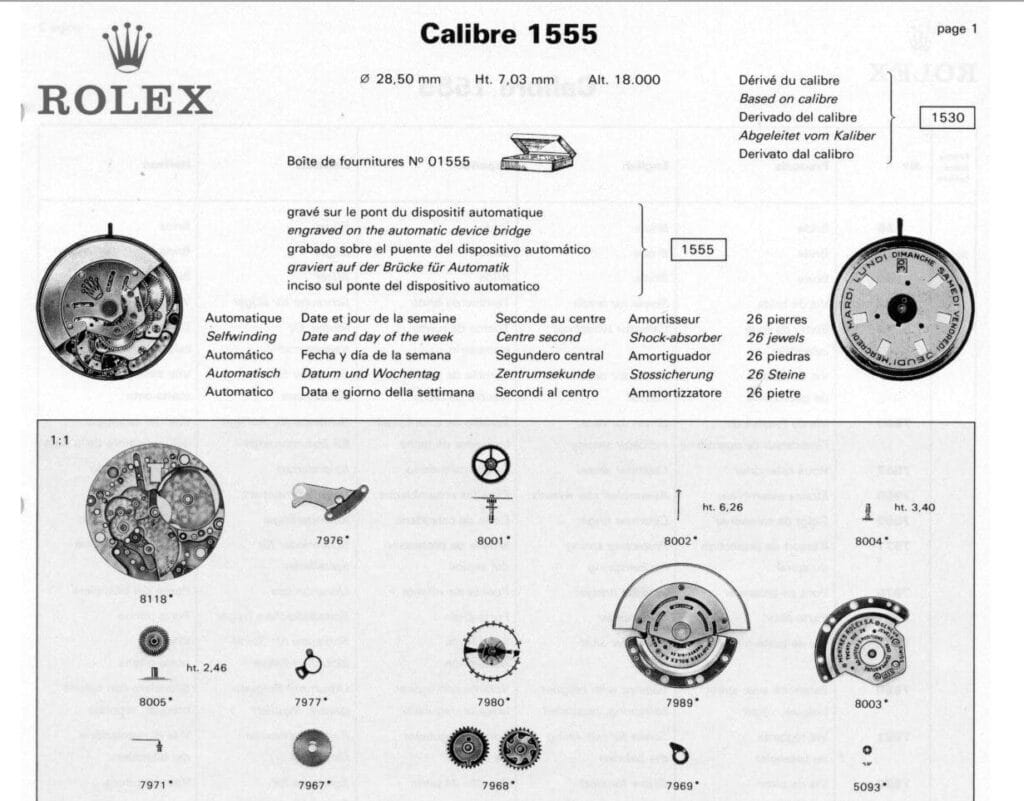
Major Component Part Numbers and Interchangeability
Parts Sourcing and Availability
Most common service parts for the 1556 remain available through specialized suppliers and aftermarket manufacturers. Critical components like balance staffs, mainsprings, escape wheels, and pallet forks are regularly stocked by parts houses serving watchmakers. Genuine Rolex parts are increasingly scarce and expensive, but high-quality Swiss-made generic replacements exist for most components. Balance complete assemblies (balance wheel with pre-timed hairspring) are occasionally available as new-old-stock or professionally refurbished units.
Common Failures and Parts Requiring Replacement
Balance staff pivots are the most common failure, typically breaking due to shock or wear. Replacement requires specialized tools (pivot tool) and watchmaking skills to rivet the new staff to the balance wheel. Third wheel pinions wear from high mileage, causing amplitude loss and erratic timekeeping. Mainsprings weaken with age and should be replaced during major service (typically every 10-15 years). The KIF Flector shock springs can break or become dislodged, requiring careful replacement. Barrel arbor bushings in the main plate and bridges can wear, though proper lubrication during service extends lifespan significantly. Calendar mechanism components (day and date wheels, jumper springs) can fail from improper quickset attempts (which the 1556 lacks) or years of use.
Performance Data
Manufacturer Specifications
| Performance Metric | Specification |
|---|---|
| Accuracy (COSC) | -4/+6 seconds per day |
| Positions Tested | 5 positions (DU, DD, PD, PU, PL) |
| Temperature Compensation | Passive via Glucydur balance and Nivarox hairspring, tested 8°C/23°C/38°C |
| Isochronism | Breguet overcoil provides improved rate consistency across amplitude range |
| Lift Angle | 52 degrees (standard for timing machine calibration) |
| Amplitude (new) | 240-260 degrees dial up when fully wound |
Observed Performance (Field Data)
Well-maintained 1556 movements typically achieve -2 to +8 seconds per day accuracy in regular wear, comparable to the original COSC specification. Examples receiving professional service with proper parts and lubrication can run to within +2 to +5 seconds per day. Vintage examples without recent service often run fast (+10 to +30 seconds per day) due to aged lubricants or magnetized hairsprings. Amplitude readings of 240-260 degrees dial up when fully wound are considered healthy. As power reserve depletes, amplitude typically drops to 200-220 degrees, with the movement maintaining acceptable rate down to approximately 180 degrees.
Common performance issues include:
- Erratic timekeeping from worn balance staff pivots, requiring staff replacement
- Low amplitude from dried lubricants, worn mainspring, or third wheel pinion wear
- Positional variation exceeding specifications, typically indicating poise errors in the balance or magnetization
- Fast running (gaining 30+ seconds per day) often indicates magnetized hairspring, requiring demagnetization
- Sudden stopping or poor amplitude when tension spring engaged, indicating friction in seconds pinion braking mechanism
The slow-change calendar mechanism gradually transitions the day and date over approximately 1-2 hours centered around midnight, rather than the instantaneous “quickset” change of later calibers. This is normal behavior for 1556 movements. Attempting to set the date or day by turning the hands between 9 PM and 3 AM can damage the calendar mechanism, as gears are partially engaged during this “danger zone”.
Collectors report that properly serviced 1556 movements deliver excellent long-term reliability when maintained on a 5-7 year service interval. The robust construction, proven architecture, and availability of service parts make the 1556 a practical choice for regular wear despite its age. Watchmakers familiar with vintage Rolex movements consider the 1556 straightforward to service, with good parts availability and no unusual complications requiring specialized knowledge.