

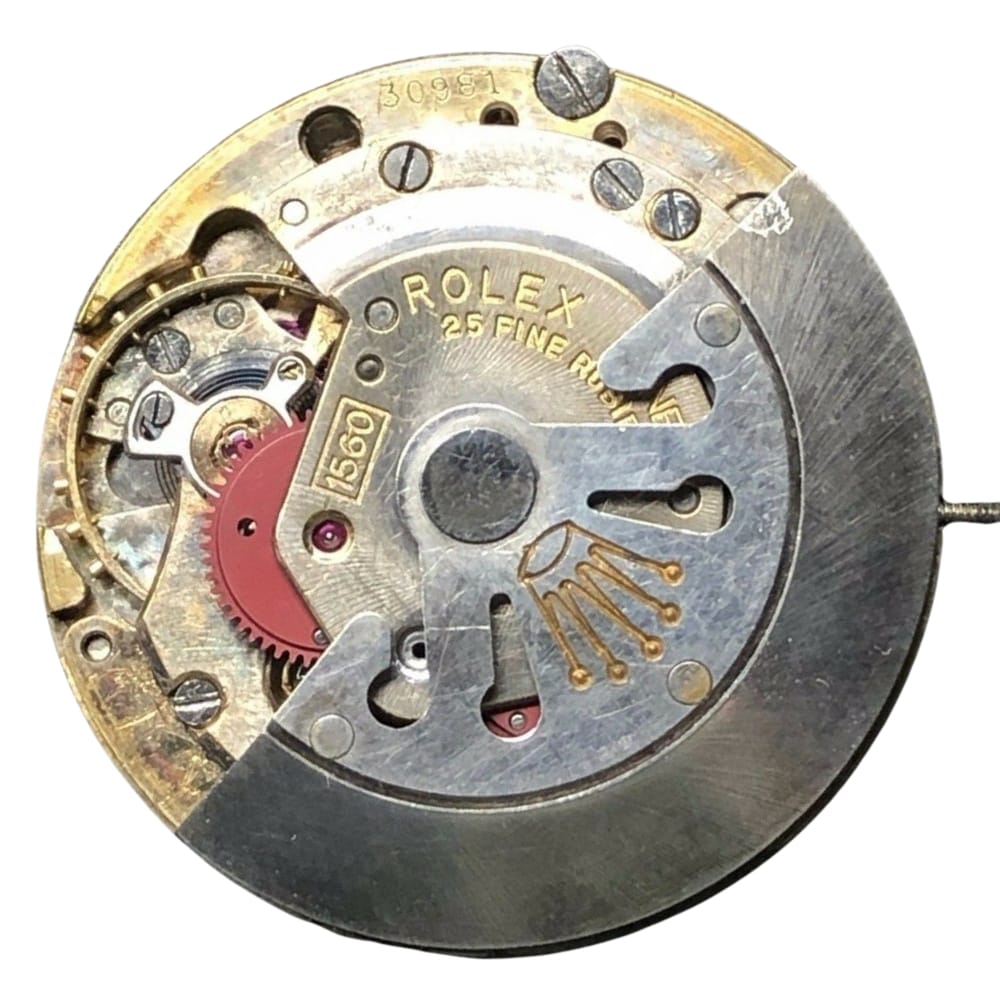
The Rolex 1560 stands as the second-generation workhorse of the company’s first true in-house automatic caliber family, powering some of the most iconic tool watches of the early 1960s, including the Submariner 5512, Explorer 1016, and countless Oyster Perpetual references. Where its predecessor 1530 established Rolex’s manufacturing independence, the 1560 earned chronometer certification, transforming these movements from capable to certified.
The 1560 arrived in 1959 as Rolex’s answer to the chronometer market, retaining the 1530’s proven architecture while adding COSC certification and the Microstella regulation system. This caliber powered both dress and tool watches with equal competence, its 18,000 vph beat rate striking a balance between accuracy and durability that appealed to professional users who needed reliability over refinement. Collectors recognize the 1560 as the bridge between Rolex’s early manufacture movements and the higher-frequency 1570 that would follow in 1965.
Based on serial number ranges, Rolex produced approximately 450,000-550,000 watches between 1959 (serial 399,453) and 1965 (serial 1,100,000). Not all contained the 1560, as Rolex deployed multiple calibers across its lineup during this period, including the date-equipped 1565, the cost-reduced 1520, and carryover 1530 movements in early production. Conservative estimates suggest 80,000-150,000 units of the 1560 were produced during its six-year run, though Rolex never published official production figures. The caliber’s relative scarcity stems from its brief production window, compressed between the 1530 (1957-1965) and the more desirable higher-frequency 1570 (1965-1977).
The 1560 occupies an interesting position in the collector market. While the higher-frequency 1570 commands premium prices due to its longer production run and technical improvements (19,800 vph, 48-hour power reserve, and later models with hacking seconds), the 1560 attracts serious collectors seeking early examples of chronometer-certified Rolex tool watches. Four-line gilt dial Submariners with 1560 movements, particularly “meters first” examples from 1965-1966, command significant premiums. Early Explorer 1016 references with 1560 movements (1963-1967) also fetch strong prices, though the 1570-equipped versions from the 1970s-1980s remain more common. Demand remains stable rather than rising, as the 1560 lacks the cachet of earlier A. Schild-based movements or the refinement of the 1570 successor.
Historical Context, Provenance, and Manufacturing Details
Rolex developed the 1560 as the chronometer evolution of the 1530, which itself marked the company’s first fully in-house automatic movement introduced in 1957. The 1530 series ended Rolex’s reliance on Aegler as an external movement supplier, though the relationship between the two companies had been so intertwined for decades that Aegler movements were effectively Rolex designs manufactured at a separate facility. When Rolex formally acquired Aegler in 2004, it merely formalized an arrangement that had existed in practice since the 1930s.
The 1560 addressed a specific market need: COSC-certified chronometer movements at a time when such certification carried genuine prestige. To achieve this certification, Rolex submitted cased movements for 15-day testing across five positions and three temperatures (8°C, 23°C, 38°C), with acceptable performance defined as -4/+6 seconds per day. The 1560 succeeded where the 1530 generally did not, earning the right to print “Superlative Chronometer Officially Certified” across four lines on the dial.
The 1560 replaced the 1530 incrementally rather than immediately. Early 1959-1960 examples of references like the Submariner 5512 shipped with 1530 movements, transitioning to 1560 as production ramped up. By 1960, the 1560 had become the standard non-date automatic movement for Rolex’s chronometer-grade watches. Its successor, the 1570, arrived in 1965 with a higher 19,800 vph frequency, longer 48-hour power reserve, and preparation for the hacking seconds feature that would be added in 1972.
Production occurred at Rolex’s Geneva facilities, with movements assembled, tested, and cased at the company’s main complex. The 1560 represented Rolex’s attempt to scale in-house production while maintaining chronometer certification, a balancing act that resulted in movements of exceptional reliability if not cutting-edge technical sophistication.
Construction and Architecture
Plate and Bridge Layout
The 1560 employs Rolex’s characteristic three-quarter plate architecture with separate bridges for the barrel, train, and balance. The mainplate is machined from brass with circular graining (perlage) applied to both dial and movement sides, a finishing technique Rolex used even on non-display movements as a quality control measure. The automatic winding mechanism mounts to the dial side of the mainplate, with the rotor, reversing wheels, and reduction train forming a separate module secured by three blued screws.

Balance Wheel
The 1560 uses Rolex part number 7980 balance assembly, a monometallic Glucydur (beryllium-copper alloy) wheel with four Microstella regulating screws. The Glucydur composition provides thermal stability and non-magnetic properties without requiring the traditional bimetallic split balance. The balance features 18 total screws: 16 inertia screws for poising and four larger Microstella screws (two gold, two nickel) for regulation. Diameter measures approximately 10-11mm. The balance operates as a free-sprung system with no regulator index contacting the hairspring, meaning all timing adjustments occur by changing the moment of inertia via the Microstella screws rather than altering effective hairspring length.
Balance Spring (Hairspring)
The 1560 uses a Breguet overcoil hairspring manufactured from Nivarox alloy (nickel-cobalt-iron-beryllium formulation). The blue coloring results from heat treatment during manufacturing, not a decorative coating. The Breguet overcoil configuration, where the outer terminal curve rises above the hairspring plane, allows the spring to breathe concentrically during expansion and contraction, reducing positional errors compared to flat hairsprings. The hairspring mounts to a stud carrier with fine adjustment capability, though primary regulation occurs via the Microstella system rather than index regulator.
Factory-installed hairspring guards prevent the body coils from catching over the overcoil during shock, a feature documented in Rolex’s 1978 technical service manual for 18,000-beat movements with Breguet overcoils. The guard must reach the second or third coil from the collet and maintain sufficient height to avoid contact when the movement sits dial-up.

Escapement Type
The caliber employs a traditional Swiss lever escapement with a club-tooth escape wheel (Rolex part 7841) featuring 15 teeth. The escape wheel pivots are jeweled at both ends with cap jewels (part 7937) for reduced friction. The pallet fork (part 7846) carries two synthetic ruby pallet stones that engage the escape wheel teeth, converting rotational energy from the gear train into discrete impulses that drive the balance wheel. This traditional escapement design prioritizes reliability and serviceability over exotic materials or geometry.
Shock Protection System
The 1560 uses KIF Flector shock absorbers to protect the balance staff pivots. The KIF Flector system employs spring-mounted jewel settings that absorb axial and radial shocks, allowing the balance to withstand impacts that would shatter rigid jewel settings. The system protects both upper and lower balance jewels, with the characteristic spring visible when viewing the balance from above. KIF systems were standard across Swiss movements of this era and remain serviceable with generic replacement parts.
Regulator Type
The 1560 operates as a free-sprung balance with Microstella regulation rather than an index regulator. This means no regulator pins contact the hairspring to adjust effective length. Instead, all timing adjustments occur by repositioning the four Microstella screws, which alters the balance wheel’s moment of inertia. Turning both gold Microstella screws clockwise speeds the movement by reducing moment of inertia; counterclockwise slows it by increasing inertia. The system requires specialized tools and greater skill than a traditional index regulator but eliminates the risk of regulator pins shifting during shock, which would alter timekeeping.
Mainspring Material and Type
The 1560 uses a white alloy mainspring, Rolex part number 7825. Rolex’s 1978 technical service manual specifies mainspring strength of 0.122 to 0.125mm thickness for 18,000-beat calibers including the 1530/1560. The mainspring design provides consistent torque delivery and resistance to setting (permanent deformation) across the 42-44 hour power reserve. The barrel (part 7827) and barrel arbor (part 7826) form a complete assembly that watchmakers often replace as a unit during service.
Gear Train Details
The 1560 uses an indirect seconds drive with the fourth wheel driving a separate center seconds pinion. The gear train comprises the great wheel (center wheel with cannon pinion, part 7829), third wheel (part 7831), fourth wheel (center seconds wheel), and escape wheel (part 7841). The indirect seconds layout requires tension adjustment to prevent seconds hand flutter but allows for servicing without disturbing the cannon pinion/hour wheel interface. The 3135 successor transitioned to direct seconds, eliminating this finicky adjustment at the cost of increased movement height.
Finishing Quality and Techniques
The 1560 receives basic industrial finishing appropriate for a chronometer tool watch movement. The mainplate and bridges feature circular graining (perlage) visible from both dial and balance sides. The rotor features Geneva stripes (Côtes de Genève) with the Rolex coronet and “Montres Rolex SA Geneva Swiss” engraving. Red anodization colors the reversing wheels, introduced by Rolex in 1957 as both a visual signature and a surface treatment to reduce wear. Edges receive light beveling but not the labor-intensive anglage (polished chamfers) found on higher-grade movements. The blue Breguet hairspring provides the movement’s primary aesthetic flourish, combined with the gold-toned brass plates visible through the case back.
Cross-Reference Data
Compatible Case References by Brand
Rolex Time-Only Models (No Date)
Rolex Date Models (1565 variant)
The date-equipped 1565 caliber shares the 1560 architecture with added calendar mechanism. Compatible references include 1500, 1501, 1502, 1503, 1505 series Oyster Perpetual Date models.
GMT Models (1560 GMT variant – rare)
The 1560 GMT added a 24-hour hand to the base 1560 architecture, used in early GMT-Master 1675 and Explorer II 1655 references. This variant transitioned quickly to the 1575 GMT with higher beat rate.
Base Caliber vs. Elaborated Versions
Dial Compatibility
The 1560 accepts dial feet in the standard 1500-series configuration with feet positioned at approximately 3:22 and 9:22 (using clock positions as reference). Dial mounting diameter measures approximately 26.9mm. Date versions (1565) require a date window cutout at 3 o’clock and additional clearance for the calendar mechanism. The movement sits in cases with an inner diameter accommodating 28.5mm movements, with case thickness typically 12-13mm to house the automatic winding assembly.
Crown and Stem Specifications
Identification Marks
Caliber Number Location
The caliber number “1560” is engraved on the hub of the balance wheel, visible when viewing the movement from the balance side. The number also appears engraved on the train wheel bridge. Some early production examples may show “1530” stampings carried over during the transition period. The engraving is small, requiring 5x-10x magnification to read clearly, and uses a serif typeface typical of Rolex movements from this era.
Logo and Brand Marks
The rotor carries the Rolex coronet and the inscription “Montres Rolex SA Geneva Swiss”. The movement displays “Swiss” or “Swiss Made” engraving, typically near the balance or on the rotor. Jewel count (“26 JEWELS” or “TWENTY SIX JEWELS”) appears engraved on a bridge, confirming chronometer grade. The dial displays “SUPERLATIVE CHRONOMETER OFFICIALLY CERTIFIED” across four lines below 6 o’clock, the key visual identifier distinguishing chronometer 1560 movements from non-chronometer 1530 predecessors.
Date Codes
Rolex case backs from the 1560 production era (1959-1965) feature Roman numeral date codes indicating quarter and year of case manufacture. These codes appear stamped inside the case back in the format “I 65” (first quarter 1965), “II 62” (second quarter 1962), etc. The movement itself does not carry specific date codes beyond the caliber number engraving. Serial numbers on the case between the lugs at 6 o’clock allow approximate dating, with 1560 production corresponding to serial ranges from approximately 399,453 (1959) through 1,100,000 (1965).
Finishing Marks
Genuine 1560 movements display circular graining (perlage) on both the mainplate dial side and movement side. The rotor features Geneva stripes (Côtes de Genève) running perpendicular to the rotor’s length. Red anodization colors the reversing wheels in the automatic winding assembly, a Rolex signature introduced in 1957. The balance wheel hub shows radial brushing, and the Breguet hairspring displays blue heat treatment coloring.
Jewel Markings
The 1560 uses pressed jewels rather than chatons (gold or brass settings) for the gear train bearings. Cap jewels protect the balance staff pivots and pallet fork pivots. The KIF Flector shock protection system uses characteristic spring-mounted jewel settings visible when viewing the balance from above. Higher-grade Rolex movements from earlier eras used gold chatons, but the 1560 prioritized durability and serviceability over decorative jewel settings.
Adjustment Markings
For COSC-certified chronometer movements like the 1560, no specific adjustment markings appear on the movement itself. The chronometer certification appears only on the dial (“SUPERLATIVE CHRONOMETER OFFICIALLY CERTIFIED”) and on the original chronometer certificate issued with the watch. Some movements may display timing marks or watchmaker service marks on bridges, added during professional servicing rather than at the factory.
Correct Serial Number Formats and Locations
Rolex serial numbers from the 1560 production era (1959-1965) appear engraved on the case between the lugs at the 6 o’clock position, requiring bracelet removal for viewing. Serial numbers from this period are purely numeric, ranging from approximately 399,453 (1959) to 1,100,000 (1965). Format consists of 6-7 digits with no letters or prefixes. The engraving is clean and crisp, applied by precision stamping equipment with consistent depth and spacing. Font is a sans-serif style characteristic of Rolex’s 1960s production.
Expected Engravings and Stampings
Genuine 1560 movements display the following engravings:
- “1560” on balance wheel hub and/or train wheel bridge
- Rolex coronet on rotor
- “Montres Rolex SA Geneva Swiss” on rotor
- Jewel count (“26 JEWELS” or “TWENTY SIX JEWELS”) on bridge
- “SWISS” or “SWISS MADE” on movement
- Part numbers on individual components (7825 on mainspring, 7980 on balance complete, 7841 on escape wheel, etc.)
Font and Marking Style by Production Era
The 1560’s six-year production run (1959-1965) shows minimal variation in engraving style, as Rolex maintained consistent manufacturing standards. Early 1959-1960 examples may show transitional characteristics from 1530 production, including occasional carryover “1530” stampings corrected during assembly. By 1960, standardized “1560” engravings appear consistently across all production. The serif typeface used for caliber numbers remained consistent throughout the 1500-series era, changing only with the introduction of 2000-series calibers in the 1970s.
Part Information

Primary Components Part Numbers
Sourcing Notes
Still Available from Suppliers:
- Mainspring (7825): Available from generic suppliers and NOS dealers
- Balance complete (7980): Increasingly scarce, NOS sources preferred
- Escape wheel (7841): Available generic and NOS
- Pallet fork (7846): Available generic
- Barrel assembly (7827/7826): Available generic and NOS
- Rotor complete (7903): Available from vintage parts dealers
- Rotor bearing jewel (7907): Commonly stocked generic replacement
Commonly Failing Parts:
- Rotor bearing/axle (7907): Wear from continuous rotation, most common service repair
- Balance staff: Shock damage or pivot wear, replacement requires specialized tools
- Barrel arbor bushings: Wear in mainplate and bridge holes, especially in early non-jeweled examples
- Reversing wheel drivers: Pivot wear in 26-jewel models, can be replaced with jeweled bushings
- Mainspring: Fatigue after years of service, should be replaced during overhaul
Acceptable Generic Replacements:
- Mainsprings: Swiss-made generic 7825 replacements widely accepted
- Pallet forks: Generic versions function adequately if properly adjusted
- Shock springs: Generic KIF Flector springs compatible
- Winding stems: Generic 0.90mm TAP 10 stems fit correctly
- Gaskets and seals: Generic crown gaskets and case back gaskets acceptable
Parts Requiring Original Rolex Components:
- Balance complete (7980): Generic balances will not maintain chronometer performance
- Hairspring: Must be fitted to original 7980 balance
- Escape wheel (7841): While generics exist, original Rolex parts maintain proper clearances
- Rotor: Original Rolex rotors maintain winding efficiency and proper weight
Performance Data
Manufacturer Specifications
Accuracy (new): -4/+6 seconds per day (COSC chronometer standard)
Positions Tested: 5 positions plus 3 temperature ranges (8°C, 23°C, 38°C) during COSC certification
Temperature Compensation: Glucydur balance and Nivarox hairspring provide passive temperature compensation across typical wearing temperatures (approximately 5°C to 35°C)
Isochronism: Breguet overcoil hairspring with free-sprung balance optimizes isochronism, meaning rate remains consistent across the amplitude range from fully wound (240-260 degrees) to near power reserve depletion (180-200 degrees)
Lift Angle: 52 degrees (manufacturer specification for timing machine calibration)
Power Reserve: 42 hours (some sources indicate 44 hours depending on mainspring strength and barrel specifications)
Beat Rate: 18,000 vibrations per hour (vph) = 2.5 Hz = 5 beats per second
Amplitude: Expected amplitude when fully wound ranges from 240-280 degrees in horizontal positions, dropping to 200-240 degrees in vertical positions. Amplitude below 180 degrees indicates service requirement.
Observed Performance (Field Data)
Typical Accuracy Range for Well-Maintained Examples:
Serviced 1560 movements with COSC certification maintained by experienced watchmakers typically achieve -3/+5 seconds per day in normal wearing conditions. This represents real-world performance accounting for wearing position, temperature variation, and power reserve state. Examples running outside -6/+8 seconds per day require regulation adjustment or service.
Common Performance Issues and Their Causes:
- Rotor bearing wear: The most common failure mode. The axle supporting the oscillating weight develops wear over decades, causing the rotor to tilt and rub against the case back. This produces a scraping sound, reduces winding efficiency, and can stop the movement. Replacement requires pressing out the worn axle and installing a new part 7907 jewel and axle assembly.
- Barrel arbor bushing wear: Early 1560 production used brass bushings in the mainplate and barrel bridge for the barrel arbor. These wear over time, creating excessive end shake and side shake that affects timekeeping consistency. Later production switched to beryllium bushings that resist wear. Worn brass bushings can be closed using a flat punch on the bottom and round punch on top, or jewels can be installed (2.30mm O.D. / 1.60mm hole).
- Mainspring fatigue: After 40-60 years, original mainsprings lose elasticity, reducing power reserve from the specified 42-44 hours to 30-36 hours. Weak mainsprings also reduce amplitude and cause rate variation as the watch runs down. Replacement with proper strength mainspring (0.122-0.125mm) restores performance.
- Balance staff pivot damage: Shock damage or wear to the delicate balance staff pivots causes erratic timekeeping and amplitude loss. This requires balance staff replacement, a skilled operation demanding specialized tools and experience.
- Hairspring magnetization: Exposure to magnetic fields causes the hairspring coils to stick together, dramatically increasing rate (fast running). While modern Rolex movements use paramagnetic Parachrom hairsprings, the 1560’s Nivarox hairspring can be magnetized and requires demagnetization during service.
Expected Amplitude:
- Fully wound (dial up): 260-280 degrees
- Fully wound (crown up/vertical): 220-240 degrees
- Power reserve depleted (dial up): 200-220 degrees
- Power reserve depleted (vertical): 180-200 degrees
Amplitude below 180 degrees in any position indicates problems: worn pivots, contaminated lubrication, mainspring issues, or excessive friction in the gear train.
Performance Degradation with Age:
The 1560 shows predictable degradation patterns. Original lubricants dry out after 4-5 years, increasing friction and reducing amplitude by 20-40 degrees. Rotor bearing wear typically becomes apparent after 20-30 years of use, though neglected examples show wear earlier. Mainspring fatigue becomes evident after 30-40 years, with power reserve dropping from 42 hours to 30-36 hours. Well-maintained examples serviced every 5-7 years maintain near-specification performance for decades.
Collector reports and auction timing results suggest that serviced 1560 movements from the 1960s routinely achieve -4/+6 seconds per day when properly regulated, matching COSC standards. This longevity stems from the movement’s conservative design: the 18,000 vph beat rate reduces component wear compared to higher-frequency movements, and the robust construction tolerates decades of use before requiring major intervention.