

Last updated ~ February 2, 2026
Brand
Production Period
1960–1977
Model Line
Case Shape
Round
Diameter
36mm
Lug to Lug
44mm
Lug Width
20mm
Case Thickness
12mm
Case Back
Screw-Down
Caliber
Crystal
Bezel
Fluted
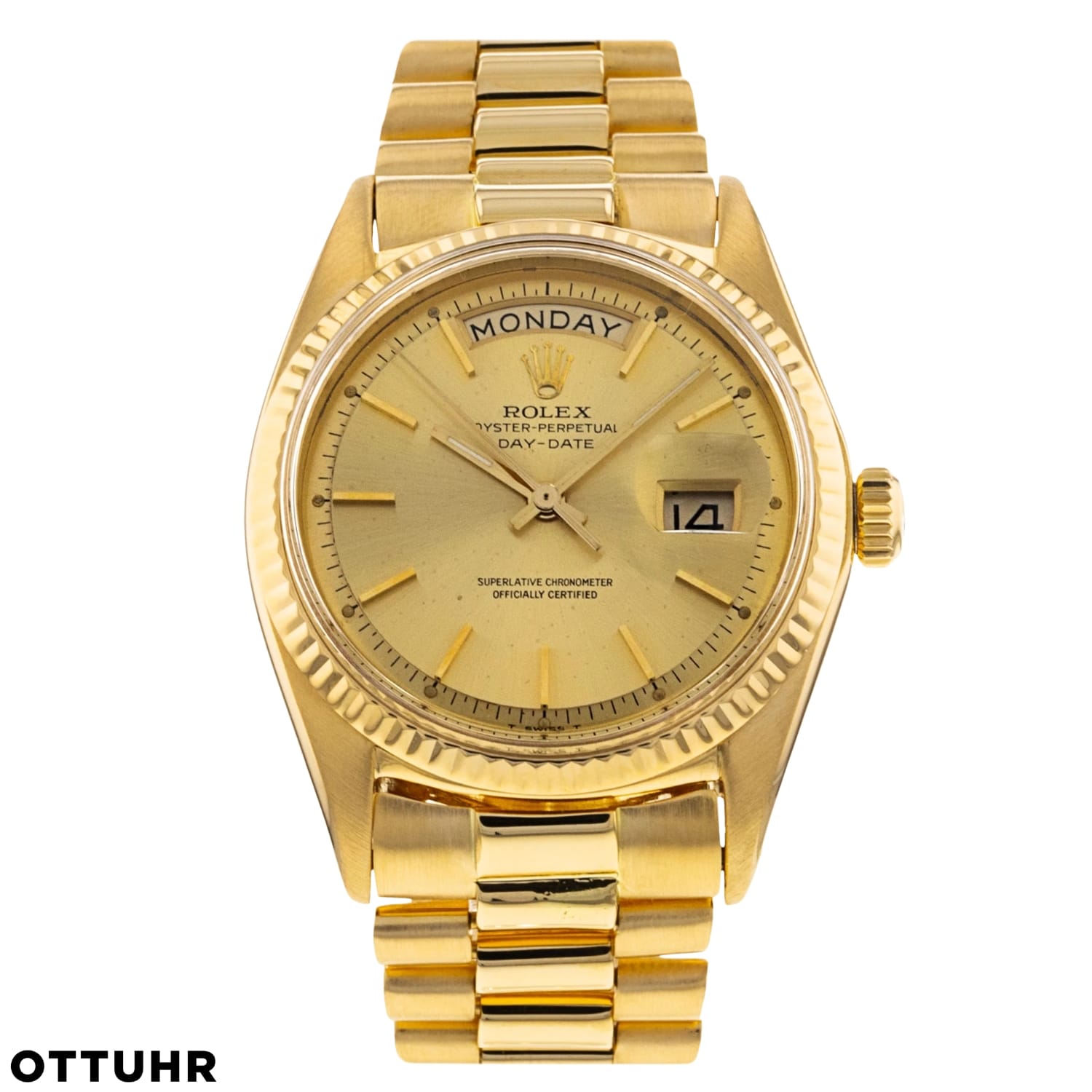
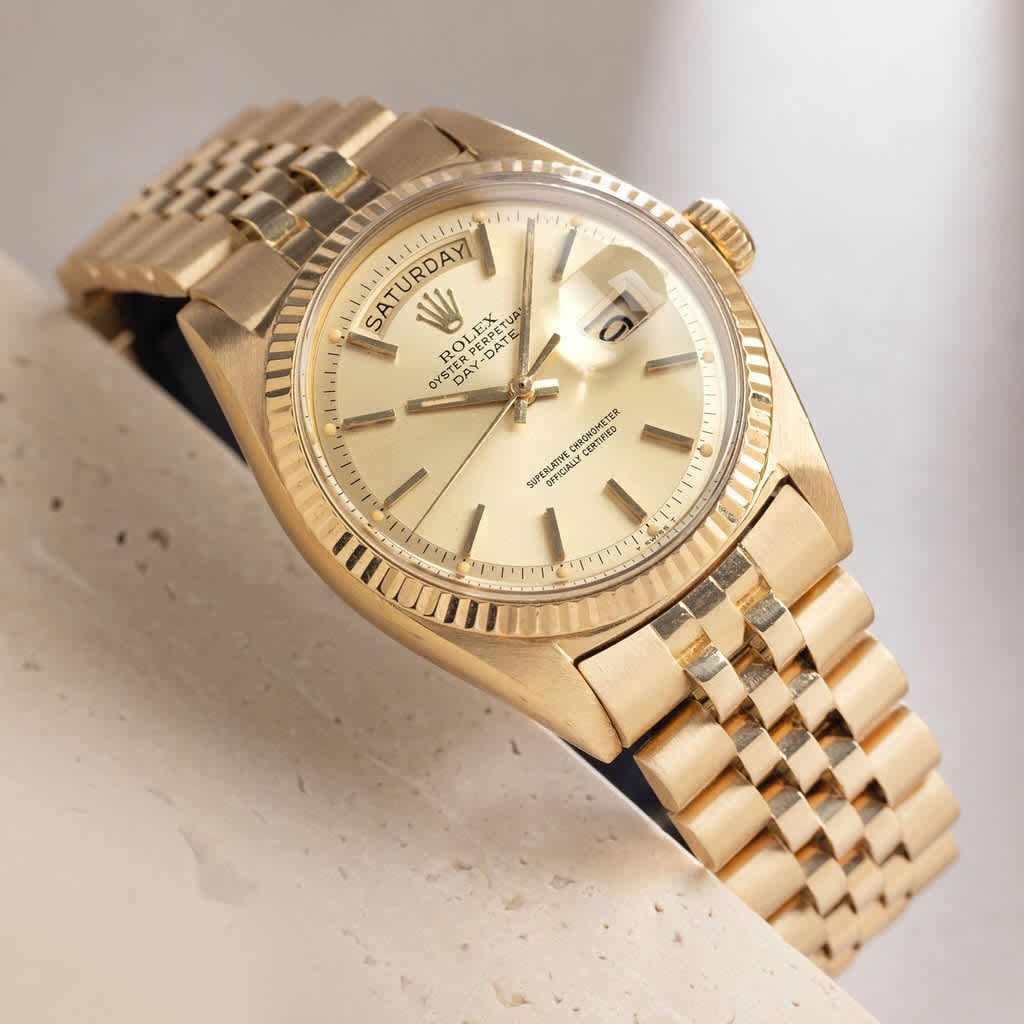
The Rolex Day-Date 1803 represents the last hurrah of mid-century design language at Rolex, the final reference to feature both an acrylic crystal and the elegant pie-pan dial that slopes gently downward at its perimeter. Produced for nearly two decades while Lyndon Johnson, Richard Nixon, and Gerald Ford wore Day-Dates in the White House, the 1803 cemented the model’s “President” nickname and became the archetypal image of vintage gold Rolex.
The 1803 succeeded the short-lived 6611 and 6611B references, incorporating Rolex’s first fully in-house movement series developed specifically for the Day-Date complication. Unlike modern iterations with quickset functionality, the 1803 requires winding through midnight to advance both calendar displays, a charming anachronism that reminds you this watch predates the microprocessor revolution. The reference debuted the straight baton hands that replaced earlier leaf-shaped hands, establishing the visual vocabulary that defines Day-Date aesthetics to this day.
Rolex never matched dial configurations to serial numbers during the 1803 era, creating a Wild West of variants. Production figures remain manufacturer-guarded, but based on serial number ranges spanning approximately 550,000 to 5,865,000 (covering 1960-1978), total output likely numbers in the tens of thousands across all metals. Yellow gold examples dominate the market, white gold appears regularly, but rose (pink) gold 1803s represent perhaps 1 in 100 examples, making them significantly scarcer. Common is the appropriate designation for yellow gold variants with standard dials, uncommon for white gold, scarce for rose gold, rare for specific dial executions like Stella lacquer or wide boy configurations, and extremely rare for stone-dial or highly unusual color combinations.
Collector demand for the 1803 has appreciated 301% from 2010 to 2025, climbing from approximately $3,295 to $13,228 at market average. Unpolished examples command premiums of 20-40% over equivalently preserved but polished pieces. Stella dials, wide boy configurations, and exotic textures (linen, wood grain) drive the highest valuations, with rare Stella examples reaching $20,000-$30,000+ depending on color and condition. The reference sits in a sweet spot: cheaper than five-digit references with modern conveniences, but substantially more characterful than anything Rolex makes today.
Historical Context, Provenance, and Manufacturing Details
Rolex introduced the Day-Date in 1956 as the first wristwatch to display both the date and the fully spelled-out day of the week. Initial references 6510 and 6511 lasted only one year before the 6611 arrived in 1957 with the improved caliber 1055 featuring a free-sprung balance with Microstella adjustment. These early models established the Day-Date’s precious metal exclusivity and President bracelet association, but technical challenges with the outsourced movement plagued reliability.
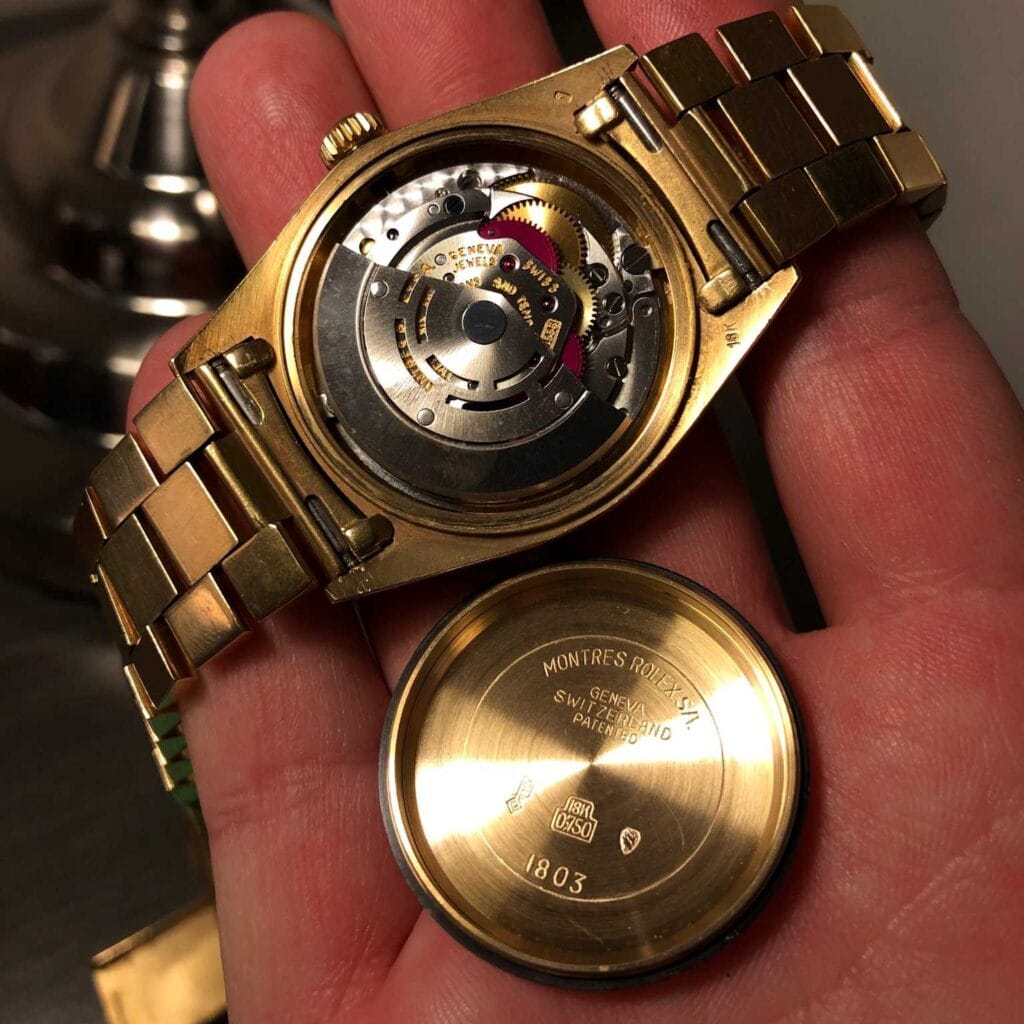
The 1803 emerged around 1960 as the third generation, incorporating Rolex’s newly developed in-house 1500-series movements. This represented a watershed: Rolex finally controlled the entire manufacturing chain for its flagship complication. The caliber 1555 initially powered the reference, beating at 18,000 vph with 25 jewels (plus additional jewels in the calendar mechanism not counted in the official rating). By 1965, Rolex had transitioned to the 1556, operating at 19,800 vph with 26 jewels and improved shock resistance. Around 1972, Rolex added the hacking feature across the entire 1500 family, allowing the seconds hand to stop when the crown is pulled for more precise time-setting.
The 1803 addressed no particular market crisis or technical challenge; it existed as refinement and optimization of an already successful formula. Rolex produced the cases in-house at their Geneva facility, while Gay Frères manufactured the majority of bracelets until Rolex acquired the company in 1998. The reference sold alongside siblings within the 1800 series: the 1802 (smooth bezel), 1804 (platinum with diamond bezel), 1806 (Florentine finish), 1807 (bark finish), and 1811 (Morellis engraved bezel).
The 1803’s 18-year run ended in 1977-1978 when reference 18038 arrived, bringing sapphire crystal, quickset date via caliber 3055, and a flatter dial profile. The 18038 sacrificed the pie-pan’s subtle elegance for improved durability and functionality, a tradeoff that makes the 1803 the last Day-Date for collectors who prioritize character over convenience.
Construction and Architecture
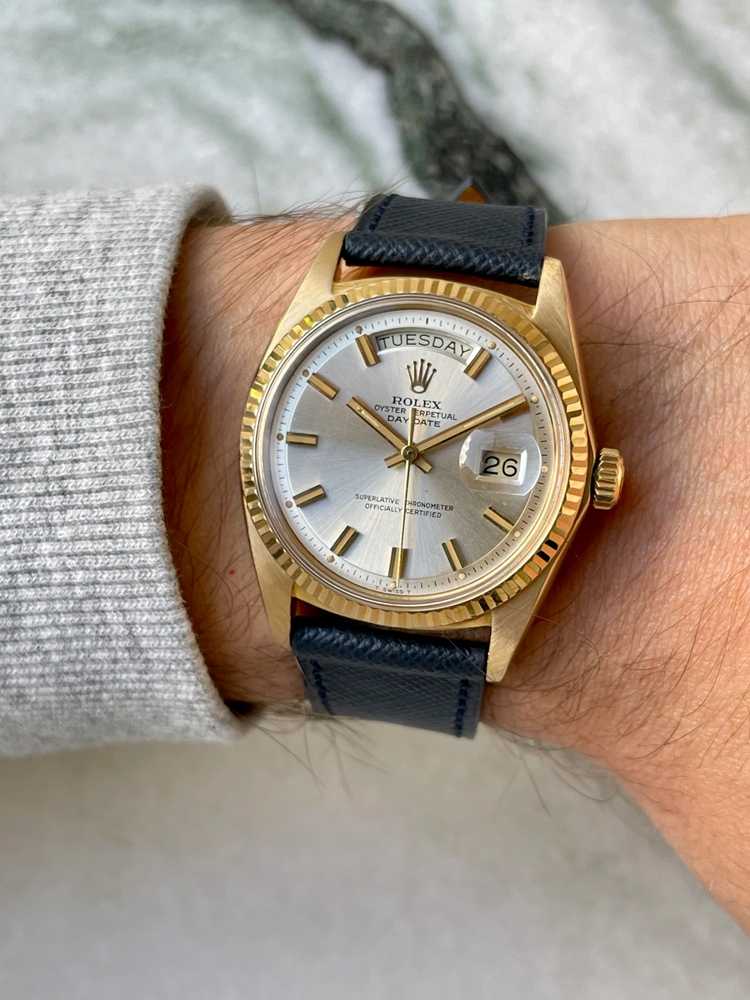
The 1803 employs a 36mm diameter Oyster case, measuring 12-13mm thick (sources vary slightly) and 44mm lug to lug. Rolex manufactured these cases in-house from solid 18k gold: yellow gold (most common), white gold (uncommon), and rose/pink gold (rare, approximately 1 in 100 examples). The case features a screw-down crown signed with the Rolex coronet and waterproofing to 100 meters (10 ATM). The crown on yellow gold examples typically shows two dots beneath the coronet, indicating 18k gold with Twinlock gasket system. White gold versions display two dots as well, while platinum pieces (not common in 1803 production) would show a single dot.
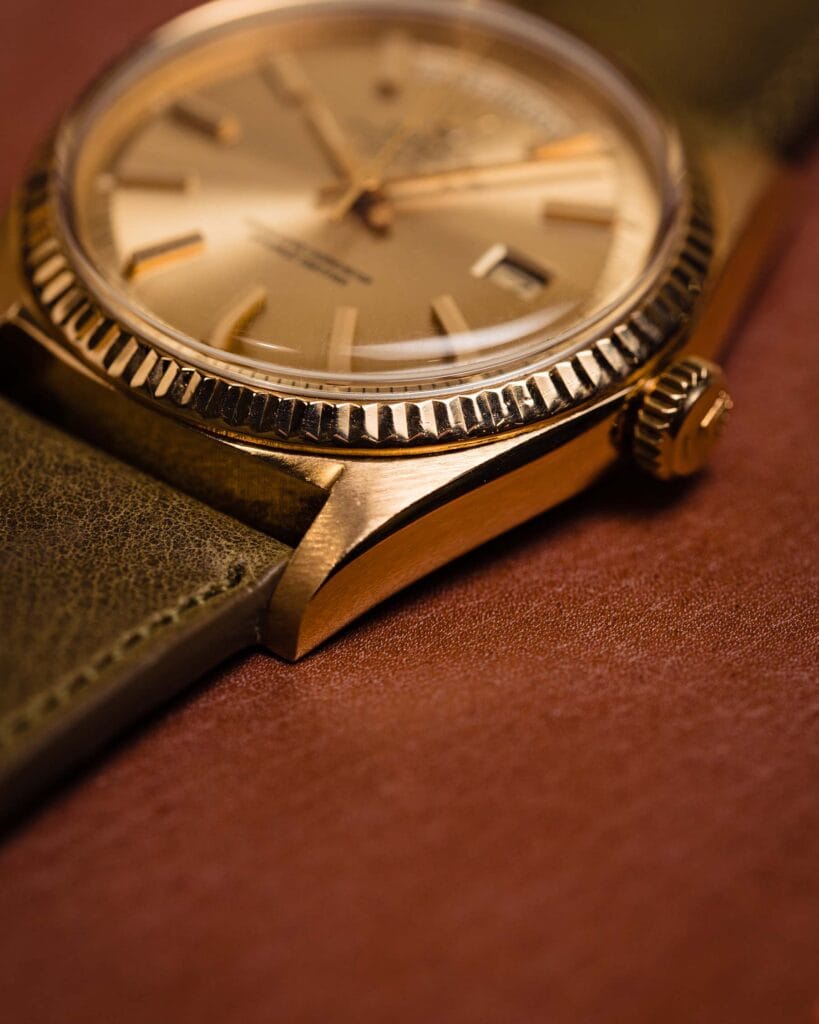
The fluted bezel, manufactured in the same precious metal as the case, provided the signature Day-Date aesthetic while also serving to compress the crystal gasket against the case. Rolex fitted all 1803s with domed acrylic (plexiglass) crystals that develop a warm patina and scratch more readily than sapphire but polish easily. The Cyclops magnifier sits at 3 o’clock over the date aperture.
Case backs are solid and screw down, with the inside stamped “1803” and Swiss hallmarks. On the case exterior, hallmarks appear on the underside of lugs: a “Geneva Key” or dog head indicating 18k gold purity. Serial numbers reside between the lugs at 6 o’clock (requires bracelet removal), ranging from approximately 550,000 (1960) through 5,865,000 (1978).
The pie-pan dial represents the 1803’s defining visual characteristic. The dial center sits flat, then slopes downward at the perimeter to create a subtle three-dimensional effect, more restrained than Omega’s dramatic pie-pans but elegant in its understatement. This dial architecture did not survive into the five-digit 18038 generation, making the 1803 the last Day-Date to feature it.
Dial configurations run the gamut. Standard finishes include champagne (most common), silver, white, black, and various sunburst textures. Linen-textured dials, where the surface has a subtle fabric-like pattern, command premiums and remain scarce. “Wide Boy” dials, produced roughly 1966-1978, feature oversized hour markers and matching extra-wide “cigarette” hands. Red quarters dials display red numerals at 12-3-6-9 positions, sometimes called “cardinal” dials after the bird. Non-luminous dials, produced primarily for the Japanese market where tritium was restricted, omit luminous plots but still sometimes carry the “T Swiss T” designation.
Stella dials represent the apex of 1803 collectibility. These hand-lacquered enamel dials, produced mid-1970s into the 1980s, came in vivid colors: oxblood, coral red, turquoise, lilac, orange, green, and others. Stella dials were manufactured by Stella SA, a Geneva-based supplier, using multiple hand-applied lacquer layers dried individually to achieve extraordinary depth and color saturation. Early Stella dials (Type 1) feature the pie-pan shape; later versions are flat. Stella 1803s command $18,000-$30,000+, with certain rare colors reaching higher.
Applied hour markers are typically batons in yellow gold (on yellow gold cases), white gold (on white gold), or rose gold (on rose gold cases). Diamond markers appear on certain configurations, usually in square settings. Sigma dials carry two small Greek sigma (σ) symbols flanking the “T Swiss T” inscription at 6 o’clock, confirming that both markers and hands are solid gold. This marking emerged in the 1970s as Swiss manufacturers sought to differentiate their products.
Hands on most 1803s are straight batons, matching the dial’s applied markers. Some examples feature dauphine hands, more common on earlier serial numbers. Luminous variants have tritium-filled plots on both dial markers and hand tips, aging to cream or custard tones with matching patina considered ideal. Non-luminous hands are solid metal with no lume.
The day display at 12 o’clock shows the day fully spelled out, available in 26 languages including English, Spanish, French, German, Arabic, and others. The date window at 3 o’clock magnifies via the Cyclops lens. Neither complication includes quickset functionality; advancing the calendar requires rotating the hands past midnight.
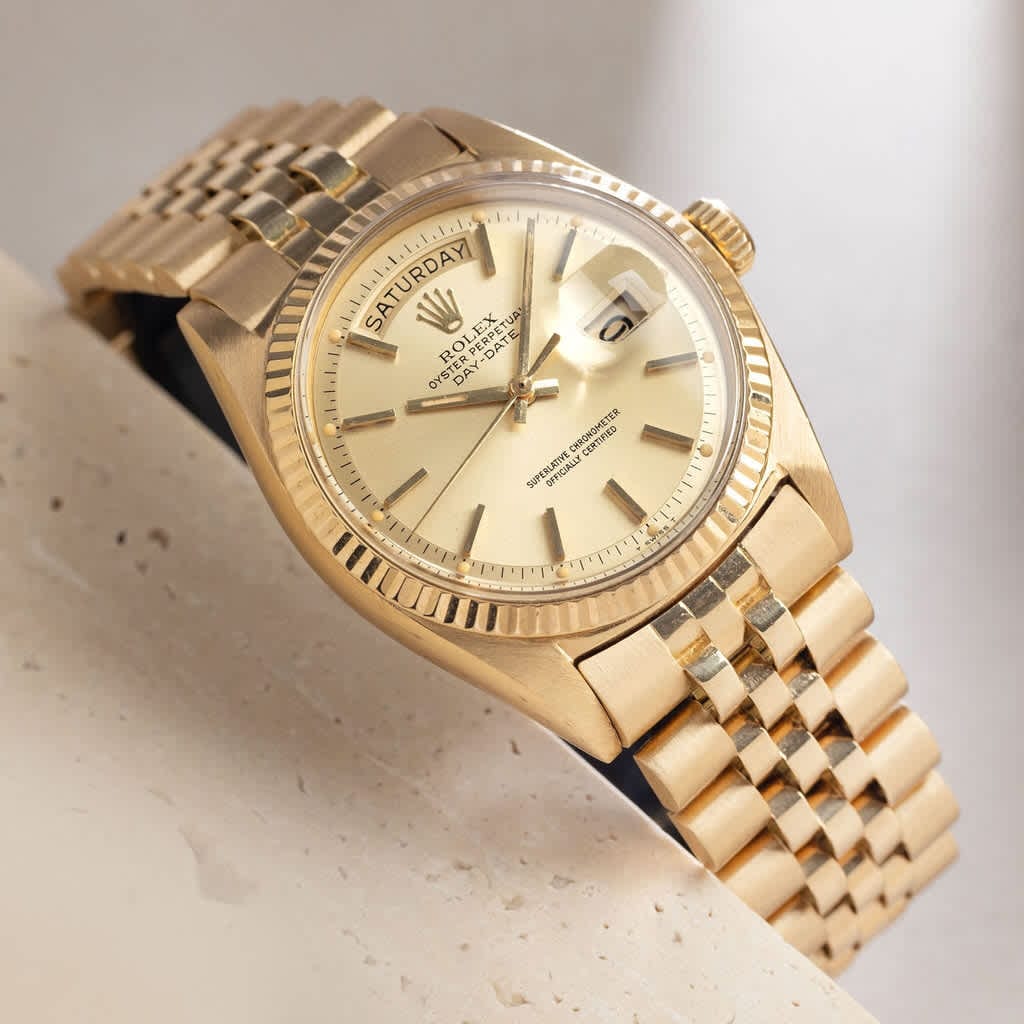
The 1803 was offered with several bracelet and strap options. The three-piece President bracelet (reference 62510H with 555 end links being one common configuration) remains the most iconic. This bracelet features semi-circular links in solid 18k gold matching the case, with a concealed Crownclasp introduced around 1969. The hidden clasp blade mechanism clicks into a folding cover, creating a seamless appearance. Bracelet date codes (stamped on the clasp interior) should roughly correspond to the watch’s serial number year, though bracelets were sometimes fitted years after case manufacture.
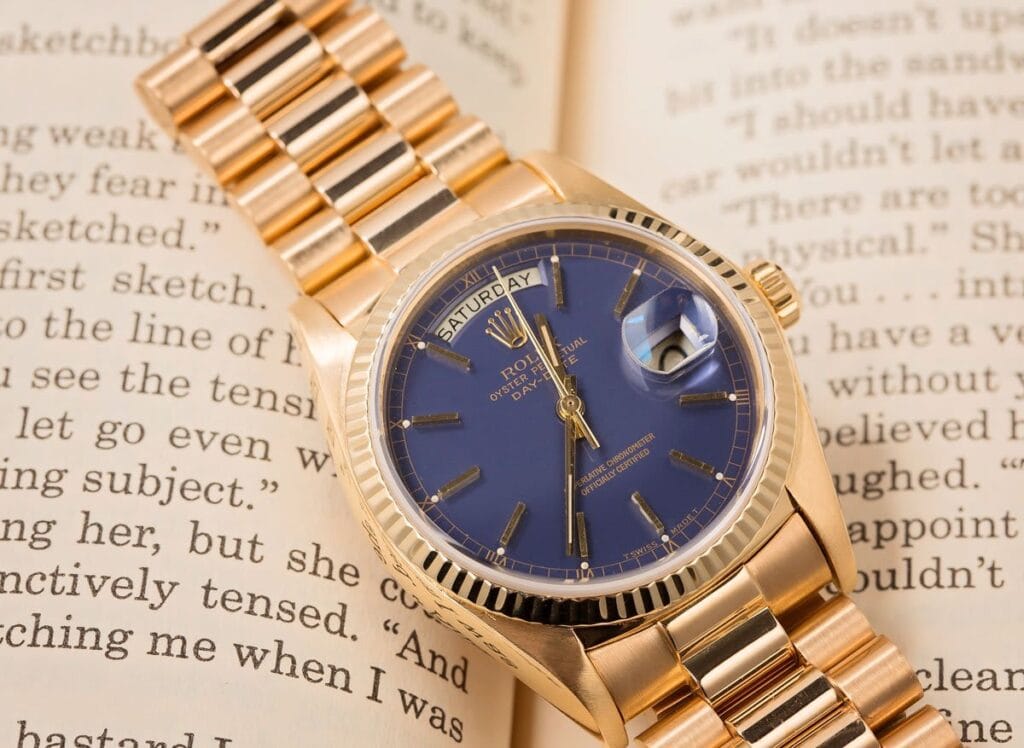
The Jubilee bracelet, with its five-link construction, appears less frequently on 1803s but is period-correct. Jubilee 1803s are scarce and command interest from collectors seeking differentiation.
Leather straps with matching gold buckles represent another factory-correct configuration, arguably the only vintage Day-Date reference that looks “cool” on leather according to collector consensus. Leather configurations are common because original President bracelets often stretched beyond wearability and were discarded or sold separately decades ago.
Dial and Bracelet Variants
| Configuration | Dial Type | Bracelet/Strap | Relative Scarcity |
|---|---|---|---|
| Standard | Champagne, silver, white, or black with applied markers | President bracelet | Common |
| Linen | Champagne or silver with fabric texture | President or leather | Uncommon |
| Wide Boy | Oversized markers and hands | President | Uncommon to Scarce |
| Red Quarters | Red numerals at cardinal positions | President or Jubilee | Scarce |
| Sigma | Sigma symbols flanking “T Swiss T” | President | Uncommon |
| Non-Luminous | No tritium plots (Japan/Asia market) | President or leather | Scarce |
| Stella | Hand-lacquered enamel in vivid colors | President | Rare to Extremely Rare |
| Diamond Markers | Factory-set diamonds | President | Uncommon |
| Stone Dial | Aventurine, wood grain, or exotic materials | President | Rare |
Cross-Reference Data
| Manufacturer | Reference | Notes |
|---|---|---|
| Rolex | 1802 | Identical to 1803 but with smooth (domed) bezel instead of fluted |
| Rolex | 1804 | Platinum case with diamond-set bezel, otherwise mechanically identical |
| Rolex | 1806 | Florentine-finished bezel and case, often with matching bracelet center links |
| Rolex | 1807 | Bark-finished bezel (Italian market), sometimes with bark-finished bracelet links |
| Rolex | 1811 | Morellis-engraved bezel, rare variant |
| Rolex | 18038 | Successor (1977-1988) with sapphire crystal, quickset date, caliber 3055 |
Movements & Calibers
Caliber 1555 (1960-1967)
The 1555 powered early 1803s, built on the architecture of Rolex’s base caliber 1530 with added day and date complications. Specifications: 28.5mm diameter, 7.03mm height (thickest of the 1500 series), 25 jewels officially (additional jewels in calendar mechanism not counted), 18,000 vph (5 beats per second), 42-hour power reserve. The movement employed a free-sprung Nivarox hairspring with Breguet overcoil, Microstella-regulated balance wheel, and KIF Flector shock absorbers. The instantaneous midnight date change mechanism used the same architecture Rolex still employs today. Accuracy was certified chronometer-grade by COSC. The 1555 lacked hacking and quickset functionality.
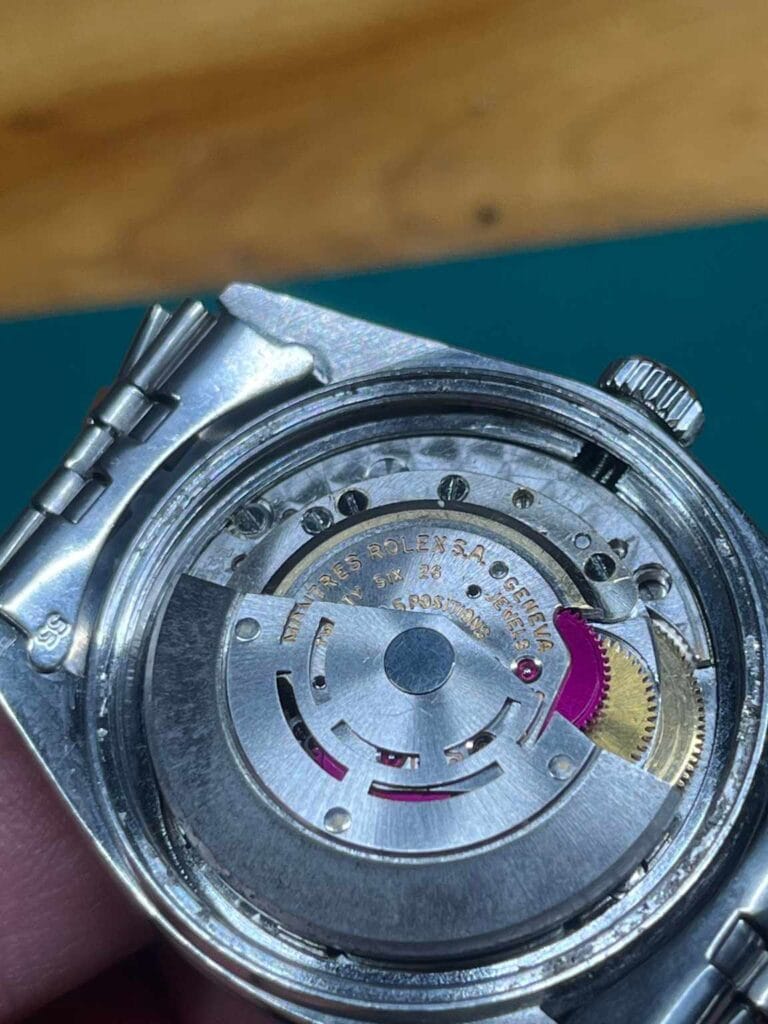
Caliber 1556 (1965-1978)
Rolex transitioned to the 1556 by the mid-1960s, overlapping with late 1555 production. The 1556 is virtually identical to the 1555 with two key differences: frequency increased to 19,800 vph for improved accuracy and shock resistance, and jewel count rose to 26 (an additional jewel in the center wheel arbor). Dimensions, power reserve, and architecture remained unchanged. Around 1972, Rolex added the hacking function: pulling the crown now stopped the seconds hand for precise time-setting. The 1556 still required slow-setting both day and date by winding hands through midnight; quickset functionality would not arrive until the caliber 3055 in 1978.
Both movements are hand-winding and automatic via bidirectional rotor. Service intervals should follow Rolex’s recommendation of 5-7 years, though many 1803s run reliably for longer periods if well-maintained. The movements are robust and easily serviced by competent watchmakers, though original parts become scarcer as decades pass.
| Caliber | Production Period | Frequency | Jewels | Power Reserve | Key Features |
|---|---|---|---|---|---|
| 1555 | 1960-1967 | 18,000 vph | 25 (+3-4 calendar) | 42 hours | Free-sprung balance, Microstella regulation, no hacking, no quickset |
| 1556 | 1965-1978 | 19,800 vph | 26 (+3-4 calendar) | 42 hours | Higher frequency, hacking (from 1972), no quickset |
Identifying Original vs. Replaced Parts
Vintage Rolex authentication demands diligence. Refinished dials represent the most common alteration, ranging from professional Rolex service replacements to ham-fisted redials that destroy value.
Original Dial Identification:
Dial printing on genuine 1803s exhibits razor-sharp edges under magnification, with consistent font spacing and alignment. The Rolex coronet logo sits precisely at 12 o’clock with fine detail in the crown’s five points. Applied markers show no glue residue or color bleed onto the marker edges; if you see lacquer overlapping onto the hour markers, the dial was refinished after markers were applied. Tritium lume should match color between dial plots and hand plots, typically aging to cream, custard, or light brown depending on exposure and storage conditions. Mismatched lume colors indicate replacement hands or relume work. The dial surface texture (sunburst, linen, etc.) should appear uniform under magnification without spray-pattern artifacts.
Sigma dials carry the small σ symbols flanking “T Swiss T” at 6 o’clock. If these symbols appear but the printing looks fresh or misaligned, suspect a redial. T Swiss T or Swiss designations should appear on tritium dials; later Luminova service dials say “Swiss Made” or similar.
Refinished Dial Red Flags:
High-gloss finish inconsistent with age-appropriate oxidation. Printing with blurred edges or inconsistent font weights. Glue residue visible around applied markers. Color bleed from dial surface onto markers or printing. Hour markers not perfectly aligned or spaced. Dial condition dramatically better than case/bracelet condition. Luminous material too white or neon compared to age-appropriate patina. Missing Swiss designation at 6 o’clock (common on cheap redials).
Hands:
Original straight baton hands should have crisp edges and uniform finishing. Tritium-filled hands age to match dial lume; significant color mismatch indicates replacement. Service replacement hands from later periods use Luminova (no radioactivity under UV light) rather than tritium (slight afterglow under UV). Dauphine hands appear on some 1803s, particularly earlier examples, and are correct if they match the watch’s serial number period.
Crown:
Original crowns are signed with the Rolex coronet and appropriate metal markings. Yellow gold 1803s typically have two dots under the coronet (Twinlock in gold), white gold also shows two dots, platinum would show one dot. Replacement crowns often have incorrect markings or poorly executed engraving. The crown should screw down smoothly; cross-threading or difficulty engaging suggests replacement or damage.
Case:
Unpolished cases retain thick, symmetrical lugs with sharp edges and visible hallmarks on the lug undersides. Factory finishing on the lug tops should be visible if the case has not been aggressively polished. Polishing rounds off edges, reduces lug thickness, and can obliterate hallmarks. Between-the-lugs serial numbers should be clearly legible; blurry or re-engraved serials indicate potential fraud. The “1803” marking inside the case back should match the reference.
Bracelet:
President bracelets should have date codes stamped inside the clasp that roughly correspond to the watch’s production year (within 1-2 years acceptable due to parts aging in inventory). Bracelet stretch is normal and expected on vintage examples; severely stretched bracelets can be repaired or replaced, though this impacts originality. Jubilee bracelets are period-correct but less common. End link references should match: 555 end links are correct for 1803, while 553 or 554 indicate other models. Gay Frères bracelets (stamped with GF or Gay Frères) are period-correct and desirable.
Collector Notes & Market Context
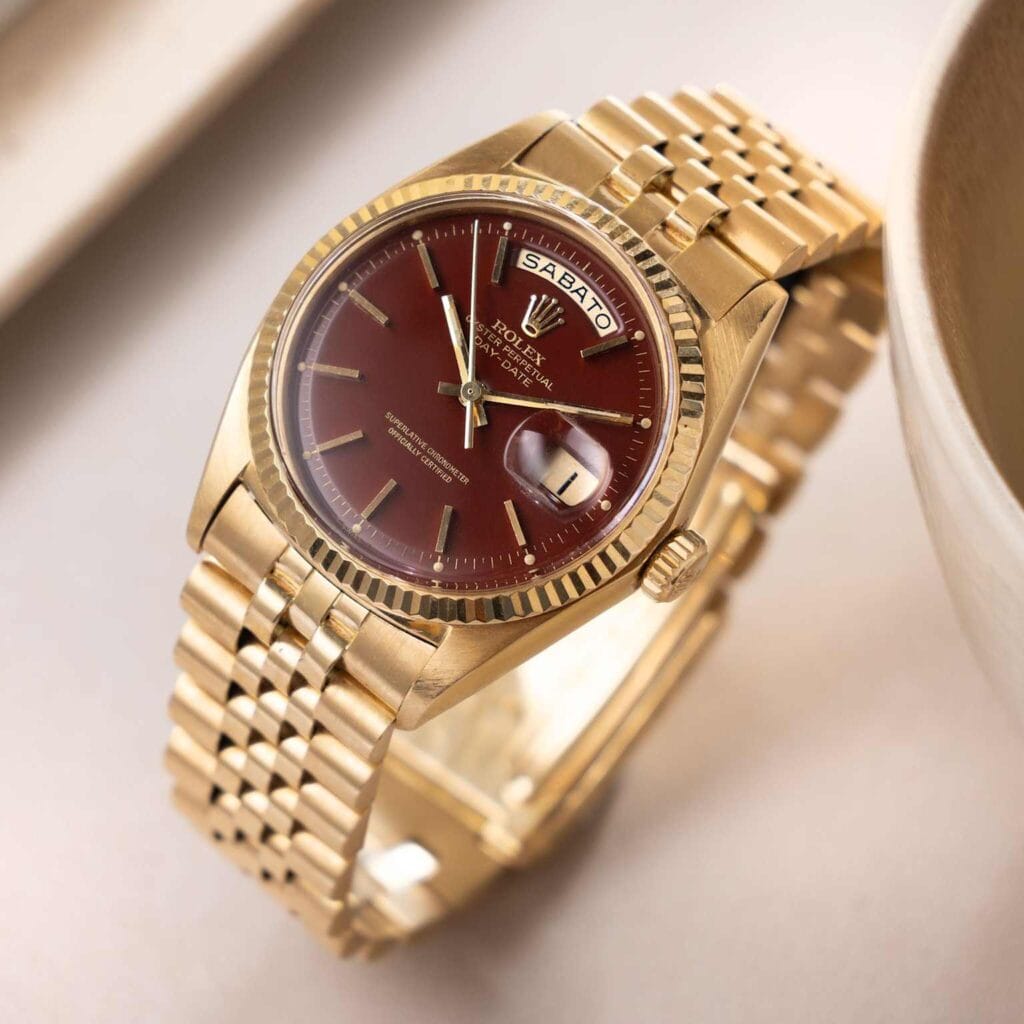
The 1803 sits at a market inflection point. Five-digit references (18038 and later) offer quickset, sapphire, and modernity, but lack the pie-pan dial and acrylic crystal’s vintage soul. Four-digit predecessors (6611) are scarcer and pricier, but mechanically inferior. The 1803 balances availability, character, and reliability.
Market pricing as of January 2026: yellow gold examples with standard dials and President bracelets trade in the $10,000-$15,000 range depending on condition and dial originality. Unpolished cases command 20-40% premiums. White gold 1803s bring $12,000-$18,000, with rarity offsetting lower precious metal demand. Rose gold examples, scarce at ~1 in 100 production, fetch $18,000-$28,000+. Stella dials start around $18,000 and climb into the $25,000-$40,000+ range for rare colors in excellent condition. Wide boy dials add $2,000-$5,000 to standard prices. Red quarters command similar premiums.
Prices have appreciated 301% from 2010 ($3,295 average) to 2025 ($13,228 average), slightly outpacing the broader Rolex market’s 550% rise but underperforming steel sports models. The 1803 benefits from Day-Date prestige without steel Daytona speculative excess. Demand remains stable, driven by collectors seeking vintage gold with wearability rather than investors chasing hype.
Most Sought-After Configurations:
Unpolished cases with sharp edges and visible hallmarks. Original Stella dials in scarce colors (lilac, coral red, turquoise). Rose gold in any dial configuration. Wide boy dials with original matching hands. Sigma dials with original lume. Linen-textured dials in excellent condition. Complete sets with box, papers, and matching serial numbers (rare for this era).
Common Pitfalls:
Refinished dials masquerading as original, often obvious under magnification. Polished cases sold as “unpolished”. Service replacement dials from Rolex official service (technically genuine but not birth year, significantly impact value). Mismatched bracelets from wrong reference or era. Stretched bracelets requiring expensive repair ($1,500-$3,000+). “Box and papers” that don’t match serial numbers. Fake Stella dials, increasingly sophisticated.
Value Drivers:
Original dial with matching lume patina: 30-50% premium over refinished. Unpolished case: 20-40% premium. Box and papers with matching serials: 15-30% premium (scarce). Rose gold: 40-80% premium over yellow gold. Stella dial: 50-200%+ premium depending on color. Wide boy or other rare dial variant: 20-50% premium.
Wearability & Lifestyle Fit
The 1803’s 36mm case wears larger than the measurement suggests, thanks to the tall bezel, prominent lugs, and substantial bracelet. Modern 40mm+ expectations make 36mm seem small until you strap it on; the watch commands visual real estate through three-dimensional architecture and reflective gold surfaces rather than diameter.
Daily Wearer Viability:
Gold’s softness and acrylic’s scratchability argue against daily wear in demanding environments. That said, many collectors wear 1803s regularly, accepting patina as part of ownership. Gold scratches polish out easily; acrylic can be buffed or replaced inexpensively. Water resistance to 100m (10 ATM) handles swimming and snorkeling if gaskets are fresh, but the crown’s Twinlock system and vintage seals recommend caution. Avoid showers (soap residue), high-impact water sports, and submersion without recent pressure testing.
Dress Watch Appropriateness:
The 1803 excels as a dress watch, especially on leather. The 36mm size, pie-pan dial, and gold construction suit business formal and black-tie contexts where modern 40mm+ sports watches appear gauche. The Day-Date complication adds practical utility without chronograph complication visual clutter. On President bracelet, the watch leans more toward “power dressy” than pure elegance; leather softens the statement.
Sport/Tool Watch Suitability:
Minimal. The 1803 is not a tool watch. Water resistance suffices for incidental exposure, but this is a luxury object first. Wearing a $13,000+ vintage gold watch for sports risks damage that impacts both function and value.
Comfort Factors:
The President bracelet weighs 80-120+ grams depending on length, creating substantial wrist presence some love and others find heavy. The Jubilee bracelet offers more flexibility and lighter feel. Leather maximizes comfort and elegance, though requires more frequent replacement. The 44mm lug-to-lug fits most wrists comfortably; under-7-inch wrists may struggle with bracelet sizing.
Gold watches resist casual strap experiments; NATO straps or canvas look incongruous on a Day-Date. Leather in brown, black, or exotic skins works beautifully. The 20mm lug width accepts standard aftermarket straps, though high-quality options befitting a luxury watch cost $200-$1,000+. Many collectors keep both a President bracelet and leather strap, swapping based on context.
The 1803 suits collectors who appreciate vintage aesthetics and accept maintenance realities. Modern buyers wanting quickset, sapphire, and worry-free daily wear should choose five-digit references. Those seeking maximum vintage character, willing to wind through midnight for calendar changes, will find the 1803 immensely satisfying. This is a watch that demands slower engagement: the acrylic crystal that scratches but glows warmly in certain light, the pie-pan dial that creates subtle depth, the caliber that requires hands-on date adjustment. These “inconveniences” are precisely the point.