

Last updated ~ February 2, 2026
Brand
Production Period
1961–1977
Model Line
Case Shape
Round
Diameter
36mm
Lug to Lug
44mm
Lug Width
20mm
Case Thickness
12mm
Case Back
Screw-Down
Caliber
Crystal
Bezel
Fixed
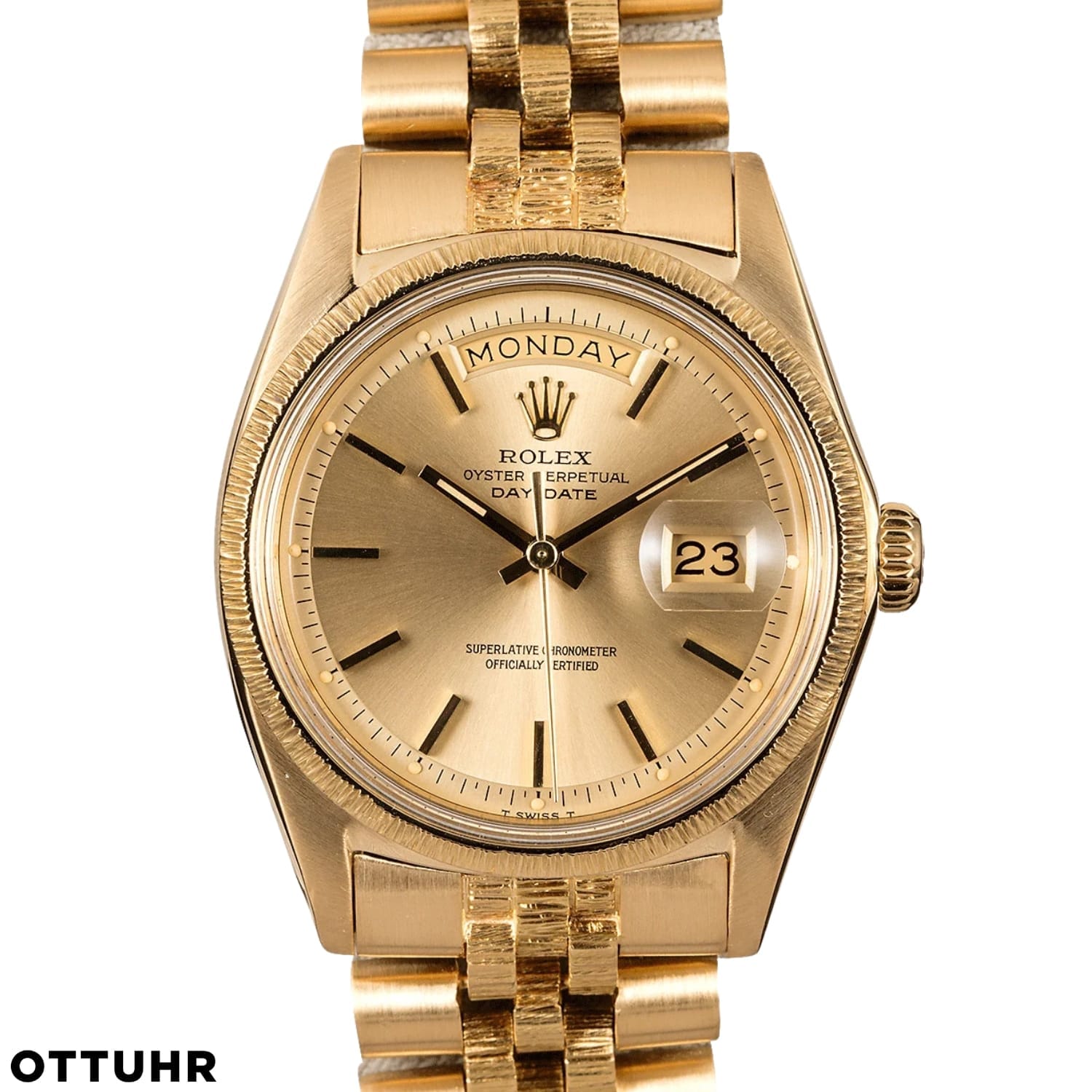
The Rolex Day-Date 1807 represents one of the most distinctive interpretations of the iconic President watch, distinguished by its hand-finished bark texture that transforms the classic fluted bezel into organic, tree-bark-inspired topography. Launched in the early 1960s as part of the 1800-series Day-Date family, the 1807 offered collectors an alternative to the ubiquitous fluted bezel of the 1803, replacing polished ridges with a chaotic, matte-finished surface that catches light in unpredictable ways. This textured finish extends to the center links of the matching President bracelet, creating a cohesive aesthetic that remains polarizing among collectors but undeniably memorable.
The 1807 occupies a specific niche within the Day-Date hierarchy. It is fundamentally an 1803 with decorative finishing, sharing the same 36mm Oyster case, pie-pan dial construction, and movement lineage. The reference caters to collectors who appreciate subtle differentiation, those who want the gravitas of yellow or white gold without the high-polish formality of a standard President. The bark finish was not merely cosmetic, it was applied by hand, meaning each example exhibits slightly different surface characteristics, making every 1807 technically unique.
Production figures for the 1807 remain undocumented by Rolex, but the reference is categorized as uncommon to scarce within the vintage Day-Date landscape. The 1807 was produced in smaller numbers than the mainstream 1803, as the bark finish appealed to a more selective clientele. Serial numbers from the 1.1 million range (early 1960s) through approximately 5 million (late 1970s) have been observed, suggesting continuous but limited production throughout the reference’s 16-year lifespan. The bark finish fell out of favor by the late 1970s when Rolex transitioned to the five-digit 180XX series with sapphire crystals and quickset movements, making the 1807 a product of a specific aesthetic moment that was not repeated in later generations.
Collector interest in the 1807 has grown steadily as vintage Rolex appreciation has matured. While the reference historically traded at a slight discount to comparable 1803 examples due to the polarizing bark finish, recent market activity shows narrowing price gaps and even premiums for well-preserved examples. Certain dial configurations command significant attention: Stella dials in vivid lacquer colors can fetch $40,000 to over $60,000 at auction, wood dials (particularly sequoia) approach similar territory, and Omani “Khanjar” examples with the Sultanate’s national emblem are exceedingly rare with fewer than a dozen known to exist. Standard champagne, silver, and black pie-pan dial examples in yellow gold typically trade between $10,000 and $15,000 depending on condition, while white gold variants command 20-30% premiums due to rarity. The bark finish itself has transitioned from a liability to a desirable quirk as collectors increasingly seek references that deviate from the standard Day-Date template.
No specific nickname has been universally adopted for the 1807, though it is occasionally referred to as the “Bark Day-Date” or “Bark President” to distinguish it from its fluted-bezel sibling.
Historical Context, Provenance, and Manufacturing Details
The Day-Date 1807 emerged during a period of design experimentation within Rolex’s precious metal offerings. When Rolex introduced the Day-Date in 1956 with the 6510 and 6511 references, the watch broke ground as the first wristwatch to display both the date and the full day of the week spelled out in a dial aperture. The initial references were replaced by the 66XX series, which achieved COSC chronometer certification, and by the early 1960s, Rolex had expanded the Day-Date into the 1800 series. This generation introduced dial diversity and, crucially, bezel variations.
The 1800 series was not monolithic. While the 1803 with its fluted bezel became the archetypal President watch, Rolex simultaneously offered the 1802 (smooth/domed bezel), 1804 (gem-set bezel), 1806 (Florentine finish), 1807 (bark finish), and 1811 (Morellis/moiré finish). These references addressed a market need: clients who wanted precious metal Day-Dates but desired aesthetic differentiation beyond dial color. The bark finish specifically responded to mid-century trends favoring textured gold surfaces in jewelry and haute horlogerie. Florentine, bark, and Morellis finishes were popular in Italian jewelry markets during the 1960s and 1970s, and Rolex capitalized on this preference by offering these textures on both bezels and bracelet center links.
The 1807 did not replace any specific predecessor, it was introduced alongside the 1803 as a style variant. The reference was launched around 1961-1963 (sources vary slightly) and remained in production until 1977-1978 when Rolex discontinued the entire 1800 series in favor of the five-digit 180XX references. The 1807’s successor in spirit was the 18078, a five-digit bark-bezel Day-Date introduced in the late 1970s with sapphire crystal and the quickset caliber 3055. However, the 18078 lacked the pie-pan dial and the vintage charm of the acrylic crystal, making it a modern interpretation rather than a direct continuation.
The 1807 was not a groundbreaking release, it was an aesthetic expansion of an established platform. Its significance lies in its rarity and its representation of a design philosophy that prioritized client personalization within the Day-Date family. The watch was manufactured at Rolex’s Geneva facilities, with cases produced by Rolex’s in-house case-making operations under the “Genex” trademark (Geneva Key hallmark #12). The bark finish was applied by hand to both the bezel and the bracelet center links, a labor-intensive process that contributed to the reference’s limited production. The President bracelet itself was often manufactured by Gay Frères, Rolex’s longtime bracelet supplier, before Rolex brought bracelet production fully in-house.
The 1807 occupies a transitional space in horological history. It represents the last generation of Day-Dates to feature pie-pan dials, acrylic crystals, and non-quickset movements. It also exemplifies the 1960s-1970s era when Rolex offered extensive customization options, a practice that was later streamlined in favor of more standardized production.
Construction and Architecture
The Rolex Day-Date 1807 is built on the classic 36mm Oyster case architecture that has defined the President lineage since 1956. The case is forged from solid 18k gold, available primarily in yellow gold and white gold, with pink/rose gold examples appearing occasionally but remaining exceptionally rare. The case features a three-piece construction: a monobloc middle case, a screw-down case back, and the distinctive bark-finished bezel. The screw-down case back is marked with the reference number 1803 on the interior (the 1807 designation typically appears only on the exterior case between the lugs), along with hallmarks indicating 18k gold purity and the Geneva Key hallmark for Genex (Rolex’s in-house case manufacturer).
The bark finish is the 1807’s defining visual characteristic. Unlike the orderly parallel ridges of a fluted bezel, the bark texture presents a chaotic, hand-applied pattern of fine lines and irregular surfaces intended to resemble tree bark. The finish is matte rather than polished, creating a subdued luster that contrasts sharply with the high-gloss fluted bezels of the 1803. Because the bark finish was applied manually, no two examples are identical in their surface topography. The bezel is fixed (non-rotating) and purely decorative, serving no functional purpose beyond aesthetics.
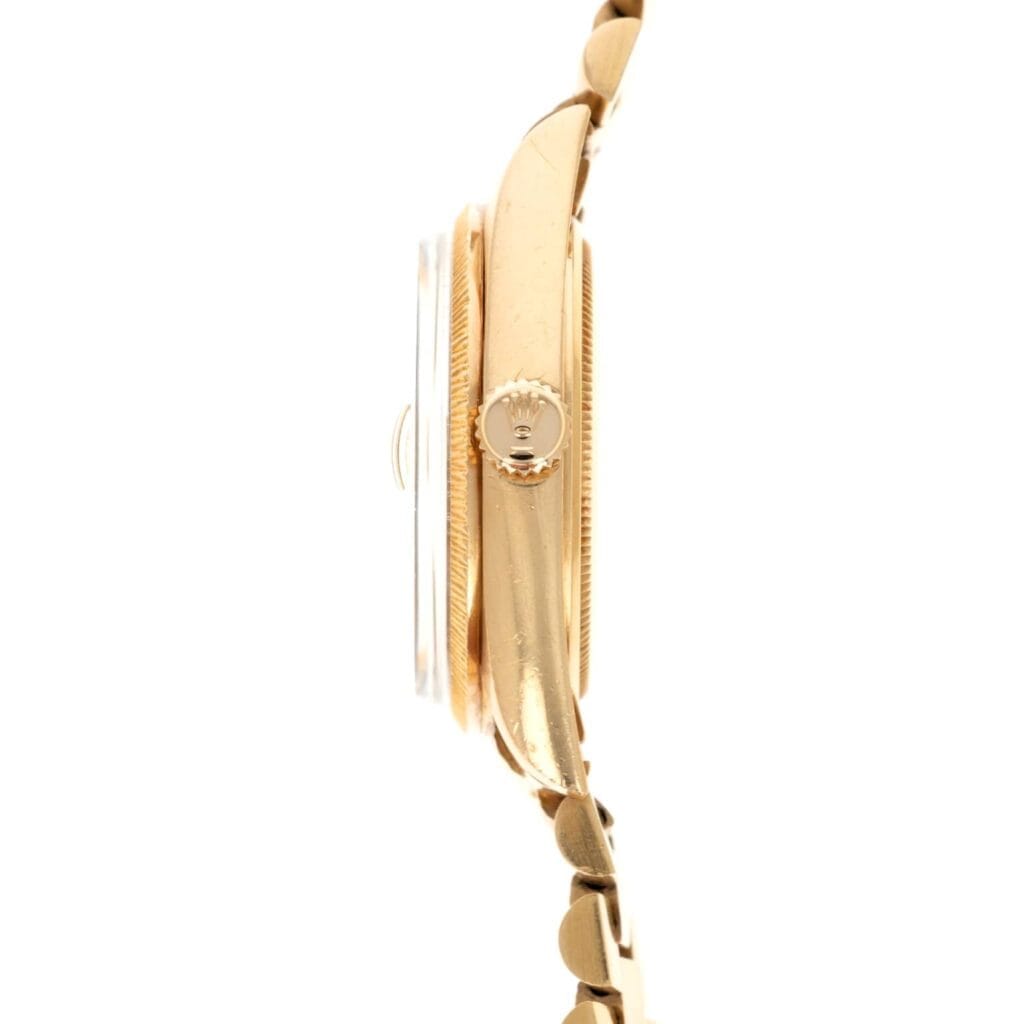
The case measures 36mm in diameter, 12 to 12.8mm in thickness (depending on the movement and whether the case back is slightly domed), and approximately 43-44mm from lug to lug. The lugs are not drilled, a characteristic of Day-Date cases from this era. The lug width is 20mm, matching the width of the President bracelet. The case features a two-dot crown, indicating that the crown is made of 18k gold (as opposed to stainless steel), a detail collectors should verify to confirm authenticity.
The crystal is acrylic (plexiglass) with a pronounced dome and a cyclops magnifier over the date window at 3 o’clock. Acrylic crystals are softer than sapphire and accumulate scratches more readily, but they can be polished using compounds like Cape Cod cloths to restore clarity. The cyclops on vintage acrylic crystals may exhibit slight yellowing or cloudiness over time, particularly if the watch has been exposed to UV light or heat.
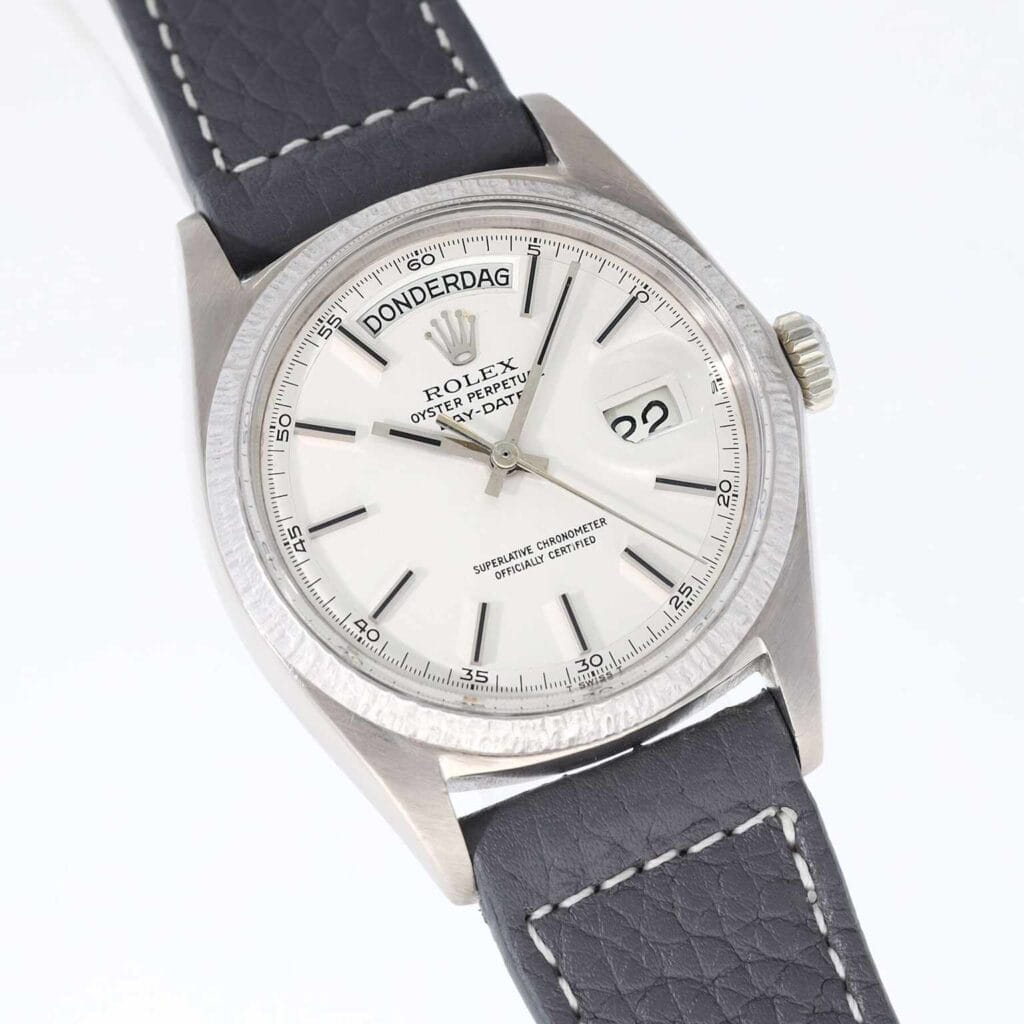
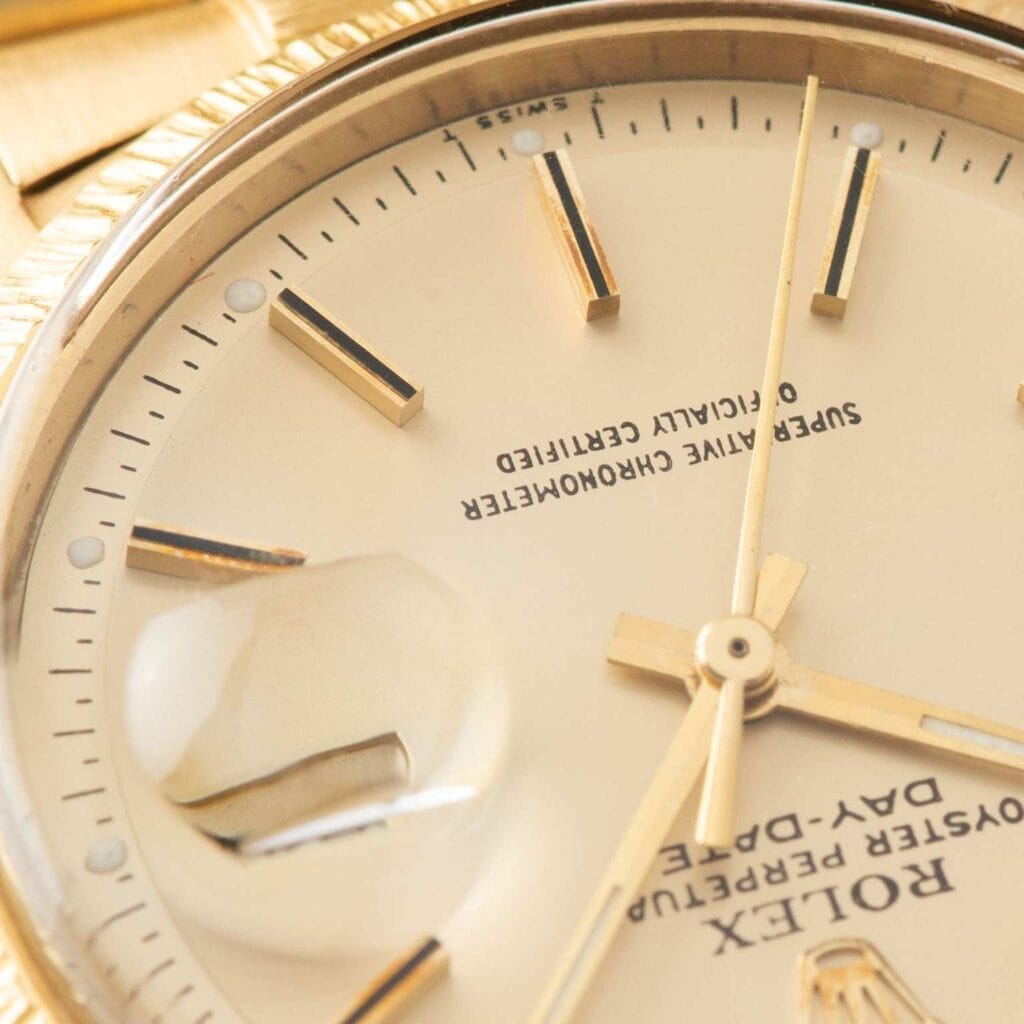
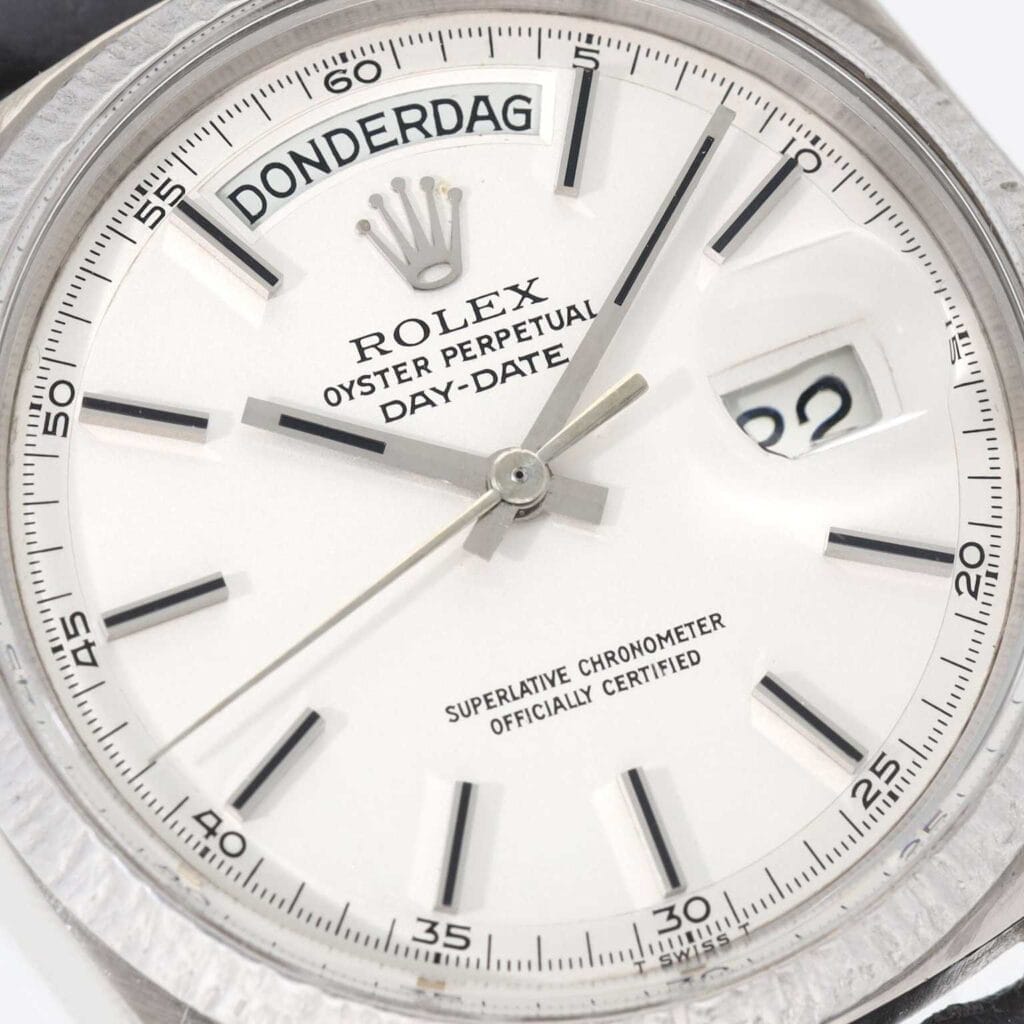
The dial is the classic pie-pan configuration, characterized by a sloped outer ring that descends from the flat center, creating a concave profile when viewed from the side. This dial architecture was specific to the 1800-series Day-Dates and was discontinued when Rolex introduced the flat dials of the 180XX series in 1977-1978. The outer minute track sits on the sloped portion, while the central dial surface remains flat. Pie-pan dials were offered in a wide array of colors and finishes, including champagne, silver, black, blue, and the highly sought-after Stella lacquer dials in vivid hues like turquoise, oxblood, coral, and green.
Hour markers are typically applied 18k gold batons or Roman numerals, with some examples featuring diamond-set indices. Sigma dials, denoted by small σ symbols flanking the “T Swiss T” text at 6 o’clock, indicate that both the dial markers and hands are crafted from solid 18k gold. The hands are dauphine or baton-style in 18k gold, matching the dial markers. Tritium luminous material was applied to the hour markers and hands from the 1960s through the late 1990s, resulting in the “T Swiss T” designation on the dial. Tritium lume ages to a creamy yellow or beige patina over time, a characteristic highly prized by vintage collectors.
The crown is a screw-down Oyster crown with the Rolex coronet logo, featuring two dots beneath the crown symbol to signify 18k gold construction. The crown screws into a threaded tube in the case to ensure water resistance up to 100 meters (300 feet), though vintage examples should not be relied upon for modern water resistance standards without recent servicing and gasket replacement.
The bracelet is the President bracelet, Rolex’s three-piece link design introduced specifically for the Day-Date. The 1807’s President bracelet features bark-finished center links that match the bezel texture, flanked by polished or brushed outer links. The bracelet is constructed entirely from 18k gold, with semi-circular link profiles that create a supple, flowing drape around the wrist. The clasp is a hidden Crownclasp, where the Rolex coronet logo serves as the release mechanism, creating a seamless appearance when closed. The clasp interior is typically stamped with hallmarks, date codes (Roman numerals I-IV for quarter and two digits for year), and metal purity marks.
The reference was also frequently sold on leather straps with matching 18k gold buckles, particularly in markets where the heavy gold President bracelet was less favored.
Dial and Design Variations
Cross-Reference Data
| Reference | Manufacturer | Dial/Bezel Notes |
|---|---|---|
| 1803 | Rolex | Fluted bezel, otherwise identical to 1807. The 1803 is the most common vintage Day-Date reference. Some 1803 examples were fitted with bark bezels or bracelets at retailers or during servicing, creating confusion with the 1807 |
| 1802 | Rolex | Smooth/domed bezel, no bark finish |
| 1804 | Rolex | Gem-set bezel, often with diamond dial markers |
| 1806 | Rolex | Florentine-finished bezel and case, linen-like texture |
| 1811 | Rolex | Morellis/moiré-finished bezel, even rarer than 1807 |
Movements & Calibers
Rolex Day Date 1803 Rolex 1556 Movement Rolex Automatic
The Rolex Day-Date 1807 was powered by two closely related movements during its production run: the caliber 1555 in early examples (circa 1961-1965) and the caliber 1556 in later examples (mid-1960s through 1977).
Caliber 1555 (Early Production, circa 1961-1965)
- Frequency: 18,000 vibrations per hour (2.5 Hz)
- Jewels: 25 jewels (with additional uncounted jewels in the calendar mechanism)
- Power Reserve: Approximately 42-48 hours
- Functions: Hours, minutes, central seconds, day display, date display
- Key Features: Bi-directional automatic winding via rotor, free-sprung Nivarox hairspring with Breguet overcoil, Microstella regulation screws, KIF Flector shock protection, instantaneous date change at midnight, slow-change day display (gradual transition around midnight), COSC chronometer certification
- Hacking: No (early versions did not feature hacking seconds)
- Quickset: No (day and date must be advanced by rotating hands past midnight)
Caliber 1556 (Mid-1960s onward, circa 1965-1977)
- Frequency: 19,800 vibrations per hour (2.75 Hz)
- Jewels: 26 jewels (additional jewel in the center wheel bearing, plus uncounted calendar jewels)
- Power Reserve: Approximately 42-48 hours
- Functions: Hours, minutes, central seconds, day display, date display
- Key Features: Bi-directional automatic winding via rotor, free-sprung Nivarox hairspring with Breguet overcoil, Microstella regulation screws, KIF Flector shock protection, full balance bridge (improved shock resistance), instantaneous date change at midnight, slow-change day display, COSC chronometer certification, hacking seconds (introduced around 1970-1972)
- Hacking: Yes (pulling the crown stops the seconds hand for precise time setting)
- Quickset: No (day and date must be advanced by rotating hands past midnight)
The transition from caliber 1555 to 1556 occurred around 1965, though both movements coexisted briefly during the transition period. The 1556 represented a meaningful upgrade in precision and reliability, with a higher beat rate improving timekeeping accuracy and an additional jewel reducing friction in the center wheel arbor. The most significant functional improvement came around 1970-1972 when the hacking seconds feature was introduced, allowing users to stop the seconds hand when pulling the crown to the time-setting position. This feature was critical for synchronizing the watch with a time reference.
Both movements lack quickset functionality for the day and date, a limitation that remained until Rolex introduced the caliber 3055 in the five-digit 180XX series in 1977. To advance the day or date on a 1807, the wearer must manually rotate the hands past midnight, a process that can be time-consuming but is consistent with the era’s mechanical constraints. The instantaneous date change occurs precisely at midnight, while the day display transitions gradually over approximately two hours centered around midnight.
The movements are marked “MONTRES ROLEX SA GENEVA,” “TWENTY SIX JEWELS” (or “TWENTY FIVE” for caliber 1555), and “ADJUSTED TO FIVE POSITIONS” on the rotor and bridges. Each movement bears a unique serial number, which does not necessarily correlate with the case serial number. The movements are finished to high standards, with Côtes de Genève striping on the rotor and bridges, blued screws, and polished bevels.
Authentic Rolex Day-Date Caliber 1556 Self-Winding
Collectors should note that both calibers 1555 and 1556 are robust and serviceable, with parts still available through Rolex service centers and independent watchmakers specializing in vintage Rolex. A full service (disassembly, cleaning, lubrication, regulation) is recommended every 5-7 years to maintain optimal performance.
Identifying Original vs. Replaced Parts
Authenticating a vintage Rolex Day-Date 1807 requires scrutiny of multiple components, as the watch’s value and collectibility hinge on originality. The following guidance outlines key authentication markers and common pitfalls.
Dials
Original 1807 dials should exhibit the following characteristics:
- Pie-pan profile with a sloped outer minute track
- “T Swiss T” or “T Swiss Made T” text at 6 o’clock, indicating tritium lume (note: some unlumed dials also carry this marking due to Rolex’s dial-printing process)
- Sigma symbols (σ) flanking the Swiss text on dials with 18k gold markers and hands (not all dials have sigma markings; their absence does not indicate inauthenticity)
- Tritium lume plots that have aged to a creamy yellow, beige, or light brown patina (pure white lume indicates reluming or a service replacement dial)
- Consistent patina between dial lume plots and hand lume (mismatched patina suggests replacement hands or dial)
- Sharp, clean printing with no fading, smudging, or irregular spacing
Refinished dials are common in vintage Rolex and can be identified by:
- Overly bright or unnaturally uniform lume (often reluminous plots glow brighter than original tritium)
- Printing that appears too bold, too thin, or misaligned
- Lack of surface texture or aging appropriate to a 50+ year-old watch
- Dial markers that appear reglued or shifted from their original positions
Service replacement dials from Rolex can be period-correct but will often lack the exact patina and character of an original dial. Collectors typically prefer original dials even if they exhibit minor imperfections.
Hands
Original hands should:
- Match the dial markers in finish (polished gold hands with polished markers, etc.)
- Exhibit tritium lume that has aged consistently with the dial lume
- Feature the correct shape (dauphine or baton) for the dial configuration
Replaced hands are identifiable by:
- Lume that does not match the dial patina (whiter, greener, or darker)
- Modern Super-LumiNova lume (greenish glow under UV light, whereas tritium does not glow or glows very faintly after decades)
- Incorrect hand shape or size relative to the dial
Original Rolex crowns for the 1807 should feature:
- Two dots beneath the coronet logo, indicating 18k gold
- Threading that matches the case tube (smooth operation, no cross-threading)
- Consistent patina with the case (replacement crowns may appear newer or differently toned)
Replaced crowns (often stainless steel crowns from service) are a red flag and can significantly diminish value.
Cases
Original 1807 cases should:
- Display sharp, crisp case markings between the lugs: “ROLEX” at 12 o’clock, “1807” at 6 o’clock, serial number at 6 o’clock (engraved deep and clean)
- Feature hallmarks inside the case back: “18k” or “750” (indicating gold purity), the Geneva Key hallmark (for Genex, Rolex’s case manufacturer), and “1803” (internal reference marking)
- Exhibit bark finish on the bezel that is consistent and hand-applied (not stamped or machined)
- Show proportionate lugs with sharp bevels and polished flanks (over-polishing rounds the lugs and reduces case width)
Over-polished cases are common in vintage Rolex and can be identified by:
- Rounded lug edges and reduced definition between polished and brushed surfaces
- Loss of sharp transitions between case components
- Reduced case thickness or altered proportions
Unpolished cases command significant premiums among collectors, as they retain the original case architecture intended by Rolex.
Bracelets
Original President bracelets with bark finish should:
- Feature bark texture on the center links that matches the bezel finish (hand-applied, irregular pattern)
- Display hallmarks inside the clasp: “18k” or “750,” date codes (Roman numeral and two digits), and maker’s marks
- Exhibit moderate to significant stretch if original to the watch (vintage President bracelets are notorious for stretch due to the softness of 18k gold)
- Include solid end links (not hollow stamped links)
Bracelet stretch is normal and expected in vintage gold bracelets, but excessive stretch (where the bracelet flops 90 degrees or more when held by the case) may require professional tightening or link replacement. Collectors generally prefer original stretched bracelets to aftermarket “tightened” bracelets, as tightening services often replace pins and bushings, rendering the bracelet non-original.
Replaced or aftermarket bracelets are common and can be identified by:
- Incorrect hallmarks or missing date codes
- Inconsistent finishing or link proportions
- Bark finish that does not match the bezel texture
Crystals
Original acrylic crystals should:
- Feature a pronounced dome with a cyclops lens over the date window
- Exhibit minor scratches and wear consistent with age (pristine crystals on 50+ year-old watches are often replacements)
Replaced acrylic crystals are not a major concern for collectors, as crystals are considered consumable parts and are often replaced during servicing. Sapphire crystal replacements are inappropriate for the 1807 and indicate incorrect servicing.
Collector Notes & Market Context
Rolex Day-Date Champagne Dial Yellow Gold 1807
The Rolex Day-Date 1807 occupies a unique position in the vintage Rolex market: it is simultaneously overlooked and coveted, depending on the dial configuration and collector priorities. Standard champagne or silver dial examples in yellow gold with original bark bracelets typically trade between $10,000 and $15,000 as of late 2024, a figure that places the 1807 slightly below the average 1803 in comparable condition. This pricing reflects the historical skepticism toward the bark finish, which some collectors find less elegant than the fluted bezel. However, this perception is shifting as collectors increasingly seek differentiation and rarity within the Day-Date family.
White gold examples command 20-30% premiums over yellow gold equivalents due to their scarcity. Pink/rose gold 1807 references are exceptionally rare and can command premiums of 50% or more when they surface. Dial configuration is the primary value driver: Stella dials in vivid lacquer colors (turquoise, oxblod, coral, green) routinely achieve $40,000 to over $60,000 at auction, with exceptional examples reaching six figures. Wood dials approach similar valuations. Omani Khanjar dials are the pinnacle of 1807 collecting, with fewer than a dozen known examples and auction results exceeding $50,000 for standard Khanjar versions and multiples of that for gem-set or “Rainbow Khanjar” configurations.
Box and papers add 10-15% to the value of standard examples and can add 20-30% to rare dial configurations. Unpolished cases with sharp lugs and crisp hallmarks command significant premiums, particularly among advanced collectors.
The most sought-after configurations include:
- Stella dials in any color, particularly oxblood, coral, and turquoise
- Wood dials in sequoia or other exotic veneers
- Omani Khanjar dials with the red national emblem
- Buckley dials with large Roman numerals in uncommon colors (blue, black)
- White gold examples with matching bark bracelets
- Sigma dials with 18k gold markers
Common pitfalls when purchasing include:
- Bark finish applied aftermarket to a standard 1803 (examine the finish closely for consistency and hand-applied irregularity)
- Refinished dials that have lost their original patina and character
- Replaced crowns in stainless steel rather than 18k gold
- Over-polished cases with rounded lugs and diminished proportions
- Aftermarket bracelet center links with bark finish that does not match the bezel
- Service replacement dials that lack the pie-pan profile or sigma markings
- Mismatched serial numbers between case and movement (indicating parts swaps)
Premiums are driven by:
- Box and papers (original Rolex boxes, guarantee booklets, and chronometer certificates)
- Unpolished cases with original metal and sharp lines
- Rare dial colors and configurations (Stella, wood, Khanjar)
- Matching patina between dial and hands
- Original bark-finished President bracelet with matching date codes
- Low serial numbers or early production examples with caliber 1555
The 1807 market is less liquid than the 1803, meaning that finding the right buyer for a rare dial configuration may require patience. However, exceptional examples with Stella or Khanjar dials generate intense bidding at major auctions and can far exceed pre-sale estimates.
Wearability & Lifestyle Fit
The Rolex Day-Date 1807 is a versatile 36mm watch that straddles the line between dress elegance and daily wearability. At 36mm, the case is proportionate for both men and women, fitting comfortably on wrists ranging from 6.25 inches (16cm) to 8 inches (20cm) without appearing oversized or undersized. The 43-44mm lug-to-lug measurement ensures that the watch sits well on smaller wrists without overhang, while the moderate case thickness (12-12.8mm) allows it to slide under dress shirt cuffs without difficulty.
Daily Wear Viability
The 1807 is suitable for daily wear with caveats. The 100-meter water resistance is theoretically adequate for handwashing, rain exposure, and incidental splashes, but vintage examples should not be relied upon for swimming or showering without recent servicing and gasket replacement. The acrylic crystal is vulnerable to scratching but can be easily polished using Cape Cod cloths or professional polishing compounds, a characteristic that makes it more forgiving than sapphire in daily use. The screw-down crown provides reasonable protection against dust and moisture ingress when properly seated.
The President bracelet is exceptionally comfortable due to its semi-circular link profile and supple drape, though vintage examples often exhibit significant stretch. Stretch does not affect functionality but can cause the bracelet to feel loose or shift excessively on the wrist. The hidden Crownclasp is elegant but lacks the micro-adjustment capabilities of modern Rolex clasps, requiring the wearer to add or remove links for precise fit.
The 18k gold construction makes the 1807 heavier than stainless steel sport watches but lighter than modern gold Day-Dates due to the hollow construction of vintage bracelet links. Total weight ranges from 110-120 grams depending on bracelet length.
Dress Watch Appropriateness
The 1807 excels as a dress watch. The bark finish adds texture without sacrificing formality, making it suitable for business settings, formal events, and black-tie occasions. The pie-pan dial and 18k gold construction convey prestige, while the 36mm case maintains proportionate elegance. Champagne, silver, and black dials are the most versatile for formal wear, while Stella dials and wood dials are best reserved for casual or creative professional environments.
Sport/Tool Watch Suitability
The 1807 is not a tool watch. The acrylic crystal, non-quickset movement, and 100-meter water resistance make it unsuitable for diving, swimming, or high-impact activities. The lack of a rotating bezel and the soft 18k gold case limit its utility in rugged environments. Collectors who intend to wear the 1807 actively should avoid exposure to:
- Water beyond handwashing or rain
- Intense vibrations or impacts (jackhammers, contact sports)
- Extreme temperatures (saunas, hot tubs)
- Magnetic fields (speakers, MRI machines)
Comfort Factors
The 1807’s 36mm case, moderate thickness, and curved lugs ensure that it wears comfortably on most wrists. The President bracelet is widely regarded as one of the most comfortable metal bracelets in horology, conforming to the wrist without pinching or binding. The weight is noticeable but not oppressive, making the watch suitable for all-day wear.
Strap Versatility
The 1807 is frequently worn on leather straps, which lighten the overall weight and shift the aesthetic toward classic formality. Common strap choices include:
- Black or brown alligator or crocodile leather with 18k gold tang buckles
- Suede or nubuck for a more casual presentation
- Custom NATO straps (unconventional but increasingly popular among younger collectors)
The 20mm lug width accommodates a wide range of aftermarket straps, though collectors should ensure that any strap and buckle combination is appropriate to the watch’s precious metal status.
The 1807 is best categorized as a collector piece that can serve as a daily wearer for those who treat their watches with care. It is not a robust sport watch, but it is more durable than its delicate appearance suggests, provided the owner respects its vintage limitations.