


Last updated ~ February 2, 2026
Brand
Production Period
1980–1988
Model Line
Case Shape
Round
Diameter
40mm
Lug to Lug
47.5mm
Lug Width
20mm
Case Thickness
13mm
Case Back
Screw-Down
Caliber
Crystal
Bezel
GMT
The Rolex GMT-Master 16750 occupies a fascinating position in horological history as the ultimate transitional reference, a bridge between the vintage charm of the 1960s and 1970s GMT-Master and the modern functionality collectors expect today. Produced for a relatively brief eight-year window from approximately 1979-1980 through 1988, the 16750 represented a quantum leap forward in GMT-Master technology while maintaining the aesthetic soul that made the collection legendary.
This reference holds particular significance because it introduced the first high-beat, quickset-equipped movement to the GMT-Master line, fundamentally improving the user experience without sacrificing the watch’s character. For collectors seeking a vintage GMT-Master with modern conveniences like hacking seconds and instant date adjustment, the 16750 delivers on both fronts. Unlike its predecessor, the 1675, which relied on the 19,800 vph Caliber 1575, the 16750’s Caliber 3075 beat at a contemporary 28,800 vph while doubling water resistance to 100 meters.

What makes the 16750 especially compelling is its dual personality across the production run. Early examples retained the matte black dials with painted tritium indices that defined 1970s Rolex sports watches, while later examples introduced glossy dials with applied white gold surrounds, previewing the aesthetic direction Rolex would take through the 1990s. Some mid-production pieces even developed the coveted “spider dial” effect, where the glossy lacquer fractured into delicate web-like patterns that collectors prize today.
History & Production Period
Rolex introduced the GMT-Master 16750 around 1979-1980 as the direct successor to the legendary Reference 1675, which had enjoyed an extraordinary 21-year production run from 1959 to 1980. The timing was significant. As commercial aviation entered a new era of efficiency and range, Rolex needed to modernize its pilot’s watch without abandoning the design language that had made the GMT-Master an icon.
The 16750 was produced until approximately 1988, making its lifespan relatively short compared to the 1675 it replaced and the 16700 that would succeed it. This eight-year window places the 16750 firmly in the transitional category, sharing characteristics with both earlier and later generations. Based on serial number research, production spanned from approximately serial 6,434,000 (1980) through 9,290,000 (1986), with R-prefix serials from 1987 through 1988.
Within Rolex’s broader strategy during the early 1980s, the 16750 represented more than just an incremental update. It was part of a comprehensive modernization effort across the sports watch line. Rolex simultaneously introduced improved movements to both the Submariner and GMT-Master collections, implementing the same quickset date technology that would become standard across the brand. The 16750 coexisted briefly with the GMT-Master II Reference 16760 “Fat Lady,” introduced in 1983, which featured an independently adjustable hour hand and sapphire crystal, creating a clear delineation between the more affordable GMT-Master and the premium GMT-Master II.

HOT ! Rolex 16750 Matte Dial 16750 Matte Dial 2025
The reference spawned two precious metal siblings: the Reference 16753 in two-tone stainless steel and yellow gold (the “Root Beer”), and the Reference 16758 in solid 18k yellow gold. These variations broadened the GMT-Master’s appeal beyond tool watch enthusiasts to those seeking luxury dress-sport pieces. Importantly, the gold 16758 received a sapphire crystal instead of acrylic, reflecting its positioning as the premium offering.
Production volumes remain estimates, as Rolex guards such information closely. However, the 16750’s eight-year run suggests considerably lower production numbers than the 1675, making it relatively scarcer in today’s market. The transitional nature also meant constant evolution, with Rolex implementing changes throughout production rather than maintaining consistency.
Technical Specifications
The Reference 16750 maintains the classic 40mm case diameter that has defined the GMT-Master since the 1675, a size that feels contemporary even by modern standards. This diameter measures the widest point of the case, excluding the crown and crown guards. The lug-to-lug measurement spans 47.5mm, making it wearable for most wrist sizes without overwhelming smaller frames.
Case thickness measures approximately 13mm including the domed acrylic crystal, slightly thicker than modern GMT-Master models due to the pronounced doming of the hesalite crystal. This thickness gives the watch substantial wrist presence while maintaining vintage proportions. The lug width is a standard 20mm, accommodating both period-correct bracelets and modern aftermarket straps.
Water resistance doubled from the 1675’s 50 meters to 100 meters (330 feet) on the 16750, a meaningful improvement that reflected Rolex’s enhanced gasket technology and case construction. This rating makes the watch suitable for swimming and everyday water exposure, though not for serious diving. The Twinlock crown system, featuring two rubber gaskets (one inside the crown, one inside the tube), provides this protection.

Rolex GMT-Master Quickset Date 16750
The crystal is acrylic (plexiglass/hesalite), maintaining continuity with vintage references rather than adopting the sapphire crystals that would appear on the 16700. This acrylic features the characteristic Cyclops magnification window over the date at 3 o’clock. Original Tropic 116 crystals have a rounded edge around the top, while service crystals feature a larger, beveled edge. The acrylic material scratches more easily than sapphire but can be polished and carries vintage appeal.
The case material for the standard 16750 is 904L stainless steel, Rolex’s proprietary alloy known for exceptional corrosion resistance and a whiter tone than standard 316L steel. The case construction includes crown guards that protect the Twinlock crown, a feature inherited from the later 1675 production. The caseback is solid and screwed down, engraved with the reference number 16750, serial number, and various Rolex markings.
Movements/Calibers
The heart of the 16750’s significance lies in its movement, the Rolex Caliber 3075. This automatic mechanical movement represented a substantial upgrade from the Caliber 1575 that powered the preceding 1675, bringing the GMT-Master into the modern era of Rolex watchmaking.
Caliber 3075 Specifications:
- Frequency: 28,800 vibrations per hour (4 Hz), a significant increase from the 1575’s 19,800 vph
- Power Reserve: Approximately 48-50 hours
- Jewels: 27 jewels
- Diameter: 28.5mm (12.5 ligne)
- Height: 6.35mm

Shop rolex 3075 movement Outlet
The higher beat rate of 28,800 vph places the 3075 in line with contemporary Swiss chronometer-grade movements, improving timekeeping accuracy and providing a smoother sweep of the seconds hand. This frequency would become standard across Rolex’s entire mechanical lineup.
Key Features & Improvements:
The quickset date function stands as the 3075’s most significant user-facing improvement. Rather than requiring the wearer to advance the hands repeatedly through 24-hour cycles to change the date, the quickset mechanism allows instant date advancement by turning the crown counter-clockwise in the second position (one click out). This saves considerable time and reduces wear on the movement. Importantly, the 3075 advances only the date wheel in quickset mode, not the hour hand, distinguishing it from the true GMT functionality of the later Caliber 3185 in the GMT-Master II.
Hacking seconds, where the seconds hand stops completely when the crown is pulled to the time-setting position, arrived with the 3075. This feature enables precise time synchronization, particularly useful for pilots and travelers needing to coordinate with air traffic control or other time-critical operations. The 1575 lacked this function entirely.
The movement features bi-directional automatic winding with a central rotor, maximizing efficiency in building the mainspring tension. Manual winding is possible with the crown in the first position (fully screwed down but disengaged), requiring clockwise rotation. The Breguet overcoil balance spring and Microstella regulation system ensure stable timekeeping across positions.
Movement Architecture Change:
One subtle but important difference distinguishes the 3075 from earlier GMT movements: the hand stack order changed. On the 1675 with Caliber 1575, the hands are layered from the dial upward as follows: 24-hour GMT hand (lowest), hour hand, minute hand, seconds hand (highest). The 3075 reversed the GMT and hour hands, placing them as: hour hand (lowest), 24-hour GMT hand, minute hand, seconds hand.
This reversal stems from the quickset date mechanism’s architecture. Because the quickset function affects the hour wheel, that hand needed to be positioned lowest on the arbor stack. This change provides an easy visual method to distinguish a matte dial 1675 from a matte dial 16750 at a glance, as the GMT hand will appear either beneath or above the hour hand depending on the reference.
The Caliber 3075 received COSC chronometer certification, as indicated by the “Superlative Chronometer Officially Certified” text on the dial. Each movement underwent testing across multiple positions and temperature ranges to verify accuracy within -4 to +6 seconds per day, Rolex’s standard that slightly exceeds COSC requirements.
Service Considerations:
Rolex recommends service intervals of approximately 5-10 years for the Caliber 3075, with many watchmakers suggesting 3-5 years for regularly worn examples. Common service issues include thickened lubricants reducing amplitude, worn date change mechanism components, and magnetization from modern electronics. The movement’s rhodium plating generally holds up well, though debris accumulation in pivot jewels can increase friction over time.
Dial Variations
The Reference 16750 exhibits two primary dial periods that create distinct collecting categories, with several important sub-variations that significantly affect desirability and value. Understanding these variations is essential for collectors seeking original configurations.

Rolex Gmt master 16750 matte dial with box & papers
Matte Dial Period (1979/1980-1984):
Early production 16750 watches featured matte black dials that carried forward the aesthetic of late-production 1675 references. These dials have a flat, non-reflective black surface with painted tritium hour markers that lack white gold surrounds. The markers consist of simple rectangular and circular shapes filled with tritium, matching the paint used on the hands.
The matte dial 16750 is considerably rarer than its glossy successor, partly due to the shorter production window (approximately 5 years compared to 3-4 years for glossy versions) and because many matte dials were replaced during service with the then-current glossy versions. Finding an original, unserviced matte dial 16750 requires careful authentication.
Visual characteristics of authentic matte dials include consistent, even black coloring without sheen, crisp white printing, and tritium plots that have aged to a warm cream or ivory tone. The tritium should display relatively uniform patination, though slight color variation between dial plots and hand lume is common and not necessarily indicative of replacement parts.
Glossy Dial Period (1984-1988):
Around mid-1984, Rolex transitioned the 16750 to glossy black dials with applied hour markers featuring white gold surrounds. This change aligned with similar updates across the Submariner and other sport models, marking a significant aesthetic shift toward the modern Rolex style that continues today. The glossy dial has a lacquered, reflective surface that catches light dramatically.

Rolex GMT-Master Ref. 16750 ‘Pepsi’ – Gloss ‘Spider’ Dial Unpolished w/ Box & Papers
The applied markers consist of a white gold frame filled with tritium compound, providing both visual depth and a more luxurious appearance than painted markers. Under magnification, you can observe the dimensional quality of these applied elements. The white gold surrounds should have consistent color and finish, without signs of tarnish or corrosion.
The “Spider Dial” Phenomenon:
A subset of glossy dial 16750 watches developed a distinctive “spider” or “crazing” effect where the lacquer developed fine cracks creating web-like patterns across the dial surface. This phenomenon occurred due to issues with Rolex’s lacquer formulation during a specific production window, roughly 1984-1986. The crazing appears only in the glossy top layer and does not affect the underlying dial surface or printing.
Spider dials are most visible when tilted under bright light, where the fine fracture lines catch illumination. The pattern varies from subtle to dramatic depending on the severity of crazing. Rolex recognized the flaw relatively quickly and adjusted the lacquer composition, making spider dials a limited production anomaly rather than a standard variation.
Collector opinion on spider dials remains divided. Some view them as desirable factory flaws with character and rarity, potentially commanding premiums. Others consider them condition issues that detract from the watch’s appearance. Authentication is important because some sellers attempt to pass heavily damaged or artificially aged dials as “spider” examples.
Dial Text Variations:
The standard dial layout includes:
- ROLEX coronet logo (applied on early examples, printed on later ones)
- “ROLEX” text below the coronet
- “OYSTER PERPETUAL” above center
- “GMT-MASTER” below center
- “SUPERLATIVE CHRONOMETER” at the bottom
- “OFFICIALLY CERTIFIED” below that
- “SWISS” or “SWISS-T<25” at 6 o’clock
The tritium designation evolved during production. Early dials may show “SWISS” only, while most production features “SWISS-T<25” indicating tritium content below 25 millicuries (925 MBq). This marking became Swiss law in 1964 and remained standard through the tritium era ending in the late 1990s.
Tiffany & Co. and Other Retailer Dials:
Rare examples feature retailer signatures, most notably “TIFFANY & CO.” printed below the center or at 6 o’clock. These retailer-signed dials command significant premiums, sometimes 30-50% above standard examples, due to their rarity and provenance. Authentication requires expert verification, as aftermarket forgeries exist.
Service Replacement Dials:
Rolex service centers replaced damaged or aging dials with contemporary versions, meaning a 1980 watch serviced in 1987 might receive a glossy dial to replace its original matte version. Service dials from the tritium era carry the same “SWISS-T<25” marking but may show characteristics slightly different from period-correct dials, such as luminous material color or coronet height.
Case & Bezel Variations
Case Construction:
The 16750 case maintains the classic Oyster construction with several identifying features collectors should recognize. The case features rounded crown guards with polished inner surfaces and brushed outer faces, protecting the Twinlock crown from impacts. These crown guards should appear symmetrical and well-defined, with sharp transitions between brushed and polished surfaces.
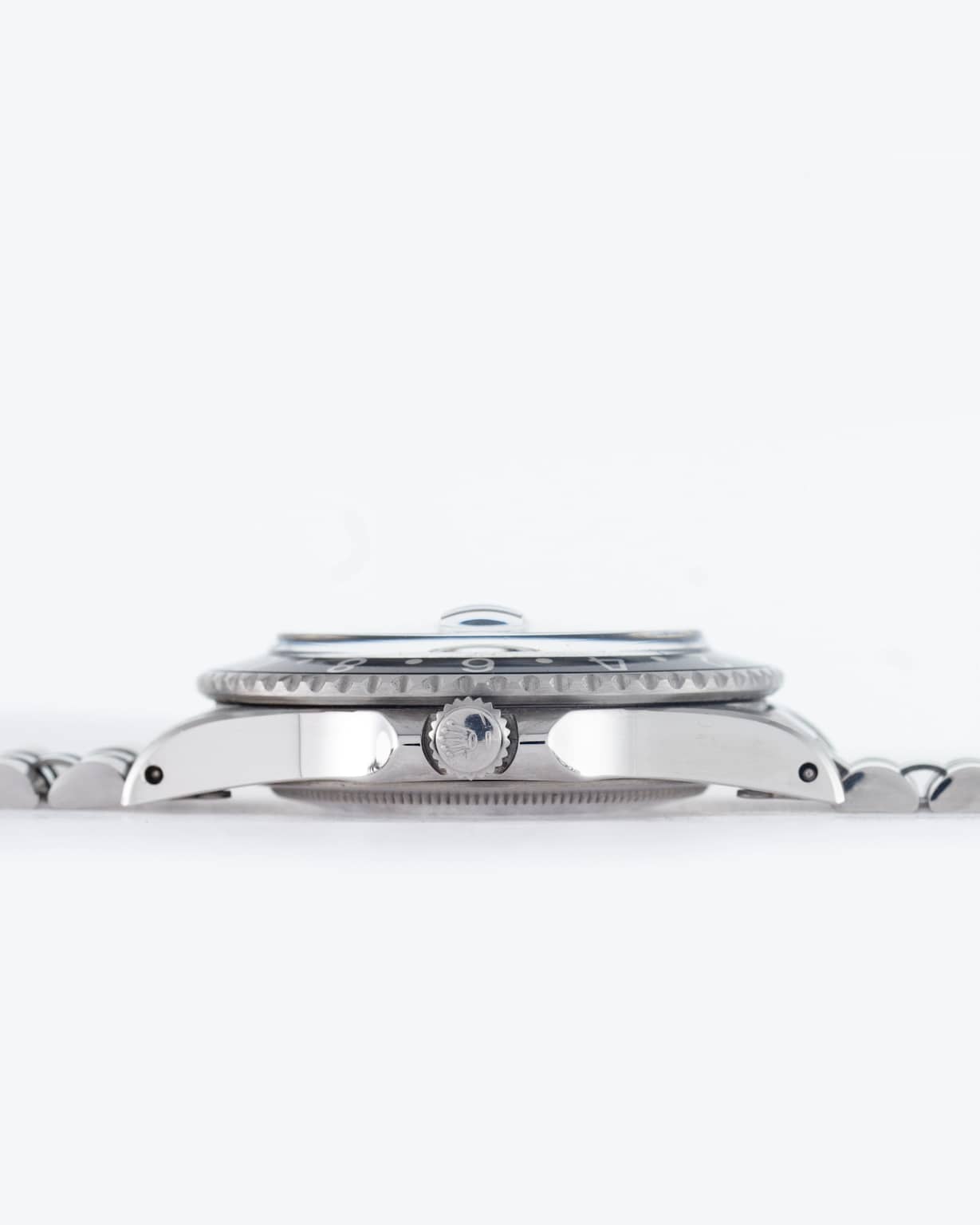
The lugs feature chamfered (beveled) edges between the brushed top surface and polished case sides. On unpolished examples, these chamfers should be crisp, narrow, and consistent across all four lugs. Over-polishing rounds these edges and can thin the lugs, destroying the original proportions. The chamfers on 16750 cases are narrower than early 1675 examples, reflecting the evolution in Rolex’s case finishing toward the end of the 1675 production.
The case sides are polished to a mirror finish, while the tops of the lugs and crown guard surfaces are brushed with a fine satin finish. This mix of finishes should show clear, sharp demarcation lines without blending. The case back is solid stainless steel with a fine circular grain pattern, engraved with model reference, serial number, and Rolex markings.
Bezel Insert Variations:
The 16750 was offered with two primary bezel insert options, each creating a distinct character:
Pepsi Insert (Blue and Red):
The iconic red and blue aluminum bezel insert, nicknamed “Pepsi” after the soft drink company’s colors, represents the classic GMT-Master aesthetic. The 24-hour scale features red numerals and markers from 12 to 6 o’clock (representing daylight hours) and blue from 6 to 12 (nighttime hours). This color scheme allows instant visual identification of day versus night in the secondary time zone being tracked.
Original Pepsi inserts from the 1980s exhibit specific characteristics. The red typically shows a slightly orange or burnt sienna tone rather than pure red, while the blue can range from a deep navy to a slightly faded lighter blue depending on UV exposure. Font styles on the numerals have subtle variations including serif versus sans-serif, with serif fonts generally appearing on earlier production. The aluminum material fades and ages uniquely on each watch, creating individual character through weathering.
All-Black Insert:
Less common but offering a completely different aesthetic, the all-black 24-hour bezel insert provided a stealthy, tool-watch appearance. The numerals and markers are engraved and filled with silver paint. Black inserts typically show more uniform aging than Pepsi versions, with the paint in the engravings potentially fading or wearing away over time. Some collectors prefer the versatile, understated look of the black bezel, which pairs well with both casual and formal attire.
Bezel Construction & Condition:
The aluminum bezel insert sits within a stainless steel bezel ring featuring 120 clicks for precise positioning. The bezel should rotate bidirectionally with firm, even resistance and distinct clicks. Loose or excessively stiff bezels may indicate worn springs or damage requiring service.
Bezel inserts commonly show wear, fading, scratches, and chips given their aluminum construction and exposed position. While some collectors prize well-preserved inserts, others appreciate faded “tropical” colors as evidence of the watch’s history. However, distinguishing between honest wear and artificially aged replacements requires expertise.
Bracelet & Strap Options
The Reference 16750 was offered with multiple bracelet options from the factory, each providing a different aesthetic and wearing experience.

Rolex GMT-Master Ref. 16750 – Matte Dial
Oyster Bracelet – Reference 78360:
The most common bracelet pairing, the Oyster 78360 represents Rolex’s classic three-link sports bracelet design. This folded-link bracelet (where each link is formed from folded metal rather than solid construction) was standard during the 16750’s production era. The 78360 features a mix of brushed center links and polished outer links, providing visual contrast while maintaining durability.
The correct end links for the 78360 bracelet on a 16750 are Reference 580. These end links attach the bracelet to the case via spring bars through the lug holes. The 580 end links are 20mm wide and feature a specific profile that fits flush against the case lugs. Incorrect end links are a common issue on vintage watches, with 501B or 593 end links sometimes incorrectly fitted.
The clasp on an authentic 78360 should be stamped with the reference number, along with a date code indicating the clasp’s manufacture period. Common date codes for 16750-era 78360 bracelets include those from the early 1980s through late 1980s. The clasp features the Oysterclasp design with a flip-lock mechanism.
Oyster Bracelet – Reference 93150:
The 93150 represents an upgrade from the 78360, featuring solid links rather than folded construction. This bracelet was offered as an option during the later 16750 production period and became more common on successor references. The 93150 has less stretch over time compared to folded-link bracelets and offers a more substantial feel on the wrist.
With the 93150 bracelet, the correct end links for the 16750 remain Reference 580. The clasp should feature the flip-lock design with a diver extension, marked with the 93150 reference number. Some 16750 watches incorrectly have 93150 bracelets fitted with wrong clasps or end links, requiring verification.
Jubilee Bracelet – Reference 62510H:
The five-link Jubilee bracelet offered a dressier alternative to the Oyster, popular among collectors who appreciated the GMT-Master’s versatility beyond tool-watch applications. The Reference 62510H Jubilee bracelet features brushed and polished links in a more intricate pattern than the Oyster, providing elegance while maintaining the 20mm lug width standard.
The correct end links for the Jubilee on a 16750 are Reference 555 or 550/502B. The Jubilee clasp also features folded construction typical of the era. While less common than Oyster-equipped examples, Jubilee 16750 watches represent legitimate factory configurations rather than later modifications.
Bracelet Condition & Authentication:
Vintage Rolex bracelets commonly exhibit stretch, where the pins between links wear and create play in the bracelet. Severe stretch can affect comfort and appearance but can sometimes be reduced through replacement of worn pins. Clasp condition, including the condition of the flip-lock mechanism, affects both functionality and value.
Bracelet codes, end link numbers, and clasp markings should all align with the period-correct options for the 16750. Mismatched components, modern service bracelets, or aftermarket replacements are common issues that can significantly affect value. Period-correct bracelets in good condition command premiums and complete the watch’s authenticity.
Identifying Original vs. Replaced Parts
For collectors pursuing vintage Rolex references like the 16750, distinguishing factory-original components from service replacements, aftermarket parts, or incorrect assemblies represents perhaps the most challenging and critical skill. Several key areas require careful examination.
Dial Authentication:
Original dials exhibit specific characteristics based on their production period. Matte dials should show flat, non-reflective black surfaces with painted tritium plots. The printing should appear crisp under magnification, with consistent font styles and spacing. Glossy dials require inspection for correct applied marker construction, with white gold surrounds properly formed and attached.
Tritium aging provides important clues but can also mislead. Original tritium typically develops cream, ivory, or light brown patina over decades. However, the exact color varies based on storage conditions, UV exposure, and the specific tritium compound batch Rolex used. Perfect uniformity between dial plots and hands is not necessarily correct, as hands and dials often aged differently due to their different constructions.
Service replacement dials from Rolex are genuine parts but may not be period-correct for the watch. A service dial from the 1990s fitted to a 1981 watch could be correct Rolex parts yet inappropriate for a collector seeking originality. Service dials often show subtly different characteristics: slightly different coronet heights, text spacing variations, or luminous material that appears too fresh for the watch’s age.
Refinished dials represent another category. Some service centers stripped and repainted dials rather than replacing them, while aftermarket refinishers offer similar services. Refinished dials typically show telltale signs under magnification: uneven printing, incorrect font weights, poor luminous material application, or altered text colors. The minute track printing and coronet logo quality are particularly revealing areas.
Hand Verification:
Correct 16750 hands should match the dial period and show appropriate aging. Mercedes-style hour and minute hands with tritium filling should display patina consistent with the dial. The GMT hand (the red arrow-tipped 24-hour hand) should show tritium in the triangular arrowhead that has aged similarly to the other hands.
Hand stacking order, discussed earlier, provides an immediate verification point. The 16750 should always have the hour hand lowest (closest to the dial), followed by the GMT hand, then minute hand, with the seconds hand highest. The 1675 uses a different order, and incorrect hand stacking immediately signals a problem.
Hand size and proportions matter significantly. The hour hand should nearly reach the hour markers, while the minute hand extends to the minute track. GMT hand length varies slightly but should align roughly with the hour markers. Hands that are too short, too long, or disproportionate suggest replacements, possibly from different Rolex references.
Service replacement hands often show different luminous material colors, especially if replaced during a service years after the watch’s production. Hands with perfectly white or green luminous material on a 1980s watch clearly indicate replacement.
Bezel Insert Assessment:
Aluminum bezel inserts cannot be definitively authenticated like signed components, creating opportunities for fraud. Original inserts show specific wear patterns, font styles, and aging characteristics. Pepsi inserts should exhibit the slightly orange-toned red and navy blue typical of 1980s aluminum, though fading varies.
Modern reproduction inserts exist in significant quantities, some quite convincing. Reproductions often show perfectly vibrant colors inconsistent with 30-40 year old aluminum, uniform color without UV fading patterns, incorrect fonts (especially serif versus sans-serif numerals), or incorrect platinum/silver fill in the engravings.
The bezel insert should fit properly within the bezel ring without gaps or rattling. Aftermarket inserts sometimes have incorrect dimensions, creating fit issues.
Case Polishing Assessment:
Unpolished cases command significant premiums, but distinguishing unpolished from skillfully refinished cases requires careful inspection. Key indicators of original finish include:
- Sharp, well-defined chamfers on the lugs with consistent width and angle
- Clear demarcation between brushed and polished surfaces without blending
- Symmetrical crown guards with defined edges rather than rounded contours
- Visible fine brushing on lug tops and crown guards in consistent parallel lines
- Case dimensions matching factory specifications without thinning
Over-polished cases show rounded lug edges, faint or absent chamfers, blended finish transitions, asymmetrical crown guards, and potentially reduced case thickness. The lug undersides provide useful reference points, as these areas typically see less polishing even on serviced watches.
Examining the case with a loupe under strong light reveals subtle finish inconsistencies. Comparing the watch to documented unpolished examples of the same reference helps establish correct proportions.
Crown Authenticity:
The Twinlock crown should be 5.3mm in diameter with the Rolex coronet logo centered on the top. The logo should be crisp and properly formed. Below the coronet, a single line (underline) should appear, indicating the Twinlock system. Crown tubes, gaskets, and springs should all be genuine Rolex components, verifiable during service.
Bracelet Verification:
Bracelet authentication involves checking reference numbers stamped on clasps and end links, date codes, and link construction. As discussed in the bracelet section, correct combinations are specific: 78360 with 580 end links, 93150 with 580 end links and flip-lock clasp, or 62510H Jubilee with appropriate end links.
Bracelet stretch and wear patterns should appear consistent with age. Excessive polish or refinishing on bracelet links, mismatched date codes between bracelet components, or modern service bracelets all affect authenticity and value.
Collector Notes & Market Context
The Rolex GMT-Master 16750 occupies a compelling position in today’s vintage watch market, offering collectors a transitional reference with both vintage charm and modern functionality at prices below the stratospheric levels of earlier GMT references.
Current Market Positioning (2024-2025):
Market data from late 2024 and early 2025 shows the 16750 trading primarily in the $15,000-$20,000 range for standard stainless steel examples with Pepsi bezels, depending on condition, originality, and dial type. Black bezel versions typically command slightly lower prices, generally $14,000-$18,000, reflecting their less iconic status. These figures represent significant appreciation from the watch’s original retail price of approximately $2,900 in the 1980s, demonstrating annual appreciation of roughly 6-9% over four decades.
Matte dial examples generally command premiums of 15-30% over glossy dial versions due to their rarity and closer aesthetic link to the coveted 1675. A pristine matte dial 16750 with box and papers can reach $22,000-$25,000 in exceptional circumstances. Spider dial examples occupy an interesting middle ground, with collector opinion divided on whether the crazing represents desirable character or a condition flaw.
The broader GMT-Master collection has demonstrated extraordinary investment performance, with 506% appreciation since 2010 according to secondary market tracking. However, the 16750 specifically has seen more modest but steady growth compared to headline-grabbing modern GMT-Master II references or early gilt-dial 1675 examples.
Comparison to Related References:
The 16750 sits between the earlier 1675 (currently $25,000-$35,000 for good examples, higher for gilt dials or rare variants) and the later 16700 (currently $16,000-$22,000). This positioning makes the 16750 an attractive entry point for collectors seeking vintage GMT-Master ownership without paying the premiums commanded by the 1675, while offering more character than the more modern-looking 16700.
The two-tone Reference 16753 “Root Beer” typically trades in the $18,000-$25,000 range, with condition and dial color affecting pricing. The solid gold Reference 16758 commands $25,000-$40,000 depending on dial color and bracelet type, with brown dial “Nipple dial” examples particularly sought after.
Configuration Premiums:
Several factors drive pricing premiums beyond base values:
Box and Papers: Complete sets with original box, papers, and hang tags command 15-30% premiums over watch-only examples. The documentation proves provenance and provides collector confidence in authenticity.
Unpolished Cases: Demonstrably unpolished examples with sharp chamfers, defined crown guards, and factory finishes can command 20-40% premiums over comparable polished examples. Collectors increasingly value originality over refinished appearance.
Matte Dials: As noted, matte dial examples generally achieve 15-30% premiums over glossy versions due to rarity and vintage aesthetic appeal.
Rare Retailers: Tiffany & Co. signed dials can command 30-50% premiums, sometimes more depending on collector enthusiasm.
Original Components: Watches retaining all original components (dial, hands, bezel insert, crown, crystal) verified as period-correct achieve significant premiums over examples with service replacements.
What Drives Demand:
Several factors support the 16750’s market positioning and future prospects:
The watch delivers authentic vintage character with the acrylic crystal, classic proportions, and aluminum bezel that define the golden age of Rolex sports watches. Yet it offers quickset date and hacking seconds that make it genuinely practical for daily wear, unlike earlier references that require cumbersome date advancement.
Supply remains limited given the relatively short eight-year production window, especially for matte dial examples. As pristine 1675 examples become increasingly expensive and scarce, collectors naturally gravitate toward the 16750 as an alternative.
The transitional nature creates collecting interest, with enthusiasts appreciating the reference’s place in GMT-Master evolution. The 16750 represents the last GMT-Master with an acrylic crystal and the last to visually resemble the classic 1675 aesthetic before the modernization that came with the 16700.
Growing appreciation for 1980s vintage Rolex models broadly has lifted the 16750 alongside other references from the era. The decade’s watches offer vintage appeal without the extreme fragility or maintenance challenges of 1960s examples.
Investment Considerations:
The 16750 has demonstrated consistent, moderate appreciation rather than explosive growth, making it more of a stable long-term hold than a short-term speculation. Realistic expectations should envision 5-8% annual appreciation under normal market conditions, with potential for stronger gains if vintage sport watch enthusiasm continues.
Condition drives value more significantly than pure rarity. An exceptional 16750 in unpolished condition with original components will substantially outperform a mediocre example, even if the latter is slightly rarer. Collectors should prioritize quality over simply acquiring the reference.
The market has shown resilience even during corrections that affected modern steel sports models. Vintage references like the 16750 tend to see less volatility than contemporary models subject to authorized dealer waitlists and speculation.
Common Pitfalls When Purchasing:
Several issues frequently trap unwary buyers:
Service Replacements: Many 16750 watches have undergone service over their 35-40 year lifespans, often receiving replacement dials, hands, or bezels that, while genuine Rolex parts, are not period-correct. Dealers may describe these as “all original Rolex parts” technically accurately but misleadingly. Verification requires expertise.
Polished Cases: The majority of vintage Rolex watches have been polished during service, sometimes multiple times. Many sellers claim “light polishing” on watches that have lost significant metal and case definition. Independent evaluation by knowledgeable collectors or watchmakers is essential.
Bracelet Issues: Mismatched bracelets, incorrect end links, service replacement clasps, and excessive stretch all affect value and authenticity. Verify bracelet references and components carefully.
Tritium Replacement: Hands or dial luminous material that has been replaced or “refreshed” with modern luminous compounds destroys vintage character and reduces value significantly. Luminous material should show appropriate aging for the watch’s age.
Movement Service History: Watches lacking recent service may require immediate $800-1,200 movement overhauls. Factor this cost into purchasing decisions. Conversely, watches serviced too frequently may have diminished originality through repeated parts replacement.
Price Justification: The market includes overpriced examples, particularly from dealers targeting buyers unfamiliar with market rates. Research current market prices across multiple platforms before committing.
What to Seek:
Ideal 16750 acquisitions feature:
- Unpolished or minimally polished cases with sharp details
- Period-correct dials and hands with matching patina
- Original bezel inserts showing honest wear rather than perfect condition or obvious replacements
- Correct bracelets with appropriate end links and date codes
- Complete service history from qualified watchmakers
- Box, papers, and documentation when possible
The 16750 rewards patient collectors who prioritize originality and condition over simply acquiring any example of the reference. The price differential between an exceptional example and a mediocre one will likely widen over time as collectors become more sophisticated and discriminating.
Images
Below are visual references showing various aspects of the Rolex GMT-Master Reference 16750:

Vintage Rolex GMT Master 16750 Pepsi sold on watchPool24
Early production matte dial 16750 with Pepsi bezel showing classic vintage aesthetic

Rolex GMT-Master Ref. 16750 ‘Pepsi’ – Transitional Matte Dial Unpolished
Transitional matte dial example displaying painted tritium markers without white gold surrounds

Rolex GMT-Master Ref. 16750 ‘Pepsi’ – Gloss ‘Spider’ Dial Unpolished w/ Box & Papers
Mid-production glossy dial with “spider” crazing effect visible under certain lighting

Rolex GMT ref 16750 Tiffany & Co Spider Dial circa 1985
Dial close-up showing spider web pattern in lacquer with Tiffany & Co. retailer signature

wristshot: Rolex GMT Master 16750 – The GP Chronicles
Wrist shot demonstrating 40mm case proportions and vintage Pepsi bezel patina

Wrist Gmt 16750 Vintage Rolex GMT-Master 16750 Pepsi
On-wrist perspective showing case profile and bracelet integration

Vintage Rolex GMT Master 16750 Black Bezel Stainless Steel
All-black bezel variant offering understated tool-watch aesthetic

1981 Rolex GMT-Master 16750 Cream Patina, All-Black Bezel
1981 example with all-black bezel and cream patina development on tritium
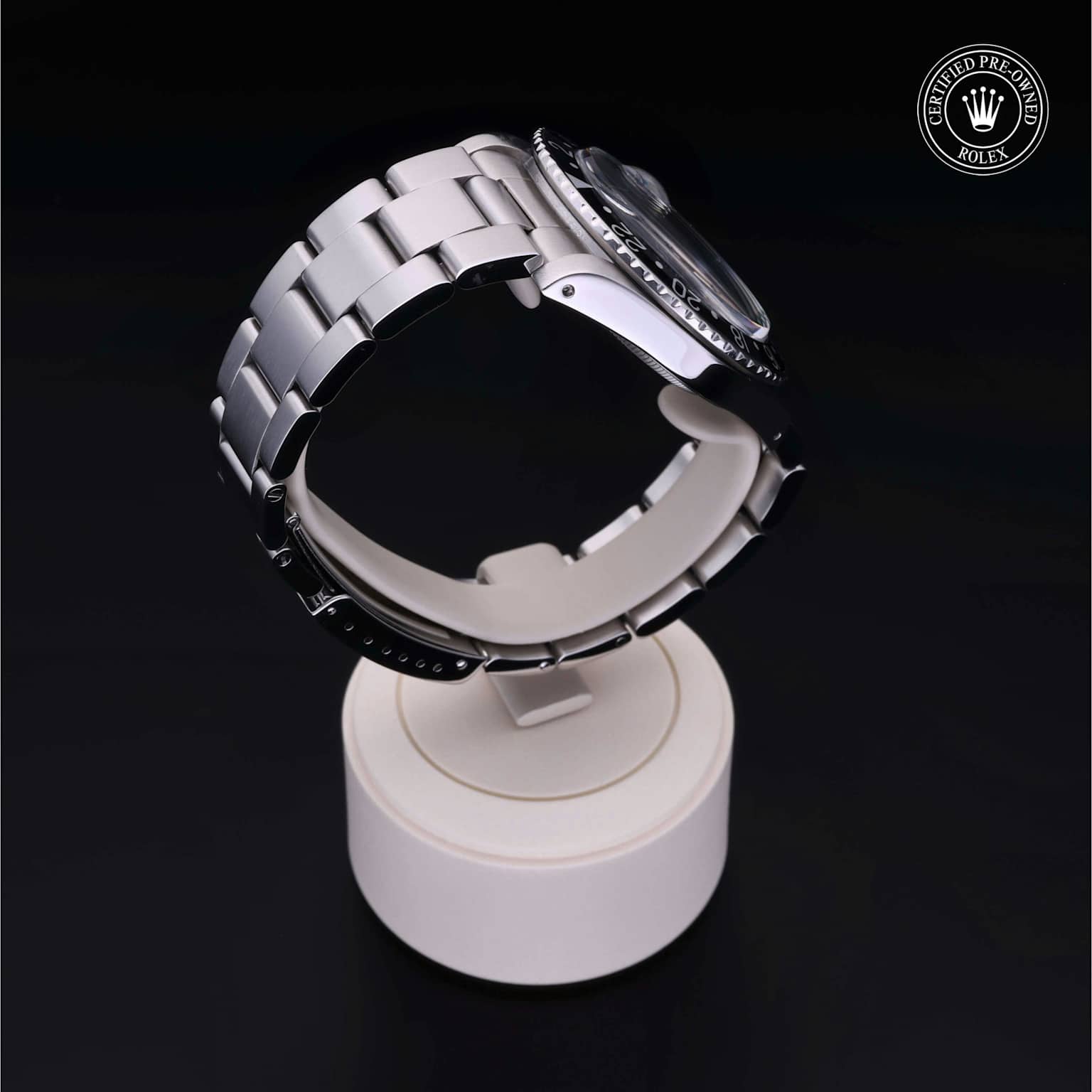
Case side profile highlighting 40mm diameter, crown guards, and acrylic crystal dome

Original Rolex Watch vintage caseback transitional GMT
Solid caseback showing reference number engraving and Rolex markings

Rolex GMT MASTER REF 16750 (1983) – SOLD – Watches of
Oyster bracelet Reference 78360 with 580 end links showing period-correct configuration

Rolex GMT Master 16750, 16753 compatible Sapphire Caseback
Alternative view of caseback details and case construction

1985 Rolex GMT MASTER 16753 Root Beer Two Tone Steel and
Related Reference 16753 two-tone “Root Beer” in steel and yellow gold

1985 Rolex GMT MASTER 16753 Root Beer Two Tone Steel and
Another example of the 16753 two-tone variant with brown dial

Rolex GMT-Master 16753 “Root Beer” – Two Tone – *Unpolished
Two-tone 16753 showing unpolished condition and original factory finishing

Rolex GMT Master 16758 NIPPLE DIAL 18K Yellow Gold Jubilee Band 40mm
Related Reference 16758 in solid 18k yellow gold with “Nipple dial”

Rolex GMT-Master Root Beer Yellow Gold Bronze Dial
Gold 16758 variant displaying Rolex’s precious metal GMT-Master offerings

Rolex GMT Master Ref. 16758 Yellow Nipple Dial Gold | S.Song
Solid gold 16758 with yellow dial and gold Jubilee bracelet

Shop rolex 3075 movement Outlet
Caliber 3075 movement showing rhodium plating and automatic rotor