

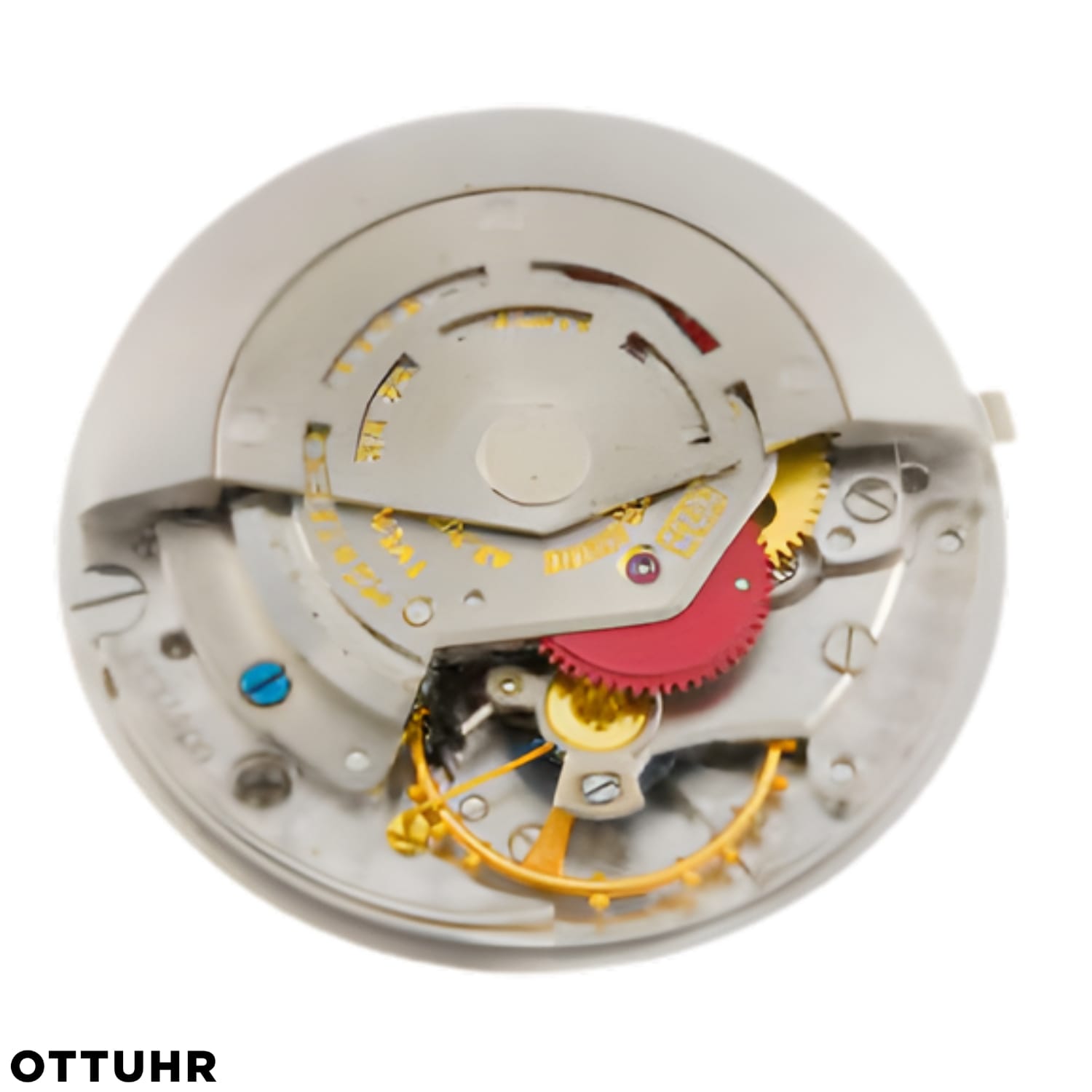
The Rolex 1555 caliber powered the world’s first wristwatch to display both the date and the full day of the week, the legendary Day-Date introduced in 1956. As Rolex’s first in-house Day-Date movement following the improved 1055 base, the 1555 marked a technical milestone: a dedicated complication movement that balanced reliability, precision, and the instantaneous midnight date and day change mechanism still used by Rolex today.
The 1555 represented Rolex’s full commitment to manufacture independence. Developed at the company’s Geneva facilities in partnership with Aegler (which Rolex had controlled since 1919 and would formally acquire in 2004), this caliber belonged to the celebrated 1500 series, Rolex’s first entirely in-house automatic movement family introduced in 1957. At 7.03mm tall, the 1555 was the thickest caliber in the 1500 range due to the additional calendar mechanism, yet it remained slimmer than its predecessor, allowing the Day-Date case to adopt a more refined profile consistent with Oyster standards.
Based on serial number ranges, approximately 1.14 million Rolex watches were produced during the 1555’s production span from 1959 (serial ~399,453) to 1967 (serial ~1,538,435). The Day-Date represented only a fraction of Rolex’s output, as the brand simultaneously produced Submariner, GMT-Master, Datejust, and other models using different calibers from the 1500 family. Conservative estimates suggest 15,000 to 30,000 units of the 1555 were manufactured during its eight-year run, though Rolex never published official production figures. The caliber is uncommon to scarce. Examples in original condition with documented provenance command premiums, particularly those paired with rare dial configurations or unusual bezel treatments like the Florentine or Morellis textures.
Collector demand for 1555-powered Day-Dates has strengthened substantially over the past fifteen years. The reference 1803, the most common 1555-equipped model, appreciated 301% from 2010 to 2025, rising from $3,295 to $13,228. Examples with exotic dials (Stella, onyx, lapis), rare languages (Arabic, Hebrew, Thai), or platinum cases command significantly higher prices. The 1555’s historical significance as Rolex’s first Day-Date manufacture caliber, combined with the model’s association with presidents and world leaders, sustains robust interest. Demand remains stable, with no indication of decline. Specific variants such as early pie-pan dial examples or watches with original boxes and papers command premiums of 30-50% over standard configurations.

Historical Context, Provenance, and Manufacturing Details
Rolex engineer Marc Huguenin developed the instantaneous date-change mechanism described in Swiss patent CH322341A of 1955, forming the technical foundation for both the Datejust and Day-Date. The Day-Date launched in 1956 with Caliber 1055, but mechanical issues with the cam system prompted rapid development of an improved movement. The 1055 distributed energy unevenly throughout the day, concentrating the load in the minutes immediately before midnight. Rolex resolved this by refining the calendar architecture and introducing the 1555 in 1959, which distributed energy more consistently and improved long-term reliability.
The 1555 addressed a specific market requirement: a prestigious, complicated movement that could achieve COSC chronometer certification while displaying both date and day. Rolex positioned the Day-Date at the absolute pinnacle of its catalog, above all steel tool watches and even precious metal Datejusts. Early Rolex advertisements emphasized the exclusivity: “It costs one thousand dollars to own the Rolex Day-Date, the watch you so often see on the wrists of presidents everywhere”. The movement’s 18,000 vph frequency, while slower than later calibers, provided exceptional shock resistance and chronometric stability during the 15-day COSC testing protocol across five positions and three temperatures (8°C, 23°C, 38°C).
The 1555 replaced the 1055 and evolved from the base Caliber 1530 (time-only) and 1535 (date-only) architectures. The 1556, introduced in 1965, eventually replaced the 1555. The 1556 operated at 19,800 vph, added one jewel (26 total), and provided marginally improved shock resistance and accuracy, though the fundamental architecture remained identical. In 1972, Rolex added hacking seconds to the 1556, allowing the seconds hand to stop when the crown was pulled for more precise time setting.
The 1555 was manufactured entirely in-house at Rolex’s Geneva facilities, though “in-house” requires clarification. Rolex purchased a controlling stake in Aegler in 1919, and movements produced at Aegler’s Bienne factory were effectively Rolex designs executed at a closely integrated partner facility. The relationship was so intertwined that Rolex movements from this era should be considered de facto in-house, even though Aegler remained a legally distinct entity until Rolex’s formal acquisition for CHF 1.2 billion in 2004. The 1555 represented a new phase of vertical integration, with movement design, testing, and final assembly consolidated under Rolex’s direct oversight.
Production occurred exclusively in Switzerland, with no changes in manufacturing location during the caliber’s lifespan. The 1555 sits at a pivotal moment in horological history: the transition from slower-frequency movements (16,200-18,000 vph) to higher-frequency calibers (19,800-21,600 vph) that dominated the 1960s and 1970s. The caliber was neither groundbreaking nor transitional, it was a workhorse designed for reliability, precision, and prestige certification rather than technical innovation. The instantaneous date and day change mechanism, however, represented genuine engineering sophistication and remains fundamentally unchanged in modern Rolex Day-Date movements.
Construction and Architecture
The Caliber 1555 employs a three-bridge architecture typical of the Rolex 1500 family. The mainplate, measuring 28.5mm in diameter and 7.03mm in height, is machined from rhodium-plated brass. Three separate bridges secure the barrel, gear train, and balance assembly. The automatic winding mechanism occupies the dial side of the mainplate, with the rotor visible from the caseback. An additional bridge on the dial side secures the calendar mechanism, including the date disc, day disc, and instantaneous change components.
The mainplate features circular graining (perlage) on both the dial and movement sides, a finishing technique Rolex applied even to non-chronometer movements. The bridges display Côtes de Genève (Geneva stripes) running in parallel lines, though the quality and depth of finishing varies by production era and individual movement grade. Earlier 1555 examples from 1959-1962 generally exhibit more meticulous finishing than later production units, though all meet COSC chronometer standards.
Balance Wheel
The 1555 uses Rolex’s free-sprung Microstella balance system, introduced in 1957 and considered revolutionary for its time. The balance wheel features four gold-colored Microstella nuts (small star-shaped regulators) that can be screwed in or out to adjust the moment of inertia, allowing fine regulation without touching the hairspring. Each Microstella screw adjustment corresponds to approximately one second per day (low-profile nuts) or two seconds per day (high-profile nuts), providing precise rate control without the friction and long-term instability associated with traditional index regulators.
The balance wheel itself is constructed from Glucydur or similar beryllium-bronze alloy, providing temperature compensation and anti-magnetic properties. Diameter and mass were optimized for the 18,000 vph frequency, resulting in a larger, slower-beating balance compared to higher-frequency movements. The balance pivots run in jeweled bearings protected by KIF Flector shock protection on both upper and lower pivots.
Balance Spring (Hairspring)
The 1555 uses a Nivarox or similar paramagnetic alloy hairspring with a Breguet overcoil terminal curve. The Breguet overcoil elevates the outer terminal curve above the plane of the hairspring coils, causing the spring to “breathe” concentrically rather than expanding laterally. This configuration significantly improves isochronism (consistent rate regardless of amplitude), resulting in more stable timekeeping as the mainspring winds down and amplitude decreases.
The hairspring attaches to a collet on the balance staff at the inner terminus and to a stud holder mounted on the balance cock at the outer terminus. The free-sprung design eliminates the traditional regulator pins that would contact the hairspring, removing a major source of friction and positional error. Hairspring length and characteristics are factory-calibrated for the 18,000 vph frequency, with the specific alloy composition providing resistance to magnetism and temperature variations across the COSC testing range (8°C to 38°C).
Escapement Type
The 1555 employs a traditional Swiss lever escapement with a club-tooth escape wheel design. The escape wheel, Rolex part 7971, features 15 teeth and is jeweled at both pivots with cap jewels. The escape wheel is manufactured from steel, as is standard for Swiss lever escapements, providing hardness and wear resistance superior to brass.
The pallet fork carries two synthetic ruby pallet stones (entry pallet and exit pallet, Rolex parts 7973 and 7974) that engage the escape wheel teeth, converting the rotational energy of the gear train into discrete impulses that drive the balance wheel. The pallet fork pivots on jeweled bearings and features a notch that engages the roller jewel (impulse pin, Rolex part 7985) mounted on the balance staff. This creates the characteristic two-beat tick of a mechanical watch.
The lift angle of the 1555 escapement is 52.0 degrees, a standard value for Swiss lever escapements of this era and essential for accurate timing machine calibration. The escapement geometry, tooth profile, and pallet stone angles are designed to maximize energy transmission efficiency while minimizing friction and wear. Long-term reliability rather than cutting-edge efficiency characterized Rolex’s escapement philosophy during this period.
Shock Protection System
The 1555 uses KIF Flector shock protection on the balance staff pivots. The KIF Flector system, one of the most respected shock protection designs in Swiss watchmaking, features a jeweled bearing with a conical pivot secured by a lyre-shaped spring underneath a C-clip embedded in the jewel setting. When the watch experiences impact, the conical pivot can move vertically within the jewel, absorbing energy that would otherwise fracture the delicate balance staff.
The KIF Flector was standard equipment on higher-grade Swiss movements during the 1950s and 1960s, competing primarily with Incabloc systems. The Flector’s design requires specific tools for removal and installation, and replacement springs can be challenging to seat correctly without the proper KIF tool. Both upper and lower balance pivots receive KIF protection, while other pivots (escape wheel, pallet fork, gear train wheels) rely on jeweled bearings without supplementary shock protection.
Regulator Type
The 1555 is a free-sprung movement, regulated entirely by the Microstella screws on the balance wheel rather than by a traditional index regulator. This design eliminates the regulator pins (curb pins) that would typically constrain the hairspring’s active length. Free-sprung regulation offers superior long-term rate stability because friction between the hairspring and regulator pins is eliminated, preventing positional errors and rate drift over time.
The Microstella system requires a specialized tool (Rolex part 2019) to adjust the screws. The tool features a graduated scale indicating the rate change per adjustment, and vintage versions were oil-filled for enhanced stability and precision. Regulation via Microstella screws is more labor-intensive than traditional index regulation, requiring the watchmaker to make incremental adjustments, test the rate, and iterate, but the result is superior chronometric performance and stability.
Mainspring Material and Type
The 1555 uses a white alloy mainspring (Nivaflex or similar), a modern mainspring material introduced in the 1950s to replace blued steel. White alloy mainsprings offer superior elasticity, resistance to setting (permanent deformation), and consistent torque delivery across the power reserve range. The mainspring measures approximately 1,680mm in length when fully extended (similar to other 1500 series calibers) and develops sufficient torque to provide the caliber’s 42-hour power reserve.
The mainspring is housed in the going barrel (Rolex part 7825, barrel drum; part 7826, barrel arbor; part 7827, barrel cover), which rotates as the mainspring unwinds, driving the center wheel. The bridle is of the slipping type, meaning the mainspring can slip within the barrel when fully wound, preventing overwinding damage. Thickness is specified at approximately 0.125mm to 0.128mm, appropriate for the 18,000 vph frequency and barrel dimensions. Mainsprings for the 1555 are interchangeable with other 1500 series calibers, including the 1530, 1535, 1556, 1560, 1565, and 1570.
Gear Train Details
The gear train consists of four wheels plus the escape wheel, following conventional Swiss practice: the barrel drives the center wheel, which drives the third wheel, which drives the fourth wheel, which drives the escape wheel. The center wheel is decentered rather than directly beneath the barrel, requiring an intermediate wheel but allowing for a larger-diameter barrel necessary for extended power reserve.
The center wheel carries the cannon pinion (Rolex part 8004) on the dial side, which drives the motion works (hour wheel and minute wheel) and is friction-fit to allow hand setting. The fourth wheel drives the seconds hand directly through the center of the movement via the sweep seconds pinion (Rolex part 8002, total height 6.26mm), providing the sweep seconds function characteristic of automatic Rolex movements.
Gear ratios are calculated to produce exactly 18,000 beats per hour from the escapement, with the fourth wheel completing one rotation per minute (driving the seconds hand), the center wheel completing one rotation per hour (via the cannon pinion and minute hand), and the hour wheel completing one rotation every 12 hours. The third wheel features particularly fine pinion leaves, and watchmakers note that worn pinions here are a common failure point in high-mileage examples requiring pinion replacement or wheel replacement.
All gear train wheels run in jeweled bearings, with the exception of certain intermediate wheels in the automatic winding and calendar mechanisms. Total jewel count is officially 25, though the calendar mechanism contains an additional 3-4 jewels not included in the official count, bringing the true total to 28-29 jewels.
Finishing Quality and Techniques
The 1555 is a COSC-certified chronometer movement, adjusted to five positions and temperature. COSC certification required 15 days of testing with the uncased movement, ensuring accuracy within -4/+6 seconds per day across five positions (dial up, dial down, crown up, crown down, crown left) and three temperatures (8°C, 23°C, 38°C).
Rolex applied “Superlative Chronometer Officially Certified” designation to 1555-equipped watches, distinguishing them from standard chronometer certification. During the 1960s, “Superlative” indicated that Rolex had applied additional internal testing and quality standards beyond COSC requirements, though the specific -2/+2 seconds per day standard now associated with the term was not formalized until 2015.
Finishing varies by production era. Earlier examples (1959-1962) exhibit more meticulous perlage, deeper Geneva striping, and chamfered edges on bridges. Later production units (1964-1967) display competent but less ornate finishing, consistent with Rolex’s philosophy of prioritizing functional reliability over decorative excess. All 1555 movements feature:
- Circular graining (perlage) on mainplates and flat surfaces
- Côtes de Genève on bridges
- Polished screw heads
- Beveled edges on bridges (anglage)
- Brushed flanks on bridges
The rotor is finished with circular graining and carries the “ROLEX GENEVA” engraving, along with the company’s crown logo. Jewel settings use gold-colored chatons (brass bezels) for the balance, escape wheel, and pallet fork pivots in higher-grade movements, while some jewels are press-fit without chatons.
Cross-Reference Data
Compatible Case References by Brand
| Brand | Reference Numbers | Production Years | Notes |
|---|---|---|---|
| Rolex | 1802 | 1959-1978 | Smooth bezel, gold case |
| Rolex | 1803 | 1959-1978 | Fluted bezel, most common reference |
| Rolex | 1804 | 1959-1978 | Diamond-set bezel |
| Rolex | 1805 | 1959-1978 | Rare variant |
| Rolex | 1806 | 1959-1978 | Florentine bezel texture |
| Rolex | 1807 | 1959-1978 | Bark bezel texture |
| Rolex | 1811 | 1959-1978 | Morellis/Moire bezel texture |
| Rolex | 1831 | circa 1960s | “Emperor” variant, 9 examples in platinum for Shah of Iran |
Note: All references produced in 18k yellow gold, 18k white gold, 18k rose gold, and 950 platinum. The 1555 was used in the first portion of production (1959-1965), with the 1556 replacing it in later examples (1965-1978). Some references transitioned from 1555 to 1556 mid-production, so reference number alone does not guarantee caliber identification.
Dial Compatibility and Specifications
All 1555-compatible dials measure 28.66mm external diameter and feature two dial feet positioned for the Day-Date configuration. The day aperture appears at 12 o’clock in an arched window, while the date aperture appears at 3 o’clock. Dial feet are positioned differently than time-only or date-only calibers, making dial interchange with non-Day-Date movements impossible without modification.
Early 1555 dials (1959-approximately 1970) feature the distinctive “pie-pan” profile, where the outer edge of the dial slopes downward, creating depth and a three-dimensional appearance. Later dials are flat. Pie-pan dials are highly collectible and command premiums of 20-40% over flat dials in equivalent condition.
Day discs are available in 26 languages, including English, Spanish, French, German, Italian, Portuguese, Dutch, Russian, Arabic, Hebrew, Chinese, Japanese, Thai, and numerous others. Aftermarket and service-replacement day discs are commonly found, and original-language verification requires documentation or expert authentication.
Crown and Stem Specifications
Stems for the 1555 interchange with the entire 1500 series (1520, 1525, 1530, 1535, 1555, 1556, 1560, 1565, 1570, 1575, 1580) and with later calibers including the 3035, 3055, 3135, and 3155. Generic aftermarket stems are widely available, though genuine Rolex stems are preferred for restoration and authentication purposes.
Identification Marks
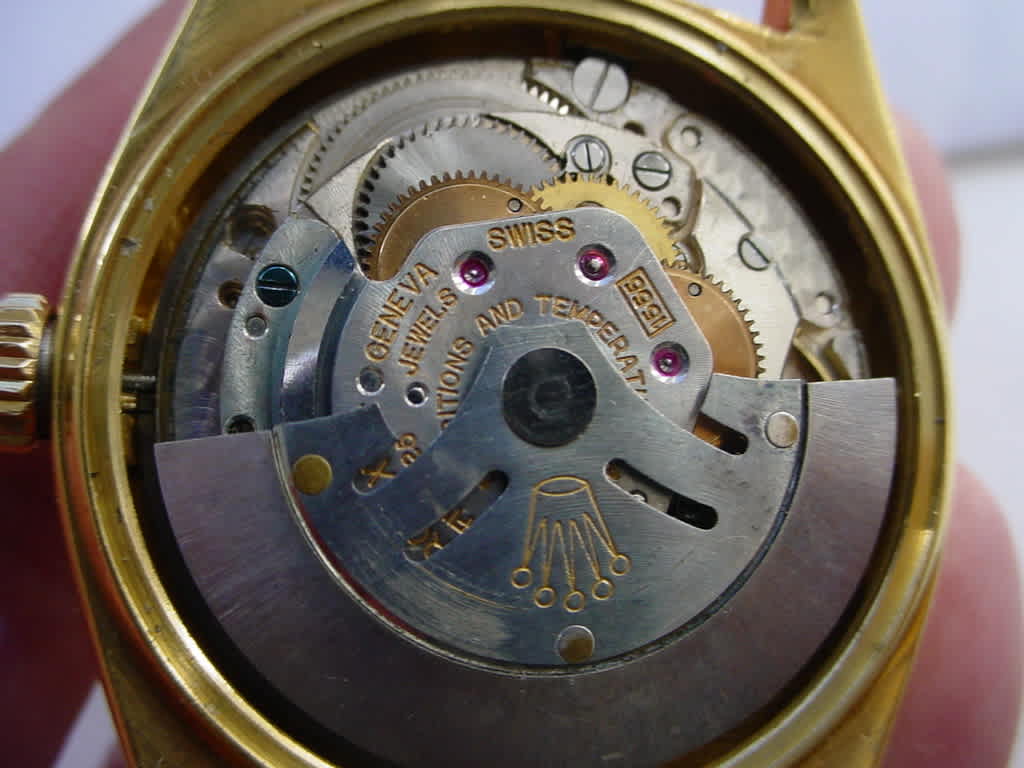
The caliber number “1555” is engraved on the automatic winding bridge visible from the caseback. The engraving is located on the large bridge that covers the oscillating weight mechanism and is easily visible when the caseback is removed. Engraving depth and font style are consistent with Rolex standards from the late 1950s and 1960s, featuring clear, evenly-spaced numerals approximately 1.5-2mm tall.
Logo and Brand Marks
The rotor carries “ROLEX GENEVA” engraving along with the Rolex crown logo. Earlier examples (1959-1961) may feature slightly different rotor engraving styles, though all authentic examples bear clear Rolex branding. The automatic winding bridge may also carry “AUTOMATIC” or “SELFWINDING” designations, along with functional markings indicating the movement’s features.
The balance cock does not carry manufacturer markings beyond the caliber designation on the automatic bridge. Some high-grade examples may show additional timing or adjustment marks, but these are inconsistent and not reliable authentication features.
Date Codes
The 1555 does not use internal date codes beyond the caliber number engraving. Serial numbers on the case between the lugs at 6 o’clock allow approximate dating:
| Year | Serial Range (approximate) |
|---|---|
| 1959 | 399,453 |
| 1960 | 516,000 |
| 1961 | 643,153 |
| 1962 | 744,000 |
| 1963 | 824,000 |
| 1964 | 1,008,889 |
| 1965 | 1,100,000 |
| 1966 | 1,200,000 |
| 1967 | 1,538,435 |
Serial numbers were engraved on the case, not the movement, making movement-only dating difficult without case correlation.
Finishing Marks
Expected finishing patterns include:
- Circular graining (perlage) on mainplates, visible as overlapping circular patterns
- Côtes de Genève on bridges, visible as parallel straight lines
- Polished screw heads with slots cut cleanly
- Beveled bridge edges (anglage), showing consistent 45-degree chamfers
- Brushed flanks on bridges, perpendicular to the Côtes de Genève
Authentic movements show consistent, machine-applied finishing. Hand-applied finishing or irregular patterns suggest refinishing or counterfeit components.
Jewel Markings
Higher-grade 1555 movements use gold-colored chatons (brass bezels) to hold jewels in the balance, escape wheel, and pallet fork pivots. Chatons should sit flush with the bridge surface and exhibit consistent sizing and placement. Some jewels are press-fit without chatons, particularly in lower-stress positions.
Rolex did not mark individual jewels with jewel counts or quality grades during this period. The official 25-jewel count excludes the 3-4 additional jewels in the calendar mechanism.
Adjustment Markings
For COSC-certified chronometer movements like the 1555, no specific adjustment markings appear on the movement itself beyond the dial designation “SUPERLATIVE CHRONOMETER OFFICIALLY CERTIFIED”. Original COSC chronometer certificates accompanied the watch when sold new, but these certificates are rarely retained by collectors and are not necessary for authentication.
Some movements may display timing marks or watchmaker service marks on bridges, added during professional servicing rather than at the factory. These marks are inconsistent and should not be considered authentication features.
Correct Serial Number Formats and Locations
Case serial numbers appear engraved between the lugs at 6 o’clock and range from approximately 399,000 (1959) to 1,538,000 (1967) for 1555 production. Serial numbers are six or seven digits during this period. Rolex reset to 100,000 in 1954 rather than continuing to seven digits, and reached the 1,000,000 milestone again in 1959, at the beginning of 1555 production.
Movement serial numbers do not appear on the 1555. Authentication relies on caliber number engraving, case serial correlation, and component analysis.
Expected Engravings and Stampings
Authentic 1555 movements should display:
- “1555” engraved on automatic winding bridge, clearly legible, approximately 1.5-2mm character height
- “ROLEX GENEVA” engraved on rotor with crown logo
- Part numbers stamped or engraved on certain components (balance complete, bridges, wheels) where specified by Rolex technical documentation
- “SWISS” or “SWISS MADE” on the mainplate visible from dial side (typically covered by dial)
Engraving depth should be consistent, with sharp, clean edges. Shallow, uneven, or poorly-centered engravings suggest refinishing or counterfeit parts.
Font and Marking Style by Production Era
Rolex maintained relatively consistent engraving styles throughout 1555 production (1959-1967). Subtle variations exist:
- 1959-1961: Slightly narrower font, deeper engraving depth
- 1962-1965: Standard production font, medium engraving depth
- 1966-1967: Identical to 1962-1965, no significant variation
Transitions in branding occurred after 1555 production ended, so caliber-specific font evolution is minimal. The rotor engraving style changed slightly in the mid-1960s, with earlier rotors featuring slightly smaller lettering.
Part Information
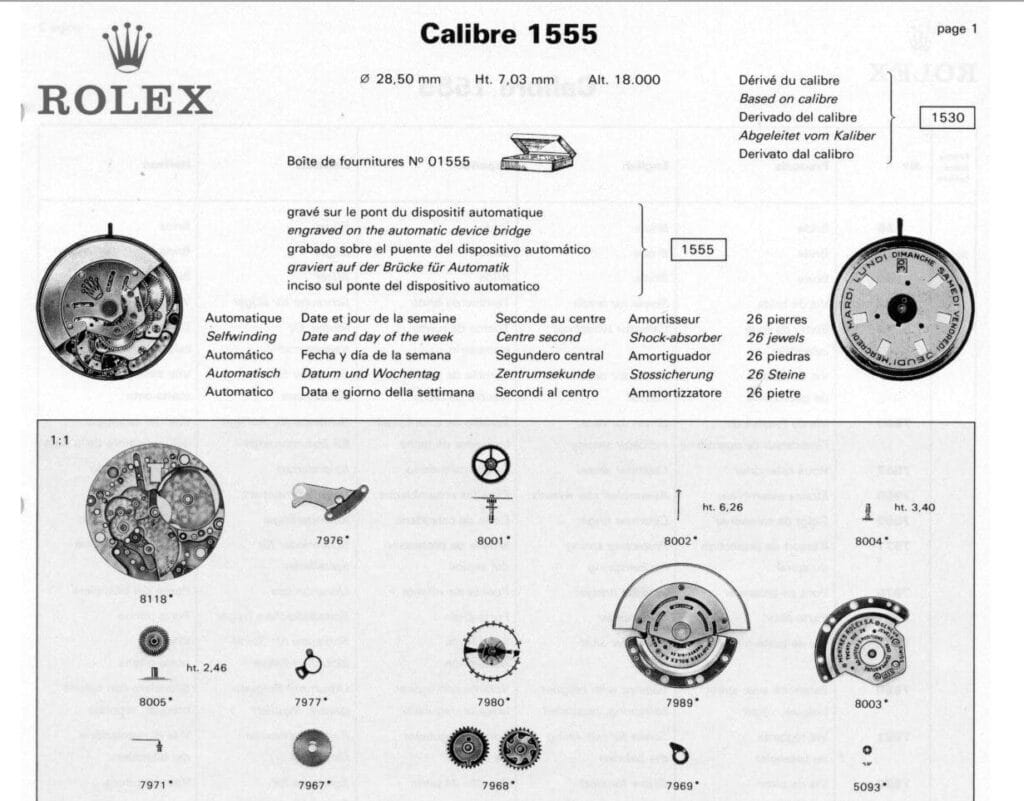
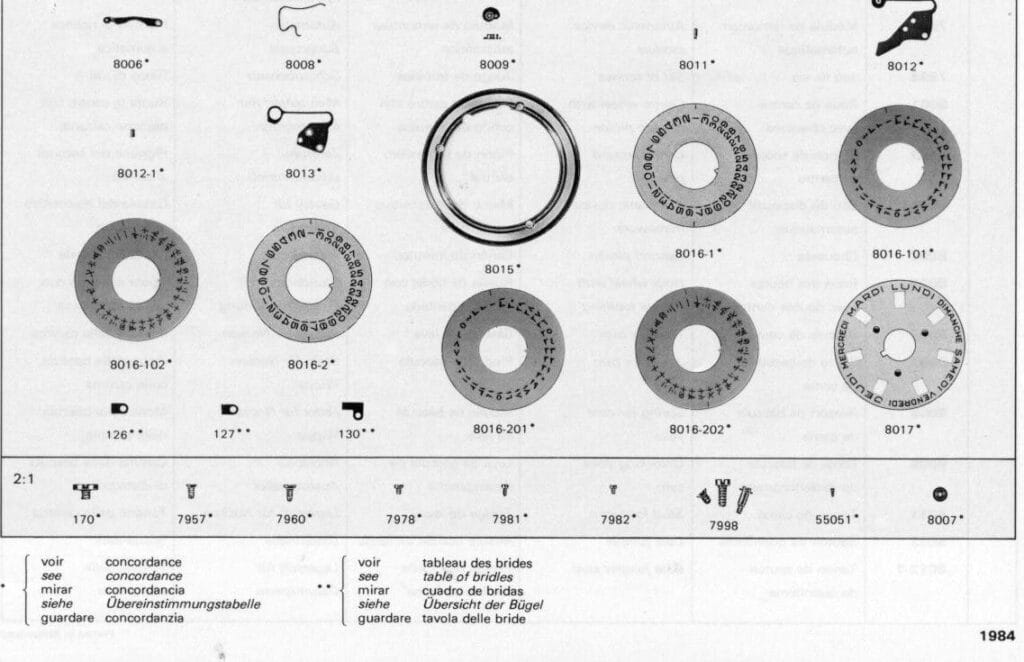
Key Part Numbers (from Rolex Technical Documentation)
Shared Parts with 1500 Series (1530, 1560, 1570)
Sourcing Notes
Genuine Rolex parts for the 1555 are available from authorized Rolex service centers, though supply is limited and prioritized for active service work. The secondary market offers genuine NOS (new old stock) parts from retired watchmakers and closed parts houses, available through specialized suppliers like Perrin Watch Parts, Cas-Ker, Watch Material, and Ofrei.
Generic aftermarket parts manufactured in Switzerland are widely available for common components: mainsprings, balance staffs, stems, gaskets, and crystals. These parts are dimensionally accurate and suitable for service work, though collectors and authenticators prefer genuine Rolex components for restoration and resale value.
Commonly failing parts include:
- Balance staff: Fractures due to shock or wear on pivots, requires replacement
- Mainspring: Loss of elasticity after decades, requires replacement every 5-10 years depending on use
- Calendar mechanism components: Calendar yoke jewel (8007), cam, and springs experience wear from daily calendar changes
- Ratchet wheel and click spring: Wear from winding, especially in heavily-used examples
- Pallet stones: Chipping or wear on impulse faces, though less common than in higher-frequency movements
Generic replacements are acceptable for mainsprings, stems, gaskets, and balance staffs. Critical components like the balance complete, hairspring, escapement parts, and calendar mechanism should use genuine Rolex parts to maintain authenticity and performance.
Performance Data
Manufacturer Specifications
| Specification | Value |
|---|---|
| Accuracy (new) | -4/+6 seconds per day (COSC chronometer standard) |
| Positions tested | 5 positions (dial up, dial down, crown up, crown down, crown left) |
| Temperature compensation | Yes, tested at 8°C, 23°C, 38°C |
| Amplitude (fully wound) | 270-290 degrees typical |
| Amplitude (near power reserve end) | 220-240 degrees typical |
The 1555 was submitted to COSC as an uncased movement for 15-day testing. COSC measured mean daily rate, mean variation in rate, maximum variation in rate, difference in rate between horizontal and vertical positions, and difference in rate between extreme temperatures. Movements meeting all criteria within tolerance received chronometer certification.
Rolex applied the “Superlative Chronometer Officially Certified” designation to 1555-equipped watches, indicating additional internal testing beyond COSC standards. During the 1960s, Rolex’s internal standards were less formally defined than the current -2/+2 seconds per day specification introduced in 2015, but the term signaled enhanced quality control and rate stability.
Observed Performance (Field Data)
Well-maintained 1555 examples typically achieve:
- Accuracy: +5 to +15 seconds per day in daily wear conditions
- Positional variation: 8-15 seconds per day difference between dial-up and crown-down positions
- Amplitude: 250-280 degrees when fully wound, 210-230 degrees near end of power reserve
- Power reserve: 40-44 hours in practice, slightly variable depending on mainspring condition and lubrication
The 1555’s 18,000 vph frequency produces a five-beat-per-second tick, creating a less smooth sweep of the seconds hand compared to higher-frequency movements (19,800 vph = 5.5 beats/second, 28,800 vph = 8 beats/second). This lower frequency contributes to superior shock resistance, as the balance wheel completes fewer oscillations and experiences less cumulative wear over time.
Common performance issues in vintage examples include:
- Rate drift due to dried lubrication: Movements requiring service often run fast (+20 to +40 seconds per day) due to increased friction in the gear train and escapement
- Positional variation exceeding 20 seconds per day: Usually indicates balance poise errors, hairspring deformation, or worn pivots
- Amplitude below 200 degrees: Suggests weak mainspring, excessive friction, or magnetization
- Intermittent stopping: Often caused by worn pallet stones, damaged escape wheel teeth, or contamination in the escapement
Professional service every 5-7 years maintains optimal performance. Overhauls should include complete disassembly, ultrasonic cleaning, replacement of worn components (mainspring, balance staff if damaged, gaskets), fresh lubrication, and timing adjustment via Microstella screws. Post-service performance should achieve -2/+8 seconds per day with positional variation under 10 seconds per day, though achieving modern Superlative Chronometer standards (-2/+2 seconds per day) with a vintage 18,000 vph movement is challenging and not expected.
Isochronism in the 1555 benefits from the Breguet overcoil hairspring, which maintains more consistent rate as amplitude decreases from fully wound to near power reserve depletion. The free-sprung design eliminates regulator pin friction, further improving long-term rate stability. However, the 1555’s isochronism is not as advanced as later free-sprung balances with modern hairspring alloys and optimized terminal curves introduced in the 1980s and beyond.
Watchmakers report that properly serviced 1555 movements are exceptionally reliable and can maintain chronometer-grade performance for decades. The lower frequency (18,000 vph vs. 19,800 vph or higher) reduces wear on escapement components, and the robust KIF Flector shock protection provides excellent impact resistance. The calendar mechanism, while complex, proves durable in practice, though the instantaneous change system requires more energy at midnight than conventional slow-change calendars, slightly increasing mainspring load during calendar changes