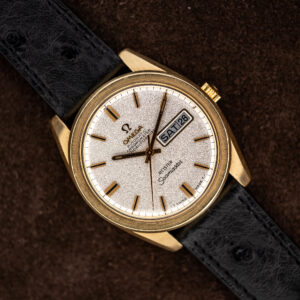
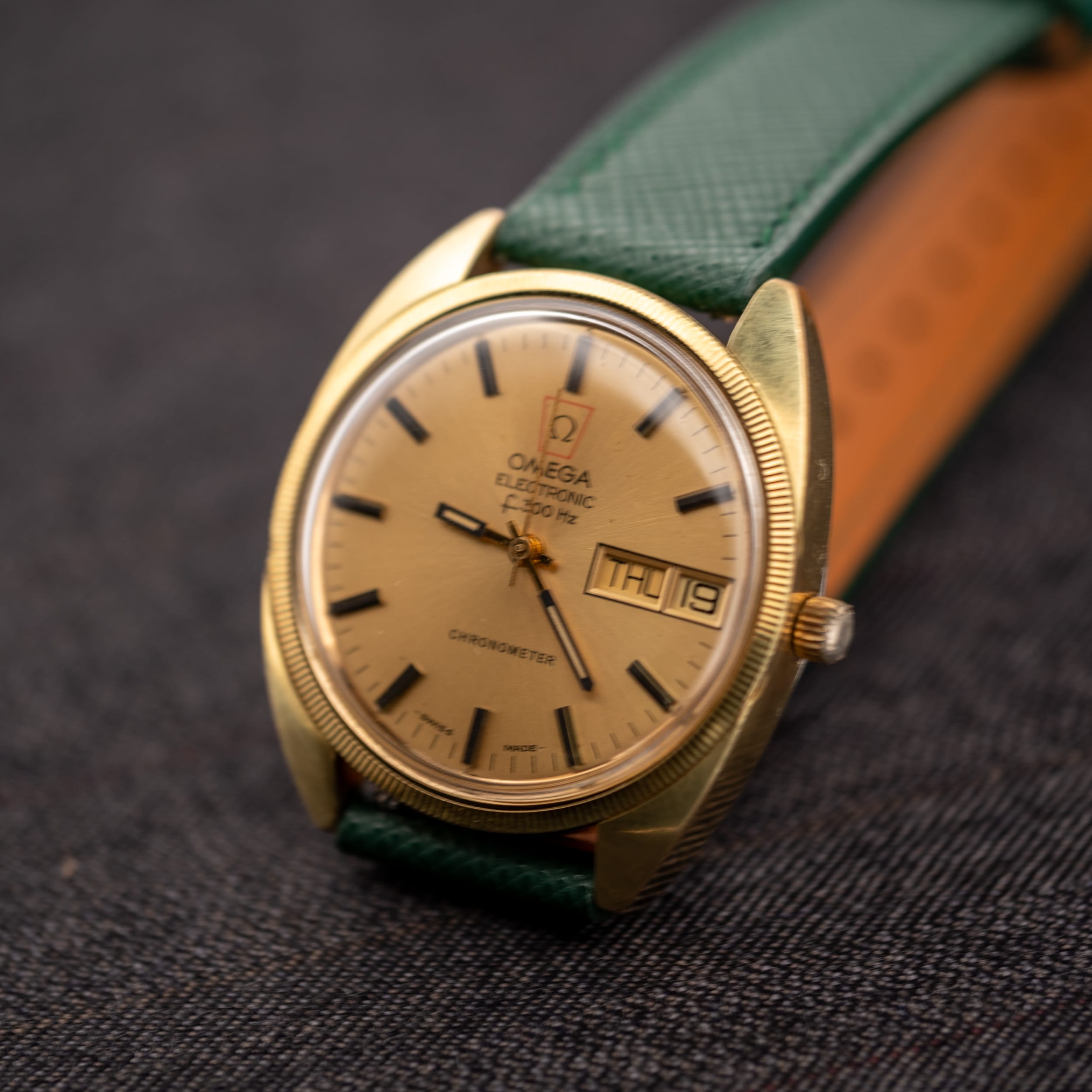
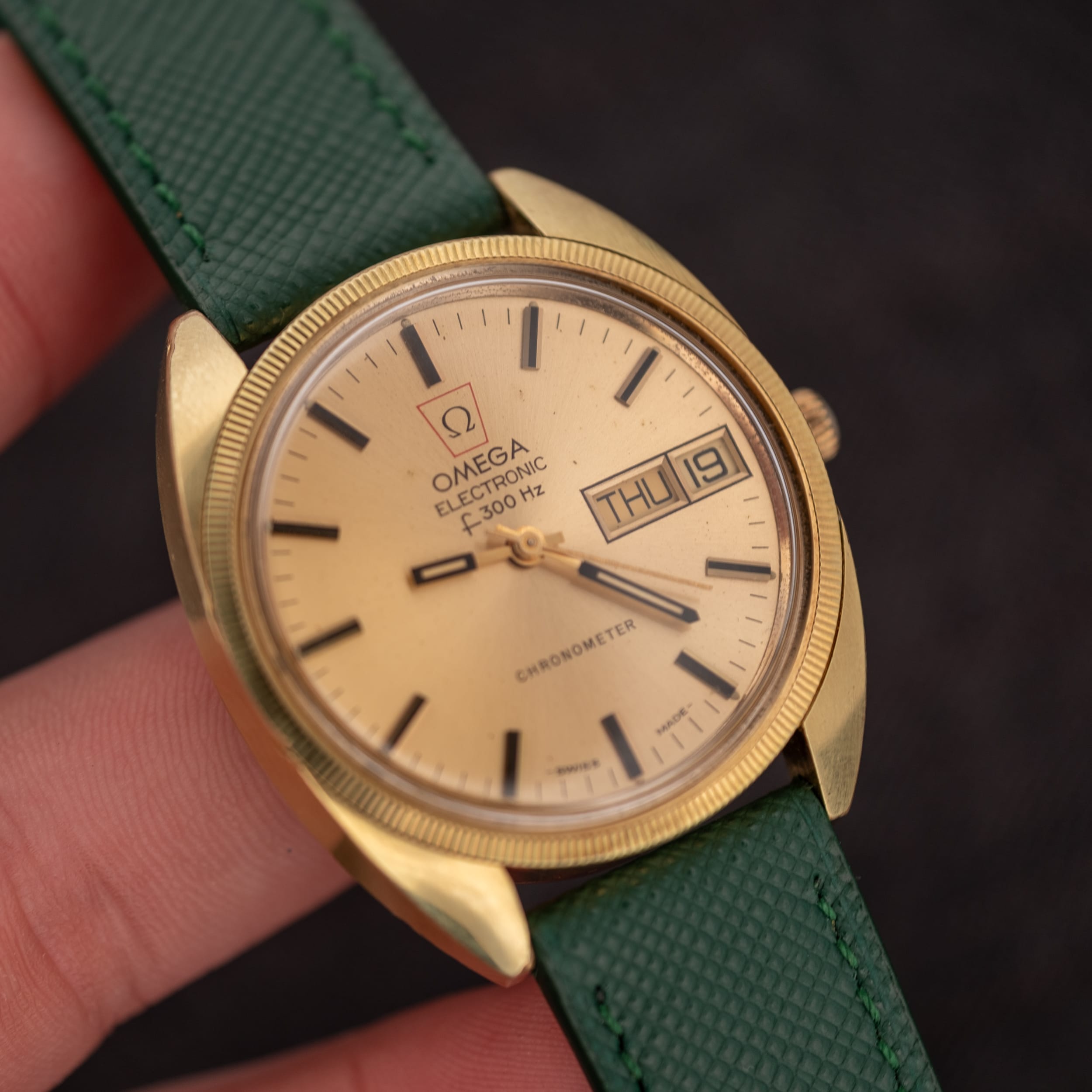
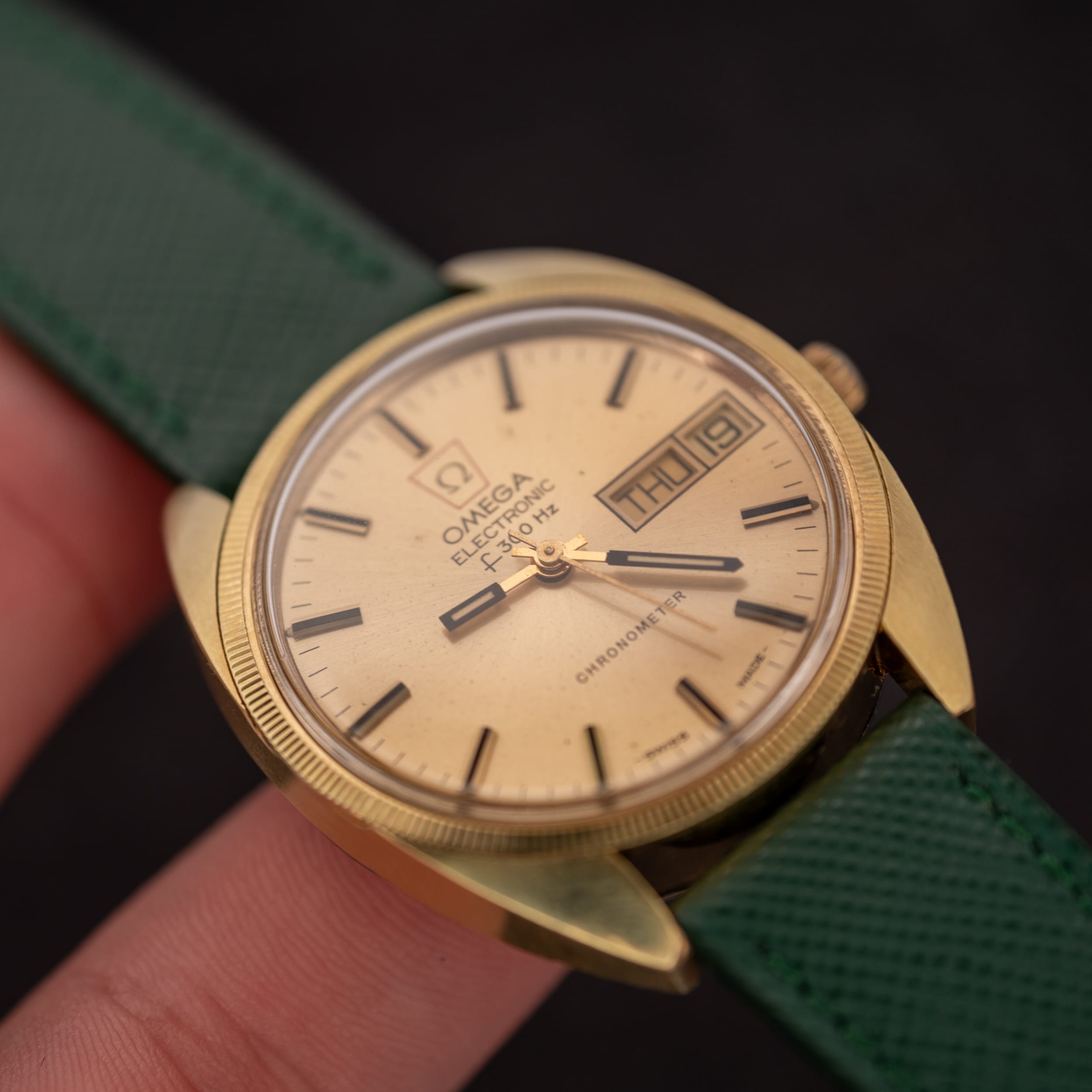
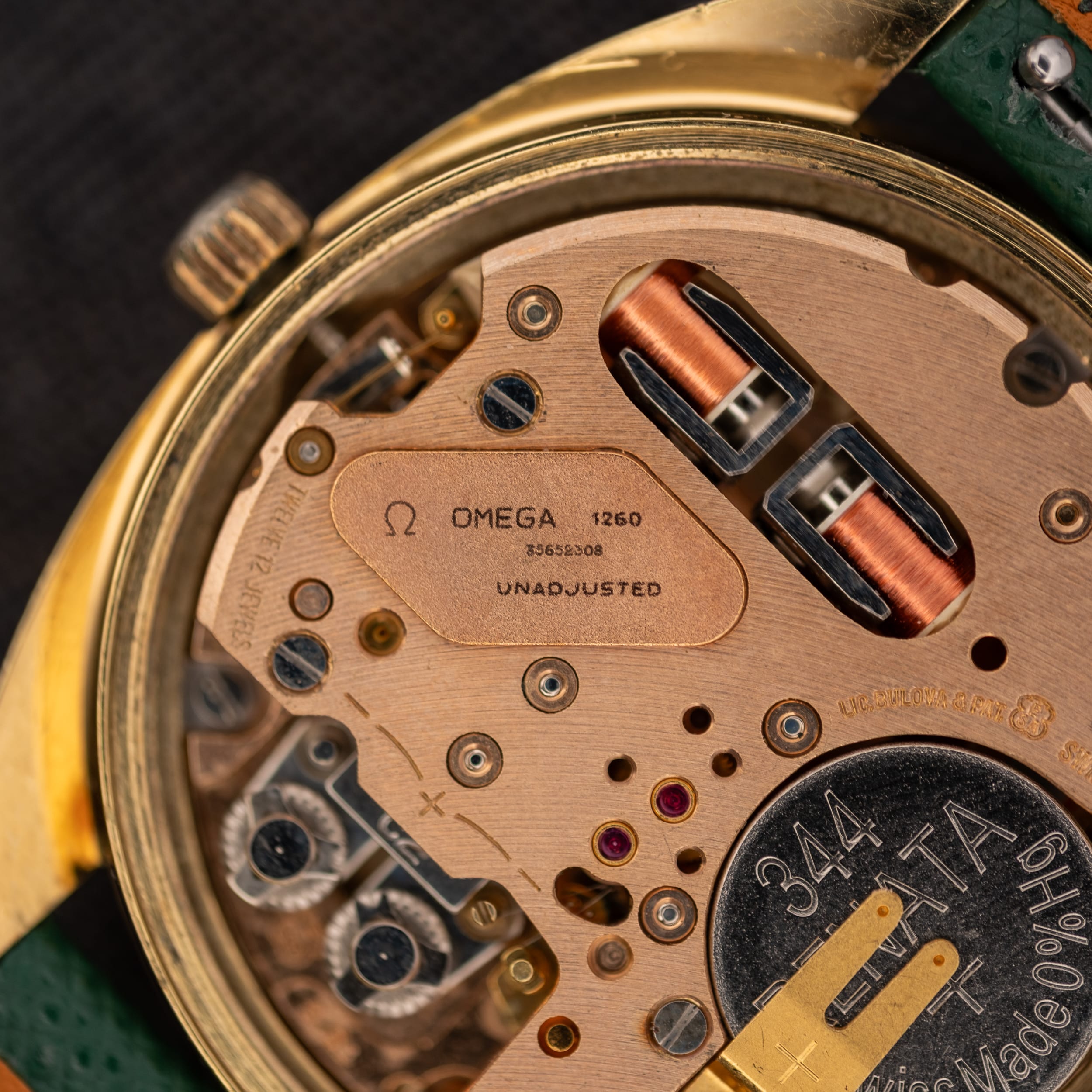
The caliber 1260 hums. It does not tick. Inside the case is a tuning fork of steel oscillating at three hundred cycles per second, driven electronically and stepped down through a tiny indexing wheel to move the hands in a continuous sweep no balance-wheel chronometer of the period could match. Omega built the Electronic F-300 Hz reference 1980045 around this caliber, dressed it in a sunburst champagne day-date dial behind a fluted gold-plated bezel, and sent it chronometer-rated. To us, this is the moment Omega ran headfirst at the electronic-watch problem with an answer that owed nothing to quartz and everything to a humming fork of steel, and in our opinion it is one of the more underread chapters in the long-form Omega catalogue.
The Omega Electronic line is its own collector niche and the story behind it is genuinely fertile. Bulova introduced the Accutron in 1960 and patented the tuning-fork drive system that made it possible, a steel fork excited by twin electromagnetic coils at hundreds of cycles per second in place of the swinging balance wheel that had regulated mechanical watches for three hundred years. ESA, the Swiss ebauche manufacture that would become ETA, licensed the underlying tuning-fork technology from Bulova in the late 1960s and developed its own family of 9162 and 9164 calibers built on the same principle. Omega took the ESA 9162 base, added its own day-date module and chronometer-grade finishing, and released the result as the caliber 1260 inside the Omega F300 Hz line, in production from roughly 1972 through 1976 before quartz arrived and quietly closed the chapter on tuning-fork wristwatches industry-wide.
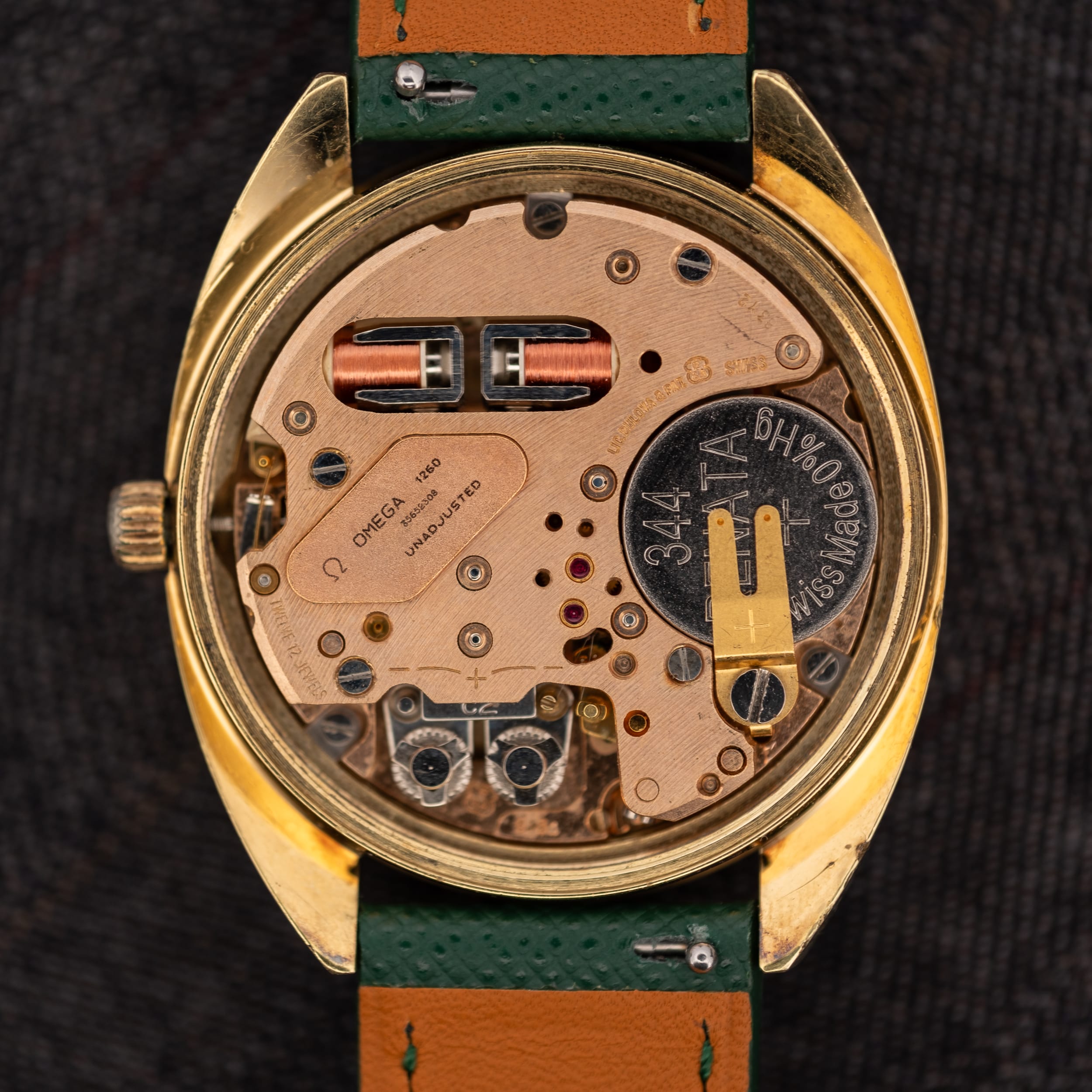
The caliber is the Omega 1260, a chronometer-rated tuning-fork movement running at 300 Hz across twelve jewels with the day-date module sitting on top of the ESA 9162 base. A 1.5 volt battery drives a pair of electromagnetic coils that excite a precisely tuned steel fork into continuous vibration at three hundred cycles per second, an index wheel converts that hum into rotational motion through a tiny ratcheting pawl, and a conventional gear train carries the result up to the hands. The result is a watch that runs to within ten seconds per month of true time at a moment in horological history when a chronometer-rated mechanical was lucky to hold ten seconds per day. Our service photographs show the two copper drive coils sitting cleanly across the upper bridge plate, the Omega-signed cartouche reading “OMEGA 1260” with the matching serial 35,652,308 and “UNADJUSTED” beneath, and the fresh Renata 344 battery seated in its retaining clip. Chronometer certification on a tuning-fork caliber was earned through the fork tuning itself rather than through positional adjustment, and the COSC standard for the F-300 Hz line was a separate Bureau Officiel rating that the 1260 carried in volume.
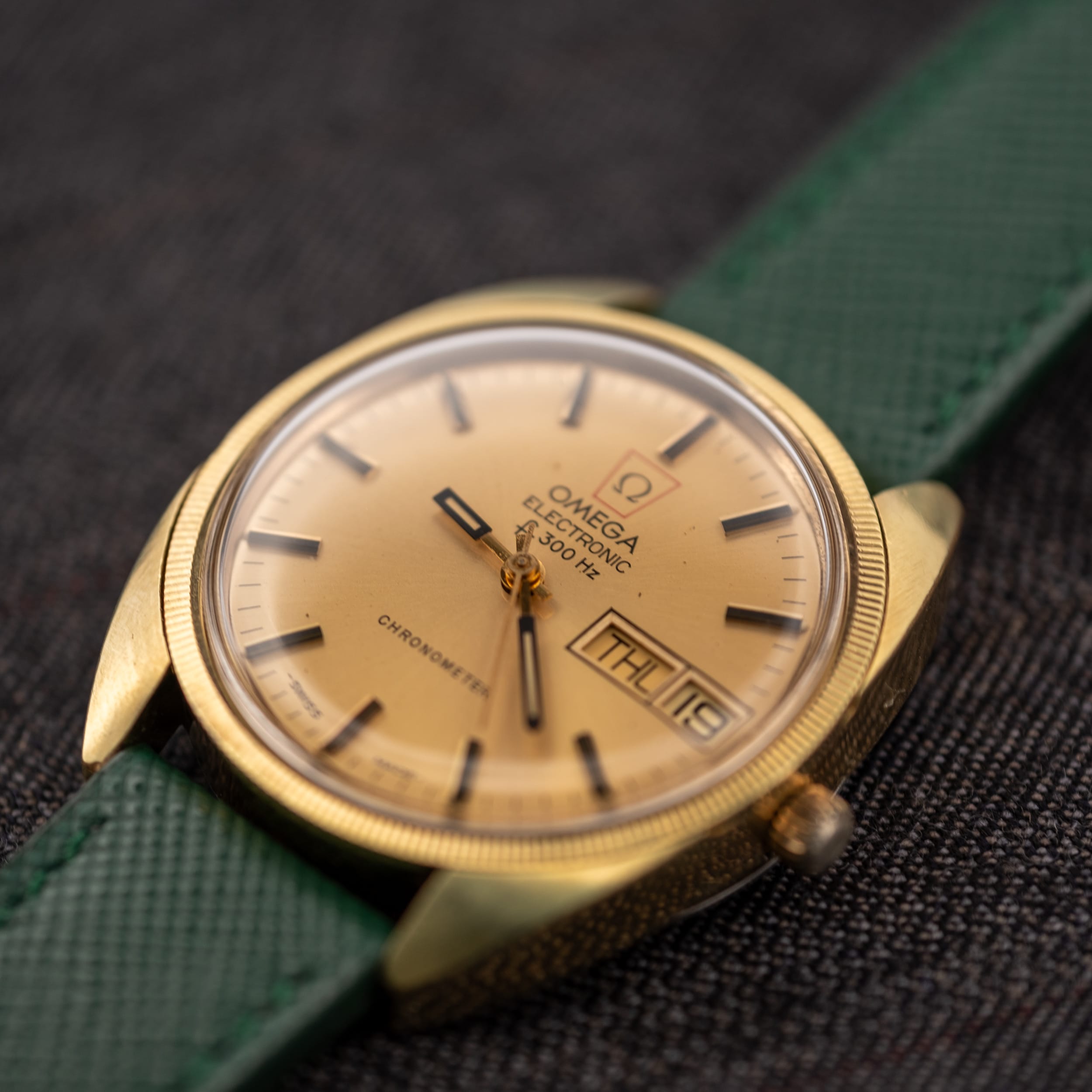
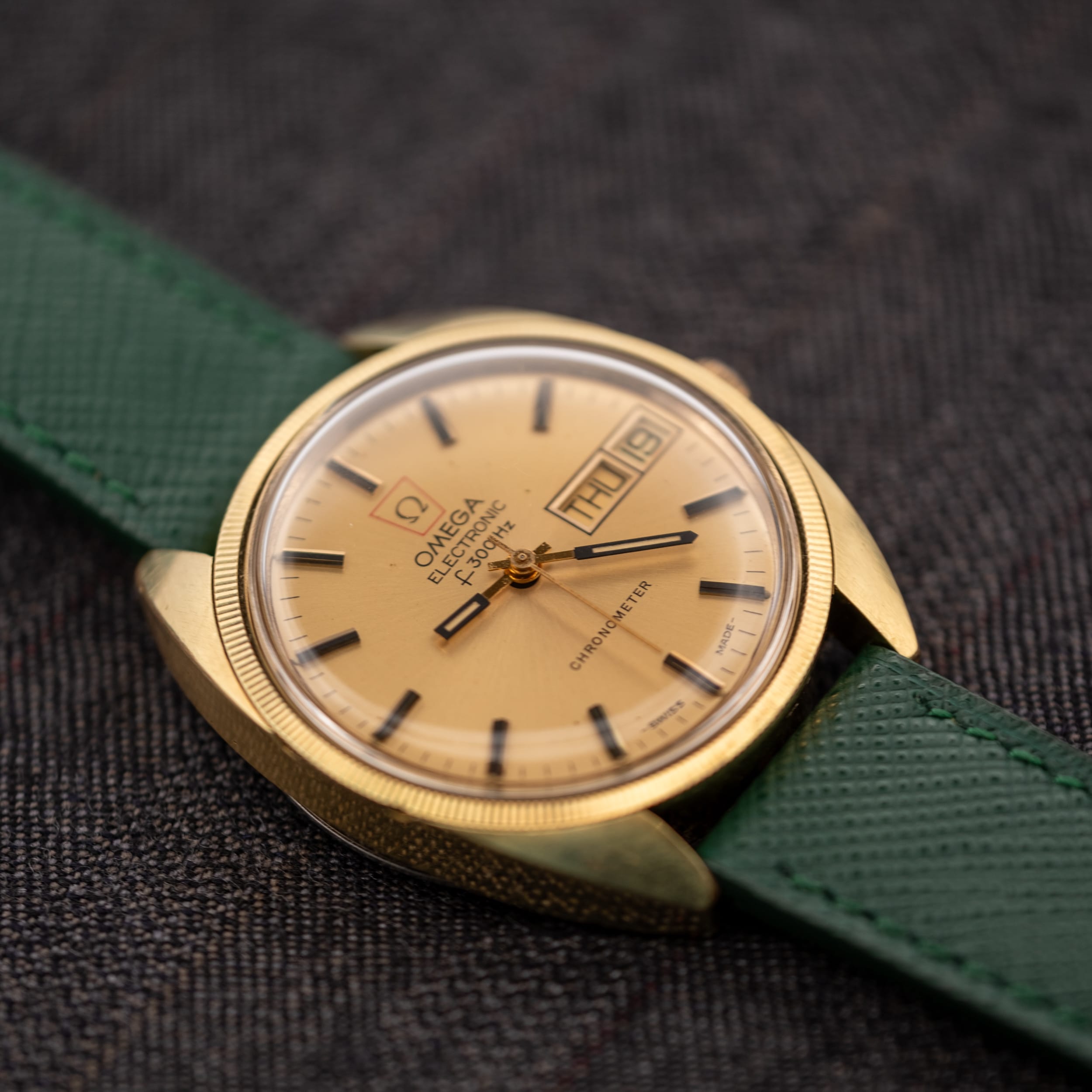
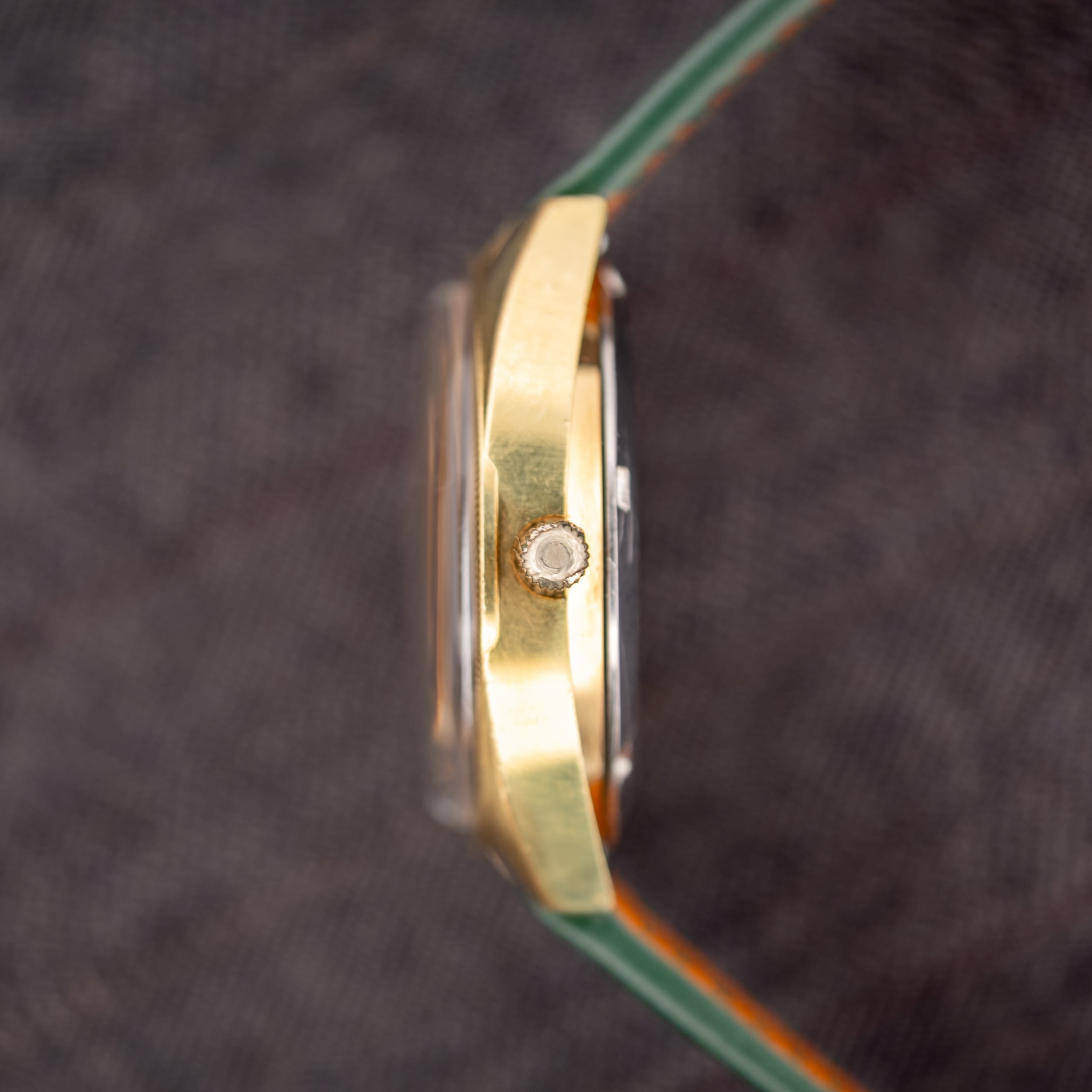
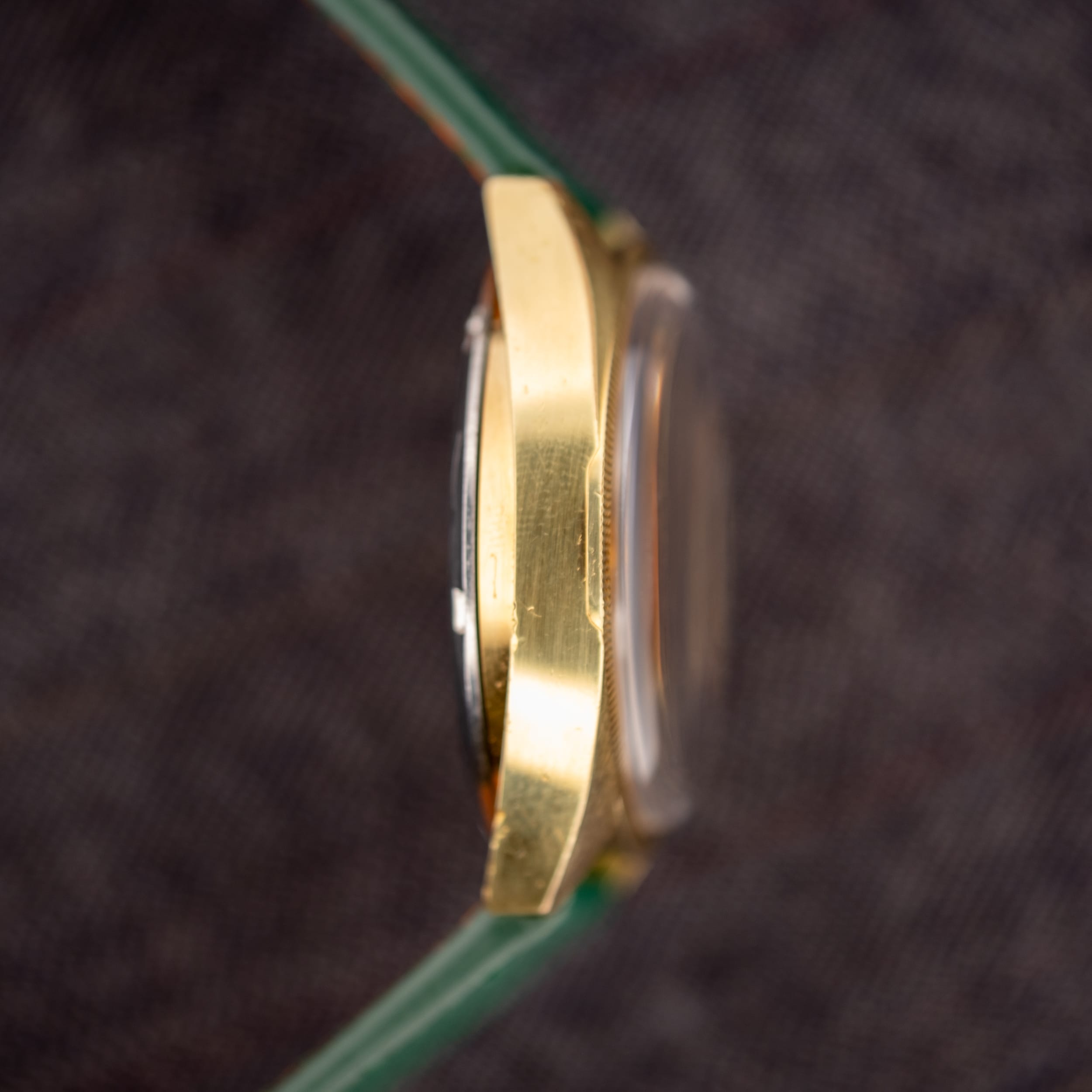
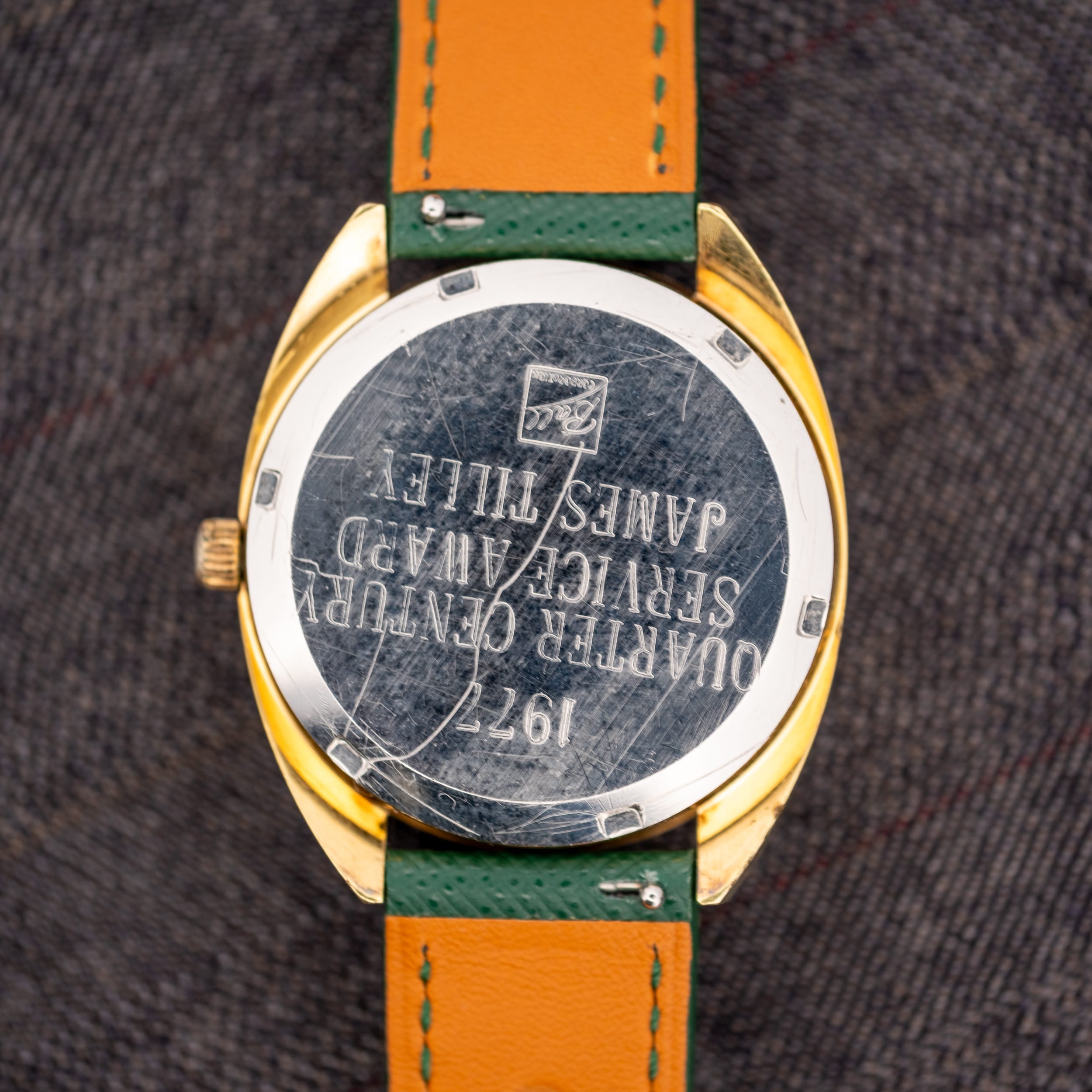
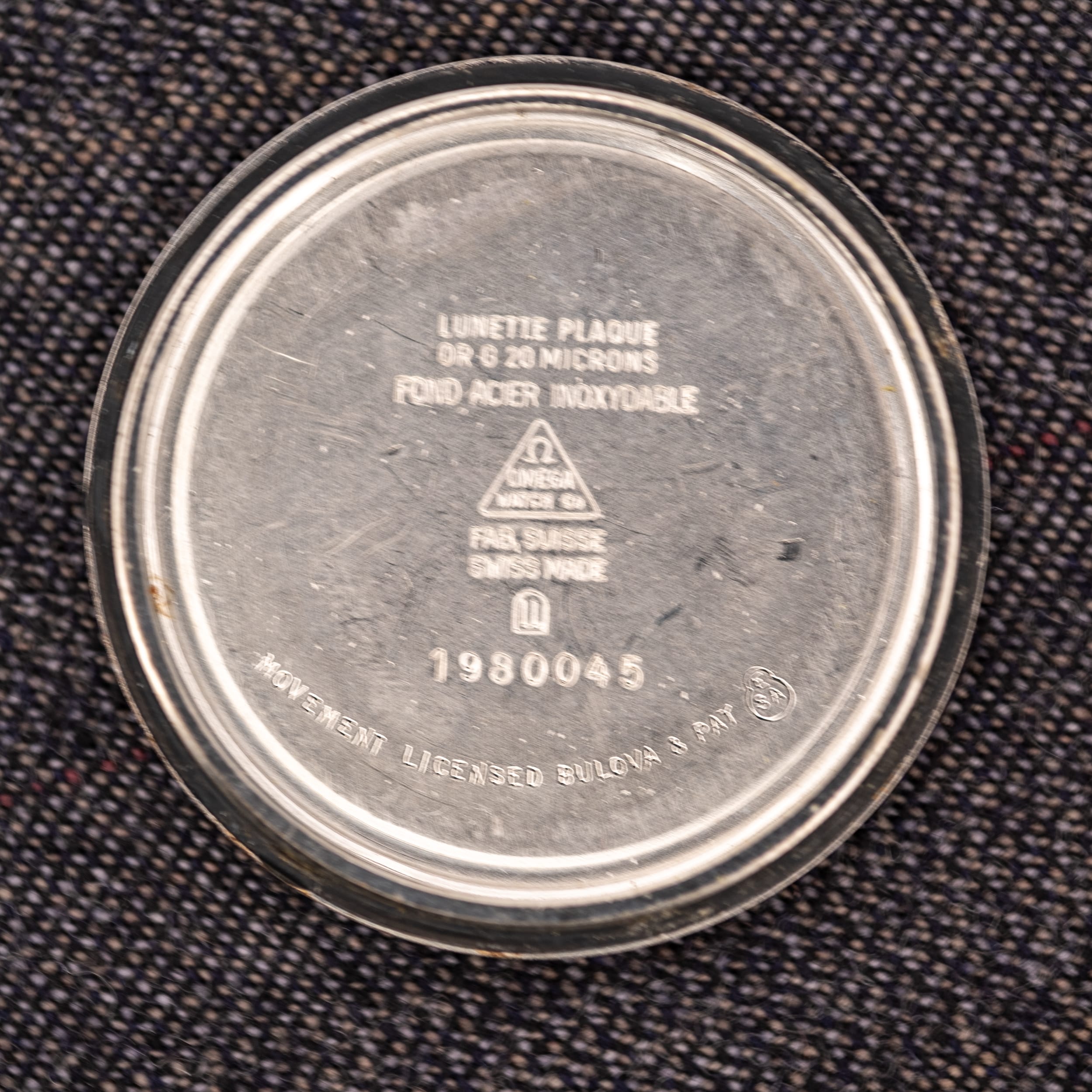
The case construction is twenty-micron gold plate applied across the bezel and the entire upper case shell, with a stainless steel screw-down back. This is not gold-filled and not gold-capped; it is a thick electroplated gold layer over a steel substructure, the standard premium plating spec Omega used on the Electronic line in the early 1970s, and at twenty microns it wears with a depth the thinner platings of the same period simply do not match. The case measures 35.2mm across with a 40.5mm lug-to-lug span and an 18mm lug width, dimensions that wear like a properly proportioned dress-sport hybrid on a modern wrist. The bezel is finely fluted around its full circumference, an architectural detail that reads as Omega’s house answer to the period-correct fluted profile but executed in gold plate over a steel-backed case. The outer caseback is stamped “LUNETTE PLAQUE OR G 20 MICRONS” and “FOND ACIER INOXYDABLE” along the upper edge, the French language designations for twenty-micron gold-plated bezel and stainless steel case back, with “MOVEMENT LICENSED BULOVA & PAT” reading clearly along the lower edge, the Omega acknowledgment of the Accutron technology license stamped directly into the case. The Omega Watch Co. triangle logo sits in the center alongside “FAB. SUISSE” and “SWISS MADE”, and the reference number “1980045” runs below. The outer caseback also carries a presentation engraving reading “QUARTER CENTURY SERVICE AWARD / JAMES TILLEY / 1977”, a dated twenty-five-year employer service award stamped into the case after the watch left the factory. Period engraving of this kind anchors the piece to a specific year and a specific recipient, and we treat it as the kind of provenance detail that adds to rather than detracts from a watch like this. Honest wear scatters across the outer caseback and case sides exactly as a watch worn and loved for fifty years should look, with the underlying steel showing through at a couple of high-contact points on the case back periphery.
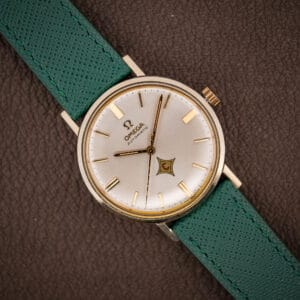
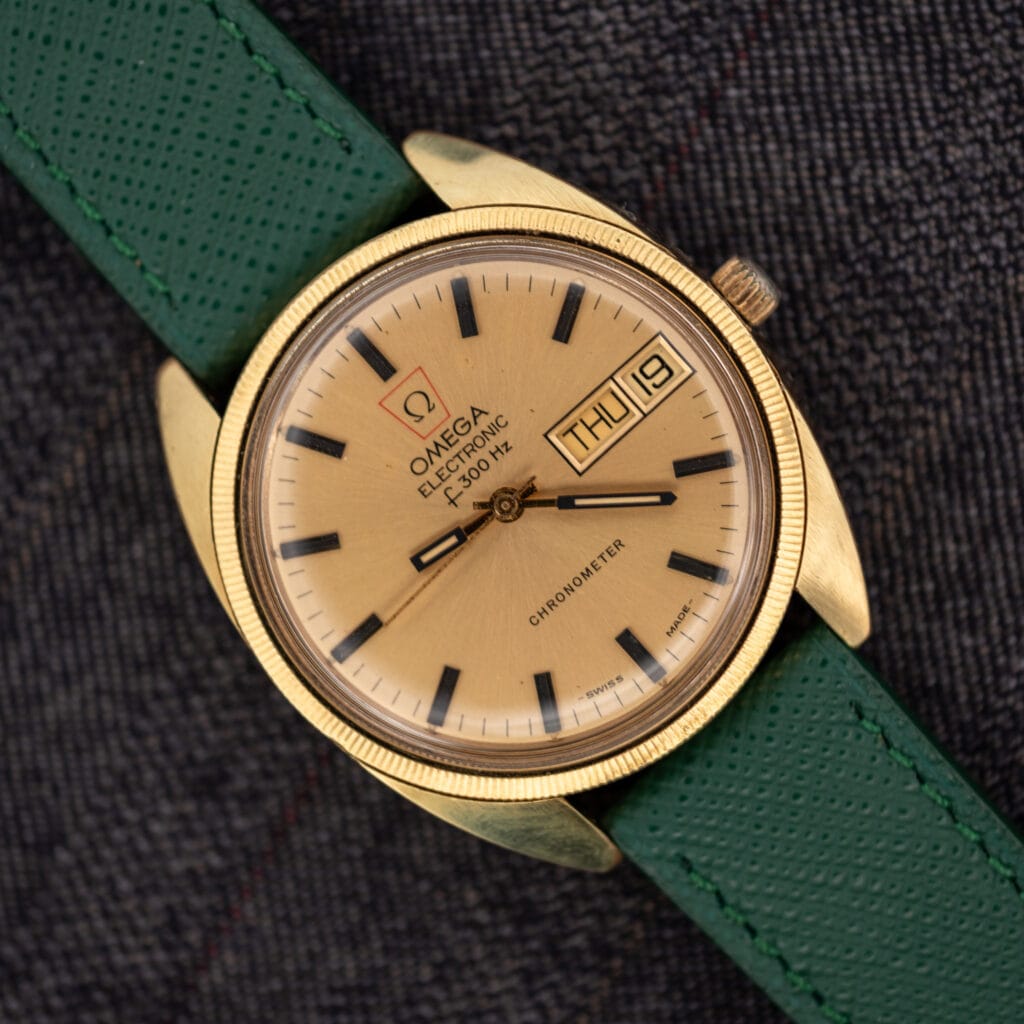
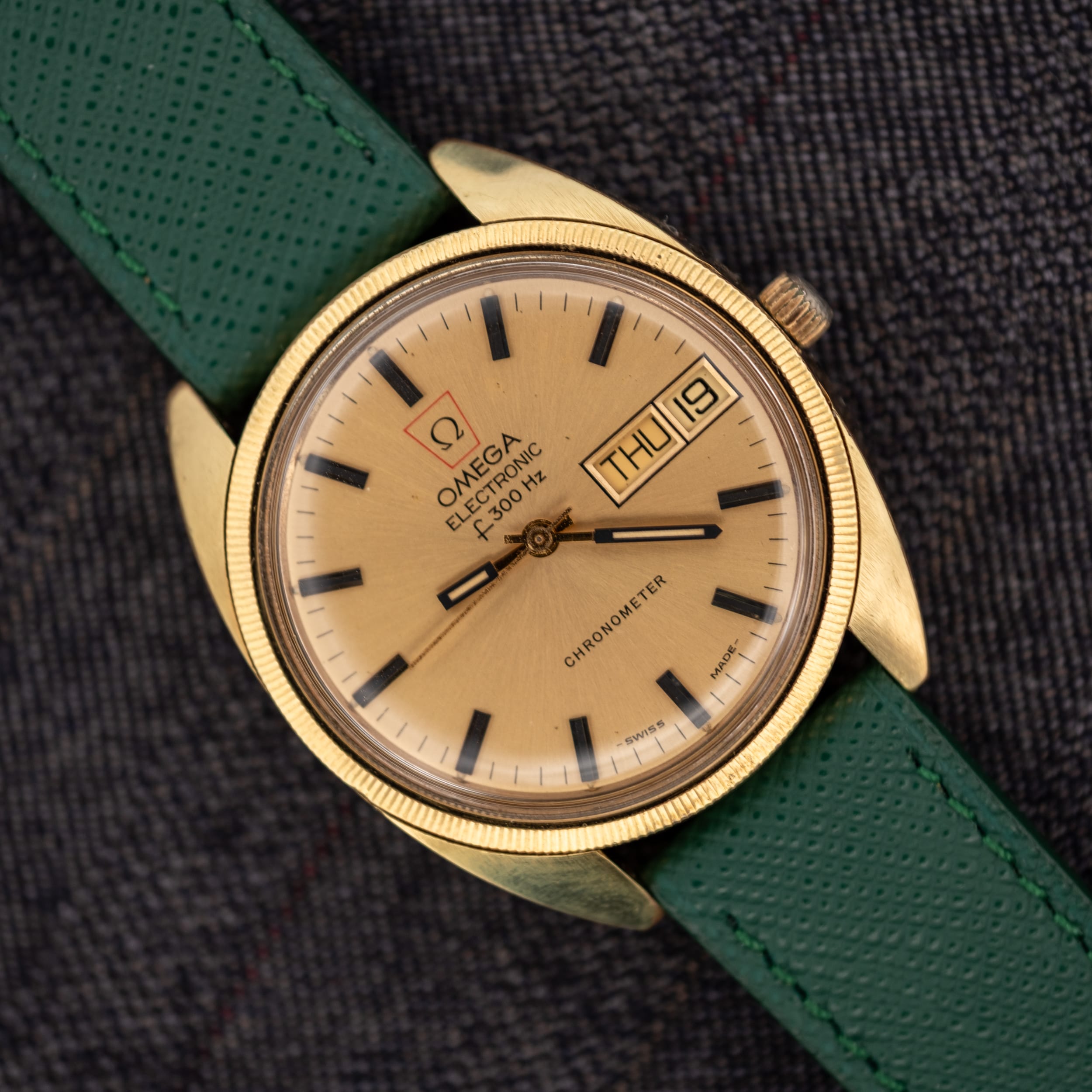
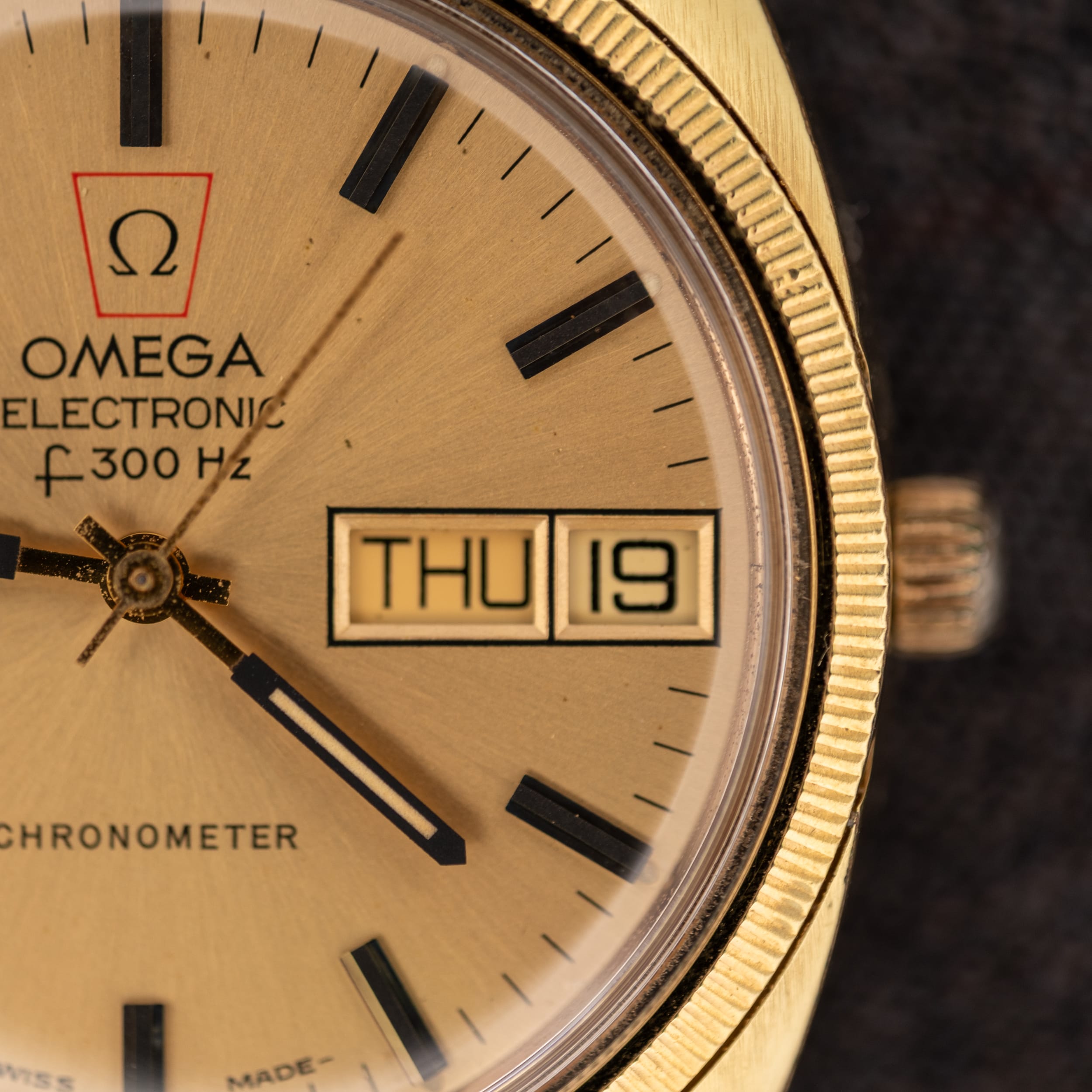
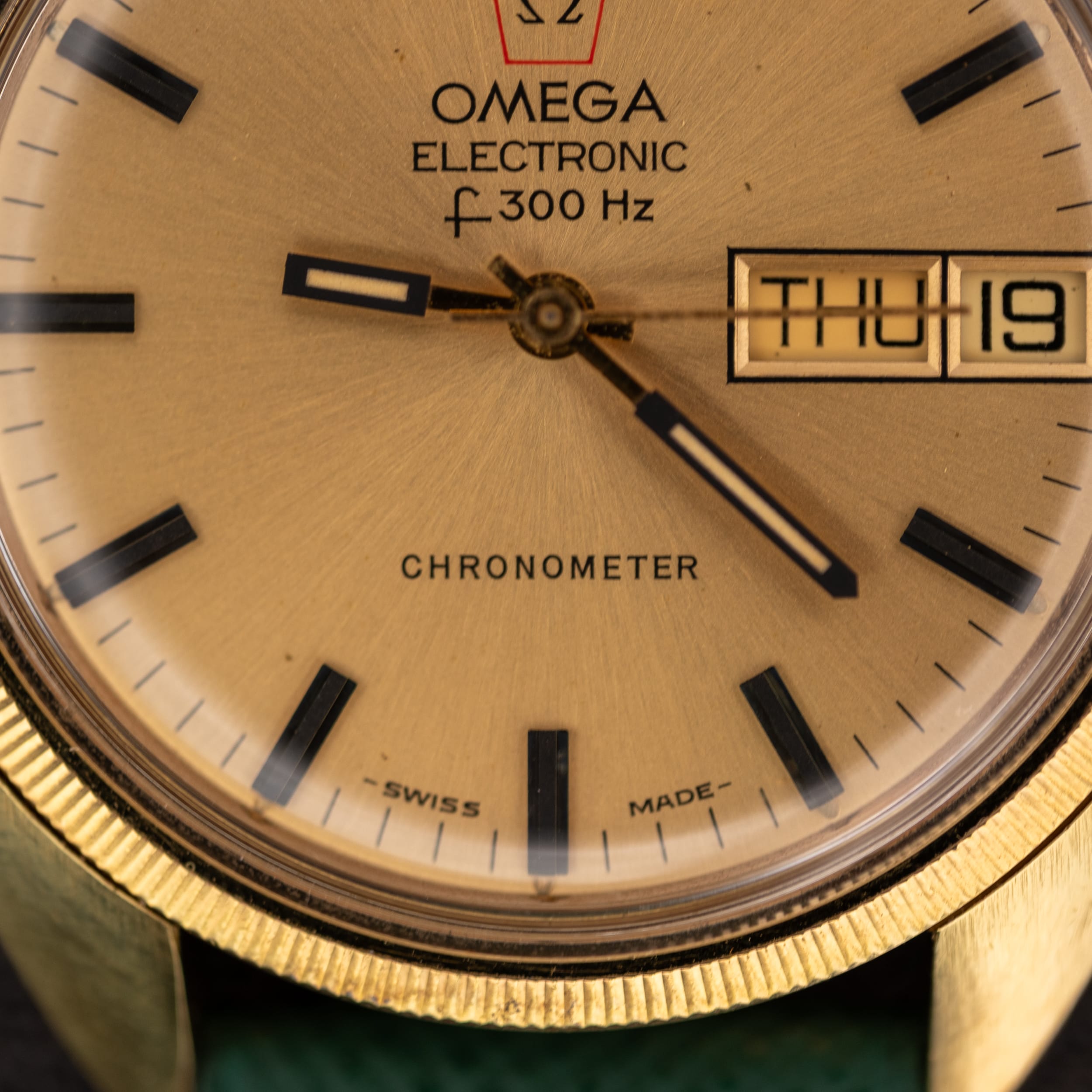
The dial is where this watch earns its place in the F-300 catalogue. A factory original sunburst champagne field carries the printed red Omega logo cartouche at twelve, the printed “OMEGA / ELECTRONIC / f300 Hz” stack reading clearly in black across the upper half, “CHRONOMETER” along the lower half, and “SWISS MADE” at the six o’clock position flanked by the printed minute track. The day-date apertures sit at three with the day in English and the date in white-on-gold print, exactly the layout the caliber 1260 day-date module was drawn to produce. Applied gold stick markers ring the dial at every hour position with dark black inlays running their full length, a two-tone marker detail that reads handsomely against the champagne field in any light. The hour and minute hands are the original Omega sword set with luminous inlays that have aged to a deep brown matching the markers, and the sweep seconds hand is the period-correct slim baton in matching gold tone. The “f300 Hz” frequency designation printed below the Electronic wordmark is the dial signature that identifies this reference as part of the F-300 line, and the originality story across the dial stays clean.
The crown is the original Omega-signed component with the period-correct logo intact and operates with the positive engagement a properly tuned caliber 1260 should give. The acrylic crystal sits clear above the dial with the gentle doming that helps the champagne field play across its surface in light.
We have paired the watch with one of our pine green saffiano leather straps and an OTTUHR signed buckle. The saturated green reads as a deliberate counterweight to the warm gold case and the champagne dial, the cross-hatched saffiano grain catching the light at the same depth as the fluted bezel, and the three-tone palette letting the red Omega logo cartouche at twelve sit as the loudest accent on the wrist exactly where the dial was drawn to put it.
Serviced in-house at OTTUHR and backed by our 2-year warranty, this is the kind of early-1970s Omega Electronic we get genuinely excited about. Factory original dial, factory hands, original signed crown, intact case stampings including the Bulova license acknowledgment, fresh battery, and the chronometer-rated caliber 1260 tuning fork humming cleanly. Tuning-fork service is its own discipline, a more delicate proposition than mechanical service that requires specialist attention to the steel fork tuning, the coil resistance, and the index wheel pawl, and a serviceable F-300 Hz with fresh battery and confirmed accuracy is increasingly the harder watch to find. For the collector who values originality over polish, who appreciates the engineering ambition of vintage Omega’s quieter corners, and who wants a piece of early-1970s electronic Swiss watchmaking with a real story attached, the Omega Electronic F-300 Hz is exactly the kind of watch we love bringing in.