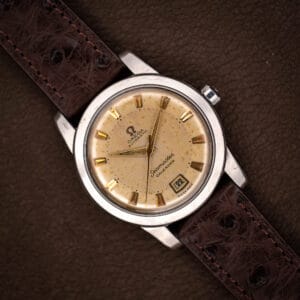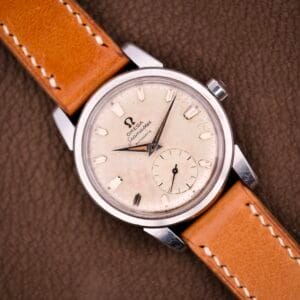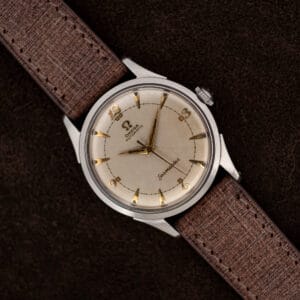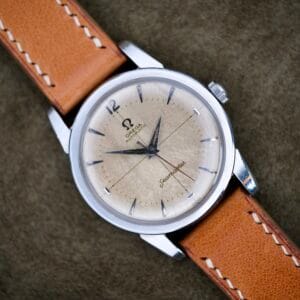
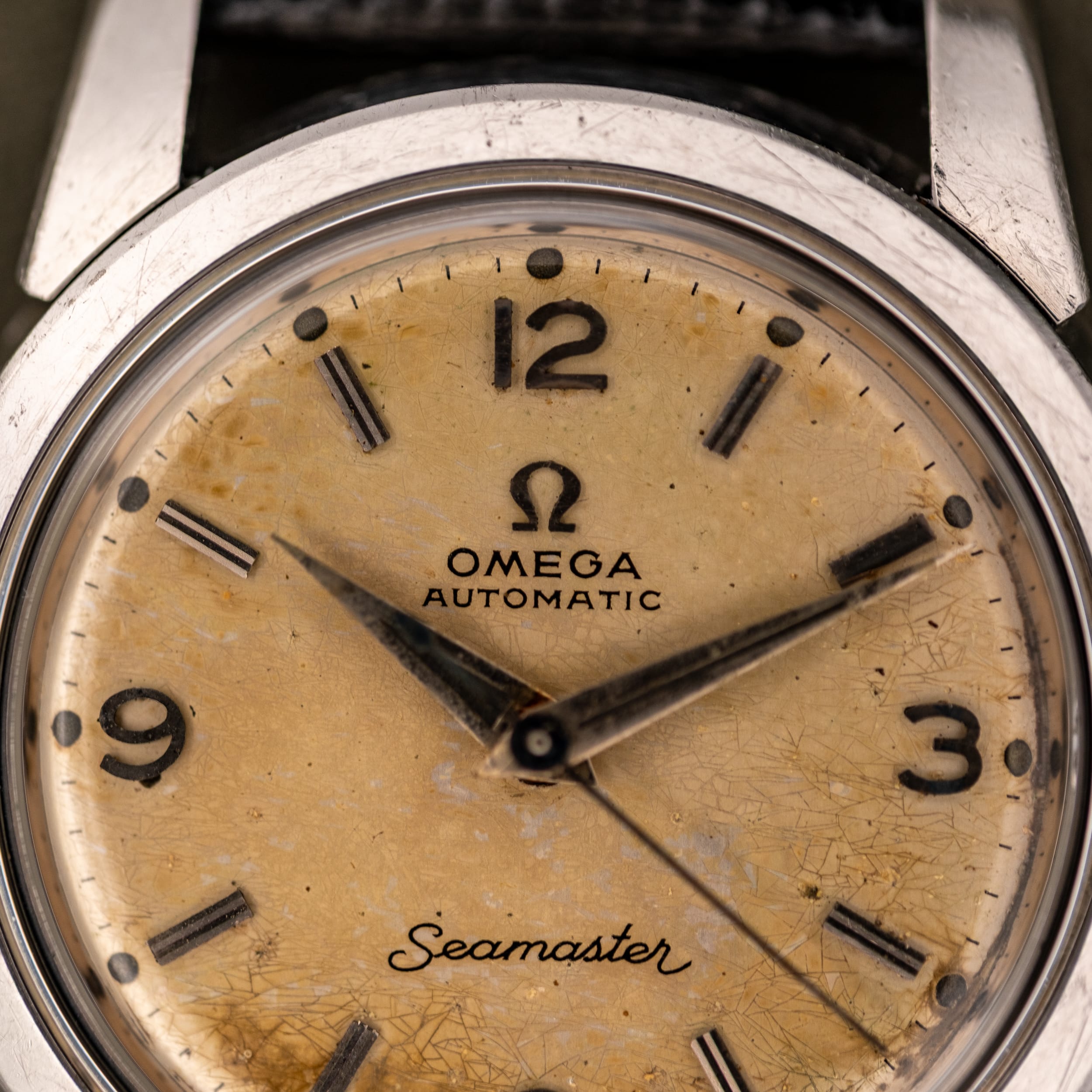
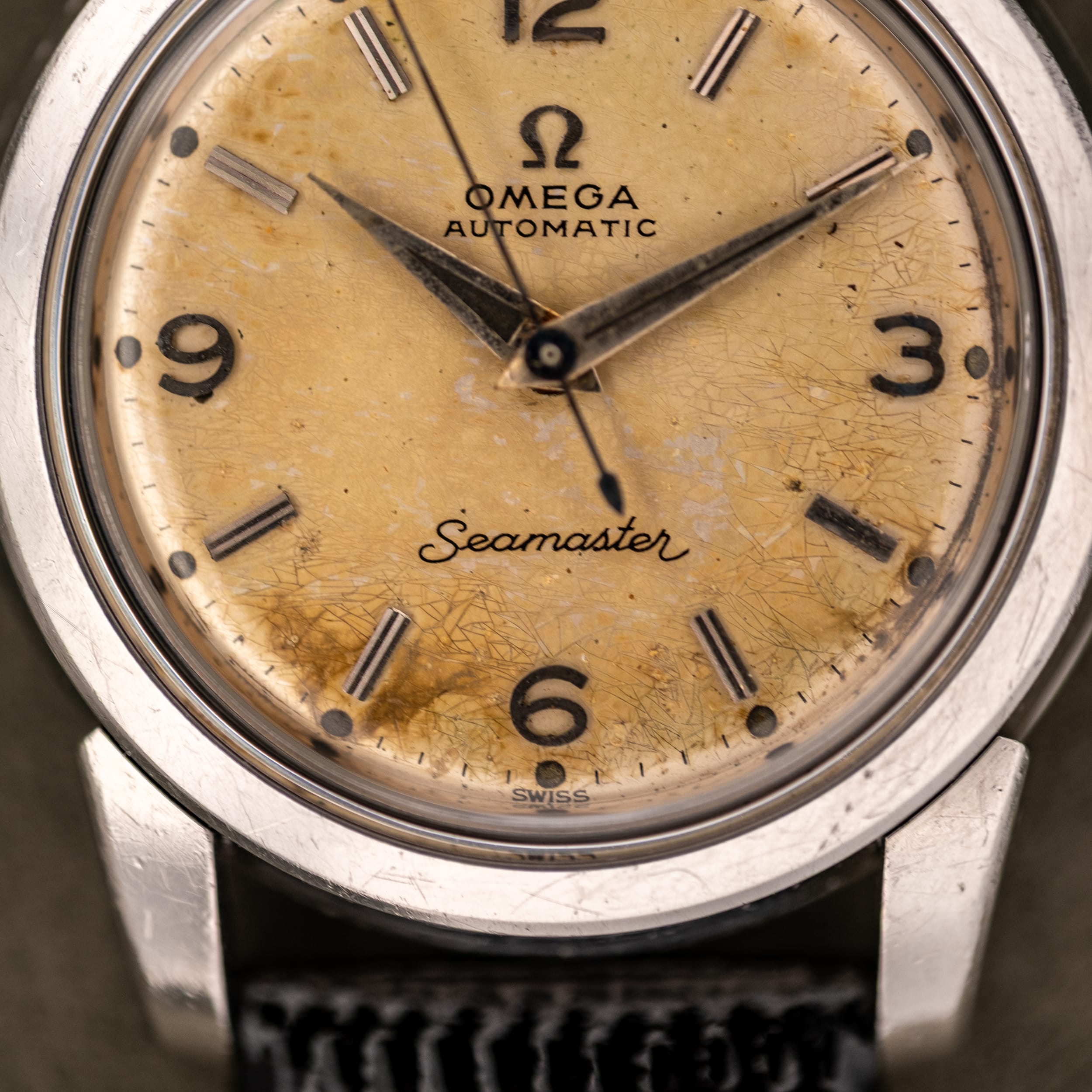
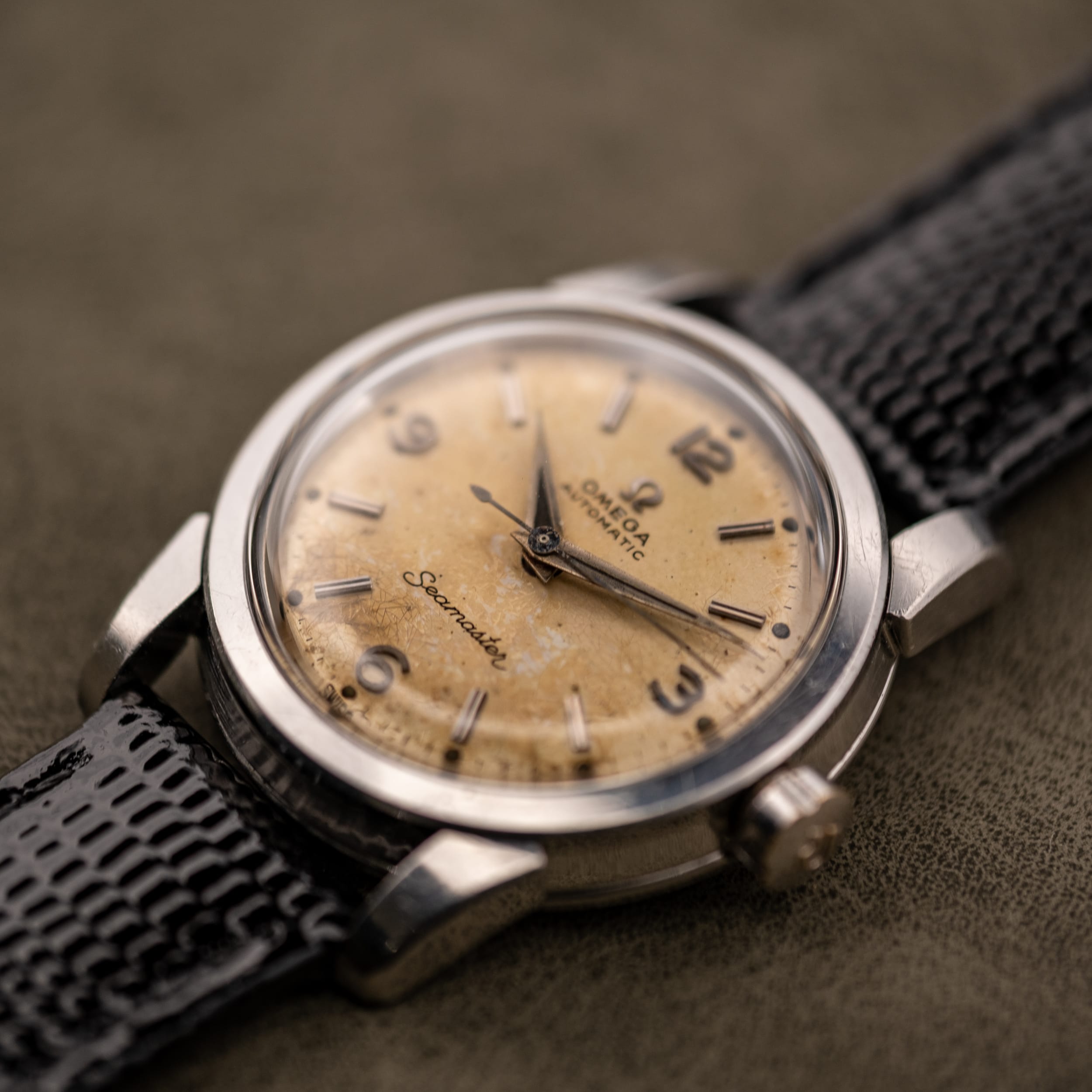
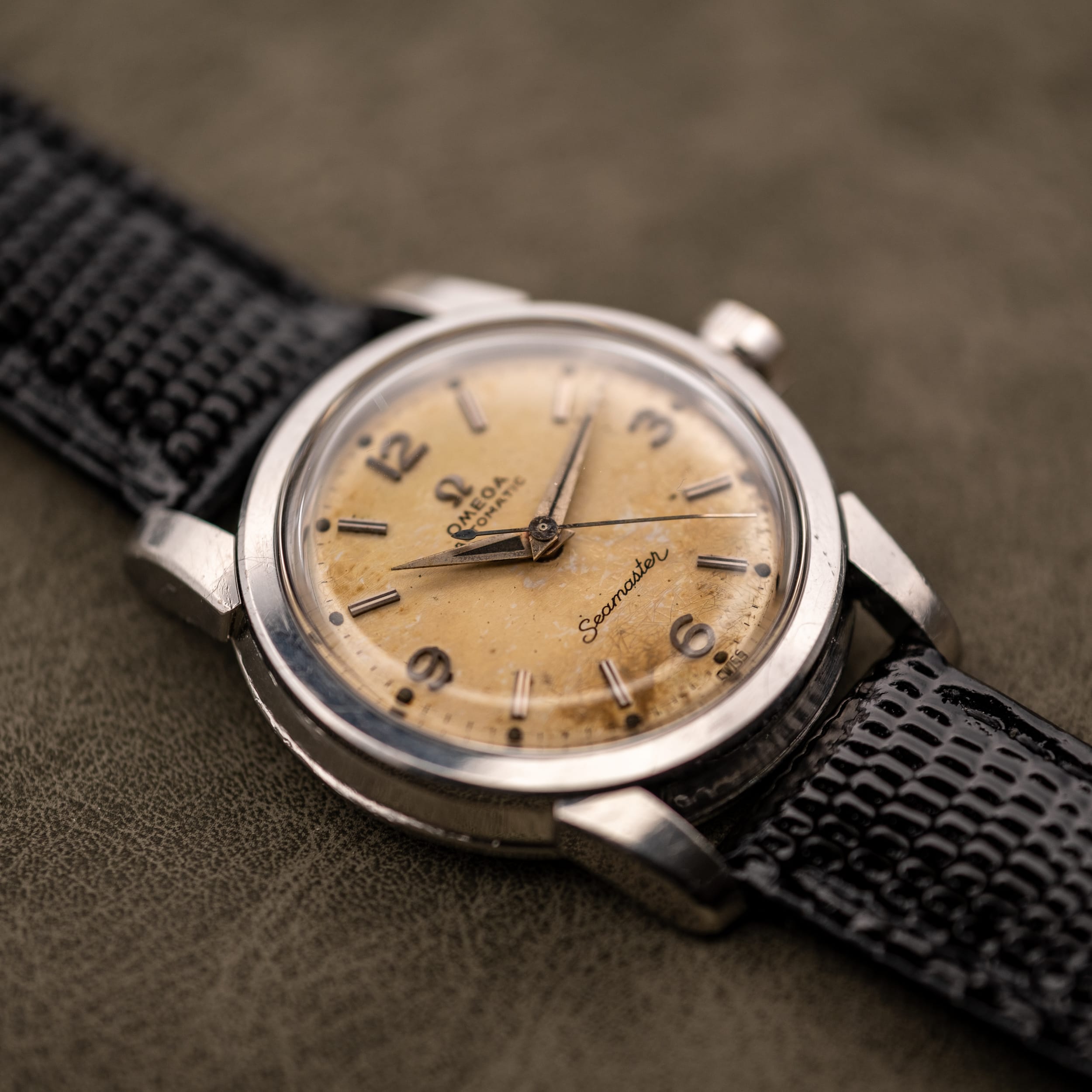
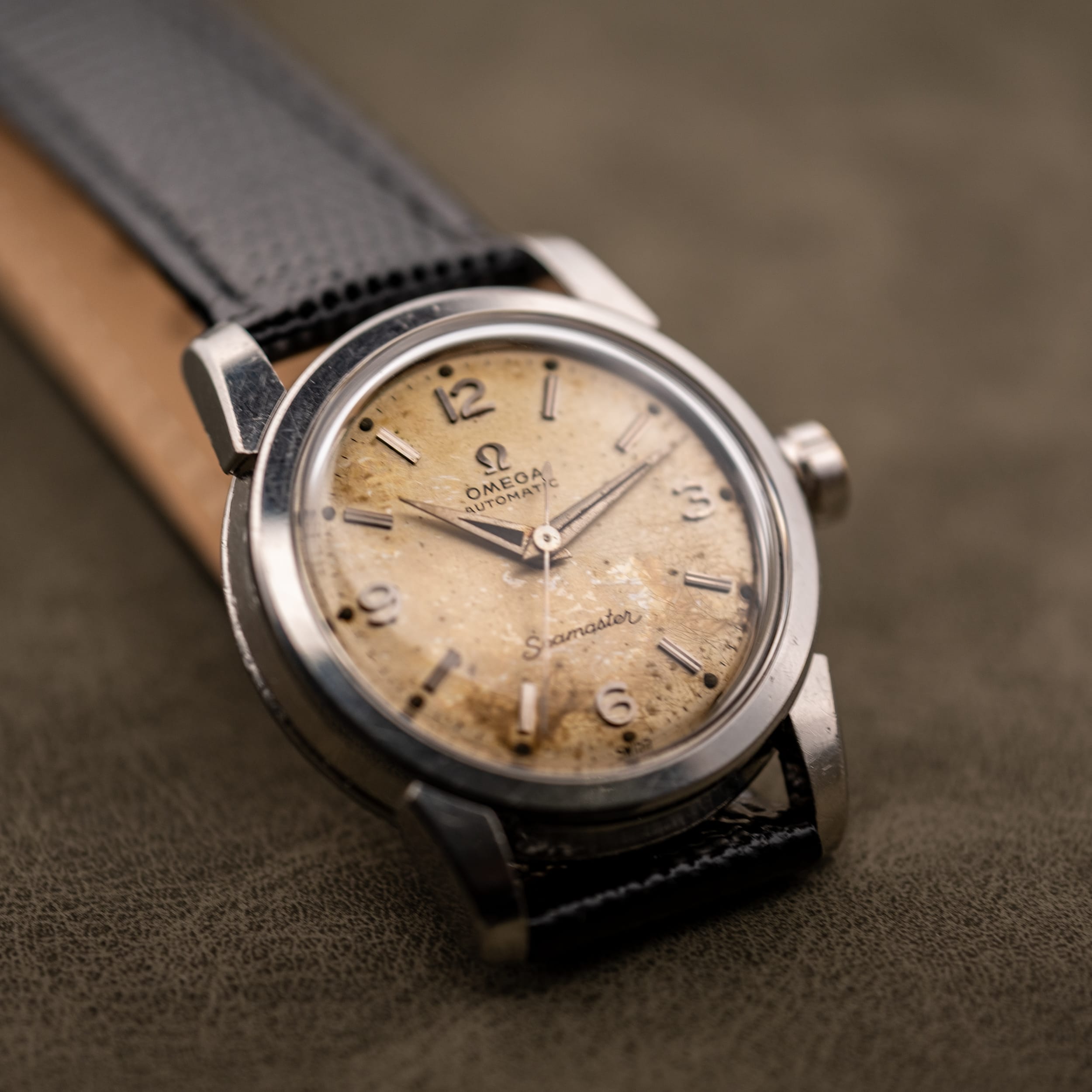
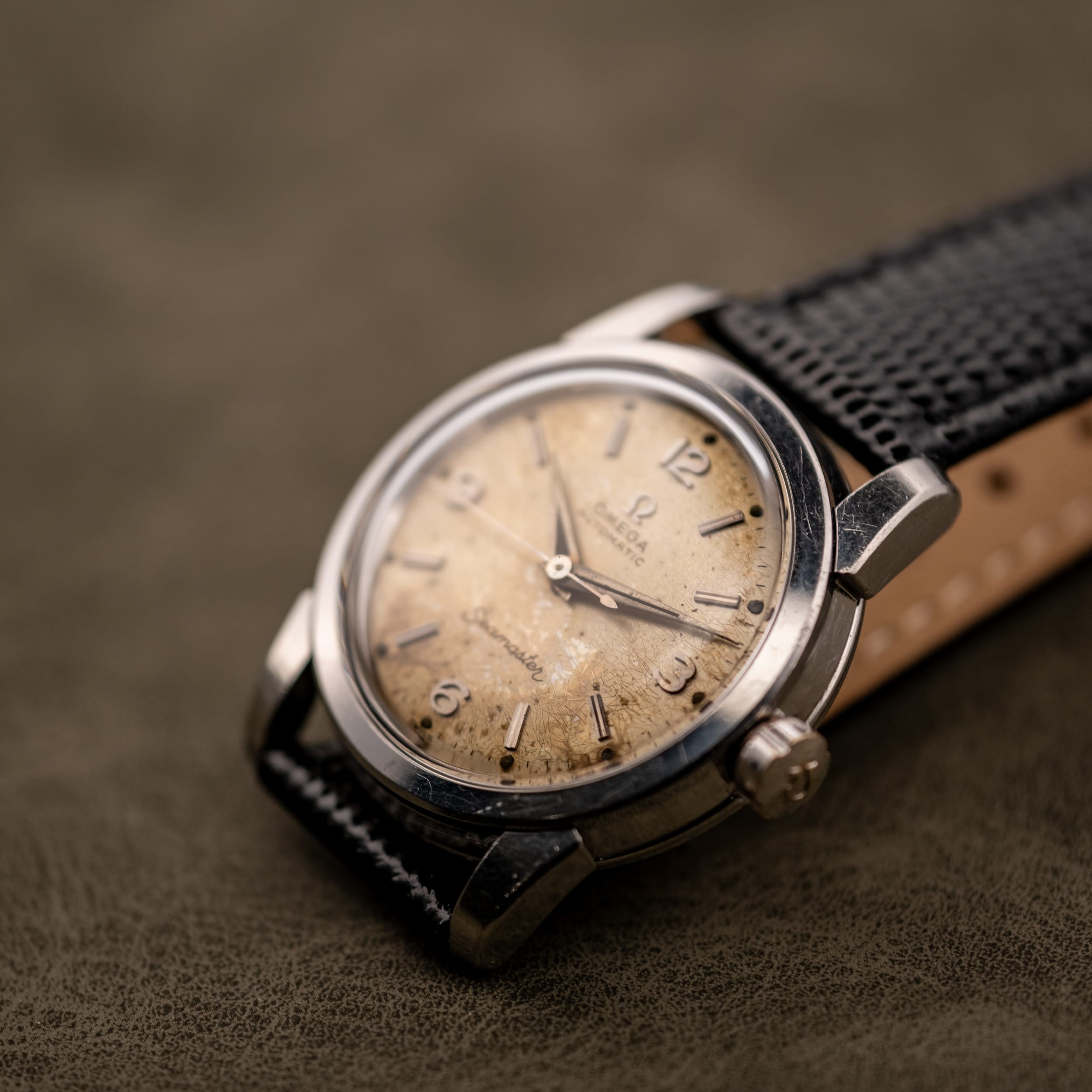
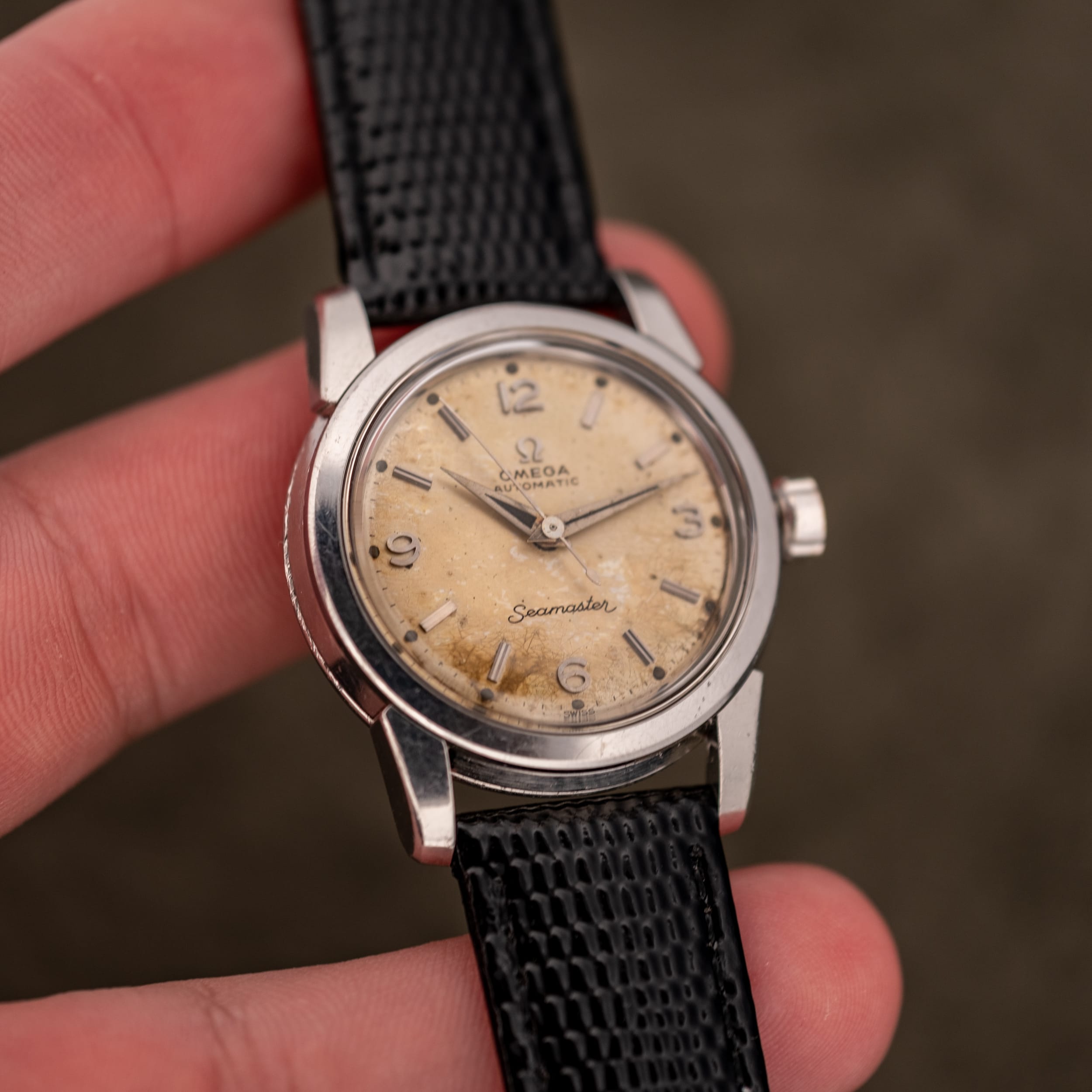
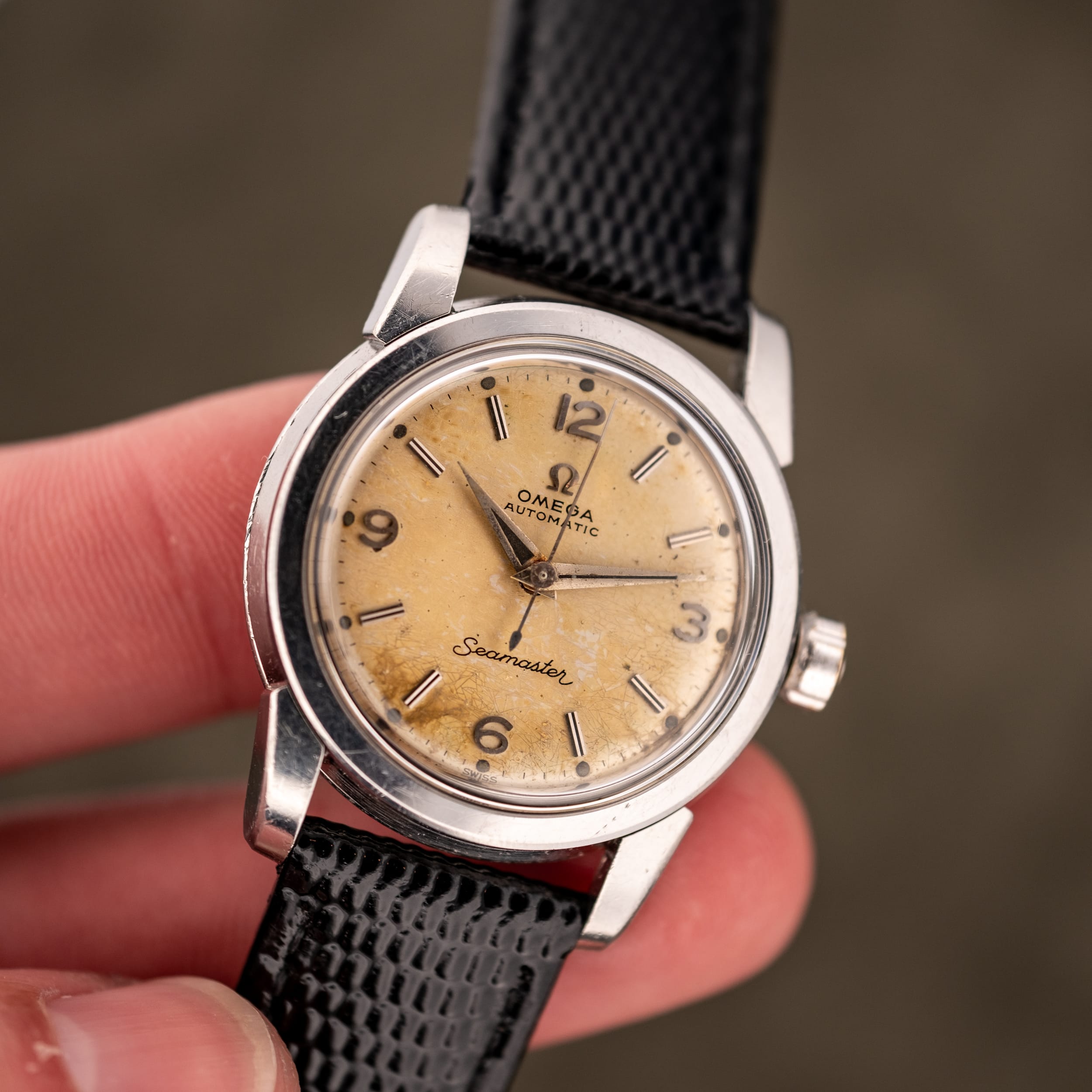

The Omega Seamaster 2828 (full reference 2828-14 SC) with the unevenly tropical-aged factory dial is one of those late-1950s Omegas that quietly carried the brand from its bumper-automatic past into its full-rotor future. No chronometer rating, no precious metal, no oversized case. Just a stainless steel Seamaster with applied Arabic numerals and stick markers, dauphine hands, and the caliber 470 ticking underneath. To us, this is the kind of reference that gets overlooked next to the Constellations and the gold-capped variants, and in our opinion that is exactly why a vintage Omega collector should be paying attention to it.
The Seamaster line launched in 1948 as Omega’s broad-market answer to its wartime waterproof military pieces, and by the second half of the 1950s the catalogue had matured into a deep family of stainless steel and gold-capped automatic dress watches. Reference 2828 sits in that mid-to-late 1950s window, with various sub-references (2828-1, 2828-9, 2828-14) marking small case and dial variations. Our example carries the 2828-14 SC stamping, the SC suffix standing for seconde au centre, Omega’s notation for central-seconds layouts.
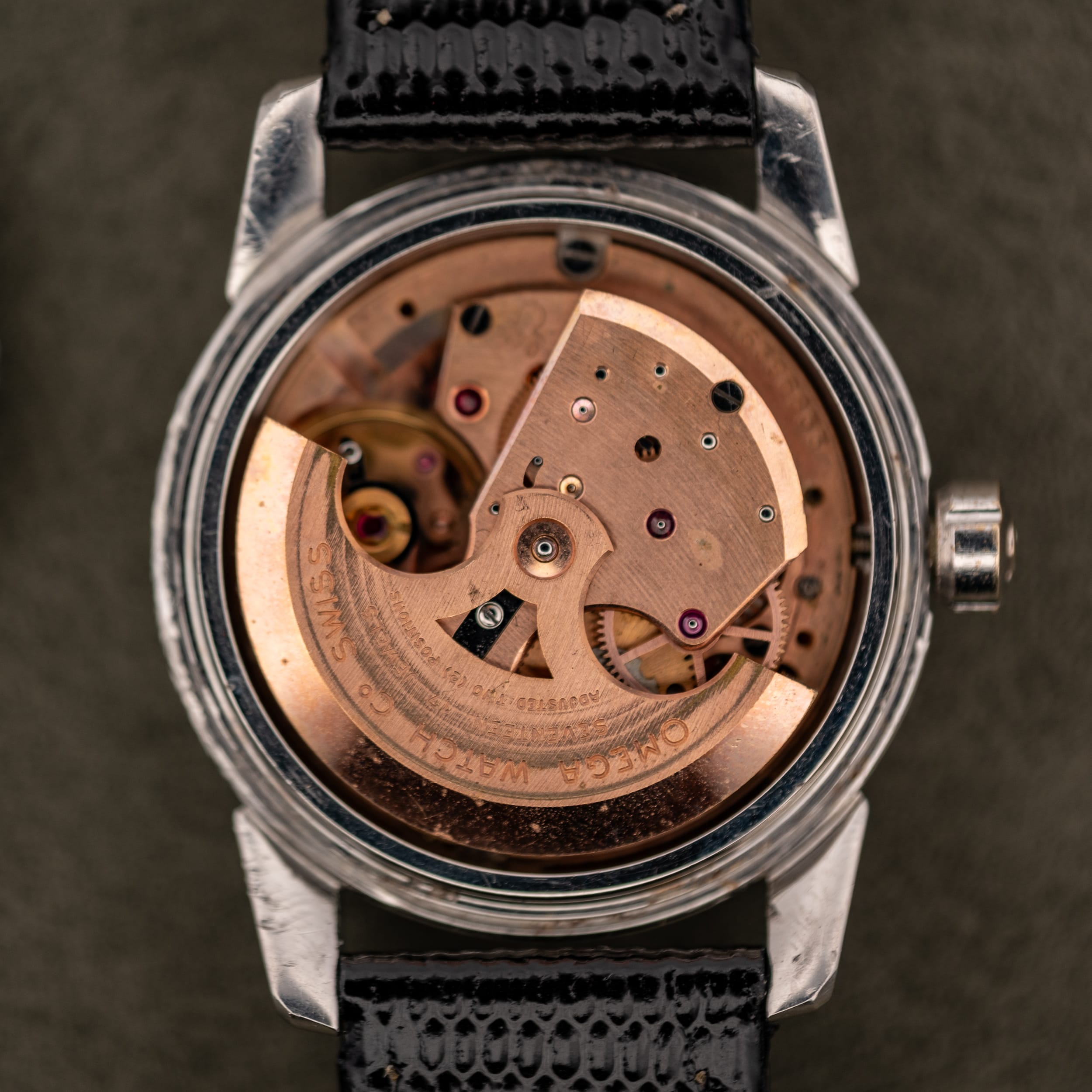
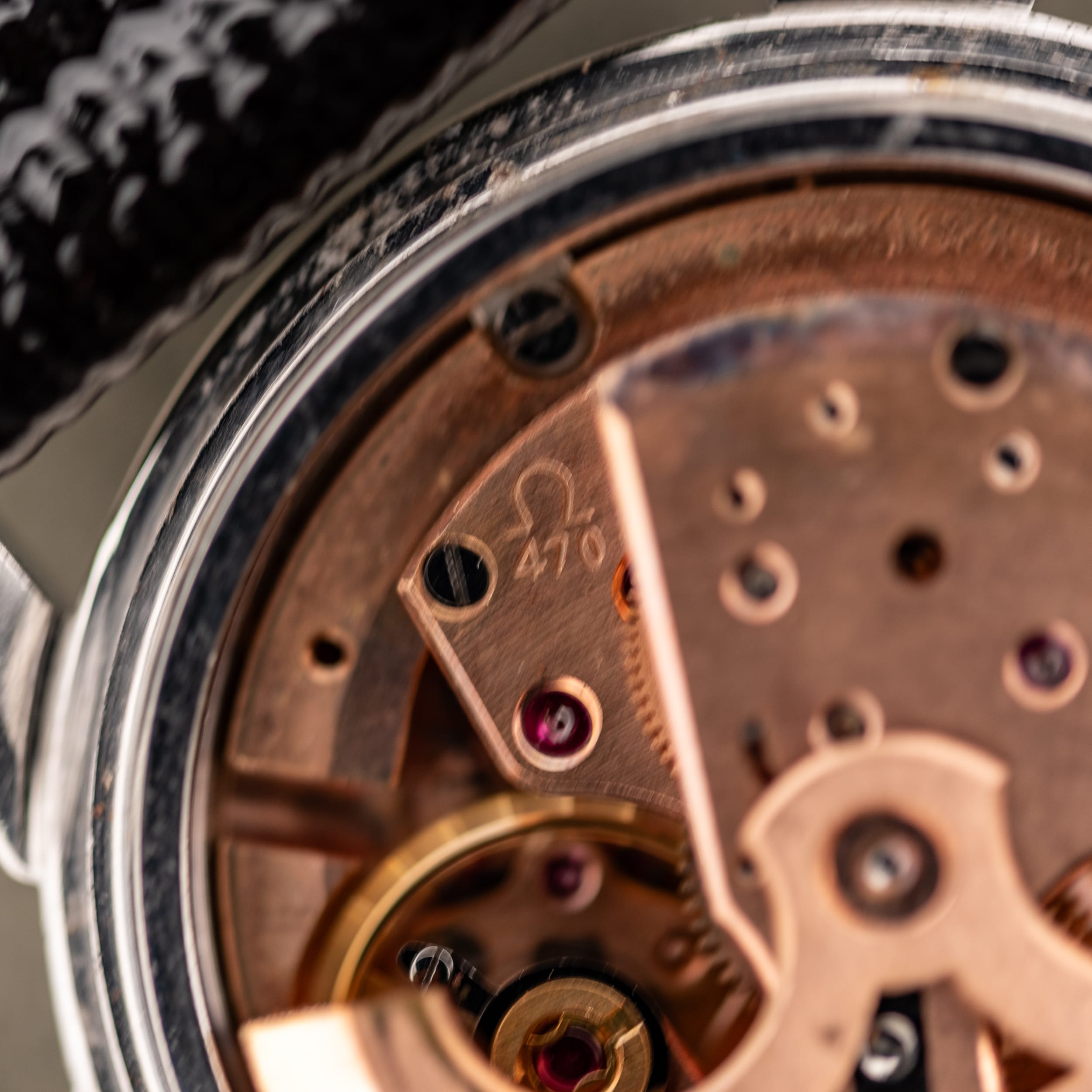
The caliber 470 is the headline mechanically. Introduced in 1955 alongside the closely related calibers 471 and 490, the 470 was Omega’s first small-diameter full-rotor automatic, replacing the long-running 28.10 mm bumper movements that had carried the brand’s automatic catalogue since the early 1940s. Where the bumpers used a half-rotor swinging through a limited arc against spring buffers, the 470 used a full-circle rotor pivoting on a central axle for far more efficient winding. The movement measures 25 mm across, runs at 19,800 vibrations per hour, and carries seventeen jewels. Our service photographs show the copper-toned bridges with the Omega symbol and the caliber designation 470 stamped clearly into the top plate, the click and ratchet wheel finished in matching rose, and the rotor still carrying its factory finish. To us, the caliber 470 is the movement that quietly bridged Omega’s prewar automatic identity and the chronometer-rated 5XX generation that followed.
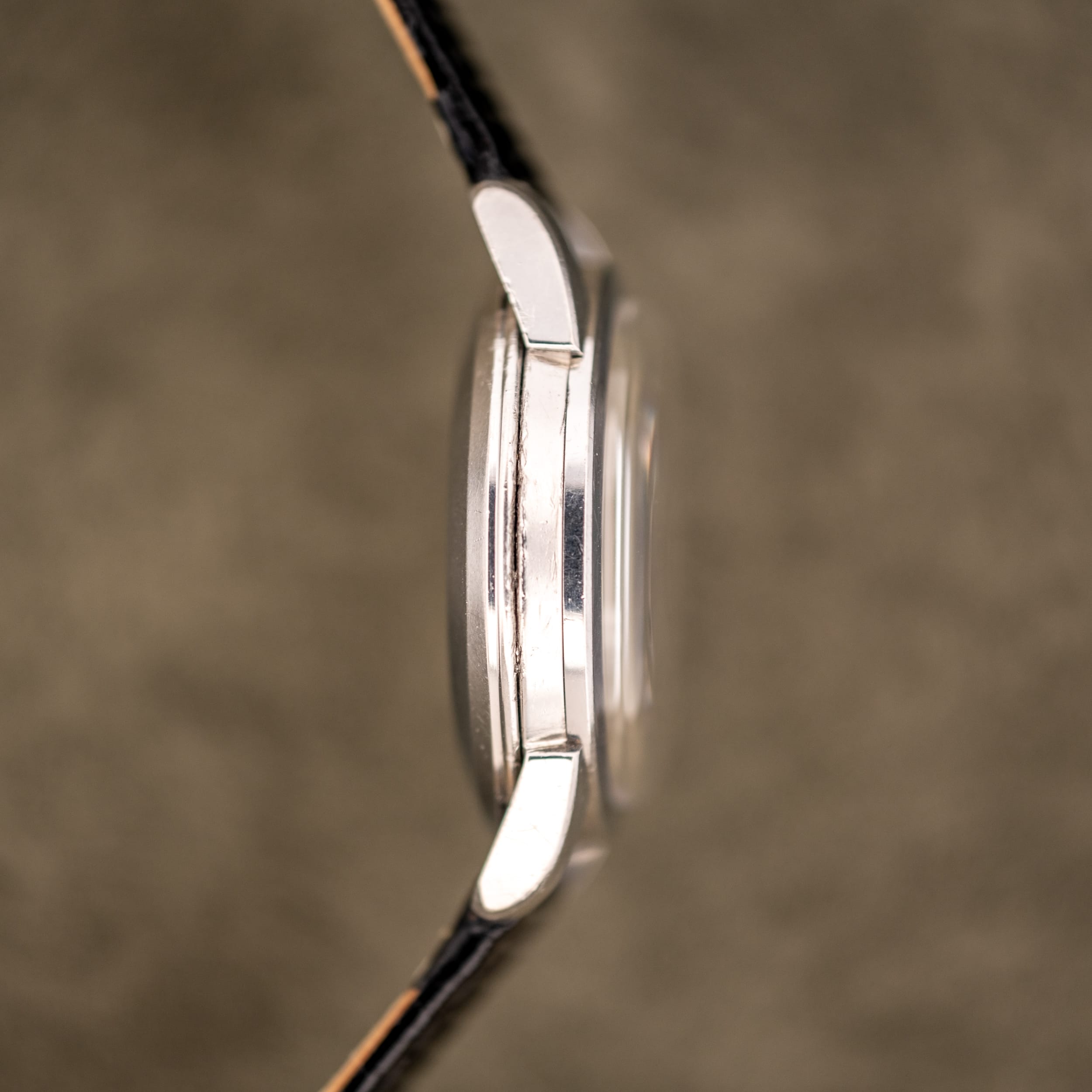
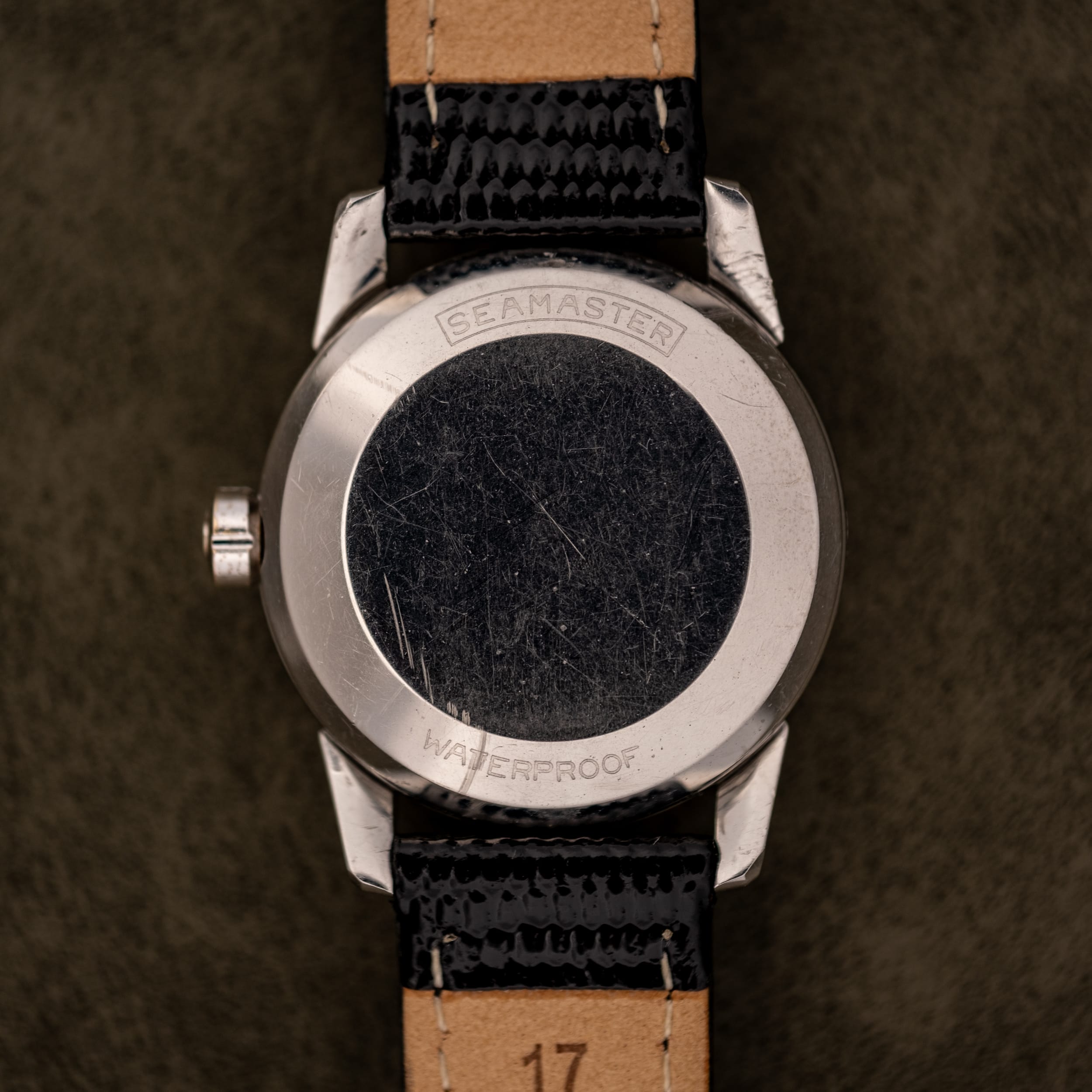
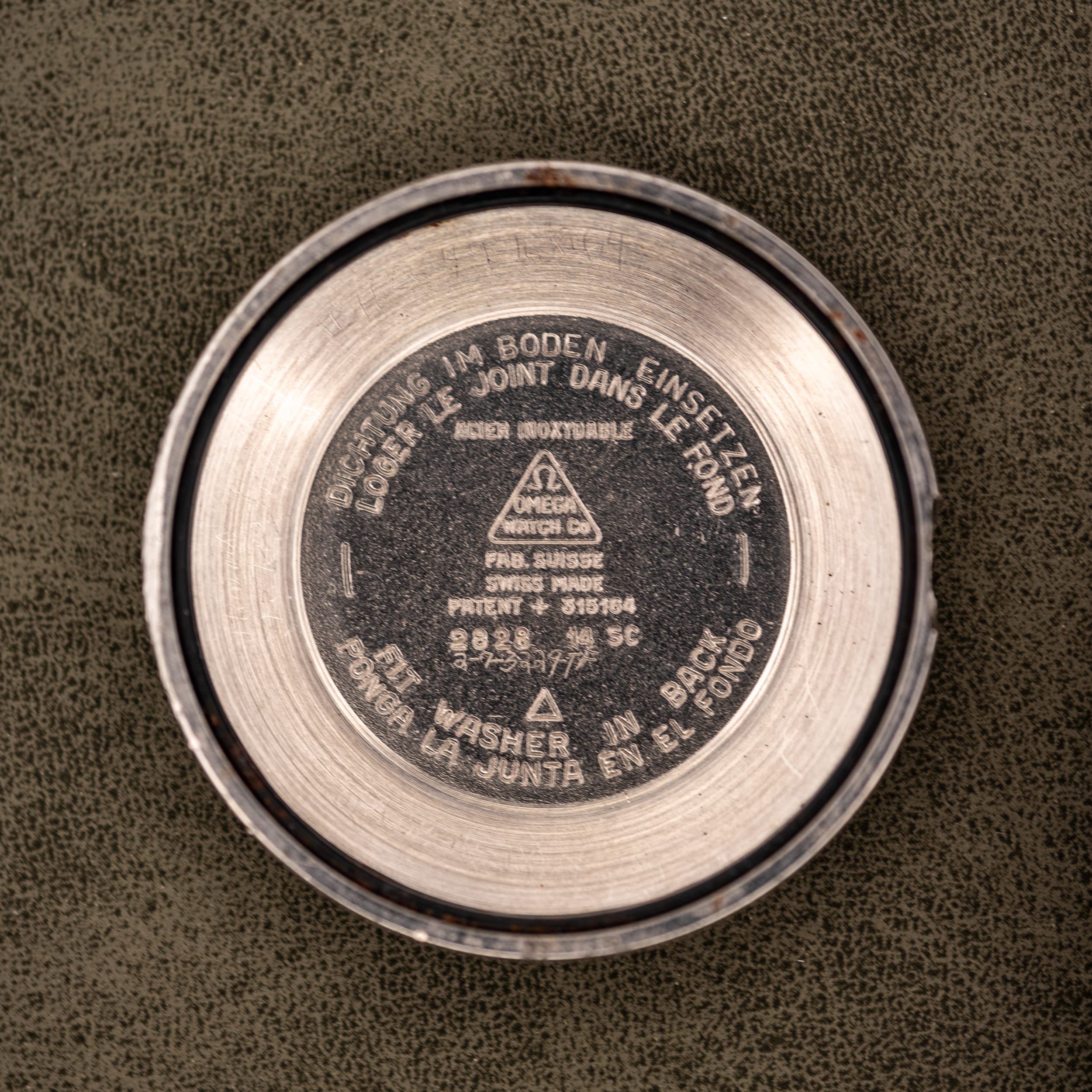
The case is a stainless steel Seamaster in the cushioned, faceted-lug configuration that defines the 2828 family, the lugs short and angular with cleanly polished upper surfaces transitioning into the case sides. The case measures 32mm across with a 39.5mm lug-to-lug span and a 17mm lug width, the kind of mid-century dress proportions that wear smaller than a modern Seamaster but exactly right for the original brief. The bezel is smooth and unsigned, and the case sides retain their polished finish with honest hairlines from sixty years of wear. The outer caseback is the screw-down style with SEAMASTER stamped along the upper edge and WATERPROOF along the lower, framing a recessed central disc that has darkened across decades into a near-black field, with honest scratching scattered across the disc and outer ring exactly as a watch carried and worn for a lifetime should look. Open the back and the inner caseback carries the full original stampings: DICHTUNG IM BODEN EINSETZEN and LOSER LE JOINT DANS LE FOND along the top, ACIER INOXYDABLE beneath, the OMEGA WATCH CO triangle logo, FAB. SUISSE / SWISS MADE, PATENT 315164, the reference 2828 – 14 SC with the matching case serial below, and FIT WASHER IN BACK / PONGA LA JUNTA EN EL FONDO closing out the bottom in the multilingual style Omega used in this era.
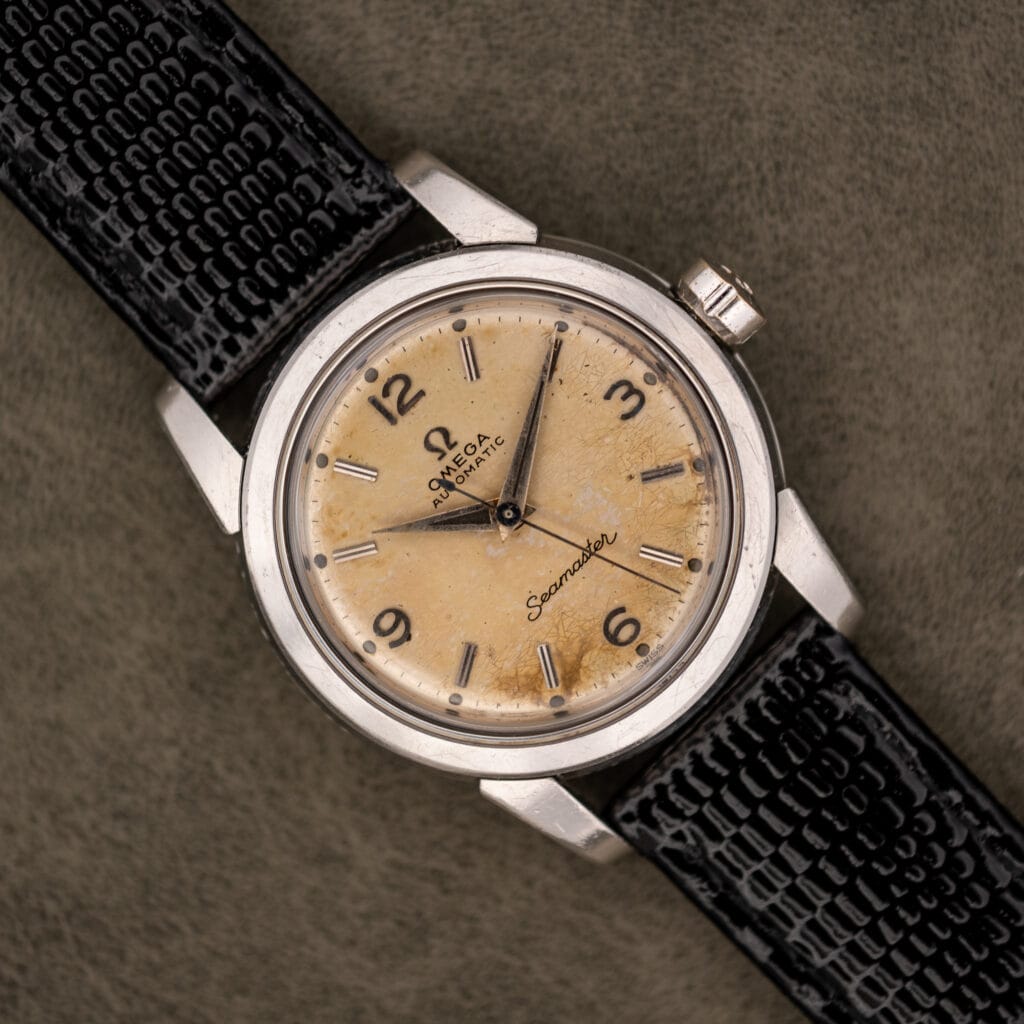
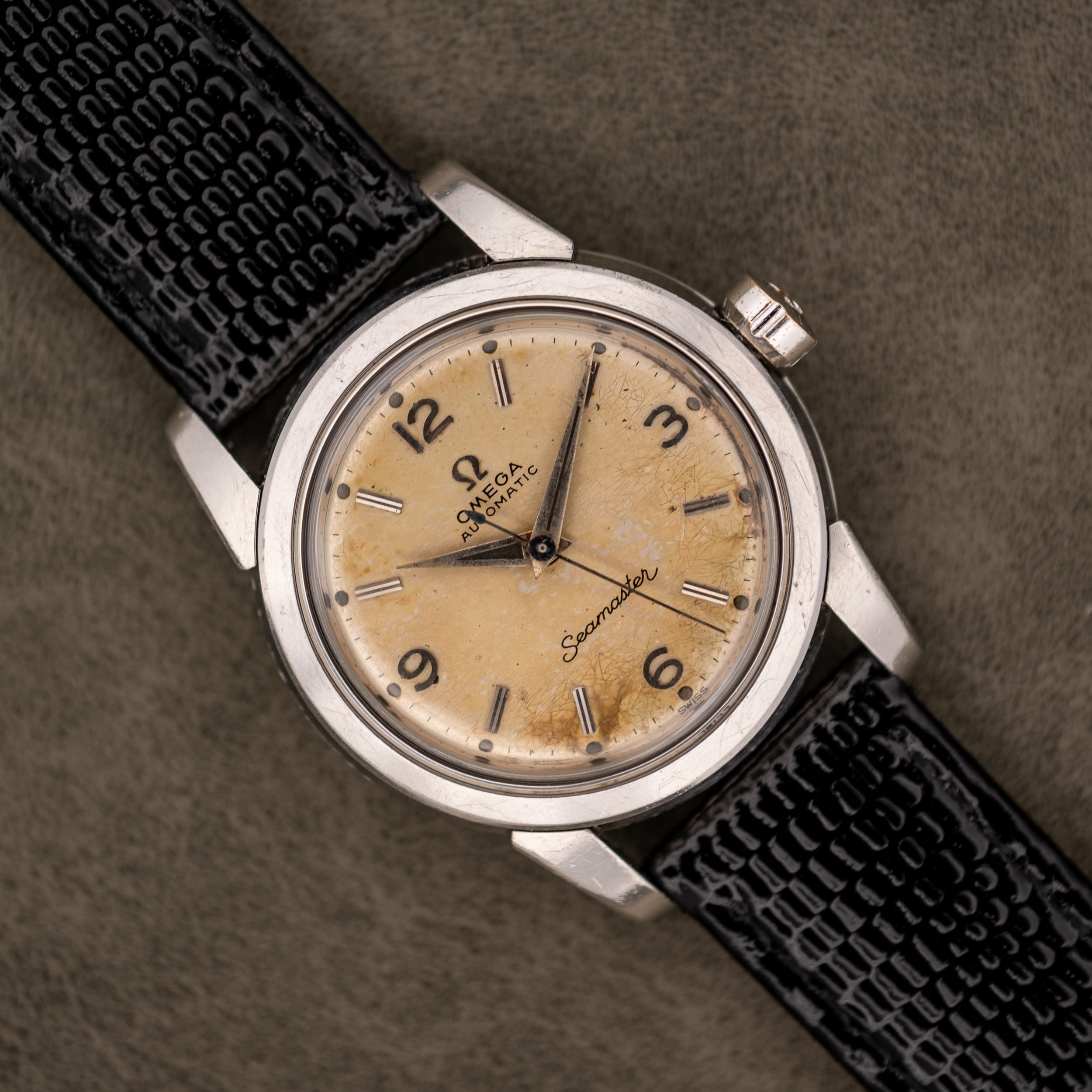
The dial is where this watch turns into something more than a base-model Seamaster. The factory original silver canvas has aged across six decades into a wonderfully uneven tropical patina, the upper half holding its cream-and-honey tonality while the lower half has deepened into a darker chocolate field that pools heavily around the six o’clock position. Original factory dial, unrestored, settled across six decades into the kind of two-tone field that develops only when the upper and lower halves of the canvas oxidize at slightly different rates. This is the original factory dial, untouched and unrestored, with every period feature reading clearly through the patina. Applied stick markers ring the dial at one, two, four, five, seven, eight, ten, and eleven, with painted Arabic numerals at twelve, three, six, and nine. The applied Omega logo sits above the printed OMEGA AUTOMATIC text, and the cursive Seamaster script prints along the lower half. The lower edge carries the printed SWISS designation only, with no T-bracket tritium notation, exactly as it should on a pre-tritium dial of this era. Refinished dials kill the value of any vintage Omega, and the factory dial is the single most important originality factor on any Seamaster this old. The dauphine hands are the original factory pair, the slim baton minute and lance-tipped hour both retaining their period steel finish with no replacement and no reluming. To us, an honestly tropical Seamaster dial in unrestored condition is the kind of accident of chemistry and time that simply cannot be designed.
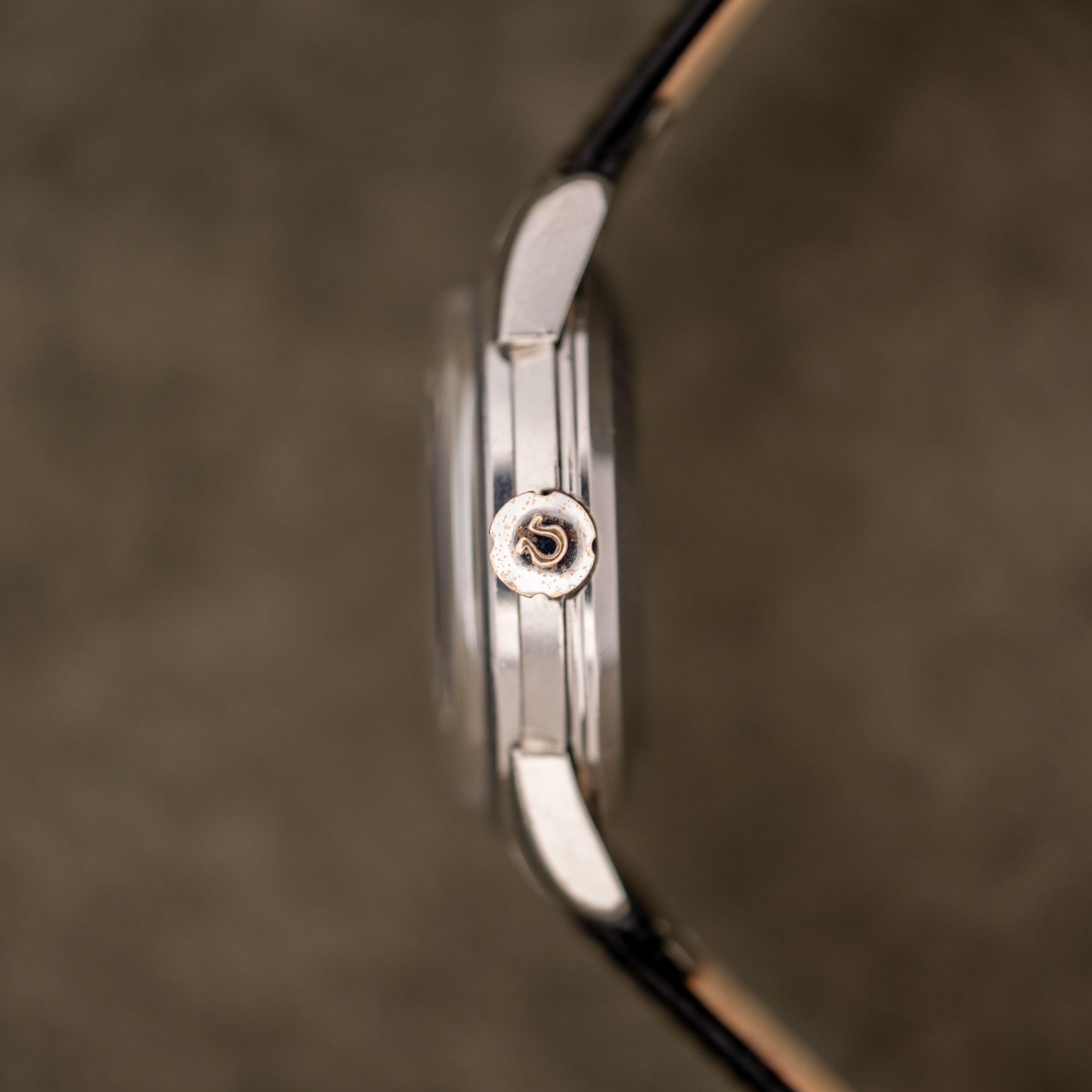
The crown is an Omega-signed component with a period logo that has aged into a softly spotted finish, and operates with the positive engagement a properly maintained caliber 470 should give. The acrylic crystal sits proud above the dial with the gentle doming that helps the patina play across its surface in light.
We have paired the watch with one of our black lizard-grain leather straps and an OTTUHR signed buckle. The deep black grain reads as a deliberate counterweight to the warm honey field of the dial, the texture giving the package the slightly formal weight that suits the late-1950s dress Seamaster character.
Serviced in-house at OTTUHR and backed by our 2-year mechanical warranty, this is the kind of late-1950s Omega Seamaster we get genuinely excited about. Factory original dial, factory hands, signed crown, intact case stampings, and the caliber 470 that quietly started the modern Omega automatic story. For the collector who values originality over polish, who reads patinated dials as character rather than damage, and who wants a piece of late-1950s Swiss watchmaking with a real story attached, this is exactly the kind of watch we love bringing in. To us, this is exactly how a 2828-14 SC should come in.