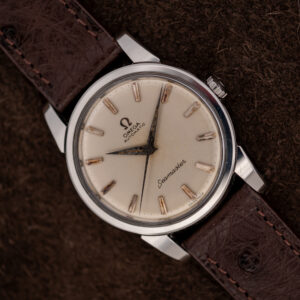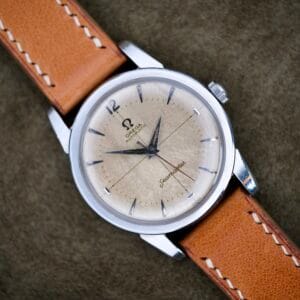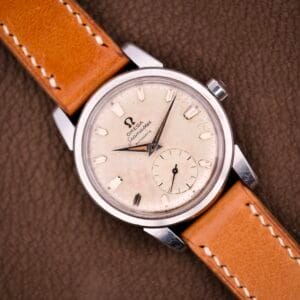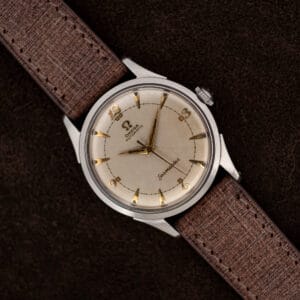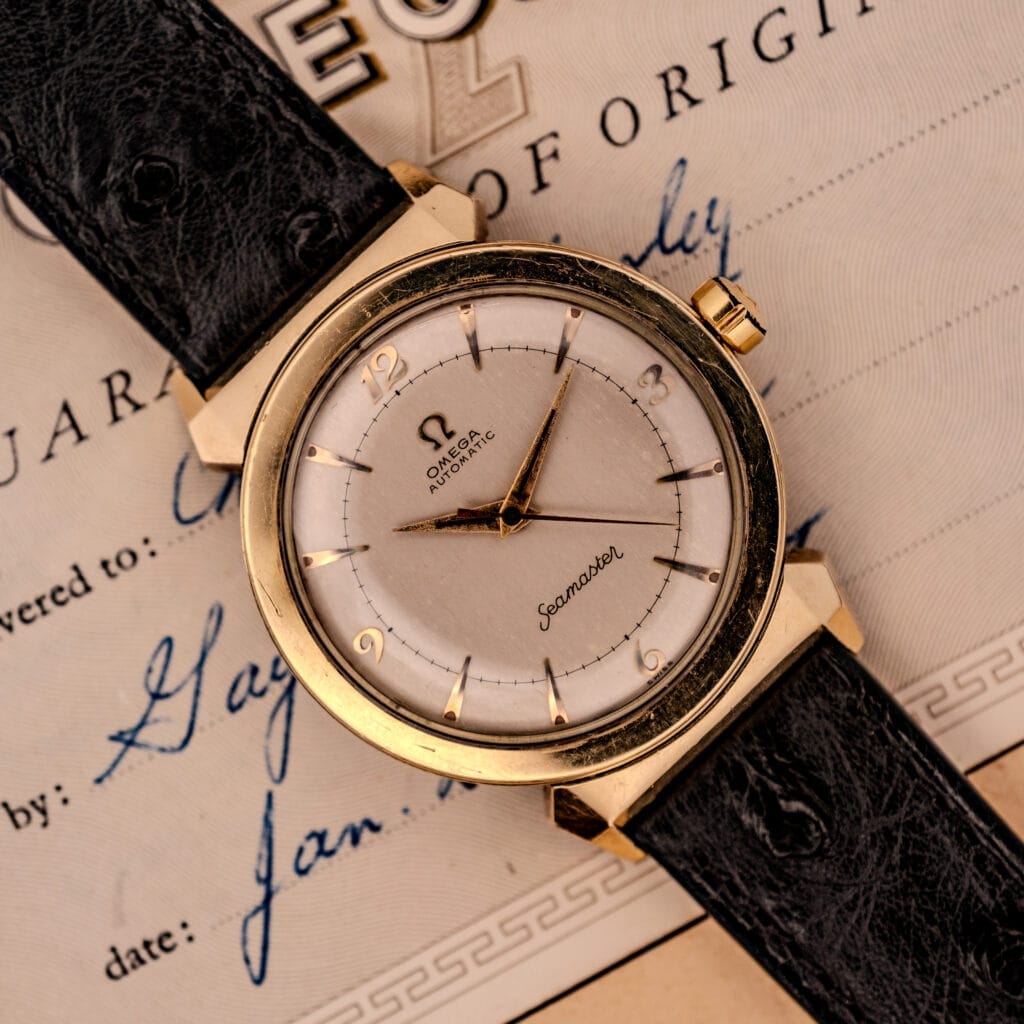
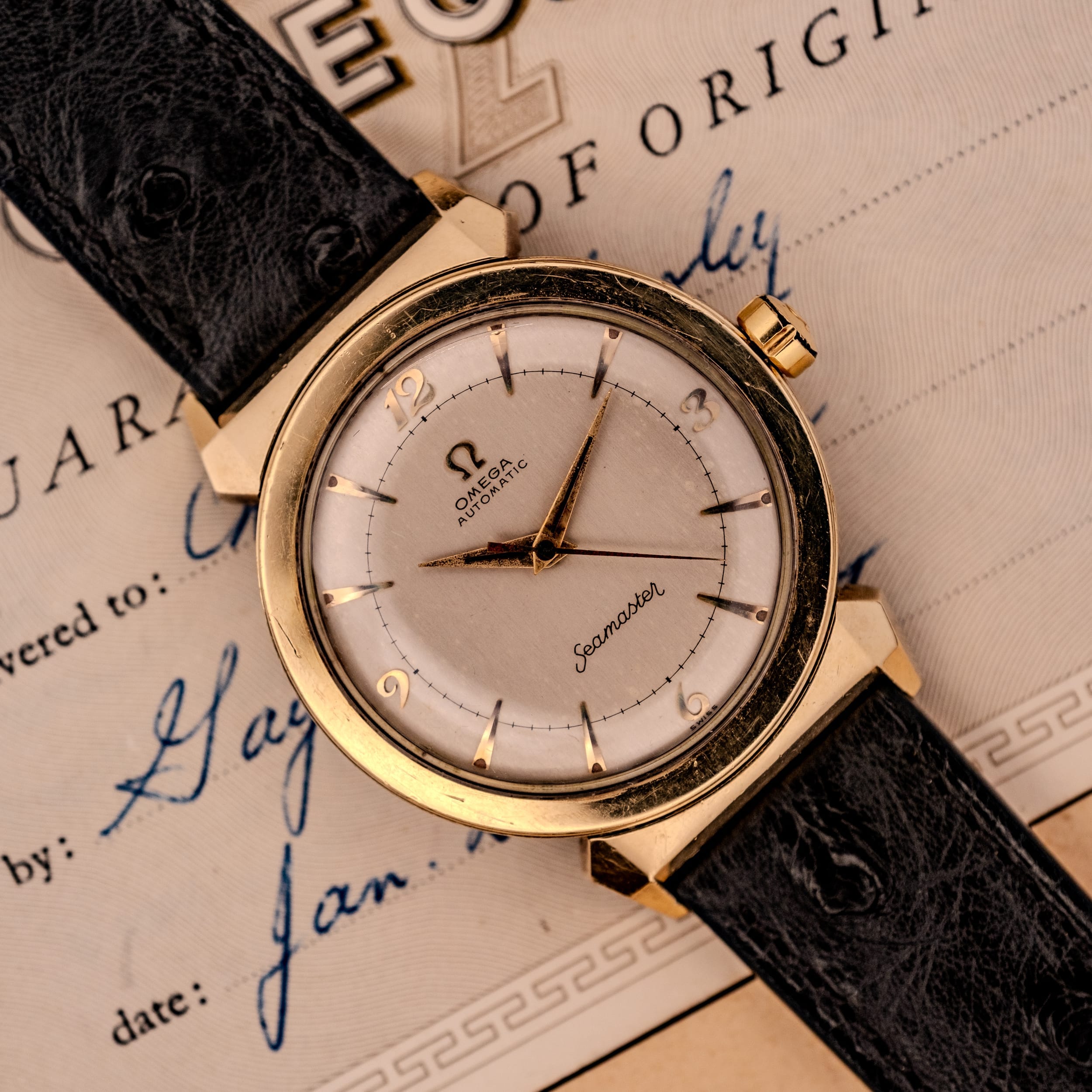
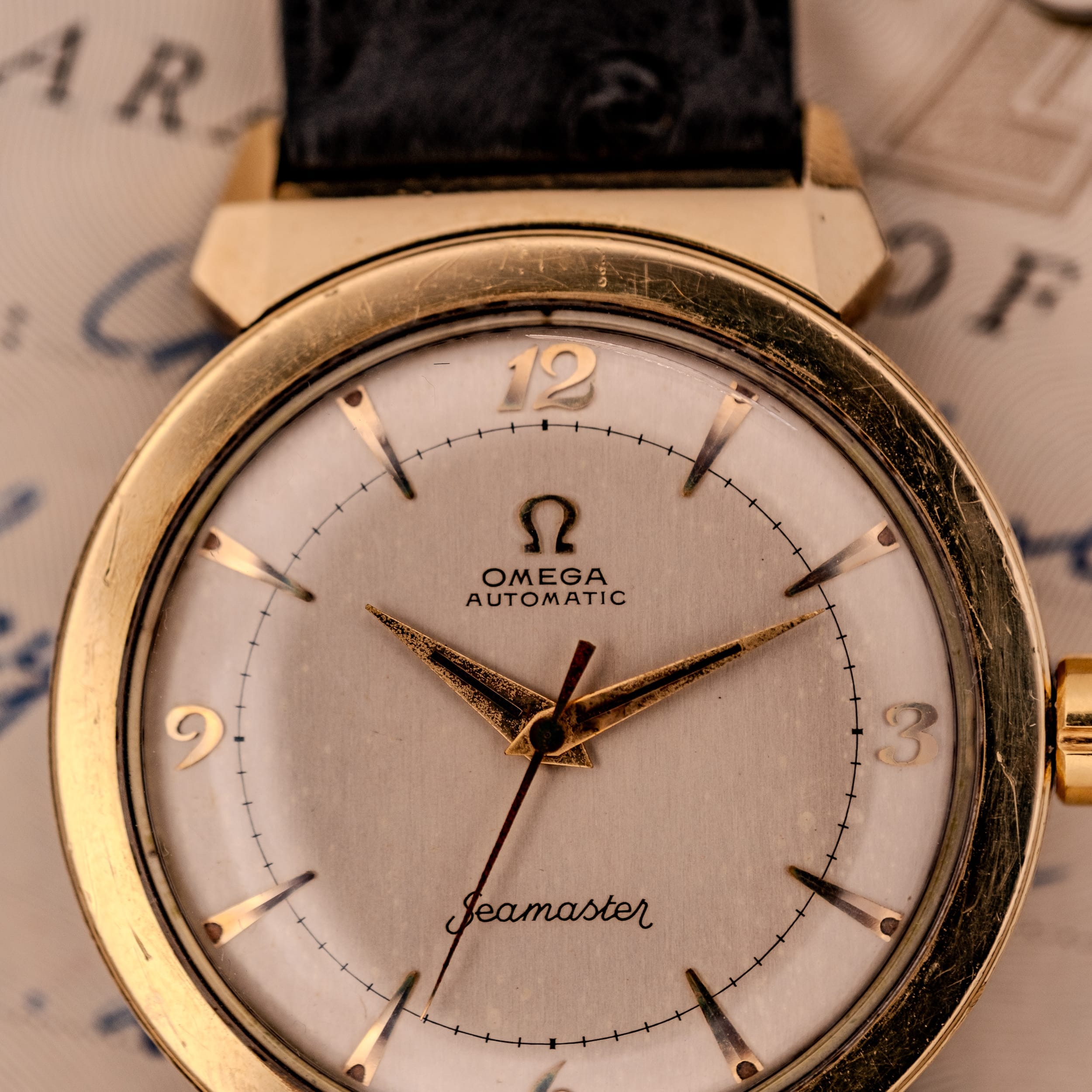
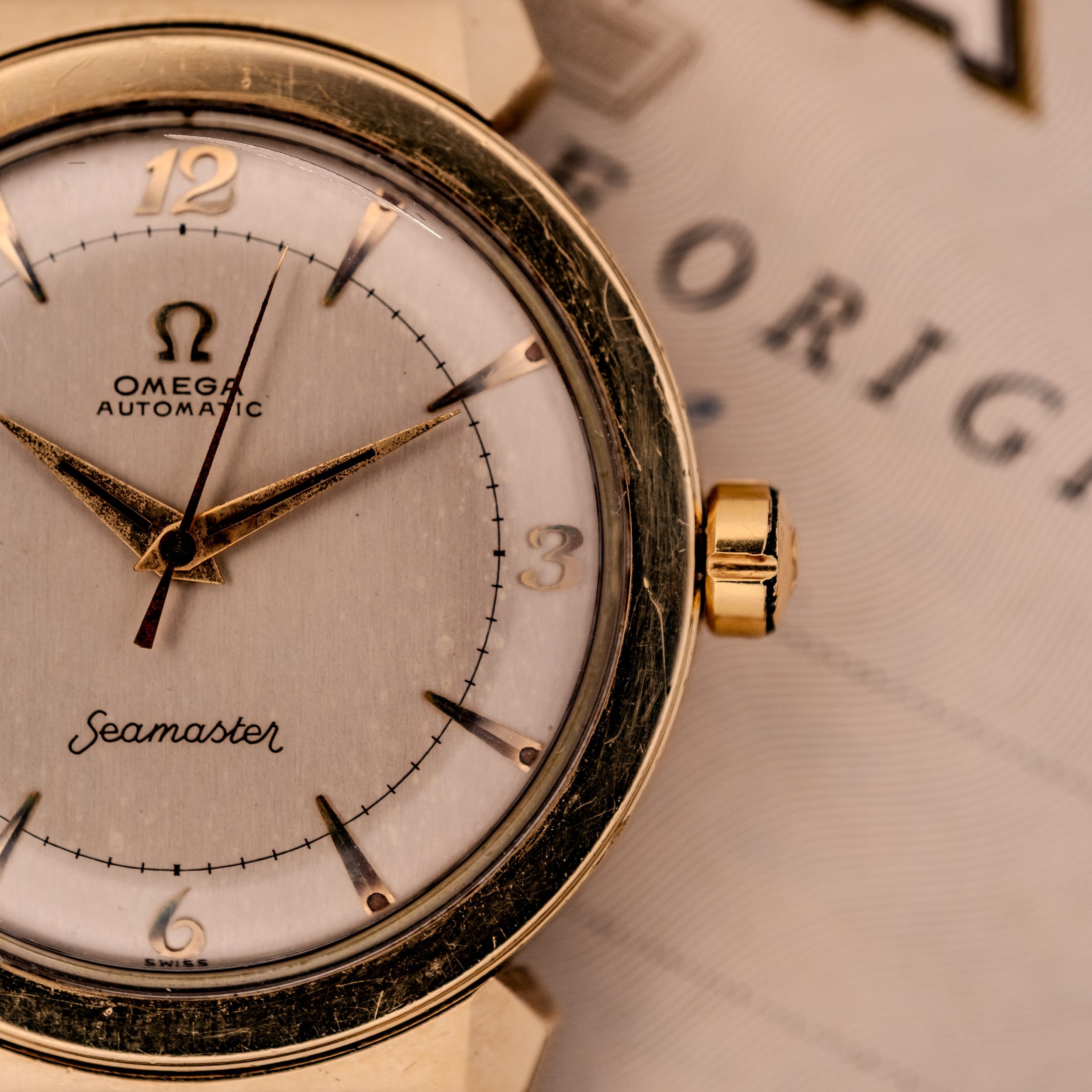
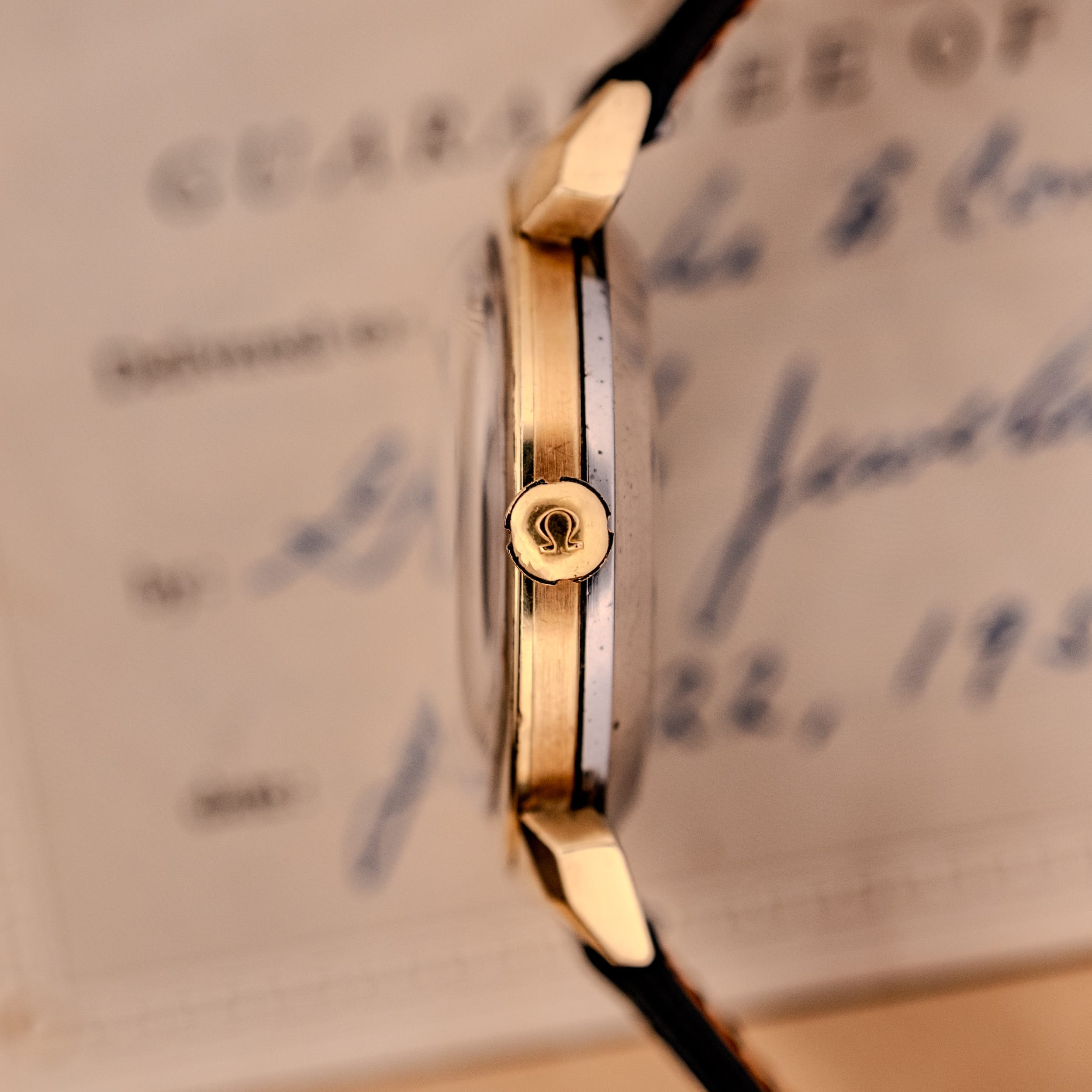
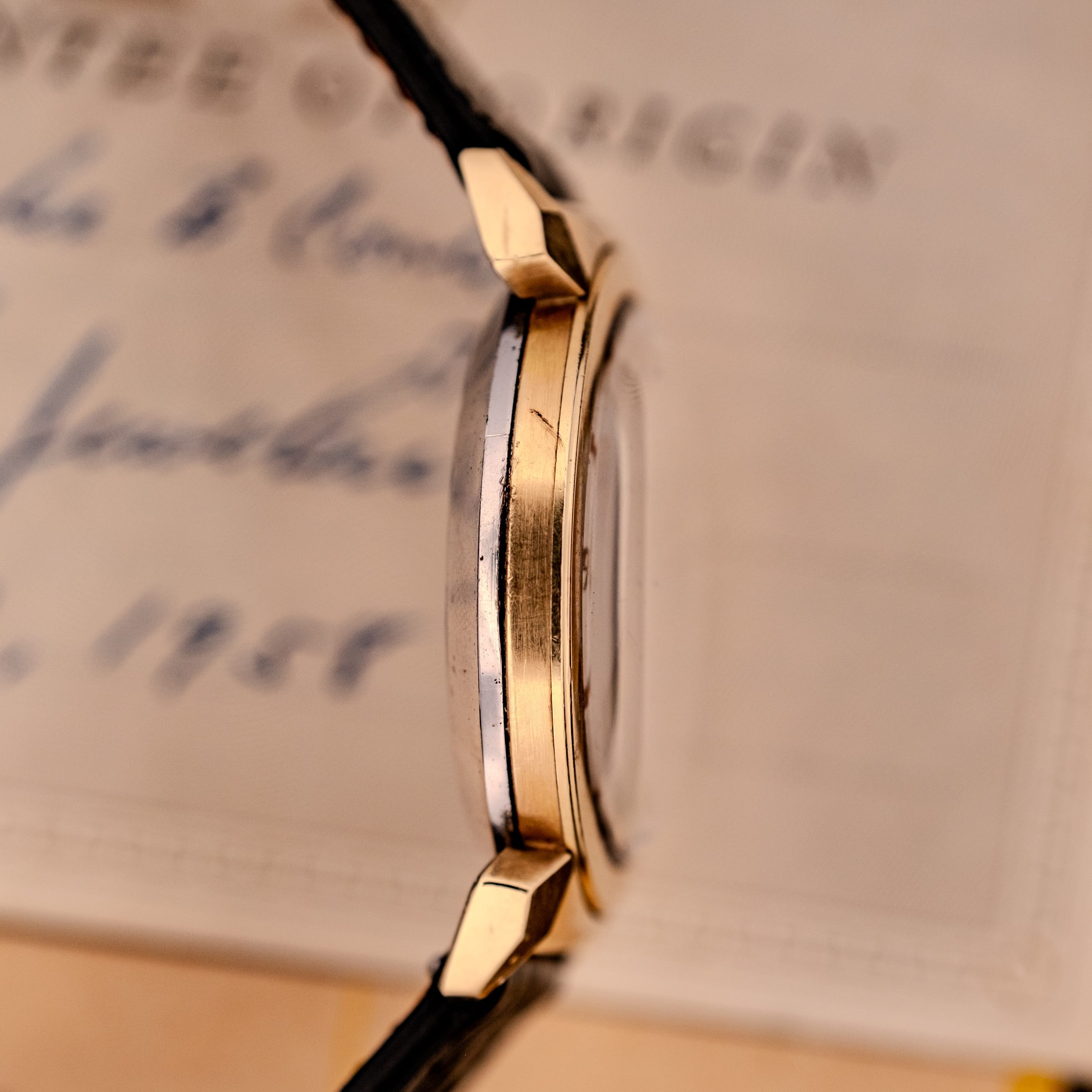
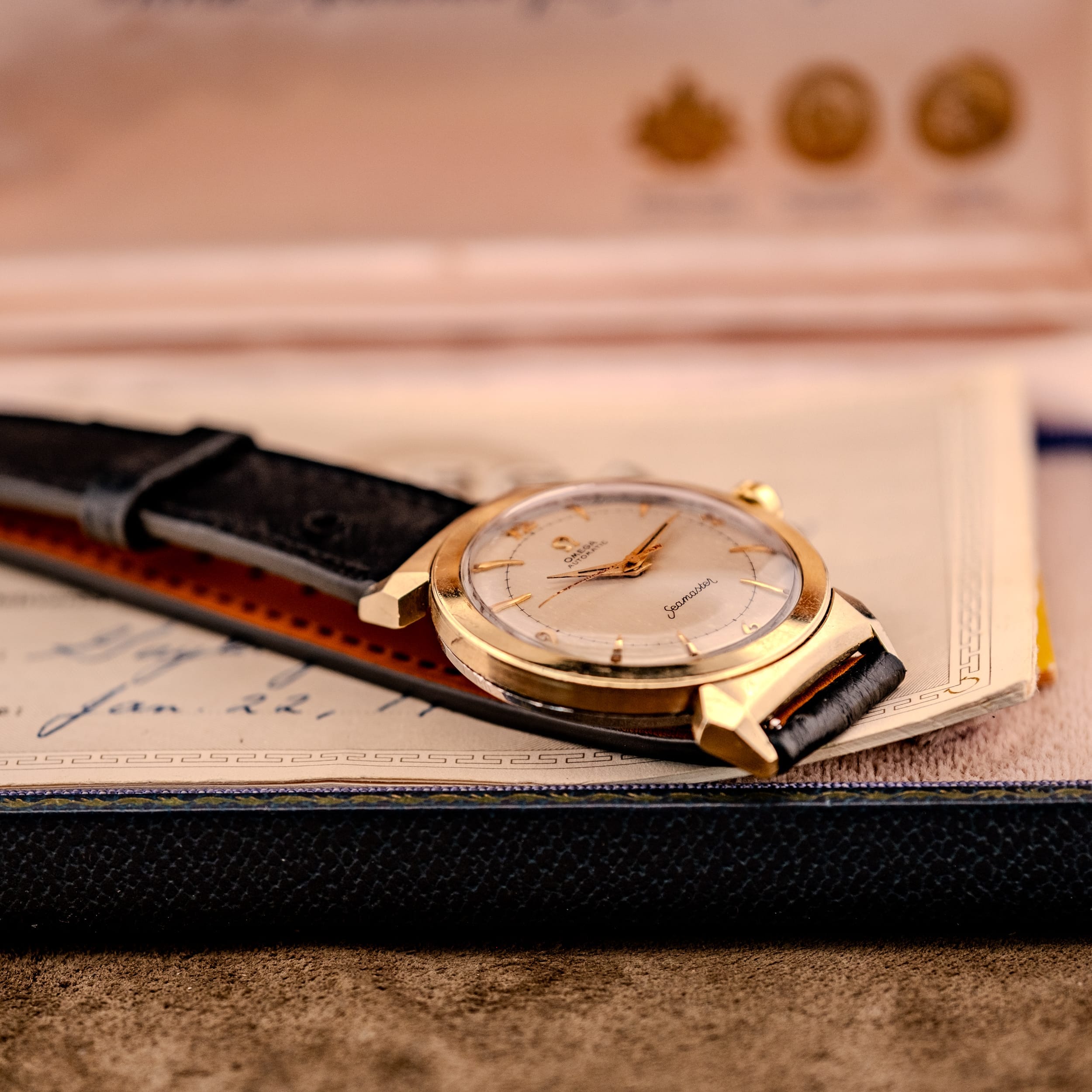
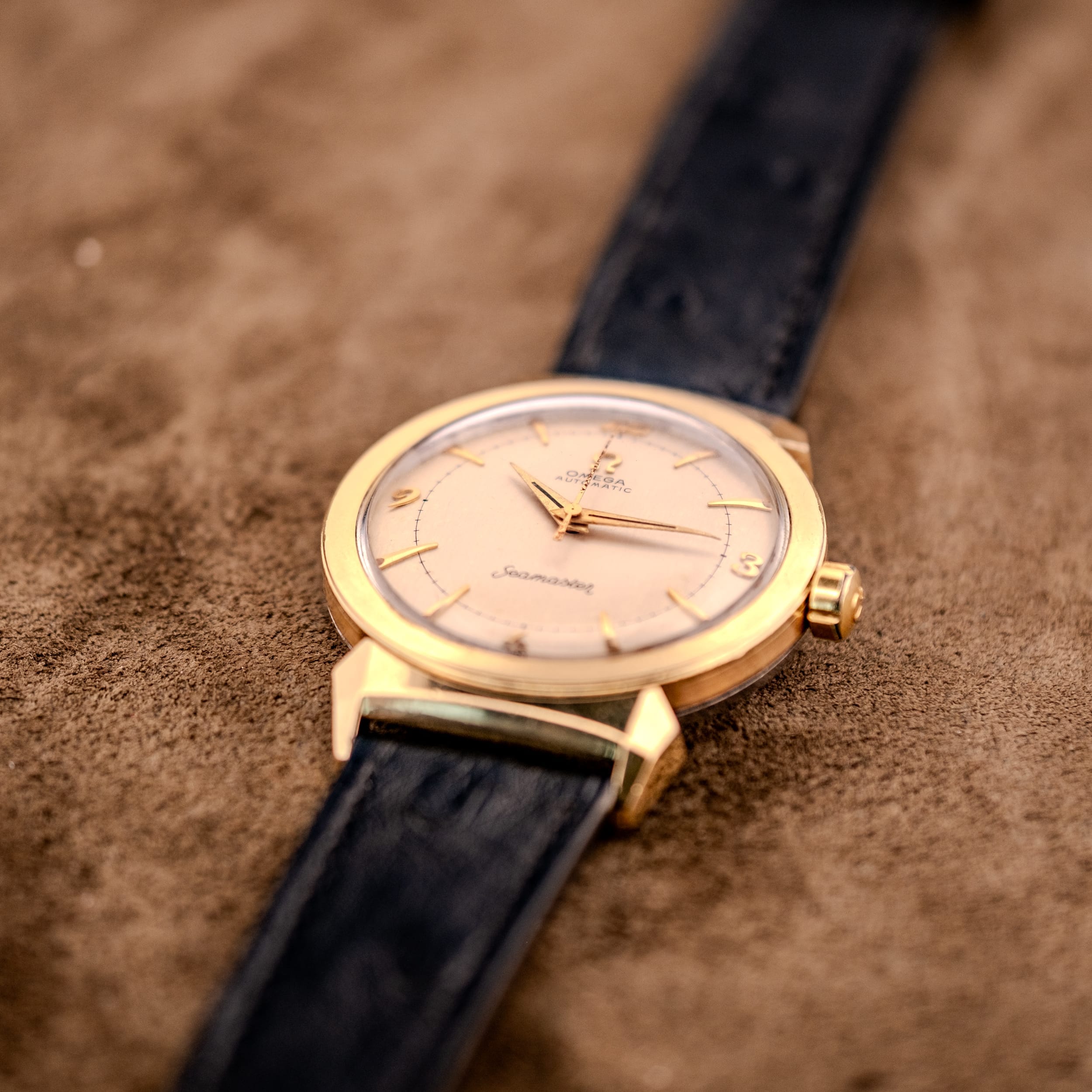
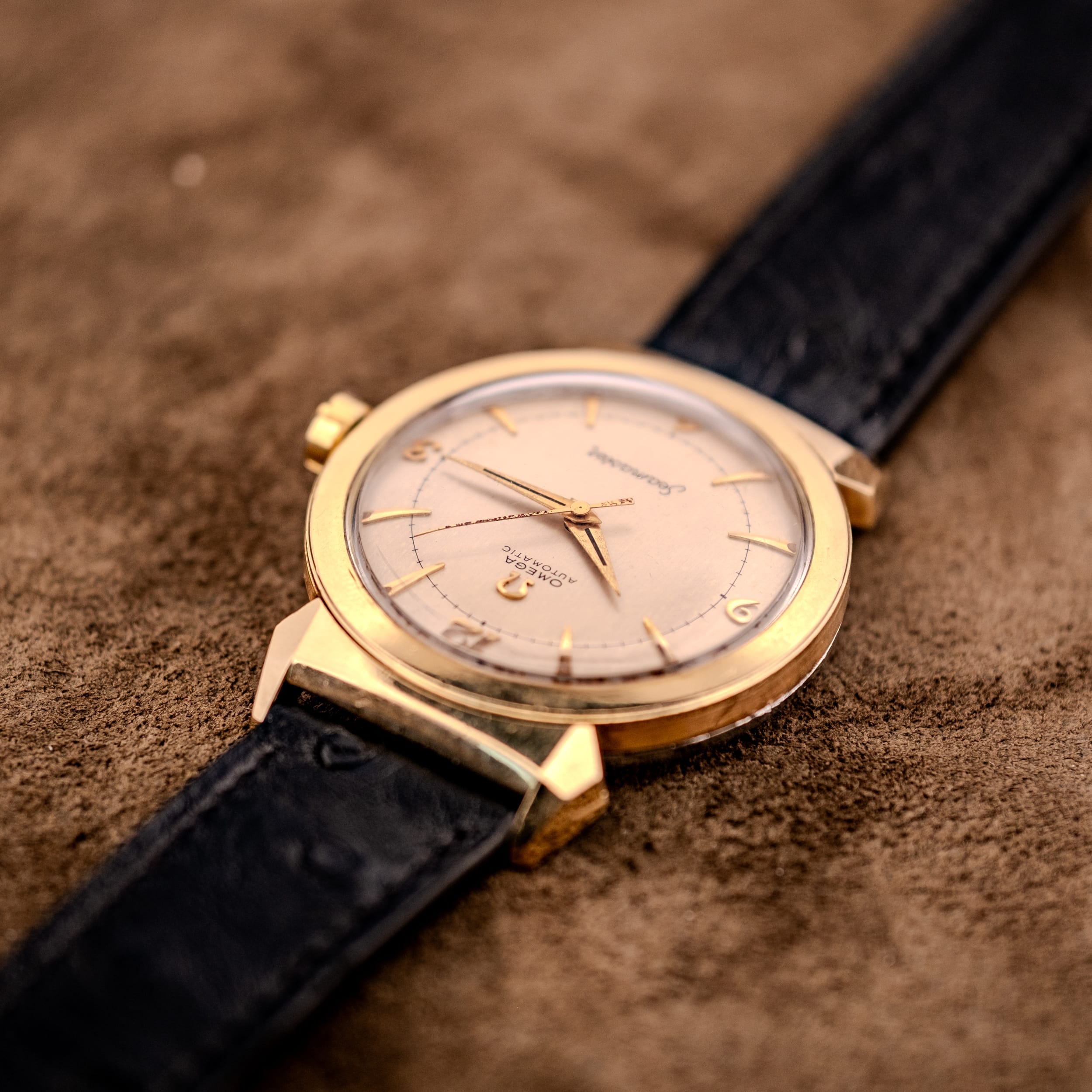
The bull horn lugs are the part of this watch we want to talk about first. They are not a flourish or a model-specific quirk so much as a small piece of case geometry that fundamentally changes how the Seamaster wears on the wrist, and on this Omega Seamaster Automatic the lug treatment is what carries the visual identity. The lugs flare outward from the mid-case at an angled, faceted shoulder and finish in a sharp downturned point, and viewed from above they read more like the horns of a steer than the conventional curved or straight lug forms that defined most mid-1950s dress watches. In our opinion, that detail is what makes Reference 14350-2 SC worth holding onto when the more common bombe-lug Seamasters of the same period are easy to find at any vintage dealer’s case.
Omega launched the Seamaster line in 1948 to mark the company’s centenary, drawing the case-sealing engineering directly from the waterproof military pieces Omega had supplied to the British Royal Navy across the early 1940s. The Seamaster’s signature contribution to mid-century horology was the O-ring case gasket, borrowed from submarine engineering, which sealed the case against temperature swings and pressure changes that the lead and shellac gaskets used elsewhere in Switzerland could not match. By the time Reference 14350-2 SC reached the catalog in the mid-1950s, the Seamaster had matured into a full dress-and-sport range, and the gold-capped variants like this one sat at the elegant end of the line where the waterproofing was understood rather than advertised.
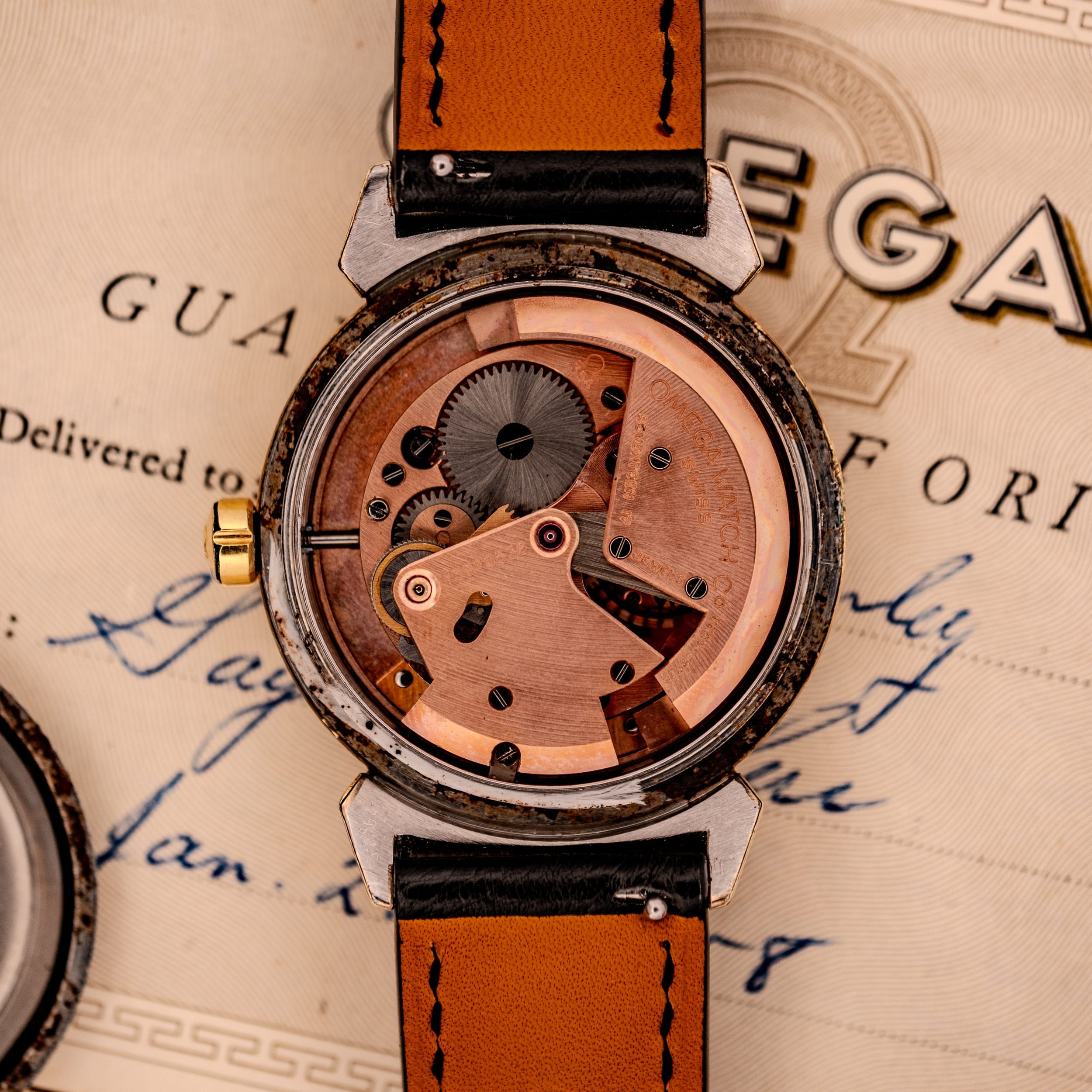
The Caliber 354 inside this Omega Seamaster Automatic is the part of the story that earns the closer reading. The 354 is a bumper automatic, meaning the rotor does not spin freely through 360 degrees but rocks back and forth through a limited arc, bouncing off sprung buffers at each end of its travel and transmitting a soft, tactile thud through the case as it reverses. The 354 was the movement Omega chose to power the very first Constellation in 1952, which places this caliber at the absolute top of Omega’s automatic production for the period, and it was also one of the last bumper architectures Omega put into series production before the brand transitioned its automatic line to the full-rotor 470 series later in the decade. The 17-jewel layout, the index regulator with micrometer fine-adjust screw, and the copper-toned bridge finishing visible through the open back at service make this a movement that vintage Omega specialists still seek out specifically. The bumper feel is something you wear, not something you read about, and there is a generation of collectors who will always prefer it.
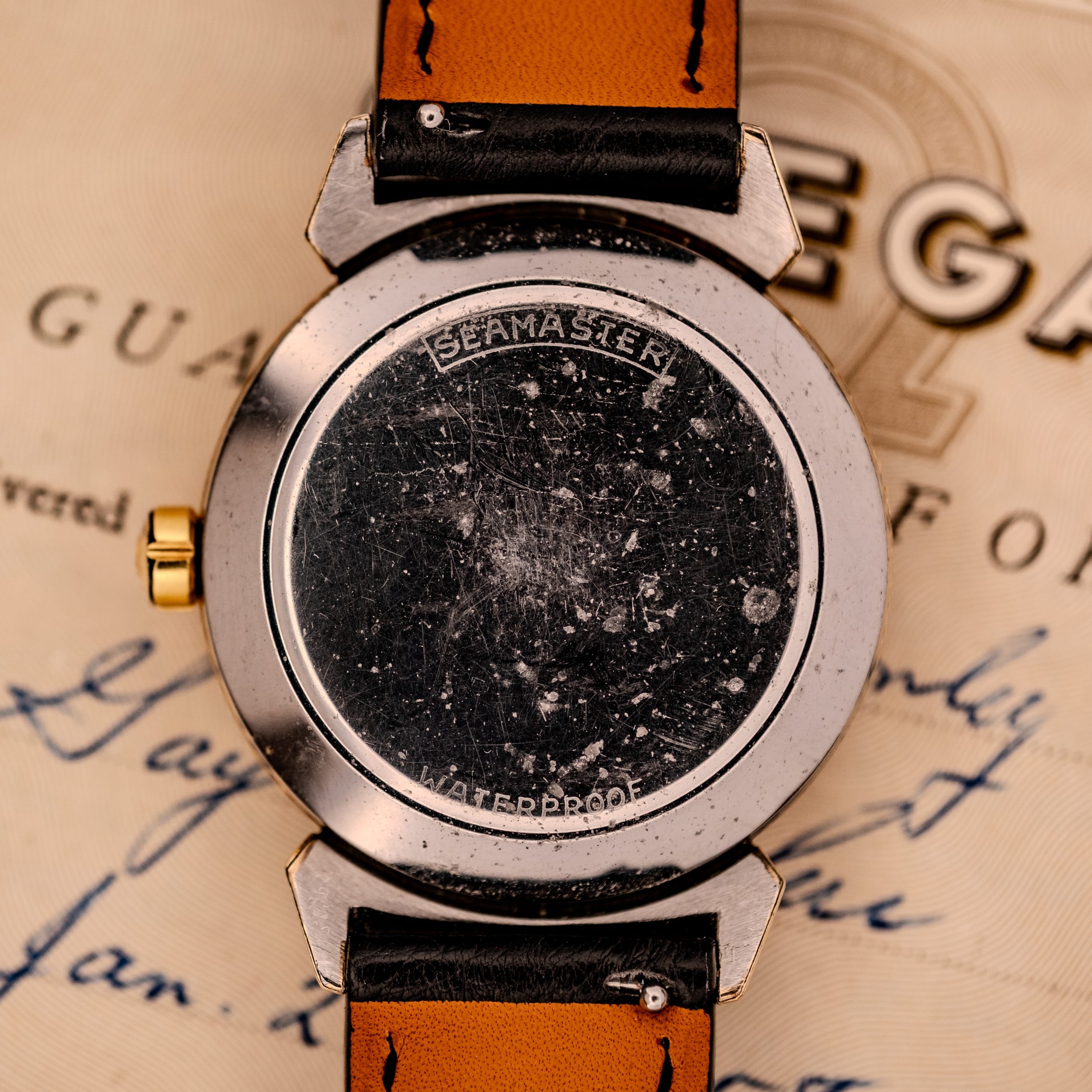
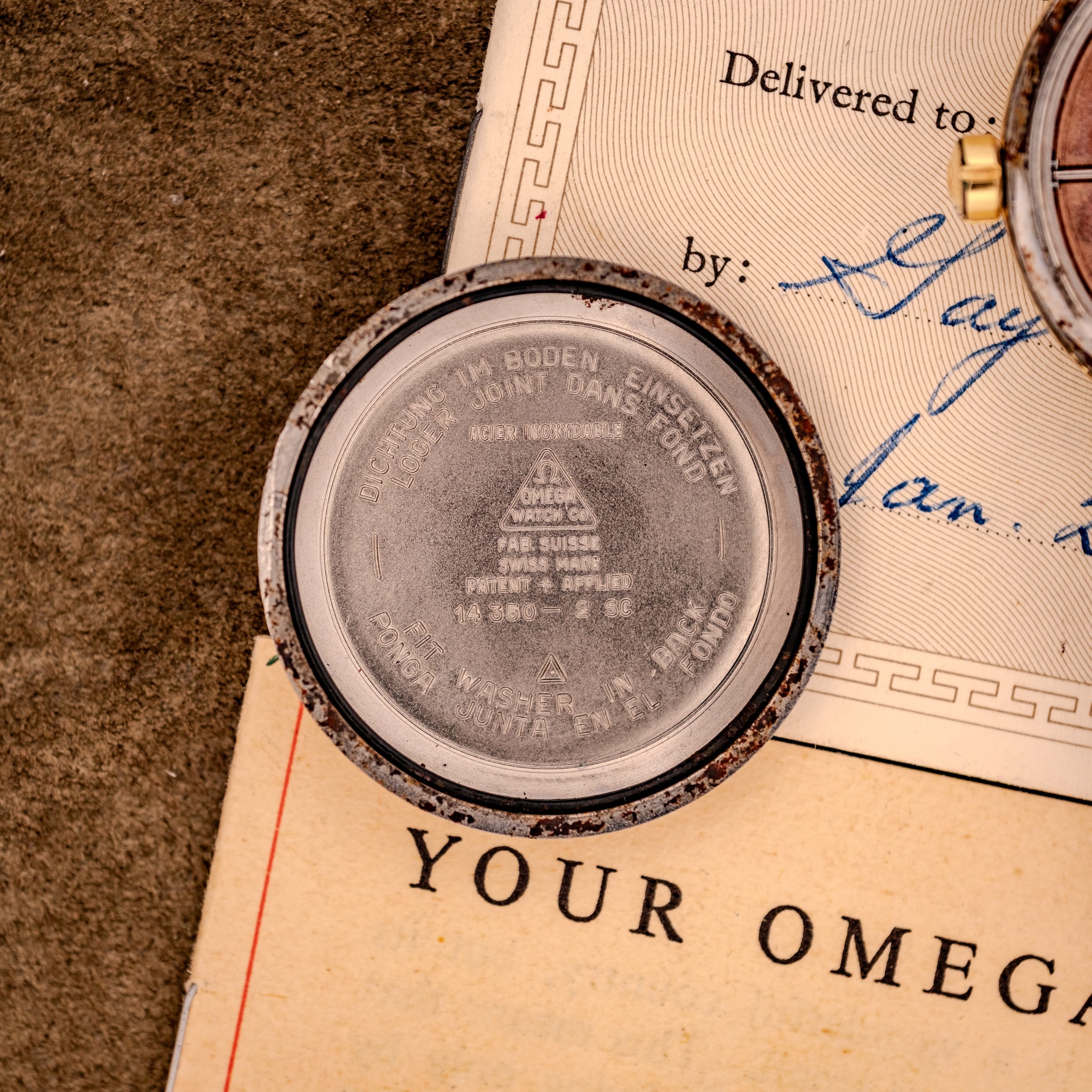
The case is 14k gold-capped over a stainless steel core, and the construction distinction matters here. Gold-capping is a substantial bonded layer of solid gold mechanically fused to a steel substructure, not the thin electrodeposit of a plated case, and the result is a warmth and depth of gold tone that ages beautifully across decades of wear. The side profile of this case (visible in the dedicated profile shots) shows the gold band running across the lugs and mid-case with the steel core just kissing through at the back edge where the construction transitions to the screw-in stainless caseback. Case width measures 34mm across the bezel, the lug width is 18mm, and the bull horn lugs give the watch a lug-to-lug span that wears meaningfully more present than the modest diameter suggests. The outer caseback is steel and stamped “SEAMASTER” on the upper arc with “WATERPROOF” on the lower arc, and it carries the honest circular tool wear and surface marks of a watch that was opened for service across multiple decades. The inner caseback is more talkative: the triangle case-maker mark with “Ω OMEGA WATCH Co” sits above “FAB. SUISSE, SWISS MADE, PATENT APPLIED” with the reference stamped as “14 350 – 2 SC” below, ringed by the multilingual “DICHTUNG IM BODEN EINSETZEN / PRESS A JOINT DANS FOND / POSER JUNTA EN EL FONDO” instruction for replacing the case gasket at service.
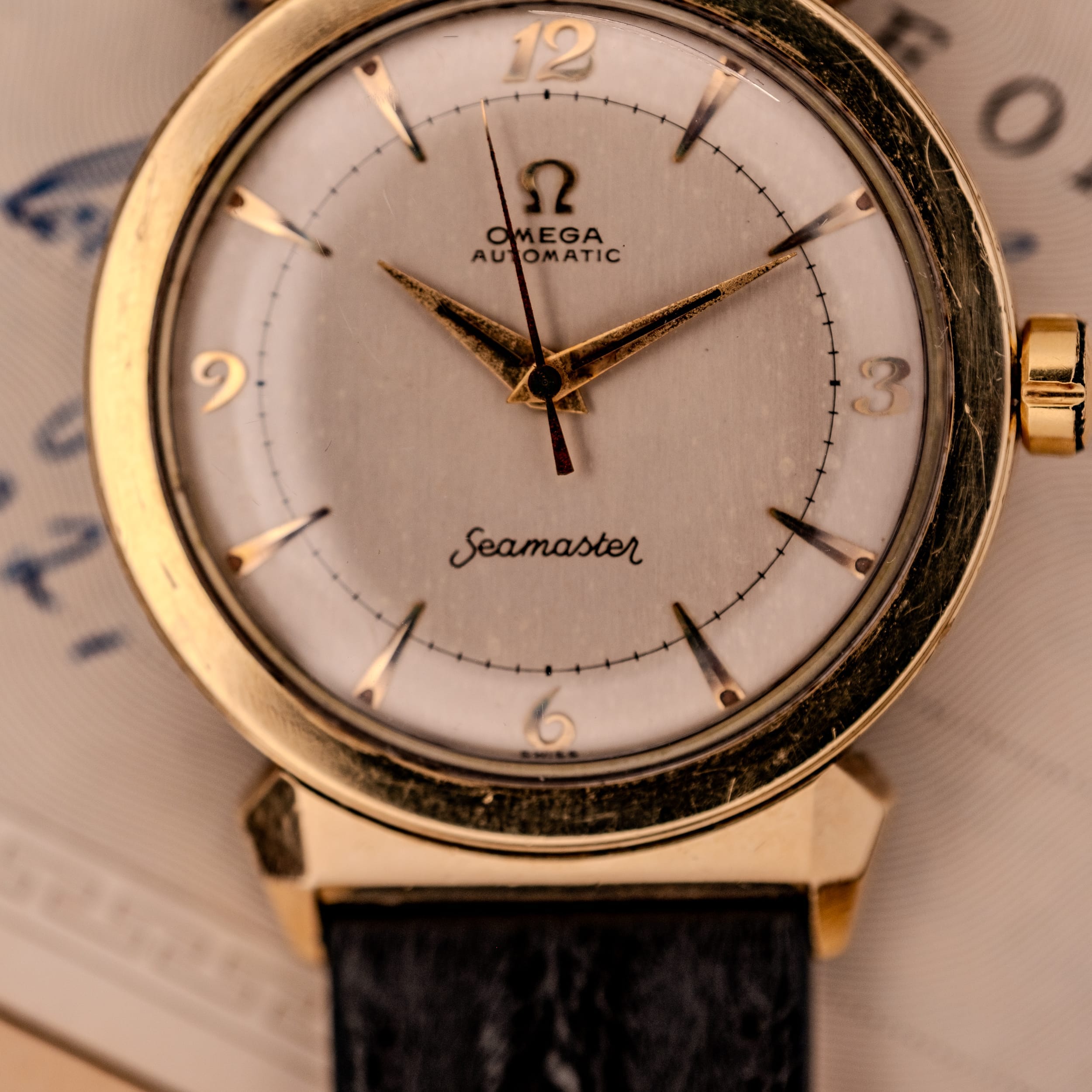
The dial has aged into the kind of soft, warm silver tone we look for on a fifty-year-old Seamaster. The brushed silver surface carries a gentle creamy warmth that develops only with time, and a light scatter of freckling along the upper edge near twelve hints at the kind of honest aging that confirms the dial is original rather than refinished. Applied gold faceted dart indices sit at every hour except 12, 3, 6, and 9, where applied gold Arabic numerals take their place in the classic mid-century quarter-Arabic layout that balances legibility with formality. The Omega Ω logo and “OMEGA AUTOMATIC” wordmark print crisply at twelve, the cursive “Seamaster” script sits at six above the 6 numeral, and a tiny “SWISS” prints at the very bottom of the dial below the chapter ring. The gold-toned dauphine hour and minute hands carry the faceted central ridge that catches light against the dial, and a slim gold sweep seconds hand finishes the visual stack. There is no lume on this dial and there should not be, as this is a dress execution where the cleaner uncluttered chapter is the point.
We pair this Omega Seamaster Automatic on an 18mm black ostrich strap with the characteristic quill pattern that gives the leather its grain, finished on a steel buckle. The black ostrich plays cleanly against the warm gold case without competing with the silver dial, and the texture keeps the wrist presentation interesting against a case that is already doing most of the visual work. The strap is sized to a 8.5-inch maximum wrist and can be re-spec’d at the buyer’s request if a different leather pairing reads better for the intended rotation.
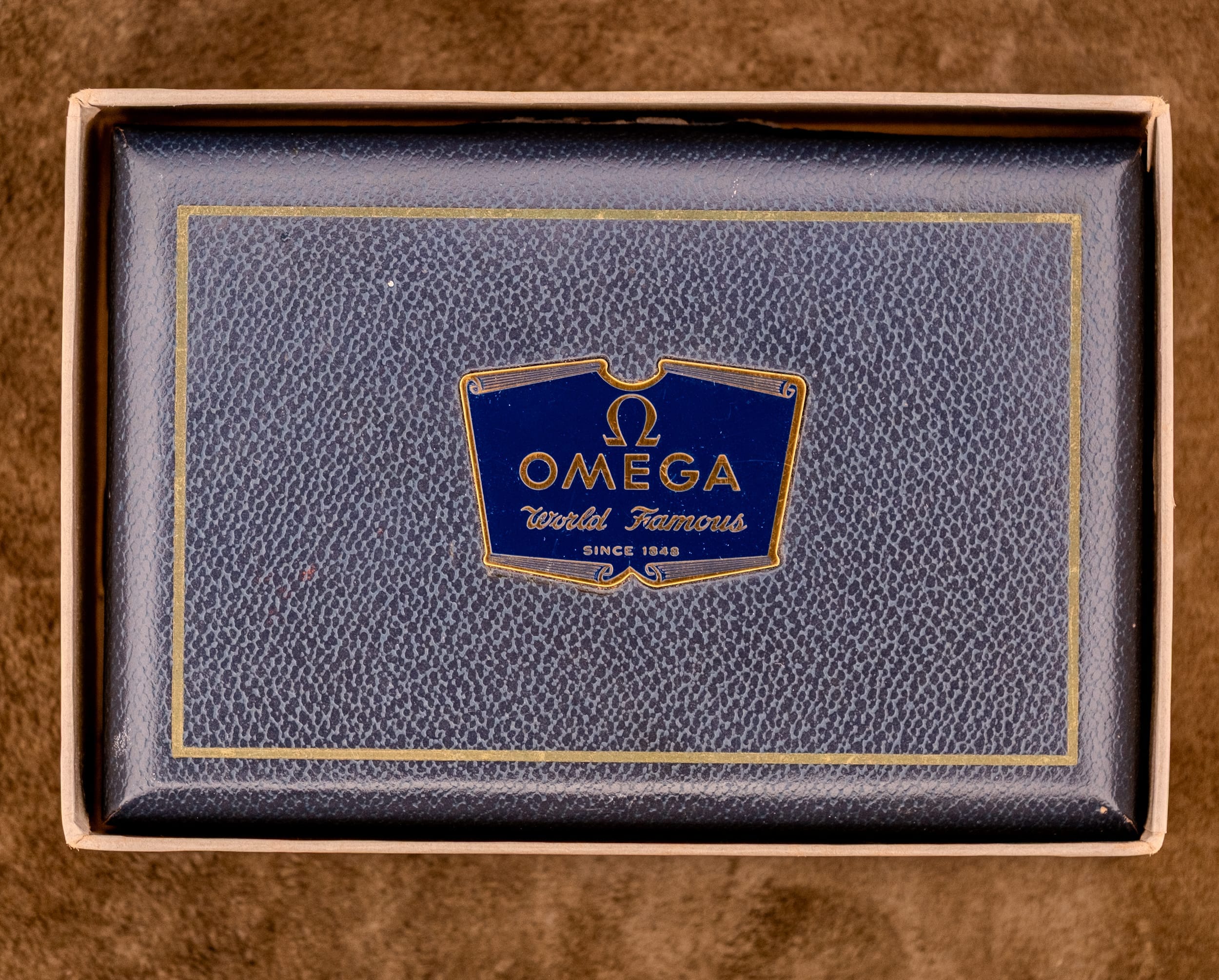
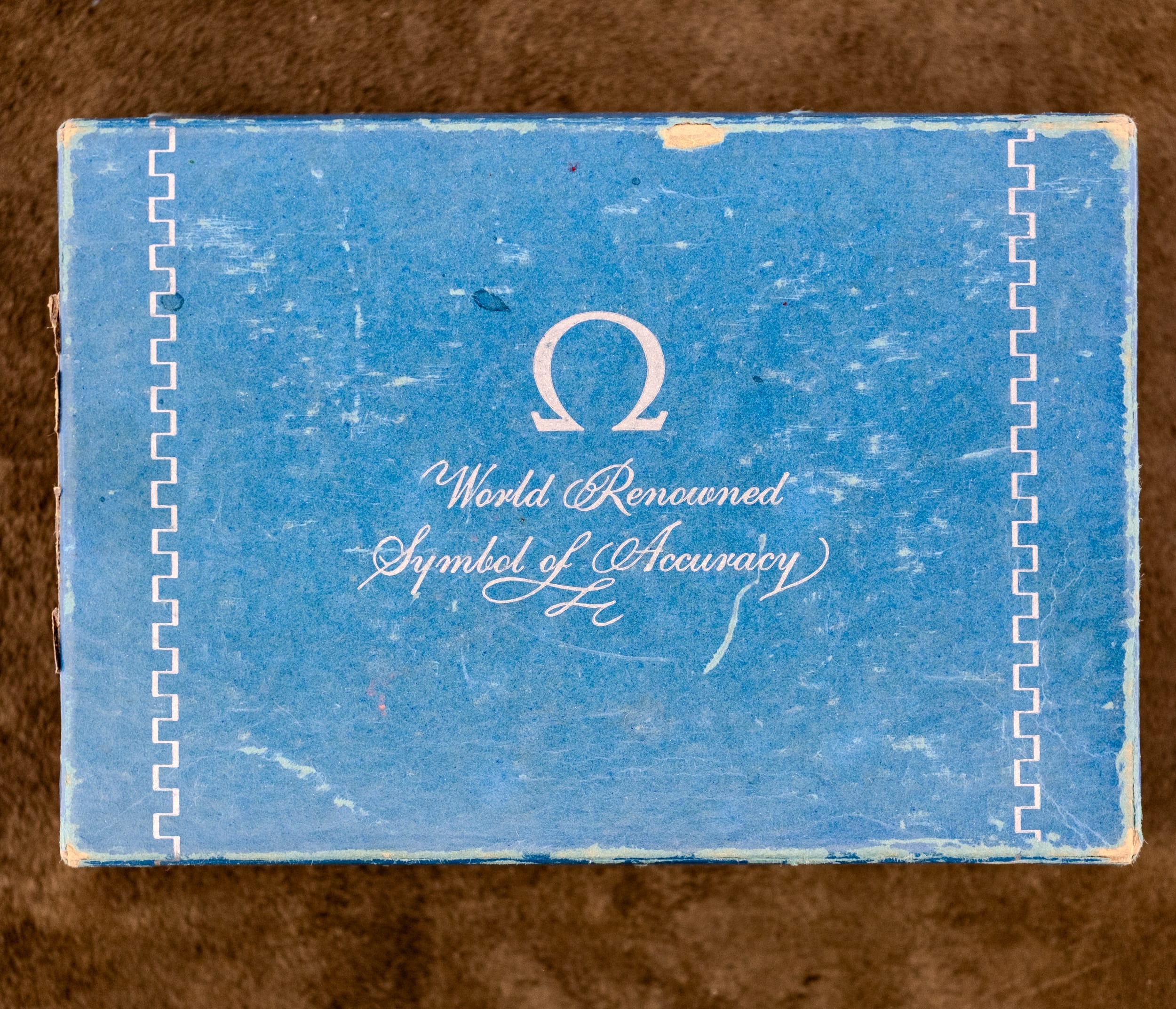
What truly elevates this listing is the completeness of the set. The watch is accompanied by its original Omega guarantee of origin card, filled out in ink with the original owner’s name and the delivery date, the navy inner presentation box with the gold “Ω OMEGA World Famous Since 1848” crest, and the blue outer sleeve carrying the “Ω World Renowned Symbol of Accuracy” script in white. Finding a mid-1950s Seamaster with its original signed papers and a complete two-box set is genuinely rare, and it transforms what would already be a compelling vintage Omega into a piece of provenance with a documented arc back to the jeweler’s counter. Serviced in-house at OTTUHR and backed by our 2-year mechanical warranty, this watch is, for the collector who values provenance and case sculpture over fame of reference, one of the more quietly characterful Omegas to come across our bench this year. To us, the combination of the bull horn lug profile, the Caliber 354 bumper architecture, the honest silver dial, and the original signed papers is the kind of completeness that does not stay in our cases for long.