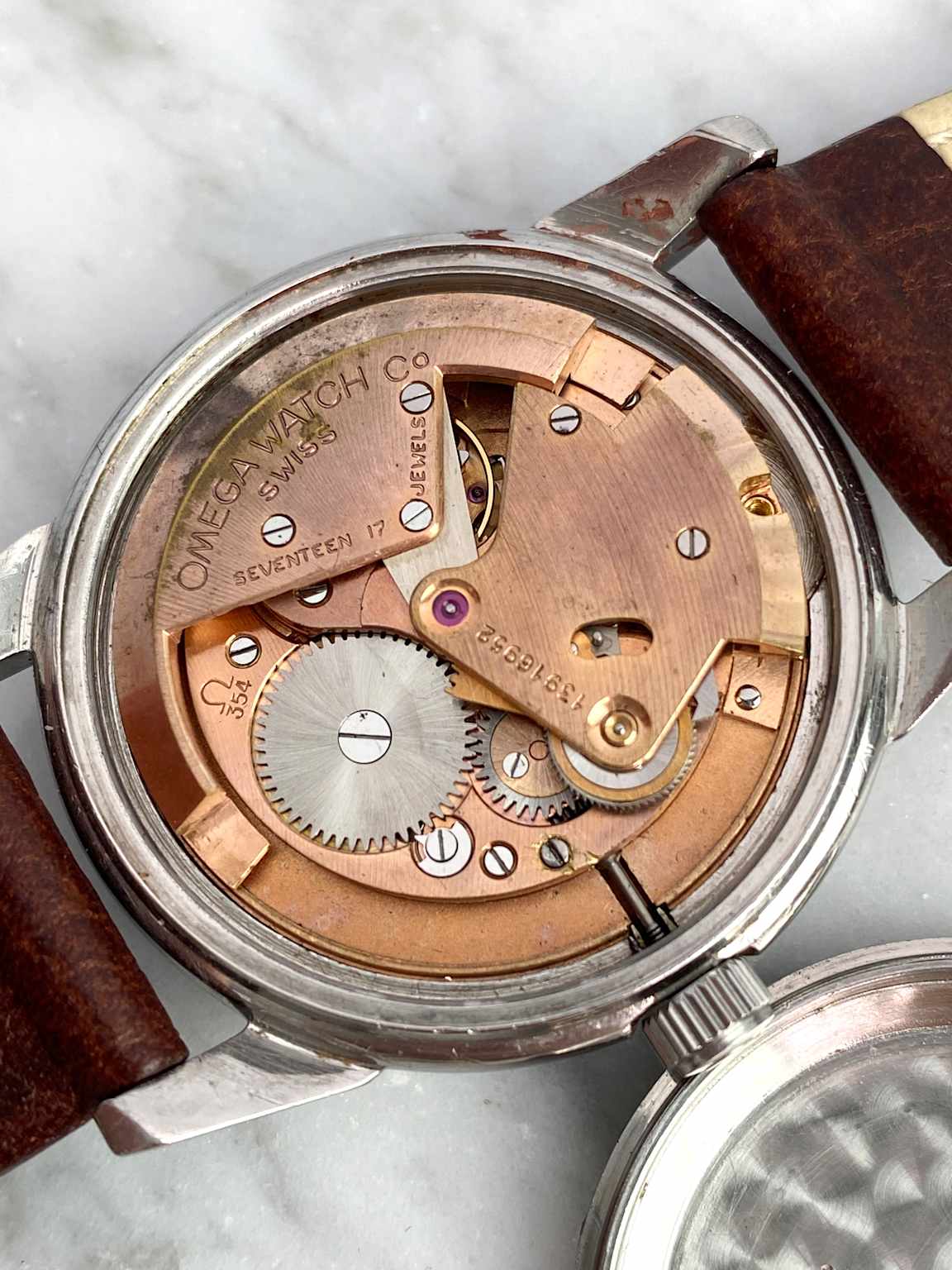
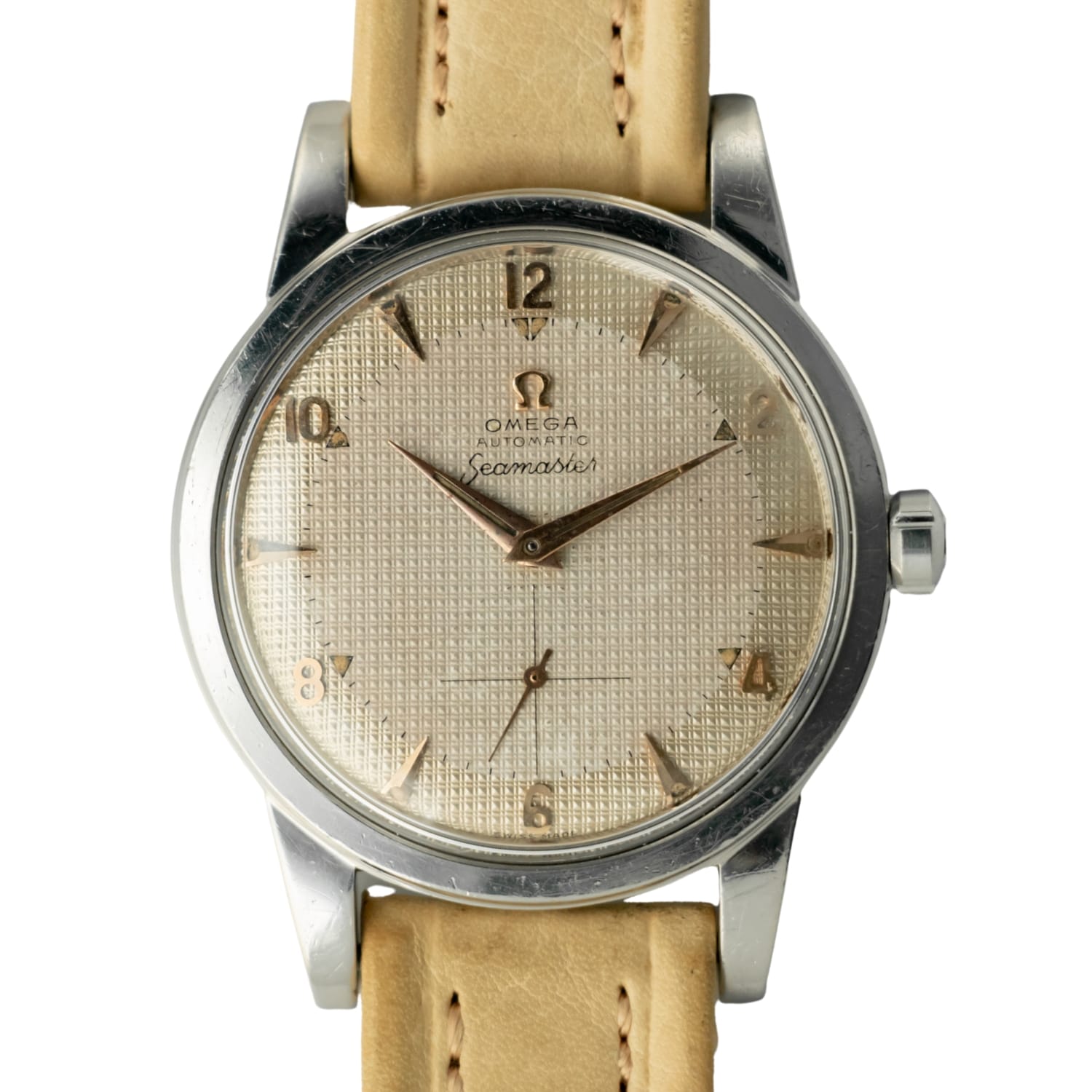
The Omega Seamaster CK 2494 represents a watershed moment in horological history—the genesis of one of the world’s most enduring and recognizable watch collections. Introduced in 1948 as part of the original Seamaster lineup, this reference embodies Omega’s strategic pivot from wartime production to civilian luxury, translating the rugged reliability demanded by military specification into elegant timepieces for peacetime consumers. The CK 2494 designation identifies a specific case architecture within the early Seamaster family, distinguished by its substantial 36mm “Jumbo” proportions, robust screw-back construction, and pioneering bumper automatic movements.
What elevates the CK 2494 beyond mere historical curiosity is its position as a genuine first-generation Seamaster—a direct descendant of the watches that established the collection’s reputation for water resistance, precision, and durability. While later Seamasters would gain fame through professional diving exploits and James Bond associations, the CK 2494 captured a different essence: accessible luxury engineering for the sophisticated gentleman of the 1950s who valued both elegance and functionality. The marriage of bumper automatic technology with waterproof case architecture represented cutting-edge innovation for its era, making the CK 2494 a technical achievement as much as an aesthetic triumph.
For collectors, the CK 2494 offers an accessible entry point into vintage Seamaster collecting with significant historical pedigree, diverse dial variations, and the engaging mechanical experience of bumper automatic winding—a technology that provides tactile feedback lost in modern full-rotor movements.
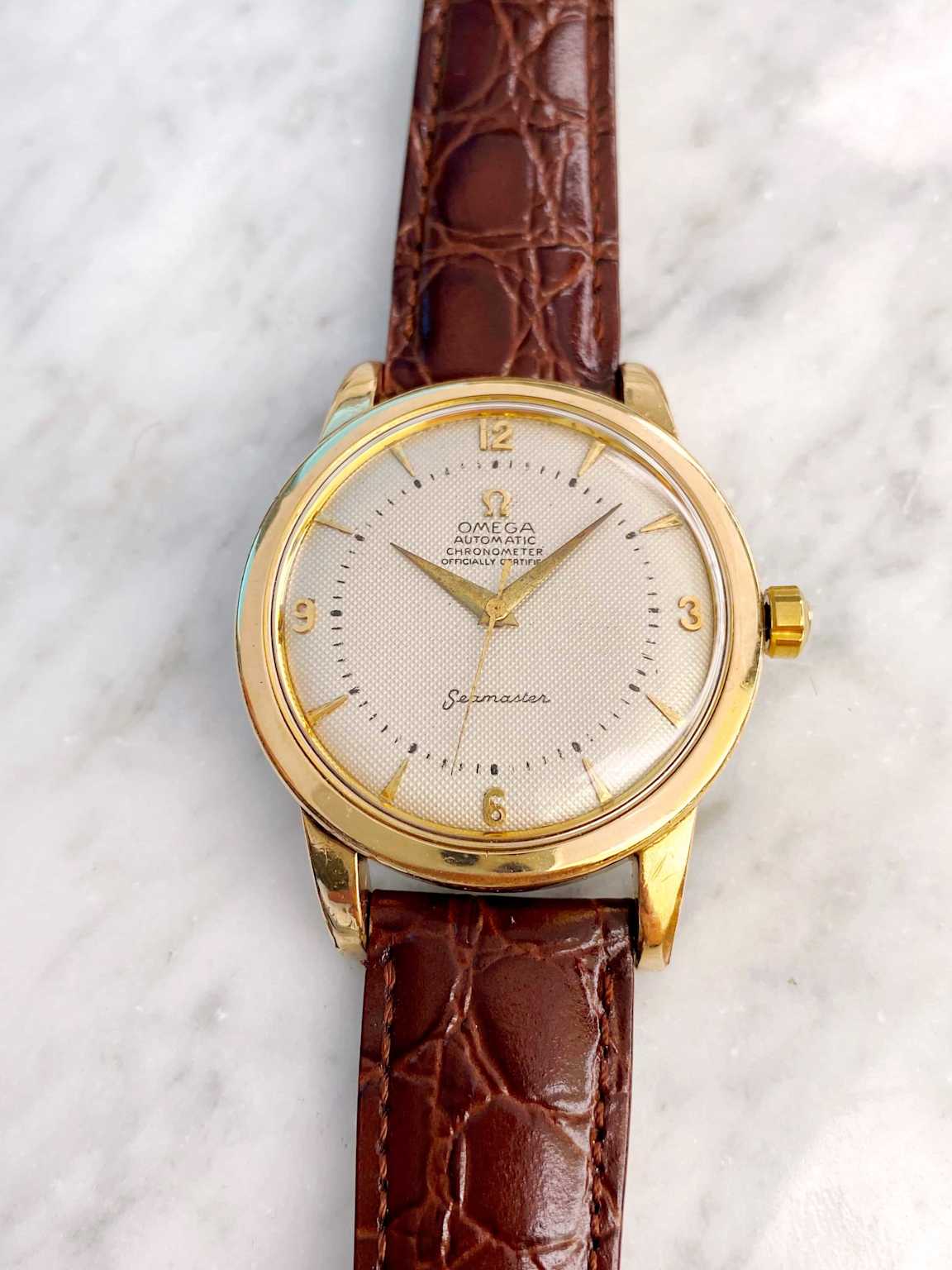
Big 36mm Omega Seamaster Honeycomb Dial Vintage Serviced
Historical Context and the Birth of the Seamaster
Post-War Innovation and the 1948 Launch
The Omega Seamaster collection emerged from the crucible of World War II as a direct application of military lessons to civilian horology. Throughout the 1940s, Omega supplied timepieces to Allied forces, including the British Royal Air Force and American military, accumulating invaluable data on what professional users demanded from wristwatches: water resistance, shock protection, antimagnetic properties, and unwavering reliability under adverse conditions. When the war concluded in 1945, Omega recognized an opportunity to commercialize these military-derived technologies for peacetime consumers.
In 1948, Omega formally launched the Seamaster line, marking the company’s commitment to creating robust yet elegant timepieces that could withstand real-world wear while maintaining dressy aesthetics. The name “Seamaster” evoked nautical capability and suggested mastery over the elements—an aspirational positioning that resonated with post-war optimism and expanding leisure culture. The inaugural Seamaster references, including the CK 2577 and CK 2494, featured several innovations that justified the “master of the sea” nomenclature:
Screw-back Cases: Unlike traditional snap-back cases that provided minimal water resistance, the Seamaster’s screw-down caseback created a compression seal enhanced by flat gaskets, delivering legitimate splash resistance (rated to approximately 30 meters or 100 feet). While modest by modern diving standards, this represented substantial advancement for dress watches of the era.
Reinforced Case Construction: The CK 2494’s two-body case architecture featured thick, sculpted lugs and robust case walls that resisted impact and provided structural integrity. The substantial bezel framed the dial while protecting the crystal from edge impacts—a design philosophy borrowed from military specifications.
Automatic Winding: By equipping the Seamaster with bumper automatic movements (calibers 332, 342, 344, 351, 354), Omega eliminated the need for daily manual winding while showcasing their technical mastery of automatic mechanisms. The bumper system, though superseded by full-rotor technology within a decade, provided reliable automatic winding suited to the active lifestyles of Seamaster owners.
The “Jumbo” Designation and Market Positioning
The CK 2494 earned its “Jumbo” designation through its generous 36mm case diameter—substantially larger than the 33-35mm norm for dress watches during the late 1940s and early 1950s. This sizing decision reflects Omega’s positioning of the Seamaster as a sports-adjacent tool watch rather than a purely formal timepiece. The larger diameter improved legibility, provided visual presence, and aligned with the watch’s practical mandate.
Interestingly, the 36mm measurement that seemed oversized in 1950 now registers as perfectly sized by contemporary standards, contributing to the CK 2494’s wearability on modern wrists. The watch achieves balance through its thick bezel and substantial lug width (18mm), preventing the case from appearing diminutive despite its modest absolute dimensions.
Production Timeline and Evolution
Omega introduced the CK 2494 case reference in 1948-1949 as part of the inaugural Seamaster wave, with production concentrated between approximately 1949 and 1955. Movement serial numbers provide dating precision:
| Movement Serial Range | Approximate Year |
|---|---|
| 10,900,000 – 11,999,999 | 1948-1950 |
| 12,000,000 – 12,999,999 | 1950-1952 |
| 13,000,000 – 13,999,999 | 1952-1954 |
| 14,000,000 – 14,999,999 | 1954-1956 |
Examples bearing serial numbers in the 12-13 million range represent the production peak, while watches with serials in the 10-11 million range constitute early pieces from the reference’s launch period. By the mid-1950s, Omega transitioned to updated case designs (such as the CK 2846) featuring modified lug shapes and updated movement families, gradually phasing out the CK 2494 architecture.
Technical Specifications
Case Dimensions and Architecture
The Omega Seamaster CK 2494 exhibits proportions carefully calibrated to balance presence and elegance:
| Specification | Measurement |
|---|---|
| Case Diameter | 36.0-36.5mm (excluding crown) |
| Lug-to-Lug Distance | 45.5-46.2mm |
| Case Thickness | 10-11mm (including crystal) |
| Lug Width | 18mm |
| Crystal Type | Acrylic (plexiglass), domed |
| Water Resistance | ~30 meters (100 feet) |
The case diameter typically measures 36mm on most examples, though slight variations between 36.0mm and 36.5mm occur depending on manufacturing tolerances and specific sub-references. Precise measurement technique matters: diameter should be measured across the case body excluding the crown but including the bezel.
The lug-to-lug measurement of approximately 46mm ensures comfortable wearability across diverse wrist sizes. Combined with the 18mm lug spacing, the CK 2494 accommodates vintage-style leather straps that complement the watch’s mid-century aesthetic. The relatively compact lug-to-lug distance prevents overhang on wrists as small as 6.5 inches while maintaining substantial presence on larger wrists.
Case thickness measures approximately 10-11mm from caseback to crystal apex, including the pronounced dome of the acrylic crystal. This modest thickness contributes to the watch’s dressy profile and enables it to slip comfortably under shirt cuffs despite its sports watch designation.
Case Construction and Design Philosophy
The CK 2494’s case architecture reflects Omega’s commitment to functional elegance through several distinctive elements:
Screw-Back Construction: The defining feature separating Seamaster references from contemporary dress watches is the screw-down caseback. Rather than a simple snap-on back plate, the CK 2494 employs a threaded caseback that screws firmly into the case body, compressing a flat gasket to create a water-resistant seal. This construction provides legitimate protection against moisture ingress during daily wear, hand washing, and incidental water exposure.
The caseback interior bears critical reference markings that enable authentication and identification:
- Full reference designation (e.g., “2657-2494 SC,” “2494-4 / 2657”)
- Omega logo within triangular frame
- Material designation (“STAYBRITE,” “ACIER INOXYDABLE,” gold purity marks)
- Serial numbers (both case and sometimes caliber designations)
- Swiss hallmarks on precious metal examples
Bezel Design: The CK 2494 features a substantial, polished bezel that serves both aesthetic and protective functions. The thick bezel creates visual weight and frames the dial, while its elevation above the crystal protects the acrylic from edge impacts during daily wear. Early production CK 2577 models (the very first Seamaster reference) featured removable bezels, but most CK 2494 examples employ fixed bezels integrated with the case body.
Lug Architecture: Perhaps the most visually distinctive element of early Seamaster references is their lug design—substantial, curved, downward-sloping lugs that integrate organically with the case body. These “beefy” lugs accomplish multiple objectives: they provide structural reinforcement for the case, create visual balance relative to the thick bezel, and ensure comfortable wrist conformity despite the watch’s larger dimensions. The lugs exhibit gentle tapering from case to strap attachment point, with polished top surfaces contrasting against brushed or polished sides depending on finishing.
Crown: Original CK 2494 crowns feature the distinctive “clover” style with four beveled facets and signed Omega logo. The crown measures approximately 5.3mm in diameter with 3mm thickness and screws onto a threaded tube extending from the case. Crown signing was standardized during the late 1940s, so genuine period crowns should exhibit the Omega logo unless replaced during service.
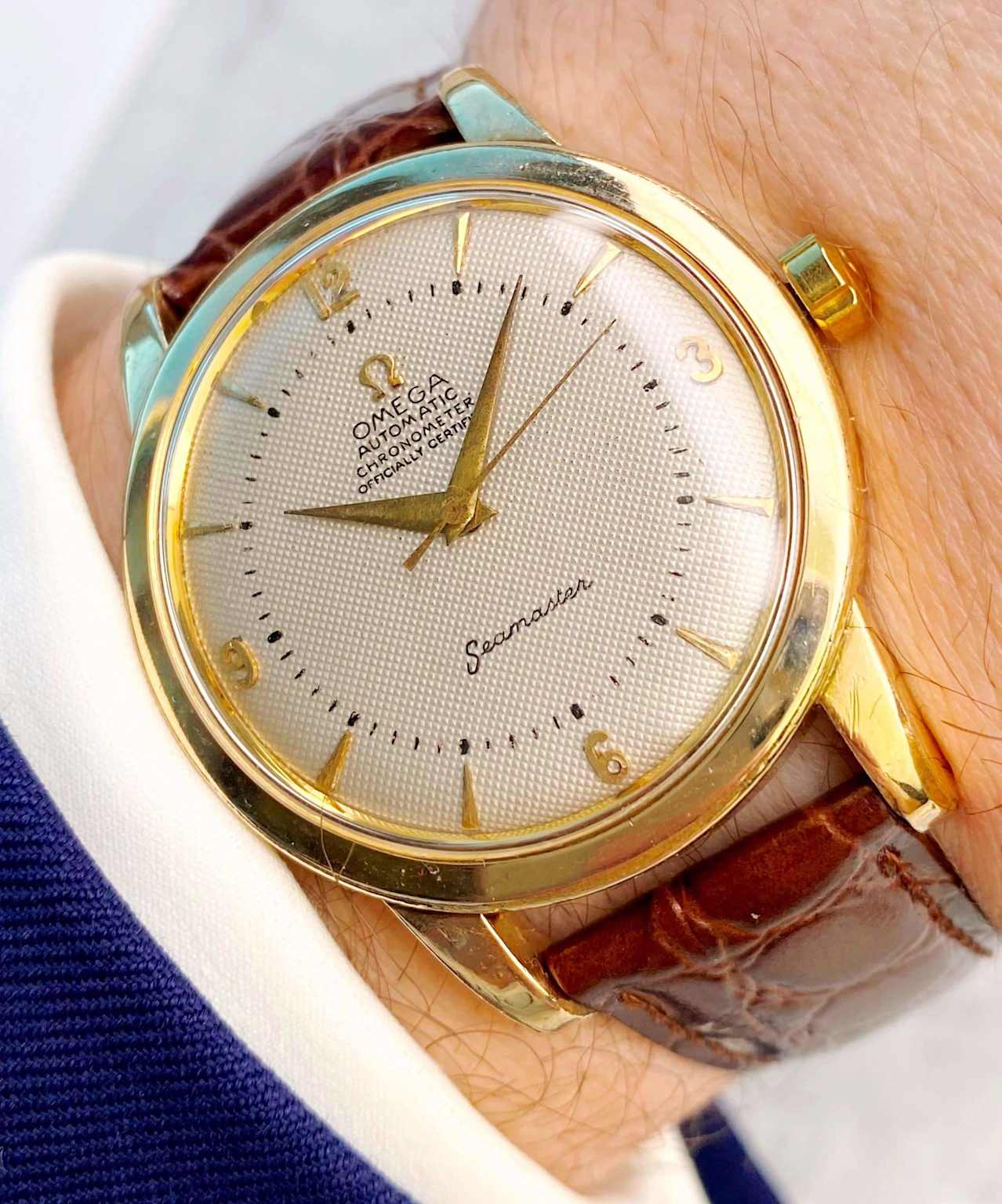
Big 36mm Omega Seamaster Honeycomb Dial Vintage Serviced
Movement Specifications: The Bumper Automatic Era
The CK 2494 housed several calibers from Omega’s legendary bumper automatic family—movements that occupy a unique position in horological history as transitional technology between manual winding and modern full-rotor automatic mechanisms.
Understanding Bumper Automatic Technology
Before examining specific calibers, understanding bumper automatic architecture is essential. Developed by John Harwood in the 1920s and refined by manufacturers including Omega, Jaeger-LeCoultre, and Universal Genève throughout the 1940s-1950s, the bumper system employed a weighted “hammer” or rotor that swung through an arc of approximately 120-270 degrees rather than rotating fully 360 degrees.
At each end of its travel, the rotor contacts spring-loaded buffers that reverse its direction—hence the “bumper” designation. This oscillating motion drives a ratchet wheel that winds the mainspring, transferring kinetic energy from wrist movement into stored mechanical energy. The characteristic tactile and audible feedback when shaking a bumper watch—a distinct “thunk-thunk” sensation—results from the rotor contacting these buffer springs.
While mechanically fascinating and fully functional, bumper systems exhibit inherent limitations relative to full-rotor technology:
Winding Efficiency: The limited oscillation arc and directional reversal at buffer springs means bumper movements wind less efficiently than full-rotor automatics, requiring more aggressive wrist motion to maintain full wind.
Mechanical Wear: The constant impact of the rotor against buffer springs creates wear points, particularly on the driving ratchet wheel and buffer spring attachments. Parts deterioration can compromise automatic winding functionality, necessitating service or component replacement.
Parts Availability: Because bumper technology was superseded by full-rotor movements by the late 1950s, service parts for bumper calibers are increasingly scarce. Worn components—especially ratchet wheels and buffer springs—may require sourcing from donor movements or specialist fabrication.
Despite these considerations, well-maintained bumper movements provide reliable service and offer an engaging mechanical experience unavailable in modern full-rotor watches. The haptic feedback creates a tangible connection to the watch’s operation that many collectors find irresistible.
Caliber Family Specifications
The CK 2494 was equipped with multiple bumper calibers as Omega refined and evolved its automatic movement family throughout the early 1950s:
Caliber 332: This sub-seconds bumper caliber appears in some early CK 2494 examples, particularly those from 1950. The caliber 332 represents an evolution of Omega’s original 28.10 RA PC bumper movement introduced in 1943, incorporating refinements learned through wartime production.
Caliber 342: Introduced in 1949 specifically for the first-generation Seamaster, the caliber 342 marked a significant advancement in Omega’s bumper technology. The movement is functionally identical to the earlier 28.10 RA SC PC but features concealed buffer springs—a cleaner aesthetic treatment that simplified servicing and improved reliability. The “SC” designation indicates “seconds center,” confirming the movement’s center seconds configuration. The 342 measures 28.1mm (approximately 12.5 lignes) in diameter and features 17 jewels, sub-seconds display at 6 o’clock, and approximately 42 hours of power reserve.
Caliber 344: Launched in 1953, the caliber 344 represents the refined evolution of the 342, incorporating minor improvements and manufacturing optimizations. Functionally similar to its predecessor, the 344 continued powering CK 2494 production through the mid-1950s as Omega’s standard Seamaster movement. The movement’s robust construction and serviceability made it a reliable choice for daily-wear watches.
Caliber 351: This sub-seconds bumper caliber served as an alternative to the center-seconds 342/344, offering traditional sub-seconds display at 6 o’clock. The 351 shares the fundamental bumper architecture with its siblings but omits the additional gearing required for center seconds display, resulting in a slightly thinner movement profile.
Caliber 354: The premium variant within the bumper family, the caliber 354 distinguished itself through the inclusion of a swan neck regulator—a precision adjustment mechanism that provides finer regulation than standard movable stud systems. The 354 often appeared in chronometer-grade watches and represented the pinnacle of Omega’s bumper automatic technology before the transition to full-rotor movements. CK 2494 examples equipped with caliber 354 are relatively scarce and command premiums when properly documented.
All these calibers share fundamental characteristics: 17-jewel construction, Incabloc shock protection (on later examples), approximately 42-44 hours of power reserve, and the distinctive bumper automatic winding system. The movements feature practical finishing appropriate to their tool-watch mandate rather than decorative elaboration, with rhodium-plated or natural brass plates and functional layout prioritizing serviceability.
Visual Design and Dial Variations
The Omega CK 2494 manifests remarkable dial diversity, reflecting both period aesthetics and Omega’s willingness to produce multiple dial configurations within a single case reference. This variety creates significant interest for collectors while also complicating authentication, as multiple genuinely original configurations coexisted.
Dial Finishes and Textures
Two-Tone Silvered Dials: The most prevalent dial treatment, two-tone silvered dials feature a metallic silver base with contrasting sector or stepped zones creating subtle visual depth. The central dial area typically exhibits a matte or brushed finish, while an outer chapter ring displays a slightly different texture or tone. These dials age gracefully, developing warm cream, champagne, or light bronze patination depending on environmental exposure and the specific alloy composition used in the silvering process. Well-aged two-tone dials with even, attractive patination are highly valued for their vintage character.
Honeycomb/Waffle Texture: Among the most distinctive and desirable dial variants, honeycomb or “waffle” dials feature engine-turned guilloche patterns creating a textured, three-dimensional surface reminiscent of a honeycomb structure. This Clous de Paris-style guilloché adds exceptional tactile and visual interest, catching and refracting light from multiple angles to create a dynamic appearance. The labor-intensive guilloche work signals quality craftsmanship and elevated production cost, making these dials relatively scarce within CK 2494 production. Honeycomb dials typically appear in cream, champagne, or light silver tones, often paired with applied rose gold markers and dauphine hands.
Cream/Champagne Dials: Factory cream or ivory dials provided a warmer alternative to stark silver finishes. These dials develop rich, even patination that enhances their vintage appeal. Distinguishing originally cream dials from silver dials that have patinated to cream tones can be challenging and requires examining aging patterns, marker oxidation, and comparing multiple verified examples.
Sector Dials: Less common configurations feature sector-style layouts with contrasting zones radiating from the center or dividing the dial into distinct geometric sections. These designs emphasize legibility through bold contrast and geometric organization.
Numeral and Index Configurations
The CK 2494 appeared with multiple hour marking arrangements, each contributing distinct character:
All Arabic Numerals: The most iconic configuration features applied Arabic numerals at all twelve hour positions, creating maximum legibility and vintage character. The numerals are typically executed in rose gilt or yellow gilt finish, applied to the dial rather than painted, providing three-dimensional depth. Original gilt numerals exhibit consistent aging and coloration across all positions, with any variance suggesting replacement or restoration.
3-6-9-12 Arabic Configuration: Alternative examples feature Arabic numerals exclusively at the cardinal positions (12, 3, 6, 9) with smaller applied dart, arrow, or diamond indices at intermediate positions. This arrangement creates visual hierarchy and improves at-a-glance legibility while maintaining refined aesthetics.
Even Number Arabic: A particularly interesting variant features Arabic numerals at all even hour positions (2, 4, 6, 8, 10, 12) with diamond or faceted indices at odd positions. This unusual configuration is less common and adds distinctive visual interest.
Mixed Markers: The most elaborate dial treatments combine Arabic numerals with alternating dart, arrow, or faceted indices in contrasting finishes. For example, the reference 2494-7 documented by Stetzco Watches features alternating rose gold Arabic numerals and rose gold dart indices, with luminous triangles at each Arabic numeral position and luminous-filled tips on the dart indices. This complex indexing creates exceptional dial richness while maintaining excellent legibility.
Hands and Luminous Material
Original CK 2494 hands exhibit several configurations depending on production year and dial style:
Dauphine Hands: The predominant hand style, dauphine (“dolphin”) hands feature the classic tapered profile with pointed tips and faceted surfaces that catch light beautifully. CK 2494 dauphine hands typically appear in rose gilt or yellow gilt finishes matching the dial’s applied markers, with luminous material inset along the hand centers for nighttime legibility. The graceful taper and substantial size of dauphine hands provide excellent legibility while maintaining elegance.
Sub-Seconds Hand: Regardless of hour and minute hand style, the subsidiary seconds hand at 6 o’clock position typically features a blued steel finish creating vivid contrast against the dial. Heat-bluing produces a rich, deep blue coloration that serves both aesthetic and functional purposes, enhancing legibility during timing operations. Well-preserved blued hands exhibit even, saturated color without fading to purple or displaying inconsistent hues.
Luminous Material: Early CK 2494 examples (circa 1948-1950) may feature radium-based luminous material on hands and hour markers. Radium exhibits characteristic warm, cream-to-tan patination and technically glows perpetually (though imperceptibly after decades of decay). By the early 1950s, Omega transitioned to tritium-based luminous compounds, which appear whiter when new and require light activation to glow. After 70+ years, neither radium nor tritium exhibits functional luminescence in most vintage examples, though radium will show residual activity under Geiger counter testing.
Lume Configuration: Luminous material application varied by dial configuration. Some dials feature lume on all markers, while others restrict lume to key positions (12, 3, 6, 9) or omit lume entirely for cleaner aesthetics. The dauphine hands typically feature luminous strips along their centers, with the seconds hand executed entirely in blued steel without lume.
Case Material Variations
Stainless Steel
The overwhelming majority of CK 2494 production utilized stainless steel construction, marketed under designations including “STAYBRITE” (a British stainless steel brand) and “ACIER INOXYDABLE” (French for stainless steel). Steel construction aligned with the Seamaster’s positioning as a durable tool watch and provided accessibility relative to precious metal alternatives.
Stainless steel CK 2494 watches exhibit varying degrees of wear consistent with 70+ years of use—case scratches, polishing evidence, and caseback patination are normal and expected. The most desirable examples retain sharp lug edges and crisp case facets, indicating minimal polishing that has preserved the original case proportions and architectural details. Over-polished cases display rounded lug edges, softened bezel profiles, and diminished case thickness—detractions that impact both aesthetics and collectible value.
Gold-Plated and Gold-Capped Cases
Omega produced CK 2494 references in various gold-finished configurations catering to buyers seeking elevated luxury without solid gold pricing:
Gold-Plated Cases: These feature a thin electroplated gold layer (typically 10-40 microns) applied over stainless steel or brass base metal. The plating provides the appearance of gold at accessible price points but wears through with use and polishing, revealing the base metal beneath. Plating thickness designations (10M, 20M, 40M, 80M) indicate microns of gold application—higher numbers signify thicker, more durable plating. Well-preserved gold-plated examples with intact plating across high-wear areas (lug tops, case flanks, bezel) command premiums, while examples with visible wear-through suffer valuation penalties.
Gold-Capped Cases: Superior to simple plating, gold-capped construction employs a substantial sheet of solid gold (typically 10-80 microns thick) mechanically bonded or pressed onto a stainless steel case core. This technique, also termed “gold-filled” or “plaqué or,” provides a thick gold layer that can withstand polishing and wear significantly better than electroplating. Omega, along with other Swiss manufacturers, mastered gold-capping during the 1950s-1960s, offering the look and feel of solid gold cases at roughly half the cost. Gold-capped CK 2494 examples typically feature stainless steel casebacks (creating a “bi-metal” configuration) or fully capped casebacks depending on the specific sub-reference.
Collectors often overlook gold-plated and gold-capped watches relative to solid gold or steel examples, creating value opportunities for informed buyers who understand the quality gradations. A well-preserved gold-capped CK 2494 with thick original capping can be visually indistinguishable from solid gold while offering significant cost savings.
Solid Precious Metals
Solid gold CK 2494 references are substantially rarer than steel or gold-finished examples, representing perhaps 5-10% of production based on market observations:
14-Karat Rose Gold: Rose or pink gold CK 2494 watches exhibit warm, copper-tinged coloration that ages beautifully. The 14-karat gold standard (.585 fineness) was common for vintage Swiss watches destined for markets including the United States and United Kingdom. Rose gold cases feature Swiss hallmarks stamped on case flanks confirming gold purity and origin.
14-Karat Yellow Gold: Yellow gold examples provide classic precious metal warmth with slightly paler tones than rose variants. As with rose gold, these feature appropriate hallmarking and solid gold construction throughout the case including caseback.
18-Karat Gold: Extremely rare in CK 2494 production, 18-karat gold examples (.750 fineness) represent the highest precious metal grade and command substantial premiums when authenticated. The rarity suggests these may have been special orders or limited regional releases rather than standard production offerings.
Solid gold CK 2494 watches typically feature matching gold crowns, gold-toned applied dial markers, and hands in complementary precious metal finishes. The combination of rare precious metal construction with first-generation Seamaster provenance makes these examples highly sought after by advanced collectors.
Sub-Reference Variations and Case Nomenclature
The CK 2494 reference encompasses numerous sub-references indicated by suffix numbers and/or cross-references with related case models. Understanding this nomenclature system is essential for properly identifying specific variants.
Reference Number Structure
The most common reference format pairs “2494” (the base bumper automatic Seamaster case) with “2657” (the related sub-seconds case reference). This cross-referencing appears stamped inside casebacks in formats including:
- “2657-2494 SC” (indicating screw-back construction)
- “2494-1 / 2657”
- “2657 / 2494-4 SC”
- “2494-7 / 2657”
The “2657” designation technically refers to sub-seconds configurations, while “2494” indicates center-seconds automatic variants, though in practice the references overlap and cross-pollinate due to Omega’s complex case numbering system. The suffix numbers (-1, -3, -4, -7, -8, -12, etc.) denote specific dial configurations, hand styles, finishing variations, or production batches.
Documented Sub-
Reference 2494-1: Among the earliest sub-references, typically featuring stainless steel cases with various dial layouts. The “-1” suffix appears consistently in early production documentation.
Reference 2494-3: This sub-reference has been documented with diverse configurations, including examples with Arabic numerals and distinctive movement calibers. A Heritage Auctions example (Lot 56295) described a 2494-3 with 36mm two-body screw-back case and large curved lugs circa 1950.
Reference 2494-4: Associated with honeycomb or waffle dial examples, suggesting the “-4” designation may correlate with this specific guilloche treatment. A Bonhams auction (Lot 48, November 2019) documented a stainless steel 2494-4 / 2657 SC from circa 1951 with caliber 354.
Reference 2494-6: Less extensively documented, appearing in dealer inventories and auction records.
Reference 2494-7: The Stetzco Watches example documented a 2494-7/2657 with elaborate two-tone waffle dial, alternating rose gold Arabic numerals and dart indices, caliber 344, from 1952. This demonstrates the considerable dial complexity possible within the CK 2494 family.
Reference 2494-8: Documented in dealer listings, though distinguishing characteristics remain unclear without additional comparative examples.
Reference 2494-12: A “Wanna Buy A Watch” listing featured a 2494-12 SC circa 1950 with 36mm steel case, smooth wide bezel, and screw-back construction. The “-12” suffix may indicate specific dial or finishing specifications.
The suffix system employed by Omega during this period was not comprehensively published, and many sub-reference distinctions remain incompletely cataloged. Collectors must rely on cross-referencing multiple verified examples, auction documentation, and Extract from the Archives certificates to establish provenance for specific sub-references.
Collecting Guidance and Authentication
Original vs. Replaced Components
Seven decades of use, service, and ownership mean that component replacement and restoration are common realities in vintage CK 2494 collecting. Understanding originality is essential for proper valuation and informed acquisition decisions.
Dial Authentication
Original Dials: Genuine period dials exhibit consistent aging patterns, with patination developing uniformly across the surface. Applied markers should be firmly attached without lifting, looseness, or rotation. Printing (including the Omega logo, “SEAMASTER,” “AUTOMATIC,” and “SWISS MADE” text) should be crisp without fuzzy edges, bleeding ink, or inconsistent letter spacing. The Omega logo should match period-correct typography—flat-footed styles for 1940s-early 1950s production transitioning to “clover” or serif styles by the mid-1950s.
Age-appropriate patination is a positive indicator of originality: even cream, champagne, or bronze tones developing across decades represent desirable vintage character. Suspicious aging includes splotchy or uneven discoloration, dark spots concentrated around markers (suggesting moisture intrusion), or pristine white/silver surfaces on watches supposedly 70+ years old.
Refinished/Restored Dials: Dial refinishing—where the metal dial base is retained but printing and finish are renewed—was common practice during service, particularly from the 1960s-1980s when collectors placed less emphasis on originality. Refinished dials typically appear too pristine for their age, with stark white or perfectly silver backgrounds, overly sharp printing, and modern typography that doesn’t match period fonts. While refinished dials can be aesthetically pleasing and maintain functionality, they significantly impact collectible value relative to original examples.
Service Replacement Dials: Omega maintained stocks of service replacement dials through decades of aftermarket support. Service dials from later periods may exhibit incorrect fonts, improper spacing, or anachronistic elements (e.g., modern Omega logo styles, incorrect “SWISS MADE” placement). Authenticating dials requires comparing suspect examples against multiple verified originals from reputable dealers, auction houses, and reference resources.
Hands
Original hands should match the dial’s style, period, and luminous material. Rose gilt dauphine hands should complement rose gilt Arabic numerals; mismatched metal tones (rhodium hands with gilt numerals) often indicate replacement. The blued steel seconds hand should exhibit consistent, saturated blue coloration—faded purple or patchy hues suggest improper heat treatment during replacement or refinishing.
Luminous-filled hands should exhibit aging consistent with the dial’s luminous markers: if dial markers show warm radium patination, hands should display similar aging. Bright white luminous compound in hands paired with aged dial lume indicates replacement.
Crown
Original Omega crowns from the late 1940s-early 1950s should be signed with the Omega logo and proportioned appropriately for the case. The clover-style crown with four beveled facets was standard for Seamaster references, measuring approximately 5.3mm diameter with 3mm thickness. Generic replacement crowns are common on vintage Omega watches, as crowns were frequently replaced during service when stems were changed. Unsigned crowns or crowns with incorrect proportions signal replacement—correctable by sourcing period-appropriate signed crowns from specialist suppliers.
Crystal
Acrylic crystals should be domed with appropriate height and profile for the period. Modern flat or low-profile acrylics are incorrect for CK 2494 references and should be replaced with period-correct high-dome crystals featuring metal tension rings. Original Omega crystals from this period typically lack laser-etched logos (this feature was introduced later), so pristine, unmarked acrylic is correct.
Movement Condition and Service Considerations
Bumper automatic movements require specialized attention due to their unique architecture and parts scarcity:
Automatic Winding Function: The bumper winding mechanism experiences wear on the ratchet wheel, buffer springs, and hammer weight pivots. A properly functioning bumper should wind the mainspring reliably through normal wrist motion and produce the characteristic “thunk-thunk” feedback when shaken. If automatic winding fails but manual winding functions normally, the bumper mechanism likely requires service or parts replacement.
Parts Availability: Because bumper technology was superseded by the late 1950s, service parts—particularly ratchet wheels and buffer spring assemblies—are increasingly difficult to source. Watchmakers may need to source components from donor movements or fabricate replacement parts for severely worn examples. This scarcity elevates service costs relative to more common manual or full-rotor movements.
Servicability: Despite parts challenges, the bumper calibers 332, 342, 344, 351, and 354 are well-documented, well-understood movements with substantial surviving populations. Competent vintage watchmakers can service these movements successfully, though specialized expertise and patience are required.
Movement Condition: Prospective buyers should request timing information (rate variation, amplitude) and confirmation that automatic winding functions properly. Clean movements with minimal plating loss and intact automatic mechanisms command premiums, while movements requiring extensive service should be valued accordingly.
Market Considerations and Valuation
The Omega CK 2494 occupies an accessible segment of vintage Seamaster collecting, with steel examples typically ranging from €1,500-€2,500 depending on condition, dial variant, originality, and provenance:
Value Drivers:
- Original, unrestored dials with attractive, even patination
- Uncommon dial configurations (honeycomb/waffle, sector, unusual numeral arrangements)
- Unpolished cases with sharp lug edges and crisp architectural details
- Complete originality (dial, hands, crown, movement)
- Proper functioning automatic winding mechanism
- Gold cases (plated, capped, or solid)
- Complete service history and documentation
- Extract from the Archives certificate confirming provenance
Value Detractors:
- Refinished or service replacement dials
- Over-polished cases with soft edges and reduced case thickness
- Incorrect or replacement hands
- Non-original crowns or crystals
- Non-functional automatic winding
- Extensive case damage (deep scratches, dents, corrosion)
- Incomplete or poorly documented service history
Price Ranges by Configuration:
Exceptional examples with complete originality, rare dial variants, and comprehensive documentation can exceed these ranges, particularly when offered through prestigious auction houses or specialist dealers.
Conclusion
The Omega Seamaster CK 2494 stands as a pivotal reference in horological history—a first-generation timepiece that established the Seamaster collection’s enduring reputation for functional elegance, technical innovation, and versatile sophistication. Launched in 1948 as Omega translated military-derived engineering into civilian luxury, the CK 2494 embodied the optimism and innovation of the post-war era through its robust screw-back waterproof construction, engaging bumper automatic movements, and “Jumbo” 36mm proportions that balanced presence with refinement.
What distinguishes the CK 2494 from its contemporaries and successors is its position at the intersection of transitional technologies: bumper automatic winding that predates modern full-rotor systems, early waterproof case architecture that preceded professional diving capability, and mid-century design language that captured elegance without ostentation. These characteristics make the CK 2494 simultaneously a technical achievement, a design milestone, and an accessible collecting opportunity for enthusiasts seeking authentic vintage Seamaster ownership without the premiums commanded by later professional references.
The remarkable diversity of dial configurations—from two-tone silvered finishes to elaborate honeycomb guilloche, from comprehensive Arabic numeral indexing to mixed marker arrangements—ensures that collectors can pursue aesthetic preferences while benefiting from the mechanical excellence of Omega’s proven bumper calibers. Whether equipped with the workhorse caliber 342, the refined 344, or the precision-grade 354 with swan neck regulation, the CK 2494 delivers the engaging tactile experience of bumper winding and the satisfaction of wearing a genuine first-generation Seamaster.
For collectors seeking entry into vintage Seamaster collecting, the CK 2494 offers substantial historical significance, diverse variant hunting opportunities, and the charm of mid-century horology at accessible price points. Understanding the specifications, variations, and authentication considerations outlined in this reference guide empowers informed acquisition decisions and deeper appreciation for this foundational Omega reference.
For additional information on vintage Omega Seamaster watches, consult authoritative resources including OmegaForums.net, Omega’s official vintage resources, and specialist dealers including Wanna Buy A Watch, Vintage Portfolio, and Sabi Watches.