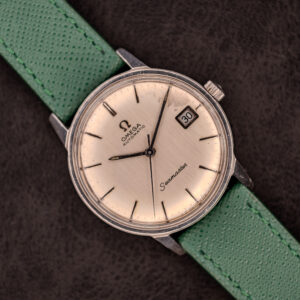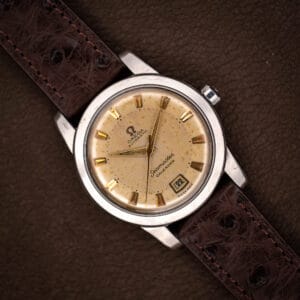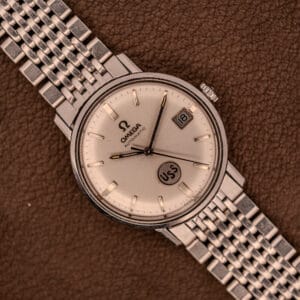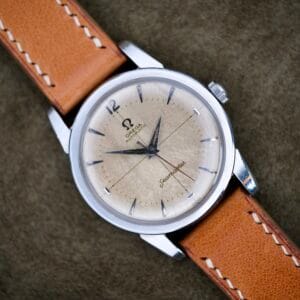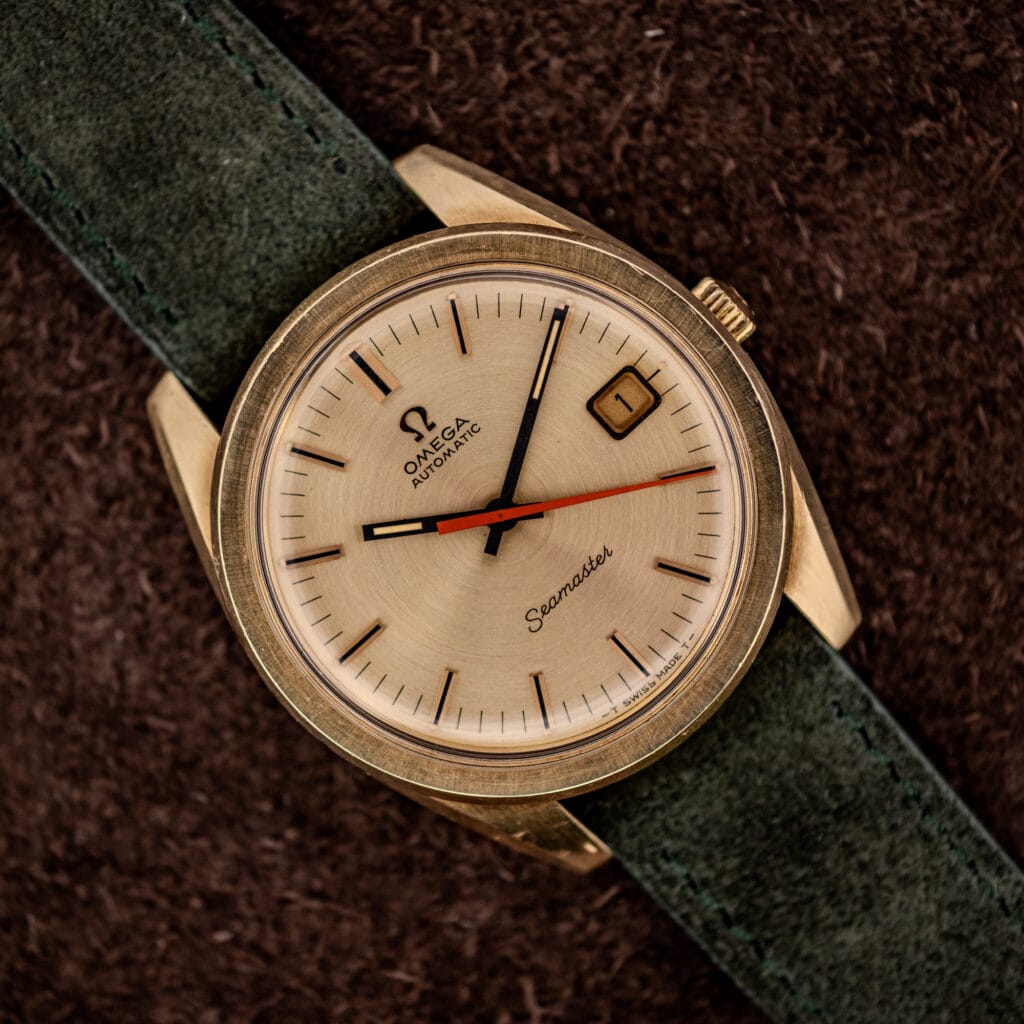
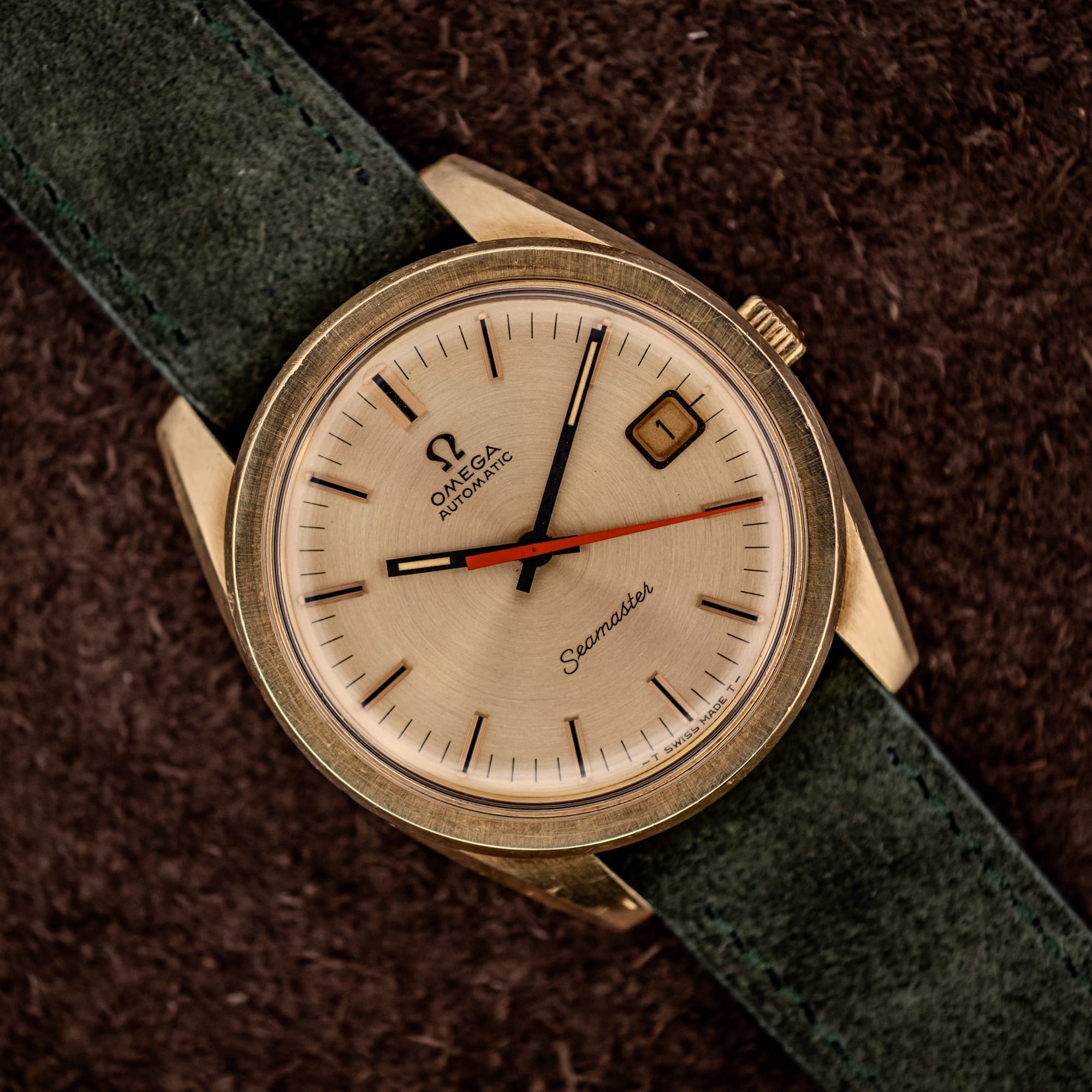
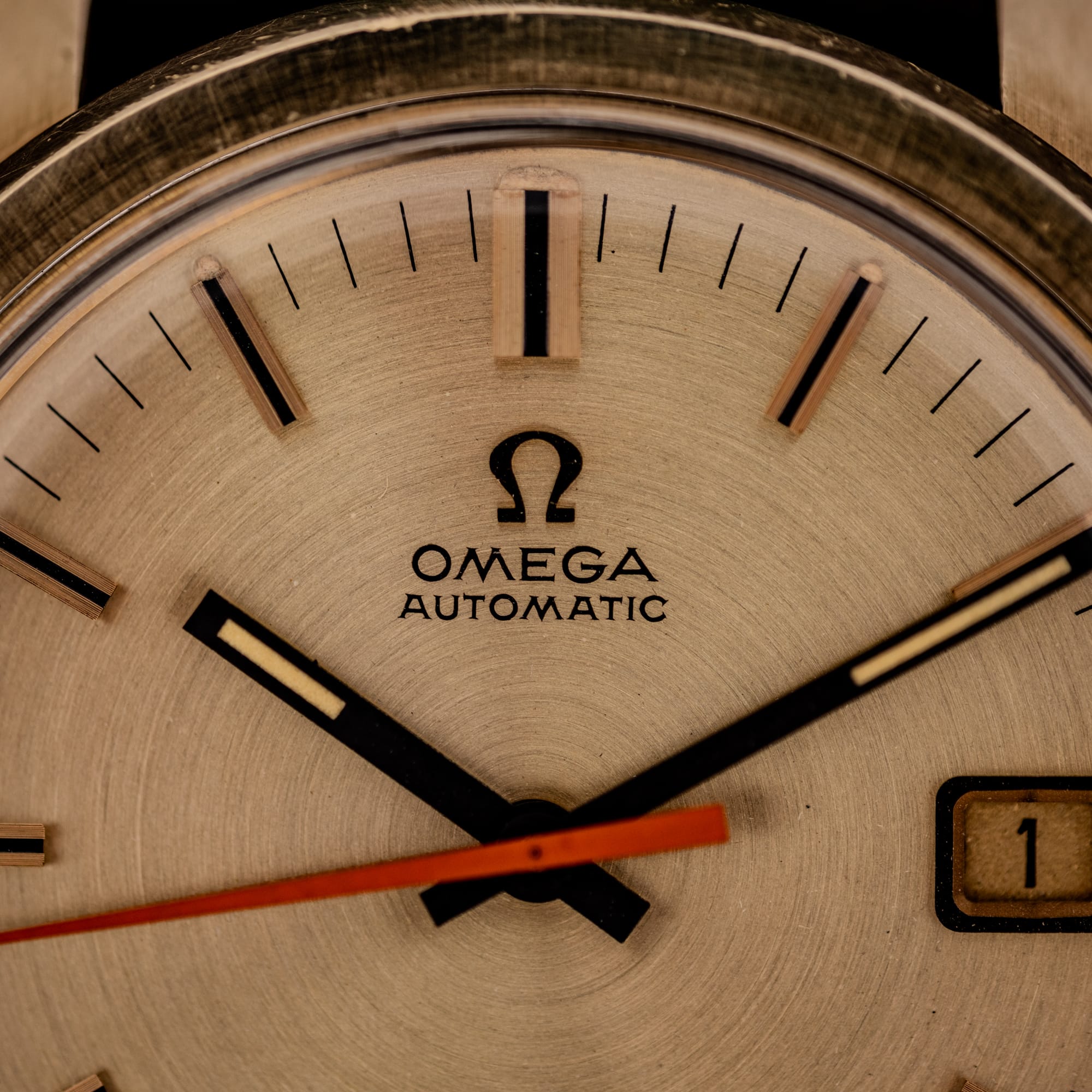
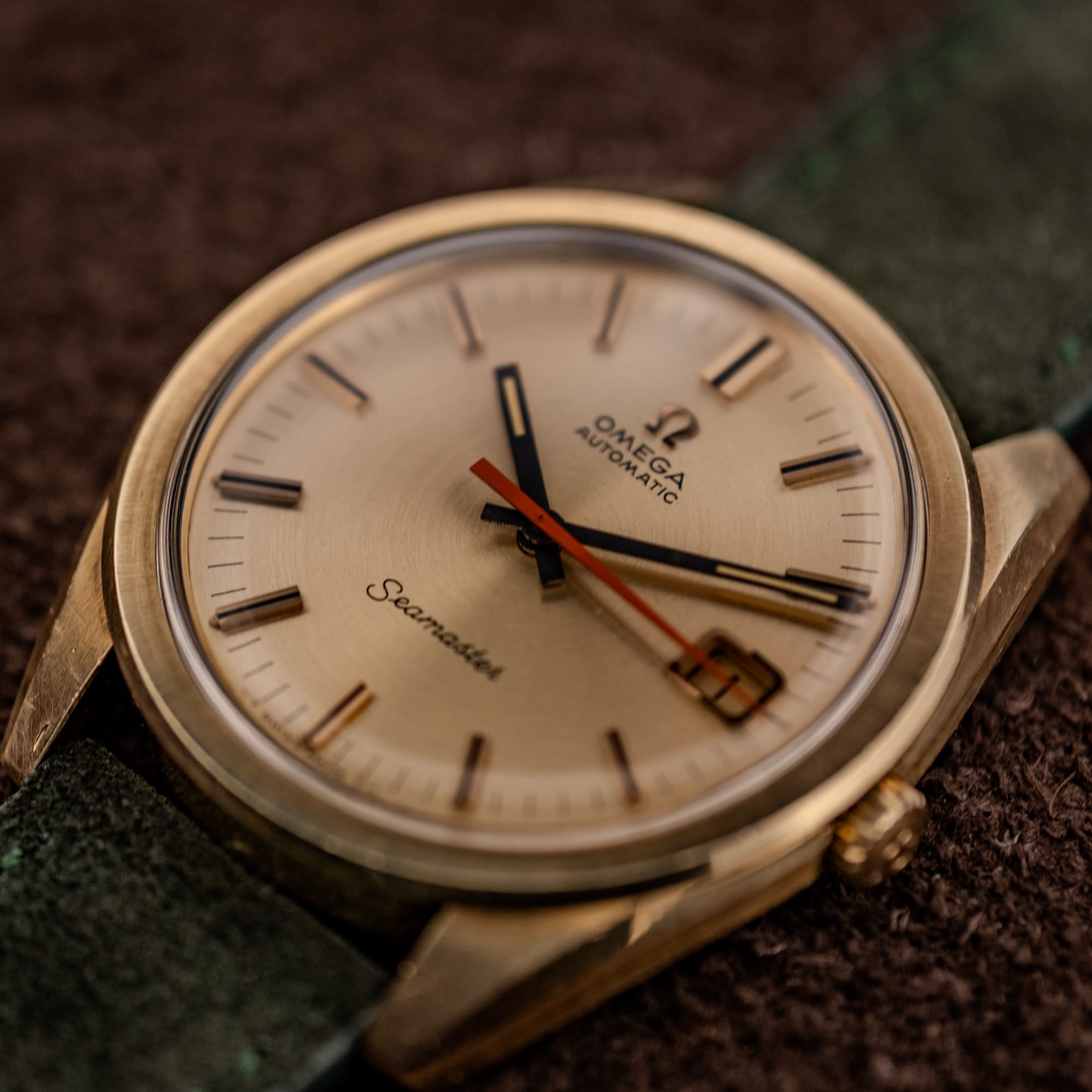
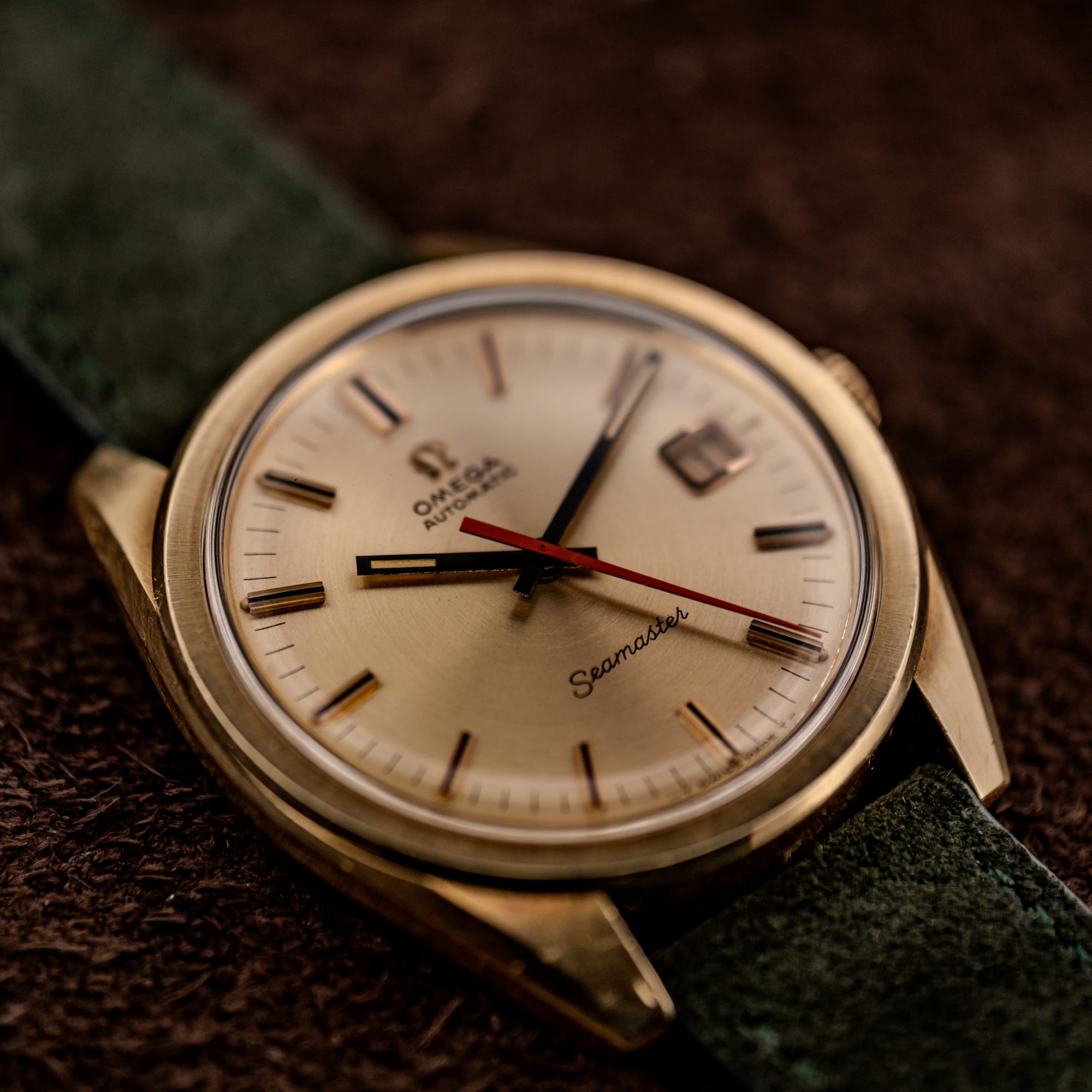
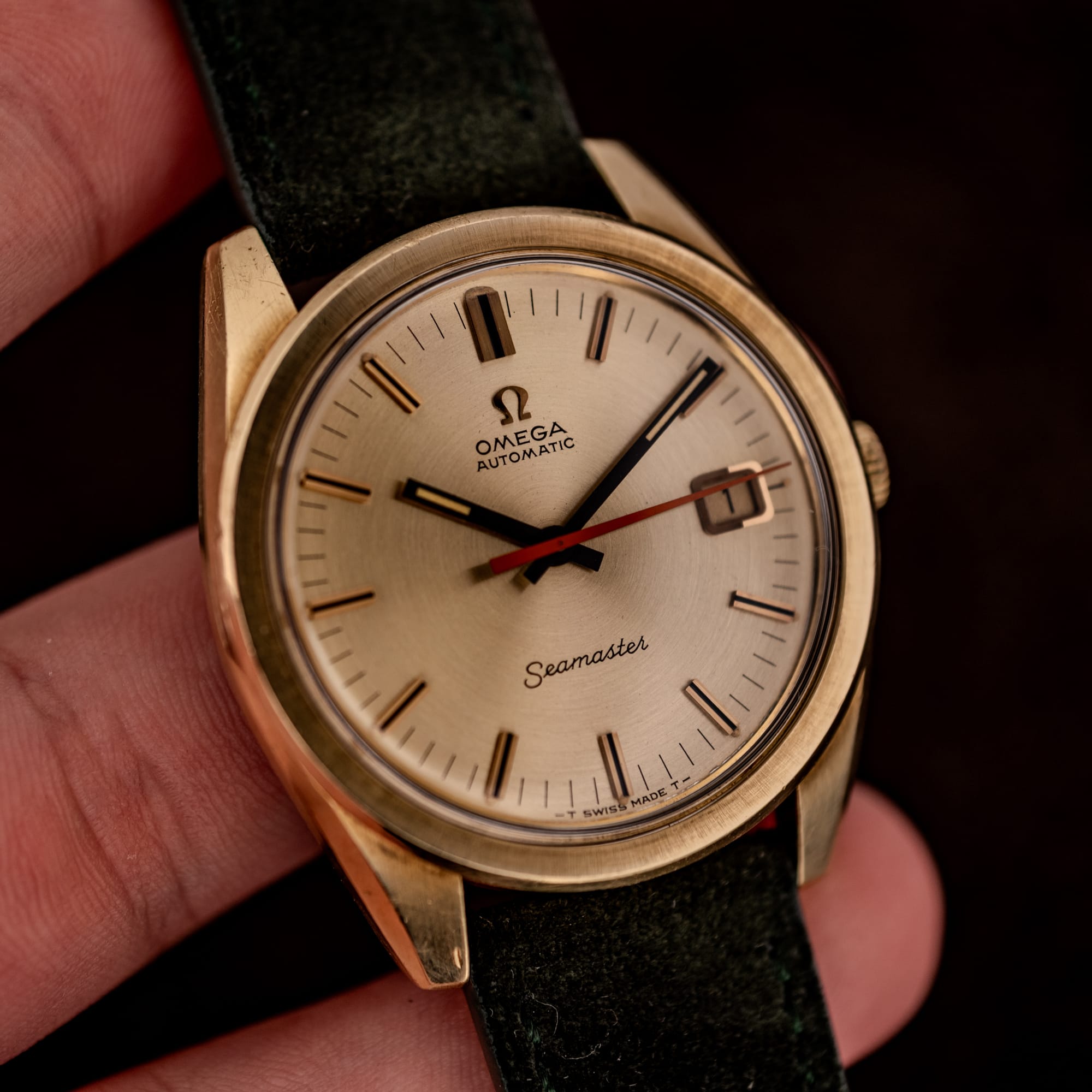
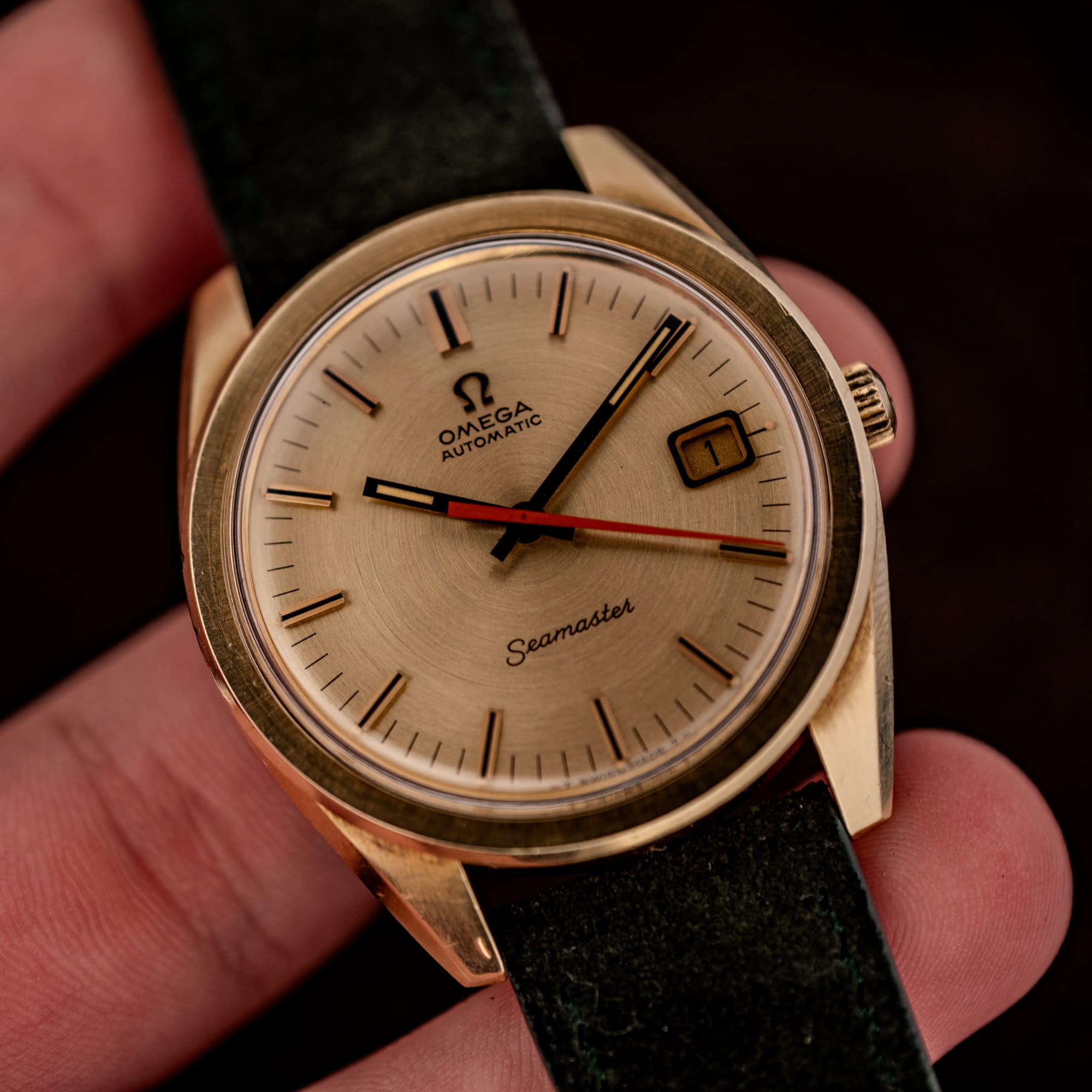
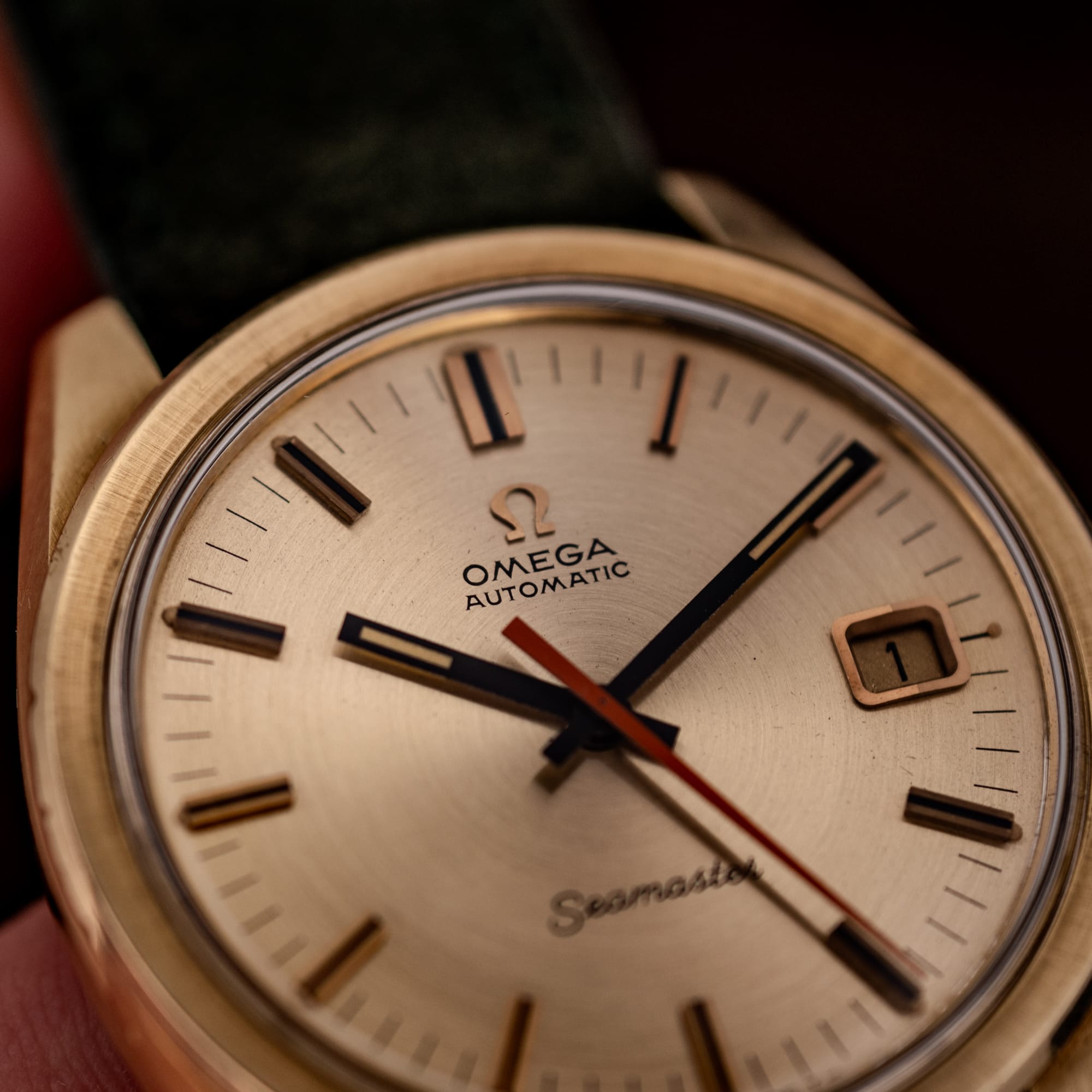
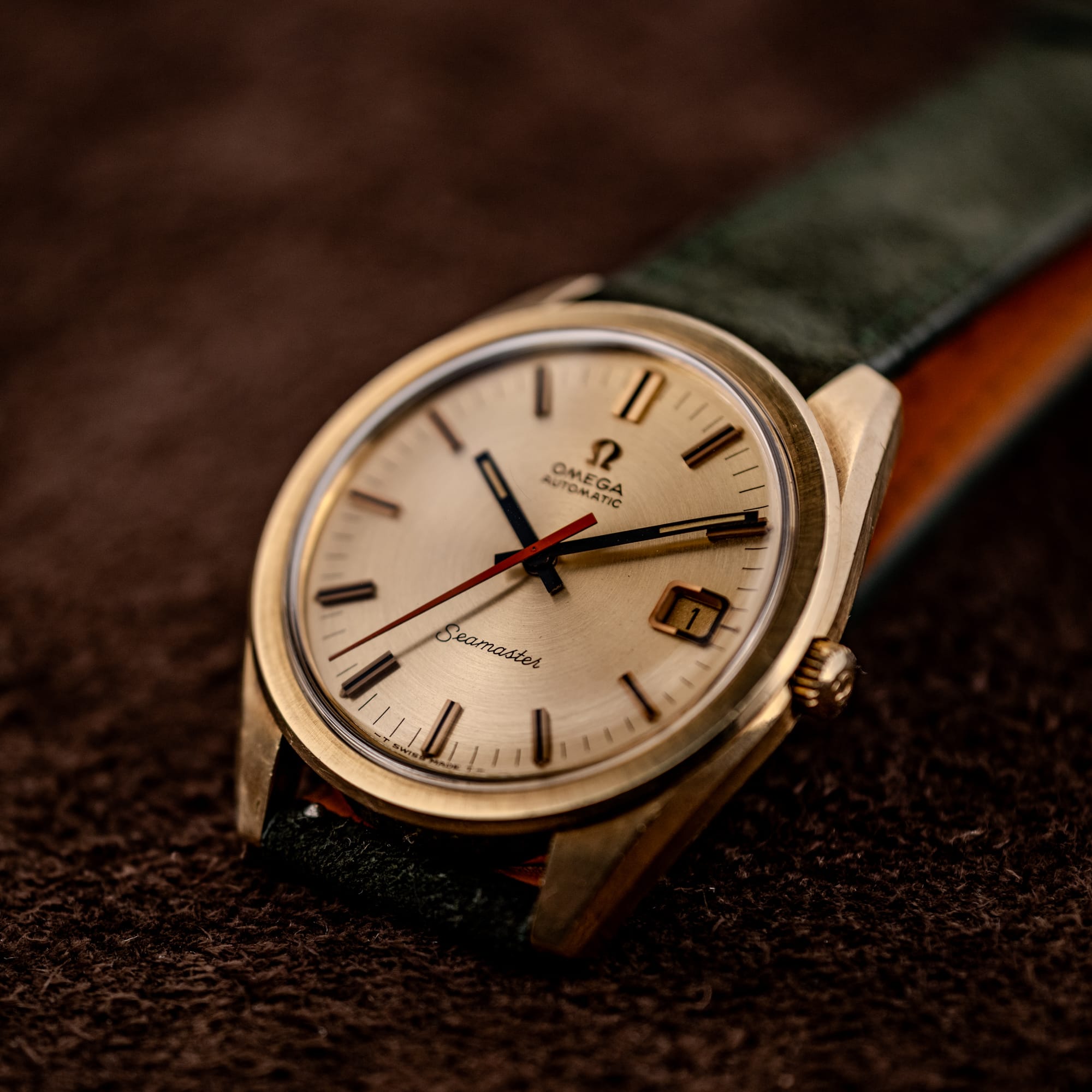
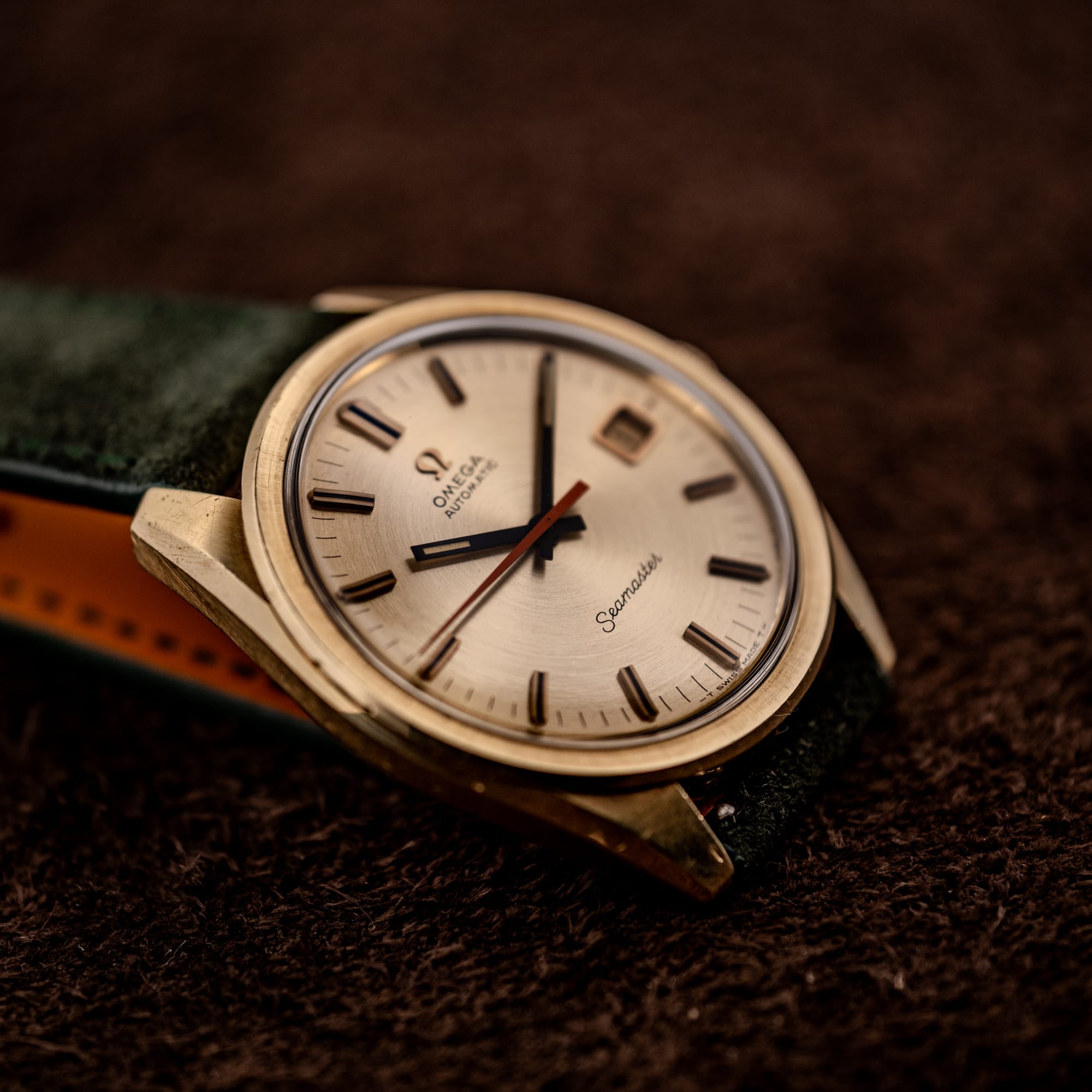
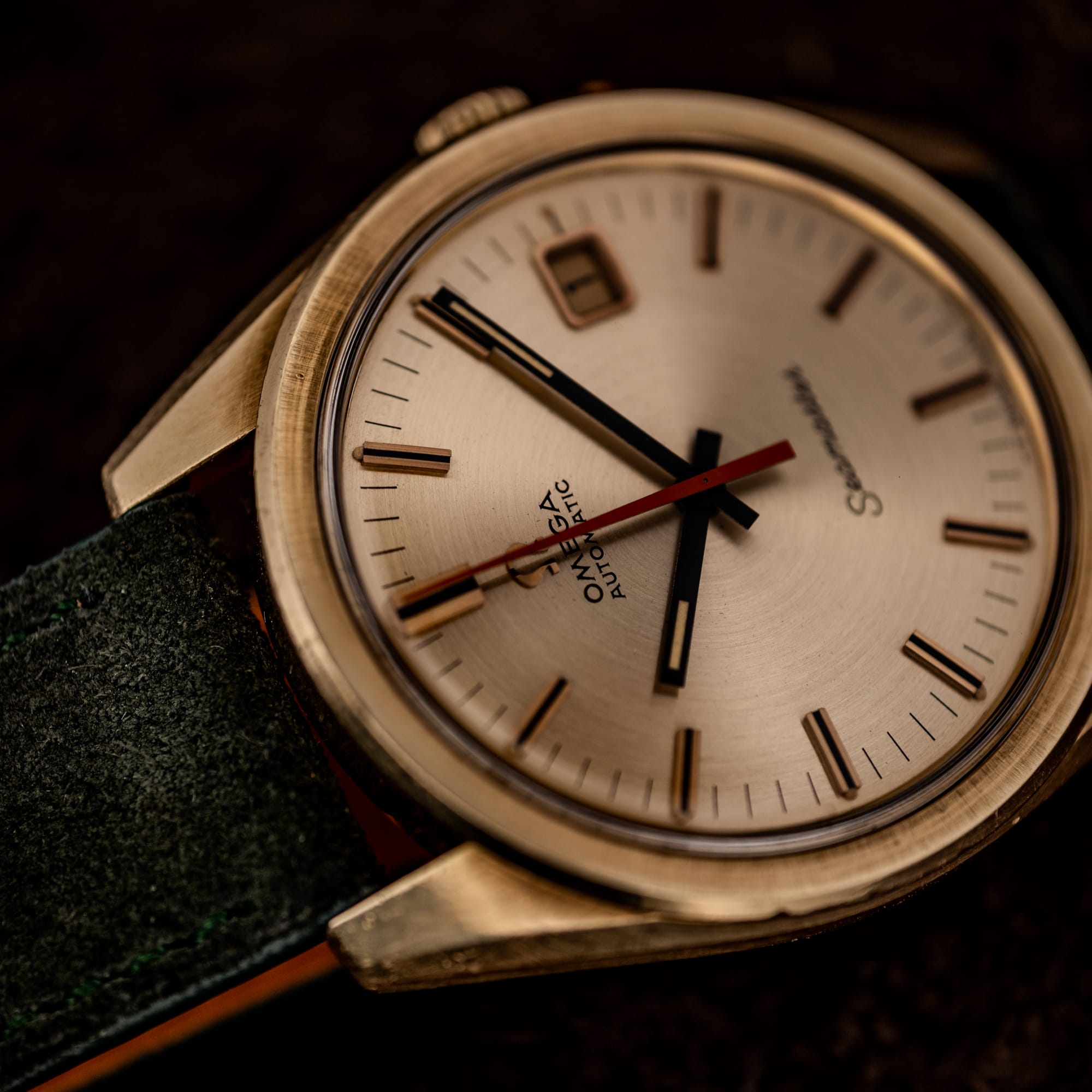
In our opinion the most interesting examples of the vintage Omega Seamaster 166.028 are the ones that hide their best trick. This one reads quietly at first, a warm gold cap, a champagne dial with the faintest sunburst, the sort of watch that goes with anything and draws no second glances. Then the seconds hand comes around in orange, and the whole composition reorganizes itself around that single stroke of color. Omega did this on purpose in 1968, and we have always thought it was one of the cleverer things the brand did with a dress-leaning automatic.
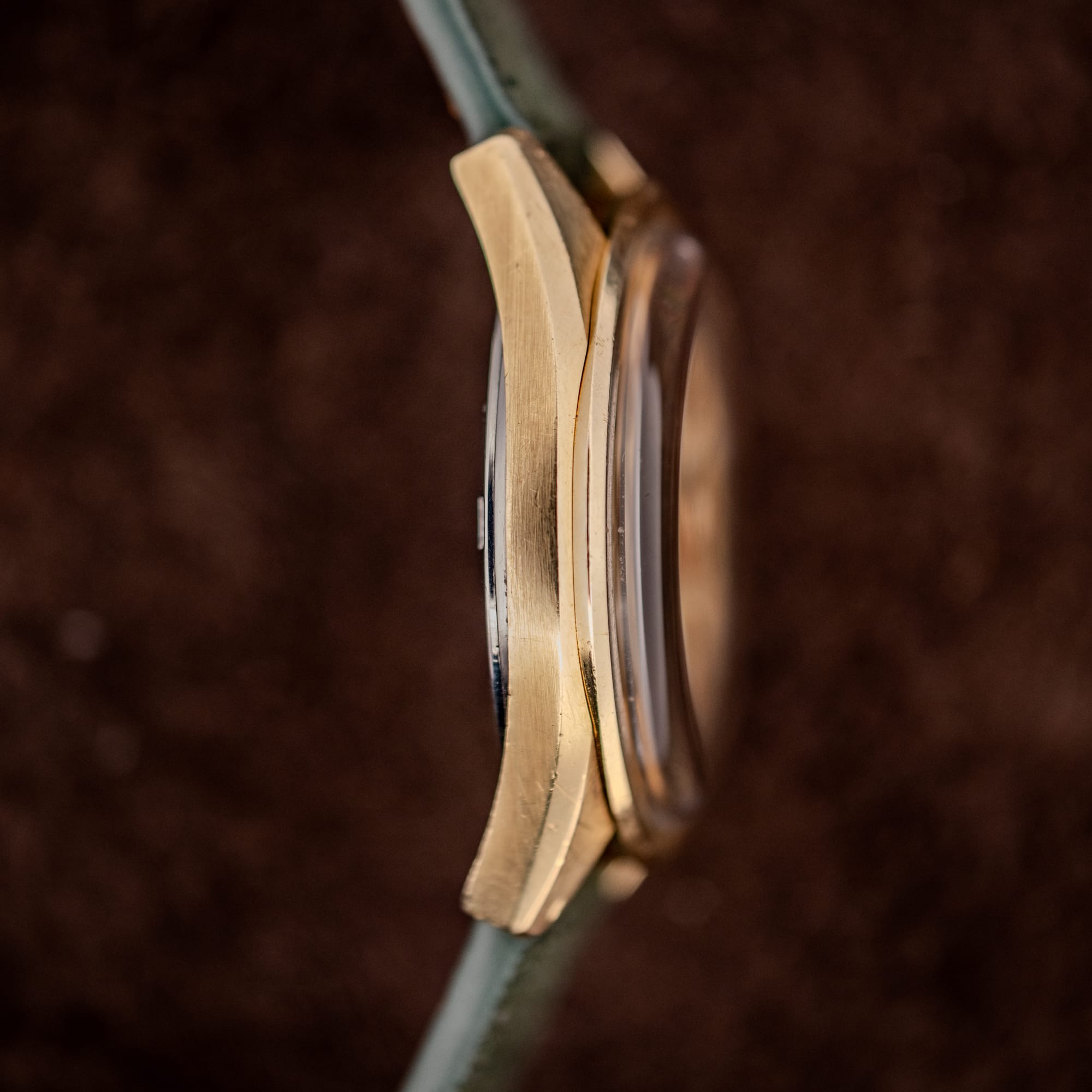
The Seamaster name began in 1948 as Omega’s water-resistant line, built on the gasket sealing the company had refined on military watches during the war. By the late 1960s the name had widened to cover handsome gold-capped automatics like this one, watches that kept the family’s robustness but dressed it in a softer, rounder case with downturned faceted lugs.
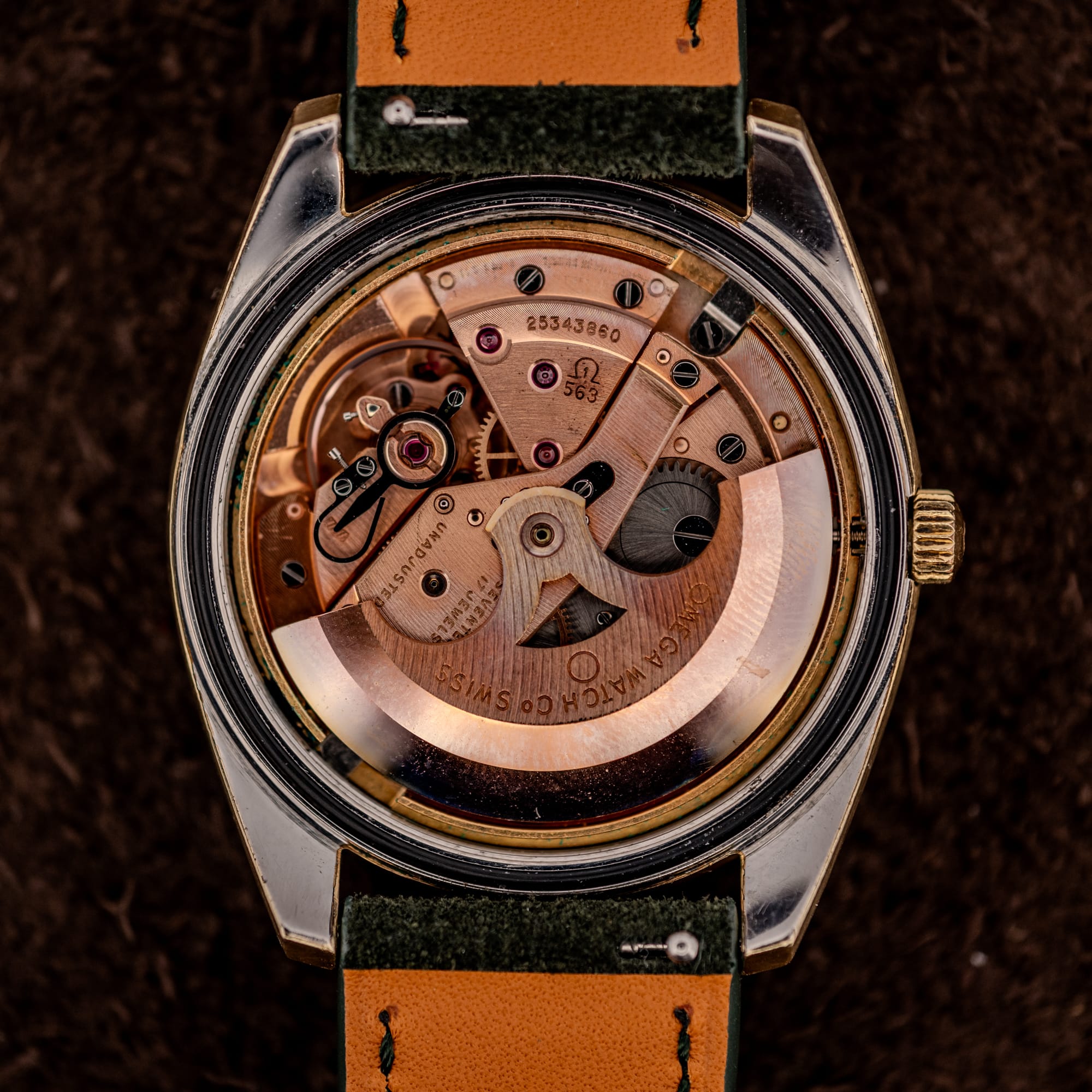
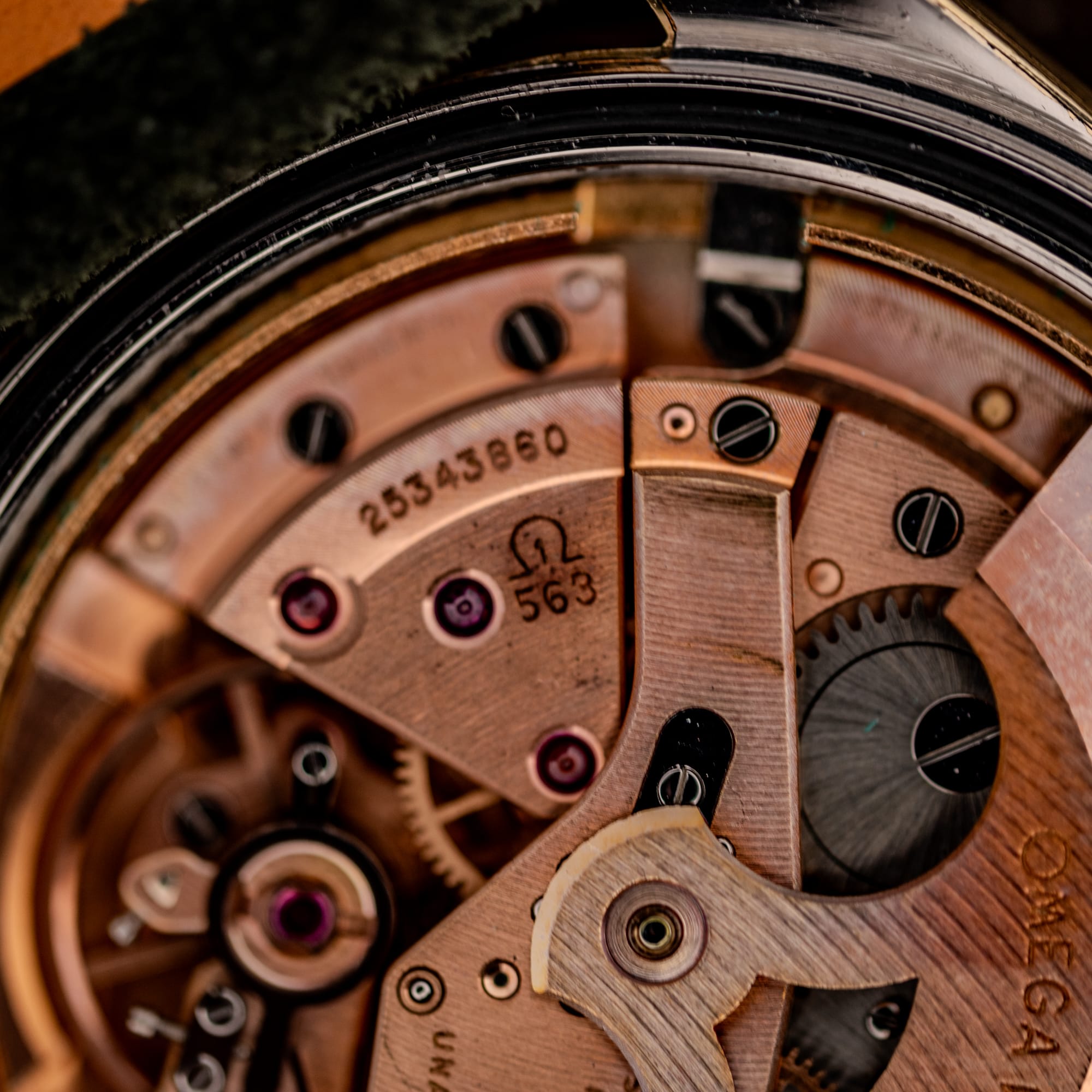
Behind the dial sits the caliber 563, a 24-jewel automatic from the 550 family that was Omega’s workhorse of the 1960s. It is the non-chronometer sibling of the caliber 564, the movement Omega did send for chronometer certification in the Constellation. Same 24 jewels, the same quickset-date architecture, the same robust build, simply never sent to the observatory for a rating. This is chronometer-family engineering without the chronometer premium, which is most of why a clean 166.028 has always been the quiet value play in the line. The bridge is signed with the Omega symbol and the caliber number 563, and the serial 25343860 places production in 1967 to 1968.
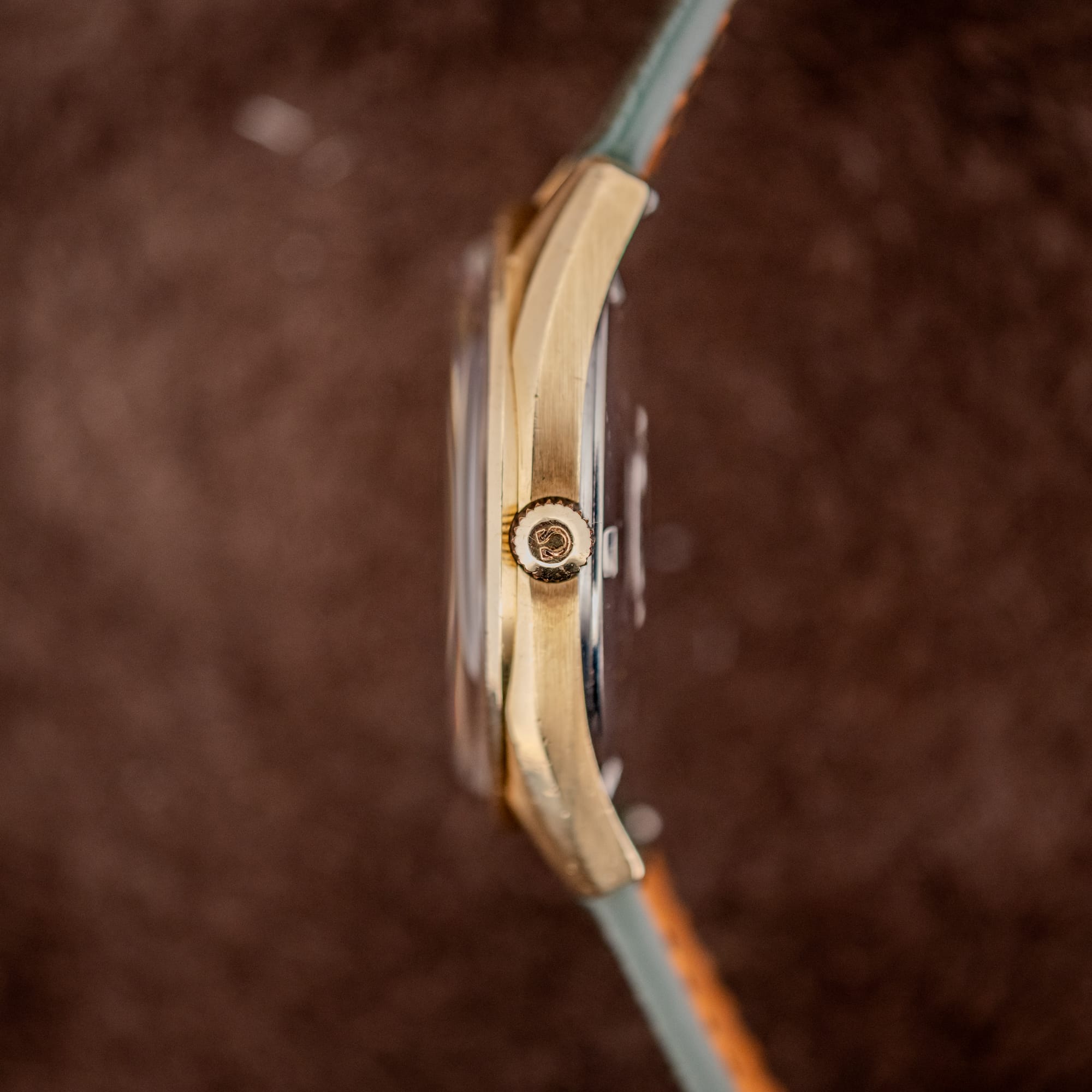
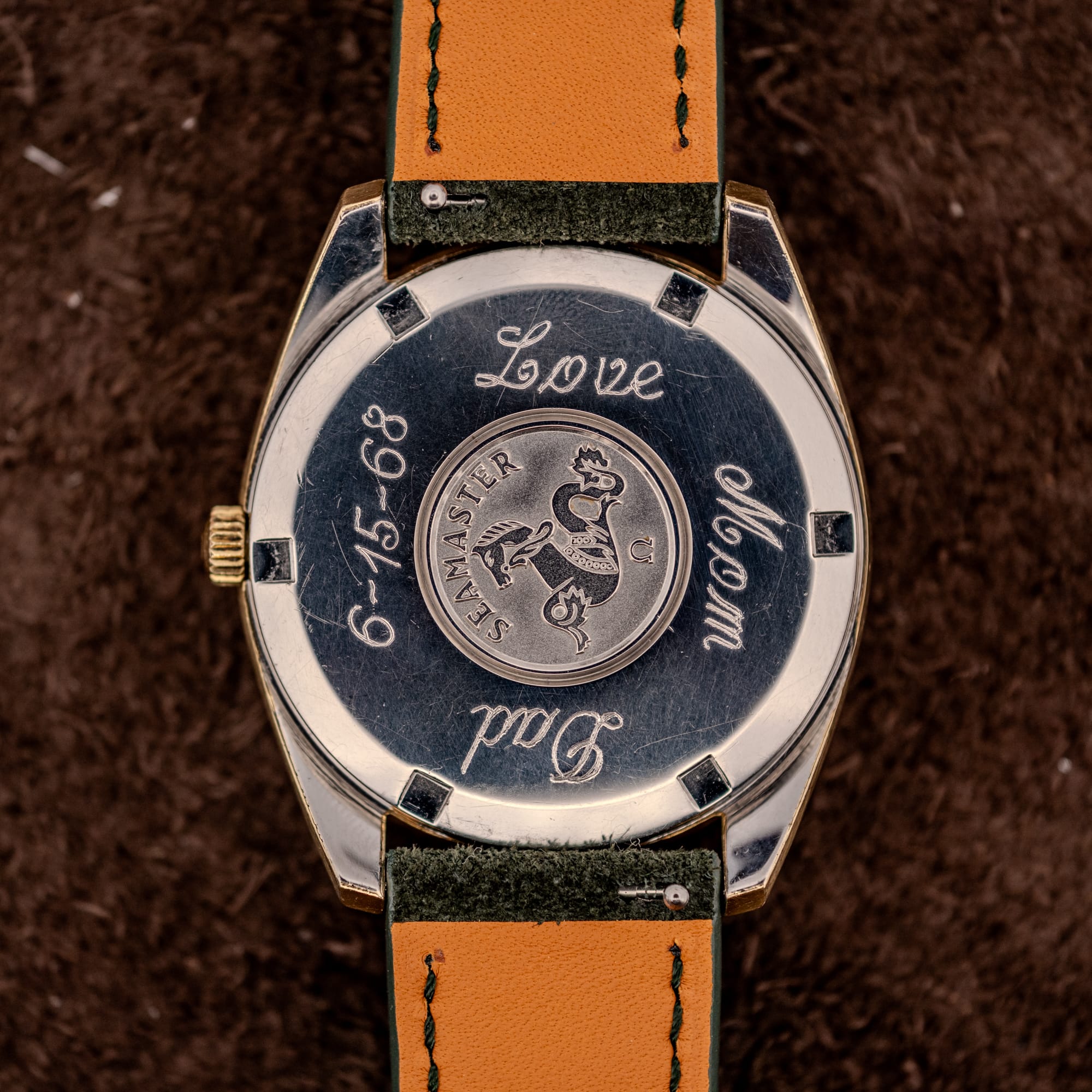
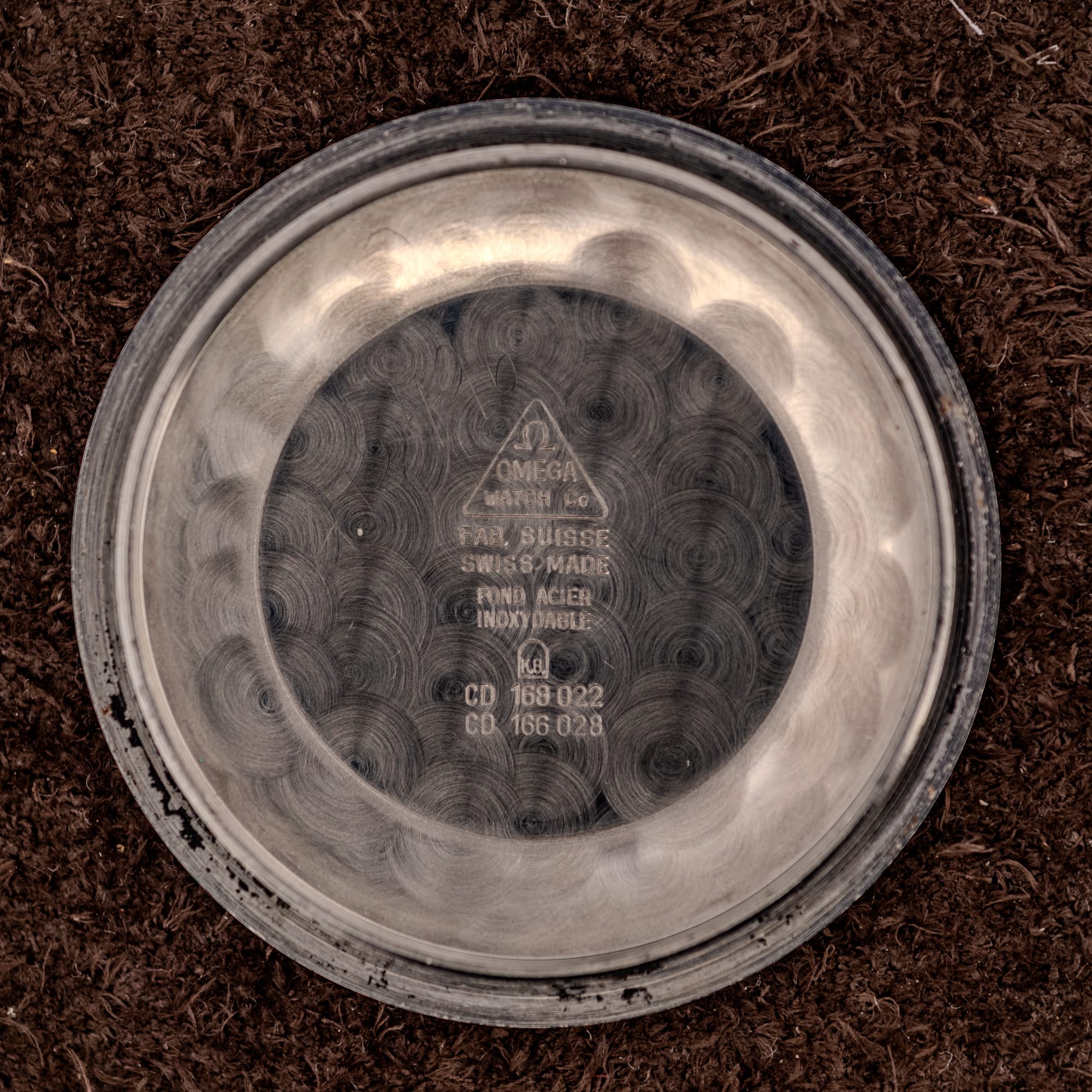
The two-reference caseback makes the same point. Omega used one case for two watches and stamped both numbers inside the back: the chronometer caliber 564 wore reference 168.022, and our non-chronometer caliber 563 wore 166.028. Lift the steel back and both are there, CD 168 022 over CD 166 028, beneath FAB. SUISSE, SWISS MADE, and FOND ACIER INOXYDABLE. The gold cap sits over a stainless steel back, 36mm across, 42mm lug to lug, with 19mm between the downturned lugs, and it shows honest hairlines across the band and a little softening at the high points, the wear a gold-capped watch earns across fifty-odd years. Then there is the back itself. Around the embossed Seamaster seahorse, a previous owner had it engraved by hand, the words Love, Mom, and Dad ringing the date 6-15-68. We would not change it for anything. It dates the watch as precisely as any archive could, and it is the reason this particular 563 spent its life exactly where the caliber was built to go.
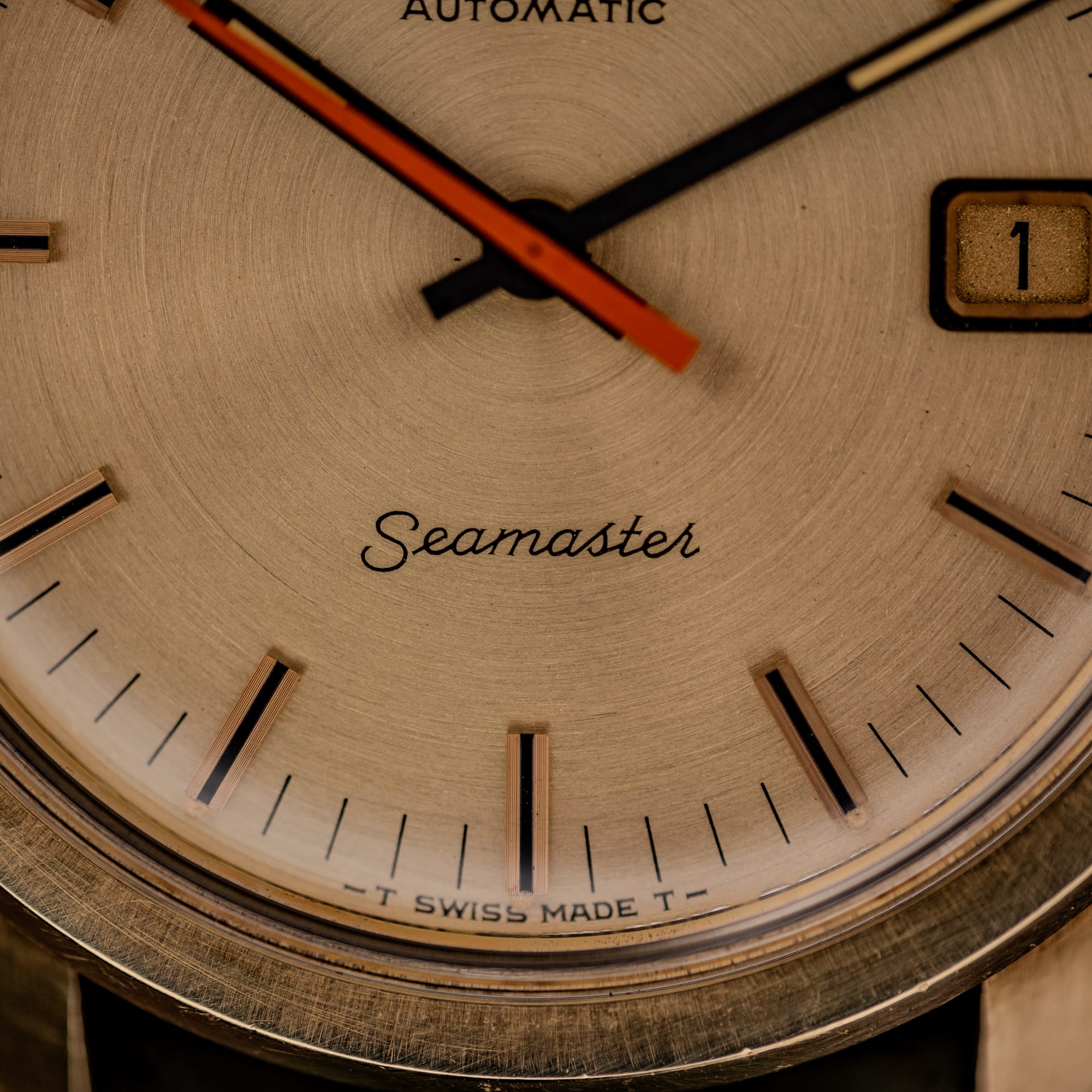
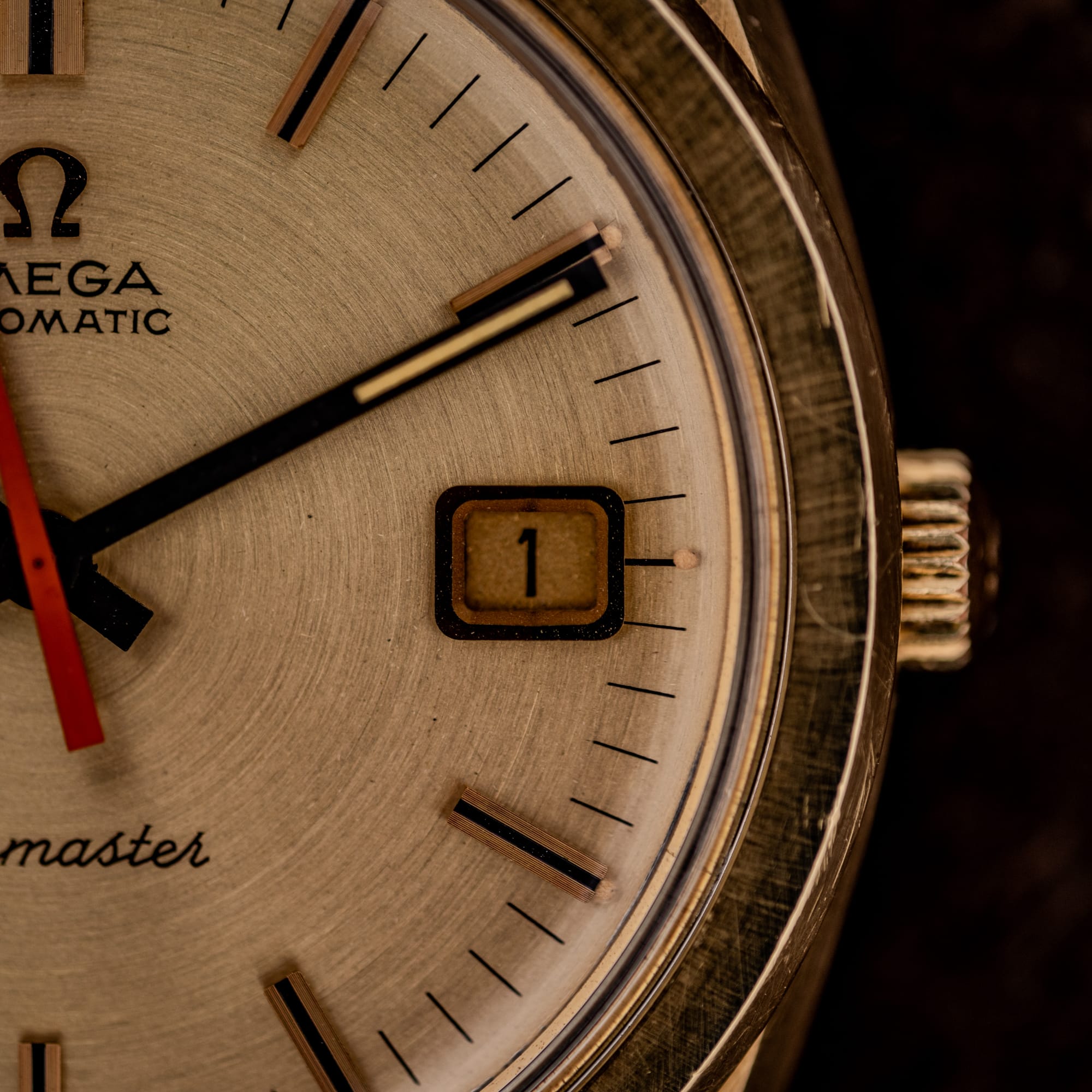
The champagne dial is original and unrestored, its fine sunburst turning silver in bright light and warm gold in the shade. The applied faceted baton markers carry dark inlaid centers and double up at twelve, OMEGA sits beneath the applied symbol with AUTOMATIC under it, and the Seamaster signature runs in script above six. The lume text reads T SWISS MADE T at the base, the tritium notation correct for a 1968 dial, and the date wheel at three has aged to a soft cream we read as character rather than fault. The hour and minute hands are blackened batons. The center seconds, of course, is orange.
We have paired it with a forest green Italian suede strap over a tan leather lining, finished with an OTTUHR signed buckle. Green against warm gold is a quiet, slightly autumnal pairing, and it leaves the orange seconds hand as the only bright note on the wrist, which is precisely where it belongs.
Serviced in-house at OTTUHR and backed by our 2-year mechanical warranty, it is honest, original, and mechanically sound. For the collector who would rather own the watch with the story than the one with the certificate, the 166.028 has always been the smarter buy. A quiet gold dress watch with one loud idea, and a back that records exactly who loved it first.