

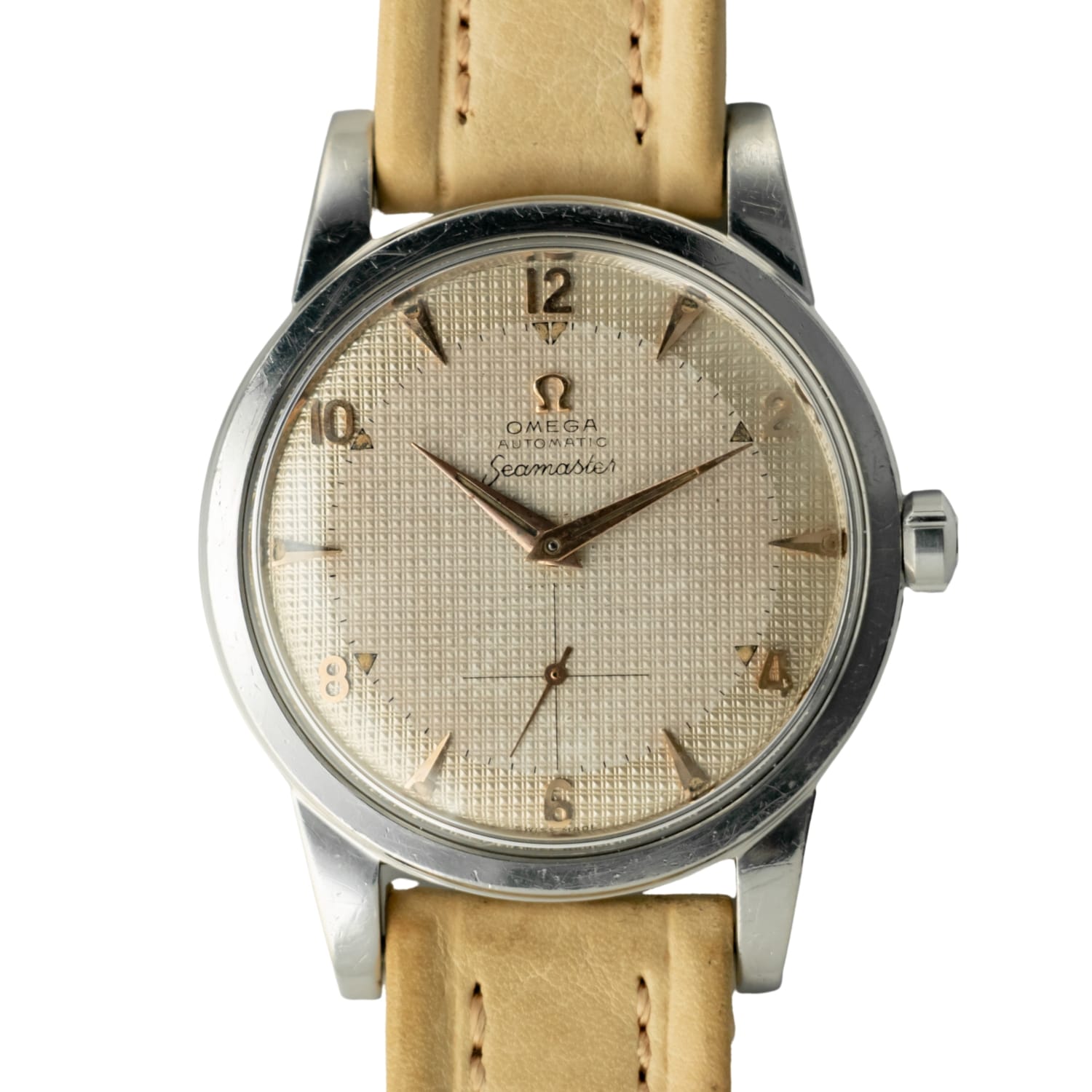
The Omega Seamaster reference 2657 represents a fascinating chapter in the early history of Omega’s most enduring collection. Launched in 1949, just one year after the Seamaster line’s debut, this reference embodies the pioneering spirit of post-war watchmaking when automatic movements were still a novel technology. Known affectionately among collectors as a “Jumbo” Seamaster due to its generous 36mm case diameter (substantial for the late 1940s and early 1950s), the 2657 stands as a bridge between classical dress watches and the sport watches that would later define the Seamaster name.
What makes the reference 2657 particularly compelling is its role as a workhorse model during Omega’s golden age of bumper automatic movements. These watches were built to be robust daily companions, featuring water resistance, legible dials, and the distinctive oscillating weight mechanism that produces an unmistakable mechanical character. Today, the 2657 remains accessible to collectors, typically trading between €600 and €2,000 depending on condition, case material, and dial preservation, making it an excellent entry point into vintage Omega collecting.

Omega Seamaster 2657 Honeycomb 1952 – GOLDAMMER
History & Production Period
The Omega Seamaster 2657 entered production in 1949, emerging during a pivotal moment in horological history when Omega was refining its automatic winding technology. The reference succeeded earlier Seamaster models and was part of the brand’s commitment to creating durable, water-resistant timepieces for everyday wear rather than purely dress occasions.
Production continued through the 1950s, with the reference appearing in Omega catalogs and production records until approximately 1958-1960, though exact discontinuation dates vary by sub-reference and market. During its production run, the 2657 underwent several evolutionary changes, particularly in movement specification and case construction, reflecting Omega’s continuous improvement philosophy.
The 2657 was marketed as part of the Seamaster family, which Omega positioned as robust, water-resistant watches suitable for active lifestyles. The 30-meter water resistance rating (marked on some dials) was genuine innovation for the era, achieved through a screw-down caseback with metal gasket. This reference competed with other mid-century sports watches but distinguished itself through Omega’s reputation for precision and the distinctive bumper automatic movement.
Estimated production quantities for the reference 2657 have never been officially disclosed by Omega. However, given the serial number ranges observed (approximately 10.8 million through 15+ million, spanning 1949-1956+), and the fact that multiple dial and case variations were produced simultaneously, several thousand examples likely left the factory. The reference remained in production for roughly a decade, making it relatively accessible today, though pristine examples with original dials and unpolished cases command premiums.

Omega Seamaster 2657 Honeycomb 1952 – GOLDAMMER
Technical Specifications
The Omega Seamaster 2657 was designed as a mid-sized automatic watch that balanced elegance with functionality, offering a compelling wrist presence during an era when most men’s watches measured 33-34mm.
Case Dimensions:
- Case diameter: 36mm to 36.5mm (excluding crown), with some examples measuring up to 37mm depending on the sub-reference and case maker
- Case thickness: Approximately 11-12mm, accommodating the bumper automatic movement
- Lug-to-lug length: 44mm to 46.2mm, providing excellent wrist presence despite the modest diameter
- Lug width: 18mm, accepting period-correct leather straps or vintage Omega bracelets
Water Resistance:
The 2657 featured modest water resistance of approximately 30 meters (100 feet), achieved through a screw-down caseback with a flat metal gasket. This was respectable for the era, though the watches should not be considered truly waterproof by modern standards. The screw-back construction was a significant advancement over snap-back cases, providing better protection against moisture and dust.
Crystal:
Original examples came fitted with acrylic (plexiglass) crystals, typically in a tension-ring configuration. Some variants featured a small Omega logo embossed in the center of the crystal, visible at certain angles. The tension ring, usually in a yellow or neutral color, compressed as the crystal was fitted into the case, providing a secure hold without adhesive.
Case Materials Available:
The reference 2657 was produced in several case material configurations:
- Stainless steel (most common)
- 14k yellow gold (solid)
- 18k yellow or rose gold (solid, relatively rare)
- Gold-capped (gold-plated top layer over stainless steel base)

Omega Seamaster Jumbo Black Waffle Gold Cap 2494-4 2657
Movements/Calibers
The reference 2657 housed several bumper automatic calibers throughout its production run, representing Omega’s transition from early automatic technology to more refined mechanisms. These movements share the distinctive “bumper” or “hammer” automatic winding system, characterized by a weighted rotor that oscillates approximately 240-270 degrees rather than rotating a full 360 degrees.
Caliber 342 (1949-1952)
The Omega caliber 342 was the inaugural movement fitted to the reference 2657 when production commenced in 1949.
Technical Specifications:
- Jewel count: 17 jewels
- Frequency: 19,800 vibrations per hour (2.75 Hz)
- Power reserve: 42 hours
- Diameter: 28.1mm (12.75 lignes)
- Height: Approximately 5.5mm
- Functions: Hours, minutes, subsidiary seconds at 6 o’clock
The caliber 342 was part of Omega’s 330 series of bumper automatics, derived from the pioneering 28.10 RA PC movement introduced in 1943. What distinguished the 342 from its predecessor was the use of concealed buffer springs rather than exposed ones, creating a cleaner movement appearance. The movement featured a unidirectional winding system, meaning the rotor only wound the mainspring when swinging in one direction.
Serial numbers for movements using the caliber 342 typically fall in the range of approximately 10.8 million to 13 million, corresponding to production years 1949-1952.

Omega Cal.342 Bumper Automatic 18ct Pink Gold 1950 – Original Dial
Caliber 344 (1952-1955)
Around 1952, Omega transitioned the reference 2657 to the caliber 344, which represented an evolution of the 342.
Technical Specifications:
- Jewel count: 17 jewels
- Frequency: 19,800 vibrations per hour
- Power reserve: 42 hours
- Diameter: 28.5mm (approximately 12.75 lignes)
- Height: Similar to caliber 342
- Functions: Hours, minutes, subsidiary seconds at 6 o’clock
The caliber 344 maintained the same basic architecture as the 342 but incorporated refinements in manufacturing and finishing. Both movements shared the characteristic bumper automatic winding mechanism with concealed buffer springs. When you shake a watch containing these movements, you can feel and hear the distinctive “clunk” as the weighted rotor bounces against the buffer springs.
Serial numbers for the caliber 344 era generally range from approximately 13 million through 15 million and beyond, corresponding to production from 1952 through the mid-1950s.
Caliber 351 and 354 (Rare Variants)
While less common in the 2657, some examples have been documented with caliber 351 and caliber 354 movements. These calibers represented parallel developments within Omega’s bumper automatic family:
Caliber 351:
- 17 jewels, similar specifications to the 342/344
- Originally developed for other Seamaster references (particularly the 2494)
- Occasionally found in 2657 cases, possibly as service replacements or special configurations
Caliber 354:
- The highest-grade bumper movement from this era
- Featured a swan-neck regulator for more precise timing adjustments
- 17 jewels, 42-hour power reserve
- This movement was also used in Chronometer-rated Constellation models
- Extremely rare in reference 2657, but documented in at least one example
Movement Characteristics and Maintenance
All these bumper automatic calibers share certain characteristics that collectors should understand:
The Bumper Mechanism:
The oscillating rotor swings freely through an arc of approximately 240-270 degrees before hitting buffer springs at each end. This distinctive action winds the mainspring in one direction only. The mechanism produces an audible and tactile “bump” that gives these movements their nickname. While less efficient than modern bi-directional full-rotor automatics, these movements were robust and provided adequate winding for daily wear.
Common Wear Points:
The bumper automatic system introduces specific long-term wear considerations. The automatic winding axle, press-fit into the automatic bridge, cannot be easily lubricated during routine service. Over decades, this axle can wear, causing the rotor to wobble excessively and potentially rub against the caseback or movement plate. Replacement of the automatic bridge assembly is sometimes necessary but can be costly, as original parts are increasingly scarce.
Additionally, the buffer springs themselves can lose tension or break over time. Watchmakers servicing these movements should inspect and replace worn buffer springs to maintain proper winding function.
Despite these considerations, properly serviced bumper movements are reliable and charming companions. Many collectors appreciate the mechanical character and historical significance of these early automatic calibers.
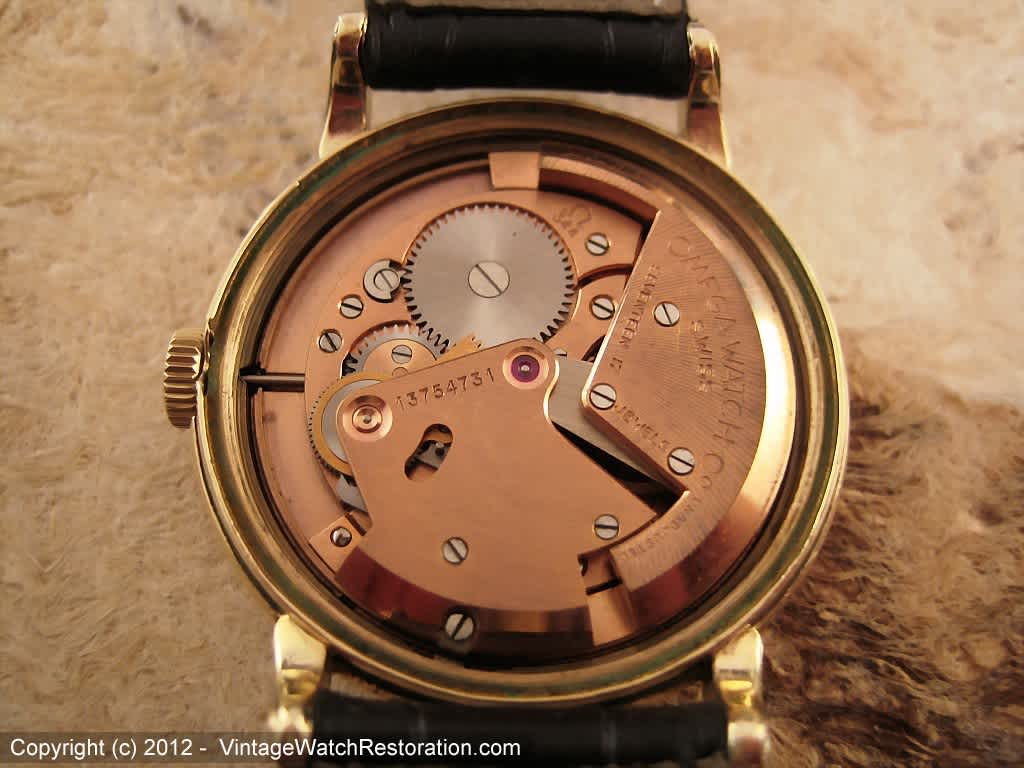
Black Dial Omega Automatic Cal 344 Bumper, Automatic, Large 35mm
Dial Variations
The Omega Seamaster 2657 appeared with a remarkable diversity of dial configurations, reflecting both factory variations and regional market preferences. This variety makes the reference particularly interesting for collectors but also complicates authentication.
Color Variations
Silver/Champagne Dials:
The most commonly encountered dial color, ranging from bright silver to aged champagne hues. Many examples show an even, warm patina that has developed over decades, transforming original silver dials into attractive caramel or bronze tones. This aging is generally viewed positively by collectors when the patina is even and the printing remains crisp.
White Dials:
Less common than silver, featuring a crisper, more opaque white base. These dials can show less dramatic aging, though some examples develop subtle cream or ivory tones.
Black Dials:
Relatively scarce on the 2657, black dials create a more sporty appearance. Examples with black dials often feature painted or applied Arabic numerals in contrasting colors.

1952 OMEGA SEAMASTER 2494-7/2657 WAFFLE DIAL, STEEL, 36MM
Dial Textures and Patterns
One of the most celebrated aspects of the reference 2657 is the variety of textured dials that appeared during production:
Honeycomb Dial:
Perhaps the most sought-after variant, featuring a geometric honeycomb (or hobnail) pattern embossed across the dial surface. This three-dimensional texture catches light beautifully and creates visual interest. Genuine honeycomb dials are relatively rare and command premiums. The pattern typically covers the entire dial surface, with applied markers sitting atop the textured base.
Waffle Dial:
Another distinctive texture, featuring a crosshatch or waffle-like pattern. The “waffle” nickname comes from the grid-like embossing that resembles a waffle iron’s surface. These dials often appeared with two-tone coloring, where the recessed portions aged differently than the raised surfaces, creating attractive visual depth.
1952 OMEGA SEAMASTER 2494-7/2657 WAFFLE DIAL, STEEL, 36MM
Golf Ball/Hobnail Dial:
Similar to honeycomb but with a subtly different dimpled pattern, sometimes described as resembling a golf ball’s surface. This variation is extremely rare and highly prized.
Linen/Grained Dial:
A finer, more subtle texture resembling linen fabric or fine grain. Less dramatic than honeycomb or waffle patterns but still providing visual interest beyond a plain dial.
Smooth/Plain Dial:
Many examples feature smooth, untextured dial surfaces with applied or printed elements. These were likely the standard production version.
Marker and Numeral Configurations
3-6-9-12 Arabic Numerals:
The most common configuration features applied Arabic numerals at the cardinal positions (3, 6, 9, 12) with subsidiary seconds display at 6 o’clock. The numerals were typically applied in gold or rose gold, even on steel-cased examples.
Full Arabic Numerals:
Less common variants featured Arabic numerals at all hour positions, sometimes with printed triangular markers filled with luminous material pointing inward toward the center.
Mixed Markers:
Some dials combined Arabic numerals at select positions (typically 12, 3, 9) with applied dart or dagger indices filling the remaining hours. The subsidiary seconds dial prevented a numeral at 6 o’clock.
Applied Dart/Dagger Indices:
Certain examples featured all applied indices without any Arabic numerals, creating a cleaner, more minimalist appearance.
Hand Styles
The reference 2657 predominantly featured dauphine-style hands in either silver, gold, or rose gold finish to complement the case material. These faceted, tapered hands provided excellent legibility while maintaining elegant proportions. The subsidiary seconds hand at 6 o’clock was typically simpler, often in a contrasting blue steel or matching the hour and minute hands.
Luminous Material
Early examples from 1949-1951 would have been fitted with radium-based luminous material, applied to the hands and hour markers. Radium has a half-life of 1,600 years and remains faintly radioactive, though it gradually damages the phosphorescent pigments it’s mixed with, often resulting in a brownish or absent lume on vintage examples.
From approximately 1952 onward, Omega began transitioning to tritium-based luminous paint, which is much safer and has a half-life of 12.32 years. Tritium dials from the 1950s have long since lost their glow but often display an attractive cream or “pumpkin” patina. The transition wasn’t immediate, so both radium and early tritium can appear on watches from the early 1950s.
Dial Markings Evolution
Text Layout:
Most 2657 dials feature the following text arrangement from top to bottom:
- “OMEGA” logo (applied in metal, typically)
- “SEAMASTER” (printed or occasionally applied)
- “AUTOMATIC” (printed)
- “SWISS MADE” (at the bottom, around 6 o’clock position)
Some dials lack “SWISS MADE” markings or feature variations in the text arrangement, which may indicate earlier production or specific market configurations.
Signature and Branding:
The applied Omega logo varied slightly in style throughout the production period. Early examples show the “flat feet” Omega symbol, while later examples may have subtle differences in the logo’s proportions.

1952 OMEGA SEAMASTER 2494-7/2657 WAFFLE DIAL, STEEL, 36MM
Case & Bezel Variations
The Omega Seamaster 2657 was produced with several case configurations, distinguished by case material, lug design, and manufacturing details.
Case Reference Numbering
The 2657 designation refers to the base reference, but the complete case marking typically appears as 2657 / 2494or variations thereof. The dual numbering system can be confusing, but it indicates that the case was shared between related references. Specific sub-references include:
- 2657-1, 2657-2, 2657-3, 2657-4: Different dash numbers indicated variations in case material, bezel style, or other specifications
- The second number (2494) often appeared alongside 2657, indicating the shared case design with reference 2494, another Seamaster variant
The inside caseback should display these reference numbers along with the case serial number, case maker’s mark, and metal quality stamps.

Omega Seamaster 2657 / 2494-11 SC Stainless steel Black 1947
Case Materials and Construction
Stainless Steel Cases:
The majority of reference 2657 examples were produced in stainless steel, which was practical, durable, and accessible. Steel cases typically feature brushed finishing on the case flanks with polished bezel and lug tops.
Gold-Capped Cases:
A popular mid-tier option, gold-capped cases feature a thin layer of 14k or 18k gold bonded to a stainless steel base. This construction provided the appearance of gold at a fraction of the cost. The gold cap typically covers the bezel, case front, and lug tops, while the caseback remains stainless steel. Over time, wear can expose the underlying steel at high-contact points like lug edges. The reference marking often included “SC” (steel and capped).
Omega Seamaster Jumbo Black Waffle Gold Cap 2494-4 2657
Solid Gold Cases:
Rarer and more valuable, solid gold examples appeared in both 14k and 18k yellow gold, and occasionally rose gold. The 14k versions are somewhat harder than 18k, making them more resistant to scratching and denting. These cases command significant premiums, particularly when in unpolished or lightly polished condition.
Lug Design Evolution
The reference 2657 underwent a notable evolution in lug design during its production run:
Early Lugs (1949-1952):
Initial production featured more slender, elegantly downturned lugs with a clean, flowing profile. These lugs extended gracefully from the case, curving gently downward to follow the wrist’s contour.
“Beefy Lugs” (circa 1952 onward):
Around 1952-1953, coinciding with the introduction of caliber 344, the lug design changed to a thicker, more substantial profile with beveled edges. These “beefy lugs” give the watch a more robust, sporty appearance and have become a signature feature appreciated by collectors. The beefier lugs are particularly prominent on steel examples; solid gold cases maintained a somewhat more conservative lug profile throughout production.

1952 Omega Seamaster ”beefy lugs” *SERVICED* – WOFS Watches
The lug design variation provides clues for dating a specific watch, though there was overlap during the transition period.
Bezel Characteristics
The reference 2657 features a smooth, flat bezel that extends slightly beyond the crystal. Unlike later sports Seamasters with rotating dive bezels, the 2657’s bezel is fixed and purely aesthetic. The bezel has a substantial width, particularly on “beefy lug” examples, contributing to the watch’s distinctive appearance.
The bezel material matches the case: steel bezels on steel watches, gold bezels on gold-capped and solid gold examples. Some two-tone examples feature gold bezels on steel cases.
Case Makers
Period-correct reference 2657 cases were manufactured by Huguenin Frères, one of the premier case makers supplying Omega during this era. The inside caseback may feature the Huguenin Frères mark, though not all casebacks are stamped with the maker’s signature. Other case makers in Omega’s network during this period included Centrale Boîtes S.A. (owned by Omega), Schmitz Frères, and others, though Huguenin Frères appears most commonly on 2657 examples.
Caseback Details
The screw-down caseback is typically smooth and polished, without external engravings on most examples. Later production runs occasionally featured the “Seamaster” designation engraved on the external caseback, though this was less common on the 2657 than on later references.
Inside Caseback Markings:
When opened, the inside of the caseback reveals:
- Case reference numbers (e.g., “2657 / 2494 SC” or variations)
- Case serial number
- Metal quality stamps (stainless steel marks, gold content marks for precious metal cases)
- Potentially the case maker’s logo or signature
- “OMEGA WATCH CO,” “FAB. SUISSE,” or “SWISS MADE” markings
The caseback gasket is a flat metal ring rather than a rubber O-ring, typical for the era.

Omega ref 2657-4 Steel Bump-Auto 36mm Jumbo Seamaster on
Crown
The reference 2657 originally came equipped with an Omega-signed “clover” crown (Omega part number 42023), characterized by its four-lobed design reminiscent of a clover leaf or four-petaled flower. This crown style was used across numerous Seamaster and other Omega references during the 1950s and is considered correct for the 2657. The crown features the Omega logo (often the period-correct “flat feet” logo) and provides comfortable grip for winding and setting.
Original crowns were typically finished to match the case: steel crowns on steel watches, gold or gold-plated crowns on gold-capped examples, and solid gold crowns on solid gold watches. Many vintage examples have had crowns replaced during service, so finding an original period-correct clover crown adds value.

Omega ref 2657-4 Steel Bump-Auto 36mm Jumbo Seamaster on
Bracelet & Strap Options
The Omega Seamaster 2657 was primarily sold with leather straps rather than metal bracelets, reflecting its design positioning as a versatile dress-sport watch.
Period-Correct Leather Straps
Original and period-appropriate straps for the 2657 were 18mm leather in various styles:
Materials:
Colors:
Black and brown were the standard offerings, with tan/cognac and darker conker shades also appearing. The strap width at the buckle end was typically 16mm, tapering from the 18mm lug width.
Buckles:
Original Omega tang buckles in steel or gold-plate accompanied the watches. Steel watches typically came with steel buckles, while gold examples received gold-plated or solid gold buckles matching the case material.
Vintage Omega Bracelets
While leather was the standard fitment, some 2657 examples have been paired with vintage Omega bracelets over the decades. Period-appropriate options include:
Beads of Rice (BOR) Bracelets:
The classic Omega “beads of rice” style with articulated cylindrical links creates an elegant, flexible bracelet. Original BOR bracelets from the 1950s-60s with 18mm end links would be suitable, though these bracelets are now collectible in their own right.
Flat Link Bracelets:
Vintage flat-link Omega bracelets in steel or gold-plate could also be appropriate, though finding examples with correct 18mm end links is challenging.
It’s important to note that most surviving 2657 examples are found on replacement straps rather than original factory straps, as leather deteriorates over 70+ years. Finding a watch on an original vintage Omega strap and buckle is rare and adds value.
Modern Replacement Options
Contemporary collectors often pair the 2657 with:
- High-quality aftermarket leather straps (shell cordovan, textured calf)
- Vintage-style NATO straps (though anachronistic for the 1950s)
- Tropic-style straps for a vintage dive watch aesthetic
The 18mm lug width is a standard size, making strap options abundant. Many collectors prefer to maintain a period-appropriate appearance with brown or black leather straps and vintage-style buckles.
Identifying Original vs. Replaced Parts
Authentication and originality assessment are critical skills when evaluating a vintage Omega Seamaster 2657. Over seven decades, many examples have been serviced, modified, or outright counterfeited, making careful inspection essential.
Dial Authenticity
Signs of Original Dials:
- Printing Quality: Original dials feature crisp, evenly printed text with consistent font styles. Factory printing was executed with precision machinery, resulting in sharp edges and uniform thickness. Use magnification (10x or greater) to examine text carefully.
- Logo Application: The Omega logo should be properly applied (not printed) in metal matching the case/marker material. The logo’s proportions should match period examples, with the “flat feet” Omega symbol typical for 1950s production.
- Dial Texture: If the dial features honeycomb, waffle, or other patterns, the texture should be consistently embossed across the entire surface. Uneven or shallow texturing may indicate a refinished dial.
- Patina Consistency: Natural aging creates relatively even patina, though some variation is normal. Suspiciously uniform “tropical” patina or artificially aged dials should raise questions.
- Luminous Material: Original radium or tritium lume should be present on both the dial indices and the hands, ideally showing similar aging patterns. Mismatched lume colors (e.g., cream on the dial but green on the hands) often indicate service replacements.
Red Flags for Refinished Dials:
- Font Inconsistencies: Crooked text, varying letter heights, or fonts that don’t match reference examples suggest hand-refinishing.
- Missing Swiss Made: Many refinishers omit the “SWISS MADE” text at 6 o’clock because adding it requires an additional printing step.
- Incorrect Text Layout: Text spacing, capitalization, or wording that doesn’t match documented examples indicates a redial.
- Overly Perfect Appearance: While condition matters, a 70-year-old dial that looks flawless should raise suspicion. Some aging is expected and often desirable.
- Paint Inconsistencies: Under magnification, hand-painted refinishes often show uneven paint thickness, brush strokes, or pooling around markers.
Hand Originality
Correct Hands:
Original dauphine hands should match the dial’s age and lume characteristics. The hands should be properly proportioned for the dial, with the minute hand reaching the minute track and the hour hand pointing correctly to the hour markers.
Replacement Indicators:
- Hands with mismatched lume (different color or luminosity than dial markers)
- Wrong style hands (alpha hands on a dial that should have dauphine hands)
- Poorly finished hands with rough edges or improper plating
- Subsidiary seconds hand in incorrect style or length

OMEGA Vintage Seamaster Automatic Ref-2657-4 Stainless Steel
Case Condition Assessment
Polishing Concerns:
Over-polishing is one of the most common condition issues affecting vintage watches. Original 2657 cases featured distinct lines and edges, particularly at the bezel-to-case junction and along the lugs. Excessive polishing rounds these edges, making the case appear “soft” and reducing collector value significantly.
What to Look For:
- Sharp, defined edges on lugs, especially the downturned tips
- Clear beveling on “beefy lug” examples
- Defined step between bezel and case body
- Crisp, deep case reference numbers inside the caseback
- Intact serial numbers (over-polishing can make these shallow or illegible)
Gold-Capped Watches:
Inspect gold-capped examples carefully for wear-through at the lug edges, bezel rim, and other high-contact points. Some wear is acceptable and expected, but extensive steel exposure reduces value.
Crown Verification
The correct “clover” crown (part 42023) should feature:
- Four-lobed clover design
- Omega logo (period-appropriate “flat feet” style for 1950s)
- Proper size and threads matching the case tube
- Finish matching the case material
Many 2657 examples have incorrect replacement crowns fitted during service. While this doesn’t make the watch worthless, an incorrect crown should be factored into value assessment.
Crystal Authentication
Original acrylic crystals, particularly those with the embossed Omega logo, are often missing or replaced. Replacement crystals are acceptable and necessary for practical use, but original crystals with the logo add to originality scores. The crystal should sit properly in the case with the tension ring providing secure fitting without wobbling.
Movement Authenticity
Verification Steps:
- Serial Number Cross-Check: The movement serial number should align with the production dates for the reference 2657 (approximately 10.8 million through 15+ million, corresponding to 1949-1956+). Movement serial numbers outside this range may indicate a replacement movement.
- Correct Caliber: Verify that the movement is one of the correct bumper automatic calibers: 342, 344, or (rarely) 351/354.
- Movement Condition: The movement should be complete, with all bridges, automatic mechanism components, and bumper springs present. Missing or mismatched parts suggest incomplete service or donor parts.
- Case-to-Movement Fit: The movement should sit properly in the case with the correct movement ring or retaining system. Loose movement or incorrect retention methods indicate potential issues.
Service Dials and Replacement Parts
During the 1960s-1980s, many vintage Omegas received “service dials” during official Omega service. These replacement dials, while genuine Omega parts, often differed subtly from original production dials in font style, lume application, or finish. Service dials are generally acceptable to collectors if properly disclosed, though they command lower prices than watches with original dials in good condition.
Similarly, service replacement hands, crowns, and crystals are common. The key is honest representation: a watch with some service parts can still be valuable and collectible, but it should be priced and described accordingly.
Collector Notes & Market Context
The Omega Seamaster 2657 occupies a sweet spot in the vintage watch market, offering genuine Omega quality, interesting historical significance, and engaging mechanical character at accessible price points.
Current Market Positioning
Value Ranges (as of late 2025):
Entry-Level Examples: €600-1,000 / $650-1,100
Watches in this range typically show honest wear, may have some replaced components (service dial, non-original crown), and are in functioning but possibly unserviced condition. Steel cases with basic silver/champagne dials predominate at this level.
Mid-Range Examples: €1,000-1,500 / $1,100-1,650
This bracket includes well-preserved steel examples with original dials, correct components, and recent service. Unpolished or lightly polished cases, attractive patina, and complete original presentation elevate watches to this tier.
Premium Examples: €1,500-2,500+ / $1,650-2,750+
Top-tier pricing applies to:
- Honeycomb, waffle, or other special dial variants in excellent condition
- Solid gold examples (14k or 18k) in unpolished condition
- Steel watches with exceptional dial preservation and full originality
- Examples with original box, papers, or documented provenance
Exceptional Examples: €2,500+ / $2,750+
Museum-quality pieces with rare dial variants, pristine condition, full documentation, and desirability factors can exceed these ranges, though the 2657 rarely commands the prices of more iconic Omega references like the Speedmaster or Seamaster 300.
Market Trends
The vintage Omega market has seen steady appreciation over the past decade, with the 2657 following broader trends. The reference benefits from:
- Jumbo Size Appeal: The 36mm case diameter is highly wearable by modern standards, unlike smaller 32-34mm vintage watches that feel diminutive on contemporary wrists.
- Bumper Movement Character: Collectors appreciate the distinctive mechanical feel and sound of bumper automatics, which differ from modern full-rotor movements.
- Seamaster Heritage: As an early Seamaster, the 2657 connects to one of watchmaking’s most storied collections, even if it predates the iconic dive watches.
- Accessible Entry Point: Compared to Speedmasters or Seamaster 300s, the 2657 offers genuine vintage Omega ownership at approachable prices.
Configurations Most Sought-After
Honeycomb/Hobnail Dials:
These textured dial variants generate the most collector enthusiasm, often commanding 50-100% premiums over similar watches with smooth dials.
Solid Gold Examples:
Particularly in 18k gold with original, unpolished cases, solid gold 2657s appeal to collectors seeking precious metal vintage watches.
Early Production “Slim Lug” Examples:
The pre-1952 examples with slender, elegant lugs represent the reference’s debut period and appeal to collectors seeking the earliest configurations.
Unpolished Cases:
Sharp, unpolished cases with intact edges and crisp markings command significant premiums as collectors increasingly value originality over artificial restoration.
Common Pitfalls to Avoid When Purchasing
- Refinished Dials: Redials are perhaps the most common issue affecting vintage Omega values. Use the authentication guidance in Section 8 to identify refinished dials, which can reduce value by 30-50% or more.
- Over-Polished Cases: Excessive polishing destroys originality and collector value. Learn to identify original case profiles and avoid heavily polished examples unless reflected in pricing.
- Incorrect Components: Mismatched hands, wrong crown, non-period bracelet, or service dial should all factor into purchasing decisions and price negotiations.
- Movement Issues: Bumper automatic movements require specialized service knowledge. Ensure the automatic winding function works properly, as repairing worn bumper mechanisms can be costly.
- Missing Movement Retention: Some 2657 examples have lost the movement retention ring or have had makeshift solutions installed. This is correctable but indicates prior watchmaker shortcuts.
- Franken-Watches: Cases, dials, and movements from different references or eras sometimes get combined. Verify serial numbers and component compatibility.
What Drives Premiums
Box and Papers:
Original presentation boxes and warranty papers are exceptionally rare for 1950s watches but can double the value of an otherwise typical example.
Unpolished Condition:
Sharp, original cases are increasingly valued as collectors recognize the irreversibility of polishing.
Rare Dial Variants:
Honeycomb, waffle, and other special textures create meaningful premiums.
Documented Provenance:
Known ownership history, particularly family provenance (inherited from original owner), adds intangible value and storytelling appeal.
Chronometer Certification:
While most 2657 examples were not chronometer-certified, any watch with original chronometer papers or movement markings indicating chronometer grade would be exceptionally desirable.
Regional Availability
The reference 2657 appears on the market globally, with concentration in:
- Europe: Germany, United Kingdom, France, and Switzerland have active vintage Omega markets
- United States: Strong collector base, particularly on the coasts
- Japan: Japanese collectors appreciate vintage Omega, and examples appear through Japanese dealers
- Australia: Growing vintage watch market with regular 2657 availability
Investment Perspective
While watches should primarily be purchased for enjoyment rather than investment, the Omega Seamaster 2657 represents reasonable value stability. The reference is unlikely to experience dramatic appreciation but should hold value reasonably well, particularly for examples in excellent condition with desirable configurations. The bumper automatic era is gaining appreciation among collectors as these movements become increasingly historical artifacts of mid-century watchmaking innovation.
The relatively limited supply of pristine examples with special dial variants creates scarcity that may drive gradual appreciation, while the abundance of standard examples provides market stability and accessibility for new collectors.
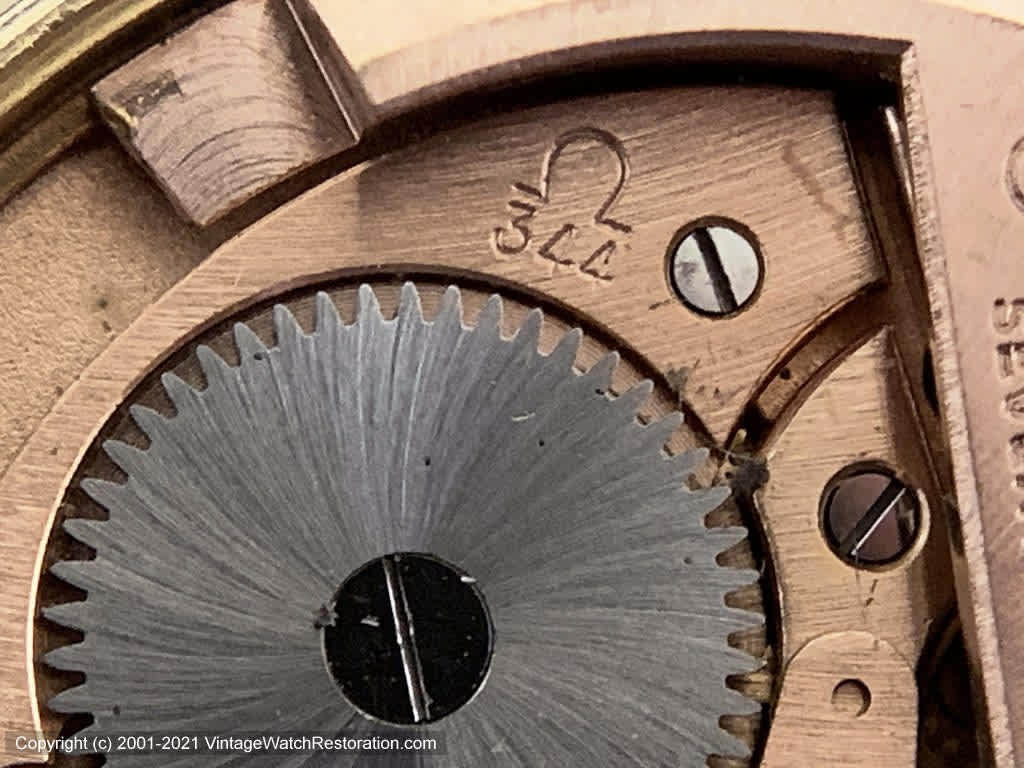
Omega Silver Dial Cal 344 Bumper, Automatic, 33mm
Images
Throughout this report, I’ve included images showing:
- Overall watch appearance from multiple angles
- Honeycomb and waffle dial variations
- Caliber 342 and 344 bumper movements
- Case profile and lug details
- Gold-capped and solid gold examples
- Caseback details and markings
- Different dial configurations and colors
These visual references help collectors understand the range of variations and authentic presentations for the reference 2657.
Conclusion
The Omega Seamaster reference 2657 stands as a testament to Omega’s post-war innovation and the company’s commitment to producing robust, elegant timepieces during the golden age of automatic watchmaking. From its introduction in 1949 through the late 1950s, this reference served countless wearers as a reliable daily companion, offering the novelty of automatic winding in a generously sized, water-resistant package.
Today, the 2657 rewards collectors with mechanical charm, historical significance, and practical wearability. The distinctive bumper automatic movements provide tangible connection to mid-century horological engineering, while the 36mm case size translates surprisingly well to modern wrists. Whether drawn to honeycomb dials, solid gold cases, or simply the appeal of an early Seamaster, collectors find in the 2657 an accessible entry point to serious vintage Omega ownership.
As with all vintage timepieces, careful authentication, condition assessment, and realistic expectations about originality are essential. The reference 2657’s seven-decade history means that perfectly original examples are increasingly rare, but honest, well-preserved watches with period-correct components remain available to knowledgeable collectors.
For the vintage Omega enthusiast, the reference 2657 offers the opportunity to own and enjoy a watch that participated in Omega’s evolution from a respected Swiss manufacturer into one of the world’s most iconic watch brands. The bumper movement’s distinctive mechanical voice, the case’s elegant proportions, and the dial’s potential for unique character combine to create a watch that transcends its modest market position, offering daily pleasure and historical connection to those who appreciate watchmaking’s heritage