

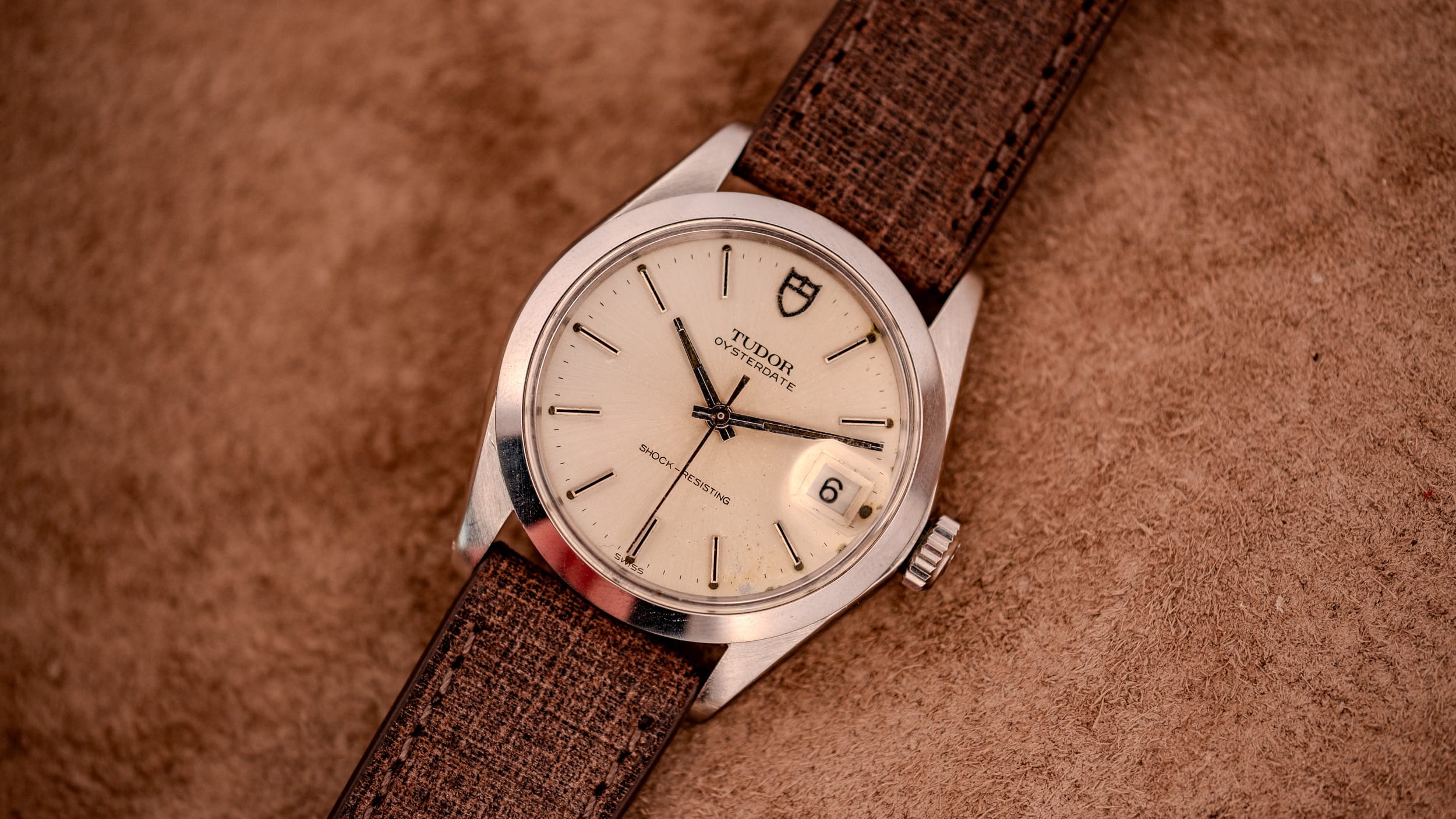
Tudor has never published an official serial number list. That single fact creates more confusion in the vintage market than almost any other identification problem I deal with on the bench. Rolex collectors have well-documented charts going back decades. Tudor collectors are working from community-compiled data, cross-referenced estimates, and hard-won experience opening casebacks.
This guide consolidates everything I know about Tudor serial numbers into one reference. The serial ranges here are drawn from the most reliable collector databases available, cross-checked against watches I have personally handled and documented. Where sources disagree, I flag the dispute. Where the data has a gap, I say so. Nothing here should be treated as officially confirmed by Tudor or Rolex S.A.
Where to Find the Serial Number
The location of the serial number on a Tudor watch depends on when it was made. Getting this wrong is the first mistake most people make, because they look in one spot, see nothing, and assume the number is missing.
Pre-1950s: Check the Caseback
Very early Tudor watches from the late 1930s and 1940s, including those in Dennison-style cases, sometimes carried serial numbers on the exterior or interior of the caseback rather than between the lugs. If you have a watch from this era and see nothing between the lugs, flip the case over. Check both the outside surface and the inside of the caseback before assuming the number is absent.
1950s Through the Late 1990s: Between the Lugs at 6 O’Clock
This is the standard location for the vast majority of vintage Tudor watches. The serial number is engraved between the lugs at the 6 o’clock position, hidden behind the bracelet or strap attachment point. You need to remove the bracelet to see it. The reference (model) number sits in the opposite position between the lugs at 12 o’clock.
Both placements mirror Rolex practice exactly, because Tudor used Rolex-supplied Oyster cases throughout this period.
Modern Tudor (Post-2010)
On contemporary Tudor models, the serial and reference numbers have moved to the underside of the lugs. You can read them by tilting the watch without removing the bracelet. Tudor did not follow Rolex’s mid-2000s practice of engraving serial numbers on the rehaut (the inner flange between the crystal and the dial). That was a Rolex-specific change that started around 2005.
Tudor Serial Number Chart by Year
Before using this chart, understand what it represents and what it does not. These numbers indicate the approximate earliest serial produced in a given year, not a hard boundary. Production batches overlapped, and a watch completed at the end of one year could carry a serial that technically falls into the next year’s range. Treat every estimate as plus or minus one year.
The chart breaks into five distinct phases. Each one has its own complications.
Phase 1: Sequential Serials (1940 to 1984)
This is the longest and most straightforward era, but it starts with a significant blind spot. The entire range from approximately 40,000 to 140,000 covers a sixteen-year window (1940 to 1956) with no annual breakdown. The reasons are practical: production disruptions during World War II, lower output volumes, and limited collector documentation from that era. If your serial falls in this range, you cannot pin down a year from the serial alone. You need the reference number and movement caliber to narrow the window.
From 1957 onward, the data improves considerably.
| Serial Number | Approximate Year |
|---|---|
| 40,000 to 140,000 | 1940 to 1956 (undifferentiated) |
| 170,000 | 1957 |
| 200,000 | 1958 |
| 280,000 | 1959 |
| 310,000 | 1960 |
| 340,000 | 1961 |
| 360,000 | 1962 |
| 390,000 | 1963 |
| 430,000 | 1964 |
| 460,000 | 1965 |
| 500,000 | 1966 |
| 570,000 | 1967 |
| 620,000 | 1968 |
| 680,000 | 1969 |
| 740,000 | 1970 |
| 750,000 | 1971 |
| 770,000 | 1972 |
| 790,000 | 1973 |
| 810,000 | 1974 |
| 830,000 | 1975 |
| 840,000 | 1976 |
| 860,000 | 1977 |
| 880,000 | 1978 |
| 900,000 | 1979 |
| 930,000 | 1980 |
| 950,000 | 1981 |
| 970,000 | 1982 |
| 980,000 | 1983 |
| 990,000 | 1984 (end of first sequence) |
The 1957 through 1984 boundaries are consistent across the major collector databases. Confidence in this range is moderate to high.
Phase 2: The 1984 Reset (No Prefix)
This is the single most dangerous ambiguity in Tudor serial number dating.
Around 1984, after the sequence reached approximately 990,000, Tudor reset its serial counter back to a low number without adding any letter prefix. That means a bare six-digit number like 170,000 could belong to a 1957 watch or a 1986 watch. There is no way to distinguish them from the serial number alone.
| Serial Number | Approximate Year |
|---|---|
| ~10,000 | 1984 (post-reset) |
| 140,000 | 1985 |
| 170,000 | 1986 |
| 190,000 | 1987 |
| 210,000 | 1988 |
| 260,000 | 1989 |
Any unlettered six-digit serial below approximately 260,000 is potentially from either the 1940s through 1960s or the 1984 through 1989 window. Resolution requires examining the reference number (a pre-1970 reference cannot be a 1986 watch), the movement caliber, and the case construction. I cover the specific cross-checks in the authentication section below.
Phase 3: B-Prefix Era (1990 to 1998)
Tudor introduced an alphanumeric serial format beginning with the letter B around 1990. This eliminated the reset ambiguity and made dating straightforward again, at least for the next eight years.
| Serial Number | Approximate Year |
|---|---|
| B330,000 | 1990 |
| B360,000 | 1991 |
| B390,000 | 1992 |
| B500,000 | 1993 |
| B560,000 | 1994 |
| B580,000 to B590,000 | 1995 (disputed between sources) |
| B790,000 | 1996 |
| B850,000 | 1997 |
| B990,000 | 1998 |
The 1995 boundary carries a minor discrepancy: some databases place it at B580,000, others at B590,000. The difference of 10,000 units is well within the margin of approximation for community-sourced data and should not affect practical dating.
Phase 4: H-Prefix Era (1999 to 2002)
The serial prefix shifted from B to H around 1999.
| Serial Number | Approximate Year |
|---|---|
| H100,000 to H130,000 | 1999 (disputed between sources) |
| H170,000 | 2000 |
| H240,000 | 2001 |
| H300,000 | 2002 |
Some sources also mention O and J serial prefixes running in parallel with the H series during approximately 2001 through 2007. This claim appears in at least two independent references but lacks well-documented watch examples in public collector forums. If you encounter a Tudor with an O or J prefix from this period, standard H-prefix charts will not apply. This remains an unresolved gap in the public record.
Phase 5: Random Serials (Post-2002)
Around 2002, Tudor adopted random serial numbers. The serials follow no sequential pattern and cannot be used to estimate a production year. This is the same shift Rolex made, just applied through a different timeline.
For dating a post-2002 Tudor, your options are the original guarantee card or certificate (if it survives), Tudor’s Watch ID system (their NFC-enabled guarantee card links to watch-specific details online), authorized dealer records, or cross-referencing the reference number against known production windows to establish a floor and ceiling estimate.
Tudor vs. Rolex: Shared Cases, Separate Serials
This is the most commonly misunderstood aspect of Tudor identification, and I correct it on the bench regularly.
Tudor used Rolex-supplied Oyster cases for the majority of its production history. That is why the serial number placement conventions are identical. But the serial numbers themselves were not drawn from the same pool. Tudor and Rolex operated separate sequential systems.
The clearest evidence is the letter prefix structure. Rolex used the letters R, L, E, X, then N, C, S, then W, T, U, A, P, K, Y, F, D, Z, M, V, and G for its letter-prefix era starting in 1987. Rolex never started a serial series with B, I, J, O, or Q. Those letters appear to have been reserved for Tudor use. The two brands coordinated their letter assignments to prevent overlap, but the numeric sequences within each prefix were independent.
The practical consequence: a Tudor with serial B504xxx and a Rolex with serial B504xxx are unrelated. They share a letter prefix assigned to each brand separately. If you apply a Rolex serial chart to a Tudor watch, your date will be wrong.
For the pure-numeric pre-1984 era, Tudor’s six-digit serials (up to approximately 990,000) ran in a range that partially overlaps with Rolex serials from the 1920s through the late 1950s. A serial number alone cannot distinguish a very old Rolex from a Tudor in this overlap zone. The case form, crown signature, reference number, and caseback text are what separate them.
Understanding Tudor Reference Numbers
The reference number and the serial number serve completely different functions, and confusing them is one of the most common mistakes I see from new collectors. The serial number is unique to each individual watch. The reference number identifies the model configuration and is the same across every watch of that type.
Where to Find It
On vintage Tudor, the reference number is engraved between the lugs at 12 o’clock, directly opposite the serial number at 6 o’clock. On modern models it appears on the lug underside or in documentation.
Four-Digit Vintage References
Vintage Tudor references are typically four digits. The key models:
| Reference | Model | Approximate Production Era |
|---|---|---|
| 7922 | Oyster Prince Submariner (first generation) | 1954 to c.1960 |
| 7928 | Oyster Prince Submariner | c.1958 to 1970s |
| 7016 | Oyster Prince Submariner (no date) | 1968 to c.1975 |
| 7021 | Oyster Prince Submariner (date) | 1969 to c.1975 |
| 7017 | Oyster Prince Date+Day (large) | 1969 to 1979 |
| 9401 | Oyster Prince Submariner (no date) | 1975 to c.1985 |
| 9411 | Oyster Prince Submariner (date) | 1975 to c.1985 |
The Slash Suffix System
Many vintage Tudor references include a slash suffix that indicates case material and bezel configuration:
/0 indicates a stainless steel case. This is the most common variant. Examples: 7016/0, 7021/0, 9401/0.
/1 indicates a yellow gold or gold-topped case variant.
/3 indicates stainless steel with a yellow gold fluted bezel.
The suffix system was informal by modern standards. Tudor documentation from this era is sparse, and collector knowledge is built from catalogued examples rather than official specifications. You will sometimes see references written without the slash (94010 instead of 9401/0), particularly in period documents.
Five-Digit References (c.1975 to 2000)
As Tudor’s lineup expanded, references grew to five digits. The final digits encode configuration details, particularly for the chronograph models:
| Reference | Model | Configuration |
|---|---|---|
| 79090 | Submariner (1980s to 1990s) | ETA 2824, steel, no date |
| 79160 | Big Block Chronograph | Black/blue tachymeter bezel |
| 79170 | Big Block Chronograph | Rotating bidirectional bezel |
| 79180 | Big Block Chronograph | Engraved tachymeter bezel |
| 79190 | Submariner (late 1990s) | Tudor-signed crown, ETA 2824 |
Modern Reference Numbers
Contemporary Tudor references like M79230B-0006 use an expanded format. The leading M designates the modern manufacture generation. The numeric string identifies the model. The trailing alphanumeric suffix encodes bracelet type, dial color, and bezel configuration. Tudor has not published a universal decoder for these suffixes.
How to Authenticate a Tudor Using Its Serial Number
A serial number by itself establishes an approximate production window. That is useful, but it is only the first step. Authentication requires checking whether the complete watch is internally consistent with that window. Here is the process I follow on the bench.
Step 1: Establish the Production Window
Use the charts above to identify whether the serial falls into a datable range. Note the approximate year. For watches with ambiguous numbers (bare serials between 10,000 and 260,000 with no letter prefix), hold both the 1940s/1960s possibility and the 1984/1989 possibility open until further evidence resolves the question.
Step 2: Cross-Check the Reference Number
Confirm that the reference number was actually in production during the period suggested by the serial. A serial of B504xxx (approximately 1993) on a reference 7016/0 is impossible. The 7016/0 was produced from 1968 to approximately 1975 and would carry serials in the 620,000 to 830,000 range. Any mismatch between serial range and reference production period is an immediate red flag.
Step 3: Verify the Movement Caliber
Open the caseback and confirm the movement caliber matches what the reference should contain. Counterfeit Tudor watches frequently use wrong-era ETA movements or generic ebauches. A genuine late-1960s Tudor Submariner 7016/0 should house an ETA cal. 2461 or 2483. Finding a 2824 in that case is a mismatch that demands explanation.
Here are the period-correct calibers for the most commonly encountered vintage Tudor references:
| Reference | Expected Caliber |
|---|---|
| 7922, 7924 | Tudor 390 / FHF 390 (17 jewel) |
| 7016/0 | ETA 2461 or ETA 2483 (25 jewel) |
| 7021/0 | ETA 2484 (25 jewel) |
| 9401/0 | ETA 2776 (25 jewel, hacking) |
| 9411/0 | ETA 2784 (25 jewel) |
| 79090 | ETA 2824 (25 jewel) |
| 79160 / 79170 / 79180 | Valjoux 7750 (Tudor-modified) |
| 79190 | ETA 2824 (25 jewel) |
For modern Tudor with in-house movements (2015 onward), the MT-series calibers share consistent specifications: 70-hour power reserve, 28,800 bph, silicon balance spring, and COSC certification. The MT designation stands for Manufacture Tudor.
Step 4: Examine the Caseback
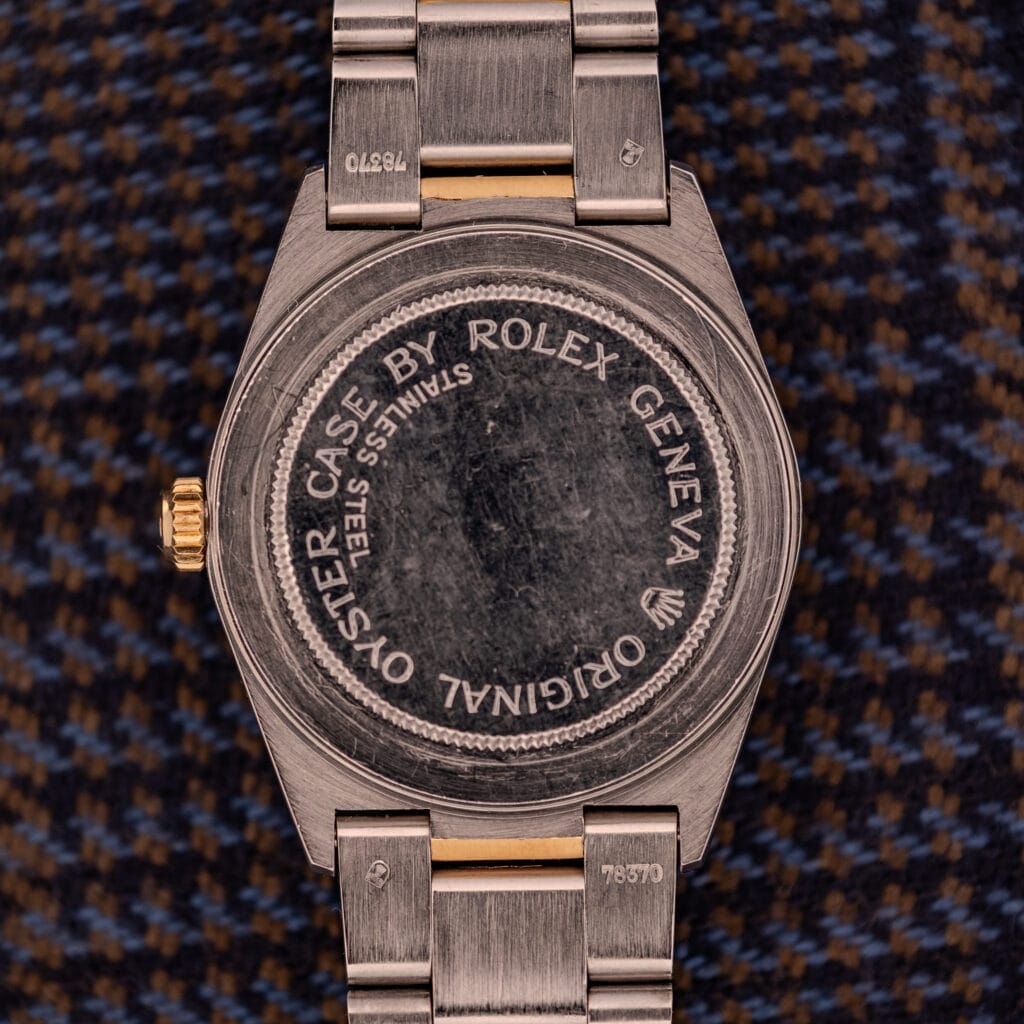
Pre-2000 Tudor Oyster cases typically carry the engraving “Original Oyster Case by Rolex Geneva” on the inner caseback surface. This text, combined with the Rolex-signed screw-down crown found on many models through the early 1990s, is a period-correct authentication marker. Absence of this engraving on a watch claimed to be from the 1970s through 1990s warrants investigation.
Note that this engraving can be replicated. It is a necessary condition, not a sufficient one.
Step 5: Check Dial Typography
Tudor dial printing conventions changed at documented points, and these serve as reliable period markers:
“T SWISS T” beneath the dial text indicates tritium luminous material. This convention was used from the late 1960s through approximately 1998, when EU regulations phased out tritium.
“SWISS MADE” or “SWISS” only appears on post-1998 dials.
The Tudor Rose logo was used until approximately 1969, when Tudor transitioned to the shield logo.
A dial with post-1998 typography on a watch carrying a B-prefix serial (nominally 1990 to 1998) indicates either a dial replacement or a forgery. Both possibilities need investigation.
Step 6: Crown and Bracelet Consistency
Early Tudor watches through approximately the early 1990s carried a Rolex-signed Triplock or Twinlock crown. The transition to a Tudor-signed crown began in the late 1990s. If the crown signature does not match the era suggested by the serial, that is another data point worth examining.
For bracelets, Tudor and Rolex oyster bracelets carry two-character date codes on the clasp indicating production month and year. These can corroborate or refine a serial number date estimate.
Common Mistakes to Avoid
Confusing the serial number with the reference number. The serial is at 6 o’clock. The reference is at 12 o’clock. They serve entirely different purposes. Many buyers photograph only the reference number and ask for a production date, which cannot be determined from a reference number.
Applying Rolex serial charts to a Tudor. Tudor and Rolex operated separate sequences. A serial of 620,000 places a Tudor in approximately 1968. The same number on a Rolex dates to the late 1950s. The charts are not interchangeable.
Ignoring the 1984 reset. The most common dating error for mid-era Tudor watches. Any unlettered six-digit serial below approximately 260,000 needs to be resolved against the reference number and movement before assigning a date.
Assuming the B prefix connects to Rolex’s letter series. Rolex never used B as a serial prefix. Tudor’s B prefix was entirely independent, beginning in 1990. There is no chronological or sequential relationship between Tudor’s B series and any Rolex letter era.
Treating serial ranges as exact boundaries. The published tables represent the approximate beginning of production in a given year. Watches produced at year end could carry serials that appear in the next year’s range. Movement preparation batches could mean a physically completed watch carries a serial from six to twelve months before retail sale. Always treat the year estimate with a margin of plus or minus one year.
A Note on Post-2002 Authentication
For modern Tudor watches, the primary authentication tool is the Tudor Watch ID system. Tudor’s NFC-enabled guarantee card, introduced and updated through the mid-2020s, links to a Watch ID page containing the registered serial number, model, and guarantee date. As of recent updates, the system uses encryption tied to the physical RFID chip, making card duplication significantly more difficult than earlier iterations.
If you are buying a modern Tudor on the secondary market, confirming the Watch ID card matches the watch in hand is the single most important step. For vintage Tudor, you are in serial number and reference number territory, and this guide is your starting point.
Related posts

Watch Shapes: Which Vintage Case Shape Fits Your Style?
Case shape changes how a vintage watch wears more than diameter alone. Compare eight silhouettes and learn which one fits your wrist and style.
Vintage Dress Watches: How to Choose One You’ll Actually Wear
The best vintage dress watch is the one you will wear beyond weddings. Here is how to choose the right size, metal, dial, shape, and strap.
Vintage Watch Styles: A Visual Guide to Finding Yours
Most buyers pick a brand and stall. Here are nine vintage watch styles, shown with real watches from our archive, and the catch that comes with each one.
Vintage Tank Watches: A Buyer’s Guide to Rectangular Watches Beyond Cartier
Every Cartier Tank alternatives list is new watches imitating old ones. The originals still exist and cost less. A buyer's guide to vintage tank and rectangular watches: the brands, the prices, and what to check.
Service History Is the Wrong Question. Here’s the Right One.
Everyone says to ask for a vintage watch's service history. Most of it can't be verified, and a receipt proves a transaction, not a result. Here's what actually tells you a watch has been serviced, and the better question to ask.
LeCoultre vs. Jaeger-LeCoultre vs. Jaeger: What the Name on the Dial Means
Three names, one Swiss firm, and one watch that isn't what it looks like. What LeCoultre, Jaeger-LeCoultre, and plain Jaeger on a vintage dial really tell you.
Omega Seamaster 166.010 Buyer’s Guide: Prices, Variants, and What to Look For (2026)
Everything you need to buy an Omega Seamaster 166.010 in 2026: real market prices by condition tier, five dial variants explained, caliber 562 vs 565, original part numbers, and what to inspect before you commit.
Omega vs Rolex: The Vintage Buyer’s Verdict
Vintage Omega vs vintage Rolex: where the Rolex premium is worth paying, where Omega is the smarter buy, and how to dodge redials on both. A collector's verdict.
Movado Kingmatic: A Vintage Buyer’s Guide to References, Calibers, and Value
The Movado Kingmatic is one of the best values in vintage automatics. A buyer's guide to its references, in-house calibers, the Sub-Sea line, what to check, and what they actually sell for.
13 Vintage Watch Collecting Tips for Beginners (From 1,000+ Watches Sold)
Thirteen vintage watch collecting tips drawn from selling over 1,000 watches. What separates a smart first buy from an expensive lesson, with no sugar.
Vintage Wittnauer Chronograph Caliber Identification: Venus 188, Valjoux 7733/7734, Landeron 248
How to identify the movement inside any vintage Wittnauer chronograph: Venus 188, Valjoux 7733 and 7734, Landeron 248, and the house numbering system Wittnauer used to mark them.
How Water-Resistant Is a Vintage Watch, Actually? The Honest Answer.
Every dealer says never get a vintage watch wet. That advice is half-engineering and half-liability theater. Here is what is actually true about vintage water resistance, where water actually gets in, and when a 1965 diver is safer than a 2-year-old modern.