

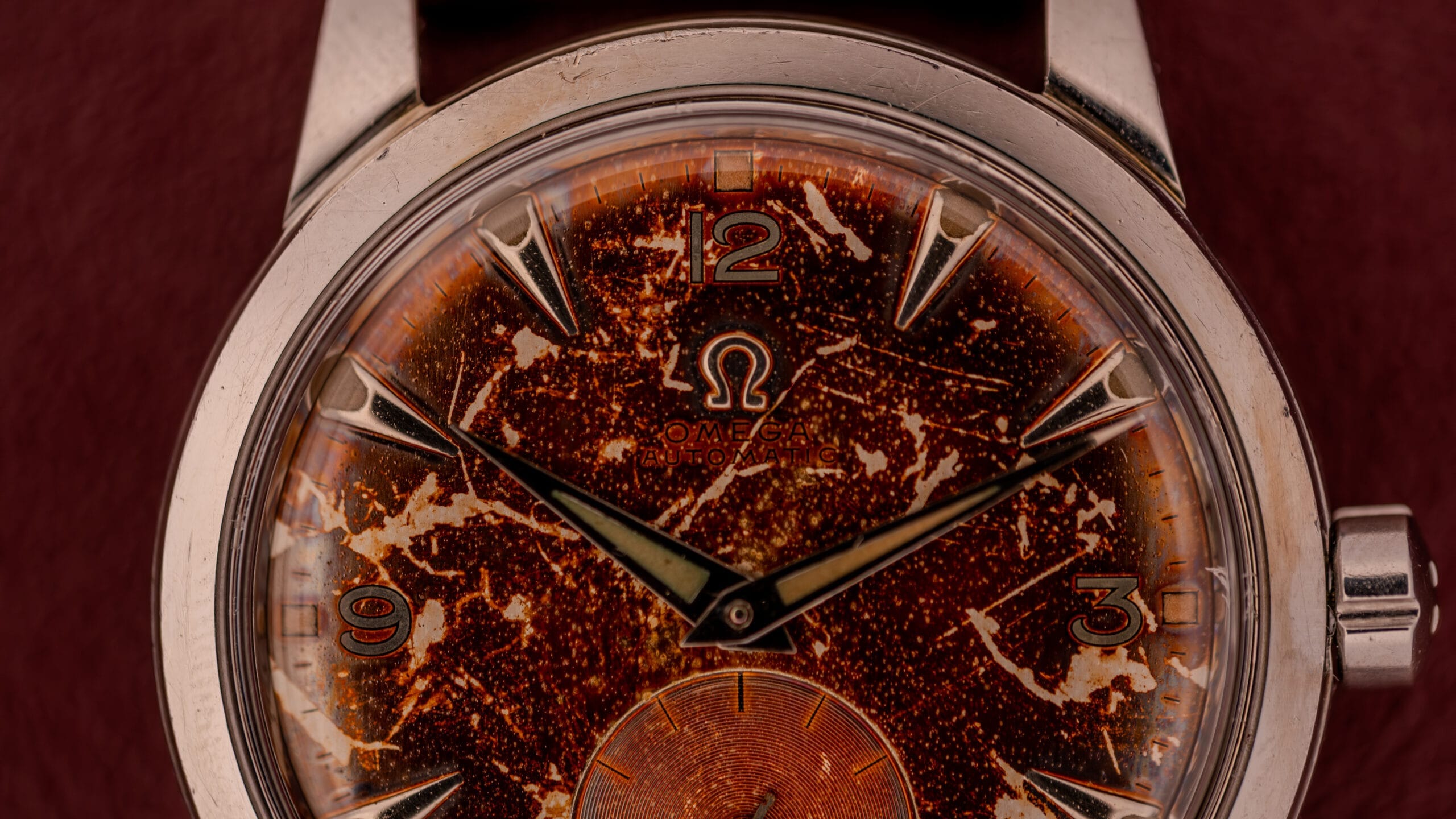
The first time I held a Omega bumper , I did not know what I was feeling. The watch was a Seamaster 2577, steel case, silver dial, nothing remarkable to look at. But when I turned my wrist, there was a small, deliberate knock from inside the case. Not a rattle. Not a malfunction. A pulse. The weight inside the movement had swung through its arc, struck a tiny spring buffer, and bounced back. It did this every time I moved. The watch was talking to me.
I have owned many watches since then, some of them considerably more expensive and objectively more refined. None of them have ever communicated quite like that Seamaster did. A modern automatic rotor spins silently and invisibly. You forget it is there. A bumper reminds you with every turn of the wrist that something mechanical is happening on the other side of the dial. It is, as one collector described it, a visceral experience you will never get from any other type of watch.
Omega produced over 1.3 million bumper movements between 1943 and the early 1960s. More than 500,000 of them received chronometer certification. They powered everything from wartime dress watches to the earliest Seamasters to the first Constellations ever made. And today, you can buy an honest, running example for less than a thousand dollars. That combination of history, mechanical personality, and accessibility is almost impossible to find anywhere else in vintage watchmaking.
What a Bumper Actually Is
The bumper automatic is a specific type of self-winding mechanism that preceded the full 360-degree rotor most modern automatic watches use. Instead of a centrally mounted weight that spins freely in both directions, the bumper uses a heavy semicircular weight that pivots through a limited arc, roughly 120 to 270 degrees depending on the caliber. When the weight reaches either end of its travel, it strikes a pair of spring-cushioned buffer stops and rebounds in the opposite direction. That rebound is the bump you feel on your wrist.
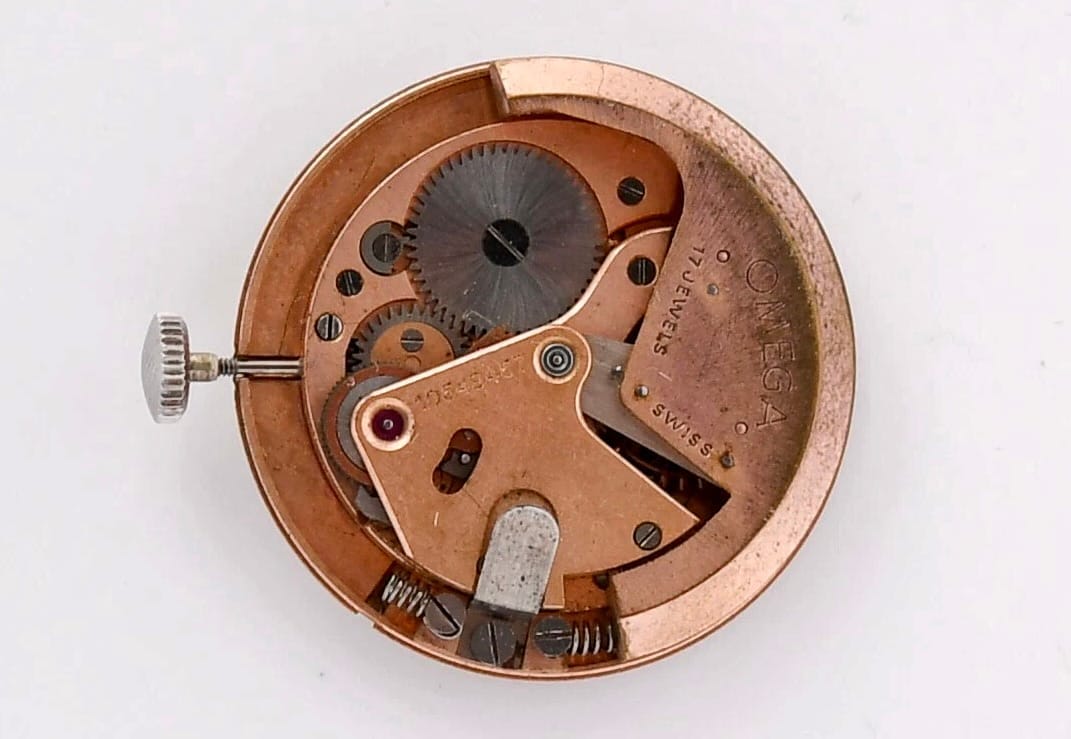
Only one direction of the swing winds the mainspring. The other direction simply clicks over a ratchet without transferring energy. This makes the bumper inherently less efficient than a full-rotor system, which captures energy in both directions. In practice, though, the difference rarely matters. A typical working day generates more than enough wrist movement to keep a bumper wound to its full 42-hour power reserve. The efficiency argument is theoretical. On a living wrist, a bumper keeps time just fine.
The reason Omega and nearly every other Swiss manufacturer besides Rolex used bumper systems for so long has nothing to do with preference. It has to do with patents. Rolex patented the modern full-rotor automatic in 1931, and those patents effectively locked out competitors for roughly two decades. Longines managed to introduce a full-rotor caliber as early as 1945 through arrangements that remain historically unclear, but everyone else, Omega included, worked around the Rolex patent by building bumpers. When the patent situation shifted in the early 1950s, Omega moved quickly to develop its own full-rotor platform. But for an entire decade before that, the bumper was the only automatic Omega made.
The bumper had one genuine mechanical advantage over the early full rotors: it was thinner. Because the oscillating weight operates in the same plane as the base movement rather than above it, bumper automatics could be built with slimmer profiles than the Rolex Perpetuals of the same era, which required the pronounced “bubbleback” case shape to accommodate the rotor sitting on top of the movement. For dress watch buyers in the 1940s and 1950s who expected slim profiles, the bumper was not a compromise. It was a feature.
The Calibers: A Quick Orientation
If the caliber numbers feel overwhelming at first, here is the simple version. Omega’s bumper family divides into two size groups (30mm and 28mm) and two seconds configurations (sub-seconds at six o’clock and center sweep seconds). Within each group, higher caliber numbers generally indicate either a date complication, chronometer certification, or both.
The 330 is the base 30mm sub-seconds movement. The 340 is the base 28mm sub-seconds. The 350 is the first center-seconds bumper. The 351 and 352 are the movements that powered the most iconic bumper Seamasters. The 354 is the chronometer that went into the first Constellations. And the 355, which carried a date complication, was the last bumper caliber Omega ever produced, remaining in production until 1962.
All of them share the same fundamental specifications: 17 jewels, 19,800 vibrations per hour, Incabloc shock protection, and approximately 42 hours of power reserve. The differences are in finishing grade, regulation type, and complication. Chronometer-certified calibers (the 331, 341, 343, 352, and 354) received additional timing and adjustment work. The most elaborately finished examples carried what Omega called the “Omega System” regulation, an adjustment mechanism derived from their observatory competition movements, with fancy-finished wheels and a specially decorated balance bridge. The 352 represents the pinnacle of this tier.
One naming detail matters for dating: Omega changed its caliber designation system in August 1949. Before that date, movements carried descriptive labels like “30.10 RA PC” (30mm, automatic winding, shock protection). After 1949, they received the clean three-digit numbers collectors recognize today. A movement stamped “330” was made after 1949. A movement marked with the old descriptive system predates the changeover. This is useful information when you are trying to date a watch without opening the caseback to check the serial number.
The Bumper Watches Worth Knowing
The bumper era produced a lot of Omega references. Not all of them are equally interesting to collectors. Here are the ones that come up most often in conversation, and why.
CK 2374: Where It All Started
The CK 2374 is Omega’s first bumper automatic, introduced in 1943. It measures 35mm, which was considered oversized for the era, with distinctive lyre-shaped lugs and a three-piece case construction. Approximately 146,200 were produced. Early examples feature sector dials with Art Deco Arabic numerals and radium-filled hands. The movement, with its visible bumper springs, represents the first generation of the mechanism in its most exposed, unapologetic form.
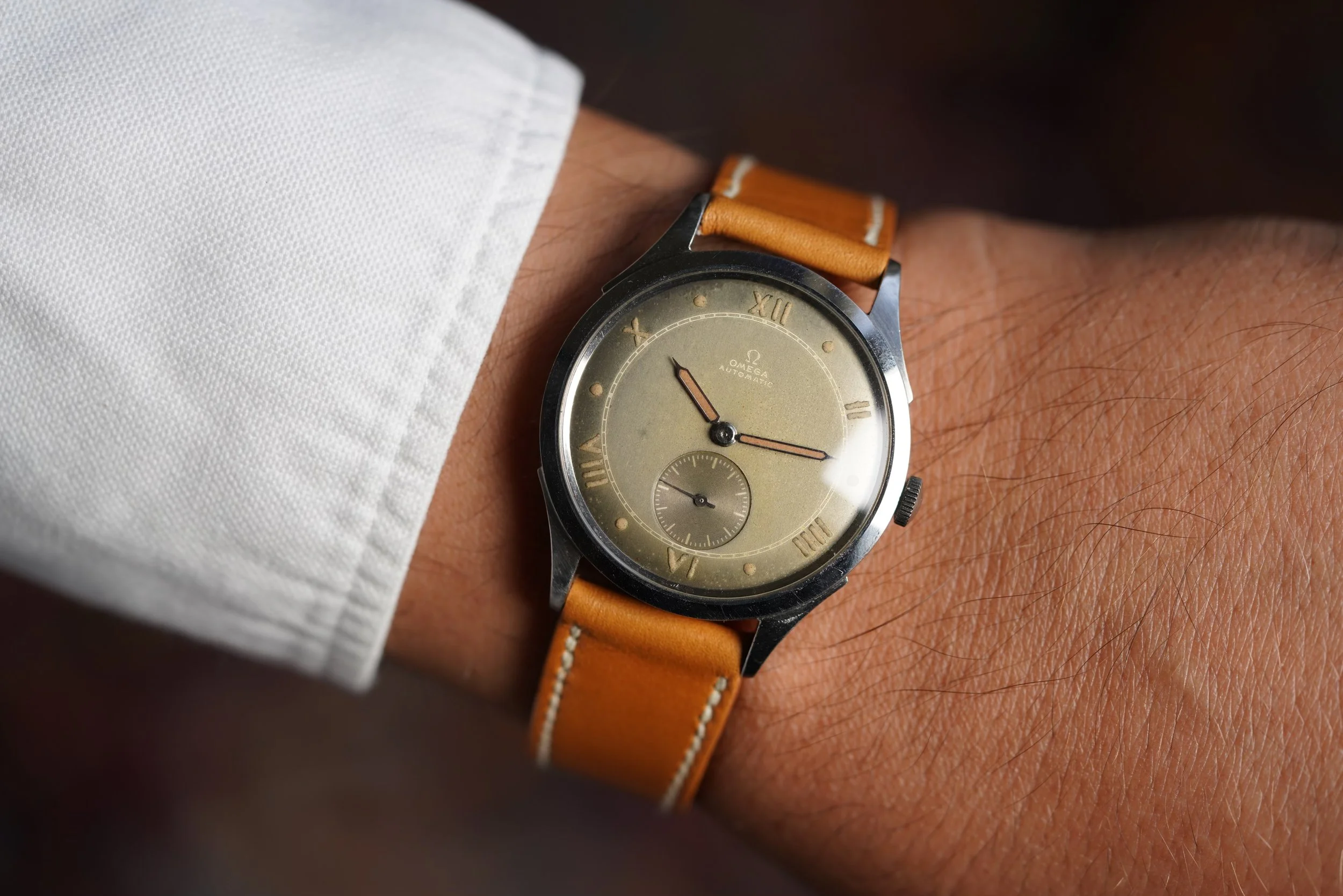
The 2374 is the watch you buy when you want “the first.” It connects you directly to Omega’s 1943 entry into automatic watchmaking. Steel examples in honest condition typically run $800 to $1,800 depending on dial originality and case condition. Early sector-dial variants command premiums.
CK 2576 and 2577: The Seamaster Heart of the Bumper Era
Introduced in 1948 to mark Omega’s centennial, these twin references defined the bumper Seamaster. The 2577 is the center-seconds variant, the more common of the two. The 2576 is the sub-seconds version with its distinctive crosshair subdial pattern, considerably rarer and arguably more visually refined.
Both measure approximately 34 to 36mm with the “beefy lug” design that evolved from slender early-production lugs (1948 to 1951) to the more pronounced, beveled lugs of 1952 to 1955. Both came in stainless steel, gold-capped, and solid gold. The dial range is extraordinary for a single reference: over 100 documented variants for the 2577, including black honeycomb guilloché dials that are dramatic under any light, silver dials with applied Breguet numerals, and tropical patina dials that have aged from silver to warm gold or chocolate brown.
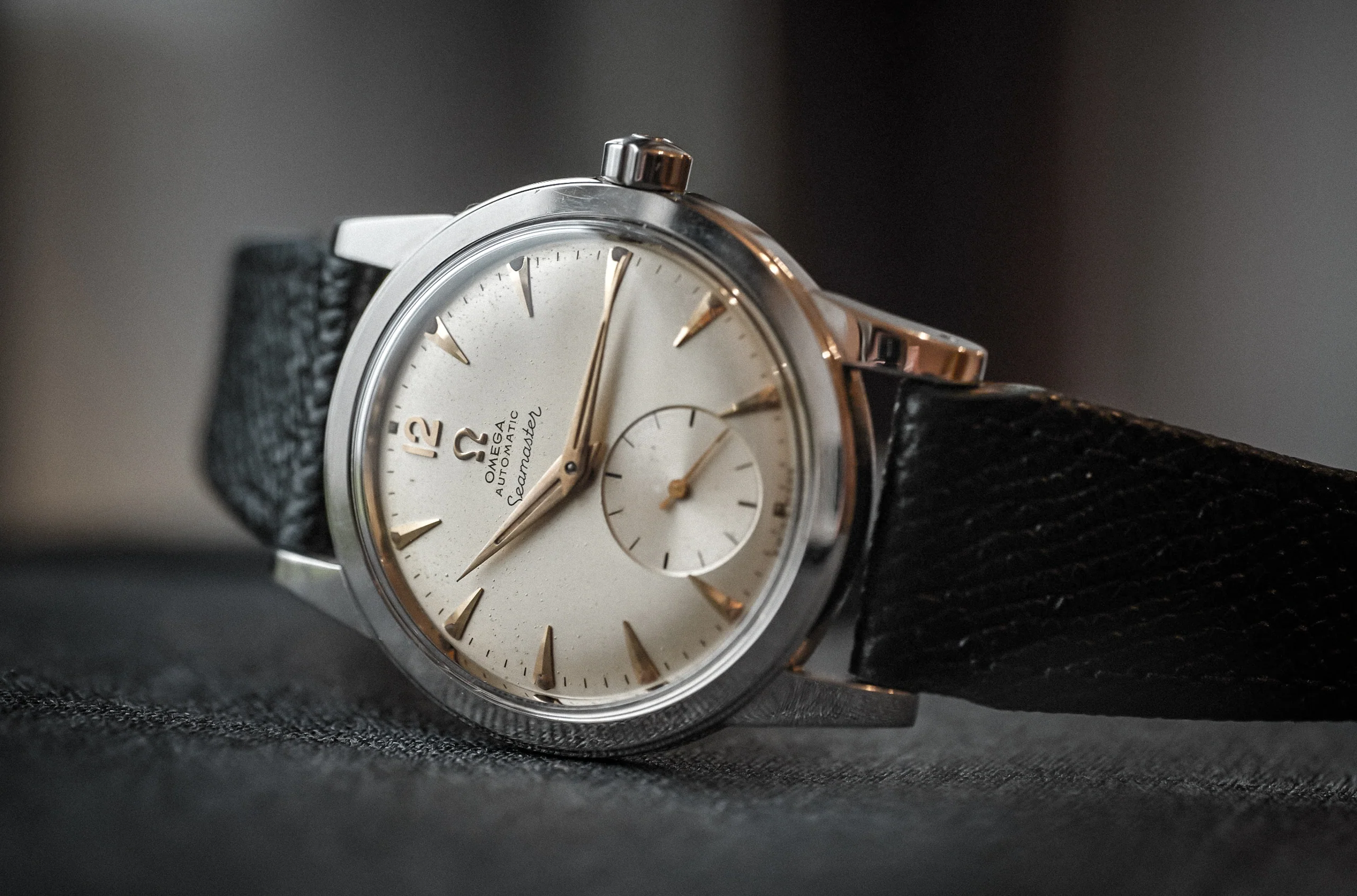
The 2577 is the entry point into bumper collecting. A well-serviced steel example with an original unpolished case and honest dial runs $600 to $900. The 2576 with its crosshair sub-seconds dial is rarer and often only slightly more expensive, which makes it one of the better quiet bargains in the category.
Omega serial number dating guide
CK 2627: Omega’s First Date Watch
The Seamaster Calendar 2627, introduced in 1952, is Omega’s first watch with a date complication. It houses the caliber 353, a bumper automatic with a calendar window at six o’clock. Early examples have square date windows; from 1953 the window becomes trapezoid-shaped. Case diameter is 35.3mm with long, chamfered lugs.
The 2627 is historically significant and surprisingly affordable. Steel examples in honest condition run $400 to $800. It is one of the most underappreciated references in the entire bumper lineup, probably because the date complication does not feel novel to modern buyers even though it was genuinely groundbreaking in 1952.
CK 2648 and CK 2782: The Bumper Constellations
The Constellation entered Omega’s catalog in 1952 as the brand’s first series-produced automatic chronometer. Every Constellation, then and now, carries chronometer certification. The bumper Constellations used the caliber 354, a center-seconds chronometer with the swan-neck regulator.
The CK 2648 is the first Constellation reference. The CK 2782 is the last bumper Constellation, produced from roughly 1953 to 1956, and it is nearly identical in external appearance to the full-rotor CK 2852 that replaced it. The definitive test between them is the wrist feel: rock the watch gently, and a 2782 produces the characteristic bump while a 2852 spins freely. Sellers who have not identified the mechanism correctly sometimes price 2782s at 2852 levels, which creates an opportunity for collectors who know what to look for.
The 2782 with its honeycomb dial and arrowhead markers is a particularly desirable variant. Steel examples currently run $2,000 to $3,500 through dealers, with gold examples reaching $3,500 to $5,500 and above.
Why Bumpers Are Getting Attention Now
Several things are converging to make bumper Omegas more interesting to collectors than they have been in years.
The most obvious is price relativity. As vintage Rolex has become increasingly inaccessible to normal collectors, comparable-era Omega pieces that were technically equal or superior in many respects remain dramatically undervalued. A bumper Seamaster that competed directly with a Rolex Perpetual in 1952 sells for a fraction of its Rolex counterpart today. A Rolex Bubbleback from the 1940s runs $4,000 to $12,000 and up. A comparable bumper Seamaster 2577 starts under $700.
Then there is the mechanism itself. The bumper represents a closed chapter. No current manufacturer produces anything like it. Owning one is owning the only production wristwatch technology that ever offered tactile feedback from the movement. In an era where collectors are increasingly drawn to mechanical experiences that modern movements cannot provide, that distinction matters.
And the coverage has helped. Fratello, Hodinkee, and Goldammer have all published features on bumper Omegas since 2021, introducing the category to a broader audience that previously associated vintage Omega exclusively with Speedmasters and Seamaster 300s.
Also Read: Best vintage watches under $1,000
What to Watch Out For
Bumper Omegas have specific condition issues that differ from later full-rotor watches, and knowing about them before you buy will save you money and frustration.
Buffer spring fatigue is the big one. The small coil springs at each end of the rotor’s arc absorb repeated impacts across decades of use. When they fatigue, they stop cushioning the weight properly. In extreme cases, the weight strikes the movement harshly enough to damage bridges or the pivot itself. Fully failed buffer springs render the automatic winding inoperative, though the watch can still be wound manually by crown. The problem: replacement buffer springs are specific to bumper movements and increasingly difficult to source. A watchmaker may need to fabricate them.
Dried lubricants are universal on any watch this old, but bumpers are particularly susceptible because the ratchet system requires specific lubrication at the click and winding gears. Dried grease causes sluggish winding or grinding wear on ratchet teeth.
Over-polishing is the non-movement issue to watch for. Many surviving bumper Omegas have been polished to the point where the original case geometry is lost. The beveled lugs on a 2577 should be sharp and distinct. If they have been rounded into soft curves, someone has been aggressive with a buffing wheel. Unpolished examples command meaningful premiums and are worth seeking out.
And a practical note: all bumper-era Omegas carry radium luminescent material on the hands and dial. This is not a health concern in normal wear (the crystal blocks alpha radiation), but if the caseback needs to come off for service, the work should be done in a ventilated area with minimal handling of the dial.
What Service Costs
Independent watchmakers experienced with pre-1960 Omega movements typically charge $300 to $500 for a full bumper automatic service. An Omega authorized service center would charge $700 and up, and vintage bumpers are generally not their specialty. The consensus from collector communities is to find a watchmaker who works regularly with vintage Swiss automatics rather than sending the watch to a brand boutique.
Parts availability is generally adequate with one important exception. Mainsprings are widely available and compatible across the entire 330 through 355 caliber family. Balance staffs, escape wheels, and pallet forks can be sourced from specialist suppliers or donor movements. Buffer springs, however, are the weak link. They are increasingly scarce and may require fabrication by a skilled watchmaker. If you are buying an unserviced bumper, budget for the possibility that buffer spring work will be part of the service.
The Transition: How the Bumper Era Ended
Omega did not abandon the bumper in one decisive move. The transition stretched across roughly six years with genuine production overlap between the old and new technologies.
In 1954 and 1955, Omega introduced the caliber 471, its first full-rotor bidirectional automatic. The full-rotor 500 series entered production in earnest by 1955 and 1956, with the first full-rotor Constellation (the CK 2852, housing a caliber 500 or 501) appearing as the direct successor to the bumper 2782. But bumper production did not stop. The caliber 355, Omega’s last bumper movement, remained in production until 1962. Omega was among the last major Swiss manufacturers to abandon the technology, maintaining bumper production longer than Jaeger-LeCoultre, Universal Geneve, and most other competitors.
The physical similarity between the last bumper Constellation (2782) and the first full-rotor Constellation (2852) is close enough that sellers regularly misidentify them. The cases are nearly the same. The dials are nearly the same. Only the movement inside tells you which era you are holding. For collectors, that overlap is part of the charm. The 2782 is the last watch Omega ever made with a mechanism you can feel working on your wrist. Everything after it is silent.
Where to Start
If this is your first bumper and you want to spend as little as possible while getting something genuinely good, the CK 2577 in steel with a plain silver dial is the answer. It is the most commonly available bumper Seamaster, parts are as accessible as they will ever be, and a serviced example with an original case runs $600 to $900.
If you want something with more visual distinction, the CK 2576 with its crosshair sub-seconds dial is rarer, more interesting to look at, and typically priced only slightly above the 2577. The sub-seconds configuration is currently less fashionable than center sweep, which means you are buying a rarer watch at a common-watch price. That will not last.
If you want historical significance at a reasonable number, the CK 2627 Seamaster Calendar is Omega’s first date watch. Steel examples under $800 are not hard to find in honest condition. It is the kind of watch that tells a specific story, and that story, the first time Omega put a date window on a wristwatch, is a good one.
And if the bumper mechanism is what draws you, wear any of them for a week. The silent rotor of a modern automatic will feel like something is missing.
Related posts
Watch Shapes: Which Vintage Case Shape Fits Your Style?
Case shape changes how a vintage watch wears more than diameter alone. Compare eight silhouettes and learn which one fits your wrist and style.
Vintage Dress Watches: How to Choose One You’ll Actually Wear
The best vintage dress watch is the one you will wear beyond weddings. Here is how to choose the right size, metal, dial, shape, and strap.
Vintage Watch Styles: A Visual Guide to Finding Yours
Most buyers pick a brand and stall. Here are nine vintage watch styles, shown with real watches from our archive, and the catch that comes with each one.
Vintage Tank Watches: A Buyer’s Guide to Rectangular Watches Beyond Cartier
Every Cartier Tank alternatives list is new watches imitating old ones. The originals still exist and cost less. A buyer's guide to vintage tank and rectangular watches: the brands, the prices, and what to check.
Service History Is the Wrong Question. Here’s the Right One.
Everyone says to ask for a vintage watch's service history. Most of it can't be verified, and a receipt proves a transaction, not a result. Here's what actually tells you a watch has been serviced, and the better question to ask.
LeCoultre vs. Jaeger-LeCoultre vs. Jaeger: What the Name on the Dial Means
Three names, one Swiss firm, and one watch that isn't what it looks like. What LeCoultre, Jaeger-LeCoultre, and plain Jaeger on a vintage dial really tell you.
Omega Seamaster 166.010 Buyer’s Guide: Prices, Variants, and What to Look For (2026)
Everything you need to buy an Omega Seamaster 166.010 in 2026: real market prices by condition tier, five dial variants explained, caliber 562 vs 565, original part numbers, and what to inspect before you commit.
Omega vs Rolex: The Vintage Buyer’s Verdict
Vintage Omega vs vintage Rolex: where the Rolex premium is worth paying, where Omega is the smarter buy, and how to dodge redials on both. A collector's verdict.
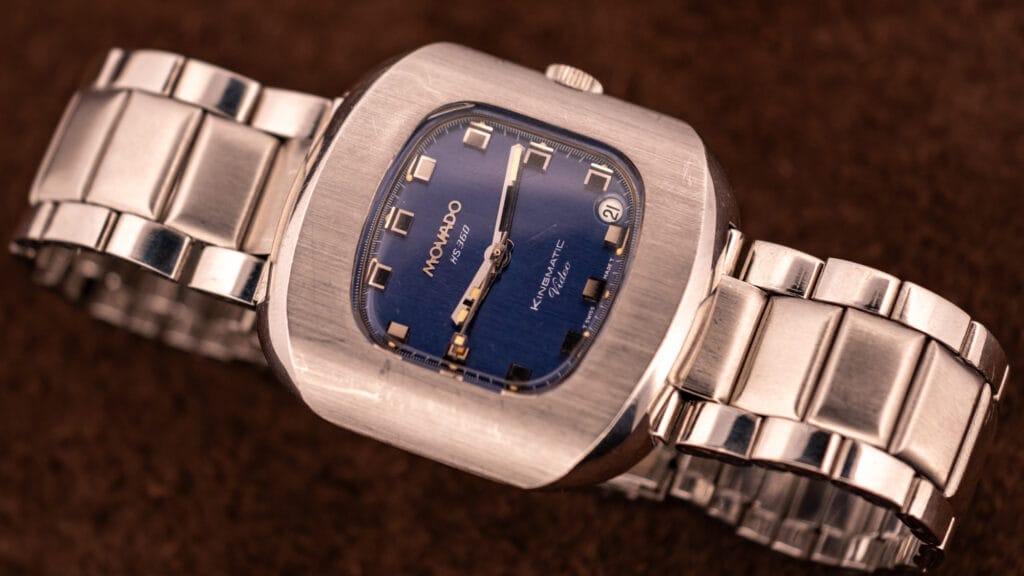
Movado Kingmatic: A Vintage Buyer’s Guide to References, Calibers, and Value
The Movado Kingmatic is one of the best values in vintage automatics. A buyer's guide to its references, in-house calibers, the Sub-Sea line, what to check, and what they actually sell for.
13 Vintage Watch Collecting Tips for Beginners (From 1,000+ Watches Sold)
Thirteen vintage watch collecting tips drawn from selling over 1,000 watches. What separates a smart first buy from an expensive lesson, with no sugar.
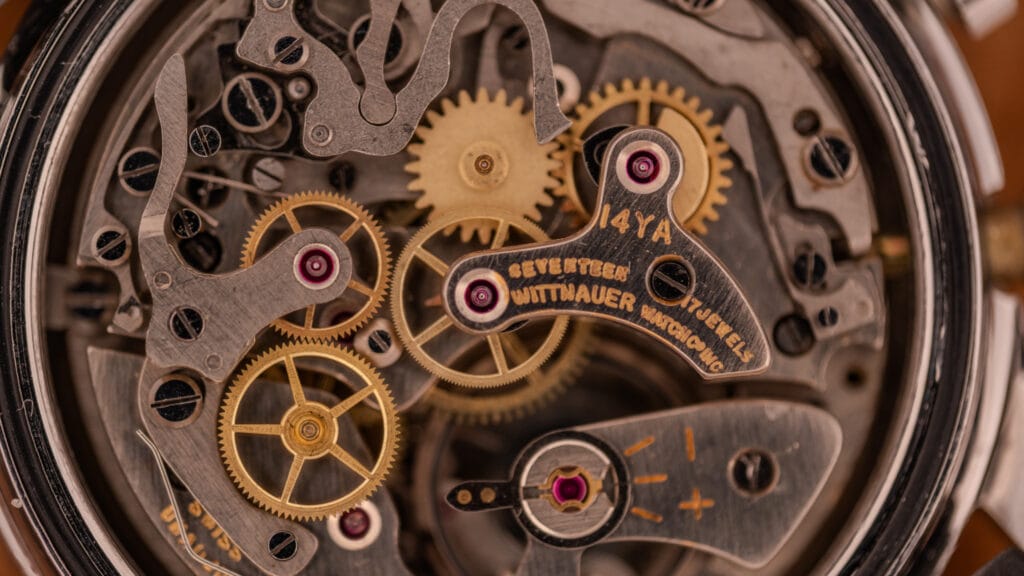
Vintage Wittnauer Chronograph Caliber Identification: Venus 188, Valjoux 7733/7734, Landeron 248
How to identify the movement inside any vintage Wittnauer chronograph: Venus 188, Valjoux 7733 and 7734, Landeron 248, and the house numbering system Wittnauer used to mark them.
How Water-Resistant Is a Vintage Watch, Actually? The Honest Answer.
Every dealer says never get a vintage watch wet. That advice is half-engineering and half-liability theater. Here is what is actually true about vintage water resistance, where water actually gets in, and when a 1965 diver is safer than a 2-year-old modern.