

Every major Swiss and American brand has a serial number table. Omega has one. Hamilton has one. Elgin has one that resolves to the month. Gruen has nothing of the sort.
The Gruen Watch Company produced some of the most innovative timepieces in American watchmaking history, then left behind almost no factory records when the Cincinnati operation closed in 1958. The serial number archives were almost certainly destroyed. What exists today is the result of decades of detective work by a small group of dedicated researchers who have reverse-engineered dating methods from surviving watches, period advertisements, and case manufacturer records.
The good news: those methods work. The better news: this guide consolidates all of them into a single walkthrough. If you have a Gruen wristwatch in your hand and want to know when it was made, start here.
What You Are Looking At
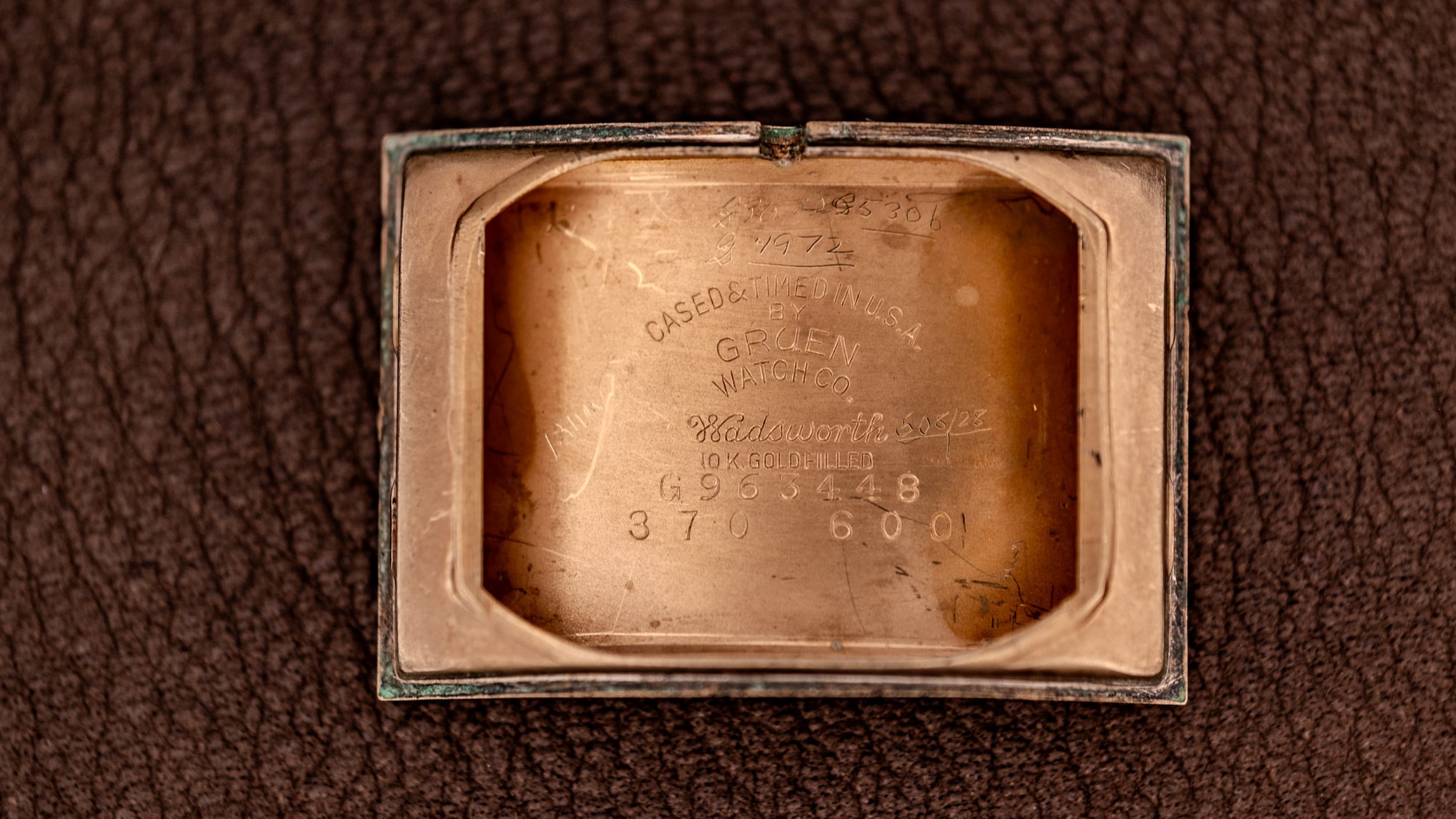
Open the caseback of a Gruen wristwatch from the mid-1930s onward and you will typically find three categories of information stamped into the metal. Understanding which number is which is the single most important step in dating your watch, and the single most common source of error.
The Three Fields
The first line usually reads “Cased & Timed in U.S.A. By Gruen Watch Co.” If the case was manufactured by an outside supplier, that company’s name or logo appears nearby. Wadsworth is the most common. Star Watch Case Co. and Keystone appear frequently as well. If no outside manufacturer name appears, the case was made in-house by Gruen’s own case division.
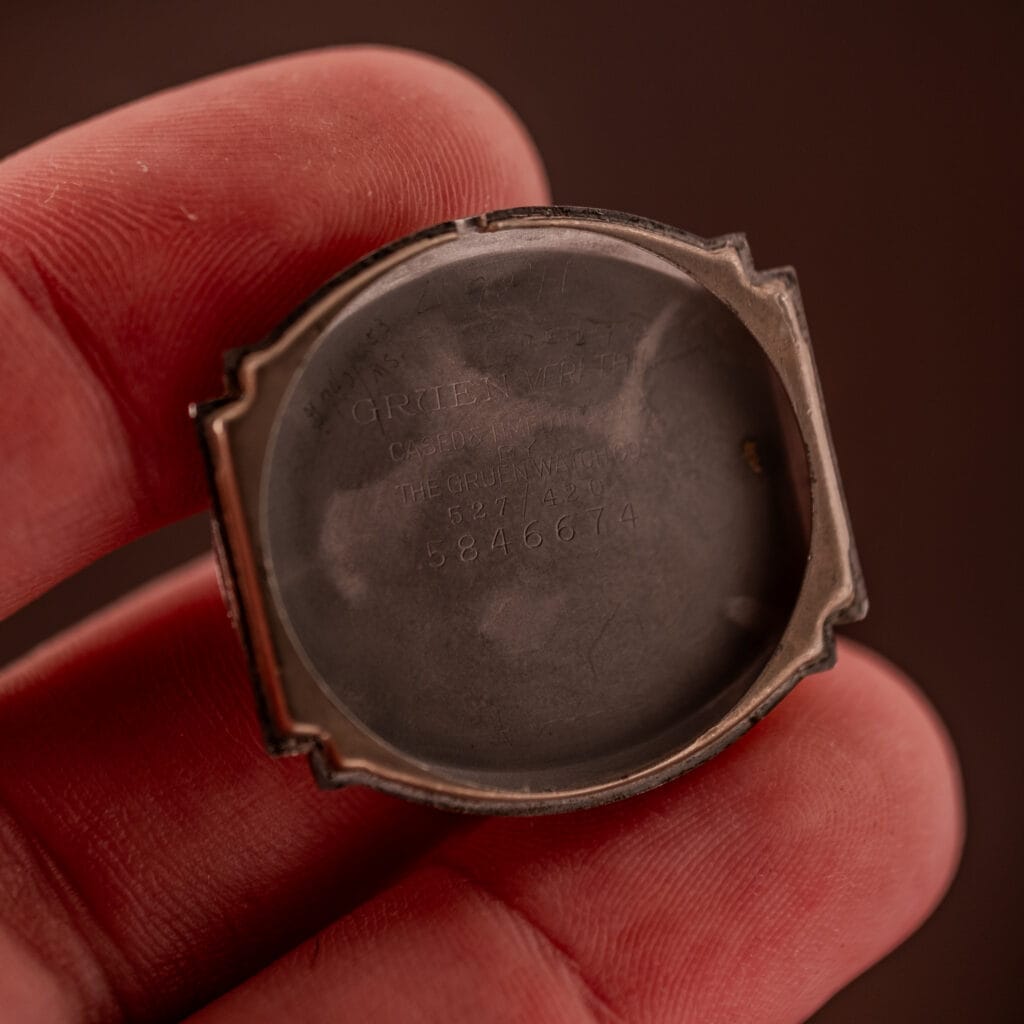
Below or adjacent to the manufacturer text, you will find the case serial number. This is a unique identifier assigned by whoever made the case. Its format varies by manufacturer: Wadsworth serials begin with letter prefixes like G or L followed by a multi-digit number. Gruen-made case serials use numeric or alphanumeric prefixes like 4, 5, B, or C. Keystone uses K. Star uses O. The length, format, and prefix differ from maker to maker, and this variation is itself a useful identifier.
The third field is the one most relevant to dating: the caliber and style number pair. These appear as two separate three-digit numbers, formatted as XXX-YYY, XXX/YYY, or XXX YYY. In most cases, the first number is the caliber (the movement type) and the second is the Style Number (a model-specific code Gruen assigned to each watch design). This pairing is the primary key to the most broadly applicable dating method available for Gruen watches.
The Movement
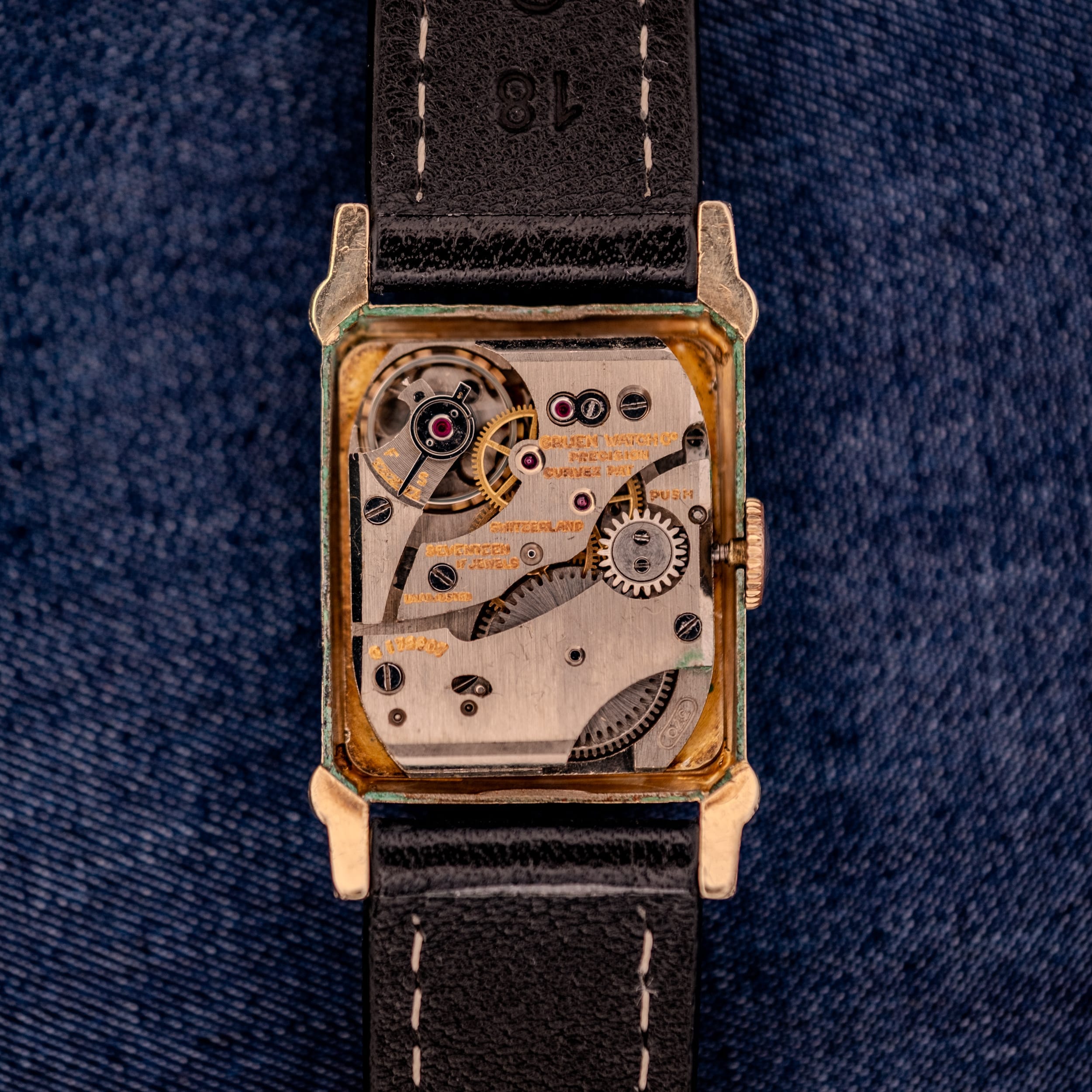
Flip the watch over, figuratively speaking. The movement itself carries its own caliber number, stamped on the plate, typically near or under the balance wheel. In certain caliber families, the movement also has a serial number. The caliber on the movement should match the caliber stamped in the caseback. If they do not match, the movement has been replaced at some point during the watch’s life. That mismatch is the first and most basic authenticity check.
The Trap: Style Number vs. Case Serial Number
New collectors regularly confuse the case serial number with the style number. This produces wildly incorrect dates, sometimes off by 20 years or more.
The distinguishing feature is format. The caliber/style pair always presents as two separate three-digit blocks next to each other, clearly separated by a space, dash, or slash. The case serial number is formatted differently: it is either a longer purely numeric string, or it combines a letter prefix with multiple digits. If what you see looks like a single long number or an alphanumeric code, that is the case serial. If you see two three-digit blocks side by side, that is the caliber/style pair.
Even once you have isolated the two three-digit numbers, you need to confirm which is the caliber and which is the Style Number. The standard convention is caliber first, Style Number second (CCC-SSS format). But Gruen occasionally reversed this order. The verification method is straightforward: look up the movement caliber stamped on the actual movement. One of the two caseback numbers should match it. The other number is your Style Number. If neither number matches the movement caliber, something more complex is going on and the movement may not be original to the case.
Method 1: Style Number Dating
The Style Number is the single most broadly useful dating tool available for Gruen wristwatches. It works across all case manufacturers, requires no caseback removal beyond reading the stamped numbers, and covers the production window from approximately 1925 through 1957.
How It Was Built
This method is the work of Mike Barnett and Barry Cooper, two Gruen researchers who spent months studying thousands of watches and cross-referencing caseback markings with vintage magazine advertisements. Their core observation was that Gruen’s Style Numbers increased monotonically over time. The higher the number, the later the model was introduced. They confirmed this pattern against seventeen period crystal catalogs from GS, Rocket, and Perfit, each of which recorded the highest Style Number in use for a given year.
The resulting paper was published in the AWCI Horological Times in May 2012 and in the NAWCC Watch & Clock Bulletin in March/April 2013. Both journals made the article freely available to non-members. The online dating calculator and downloadable Windows application on GruenWristwatches.com automate the lookup.
The Table
The Style Number table gives the lowest Style Number assigned in each year. A watch with a given Style Number was introduced in the year corresponding to the nearest benchmark at or below that number. Selected anchor points from the full table:
| Lowest Style # | Year | Lowest Style # | Year |
|---|---|---|---|
| 0-11 | 1925 | 449 | 1941 |
| 55 | 1926 | 495 | 1942 |
| 86 | 1930 | 506 | 1943 |
| 107 | 1931 | 512 | 1944 |
| 183 | 1935 | 541 | 1945 |
| 220 | 1936 | 544 | 1946 |
| 255 | 1937 | 583 | 1948 |
| 304 | 1938 | 641 | 1950 |
| 372 | 1939 | 742 | 1951 |
| 390 | 1940 | 933 | 1956 |
What This Date Means (and What It Does Not)
The Style Number date is the model introduction date, not the date your specific watch was assembled. It tells you when the design first went on sale. If the model proved popular, it may have remained in production for years afterward. A Style Number that resolves to 1942 means the model was introduced in 1942. The specific watch in your hand could have been assembled and sold in 1942, or in 1946 using the same design.
Think of it as a floor: your watch cannot be older than the Style Number date. It can be newer. When searching identification guides and period advertisements for your watch, start at the Style Number date and search forward.
Barnett recommends searching one year before the Style Number date in identification books as well, to account for the method’s inherent margin of error, which runs approximately plus or minus one year.
The WWII Anomalies
The Style Number system is remarkably consistent from 1925 through the early 1940s and again from 1946 onward. The war years are the problem zone.
Between 1942 and 1946, Gruen introduced roughly 50 new Style Numbers, compared to about 67 in the preceding four years. Civilian watch production slowed dramatically during the war, and this compression created two specific anomaly types that every Gruen researcher needs to understand.
Movement migration occurred when Gruen updated the movement in an existing model without changing the model design. The Style Number stayed the same; only the caliber number changed. The 1951 Gruen Submarine is the textbook example: some casebacks read 421-725 (Cal. 421 movement) while others read 426-725 (Cal. 426 movement). Both are correct, factory-original configurations. Style Number 725 identifies the Submarine model regardless of which movement is inside.
Style Number reuse is more problematic. During and immediately after WWII, Gruen occasionally reassigned old Style Numbers to entirely new models. Style Number 498 is the most extreme known case: researchers have documented it paired with calibers 335, 422, 430, 435, 440, and 3351. Caliber 335 did not enter production until 1948, yet Style Number 498 nominally dates to 1942. A watch with a Cal. 335 movement and Style Number 498 is not from 1942. The Style Number was recycled.
The detection method: look up your Style Number in the Style Caliber Table (published in Figure 6 of the Barnett/Cooper paper and accessible through the GruenWristwatches.com calculator). Check whether the caliber found in your watch appears in the list of calibers known to use that Style Number. If the caliber did not exist until years after the Style Number’s nominal date, reuse has occurred, and the watch is from the later period.
The Three-Digit Rollover
Around 1956, Style Numbers exceeded 999. Gruen’s case-stamping continued to use only three digits, so the counter simply rolled over. Style Number 1,002 appears stamped as 002. If your caseback reads something like 422-002 and the caliber dates to the 1950s, the actual Style Number is 1,002, not 2.
When Style Number Dating Does Not Apply
Certain Gruen watches fall outside the method entirely. Older models and many round-case watches may carry only a single three-digit number (the caliber) with no Style Number present. Solid gold cases and some Swiss-cased imports often lack the number pair. Anything before 1925 predates the system.
Method 2: Case Serial Number Dating
If the Style Number tells you the earliest possible date for the model, the case serial number tells you when the physical case was manufactured. Among experienced Gruen researchers, this is considered the most authoritative date. The case is the component that was not routinely swapped, replaced, or interchanged. When you can decode the case serial, you have the closest thing to a birth certificate that a Gruen watch will ever provide.
The catch: only Wadsworth case serial numbers have been fully decoded into usable tables. Serial numbers from other manufacturers have been partially cracked, and the partial tables are explicitly labeled experimental.
Wadsworth Cases: The Gold Standard
Wadsworth Watch Case Co. was one of Gruen’s longest-running and most important case suppliers, operating from 1892 until its absorption by Elgin National Watch Co. in 1953. Two separate decoding techniques cover different eras of Wadsworth production.
Technique 1 (G or L prefix, 1937 to 1954): Published by Jack Wood in the September/October 2012 issue of the NAWCC Bulletin. This technique requires two conditions: the case must be confirmed as Wadsworth-manufactured, and the serial number must begin with the letter G or the letter L.
The first two characters of the serial form the prefix code. A letter (G or L) followed by a single digit. Look up the prefix code in the table to recover the approximate manufacture date. The remaining digits are an incremental sequence within that production batch.
| Prefix | Year | Prefix | Year |
|---|---|---|---|
| G0 | 1937-1939 | G7 | 1946-1947 |
| G1 | 1939-1941 | G8 | 1947-1948 |
| G2 | 1941-1942 | G9 | 1948-1949 |
| G3 | 1942-1943 | L0 | 1949-1950 |
| G4 | 1943-1944 | L1 | 1950-1951 |
| G5 | 1944-1945 | L2 | 1951-1952 |
| G6 | 1945-1946 | L3 | 1952-1953 |
| L4 | 1953-1954 |
A Wadsworth case serial of L252366 gives prefix code L2, which maps to 1951-1952.
Technique 2 (Prefix 5, 1925 to 1930): Developed by Barry Cooper for the earlier period when Wadsworth serial numbers begin with the digit 5 rather than a letter. The first two digits serve as the lookup code:
| First Two Digits | Year |
|---|---|
| 50 | 1925 |
| 51 | 1926 |
| 52 | 1927-1928 |
| 53 | 1929 |
| 54 | 1930 |
Accuracy is approximately plus or minus one to two years. Note the gap: no published Wadsworth technique exists for the period between 1930 and 1937. Wadsworth serials from that window use different numbering schemes that remain undecoded.
Gruen In-House Cases
When the caseback shows no outside manufacturer name alongside the “Cased & Timed” text, the case was made by Gruen’s own case-making division (Gruen National Watch Case Co., Cincinnati, 1921 to 1958). An experimental decode table published on GruenWristwatches.com identifies four sequential prefix series covering approximately 1941 to 1954.
| Year | Prefix 4 | Prefix 5 | Prefix B | Prefix C |
|---|---|---|---|---|
| 1941 | 42, 43 | — | — | — |
| 1942 | 44, 45 | — | — | — |
| 1943 | (gap) | — | — | — |
| 1944 | 46 | — | — | — |
| 1945 | 47 | 56 | — | — |
| 1946 | — | 59 | — | — |
| 1947 | — | — | B2-B7 | — |
| 1948 | — | — | B8 | — |
| 1949 | — | — | B9 | C1 |
| 1950 | — | — | — | C2 |
| 1951 | — | — | — | C4 |
| 1952 | — | — | — | C5 |
| 1953 | — | — | — | C7 |
| 1954 | — | — | — | C9 |
This table is labeled “HIGHLY EXPERIMENTAL” by its publishers. Note the 1943 gap where no codes have been confirmed, and the absence of any decode for Prefix D, which appears on cases from 1954 onward.
A potential confusion point: the Prefix 5 series in the Gruen in-house table (codes 56 and 59, covering 1945 to 1946) overlaps numerically with the Wadsworth Prefix 5 technique (codes 50 through 54, covering 1925 to 1930). The manufacturer identification in the case interior resolves the ambiguity. Wadsworth cases display the Wadsworth name. Gruen-made cases show no outside manufacturer.
Keystone and Star Cases
Both Keystone and Star serial number decodes are extremely sparse and should be treated with appropriate caution.
Keystone cases carry a K prefix. Only seven code points covering 1947 to 1949 have been confirmed: K10 through K13 map to 1947, K14 and K15 map to 1948, and K16 maps to 1949. Nothing is published for Keystone Gruen cases before 1947 or after 1949.
Star cases carry an O prefix. Only three data clusters spanning 1947 to 1951 have been documented: O36 maps to 1947, O45 through O53 maps to 1950, and O58 maps to 1951.
Both tables are labeled experimental.
Case Date vs. Introduction Date
An important conceptual point that trips up even experienced collectors: the Wadsworth Date (case manufacture date) is always later than the Style Number Date (model introduction date). This makes perfect sense once you think about it. A model introduced in 1940 might remain in production through 1945. A case manufactured in 1944 for continued production of that same model will yield a Wadsworth Date four years after the introduction date.
When using the case date for model identification, search backward from the case date by one to five years in reference literature. The advertisements and catalog entries you need were generated at or near the introduction date, not during the continuing production run.
Method 3: Movement Serial Number Dating
Movement serial numbers are the least reliable dating method for Gruen watches when used alone, but they provide a valuable cross-check when used alongside case dating and Style Number dating.
The reason for the low standalone reliability is one word: swaps. Watchmakers routinely replaced entire Gruen movements as a repair method. Gruen movements within the same family are often physically interchangeable, making a swap faster and cheaper than troubleshooting a damaged movement. This practice severs the chronological link between case and movement. GruenWristwatches.com rates the standalone accuracy of movement serial dating at as low as 50% due to the prevalence of swaps.
That said, when the movement serial date and the case serial date agree, confidence is high. When they diverge by five or more years, you are almost certainly looking at a replaced movement.
The 405 Family (Most Broadly Applicable)
For calibers 405, 406, 410, 411, 420, 421, 425, and 426 (and their sweep-second variants), a detailed serial number decode has been published by Jack Wood and Mike Barnett. These calibers powered the bulk of Gruen’s production from the late 1930s through the early 1950s, so this table covers the most watches.
| Movement Serial | Approximate Year |
|---|---|
| 700,000 | 1939 (pre-reset) |
| 900,000 | 1940-1941 |
| 010,000 | 1941 (post-reset) |
| 400,000 | 1942 |
| 750,000 | 1943-1944 |
| 900,000 | 1945 |
| A 100,000 | 1945 |
| A 900,000 | 1946-1947 |
| B 100,000 | 1947 |
| B 900,000 | 1948-1949 |
| C 100,000 | 1949-1950 |
| C 800,000-900,000 | 1952 |
Caliber 440 Curvex
The Cal. 440 uses a different format than all other post-1940 Gruen movements: a four-digit number with an optional single-letter prefix (none, A, B, or C). Each prefix represents a batch of 10,000 movements.
| Prefix | Effective Range | Approximate Date |
|---|---|---|
| (none) | 0-9,999 | 1940-1944 |
| A | 10,000-19,999 | 1945-1947 |
| B | 20,000-29,999 | 1948-c.1950 |
| C | 30,000-39,999 | c.1950-1953 |
The prefix letter is typically found near the click on the movement plate. Check carefully. Some movements have the prefix stamped in an easy-to-miss location.
Barnett decoded this table by cross-referencing Cal. 440 serial numbers found inside Wadsworth cases whose manufacture dates could be established independently. The method assumes that movement and case were manufactured near each other in time, but the delta can be one to three years in either direction.
The explicit warning from the research community: one Cal. 440 movement date alone is not enough to accurately date a Curvex watch. Without corroborating case date or Style Number data, you are guessing. The researchers who built this table will tell you that directly.
Caliber 295 Curvex
The Cal. 295 serial number system was decoded in February 2018 alongside the 440. This is a 17-jewel Precision movement introduced in 1946, used in women’s Curvex watches. The lookup table is hosted on GruenWristwatches.com’s serial number page. Because the 295 had a shorter production run than the 440, the serial range is narrower and the table spans fewer years.
All Other Calibers
For every Gruen caliber outside the 405 family, the 440, and the 295, no individual serial number decode exists. The only available tool is the Caliber-Date Table, which provides the year each caliber entered production. This functions as a hard floor: a watch cannot be older than the year its caliber was introduced. But a caliber with a 1940 introduction date could appear in a watch assembled anytime between 1940 and the early 1950s.
The Caliber-Date Table traces its lineage to Charlie Cleves, who published the original version in the AWCI Horological Times in May 1989. Barry Cooper’s substantially enhanced version, covering over 200 calibers with jewel counts and quality grades, is hosted on GruenWristwatches.com.
The Triangulation Method: Putting It All Together
No single data point reliably dates a Gruen wristwatch. Every method described above has limitations: the Style Number provides only a model introduction date, the case serial covers only certain manufacturers for certain years, and movement serials are undermined by the prevalence of swaps.
The standard practice among experienced Gruen researchers is to gather every available date and weight them against each other.
The Weighting Hierarchy
Case manufacture date (highest weight). If you can decode the case serial, this is your answer. The case is the component that was not swapped or replaced. It is the physical artifact that left a factory on a specific date. This is the watch’s birthday.
Style Number date (hard floor). Your watch was not made before the Style Number date. Period. It may be significantly newer, but it cannot be older. This provides the starting point for identification research.
Caliber-Date Table (secondary floor). The caliber introduction date provides an independent second floor. If the Style Number points to 1942 but the movement is a Cal. 475 (introduced 1951), either the Style Number is being misread, the numbers are reversed, or you are looking at a reuse scenario.
Movement serial date (lowest weight, corroborating only). Where decodable, the movement serial adds a fourth data point. But it should confirm, not override, the case date. When all available dates cluster within a two-to-three year window, confidence is high. When the movement serial date diverges significantly from the rest, the most likely explanation is a swap.
The Practical Workflow
Here is the sequence I recommend for any Gruen wristwatch that lands on your bench or in your collection:
Step 1. Open the caseback and record both numbers in the caliber/style pair. Note the case serial number and any prefix. Photograph everything.
Step 2. Run the Style Number through the dating table or the GruenWristwatches.com calculator. Record the result as your Foundation Date. This is the earliest possible year for the model.
Step 3. Identify the case manufacturer from the case interior markings and serial number prefix. Apply the appropriate dating table (Wadsworth G/L, Wadsworth Prefix 5, Gruen in-house, Keystone K, or Star O). If you have a decodable case serial, record the case date. This becomes your primary anchor.
Step 4. Look up the caliber in the Caliber-Date Table to confirm the movement’s production floor. If the caliber introduction date conflicts with the Style Number date, investigate further.
Step 5. If the caliber is in the 405 family, the 440, or the 295, check the movement serial against the appropriate table. Record the result as supplementary evidence, not controlling evidence.
Step 6. Reconcile. If the dates cluster, you have a confident date range. If the movement serial is the sole outlier, it is almost certainly a swap. If the Style Number date is later than the case date, double-check that you have the caliber and Style Number in the right order. A gap of two to three years between Style Number date and case date is normal for popular models that remained in production. A gap of five or more years warrants closer scrutiny.
Step 7. Search reference literature using the Foundation Date as your starting point, looking one to two years in either direction. The Gruen Watch Model Identification Guides (Volumes 1 and 2), the Gruen Watch Catalog, and the Decade Series newspaper advertisement books are the primary resources.
Detecting Movement Swaps
Because swaps are so common in vintage Gruens, a few detection methods are worth knowing.
The most obvious indicator is a caliber mismatch: if the caliber stamped in the caseback does not match the caliber on the movement, a swap has occurred. This is definitive.
Subtler cases require cross-referencing. The Style Number should pair logically with the movement caliber. The GruenWristwatches.com Style Number tool lists the expected calibers for each Style Number. An unexpected pairing is a red flag.
Date congruence matters. If the case serial decodes to 1946 and the movement serial decodes to 1952, either the movement was replaced or (less likely) the case sat in a warehouse for six years before assembly. The swap explanation is overwhelmingly more probable.
Physical condition can also be telling. An original movement should show a wear profile consistent with the case: similar oxidation, dust accumulation, and lubrication age. A movement that looks substantially cleaner or newer than the case is suspicious. This is not conclusive on its own, but combined with a date discrepancy, it strengthens the swap diagnosis.
A Note on What This Guide Cannot Do
This guide consolidates the dating methods published by the Gruen research community into a practical workflow. It does not replace the original research, and it depends on tables and decode methods that the researchers themselves describe as approximations built from surviving physical evidence rather than factory archives.
Gruen Watch Company records are believed to have been destroyed. Every tool available today was built by empirical correlation, cross-referencing observed serial numbers with dated advertisements, catalog entries, and inscriptions. The work is remarkable, but all of it carries the caveat that it is detective work, not factory documentation.
Certain areas remain incomplete. Non-Wadsworth case serial decodes are experimental and sparse. Movement serial decodes cover only three caliber families. The Style Number method does not extend reliably before 1925 or after 1957. Post-453 catalog calibers like the Cal. 510 are absent from the Caliber-Date Table. WWII-era Style Number reuse anomalies almost certainly include undocumented cases not yet identified.
The single most comprehensive resource for Gruen dating research remains GruenWristwatches.com, maintained by Mike Barnett. The serial number tables, the Style Number calculator, the Movement Map, and the Caliber-Date Table are all hosted there. The site’s identification tutorial walks through the full process with worked examples. If you get deep into Gruen collecting, the Model Identification Guides (Volumes 1 and 2) and the Gruen Watch Catalog are essential reference books.
Related posts
Watch Shapes: Which Vintage Case Shape Fits Your Style?
Case shape changes how a vintage watch wears more than diameter alone. Compare eight silhouettes and learn which one fits your wrist and style.
Vintage Dress Watches: How to Choose One You’ll Actually Wear
The best vintage dress watch is the one you will wear beyond weddings. Here is how to choose the right size, metal, dial, shape, and strap.
Vintage Watch Styles: A Visual Guide to Finding Yours
Most buyers pick a brand and stall. Here are nine vintage watch styles, shown with real watches from our archive, and the catch that comes with each one.
Vintage Tank Watches: A Buyer’s Guide to Rectangular Watches Beyond Cartier
Every Cartier Tank alternatives list is new watches imitating old ones. The originals still exist and cost less. A buyer's guide to vintage tank and rectangular watches: the brands, the prices, and what to check.
Service History Is the Wrong Question. Here’s the Right One.
Everyone says to ask for a vintage watch's service history. Most of it can't be verified, and a receipt proves a transaction, not a result. Here's what actually tells you a watch has been serviced, and the better question to ask.
LeCoultre vs. Jaeger-LeCoultre vs. Jaeger: What the Name on the Dial Means
Three names, one Swiss firm, and one watch that isn't what it looks like. What LeCoultre, Jaeger-LeCoultre, and plain Jaeger on a vintage dial really tell you.
Omega Seamaster 166.010 Buyer’s Guide: Prices, Variants, and What to Look For (2026)
Everything you need to buy an Omega Seamaster 166.010 in 2026: real market prices by condition tier, five dial variants explained, caliber 562 vs 565, original part numbers, and what to inspect before you commit.
Omega vs Rolex: The Vintage Buyer’s Verdict
Vintage Omega vs vintage Rolex: where the Rolex premium is worth paying, where Omega is the smarter buy, and how to dodge redials on both. A collector's verdict.
Movado Kingmatic: A Vintage Buyer’s Guide to References, Calibers, and Value
The Movado Kingmatic is one of the best values in vintage automatics. A buyer's guide to its references, in-house calibers, the Sub-Sea line, what to check, and what they actually sell for.
13 Vintage Watch Collecting Tips for Beginners (From 1,000+ Watches Sold)
Thirteen vintage watch collecting tips drawn from selling over 1,000 watches. What separates a smart first buy from an expensive lesson, with no sugar.
Vintage Wittnauer Chronograph Caliber Identification: Venus 188, Valjoux 7733/7734, Landeron 248
How to identify the movement inside any vintage Wittnauer chronograph: Venus 188, Valjoux 7733 and 7734, Landeron 248, and the house numbering system Wittnauer used to mark them.
How Water-Resistant Is a Vintage Watch, Actually? The Honest Answer.
Every dealer says never get a vintage watch wet. That advice is half-engineering and half-liability theater. Here is what is actually true about vintage water resistance, where water actually gets in, and when a 1965 diver is safer than a 2-year-old modern.