

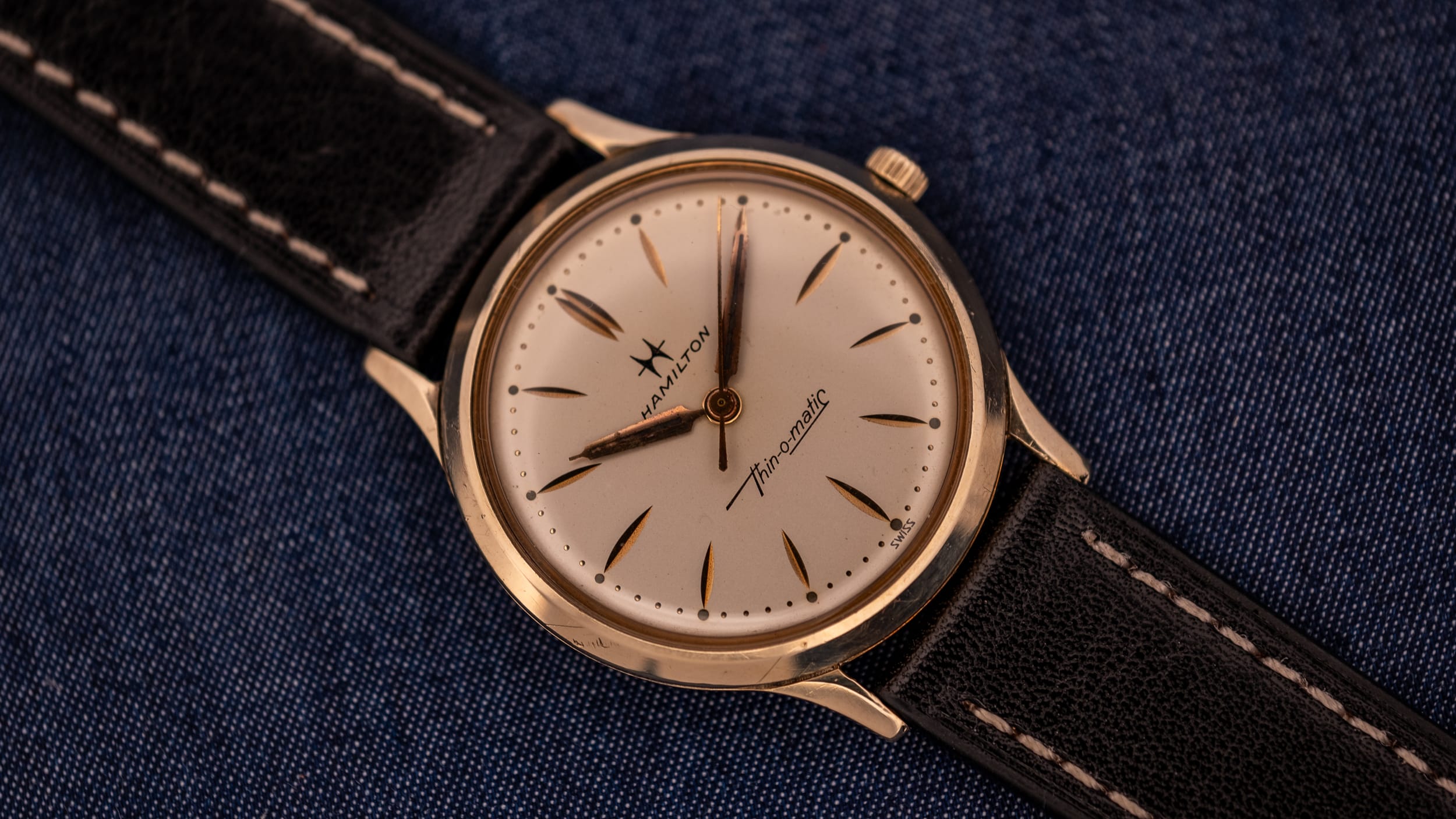
In 1969, Hamilton Watch Company transferred its remaining movement production from Lancaster, Pennsylvania to Biel, Switzerland. The Lancaster factory, which had operated continuously since 1892, was shut. The closure ended 77 years of American watchmaking at a single address and completed a trajectory that had been visible for at least two decades: the American watch industry’s long, uneven retreat before Swiss manufacturing, Japanese quartz, and the economics of labor-intensive precision work.
What the Lancaster shutdown obscures is the quality of what came before it. In the twenty years preceding that closure, Hamilton made two distinct engineering arguments about what a dress watch should do. The first was about protection. In 1948, Hamilton introduced a case-sealing system it called the CLD, a designation that the Hamilton Chronicles restoration archive documents as phonetically spelling out the word “sealed.” The second was about profile. In 1959, Hamilton introduced the Thin-O-Matic, an automatic movement series using micro-rotor construction to achieve the slim case heights that formal wear required.
Both lines ended or were transferred to Swiss production within a decade of each other. Both remain substantially underpriced in the current collector market. What follows is an account of what they were, what they used, and where to find the pieces worth buying.
For a longer account of the full Hamilton arc in American manufacturing, see the OTTUHR guide to the rise and fall of American watchmaking.
CLD: “Phonetically, It Spells Sealed”
Hamilton introduced the CLD principle in 1948 with a model called the Brandon. The CLD designation, documented by the Hamilton Chronicles blog (the most thorough published source on vintage Hamilton restoration), was chosen because the three letters sound out the word “sealed.” The line was built around a specific case construction: two-piece cases in which the bezel and crystal assembled onto the main body, with gaskets at three critical points. One gasket ran around the crystal. One sealed the bezel-to-case junction. One wrapped the crown stem assembly. The movement loaded from the front of the case, not the rear, a meaningful construction distinction from most period designs.
The 1949 Hamilton catalog included an explicit description of the CLD technology and reproduced a cross-section diagram of the gasket arrangement. Hamilton made no waterproof claim for the line. The documentation is direct: the system was designed and tested for resistance to moisture and atmospheric dust, not for immersion. A 1949 catalog page reproduced on Hamilton Chronicles shows the system alongside text that framed CLD as an advance over the unsealed competition. It was accurate framing. Mid-century mechanical movements were sensitive to lint and dust, which would migrate past unsecured crystals and crowns and begin abrading pivots and jewels. CLD was Hamilton’s answer to a problem that affected every mechanical watch of the period.
The Brandon, the first CLD model, was produced from 1948 through 1951. Only the 1948 examples had flexible lugs, a hinge-articulated lug that allowed the strap to lie flat against the wrist, used in the first production year only and not repeated. Fixed, shortened lugs replaced them from 1949 forward. The Brandon used Hamilton’s 17-jewel 14/0-sized 980 movement. Dials came in butler-finished silver with solid gold numerals or black with solid gold numerals. The black-dial variant is scarce. The CLD marking appeared printed below the Hamilton name on most dials, though some examples from the later production years omit it. Hamilton Chronicles attributes this to production variation rather than any deliberate change.
Over the following years, Hamilton expanded the CLD concept across a range of approximately 15 confirmed models. Tom Adelstein’s documentation on Vintage-Hamilton-Wristwatches lists the confirmed names: Vardon, Steeldon, Langdon, Brandon, Nordon, Beldon, Lange, Norde, Tildon, Reardon, Kingdon, Sheldon, Lyndon, Croydon, and Haddon. The naming convention, the recurring -don and -don-variant suffix, was Hamilton’s consistent period branding pattern, applied across multiple lines and model years. The CLD line eventually extended to automatic variants: the K-200, K-300, and K-400.
The most common caliber across the CLD line was the Hamilton 747, a 17-jewel grade. The Brandon used the 980, a 14/0-size grade. Most CLD cases were either solid 14K gold or gold-filled, with a smaller number of stainless steel variants.
For collectors, the Hamilton Lyndon CLD is one of the more accessible and distinctive references in the line. Produced in the early 1950s, the Lyndon featured a 34 by 40mm case with stepped lugs. The lug geometry angles down from the case middle in a distinct double-shoulder profile, period-correct to early 1950s American watch design. The case was gold-filled, the dial carried gold applied indexes with luminous dots, and the movement was a 17-jewel manual wind. Hamilton Chronicles documents the 1953 Lyndon specifically. An example dated to approximately 1952 appears in the WannaBuyAWatch dealer archive, confirming the stepped lug construction and gold-filled case. The Hamilton Lyndon CLD in the OTTUHR shop is a documented example of this reference with unpolished stepped lugs and an original champagne dial.
One practical note for anyone handling a CLD watch today: the rubber gaskets were degrading within a decade of production, and any surviving CLD watch is now more than 70 years old. The sealing system is functionally inert on any unrestored example. The name may spell “sealed.” The watch is not.
The Thin-O-Matic: A Different Problem
The CLD line had addressed what happens to a movement in dusty environments. The Thin-O-Matic addressed what happens to a movement in a dinner jacket.
By the late 1950s, European dress watch culture had established thinness as a premium differentiator. Piaget, operating from La Côte-aux-Fées, had been producing ultra-thin calibers since the 1940s and was applying that expertise systematically to wristwatches. Jaeger-LeCoultre had produced the Caliber 101 (at the time the smallest mechanical watch movement made) in 1929, and its tradition of thin-movement production was well established. A thick-cased automatic on the wrist beneath a dress shirt cuff was, increasingly, a social liability. The market for dress watches was sorting itself by profile.
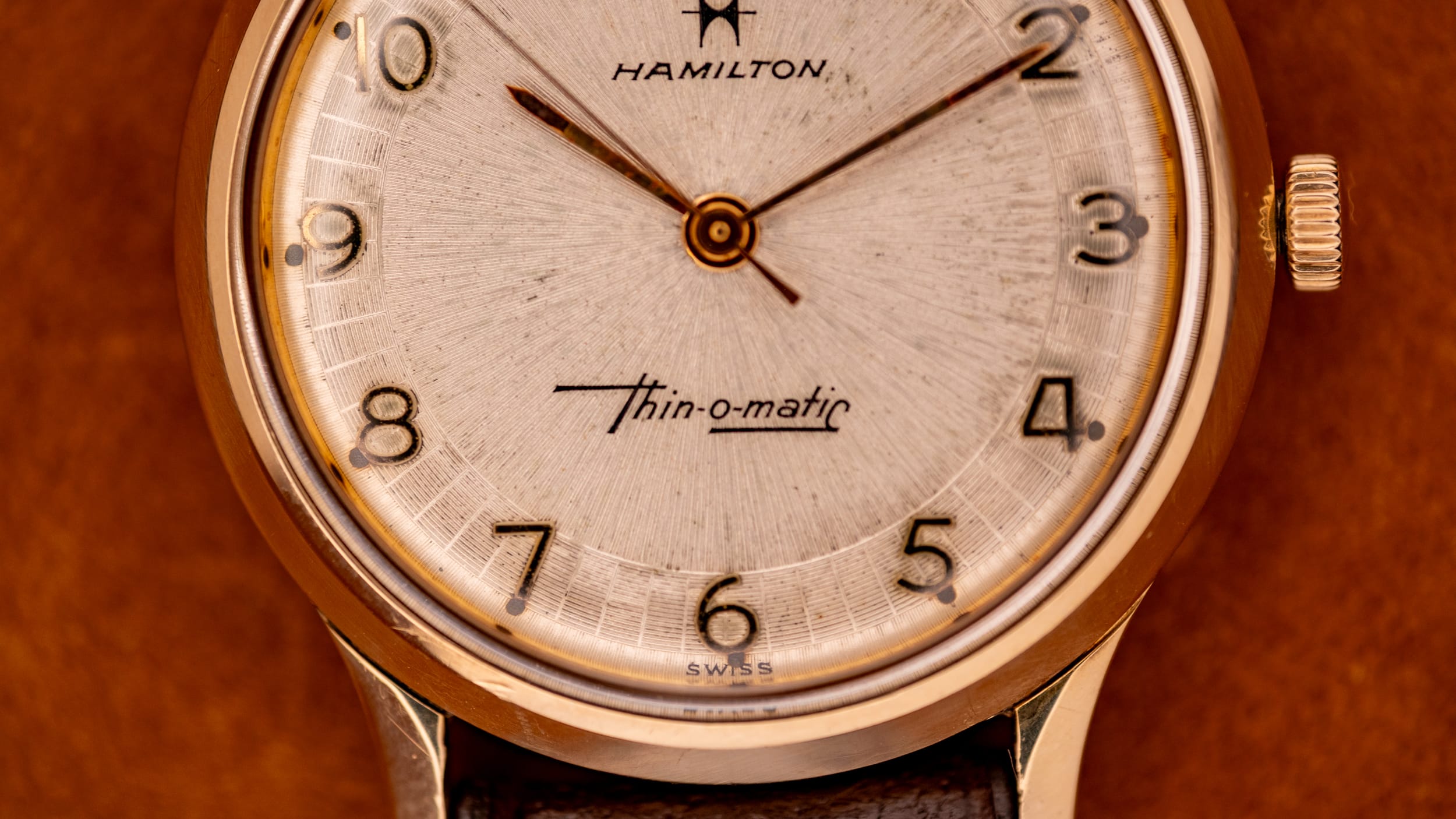
Hamilton’s response, launched in 1959, was the Thin-O-Matic. The line name was direct, which was consistent with Hamilton’s period naming conventions. The Thin-O-Matic was thin, and it was automatic. The first models were the T-501 and the T-101. The T-501 was stainless steel. In Hamilton’s Thin-O-Matic reference nomenclature, the 500-series prefix consistently denotes stainless steel construction. The T-101 was 18K yellow gold, among the rarest of the early references.
Both used the caliber 663, or in some later T-501 examples the closely related 666. The distinction between the two, documented in the Hamilton Chronicles T-501 restoration entry, is that the 663 is based on the Buren 1005 ébauche and the 666 on the Buren 1005A. The two calibers are, for most practical purposes, interchangeable. Hamilton Chronicles notes that the author is “not entirely sure what’s different between a 663 and 666 other than one is based on a Buren 1005 and the other on a 1005A.” They seem to be. Both are 17-jewel grades.
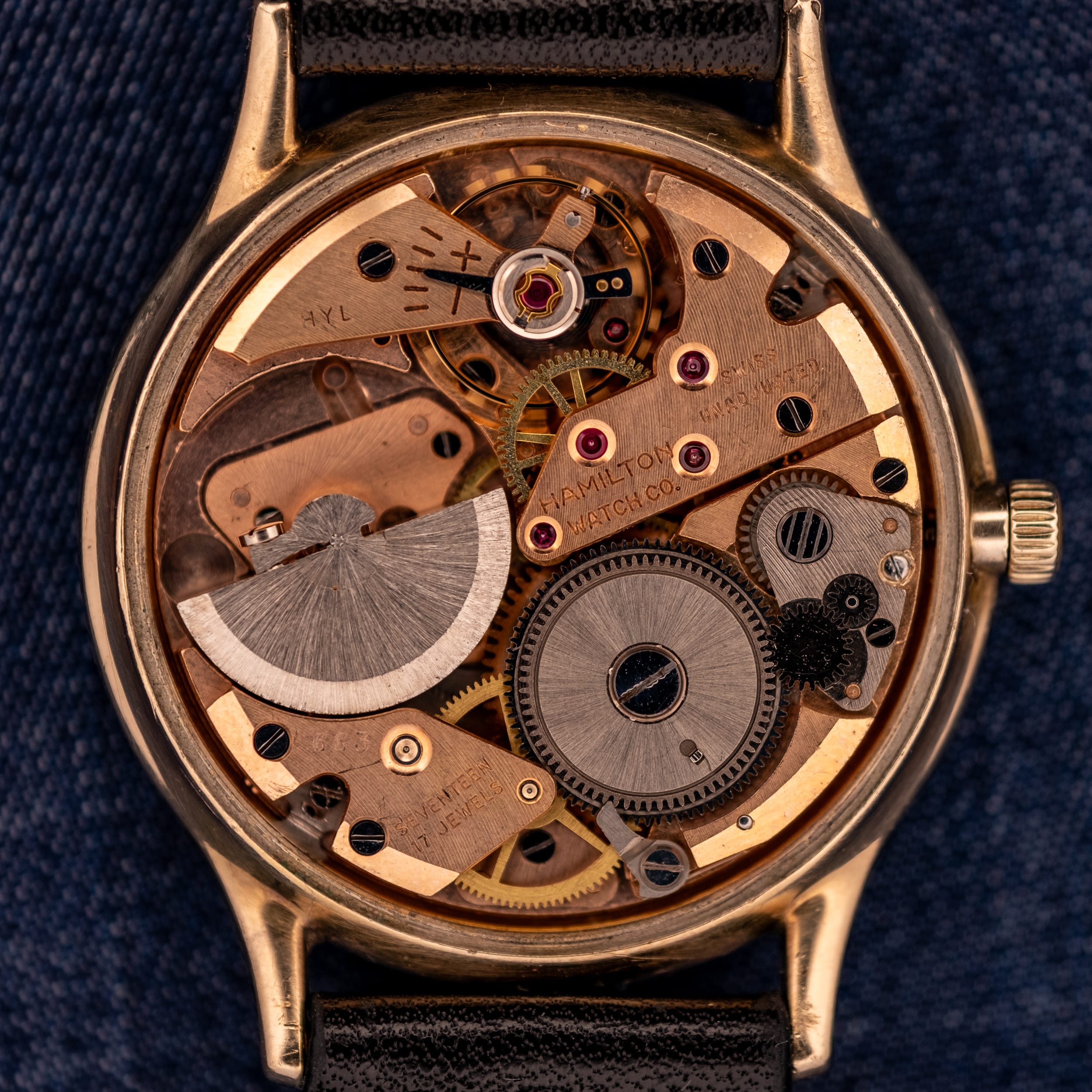
The 663 and 666 were micro-rotor movements. Rather than a conventional rotor (the full-circle oscillating weight that swings above the movement in most automatics), the micro-rotor is a small, dense weight embedded within the plane of the main plate, sitting in a recessed pocket cut into the movement itself. This construction allowed all components to occupy one side of the movement, reducing total stack height substantially. The case back of a micro-rotor Thin-O-Matic is flat: there is no rotor arc to accommodate. This is the primary visual diagnostic at the case back for distinguishing a genuine Thin-O-Matic from Hamilton’s Accumatic line, which used conventional rotors and pie-pan-shaped case backs. The micro-rotor calibers of the early production years were finished with pink plating on the bridges and main plate.
In 1960, Hamilton added a black-dialed variant of the T-501 to the range, offered at the same price whether the buyer chose a bracelet or a strap. The T-501 ran for three years of production, 1959 through 1961, before the reference line developed further.
The Masterpiece designation in Hamilton’s nomenclature indicated the top of the dress range. The Hamilton Masterpiece Thin-O-Matic in 10K gold represents the premium tier of the line: a slim, gold-cased automatic with the micro-rotor caliber, in proportions suitable for formal wear. The Masterpiece Electronic, running in parallel, used a battery-powered tuning fork caliber 702. The Hamilton Masterpiece Electronic in the OTTUHR shop documents this adjacent program. Same Masterpiece case grade, completely different technical approach.
In 1966, Hamilton acquired the Buren Watch Company of Buren am Aare, Switzerland, the firm whose ébauche families had underpinned the 663 and 666 from the beginning. The acquisition was both defensive (securing an ébauche supply that Hamilton could not manufacture in-house in Lancaster) and transitional. Post-1966, the Thin-O-Matic calibers shifted from the pink-plated Buren 1005-family movements to nickel-plated micro-rotors derived from Buren’s 1280, 1281, 1320, and 1321 grades. The reference prefix also changed, from T to TM, beginning around 1967. A T-prefix watch and a TM-prefix watch are different production eras. Both run well. The collector distinction sits with the T-prefix Lancaster-era production.
Three years after the Buren acquisition, the Lancaster factory closed. The Thin-O-Matic line continued under Swiss Hamilton, but the pieces carrying T-prefix references and pink-plated Buren-1005 movements represent the American chapter. That production window runs from 1959 to approximately 1966.
A Collector’s Map
The CLD and Thin-O-Matic lines together span the 1948-to-1966 Lancaster window of Hamilton dress production. The references in the current market break down as follows.
Hamilton CLD references
The Brandon in its 1948 flexible-lug configuration is the most collectible single reference in the line. Flexible lugs appear only in the first production year, making year identification straightforward: 1948 examples have flexible lugs; 1949 through 1951 examples do not. A clean 1948 Brandon with intact butler-silver dial and confirmed flexible lugs typically runs $350 to $650 at specialist dealers. Fixed-lug Brandons from 1949 through 1951 are more common and typically available in the $200 to $450 range.
The Lyndon CLD, with its stepped lugs and gold-filled construction, sits consistently in the $200 to $425 range. It is among the more wearable CLD references given its case proportions. The 34 by 40mm size fits a contemporary wrist without the slightly small appearance of the Brandon. The Lange CLD, in solid 14K gold, runs $500 to $1,100 when the case edges show minimal wear.
The Automatic K-series CLDs (K-200, K-300, K-400) appear less frequently in the secondary market but represent the automatic-movement extension of the CLD principle. They carry a modest premium over comparable manual-wind examples.
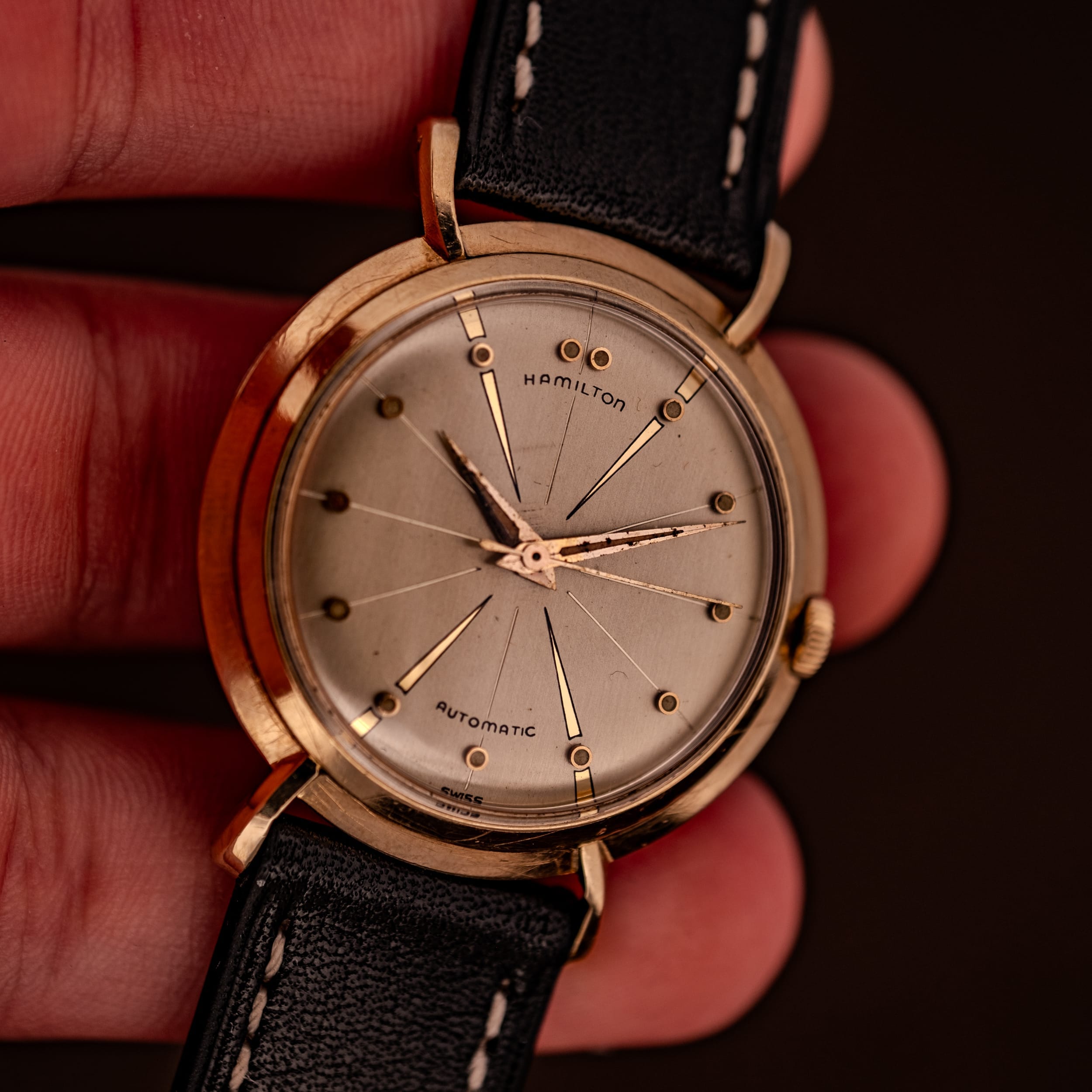
Hamilton Thin-O-Matic references
T-501 (1959-1961, stainless, cal. 663 or 666): $325 to $625 for a clean, unpolished example with an original dial. Refinished dials are common in this price range; original dials show applied gold indexes with consistent age-related toning across the surface. A refinished dial reads as too even under good light.
T-401 (another early stainless reference from 1959): comparable range to the T-501.
Masterpiece Thin-O-Matic in 10K gold: $550 to $950 for a typical example in worn but honest condition; $1,000 to $1,500 for exceptional, unpolished examples with confirmed original dials.
T-101 (18K gold, 1959): the rarest of the first-year references, running $1,200 to $2,500 depending on case condition. Gold content establishes a meaningful floor.
Second-generation TM-prefix references (post-1967): generally available at a 20 to 30 percent discount to equivalent T-prefix examples. Mechanically sound, and in many cases aesthetically identical to late T-series production. The collector distinction is provenance.
Chrono24 dealer asking prices for gold-filled Thin-O-Matics in 2025 and 2026 range from $412 to $995, with the spread reflecting case condition more than reference distinction. The $412 examples are typically worn gold-fill with polished cases; the $900-plus examples are clean and unpolished with original dials.
What to Inspect
On CLD watches, the two-piece case and gasket construction create specific failure points. The crown stem is a two-piece design, allowing the crown to operate through the sealed case body, and this joint wears with regular use over decades. A difficult or loose crown on a CLD watch is almost always a stem problem. Replacement stems for some models are scarce. Inspect crown engagement carefully before committing to a purchase.
Case condition on gold-filled examples is the primary value driver. Gold-filled construction bonds a layer of gold mechanically to a base metal core. It wears through at lug tips and case edges with use over time. A CLD watch with significant wear-through at the lugs has lost most of its aesthetic value regardless of movement condition. Under direct light, check the lug tips and case-back edge for exposed base metal before any purchase.
On Thin-O-Matic watches, the primary diagnostic is the case back. A flat back confirms micro-rotor construction and identifies a genuine Thin-O-Matic caliber. A dome or pie-pan back indicates a conventional-rotor Accumatic caliber in what may be marketed as a Thin-O-Matic case. The movement is different in that scenario, and the collector value is different accordingly.
Plating color on the movement identifies era. Pink plating on bridges and main plate means pre-1966 Lancaster production: a 663 or 666 caliber. Nickel plating means post-acquisition Buren-family production. Both run well and both can be serviced. The distinction matters for collectors who place a premium on American-era manufacture.
On both lines, dial originality is the single most consequential factor in value. Hamilton dress dials of this period were refinished in significant numbers during the 1970s and 1980s, when the watches were inexpensive and owners sought to restore appearance rather than preserve originality. A refinished dial shows even, perfect printing without the micro-oxidation and tonal aging that develops in original printed surfaces over 60 to 70 years. Applied gold indexes on a refinished dial typically show an even, bright finish; original indexes have minor variation from oxidation and age. The firm most commonly associated with Hamilton refinishing of this period is International Dial Company. The work reads as correct on casual inspection. It does not read as correct under magnification or good raking light.
The Market Has Not Corrected
Hamilton’s American era ended without the mythology that sustains collector premiums at comparable Swiss houses. There is no Lancaster-era narrative equivalent of Rolex’s Oyster case story, no Hamilton equivalent of the Omega Constellation observatory certification program. There is no archival marketing campaign that contemporary collectors invoke when pricing the dress production. Hamilton’s collector identity in the current market runs through the post-Swiss-transition Khaki Field and the Ventura. Those products have no genealogical connection to the Lancaster dress lines.
The result is a structural underpricing that is well-documented by comparison. A Longines Ultra-Chron or an Omega Genève in similar case materials and movement specification from the same period trades at two to three times the price of a comparable Hamilton Masterpiece Thin-O-Matic. The movements are not two to three times better. The dials are not more refined. The cases are not more precisely finished. The premium is entirely attributable to brand narrative and collector community formation, both of which Longines and Omega have invested in heavily over the last decade, and neither of which Hamilton’s current stewards have applied to the Lancaster-era dress production.
The CLD line represents a sealing technology that preceded the mass adoption of screw-down crowns and O-ring case backs by the broader industry. The Thin-O-Matic represents an automatic micro-rotor movement family that Hamilton sourced from Buren, then acquired Buren to secure, then lost to Swiss transition. The production arc ended as the American watch industry itself ended. These are not minor historical footnotes. They are watches from the last chapter of a manufacturing tradition that no longer exists, priced as if the tradition never mattered.
That will not remain true indefinitely. The collector attention that has repriced Longines, elevated mid-century Omega dress references, and put Tissot Visodate examples beyond what the market expected five years ago follows a consistent pattern: community formation, archival documentation, editorial attention, and then price discovery. The Hamilton Lancaster-era dress lines have the archival documentation, in the form of Hamilton Chronicles and Vintage-Hamilton-Wristwatches. The editorial attention is beginning. The price discovery has not yet arrived.
Browse Hamilton watches currently in the OTTUHR collection, including CLD and Thin-O-Matic examples as they become available.
Related guides
More Hamilton: date your Hamilton by its serial number, and our beginner’s buying guide.
Related posts
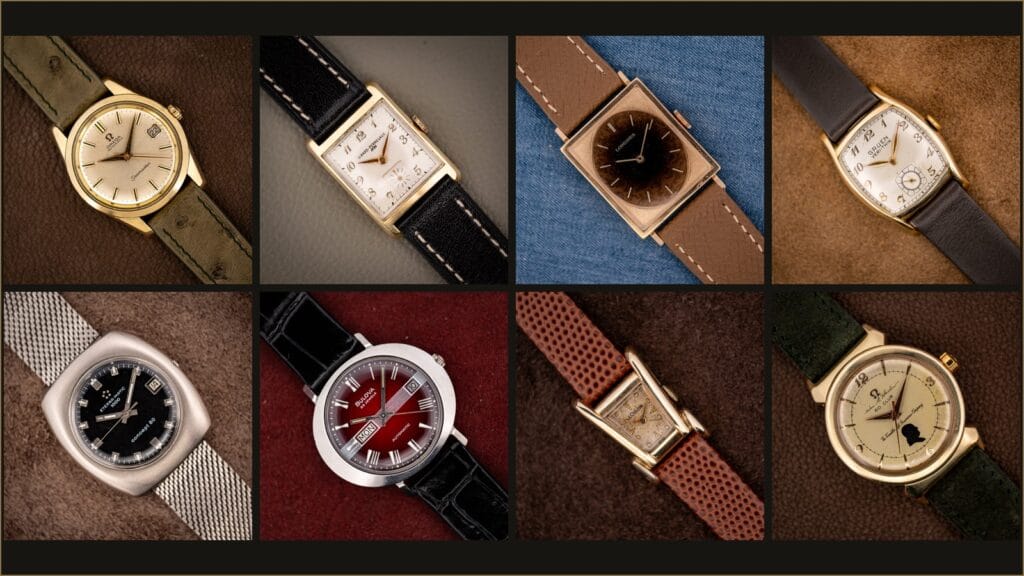
Watch Shapes: Which Vintage Case Shape Fits Your Style?
Case shape changes how a vintage watch wears more than diameter alone. Compare eight silhouettes and learn which one fits your wrist and style.
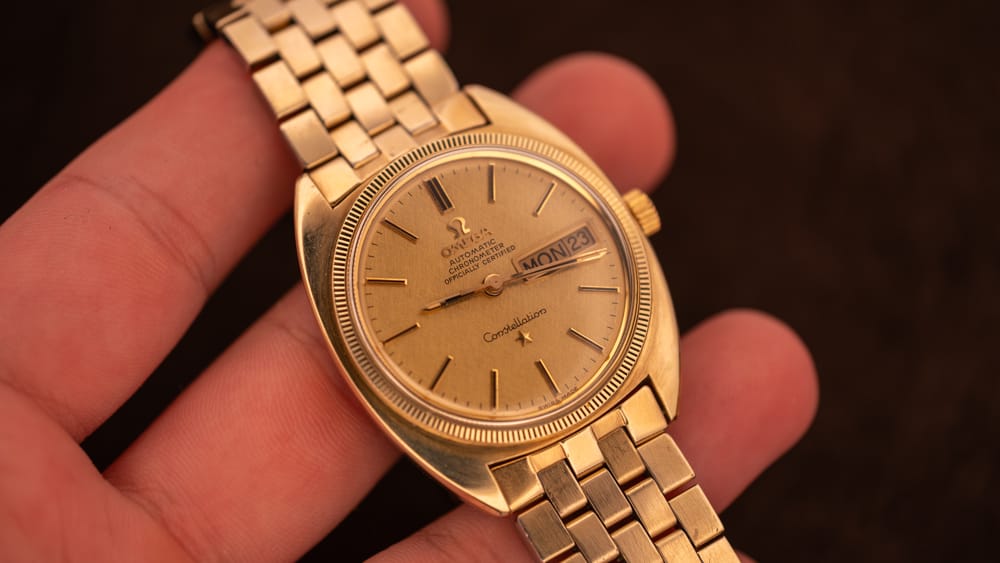
Vintage Dress Watches: How to Choose One You’ll Actually Wear
The best vintage dress watch is the one you will wear beyond weddings. Here is how to choose the right size, metal, dial, shape, and strap.
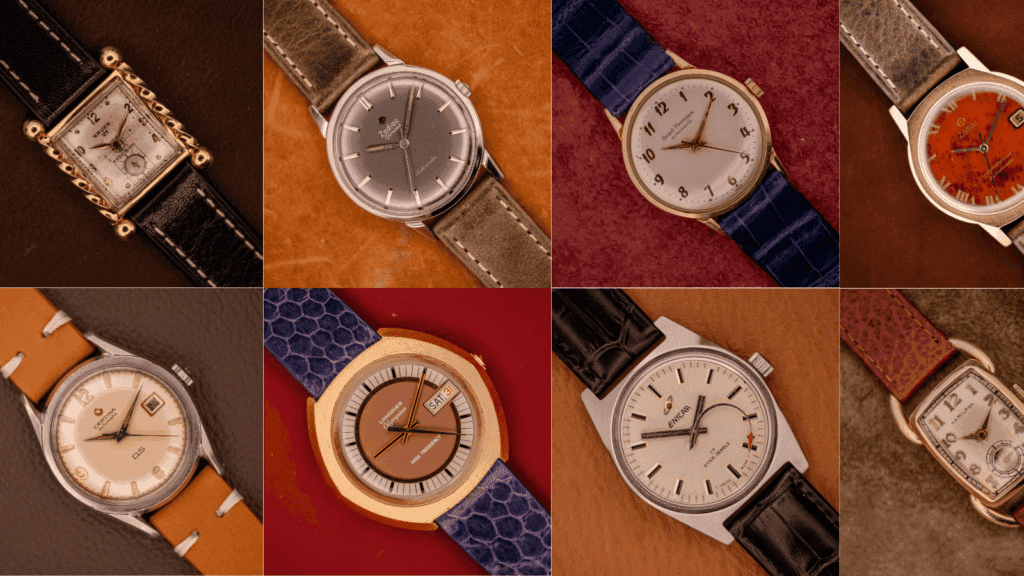
Vintage Watch Styles: A Visual Guide to Finding Yours
Most buyers pick a brand and stall. Here are nine vintage watch styles, shown with real watches from our archive, and the catch that comes with each one.
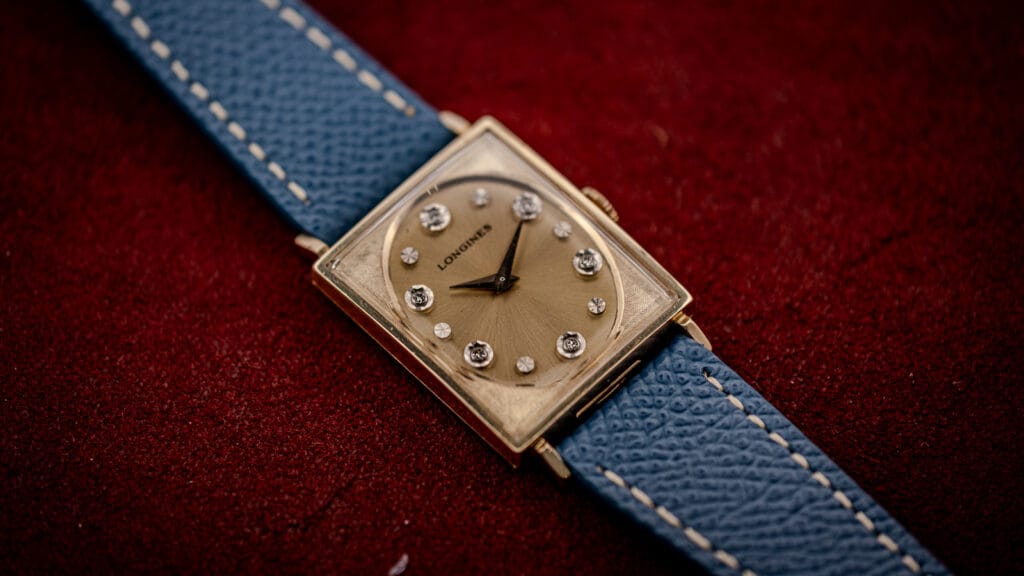
Vintage Tank Watches: A Buyer’s Guide to Rectangular Watches Beyond Cartier
Every Cartier Tank alternatives list is new watches imitating old ones. The originals still exist and cost less. A buyer's guide to vintage tank and rectangular watches: the brands, the prices, and what to check.
Service History Is the Wrong Question. Here’s the Right One.
Everyone says to ask for a vintage watch's service history. Most of it can't be verified, and a receipt proves a transaction, not a result. Here's what actually tells you a watch has been serviced, and the better question to ask.
LeCoultre vs. Jaeger-LeCoultre vs. Jaeger: What the Name on the Dial Means
Three names, one Swiss firm, and one watch that isn't what it looks like. What LeCoultre, Jaeger-LeCoultre, and plain Jaeger on a vintage dial really tell you.
Omega Seamaster 166.010 Buyer’s Guide: Prices, Variants, and What to Look For (2026)
Everything you need to buy an Omega Seamaster 166.010 in 2026: real market prices by condition tier, five dial variants explained, caliber 562 vs 565, original part numbers, and what to inspect before you commit.
Omega vs Rolex: The Vintage Buyer’s Verdict
Vintage Omega vs vintage Rolex: where the Rolex premium is worth paying, where Omega is the smarter buy, and how to dodge redials on both. A collector's verdict.
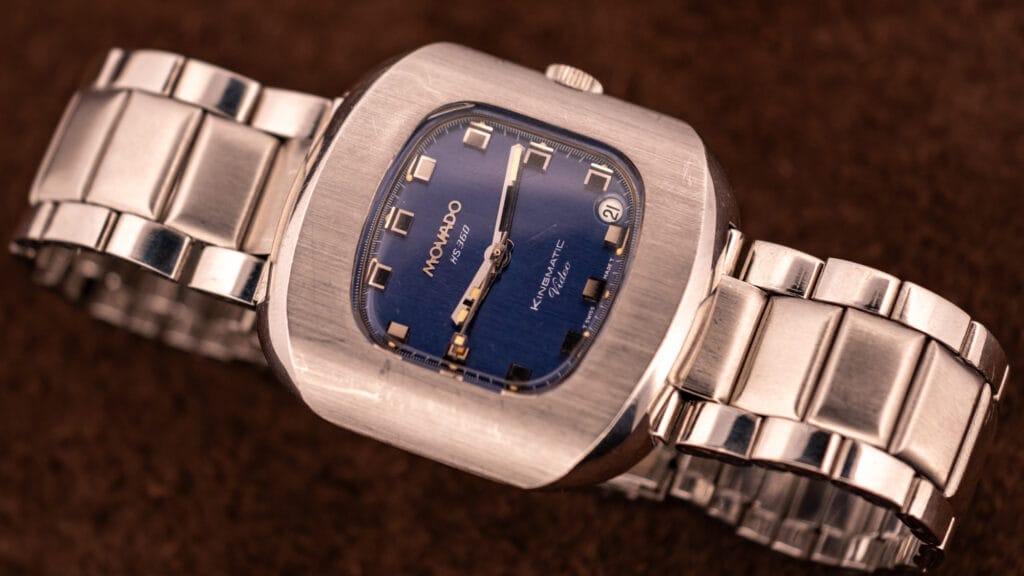
Movado Kingmatic: A Vintage Buyer’s Guide to References, Calibers, and Value
The Movado Kingmatic is one of the best values in vintage automatics. A buyer's guide to its references, in-house calibers, the Sub-Sea line, what to check, and what they actually sell for.
13 Vintage Watch Collecting Tips for Beginners (From 1,000+ Watches Sold)
Thirteen vintage watch collecting tips drawn from selling over 1,000 watches. What separates a smart first buy from an expensive lesson, with no sugar.
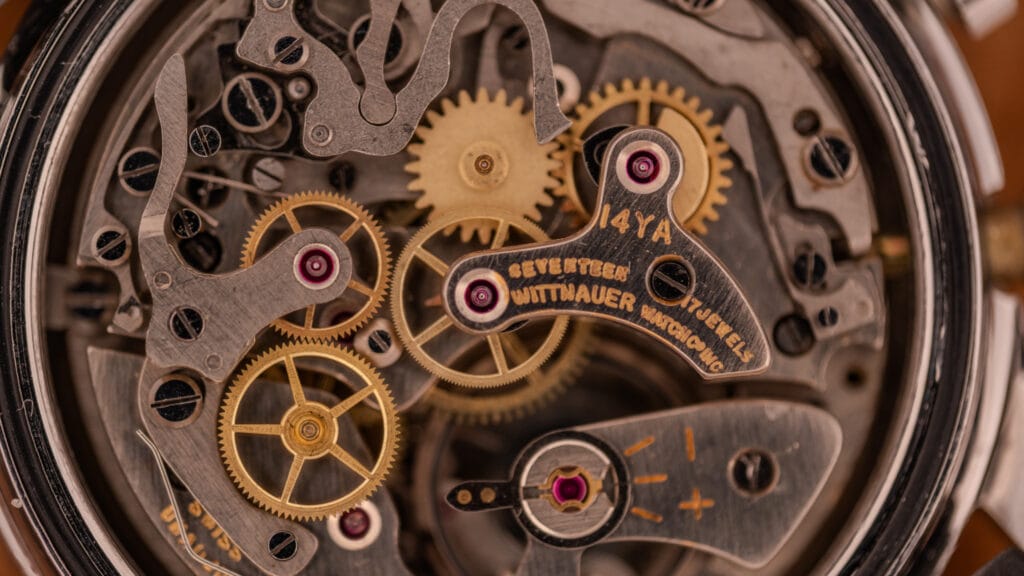
Vintage Wittnauer Chronograph Caliber Identification: Venus 188, Valjoux 7733/7734, Landeron 248
How to identify the movement inside any vintage Wittnauer chronograph: Venus 188, Valjoux 7733 and 7734, Landeron 248, and the house numbering system Wittnauer used to mark them.
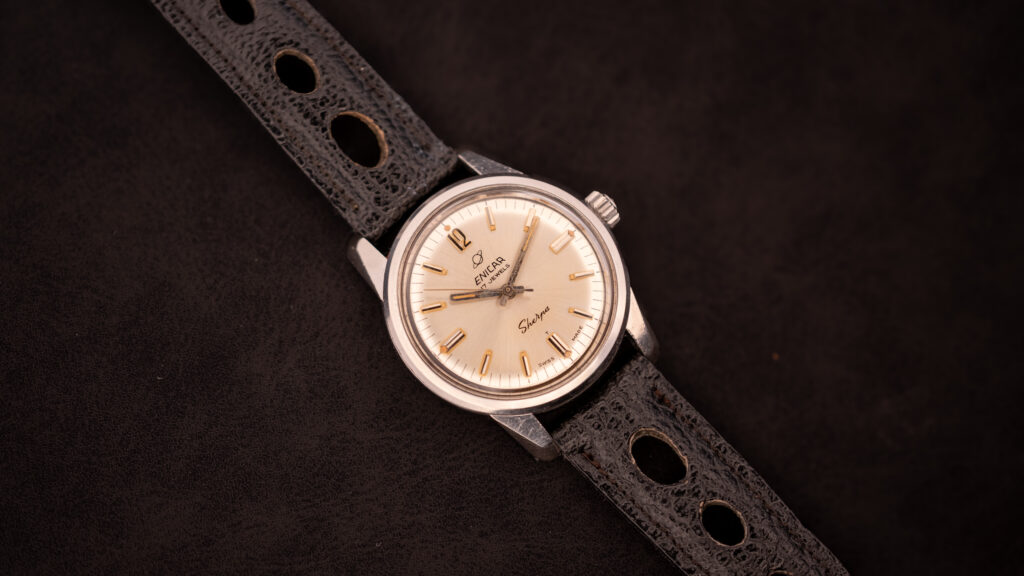
How Water-Resistant Is a Vintage Watch, Actually? The Honest Answer.
Every dealer says never get a vintage watch wet. That advice is half-engineering and half-liability theater. Here is what is actually true about vintage water resistance, where water actually gets in, and when a 1965 diver is safer than a 2-year-old modern.