

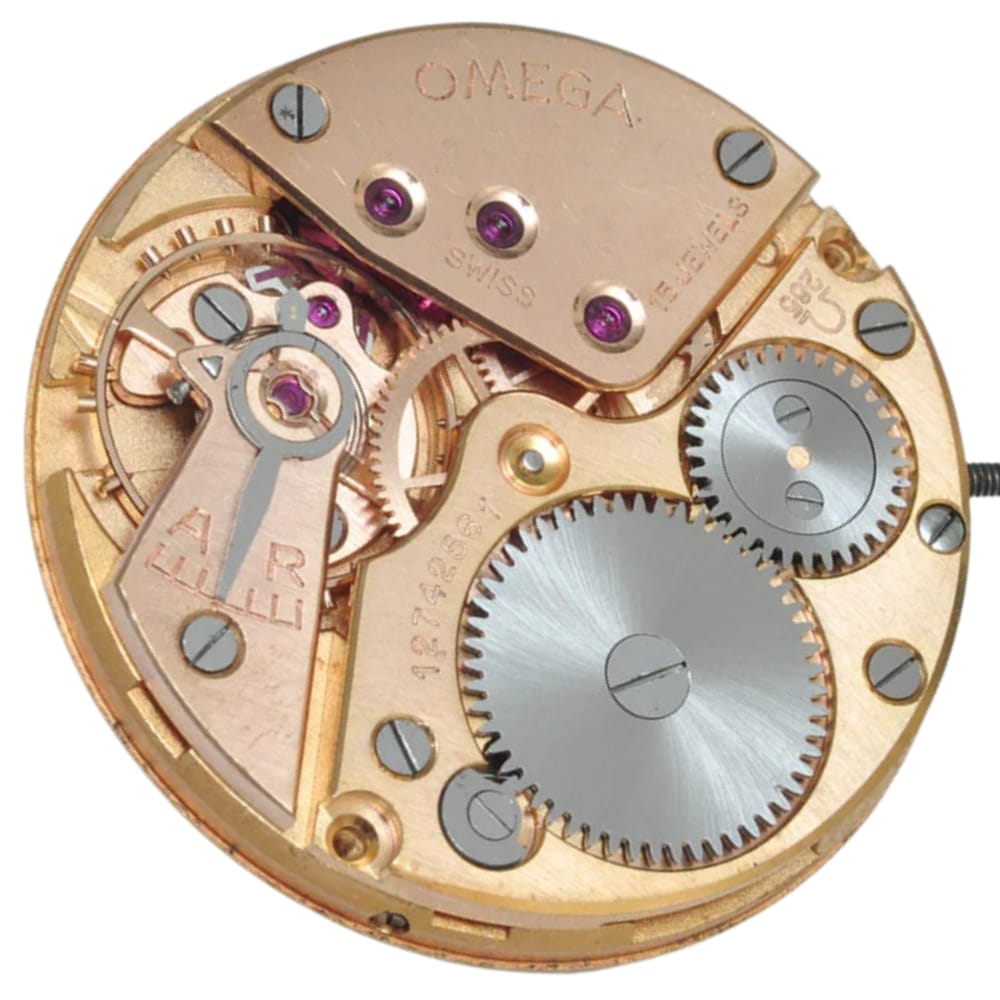
The Omega 265 represents a specific expression of one of Omega’s most consequential movements: the legendary 30mm family that powered over 110,000 British military watches during World War II and established the brand’s reputation for precision timekeeping under adverse conditions. When collectors discuss the 30T2, they reference not a single caliber but an entire architectural lineage spanning 1939 to 1963, and the 265 occupies a specific position within this ecosystem as the antimagnetic, 15-jewel variant introduced after Omega’s 1949 nomenclature change.
Originally designated 30T2 PC AM (Pare-Chocs Antimagnétique), the caliber received the numeric designation “265” when Omega systematically renamed its movements in 1949, transitioning from alphanumeric codes to three-digit identifiers. The movement architecture remained fundamentally unchanged through this rebadging, maintaining the engineering principles that made the 30T2 successful: a 30mm diameter that accommodated the largest possible balance and barrel for exceptional timekeeping, beryllium bronze construction with copper-gilt plating, and Incabloc shock protection.
Omega manufactured approximately 3 million movements across the entire 30mm family during its 24-year production run, making individual caliber 265 examples relatively common rather than scarce. The movement powered mid-sized dress watches from 33mm to oversized “Jumbo” references approaching 39mm, serving civilian customers who valued precision but did not require chronometer certification. Serial numbers in the 11 million range correspond to production years 1947-1950, the 12 million range dates to 1950-1952, and the 13 million range spans 1952-1954.
The caliber 265 occupies middle ground in collector estimation. It lacks the prestige of the chronometer-grade 262 (30T2 RG) with its fine regulator, but offers superior antimagnetic properties compared to the base 260 caliber. Collector demand remains stable rather than ascending, with properly serviced examples commanding $800-$2,000 depending on case reference and dial condition. Specific case references including military-adjacent models show elevated interest, though the 265 itself saw no military contracts, those being fulfilled by earlier 30T2 variants.
Development History
The caliber 265’s origins trace to 1938, when Omega Technical Director Henri Gerber tasked engineer Jean-Pierre Mathey Claudet with developing a manual-wind movement optimized for accuracy rather than miniaturization. The first 30mm prototype entered production in December 1938, with the refined 30T2 variant launching in 1939. Omega’s design philosophy rejected the “miniaturized pocket watch” architecture common to contemporary calibers like the IWC 83, instead adopting what appeared as brutish simplicity: large functional plates, minimal decorative finishing, and component dimensions selected through systematic research to identify ideal proportions.
The 30T2 achieved immediate market validation when the British Ministry of Defence ordered 110,000 examples for RAF pilots during World War II, representing over half of Omega’s 1943 production and more than 10% of total wartime output. These military contracts established Omega’s reputation for producing accurate, serviceable movements that watchmakers praised for logical construction and ease of assembly decades after production ceased.
Predecessor and Successor Relationships
The caliber 265 evolved directly from the 30T2 PC AM base movement introduced circa 1943-1944. When Omega restructured its nomenclature in 1949, the 30T2 family split into the 260-series (small seconds at 6:00) and 280-series (center seconds), with the 265 representing the antimagnetic 15-jewel variant.
The caliber’s immediate relatives include:
- 260: Base 15-jewel version without antimagnetic treatment
- 261: 15-jewel antimagnetic variant (minimal differences from 265)
- 262: 17-jewel chronometer grade with eccentric fine regulator (30T2 RG)
- 266: 17-jewel antimagnetic version with Incabloc
- 267: 17-jewel antimagnetic variant
- 268: Ring balance rather than screw balance
- 269: Flat hairspring rather than Breguet overcoil
The caliber 286, produced until 1966, represents the final descendant of the 30mm lineage, marking the conclusion of a 27-year production run immediately before the quartz crisis disrupted Swiss mechanical watchmaking.
Manufacturing Context
The caliber 265 is an in-house Omega manufacture movement, designed and produced entirely at the Bienne facility under Henri Gerber’s technical direction. Unlike ebauche-based calibers that source movement blanks from suppliers like ETA, Peseux, or AS Schild, the 30mm family represents fully integrated manufacture, from raw material to finished caliber.
The movement plates consist of beryllium bronze alloy with copper-gilt plating, a material selection providing both antimagnetic properties and an aesthetically pleasing rose-gold appearance that distinguishes vintage Omega movements. This copper-plated beryllium bronze construction appeared consistently across 30mm production from at least 1943 through the series’ conclusion in the 1960s.
The 30mm family stands among the most influential manual-wind movements of the mid-20th century, though the caliber 265 itself occupies a supporting rather than starring role within this lineage. The chronometer-grade 30T2 RG variants achieved first-place “for precision” at 1946 chronometry trials in Neuchâtel, Geneva, and Kew, establishing Omega’s observatory competition credentials. During the 1950s, Omega commanded 30-50% of all chronometer certificates issued annually, success built substantially on 30mm movement architecture.
The caliber 265 served as Omega’s workhorse rather than its champion, powering thousands of civilian dress watches while higher-grade variants competed in observatories and military specifications. This positioning as reliable commodity rather than exceptional instrument explains both its relative abundance and its stable rather than ascending collector valuation.
Construction and Architecture
Plate and Bridge Layout
The caliber 265 employs a three-quarter plate architecture with two principal bridges: a barrel bridge and a balance cock. The movement utilizes beryllium bronze construction with copper-gilt plating, creating the characteristic rose-gold appearance visible on plates and bridges. This finishing reflects mid-tier manufacturing standards, prioritizing functional reliability over decorative elaboration.
The architectural philosophy emphasizes mechanical logic over visual complexity. Component layout provides clear access paths for disassembly and service, a design choice that earned praise from watchmakers who serviced these movements decades after production. The bridge configuration uses fewer components than contemporary pocket-watch-derived designs, reducing potential failure points while maintaining structural rigidity necessary for consistent timekeeping.
Balance Wheel
The caliber 265 features a screw-adjusted Glucydur balance wheel, representing monometallic balance technology that replaced earlier bimetallic compensation balances. The Glucydur alloy (beryllium-copper) provides inherent temperature compensation without requiring bimetallic construction, a significant technical advancement introduced during the mid-20th century.
The balance diameter maximizes the available 30mm movement space, a deliberate design decision to enhance timekeeping stability through increased moment of inertia. The screw-adjusted configuration allows watchmakers to perform timing adjustments by adding or removing small screws positioned around the balance rim, though the 265 does not feature extended mean-time screws common to higher-grade movements. Timing adjustments beyond regulator arm positioning require adding spacer washers to existing screws or filing material to modify mass distribution.
Balance Spring (Hairspring)
The movement employs a Breguet overcoil hairspring, a configuration credited to Abraham-Louis Breguet that elevates the outer coil above the main spiral plane. This overcoil design maintains concentric expansion and contraction as the hairspring breathes, minimizing positional errors caused by gravity acting on an eccentric spiral.
The hairspring material specification varies by production period, with earlier examples potentially using traditional steel alloys while later production incorporated Nivarox or similar materials. The Breguet overcoil represents superior construction compared to flat hairsprings used in economy-grade variants like the caliber 269, contributing to the 265’s reliable timekeeping characteristics.
The regulator system utilizes a two-piece index regulator (part 1333) that allows fine adjustment of the effective hairspring length, directly controlling the movement’s rate. This index configuration provides adequate precision for non-chronometer-grade movements while remaining simple to service and adjust.
Escapement Type
The caliber 265 incorporates a Swiss lever escapement with club-tooth escape wheel and straight-line lever geometry. The escapement features jeweled pallet stones and a single impulse jewel mounted in the balance roller, representing standard Swiss lever construction for mid-tier manual movements of this era.
The escapement demonstrates Omega’s research into optimal component proportions within the 30mm diameter constraint. According to period sources, the 30T2 family utilized “the smallest escapement used in calibers of this type, combined with the largest barrel and balance permitted by the size of the caliber”. This dimensional optimization contributed to the movement’s reputation for reliable performance and ease of regulation.
Shock Protection System
The movement employs Incabloc shock protection on both balance staff pivots (upper and lower jewels), identified as part numbers 265-1346 (lower) and 265-1347 (upper) in parts catalogs. The Incabloc system uses a spring-mounted jewel setting that absorbs impact energy when the watch experiences shock, protecting the delicate balance staff pivots from breakage.
The Incabloc jewel settings consist of a hole jewel, cap jewel (endstone), and retaining spring assembled into a removable unit. This modular design allows watchmakers to service or replace shock protection components without disturbing the main movement plate, though pressing out and reinstalling Incabloc settings requires specialized tools to maintain proper depth and alignment.
Regulator Type
The caliber 265 uses a two-piece index regulator system (Omega part 1333) consisting of a regulator body and separate pointer arm. This configuration allows adjustment of the effective hairspring length by moving the index pins closer to or farther from the balance wheel center, thereby speeding or slowing the rate.
The regulator mounts to the balance cock and operates through a friction-fit mechanism that holds adjustment position while allowing watchmaker repositioning during regulation. The two-piece design provides adequate adjustment range for non-chronometer movements without requiring the micrometric fine adjustment capabilities of the eccentric regulator used in chronometer-grade caliber 262 variants.
Standard 30mm movements including the 265 do not incorporate swan-neck fine regulators, though Omega experimented with swan-neck configurations on limited production runs of caliber 283 (center seconds version) before marking these designs obsolete around 1954.
Mainspring Material and Type
The mainspring specifications for caliber 265 match dimensions documented for the broader 30mm family: 1.25mm height, 0.090mm thickness (or 0.075mm in some references), 240mm length, and 7.5mm arbor diameter. Cross-reference sources identify this as GR3095 or GR2894 in generic replacement catalogs.
The mainspring barrel measures approximately 11.5mm diameter, representing significant proportion of the 30mm movement diameter and reflecting Omega’s design philosophy prioritizing energy storage capacity. The mainspring configuration uses traditional fixed attachment rather than slipping bridle, appropriate for manual-wind applications requiring full torque delivery throughout the power reserve cycle.
Generic Swiss-made Nivaflex replacements remain available from multiple suppliers, providing modern alloy characteristics (reduced set, improved longevity) while maintaining dimensional compatibility with original specifications.
Gear Train Details
The gear train follows conventional four-wheel configuration: barrel, center wheel, third wheel, and fourth wheel (seconds wheel). The caliber 265 employs indirect small seconds drive, with the fourth wheel positioned to drive the small seconds hand at the 6:00 position on the dial.
The center wheel integrates with the cannon pinion (height 5.61mm per parts catalog) that drives the minute hand and connects to the motion works for hour indication. Gear ratios follow standard Swiss practice for 18,000 vph movements, though specific tooth counts and ratio documentation remains sparse in available literature.
Finishing Quality and Techniques
The caliber 265 receives mid-tier finishing appropriate for non-chronometer-grade manual movements produced in substantial quantities. The movement plates display perlage (circular graining) applied in overlapping patterns across visible surfaces beneath bridges. This perlage serves both aesthetic and functional purposes, creating texture that prevents microparticles from affecting chronometry while adding visual interest.
Bridges and cocks show functional rather than decorative finishing, lacking the Côtes de Genève striping reserved for higher-grade Omega movements. The movement’s copper-gilt plating creates a rose-gold appearance that characterizes vintage Omega calibers, though this represents protective plating rather than precious metal content.
Screw heads receive basic polishing with cleanly cut and centered slots, reflecting competent but not exceptional finishing standards. Jewel settings use pressed rather than gold-chatons configuration, consistent with mid-tier movements where functional reliability outweighs decorative elaboration. The absence of hand-applied anglage (beveling), mirror polishing, and decorative striping correctly identifies the 265 as a production-grade rather than haute horlogerie movement.
Chronometer-grade variants within the 30mm family (caliber 262/281) demonstrate significantly elevated finishing including mirror-polished and anglaged components, but these refinements remain absent from standard 265 production.
Cross-Reference Data

Alternative Caliber Names
| Manufacturer | Caliber Designation | Notes |
|---|---|---|
| Omega | 30T2 PC AM | Original designation before 1949 nomenclature change |
| Omega | 30T3 PC AM 15P | Alternate designation found in parts catalogs |
The caliber 265 designation represents Omega’s post-1949 numbering system applied to movements previously identified by alphanumeric codes.
Base Caliber vs. Elaborated Versions
| Variant | Jewels | Key Differences | Notes |
|---|---|---|---|
| 260 (30T2 PC) | 15 | Base version, no antimagnetic treatment | Foundation caliber |
| 265 (30T2 PC AM) | 15 | Antimagnetic balance, Incabloc | Subject of this report |
| 261 | 15 | Antimagnetic, minimal differences from 265 | Rare variant |
| 262 (30T2 RG) | 17 | Chronometer grade, eccentric fine regulator | Higher finishing |
| 266 | 17 | 17 jewels, antimagnetic, Incabloc | Common upgrade from 265 |
| 267 | 17 | 17 jewels, antimagnetic | Variant of 266 |
| 268 | 17 | Ring balance instead of screw balance | Less common |
| 269 | 17 | Flat hairspring instead of Breguet overcoil | Final variant (1963) |
Center seconds versions carry 280-series designations (280, 281, 283, 284, 285, 286) with corresponding specifications but modified gear train for indirect center seconds.
Compatible Case References by Brand
Case references accept both 15-jewel (265) and 17-jewel (266, 267) movements interchangeably, as the movements share identical dimensions and dial foot positioning.
Dial Compatibility Note
Dial foot positions for caliber 265 follow standard Omega 30mm configuration with feet located to accommodate small seconds at 6:00 position. The movement mounting diameter measures 30.0mm with mounting height (F) of 0.5mm and stem height (T) of 1.7mm. Dials designed for any 260-series caliber (260, 261, 262, 265, 266, 267, 268, 269) share compatible foot positioning, allowing interchange provided the seconds subdial matches the movement configuration (small seconds vs. no seconds).
Date window compatibility does not apply as the caliber 265 lacks date function. Collectors restoring or modifying examples should verify dial foot diameter (typically 1.04mm) and ensure proper alignment with movement holes before soldering replacement feet.
Crown and Stem Specifications
The stem male section threads into the crown while the female section engages with the winding pinion inside the movement. Period-correct Omega-signed crowns measure 1.8mm depth with 2.2mm pendant tube diameter, while case tubes measure approximately 1.4mm height and 2.1mm diameter.
Identification Marks
Caliber Number Location
The caliber number “265” appears engraved on the movement’s balance cock (bridge) positioned above the balance wheel. This marking follows Omega’s standard practice of identifying post-1949 movements with three-digit numerical designations visible when the caseback is removed.
Earlier production examples manufactured before 1949’s nomenclature change may display “30T2 PC” or “30T2 PC AM” on the main plate or balance cock, identifying the movement by its original alphanumeric designation. Both markings reference identical movements, the difference reflecting only the transition in Omega’s numbering system.
Logo and Brand Marks
Authentic caliber 265 movements display “OMEGA” engraving on the main plate, typically positioned near the center wheel or visible through the balance cock cutout. The movement should also show “SWISS” or “SWISS MADE” marking, confirming Swiss manufacture.
Jewel count marking “15 RUBIS” or “15 JEWELS” appears engraved on the movement, distinguishing the 15-jewel caliber 265 from 17-jewel variants (266, 267). The Incabloc logo may appear near the balance cock, indicating shock protection presence, though not all examples display this marking prominently.
Quality stamps, adjustment markings, or specialized certifications do not appear on standard caliber 265 movements. Such markings distinguish chronometer-grade variants (262, 281) that received observatory testing or military specifications, neither of which applies to the commercial-grade 265.
Date Codes
Omega movements of this era do not employ date codes in the modern sense. Production year determination relies on serial number ranges rather than coded markings:
- 11,000,000 – 11,999,999: 1947-1950
- 12,000,000 – 12,999,999: 1950-1952
- 13,000,000 – 13,999,999: 1952-1954
Serial numbers appear engraved on the movement, typically on the barrel bridge where clearly visible after caseback removal. The seven-digit format follows Omega’s sequential numbering system used from 1894 until approximately 2019.
Finishing Marks
Authentic caliber 265 movements display perlage (circular graining) on the main plate and visible surfaces beneath bridges. This circular pattern appears as overlapping rings created by rotating abrasive tools, serving both aesthetic and functional purposes by preventing microparticle accumulation.
The movement lacks Côtes de Genève striping on bridges, the absence of which is correct for this commercial-grade caliber. Any movement displaying Geneva stripes or elaborate anglage raises authenticity concerns unless documenting a factory-modified chronometer variant, which would carry different caliber designation.
Screw heads show basic polishing with cleanly cut, centered slots. The copper-gilt finish on plates and bridges creates the characteristic rose-gold appearance, though plating quality and color intensity vary across production years.
Jewel Markings
The caliber 265 employs pressed jewel settings rather than gold chatons, reflecting mid-tier construction standards. Jewel holes should appear clean and properly seated, with cap jewels (endstones) visible on both sides of the balance staff pivots where Incabloc shock protection mounts.
Upper and lower balance jewels utilize Incabloc assemblies consisting of hole jewel, cap jewel, and spring retainer, identifiable by the characteristic Incabloc spring shape. These settings should show consistent finishing and proper seating depth when examined under magnification.
Adjustment Markings
Standard caliber 265 movements do not carry adjustment markings, as this commercial-grade caliber did not receive chronometer certification or specialized positional testing. The absence of markings such as “ADJUSTED,” “5 POSITIONS,” “CHRONOMETER,” or similar inscriptions is correct and expected.
Chronometer-grade variants within the 30mm family (caliber 262, 281) display “CHRONOMETRE” on both dial and movement, accompanied by adjustment markings indicating testing positions and temperature ranges. Any caliber 265 showing chronometer markings represents incorrect dial pairing or misrepresentation, as the base 15-jewel movement with standard index regulator lacks the specifications required for chronometer certification.
Correct Serial Number Formats and Locations
Omega serial numbers for caliber 265 movements follow seven-digit format ranging from approximately 11,000,000 through 13,999,999, corresponding to production years 1947-1954. Later examples may carry higher serial numbers if production extended beyond 1954, though the caliber 265 designation remained in use until 1963 when the entire 30mm family concluded production.
The serial number engraves onto the movement’s barrel bridge, visible after removing the caseback. Authentic engravings show consistent depth, sharp character definition, and proper numeric font characteristic of Omega factory work from this era.
Serial numbers should consist solely of numerals without prefixes, suffixes, or alphabetic characters. The sequential numbering system assigns unique identifiers to each movement without gaps or repeated sequences, allowing authentication through Omega archives or Extract from the Archives documentation.
Expected Engravings and Stampings
Authentic caliber 265 movements display the following engravings:
- Main Plate:
- “OMEGA” (manufacturer name)
- “SWISS” or “SWISS MADE” (country of origin)
- Possible “15 RUBIS” or “15 JEWELS” (jewel count)
- Barrel Bridge:
- Seven-digit serial number
- Possible additional markings related to production codes
- Balance Cock:
- “265” (caliber designation)
- Possible “ANTIMAGNETIC” or similar marking (variant dependent)
- Possible Incabloc logo or marking
All engravings should appear sharply defined with consistent depth reflecting machine or hand engraving techniques employed during 1940s-1960s production. The copper-gilt finish on movement plates sometimes obscures fine engravings, requiring proper lighting and magnification for complete verification.
Stampings should show clean edges without evidence of modern laser engraving, which produces different edge characteristics than period-correct engraving methods. Font style matches Omega factory standards from the mid-20th century, with serif or sans-serif characters depending on specific marking type and production period.
Font and Marking Style by Production Era
Early production caliber 265 movements (1947-1950, serial numbers 11,000,000-11,999,999) may display alphanumeric “30T2 PC AM” markings alongside or instead of numeric “265” designation, reflecting the transitional period when Omega implemented its new nomenclature system.
Post-1949 production standardized on “265” numeric designation with consistent font style characteristic of Omega’s post-war engraving standards. The engraving depth remains relatively shallow but clearly legible, with individual character height typically 1-2mm depending on marking location and importance.
The Omega logo evolved throughout the 20th century, with 1940s-1960s examples showing less rounded characters compared to modern Omega branding. Collectors should reference period-appropriate Omega advertising and catalog imagery to verify logo style consistency with claimed production year.
Changes in movement finishing, plating color intensity, and jewel setting techniques occurred gradually throughout production but do not correspond to specific year transitions documented in available literature. The beryllium bronze construction with copper-gilt plating remained consistent across the entire production run.
Part Information

Parts Catalog Cross-Reference
The following tables document key serviceable components with part numbers from Omega parts catalogs:
Movement Structure
| Part Name | Part Number | Notes |
|---|---|---|
| Main Plate | 265-1000 | Foundation component |
| Barrel Bridge | 265-1001 | Holds mainspring barrel |
| Balance Cock | – | Holds balance assembly |
| Crown Wheel Seat | 265-1103 | Mounting for winding mechanism |
Power Train
Escapement and Regulation
Shock Protection
Keyless Works and Setting
Dial Train
| Part Name | Part Number | Notes |
|---|---|---|
| Hour Wheel | 255/390 | Height 1.05mm |
| Minute Wheel | 260/631 | – |
| Small Seconds Pinion | 275/338 | Height 5.19mm |
Miscellaneous
Interchangeability Notes
The caliber 265 shares substantial parts compatibility with the entire 260-series family (260, 261, 262, 266, 267, 268) and center-seconds 280-series (280, 281, 283, 284, 285, 286). Components including stems, keyless works, jewel settings, and many gear train parts interchange freely, though collectors seeking originality should verify part numbers match caliber-specific specifications.
Balance complete assemblies (part 1327) require careful matching, as variations exist in balance type (screw-adjusted vs. ring), hairspring configuration (Breguet overcoil vs. flat), and adjustment state (regulated vs. unregulated). Generic replacement balances may function mechanically but compromise period correctness for restoration projects.
Mainsprings specify GR3095 or GR2894 in generic catalogs, with dimensions 1.25mm height, 0.090mm thickness (or 0.075mm alternate), 240mm length, 7.5mm arbor diameter. Modern Nivaflex alloy replacements provide superior performance characteristics while maintaining dimensional compatibility.
Sourcing Notes
Currently Available Components (as of 2025):
- Mainsprings: Widely available from multiple suppliers in both original Omega and generic Swiss-made Nivaflex versions
- Balance complete: Available new-old-stock and aftermarket from specialist suppliers
- Stems: Generic replacements compatible across 30mm family readily available
- Incabloc parts: Upper and lower assemblies, springs, and jewels available
- Regulators: Both single-piece (1331) and two-piece (1333) versions available
- Escape wheels and pallet forks: Available in various configurations
Commonly Failing Components:
- Mainspring: Sets and loses power reserve with age; replacement recommended during any service
- Balance staff pivots: Vulnerable to breakage from shock or wear despite Incabloc protection
- Incabloc springs: Fatigue and lose tension, compromising shock protection effectiveness
- Hairspring: Magnetization (despite antimagnetic designation) and physical deformation from improper handling
- Pallet fork: Worn pivots affecting escapement geometry and accuracy
- Click spring: Weakening allows winding mechanism slippage
Acceptable Generic Replacements:
- Mainsprings: Generic Swiss Nivaflex in correct dimensions performs equivalently to original
- Stems: Compatible replacements from other 30mm calibers function identically
- Jewels: Generic hole jewels and cap jewels in correct dimensions acceptable for non-collector restorations
- Gaskets and case components: Modern materials provide superior water resistance
Components Requiring Original Omega Parts:
- Balance complete with hairspring: Generic replacements compromise timekeeping and originality
- Escape wheel and pallet fork: Dimensions and surface finish critical for proper escapement function
- Movement plates and bridges: Structural components define authenticity
- Decorative finishing components: Restoration of copper-gilt plating requires period-appropriate techniques
Performance Data
Manufacturer Specifications
Omega did not publish detailed performance specifications for commercial-grade caliber 265 movements, reserving such documentation for chronometer-certified variants. The following specifications represent typical parameters for properly serviced examples based on movement architecture and observed performance:
The antimagnetic designation reflects beryllium bronze balance construction and copper-plated movement plates, though antimagnetic performance remains far below modern standards. Early antimagnetic movements resist everyday magnetic fields (compass, household motors) but fail when exposed to strong sources like modern electronics or MRI equipment.
Observed Performance (Field Data)
Collector reports, watchmaker observations, and auction house timing data provide the following performance expectations for properly maintained caliber 265 movements:
Accuracy Ranges:
- Well-maintained, recently serviced: +/- 10-15 seconds per day
- Good condition, service history unknown: +/- 20-40 seconds per day
- Requiring service, aged lubricants: +/- 60+ seconds per day, erratic performance
One documented example (serial 11,770,312, dated 1948) achieved +9 seconds per day after full service by an Omega specialist, representing exceptional performance for a commercial-grade movement. Another example (serial 12,898,576, dated 1952) ran at +12 seconds per day after complete overhaul. These results demonstrate the movement’s capability when properly serviced, though not all examples achieve this level.
Typical Amplitude:
- Fully wound: 260-295 degrees (movement-dependent)
- After 24 hours running: 240-270 degrees
- Requiring service: <220 degrees, indicating friction or lubrication issues
Lower amplitudes correlate with accuracy degradation, as insufficient balance swing reduces escapement efficiency and increases positional sensitivity. Well-serviced movements maintain amplitude above 250 degrees across the full power reserve cycle.
Common Performance Issues and Causes:
- Magnetization: Despite antimagnetic designation, hairspring magnetization remains possible from modern magnetic fields, causing erratic timekeeping, gaining behavior, or complete stoppage. Demagnetization requires specialized equipment but resolves the issue without disassembly.
- Dried Lubricants: Aged movements (40+ years since last service) experience oil deterioration, increasing friction at pivot points and reducing amplitude. Symptoms include position-dependent rate variation, stopping when set down, and gradual amplitude decrease. Complete service with cleaning and relubrication resolves this condition.
- Balance Staff Damage: The most common catastrophic failure despite Incabloc protection. Broken pivots from impacts or worn jewels from accumulated running require balance staff replacement. Generic replacement staffs exist but proper installation requires specialized tools and expertise.
- Mainspring Fatigue: Original mainsprings lose elasticity after decades, reducing delivered torque and power reserve duration. Replacement with modern Nivaflex alloy restores full power reserve (43-45 hours) and improves isochronism.
- Worn Pallet Jewels: Accumulated wear on pallet stones degrades escapement geometry, increasing variation between positions and reducing amplitude. Pallet fork replacement or re-jeweling addresses this issue.
Performance Degradation with Age:
Without service intervention, caliber 265 movements exhibit predictable performance degradation:
- 10-15 years: Minimal accuracy change, slight amplitude reduction
- 20-25 years: Noticeable rate drift, position-dependent variation increases
- 30-40 years: Significant accuracy degradation, amplitude drops below 250 degrees
- 50+ years: Stopping when set down, erratic behavior, potential complete failure
The 30mm family’s reputation for reliability and serviceability means properly maintained examples continue functioning reliably 70+ years after production. Regular service intervals (5-7 years) preserve performance and prevent accelerated wear from dried lubricants or accumulated debris.
Isochronism Characteristics:
The caliber 265 demonstrates adequate isochronism (consistent rate across the power reserve curve) for a commercial-grade movement. Amplitude typically drops 20-40 degrees from fully wound to 24 hours running, with corresponding rate change of 5-15 seconds per day. This variation reflects the movement’s lack of chronometer-grade regulation and adjustment, though properly serviced examples minimize this drift through careful regulation at multiple positions on the regulator curve.
Watchmakers note the 30mm family’s ease of regulation compared to contemporary movements, attributed to the large balance diameter providing substantial adjustment authority and the simple two-piece regulator offering clear tactile feedback during adjustment