

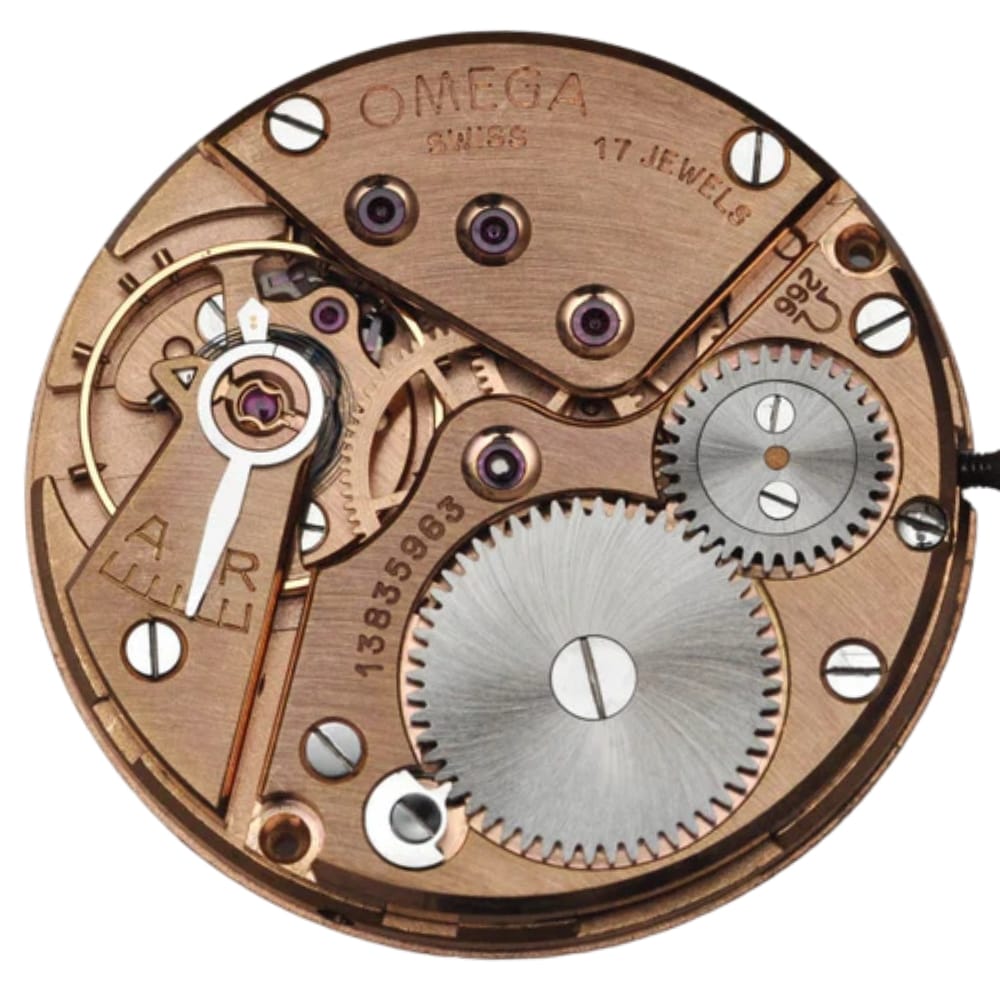
The Omega 266 represents the antimagnetic, 17-jewel evolution of a movement family that established Omega as one of the most trusted names in precision timekeeping during the mid-20th century. Part of the legendary 30mm series that powered Omega’s reputation from 1939 through 1963, the 266 delivered military-grade antimagnetic protection and observatory-caliber architecture to the civilian dress watch market at a price point accessible to working professionals. This caliber appeared in watches worn by everyone from military officers returning from World War II to civil servants stationed abroad, making it one of the most widely distributed precision movements of the 1950s.
The Caliber 266 sits squarely in the middle of Omega’s 30mm hierarchy as a reliable dress watch movement with enhanced specifications over the base 260 caliber. With 17 jewels instead of the base model’s 15, full antimagnetic protection, and Incabloc shock resistance, the 266 offered genuine technical advantages while remaining straightforward to service. Its reputation among collectors and watchmakers centers on dependability rather than chronometer-grade finishing, the movement routinely achieves excellent timekeeping when properly maintained despite lacking the fine adjustment mechanisms found on higher-specification variants like the 262 or 281. The caliber’s large balance wheel, conservative gear ratios, and Breguet overcoil hairspring contribute to stable rate performance across positions and throughout the power reserve.
Omega manufactured approximately 2,883,200 movements across the entire 30mm caliber family during its 27-year production span from 1939 to 1963. The Caliber 266 itself, produced from 1949 through 1963 as part of the second-generation 260-series renumbering, represents a substantial portion of that total production. Based on serial number distribution across the 12 million to 20 million range (corresponding to the 1950-1963 production window), the 266 likely accounts for several hundred thousand units, making it common rather than scarce in today’s vintage market. The movement appears regularly in dealer inventories and online platforms, typically found in reference 2639 cases but also in numerous other case designs from the period. Availability of service parts remains excellent, with mainsprings, balance staffs, and other consumables still offered by suppliers specializing in vintage Omega components.
The Caliber 266 occupies a stable position in the collector market with modest but steady demand. Watches powered by the 266 typically trade at accessible price points compared to chronometer-certified variants or iconic references like the Seamaster 300, reflecting the caliber’s workhorse status rather than rarity or prestige. Original-condition examples with untouched dials and copper-gilt movement finishes command premiums over refinished pieces, as do gold-cased variants and watches retaining period-correct crowns and crystals. Collector interest remains strongest among enthusiasts who value historical authenticity and reliable daily-wear functionality over investment potential or chronometer certification. The caliber benefits from strong name recognition within the broader 30mm family, which continues to attract collectors seeking accessible entry points into vintage Omega ownership.
Historical Context, Provenance, and Manufacturing Details
Omega developed the base Caliber 30 beginning in 1938 under the direction of assistant technical director Henri Kneuss, presenting the finished design in December 1938 and commencing production in February 1939. The movement addressed the market’s demand for a robust, accurate, and affordable manual-wind caliber that could compete with Rolex’s dominance in precision timekeeping while offering superior serviceability. The original 30mm designation, followed by the 30T2 variant name (indicating the second technical modification series), established a platform that Omega would refine continuously for more than two decades. During World War II, the 30mm family proved its reliability in military service, with over 110,000 watches delivered to British armed forces between 1940 and 1945, representing more than half of Omega’s total 1943 production.
In 1949, Omega implemented a comprehensive movement nomenclature change that converted alphanumeric caliber designations to three-digit numbers. The 30T2PC AM (Pare-chocs, Antimagnetique) subseconds variants became the 260-series calibers, with the Caliber 266 specifically denoting the 17-jewel antimagnetic configuration. This renumbering simplified parts ordering and reduced confusion in Omega’s expanding global service network. The Caliber 266 directly succeeded the 30T2PC AM 17-jewel variant while incorporating incremental improvements to finishing and component specifications developed during the late 1940s. The caliber remained in production through 1963, when the entire 30mm family was phased out in favor of the 600-series calibers based on automatic movement architecture with the rotor removed.
The Caliber 266 is an entirely in-house Omega manufacture movement, with all components designed, produced, and finished at Omega’s manufacturing complex in Bienne, Switzerland. Unlike many competitors who relied on ebauche suppliers such as ETA (Eterna), Peseux, AS Schild, or Felsa for base movements, Omega maintained complete vertical integration over the 30mm family throughout its existence. This manufacturing independence allowed Omega to implement quality improvements and specification changes without dependence on external suppliers, contributing to the movement’s reputation for consistent performance across production runs. The caliber shares its fundamental architecture with pocket watch movements from the same era, featuring a large balance wheel, substantial mainspring barrel, and conservative gear train ratios that prioritize longevity over compactness.
Production occurred exclusively in Bienne with no documented changes in manufacturing location during the caliber’s 1949-1963 lifespan. The movement carried Omega’s standard copper-gilt finish that became characteristic of 260-series calibers from 1949 onward, replacing the rhodium plating used on earlier 30T2 variants. This finishing change, while primarily aesthetic, provided a distinctive visual identifier for post-1949 production and improved corrosion resistance in humid climates. The Caliber 266 represents a transitional design philosophically, combining traditional pocket watch construction principles with modern shock protection and antimagnetic materials, produced during the final decades before quartz technology would fundamentally reshape the industry.
Construction and Architecture
Plate and Bridge Layout
The Caliber 266 employs a traditional three-quarter plate construction with two primary bridges mounted atop the base plate. The barrel bridge supports the mainspring barrel and winding mechanism, while the train wheel bridge carries the third wheel and fourth wheel with its extended pivot for the subseconds hand at 6 o’clock. The balance cock, mounted separately on the base plate, positions the balance wheel prominently above the movement with clear visual access for regulation. This layout follows pocket watch design principles with the center wheel and escape wheel pivoted directly in the base plate rather than carried on a separate bridge. The bridges are constructed from brass with copper-gilt plating applied during post-1949 production, replacing the earlier rhodium-plated finish used on pre-renumbering 30T2 variants. The architectural philosophy prioritizes accessibility for service, with all major components easily removable using standard watchmaker’s tools and minimal specialized equipment required for complete disassembly.
Balance Wheel
The Caliber 266 utilizes a bimetallic screw-adjusted balance wheel approximately 10mm in diameter, substantially larger than contemporary movements of similar size. The balance features two opposing pairs of timing screws positioned at the ends of the balance arms, allowing watchmakers to adjust rate by turning screws inward (to speed the movement) or outward (to slow it). The bimetallic construction, consisting of a brass inner layer bonded to a steel outer layer, provides passive temperature compensation by expanding and contracting at different rates as ambient temperature changes. This design addresses the reality that hairspring elasticity varies with temperature, with the bimetallic balance automatically adjusting its moment of inertia to maintain consistent timekeeping across temperature ranges. The balance wheel’s large diameter and conservative oscillation frequency of 18,000 vph create a deliberate, almost pocket watch-like beat rate that contributes to the movement’s characteristic slow, steady tick.
Balance Spring (Hairspring)
The movement employs a Breguet overcoil hairspring manufactured from a temperature-compensated alloy, most likely Nivarox or a similar formulation. The Breguet overcoil configuration elevates the outer terminal curve of the hairspring above the main spiral plane, creating a two-level structure that promotes concentric breathing as the spring expands and contracts. This concentricity ensures that the balance’s center of gravity remains stable throughout oscillation, improving positional performance compared to flat hairsprings. The overcoil design, credited to Abraham-Louis Breguet in the early 19th century, was considered a premium feature in 1950s watchmaking and indicates Omega’s commitment to performance in the 30mm family. The hairspring attaches to the balance staff via a traditional collet, with the outer terminal curve secured by a stud holder mounted on the balance cock. The effective length of the hairspring, and therefore the movement’s rate, is adjusted by moving the regulator index to change which portion of the spring actively participates in oscillation.
Escapement Type
The Caliber 266 features a Swiss lever escapement with jeweled pallet stones, the industry-standard design that has dominated mechanical watchmaking since the late 18th century. The escapement consists of a 15-tooth escape wheel that alternately engages entry and exit pallet stones mounted on a forked lever, with energy transmitted to the balance wheel via an impulse jewel embedded in the roller table. Both the locking and impulse functions occur through sliding contact between the escape wheel teeth and the angled impulse faces of the pallet stones, creating friction that requires regular lubrication to maintain optimal performance. The pallet stones are manufactured from synthetic ruby, providing hardness and wear resistance superior to metal pallets while requiring oil to prevent excessive friction. The escapement architecture delivers consistent impulses to the balance wheel with each oscillation, maintaining the movement’s amplitude and compensating for energy losses from friction and air resistance throughout the gear train.
Shock Protection System
The movement incorporates Incabloc shock protection devices at both the upper and lower pivots of the balance staff. The Incabloc system, introduced in 1934 and widely adopted throughout the Swiss watch industry by the 1940s, uses a spring-loaded conical jewel setting that allows the balance staff pivot to deflect laterally during impact and then return to center position automatically. The system protects the extremely fine balance staff pivots, typically only 0.08-0.10mm in diameter at the balance wheel end, from breakage during drops or sudden impacts. In the Caliber 266, Incabloc devices are fitted to the balance cock (upper pivot) and the base plate (lower pivot), visible as characteristic lyre-shaped spring assemblies surrounding gold chatons that hold the jewel bearings. The shock protection extends the practical lifespan of the movement significantly compared to earlier non-protected calibers, though users should still avoid unnecessary impacts that could damage other components not protected by shock absorbers.
Regulator Type
The Caliber 266 employs a traditional index regulator with a pointer indicating fast (+) and slow (-) directions marked on the balance cock. The regulator consists of a steel arm pivoted concentrically on the balance cock, with two brass pins forming an index staff through which the outer coil of the hairspring passes. Moving the regulator pointer toward the fast marking shortens the effective length of the hairspring, increasing oscillation frequency and causing the watch to gain time. Conversely, moving toward the slow marking lengthens the active portion of the hairspring, reducing frequency and causing the watch to lose time. The adjustment range spans several minutes per day, sufficient for normal regulation but lacking the precision of micrometric regulators or eccentric screw systems found on chronometer-grade variants like the Caliber 262. Watchmakers typically perform initial rough regulation using the index pointer, then make final adjustments by repositioning timing screws on the balance wheel for movements requiring precision beyond the regulator’s range.
Mainspring Material and Type
The movement uses a traditional alloy mainspring measuring 1.50mm in height, 0.140mm in thickness, 320mm in length, and wound in an 11.5mm diameter barrel. The mainspring part number 260-1208 is shared across the entire 260-series family, including calibers 260, 261, 262, 265, 267, 280, and 281, simplifying parts inventory for watchmakers servicing multiple 30mm variants. The spring is of the slipping bridle type, with the outer end attached to the barrel wall via a hook that allows the spring to slip when fully wound, preventing mainspring breakage from overwinding. Generic Swiss-made replacements manufactured by suppliers such as Nivaflex remain readily available through watch parts distributors, ensuring long-term serviceability. The large barrel diameter and conservative spring specifications contribute to the movement’s 45-hour power reserve, impressive for a subseconds manual-wind caliber of this era.
Gear Train Details
The gear train follows a conventional four-wheel configuration with the center wheel (carrying the minute hand via the cannon pinion), third wheel, fourth wheel (with extended pivot for the subseconds hand), and escape wheel arranged in line from the barrel to the escapement. The center wheel is pivoted directly in the base plate rather than carried on the barrel bridge, a design choice inherited from pocket watch construction that provides robust support for the cannon pinion friction fit. The third wheel and fourth wheel are mounted on the train wheel bridge, with the fourth wheel’s lower pivot extended through the dial side of the base plate to carry the subseconds hand at the 6 o’clock position. Gear ratios are conservative compared to later high-frequency movements, reducing wear rates and improving long-term reliability at the expense of resistance to positional variation. The wheels display functional finishing with properly shaped tooth profiles and light beveling, adequate for reliable operation but lacking the mirror polish and extensive anglage found on chronometer variants.
Finishing Quality and Techniques
The Caliber 266 exhibits standard-grade finishing appropriate for a mid-tier dress watch movement rather than luxury-level decoration. The base plate features perlage (circular graining) applied in a regular pattern across visible surfaces, with the copper-gilt plating providing a warm golden tone characteristic of post-1949 production. Bridges display straight graining (Côtes de Genève) running parallel to their length, with beveled edges showing light anglage but not the deep, mirror-polished chamfers found on higher-grade movements. Screw heads are polished and slotted cleanly, though not blued or extensively finished. The crown wheel, ratchet wheel, and click show functional finishing with polished surfaces but lack the extensive hand-finishing applied to chronometer-grade variants. Components visible through the dial side, including the cannon pinion, setting mechanism, and dial foot screws, receive minimal decorative treatment as they are not meant for viewing. The overall finishing philosophy prioritizes durability and ease of service over visual impact, consistent with the caliber’s positioning as a reliable workhorse rather than a showpiece movement.
Cross-Reference Data
Alternative Caliber Names (Rebranded Versions)
The Caliber 266 was not rebadged or sold to other manufacturers under alternative names. Omega maintained exclusive use of the 30mm family for its own watch production throughout the movement’s existence. However, the caliber shares fundamental architecture and many interchangeable parts with its sibling movements in the 260-series family.
| Manufacturer | Caliber Designation | Notes |
|---|---|---|
| Omega | 30T2PC AM 17 | Pre-1949 designation for the same movement |
| Omega | 266 | Official 1949-1963 designation |
Base Caliber vs. Elaborated Versions
The Caliber 266 represents a mid-tier elaboration of the base Caliber 260, with several related variants offering different specifications within the 30mm subseconds family.
| Variant Name | Differences | Jewel Count |
|---|---|---|
| Cal. 260 | Base model, no antimagnetic protection | 15 |
| Cal. 261 | Antimagnetic protection added | 17 |
| Cal. 262 | Chronometer grade with excenter regulator | 17 |
| Cal. 265 | Antimagnetic protection added | 15 |
| Cal. 266 | Antimagnetic protection, 17 jewels | 17 |
| Cal. 267 | Antimagnetic protection, 17 jewels | 17 |
| Cal. 268 | Ring balance instead of screw balance | 17 |
| Cal. 269 | Flat hairspring instead of Breguet overcoil | 17 |
Compatible Case References by Brand
The Caliber 266 appeared in numerous Omega case references throughout the 1950s, primarily in dress watch and early Seamaster configurations.
| Brand | Reference Numbers | Production Years |
|---|---|---|
| Omega | 2639 (multiple suffixes: -9, -13, -14) | 1950-1955 |
| Omega | 2750, 2750-7 | 1954-1957 |
| Omega | 2791, 2791-6 | 1953-1956 |
| Omega | 2505, 2505-10, 2505-11 | 1955-1958 |
| Omega | 2890-1 | 1952-1955 |
| Omega | 2748, 2748-5, 2748-7 | 1954-1956 |
| Omega | 2937 (Seamaster variant) | 1954-1957 |
Dial Compatibility Note
The Caliber 266 utilizes two dial feet positioned at 11:32 and 4:28 (hour:minute clock method) based on standard 30mm family dial architecture. The subseconds register location at 6 o’clock is fixed by the fourth wheel pinion extension, requiring dials designed specifically for subseconds display at that position. Dials from center-seconds variants (280-series calibers) are not compatible due to different hand pinion heights and dial foot positions. The movement accommodates various dial sizes depending on case design, typically ranging from 27mm to 32mm in diameter, with dial foot heights standardized across the 30mm family for interchangeability within subseconds variants.
Crown and Stem Specifications
Period-correct crowns from the 1950s were typically unsigned, as Omega did not regularly apply brand markings to winding crowns during this era. Any signed crown on a 1950s 266-powered watch indicates replacement with a later part, though this does not affect functionality. The winding stem part number 260-1106 fits all 30mm calibers including subseconds and center-seconds variants, simplifying replacement part sourcing.
Identification Marks
Caliber Number Location
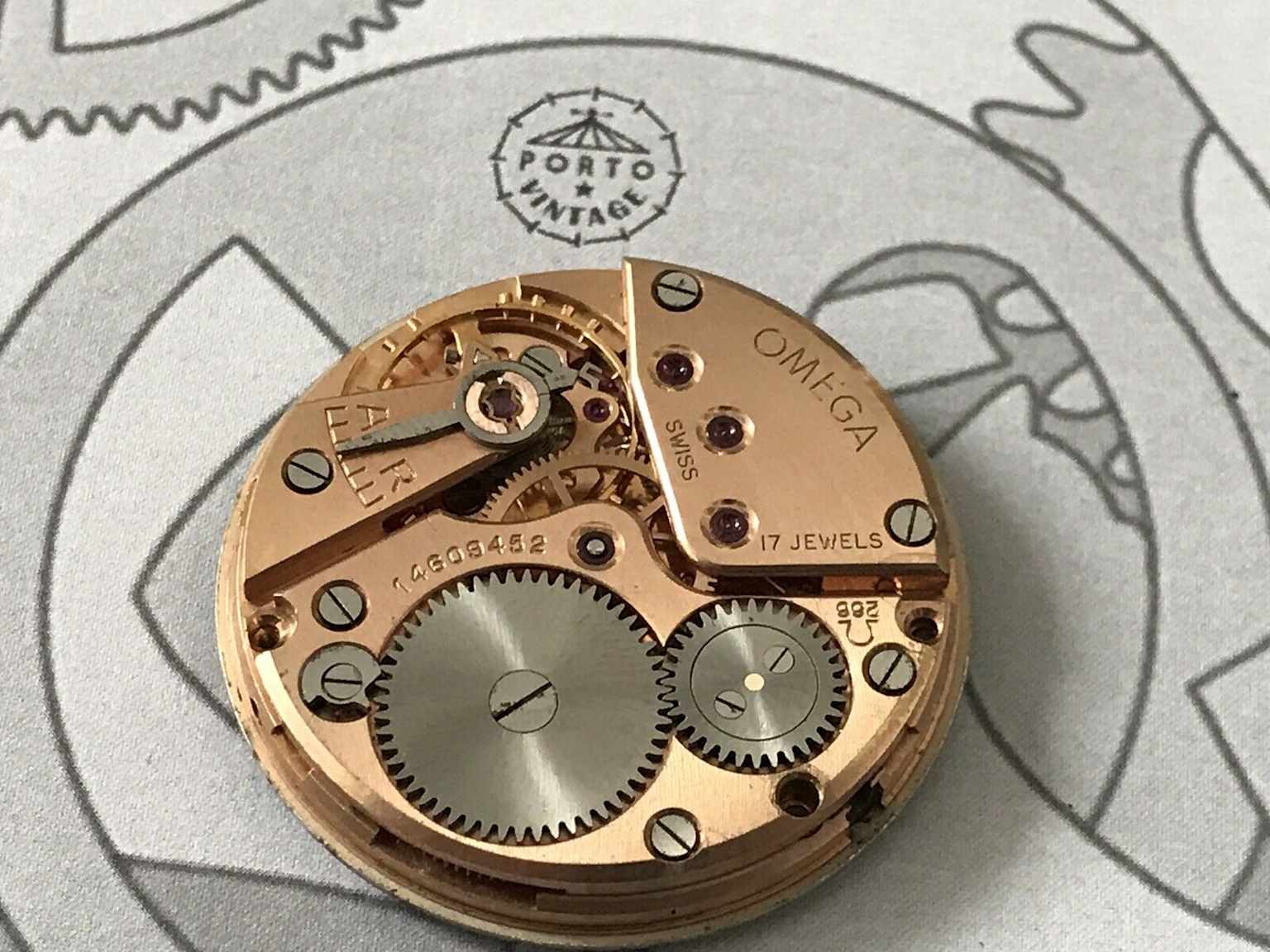
The caliber number “266” is engraved on the train wheel bridge, typically positioned near the fourth wheel in clear, stamped numerals. On some examples, the full designation “30 13 Pc AM 17 pierres” (30mm, 13 lignes, Pare-chocs, Antimagnetique, 17 jewels) appears instead of or alongside the numerical designation. The marking is applied via stamping during manufacturing and should show consistent depth and clarity on authentic examples. Refinished movements may show lighter or less distinct markings if bridges were aggressively polished during service.
Logo and Brand Marks
Authentic Caliber 266 movements display “Omega Watch Co.” engraved in a curved arc on the train wheel bridge above the caliber number. The word “Swiss” or “Swiss Made” appears on the base plate near the balance cock. The Omega logo (the Greek letter Ω) does not typically appear on the movement itself during this era, unlike later movements that prominently feature the symbol. The copper-gilt plating characteristic of 260-series calibers provides a distinctive warm golden appearance that contrasts with the earlier rhodium-plated finish of pre-1949 30T2 variants. Any movement marked “266” showing rhodium plating should be examined carefully for authenticity, as this combination would be inconsistent with standard production practices.
Date Codes
The Caliber 266 does not use a manufacturer-applied date code system. Production year is determined exclusively through the movement serial number cross-referenced against Omega’s production records. Case backs on some examples may show two-digit date stamps (e.g., “54” for 1954) indicating case manufacturing year, but these reflect case production rather than movement assembly and may not align precisely with movement date.
Finishing Marks
Authentic Caliber 266 movements display perlage (circular graining) on the base plate in a regular pattern across all visible surfaces. Bridges show straight graining (Côtes de Genève) running parallel to their length, with light beveling along edges. The copper-gilt plating should appear uniform in color and coverage, with no copper showing through on high points. Screw heads are polished flat with clean slots, though not extensively finished. The crown wheel and ratchet wheel show functional polishing but lack the mirror finish of chronometer variants. Any movement showing excessive polishing, buffed-away markings, or inconsistent finish quality may have been over-serviced or inappropriately refinished.
Jewel Markings
Jewel settings in the Caliber 266 consist primarily of pressed jewels for the gear train pivots, with the balance staff and pallet fork jewels mounted in gold-colored chatons for the Incabloc shock protection system. Chronometer-grade variants of the 30mm family sometimes feature gold chatons throughout the movement, but the standard 266 uses this only where the shock protection system requires it. The jewel count “17 Jewels” or “17 Rubis” is engraved on the train wheel bridge near the caliber number. Authentic jewels are synthetic ruby with characteristic translucent red color when viewed under magnification, while the shock protection jewels may appear slightly different in tone due to their conical shape and spring mounting.
Adjustment Markings
Standard-grade Caliber 266 movements carry no adjustment markings, as they were not submitted for chronometer certification or formal positional adjustment testing. The absence of markings such as “Adjusted,” “Adjusted 5 Positions,” or “Chronometer” is correct and expected for this caliber. Any 266-marked movement showing adjustment engravings should be examined carefully, as such markings would indicate either a parts swap from a higher-grade movement or inappropriate addition during servicing. Chronometer-certified versions of the 30mm family received separate caliber designations (262 for subseconds, 281 for center seconds) and display proper adjustment markings including positions tested and temperature compensation.
Correct Serial Number Formats and Locations
Movement serial numbers appear on the barrel bridge of the Caliber 266, typically positioned near the mainspring barrel in a straight line of seven to eight digits. The serial number is stamped rather than engraved, producing consistent depth and clear numerals on authentic examples. Serial numbers follow Omega’s sequential numbering system initiated in 1894, with 266-era examples falling within the 12,000,000 to 20,999,999 range corresponding to 1950-1963 production. Examples showing serial numbers below 12,000,000 would predate the 266 designation (which began in 1949) and should be marked with the earlier 30T2 nomenclature instead. Examples above 21,000,000 would postdate the caliber’s discontinuation in 1963 and indicate either incorrect identification or non-original components.
Expected Engravings and Stampings
Authentic Caliber 266 movements display the following markings in the specified locations:
Train wheel bridge:
- “Omega Watch Co.” in curved arc
- Caliber number “266” or full designation “30 13 Pc AM 17 pierres”
- Jewel count “17 Jewels” or “17 Rubis”
- Serial number (seven or eight digits)
Base plate:
Balance cock:
All engravings should show consistent depth, style, and clarity appropriate to factory application rather than hand-added markings. The copper-gilt plating should be uniform in areas surrounding engravings, with no evidence of re-engraving or marking modification.
Font and Marking Style by Production Era
The Caliber 266 maintained consistent engraving style throughout its 1949-1963 production span, with stamped markings showing the characteristic sans-serif font used across Omega’s 260-series family. The copper-gilt finish replaced the earlier rhodium plating used on pre-1949 30T2 variants, providing the most significant visual distinction between early and later production within the 30mm family. No mid-production font changes or stylistic variations are documented for the 266 specifically, unlike some longer-running calibers that transitioned through multiple aesthetic phases. The Omega logo (Ω symbol) does not appear on movements from this era, with brand identification limited to the “Omega Watch Co.” text engraving. Any 266-marked movement showing the Omega symbol on the movement itself would indicate either a parts swap or incorrect identification, as this marking convention was not adopted until later calibers.
Part Information

Mainspring
Genuine Omega mainsprings part number 260-1208 remain available through some suppliers, while high-quality Swiss-made generic replacements from manufacturers like Nivaflex are widely stocked by parts distributors. Generic mainsprings specified as 1.50mm height, 0.140mm thickness, 320mm length, and 11.5mm barrel diameter will function correctly. The universal compatibility across the entire 30mm family simplifies sourcing and inventory management for watchmakers servicing multiple variants.
Balance Complete
Balance assemblies for the 30mm family feature bimetallic screw-adjusted construction with Breguet overcoil hairsprings. Complete balance assemblies are available as matched units (balance wheel, staff, roller, and hairspring) to ensure proper functionality, though individual components like balance staffs can be sourced separately for repairs. Watchmakers should note that balance spring replacement requires precise adjustment of stud position and beat error correction, making complete balance assembly replacement often more practical than hairspring service alone.
Escapement Components
| Part Name | Part Number | Interchangeability Notes |
|---|---|---|
| Escape Wheel | 265-1240 | Pivoted escape wheel assembly |
| Pallet Fork & Arbor | 265-1305 (approx) | Complete assembly |
Escape wheels and pallet forks are available through vintage parts suppliers, with many components shared across the 260-series family. The 15-tooth escape wheel features standard Swiss lever geometry compatible with other 30mm variants.
Winding Mechanism
Winding mechanism components remain widely available with excellent cross-compatibility throughout the 30mm family. The universal winding stem (260-1106) simplifies replacement, as the same part fits all 30mm variants regardless of jewel count or complication.
Gear Train Components
Gear train components show good availability through parts suppliers specializing in vintage Omega movements. The fourth wheel’s extended lower pivot for the subseconds hand at 6 o’clock distinguishes subseconds variants from center-seconds calibers and cannot be interchanged between the two configurations.
Shock Protection Components
Incabloc components use industry-standard specifications and can be sourced from general watch parts suppliers rather than requiring Omega-specific parts. The characteristic lyre-shaped spring and conical jewel setting are generic components used across numerous Swiss movements from the same era.
Sourcing Notes
Parts availability for the Caliber 266 remains excellent nearly six decades after production ended, due to several factors: the movement’s high production volume created a large installed base, the 30mm family’s widespread use means many suppliers stock components, the simple architecture reduces the number of unique parts requiring specialized sourcing, and many components interchange with related 260-series and 280-series calibers.
Readily Available Components:
- Mainsprings (both genuine and high-quality generics)
- Balance staffs and complete balance assemblies
- Winding stems (universal for entire 30mm family)
- Crown wheels, ratchet wheels, and click springs
- Incabloc shock protection components
- Various screws and small parts
Components Requiring Careful Sourcing:
- Complete balance assemblies with original Breguet hairsprings (generic replacements available but matching original specifications requires attention)
- Pallet fork assemblies (available but require verification of dimensions)
- Escape wheels (available but verify tooth count and pivot diameters)
Common Failure Points:
- Balance staff pivots (especially dial-side lower pivot due to impact damage)
- Mainspring (weakens with age, routine replacement during service)
- Pallet jewels (oil degradation can cause excessive wear)
- Incabloc shock protection jewels (chip or crack from severe impacts)
Generic replacements are acceptable for consumable items like mainsprings and shock protection components, where dimensional specifications rather than brand origin determine functionality. For critical timing components like balance assemblies and escapement parts, watchmakers should verify compatibility through dimensional measurement or test fitting rather than relying solely on part number cross-references.
Performance Data
Manufacturer Specifications
Omega specified the Caliber 266 for accuracy of +/- 60 seconds per day in standard grade, adequate for reliable daily timekeeping but well short of chronometer standards. The movement underwent basic quality control testing during production but was not subjected to formal multi-position rating or COSC certification. Temperature compensation relies on the bimetallic balance wheel construction, which automatically adjusts moment of inertia as ambient temperature changes to counteract the effects of temperature on hairspring elasticity. The system functions passively without adjustment mechanisms, providing adequate compensation for typical temperature variations encountered in daily wear.
Isochronism (consistency of rate across different amplitude levels) benefits from the movement’s large balance wheel and conservative mainspring specifications, allowing relatively stable timekeeping as the watch runs down from full wind to nearly depleted power reserve. The 45-hour power reserve provides sufficient runtime for weekend storage without requiring daily winding, a practical advantage for users who rotate multiple watches. The movement’s lift angle of 49 degrees falls within normal parameters for Swiss lever escapements and must be correctly set on timing machines for accurate amplitude and rate measurements.
Observed Performance (Field Data)
Well-maintained Caliber 266 examples regularly achieve +/- 10-15 seconds per day in normal wrist wear, significantly better than Omega’s factory specification and typical for properly serviced movements receiving competent regulation. Watchmakers consistently report that the caliber’s simple architecture and large balance make achieving good timing results straightforward compared to smaller or more complex movements. Examples serviced by competent watchmakers routinely run at +/- 5 seconds per day when properly regulated, with exceptional examples approaching +/- 2-3 seconds daily when freshly serviced and carefully adjusted. This performance rivals modern mechanical watches despite the 266’s 1950s-era technology and basic regulation system.
Common Performance Issues and Causes:
- Excessive rate variation between positions: Usually indicates worn balance staff pivots, dried pallet fork lubrication, or hairspring distortion. The large balance wheel makes the movement somewhat sensitive to positional changes compared to higher-frequency modern movements.
- Declining amplitude as power reserve depletes: Normal behavior, but excessive amplitude drop (more than 60-80 degrees from fully wound to 36 hours) suggests mainspring weakness, excessive friction in gear train, or dried lubricants.
- Erratic timekeeping or stopping: Most commonly caused by magnetization despite the movement’s antimagnetic designation (which provides protection but not complete immunity), dried oils causing excessive friction, or damaged pallet stones requiring replacement.
- Inability to achieve manufacturer-specification power reserve: Indicates weak mainspring requiring replacement, barrel arbor friction preventing full mainspring wind, or excessive gear train friction consuming power.

Expected Amplitude Ranges:
- Fully wound, dial up: 260-280 degrees (adequate performance)
- Fully wound, dial up: 280-310 degrees (good performance)
- After 36 hours, dial up: 200-240 degrees (acceptable decline)
- Dial down position: 10-30 degrees lower than dial up (normal positional variation)
Amplitude below 200 degrees in any position indicates insufficient energy reaching the escapement, requiring investigation of mainspring condition, barrel friction, gear train binding, or excessive lubrication viscosity. Amplitude exceeding 320 degrees suggests over-lubrication of the escapement or incorrect lift angle setting on the timing machine.
Age-Related Performance Degradation:
The Caliber 266 typically shows minimal performance degradation when properly maintained with regular service intervals of 3-4 years. The movement’s robust construction, conservative specifications, and simple architecture contribute to excellent longevity. Common age-related issues include:
- Mainspring fatigue (weakening after 10-15 years without replacement): Routine replacement during service restores full power reserve.
- Pivot wear (especially balance staff lower pivot): More common in movements without shock protection, but still occurs eventually even with Incabloc.
- Hairspring set (permanent distortion from impacts or improper handling): Requires replacement or careful reshaping by experienced watchmaker.
- Pallet stone wear (from dried lubrication): Preventable through proper service intervals, but requires pallet fork replacement when wear becomes excessive.
Examples receiving regular professional service throughout their lifespan often maintain excellent performance even after 70+ years, demonstrating the caliber’s fundamental robustness and the effectiveness of proper maintenance