

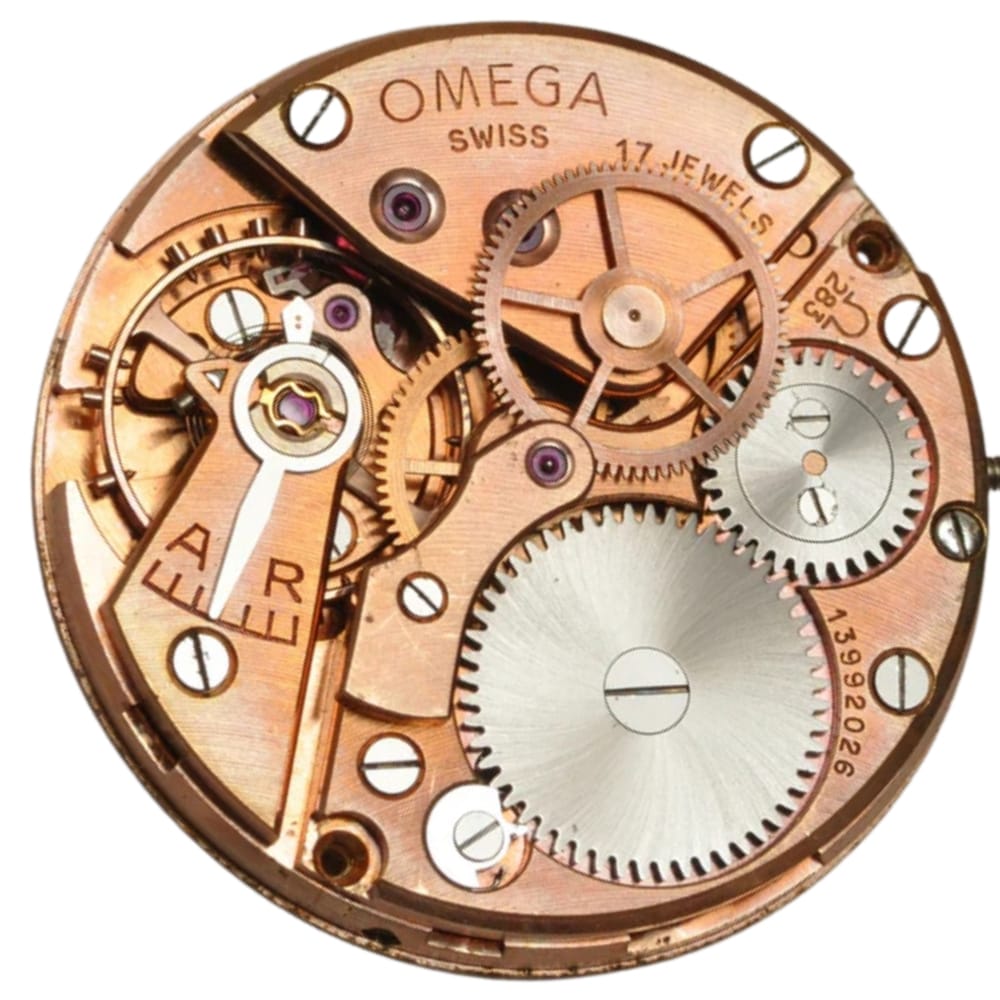
The Omega 283 represents the antimagnetic variant of one of the most successful movement platforms in Omega’s history. Descended from the 30T2 SC that won first prize for precision at the Kew Observatory trials in 1946, the caliber 283 designation appeared in 1949 when Omega restructured its nomenclature to three-digit numbering. This movement powered countless mid-century dress watches, military timepieces including the RAF 6B/542, and early tool watches, solidifying Omega’s reputation for precision timekeeping during the formative post-war period.
The 283 was designed for versatility rather than specialization. At 30mm diameter with center seconds and 17 jewels, it bridged the gap between basic timekeeping and chronometer-grade precision. The antimagnetic designation, while not requiring the soft iron cage of true anti-magnetic watches, indicated enhanced resistance to magnetic fields through careful material selection. This made it suitable for military aviators, engineers, and professionals working near electromagnetic equipment. The movement’s robust architecture, generous tolerances, and straightforward construction created a workhorse caliber that watchmakers appreciated for its serviceability and reliability.
Production of the entire 30mm caliber family reached approximately 3 million units between 1939 and 1963, with the 283 accounting for a substantial but unconfirmed portion manufactured between 1949 and 1963. The caliber appears commonly in the collector market. Availability ranges from plentiful in basic dress watch configurations to uncommon in specific military variants or chronometer-adjusted examples. Serial number ranges indicate production throughout the 1950s, with the highest concentrations appearing between 12 million (1950) and 20 million (1963). The widespread use across multiple case references and dial configurations, combined with the 25-year production span of the 30mm family, ensures collectors can source examples without exceptional difficulty.
The caliber 283 occupies a stable position in the collector market, valued more for horological integrity and wearability than rarity or investment potential. Military examples, particularly the RAF 6B/542 with its fat or thin arrow markings, command premiums due to historical significance and provenance rather than movement distinction. Standard dress watch examples trade affordably, making this an accessible entry point into vintage Omega mechanical movements. Demand remains steady among collectors seeking honest mid-century timepieces with established service networks and parts availability. The movement’s reputation for reliability and its connection to Omega’s observatory trial success contributes to sustained interest without speculative pricing.
Historical Context, Provenance, and Manufacturing Details
Development of the Calibre 30 began in 1938 under the direction of Henri Gerber, Omega’s technical director from 1928 through the 1960s. Henri Kneuss, Gerber’s assistant technical director and entirely self-taught without formal watchmaking education, led the actual design work. Kneuss created a prototype presented in December 1938, with series production commencing in February 1939 under the designation 30T2 (30mm, two trains, referring to the going and winding trains). The center seconds variant, 30T2 SC (sweep center), incorporated an additional bridge to drive indirect central seconds via the upper third wheel, distinguishing it from small-seconds configurations.
The 30mm caliber was developed to replace Omega’s aging 26.5mm family that had served through the 1930s, addressing market demand for larger wristwatch movements while incorporating lessons learned from Omega’s observatory competition program. The design prioritized robustness and serviceability over decorative finishing, reflecting Kneuss’s practical engineering philosophy. The movement proved exceptionally capable in chronometric performance. In 1946, refined 30T2RgSC variants (réglage, meaning fine regulation) won first prize for precision at the Kew Observatory trials. Between 1945 and 1951, Omega’s 30mm movements, regulated by legendary régleurs including Alfred Jaccard, won first place at Geneva and Neuchâtel Observatory trials multiple times, often relegating Omega’s own tourbillon movements to second place.
In 1949, Omega implemented a three-digit nomenclature system for all calibers. The 30T2 SC became Calibre 280, with subsequent variations numbered according to specific modifications: 281 (chronometer with excenter micro-regulator), 283 and 284 (antimagnetic versions), 285 (smooth balance instead of screw-adjusted), and 286 (flat hairspring instead of Breguet overcoil). The caliber 283 specifically incorporated enhanced antimagnetic properties, though sources differ on whether this was achieved through material selection alone or included soft iron dust covers in certain applications. Military examples, particularly the RAF 6B/542 issued in 1953, featured an inner soft iron case between the movement and outer case, providing genuine Faraday cage protection against magnetic fields encountered in aviation environments.
Production occurred at Omega’s Bienne, Switzerland facilities. The 30mm family remained in production until 1963, when Omega phased out manual-wind calibers in favor of automatic movements. The platform’s 25-year production span and 3-million-unit output made it one of the longest-lived and most successful movement families in Omega’s history, powering dress watches, military timepieces, early Seamasters, Rancheros, and countless dial variants across multiple markets including the Century, Genève, and export collections.
The caliber 283 was entirely manufactured in-house at Omega, not based on ebauche movements from external suppliers. While Omega would later adopt ETA ebauches in the 1980s, the 30mm family represents a period when Omega maintained complete vertical integration from raw materials through final assembly and regulation.
Construction and Architecture

Plate and Bridge Layout: The caliber 283 employs a three-quarter plate construction with three separate bridges (train bridge, pallet bridge, and balance bridge), a characteristic configuration providing excellent stability while maintaining serviceability. The base plate and bridges are brass with rhodium plating on movements manufactured during the 30T2 designation era and copper-gilt finish on movements numbered under the 260-series system. The architecture follows a clean, functional design philosophy with minimal ornamentation beyond polished beveled edges on bridge perimeters and screw slots.
Balance Wheel: The movement features a screw-adjusted beryllium bronze (Glucydur) balance wheel with diameter appropriate to the 30mm movement size. The Glucydur alloy provides superior stability compared to earlier bimetallic compensated balances, resisting deformation under temperature variations and exhibiting inherent antimagnetic properties. The balance incorporates four timing screws (some examples show more) positioned at cardinal points around the rim, allowing watchmakers to adjust rate by adding or removing weight at specific locations. The balance operates at 18,000 vph (2.5 Hz), a semi-slow frequency that contributes to the movement’s robustness and reduced pivot wear compared to higher-frequency designs.
Balance Spring (Hairspring): The caliber 283 utilizes a Nivarox hairspring in Breguet overcoil configuration. Nivarox, an iron-nickel-beryllium alloy (composition: 42-48% cobalt, 15-25% nickel, 16-22% chromium, with titanium and beryllium), provides self-compensating temperature characteristics and superior resistance to oxidation and magnetic influence compared to traditional steel springs. The Breguet overcoil, with its raised terminal curve that allows the spring to breathe concentrically during expansion and contraction, improves isochronism and positional accuracy. The outer terminal attaches to a stud on the balance bridge, while the inner terminal fixes to the collet on the balance staff. This configuration distinguishes the 283 from the later caliber 286, which employed a flat hairspring.
Escapement Type: The movement employs a traditional Swiss lever escapement with jeweled pallet fork. The escape wheel drives two pallet jewels (ruby or synthetic sapphire), which alternately lock and release the escape wheel teeth to regulate power delivery to the balance. The pallet fork arbor pivots in jeweled bearings, and the roller table on the balance staff incorporates an impulse jewel (ruby pin) that receives impulses from the pallet fork during each oscillation. The escapement represents proven Swiss lever technology without innovations, valued for reliability and ease of servicing rather than technical advancement.
Shock Protection System: The caliber 283 incorporates Incabloc shock protection on the balance jewels. The Incabloc system uses a spring-loaded jewel assembly that allows the balance staff pivots to move vertically during shock events, preventing pivot damage. The cap jewel (top) and hole jewel (bottom) sit in conical settings held by a lyre-shaped spring. When subjected to impact, the spring compresses, allowing the jewels to move and absorb energy before returning to their original positions. Part numbers for balance jewels include cap jewel 122.11 (also designated 122.21 or 122.41), shared across calibers 266, 267, 268, 283, and 284. The Incabloc system provides adequate protection for dress watch applications but less robust protection than later KIF designs favored in professional tool watches.

Regulator Type: The caliber 283 uses a standard index regulator (swan-neck style not present on base 283, though appearing on chronometer-adjusted 281 variants). The regulator consists of a regulator arm that pivots on the balance bridge, with pins that embrace the outer coils of the hairspring. Moving the regulator arm toward “A” (advance) or “R” (retard) effectively shortens or lengthens the active portion of the hairspring, adjusting the rate. This system allows for relatively coarse adjustment during initial regulation, with fine adjustment accomplished through balance wheel timing screws. The excenter micro-regulator seen on caliber 281 chronometer variants is absent on the 283.
Mainspring Material and Type: The caliber 283 employs an “unbreakable” alloy mainspring (marketing terminology for white metal mainsprings that resist brittleness better than traditional blue steel). Sources cite varying dimensions: 1.50mm height x 0.135-0.145mm thickness x 320-340mm length x 11.0-11.5mm barrel diameter. The discrepancy likely reflects manufacturing tolerances or aftermarket replacement variations. Part number 1208 is cited for the mainspring. The spring features a slipping bridle attachment allowing controlled power delivery as the spring approaches full wind, preventing overwinding damage. The spring sits in a traditional going barrel (part 182/135, shared with ETA 640) that drives the center wheel.
Gear Train Details: The caliber 283 employs a four-wheel train (going barrel, center wheel, third wheel, fourth wheel with seconds) plus an additional upper third wheel that drives the indirect center seconds. The center wheel, driven by the barrel, makes one rotation per hour and carries the cannon pinion (part 1225) to which the minute hand attaches. The third wheel transmits power to the fourth wheel, which makes one rotation per minute and carries the seconds hand in small-seconds configurations. The indirect center seconds mechanism employs an intermediate wheel mounted on an extended third wheel arbor (upper third wheel) that drives the center seconds pinion via the sweep second pinion friction spring (part 1249, driving wheel). This configuration, necessitating an additional bridge (sweep second cock, part 1007), distinguishes SC (sweep center) variants from small-seconds 30T2 movements. Fourth wheel part number: 1243.
Finishing Quality and Techniques: The caliber 283 exhibits mid-grade finishing appropriate to its position as a production movement rather than chronometer-grade or observatory-trial piece. The base plate features perlage (circular graining) applied consistently across visible surfaces, providing both aesthetic appeal and practical function by trapping suspended particles away from bearing surfaces. Bridges display rhodium plating (early production) or copper-gilt finish (later production under 260-series designations) with beveled edges exhibiting moderate anglage (chamfering). Screws are polished with cleanly finished slots, though without the deep polishing or blued heat treatment seen on higher-grade movements. The crown wheel and ratchet wheel display functional finishing without extensive polishing. Comparison with chronometer-grade 30T2Rg variants reveals the differences: chronometer movements feature polished winding wheels with shaped teeth, deeper anglage, polished and beveled screwheads, and overall finer execution throughout. The 283’s finishing represents competent industrial production focused on reliability and serviceability rather than visual presentation.
Cross-Reference Data

Alternative Caliber Names and Rebranded Versions
| Manufacturer | Caliber Designation | Notes |
|---|---|---|
| Omega | 30T2 SC PC AM | Original designation before 1949 nomenclature change; 30 = 30mm diameter, T2 = two trains, SC = sweep center, PC = pierre chocs (shock protected), AM = antimagnetic |
| Omega | 30 SC T2 17 pierres | Alternative designation format |
| Omega | 283 (30 SC T3 PC AM 17 p) | Full technical designation with jewel count |
The caliber 283 was not rebranded for other manufacturers. Omega maintained exclusive use of this caliber across its own product lines.
Base Caliber vs. Elaborated Versions
| Variant | Differences | Jewel Count | Functions | Notes |
|---|---|---|---|---|
| 260 (30T2) | Base caliber, 15 jewels, no shock protection | 15 | Center seconds | Earliest production, bimetallic balance |
| 280 (30T2 SC) | Base 17-jewel with Incabloc | 17 | Center seconds | Renumbered designation from 1949 |
| 281 (30T2Rg) | Excenter micro-regulator for chronometer adjustment | 17 | Center seconds | Fine regulation capabilities, chronometer-grade finishing |
| 283 | Antimagnetic variant | 17 | Center seconds | Enhanced antimagnetic properties through material selection |
| 284 | Antimagnetic variant, sub-seconds | 17 | Sub-seconds | Antimagnetic with small seconds configuration |
| 285 | Smooth balance wheel instead of screw-adjusted | 17 | Center seconds | Simplified balance without timing screws |
| 286 | Flat hairspring instead of Breguet overcoil | 17 | Center seconds | Simplified hairspring configuration |
The base caliber for the entire family is the 265, introduced when Omega began copper-gilt plating. Calibers 265, 266, 267, 268, 269, 283, 284, 285, and 286 share substantial parts interchangeability, particularly in the gear train and escapement components.
Compatible Case References by Brand
| Brand | Reference Numbers | Production Years | Notes |
|---|---|---|---|
| Omega | CK2320 | ca. 1950 | 14K gold case, 35mm |
| Omega | BK2810-2SC, BK2810-3SC | ca. 1954-1956 | UK market, gold-plated, Dennison case |
| Omega | 2496-6, 2496-10 | ca. 1952-1954 | Dress watch, 34mm |
| Omega | 2504-13SC | ca. 1952 | Steel case |
| Omega | 2640-7SC | ca. 1952-1953 | Gold and steel case with rare honeycomb dial |
| Omega | 2777-1 | 1953 | RAF military 6B/542, stainless steel with soft iron inner case |
| Omega | 2810-1SC | ca. 1956 | Classic dress watch |
| Omega | 2990-1 | ca. 1957-1958 | Early Seamaster, some designated as “pre-Ranchero” |
| Omega | CK2996-1 SC | ca. 1958 | Ranchero, tool watch configuration |
Note: “CK” prefixes generally indicate export/international market cases, while “BK” prefixes indicate British/UK market cases, typically manufactured by Dennison in Birmingham. Many UK market cases feature hallmarks and Dennison case serial numbers alongside Omega designations.
Dial Compatibility Note
Dial foot positions for the caliber 283 follow the standard 30mm family configuration. Dials measure approximately 29.3mm diameter with two feet positioned at 3 and 9 (or 2.5 and 8.5 depending on case design). No date window applies to the 283, simplifying dial restoration and replacement. Collectors should verify dial foot positions match the movement pillar locations before attempting dial installation. Original dials for the 283 span enormous variety: black, silver, cream, champagne, crosshair, honeycomb, Arabic numerals, applied indices, painted markers, gilt, and military-specification radium or tritium lume. Dial compatibility extends across the 280-286 family, though watchmakers should verify seconds hand positioning (center vs. sub-seconds) matches the movement configuration.
Crown and Stem Specifications
| Component | Specification | Notes |
|---|---|---|
| Stem Thread | TAP 10 | Standard Swiss thread size |
| Stem Part Number | 200/131F | Fits calibers 283, 284 |
| Setting Mechanism | Clutch lever with setting lever spring | Part 443/216 (setting lever), 440/138 (setting spring) |
Crown specifications vary by case manufacturer and market. Original unsigned crowns are correct for many dress watch configurations, while military examples may feature specific crown designs per specifications. Replacement crowns should match the case tube thread pitch and diameter. Dennison cases frequently use different crown specifications than Swiss-made Omega cases.
Identification Marks
Caliber Number Location: The caliber number “283” is stamped on the movement plate, typically visible near the balance bridge or on the main plate between the barrel bridge and center wheel. Some examples show the number stamped on the rim of the movement plate near the edge. The location varies slightly depending on production period, but the number always appears clearly stamped (not engraved) on the brass movement plate.
Logo and Brand Marks: The movement plate features “Omega” engraved in script, typically positioned on the train bridge or main plate. “Swiss” or “Swiss Made” appears on the main plate, often near the balance bridge. The 17 jewels count (“17 Jewels” or “17 Rubis”) is marked on the movement, usually on the train bridge or barrel bridge. The Omega logo (symbol) appears on the balance bridge or balance cock on most examples, though not universally present across all production periods.
Date Codes: The caliber 283 does not use date codes. Dating relies entirely on serial numbers stamped on the movement. The serial number, typically seven or eight digits, appears on the main plate and corresponds to Omega’s sequential numbering system. Serial number ranges by approximate year:
- 11,000,000-11,999,999: 1947
- 12,000,000-12,999,999: 1950
- 13,000,000-13,999,999: 1952
- 14,000,000-14,999,999: 1954
- 15,000,000-15,999,999: 1956
- 16,000,000-16,999,999: 1958
- 17,000,000-17,999,999: 1959
- 18,000,000-18,999,999: 1961
- 19,000,000-19,999,999: 1962
- 20,000,000-20,999,999: 1963
These ranges provide approximate production years. Serial numbers do not precisely correlate to manufacture dates due to batch production and parts inventory systems.
Finishing Marks: Expected finishing patterns include perlage (circular graining) on the base plate, visible as overlapping circular patterns approximately 1-2mm in diameter covering the plate surface. Earlier production (30T2 designation era) shows rhodium plating on bridges and plates, creating a bright silver appearance. Later production under the 260-series designation features copper-gilt plating, creating a pinkish-gold appearance. Bridges should exhibit beveled edges (anglage) with clean, uniform chamfers around perimeters. This beveling appears less pronounced than on chronometer-grade movements but should be present and consistent. Winding mechanism components (crown wheel, ratchet wheel, winding pinion) display functional finishing without extensive polishing. Screws should have polished heads with cleanly finished slots, though not blued or extensively decorated.
Jewel Markings: Jewel settings on the caliber 283 employ pressed jewels rather than gold chatons. The balance jewels sit in Incabloc shock protection with the characteristic lyre-shaped spring visible on the balance bridge. Pallet jewels are ruby or synthetic sapphire set directly into the pallet fork without decorative chatons. Seventeen jewels total: two balance jewels (hole and cap), two pallet jewels, fifteen additional jewels in the gear train and escapement. The absence of gold chatons is correct for this grade level and should not suggest authenticity concerns.
Adjustment Markings: The caliber 283 in standard form does not carry chronometer certification or adjustment markings. Watchmakers may have added timing or regulation marks during servicing, but factory adjustment markings (indicating adjustment to 2, 3, or 5 positions and temperature ranges) appear only on caliber 281 chronometer-grade variants. The absence of adjustment markings is correct and expected for caliber 283.
Correct Serial Number Formats and Locations: Serial numbers on caliber 283 movements appear as seven or eight-digit numeric sequences stamped on the movement plate. The serial number should match Omega’s sequential system, falling within ranges consistent with the movement’s production era (1949-1963, corresponding to serial numbers approximately 12,000,000 through 20,999,999). The serial number appears clearly stamped with consistent digit height and depth. The movement serial number should not be confused with case serial numbers, which appear separately on the case back or case interior.
Expected Engravings and Stampings: Legitimate caliber 283 movements display sharp, clearly defined stampings and engravings. The “283” caliber number features consistent font with uniform depth. The “Omega” script shows elegant, flowing letters with consistent line weight. Jewel count markings (“17 Jewels” or “17 Rubis”) appear in clean, easily readable typeface. “Swiss Made” or “Swiss” shows clear, stamped letters. Counterfeit or misidentified movements often display inconsistent engraving depth, irregular fonts, or poorly executed stampings. Watchmakers’ marks from previous servicing may appear on the movement (dates, initials, timing marks), which do not indicate inauthenticity but rather service history.
Font and Marking Style by Production Era: Early production (1949-1952, serial numbers 12-14 million) under the initial 283 designation shows rhodium plating with consistent engraving styles matching the 30T2 SC era. Mid-production (1953-1958, serial numbers 14-17 million) may show transition to copper-gilt plating under the 260-series system, with identical caliber designation “283” but different surface finish. Late production (1959-1963, serial numbers 17-20 million) maintains copper-gilt plating with consistent marking styles. Font styles remain remarkably consistent throughout production, though subtle variations in engraving depth and stamp pressure occur. The key identification remains the caliber number “283” regardless of surface plating changes.
Part Information

Major Component Part Numbers
| Part Name | Part Number | Interchangeability Notes |
|---|---|---|
| Mainspring | 1208 | Dimensions: 1.50 x 0.135-0.145 x 320-340 x 11.0-11.5mm; fits 280, 283 |
| Balance Complete | 1327 | Fits 266, 267, 283, 284; includes staff, balance wheel, hairspring, and roller |
| Hairspring | 260-1320 | Base caliber 260 series part, fits 283 |
| Escape Wheel | 1305 (705) | Shared across 265, 266, 267, 268, 269, 283, 285, 286 |
| Pallet Fork (jeweled) | 1316 (710) | Complete with arbor and jewels |
| Pallet Arbor | 72S/99P or 714/AS1290 | Fits 284, similar specification |
| Crown Wheel | 1101 | Fits 262, 281, 283 family |
| Crown Wheel Core | 260-series designation | Fits 260 base caliber family |
| Ratchet Wheel | 1100 or 415/154 | Winding mechanism component |
| Click Spring | 430/138 | Shared with 284 |
| Setting Lever | 443/216 | Clutch mechanism |
| Setting Lever Spring | 440/138 | Clutch spring |
| Center Wheel with Cannon Pinion | 1225 | Part 240/211 for cannon pinion alone; height 2.80mm |
| Third Wheel | 210/201 | Gear train component |
| Fourth Wheel with Seconds | 1243 | Fits 283, 284, 285, 286; center seconds configuration |
| Sweep Second Cock (Bridge) | 280-1007 | NOTE: Different from small seconds configuration; specific to 280, 283, 284, 285, 286 |
| Barrel with Cover | 182/135 | Shared with ETA 640 |
| Barrel Arbor | 195/171 | Mainspring arbor |
| Driving Wheel (Upper Third Wheel) | 1249 | Drives center seconds mechanism |
| Balance Jewel (Cap, Lower) | 122.11 = 122.21 = 122.41 | Incabloc cap jewel for balance; fits 266, 267, 268, 283, 284 |
Sourcing Notes
Currently Available Parts: Mainsprings (part 1208) remain available from multiple suppliers including Perrin Watch Parts, Cas-Ker, and Watch Material. Generic Swiss-made Nivaflex mainsprings in the correct dimensions (1.50 x 0.135-0.145 x 320-340mm) serve as acceptable replacements when original stock is unavailable. Fourth wheels (part 1243), escape wheels (part 1305), and pallet forks (part 1316) periodically appear in supplier inventories, though availability fluctuates. Balance complete assemblies (part 1327) appear occasionally but are challenging to source due to age and demand. Common wear items including click springs, setting levers, and setting springs remain available.
Commonly Failed Parts: Mainsprings fail through age-related fatigue despite “unbreakable” designation, losing elasticity and power delivery capacity after decades. Symptoms include reduced power reserve and progressive timekeeping loss. Balance staffs require replacement when pivots suffer damage from shock or wear, identifiable through excessive end shake or pivot scoring visible under magnification. Hairsprings suffer magnetization, corrosion, or physical damage, manifesting as erratic rate with position changes or inability to regulate the movement. The Incabloc shock protection springs lose tension or break entirely, leaving balance pivots vulnerable to damage. These represent the most frequent failures requiring part replacement during service.
Acceptable Generic Replacements: Mainsprings accept generic Swiss-made Nivaflex replacements in correct dimensions. Balance staffs require fitting and often necessitate purchasing a complete balance assembly rather than attempting staff replacement alone due to the technical difficulty of removing and replacing balance springs. Generic Incabloc jewels and springs are available in standard sizes and substitute acceptably for original parts. Generic escape wheels and pallet forks exist but require careful dimensional verification before installation, as minor variations can affect escapement function. Watchmakers generally prefer original Omega parts for critical components (escape wheel, pallet fork, balance) while accepting quality generic replacements for wear items (mainspring, shock jewels, setting mechanism components).
Performance Data
Manufacturer Specifications: Omega specified the caliber 283 for +/- 60 seconds per day accuracy when new, a standard tolerance for non-chronometer movements of this era. The movement was not tested in multiple positions as standard practice (unlike chronometer-grade caliber 281 variants tested in 5 positions and temperature ranges). Temperature compensation relies on the Nivarox hairspring’s self-compensating alloy composition and the Glucydur balance wheel’s stability across temperature ranges, eliminating the need for complex bimetallic compensating balances. Isochronism, the consistency of rate across the mainspring’s winding range, benefits from the slipping bridle mainspring attachment and the Breguet overcoil hairspring configuration, though Omega did not publish specific isochronism data for production movements.
Observed Performance (Field Data): Well-maintained caliber 283 examples typically achieve +5 to +15 seconds per day accuracy in the dial-up position, with rate variation of +/- 10-20 seconds per day across positions. Watchmakers report the movement responds well to regulation, with experienced technicians capable of achieving +/- 5 seconds per day performance in the primary wearing position. Freshly serviced examples show amplitude readings of 270-290 degrees when fully wound in dial-up position, dropping to 230-250 degrees near the end of the 45-hour power reserve. These amplitude figures indicate healthy escapement function and adequate mainspring power delivery.
Common performance issues and their causes include progressive timekeeping loss over the winding cycle, indicating weakened or damaged mainspring requiring replacement. Rate instability across positions suggests worn balance pivots, dried lubrication in the escapement, or damaged Incabloc shock protection requiring service. Erratic rate with position changes, particularly if accompanied by position-dependent stopping, indicates hairspring magnetization (easily tested with a compass; if the compass needle deflects near the movement, demagnetization is required). Amplitude drop exceeding 50-60 degrees from fully wound to near-depleted power reserve suggests excessive escapement friction from dried lubrication or worn pallet jewels.
Expected performance degradation as the movement ages follows predictable patterns. Movements 10-15 years since last service show moderate accuracy decline (typically +20 to +40 seconds per day) with acceptable amplitude. Movements 15-20 years since service risk pivot wear and mainspring crystallization, manifesting as inconsistent running and amplitude below 200 degrees. Movements 20+ years since service face high risk of complete failure from dried lubrication, corroded pivots, or crystallized mainspring lubricants, though the caliber 283’s generous tolerances and robust architecture allow many examples to continue running (albeit with poor accuracy) decades past recommended service intervals. Watchmakers note the movement’s forgiving nature during service, with most examples responding well to proper cleaning, lubrication, and adjustment.
Environmental factors affecting performance include moisture exposure, as the non-water-resistant cases typical of dress watches housing the 283 provide minimal protection. Moisture penetration causes rapid oxidation of the copper-gilt finish and corrosion of steel components. Magnetic fields represent another concern, as the 283 lacks modern anti-magnetic shielding despite its antimagnetic designation. Exposure to speakers, magnetic clasps, and modern electronic devices can magnetize the hairspring, requiring demagnetization for restoration of proper timekeeping. Collectors should store vintage caliber 283 watches away from magnetic sources and avoid moisture exposure to preserve long-term function.