

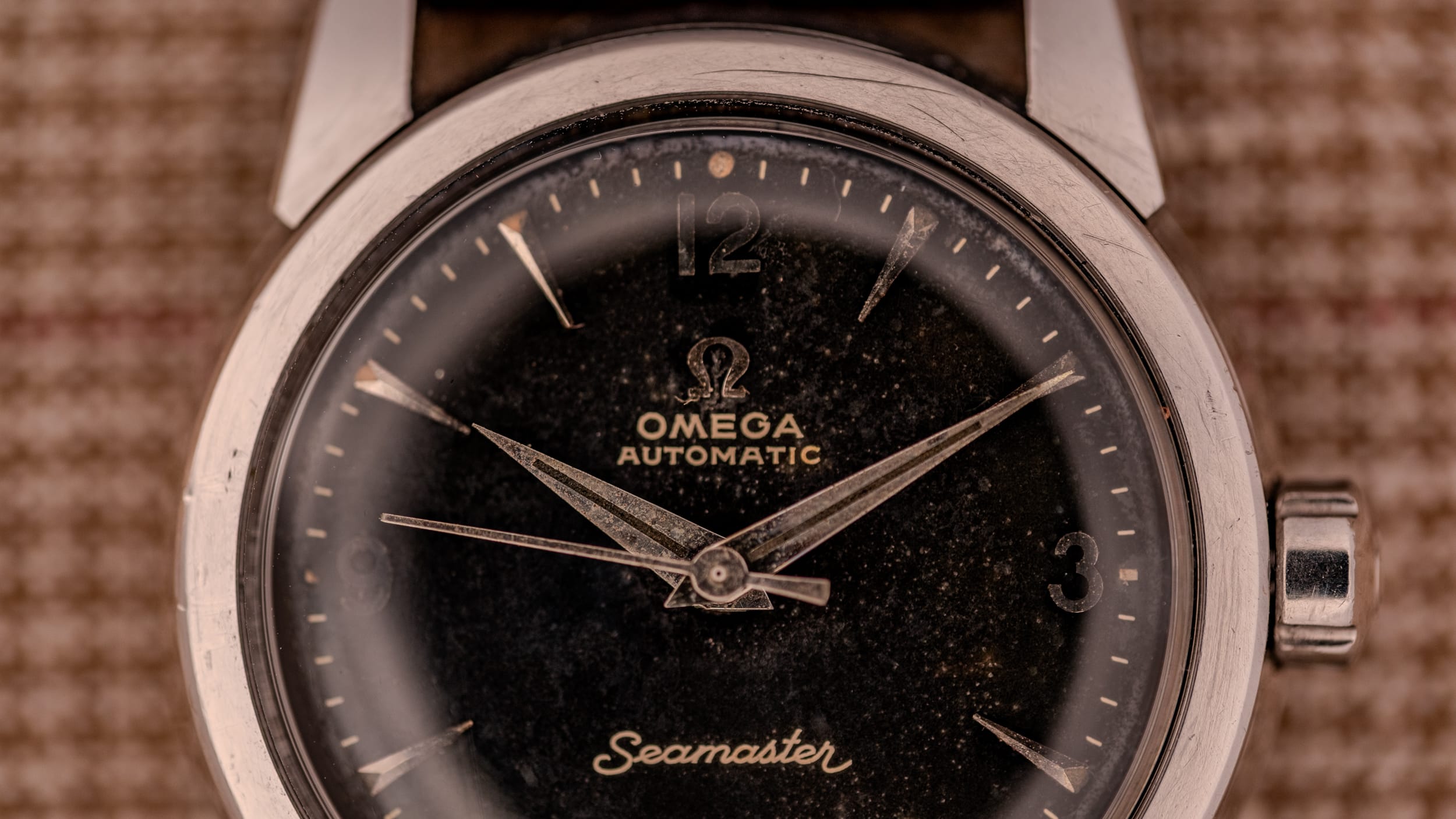
Most people think they understand why tropical dials command a premium. The story usually stops at “black turned brown, collectors love it.” That’s the surface version. The real story goes deeper, and it applies to far more than Rolex Submariners.
Original black dials, across every brand, every decade, every reference from the mid-century era, are among the rarest things you’ll encounter in vintage watches. Not because manufacturers made fewer of them (though in certain eras they did), but because virtually everything about a black dial’s existence conspired to destroy it over the past 60 to 80 years. UV light, radium, unstable varnish, humidity, and well-intentioned watchmakers all took their turn.
I’ve opened thousands of casebacks. The ratio of original, unmolested black dials to replaced or refinished ones is far worse than most collectors assume. Here’s why.
The Varnish That Betrayed an Entire Industry
Every conversation about black dial degradation eventually arrives at a single material: nitrocellulose varnish. The watch industry knows it as Zapon.
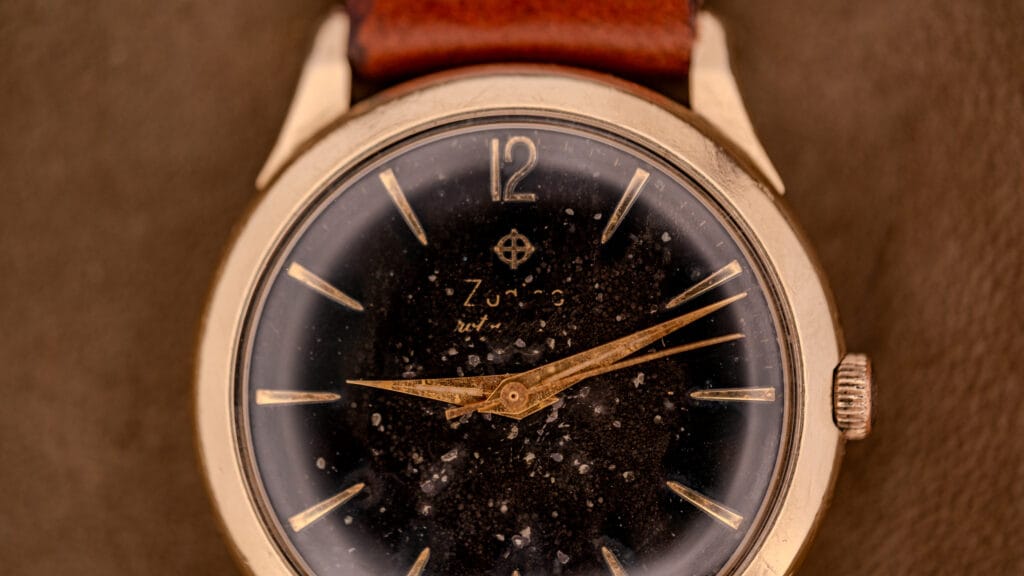
From roughly the 1920s through the 1970s, virtually every major Swiss manufacturer, including Rolex, Omega, Patek Philippe, Jaeger-LeCoultre, and Longines, applied this varnish to protect their dials from corrosion. Zapon is a nitrocellulose-based clear coat dissolved in a volatile solvent. It sealed the pigment layer, gave dials their glossy finish, and did its job reasonably well under normal conditions.
The problem is that nitrocellulose is porous. Unlike modern polyurethane finishes, which create an essentially impenetrable barrier, Zapon allows oxygen and moisture to pass through slowly and interact with the metal dial substrate beneath it. Over decades, this produces oxidation, discoloration, and the breakdown of the pigment layer itself. Collectability has documented this process extensively across Patek Philippe references, noting that Zapon was used by Patek well into the 1970s and reacted with the silver dial bases the brand favored.
This is not a Rolex-specific problem. It is not an Omega-specific problem. It is a material science limitation that affected the entire Swiss watch industry for the better part of 50 years. Every brand that used Zapon, and that’s nearly all of them, produced dials that were chemically predisposed to degrade.
On a white or silver dial, this degradation reads as subtle yellowing or warm toning. Collectors often describe it as “creamy” or “ivory” patina. It’s gentle. On a black dial, the same chemical process produces something far more dramatic: the pigment layer shifts visibly toward brown, sometimes uniformly (the prized “tropical” effect), sometimes in blotches and uneven patches that read as damage. As Beyond the Dial explains in their collector guide to varnished dials, the yellowing of nitrocellulose is irreversible once it starts, and the process can affect the varnish, the dial base, and the space between them simultaneously.
The key point here is that the varnish itself didn’t care what color was underneath. The degradation mechanism was identical across dial colors. But the visual consequence on black dials was always more severe and more visible, which triggered the next problem.
Radium Was Eating the Dial From the Inside
UV exposure and varnish porosity attacked dials from the outside. Radium attacked them from within.
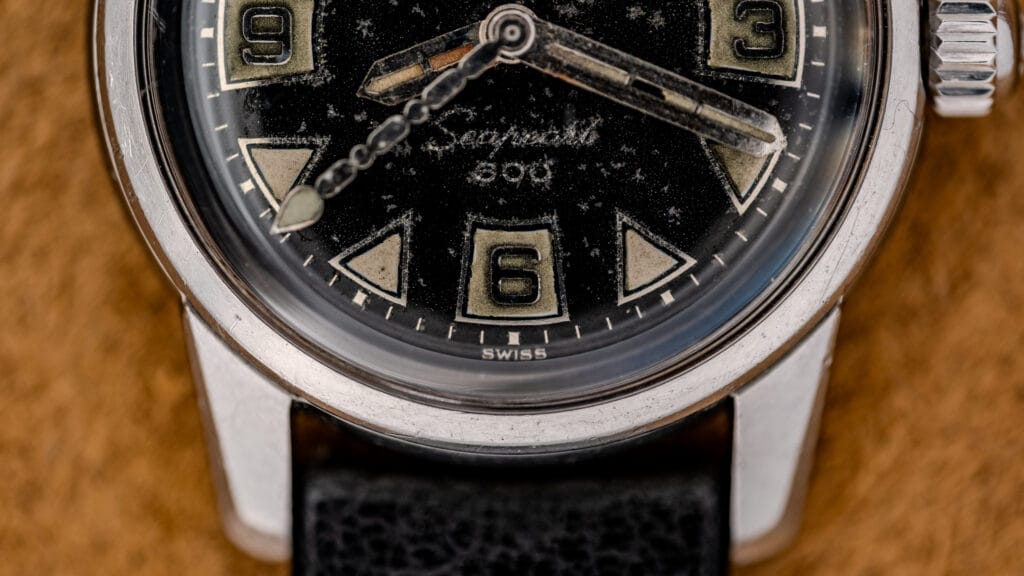
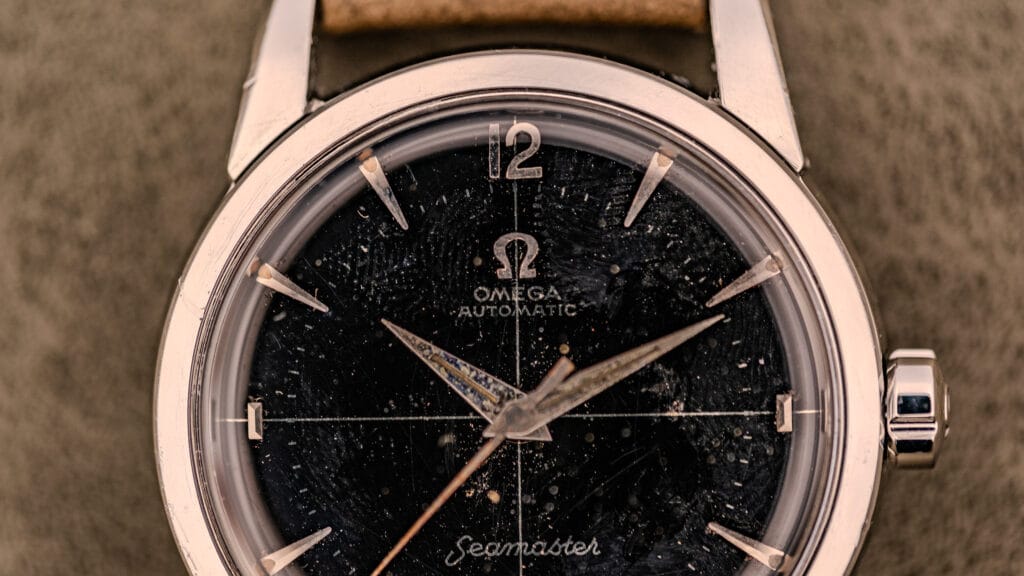
Every luminous vintage watch produced before the early 1960s used radium-based paint on its hands and hour markers. Radium is an alpha emitter with a half-life of 1,600 years, meaning the radium applied to a 1955 Seamaster dial is still nearly as radioactive today as the day it was painted.
The luminescent glow itself dies within about five years as the radiation destroys the zinc sulfide phosphor that produces light. But the radium keeps emitting. And that emission degrades surrounding materials.
On a black dial, the effects are specific and identifiable. Gamma radiation from the radium slowly breaks down the lacquer and pigment layer immediately surrounding each lume plot. The result is a series of brown “halos” or starburst patterns radiating outward from the hour markers. On watches stored unworn for long periods, the hands, hovering in the same position above the dial, leave faint brown shadow marks on the surface below them. Fratello Watches documented this phenomenon well, noting that radium’s gamma radiation eats away at the lacquer and can leave ghostly shadows on the dial from the hands above.
I see this regularly during case openings on 1940s and 1950s pieces. The radium burn pattern is often the single best indicator that a black dial is genuinely original to the watch. A refinished dial won’t show it because the damage was in the original lacquer layer. But it also means that many original black dials from this era carry visible radiation damage as part of their identity. They aged harder than their silver-dialed counterparts purely because of the chemistry involved.
And here’s the uncomfortable math: the watches most likely to have black dials in this era were sport and tool watches, including divers, chronographs, and military pieces, which also happened to carry heavier lume applications than dress watches. More lume meant more radium. More radium meant more dial degradation.
The Production Imbalance Most Collectors Don’t Know About
Before we get to the most devastating factor, it’s worth establishing something about production ratios.
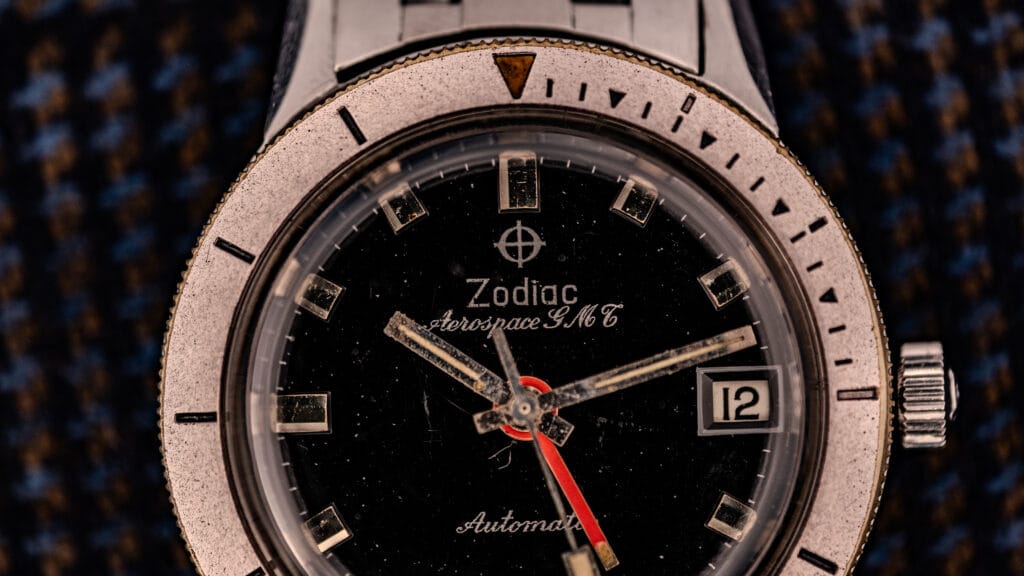
Data analysis by Goldammer examining over 2,500 vintage watches publicly listed on Chrono24 reveals a clear pattern: black dials experienced a significant dip in production between roughly 1945 and 1960. The postwar era was dominated by dress watches, and dress watches overwhelmingly came in white, silver, and cream dials. Black dials accounted for a minority of total production during the most celebrated vintage era. As their analysis puts it, black is the color for most of the 20th century, just not from 1945 to 1960.
Black dials claimed something approaching 40% market share from the mid-1960s onward, driven by the rise of sport watches, tool watches, and chronographs. But for the golden era of vintage collecting, the late 1940s through the early 1960s, the era of hand-wound Seamasters, early Submariners, and first-generation Speedmasters, black dials were not the default choice.
This matters because the starting population was already smaller. If you then apply the degradation factors above to a smaller pool, the attrition rate becomes brutal.
The Real Killer: Decades of Routine Dial Replacement
Everything I’ve described so far, varnish failure, radium burn, UV-induced tropicalization, happened gradually over decades. But the most devastating blow to original black dials was dealt by people trying to help.
For most of the 20th century, dial replacement during servicing was standard practice. Not controversial, not reluctant. Standard. Rolex, Omega, JLC, and virtually every other manufacturer routinely replaced dials as part of their service process. Vintage Gold Watches makes this point plainly: it is not often appreciated that these brands would replace dials when servicing a watch, especially when a dial showed damage through general aging. And as forum discussions on WatchUSeek have noted, for large parts of the 20th century, refinishing was considered a desirable part of service, and many major brands did it routinely.
The customer expected it. A fresh dial was considered part of good service, the same way a new gasket or fresh oil was.
Now think about what this means for black dials specifically.
A silver or white dial that aged gracefully, taking on a subtle cream tone, maybe some light yellowing, might pass through service without being flagged. The degradation was mild enough that many watchmakers left it alone. But a black dial that had turned brown? A black dial with visible radium halos around the markers? A black dial with lacquer cracks or pigment loss? That was an obvious candidate for replacement. Every single time.
Over the course of 50 to 70 years of servicing, the cumulative effect was enormous. Each service interval, and a well-maintained watch might see five to eight services over its lifetime, was another opportunity for an original black dial to be swapped out. The very visibility of black dial degradation, the same quality that now makes tropical dials valuable, was the reason so many originals were destroyed long before anyone thought to preserve them.
I regularly examine watches where the movement, case, crown, and hands are all period-correct, but the dial is a later replacement. On black-dialed references, this is the norm, not the exception. Finding a truly original, unserviced black dial from the 1950s or 1960s, on any brand, is an event.
The Compounding Effect
What makes original black dials genuinely rare is not any single factor. It’s the compound effect of all four working simultaneously across decades.
Fewer were produced in the first place. The postwar dress watch era favored light dials, and black-dialed production didn’t reach parity until the mid-1960s. Every piece from before that inflection point started from a smaller initial pool.
The materials degraded them harder. Nitrocellulose varnish allowed oxidation and moisture intrusion on every dial regardless of color, but the visual effect was dramatically more pronounced on black. Radium lume burned hotter on tool watches, which were disproportionately black-dialed. UV exposure turned black to brown in ways that white dials simply never experienced.
The degradation made them targets for replacement. A subtly yellowed silver dial could pass through service unscathed. A visibly tropicalized or radium-burned black dial was considered damaged and routinely swapped. The more a black dial aged, the more likely it was to be destroyed by a well-meaning watchmaker.
And the ones that survived are only growing more scarce. Every remaining original black dial is either locked in a collection, priced accordingly, or sitting in someone’s drawer unrecognized, slowly continuing to degrade through the same mechanisms that have been working on it for 60 years.
What This Means at the Bench
I see the practical consequences of this every week. When a watch with an original black dial from the 1950s or 1960s comes across the bench, truly original, with matching patina on hands, dial, and lume, I treat it differently than almost any other component.
A replacement caseback is straightforward. Replacement hands are disappointing but manageable. A refinished case can be forgiven if the proportions are preserved. But an original black dial with period-correct aging is irreplaceable. It cannot be manufactured. It cannot be convincingly faked to someone who knows what they’re looking at. And the supply is not being replenished.
This applies across every brand I work with. Omega, Rolex, Longines, Universal Genève, Movado, Wittnauer. The story is the same. The varnish was the same. The radium was the same. The servicing culture was the same. The original black dials are disappearing at the same rate.
When I authenticate a piece with a suspect black dial, the first things I look for are the telltale signs that only time can produce: consistent radium burn patterns around the markers, lume patina that matches between hands and dial, varnish aging that’s uniform across the surface rather than applied, and printing wear that’s commensurate with the case condition. These are the fingerprints of an original. A refinished dial, even a well-executed one, can’t reproduce them because they’re the product of 60-plus years of specific chemical processes happening in a specific sequence.
The Collector’s Takeaway
If you’re shopping for vintage watches and you encounter an original black dial in strong condition, understand what you’re looking at. It survived production in a minority color. It survived a varnish technology that was chemically destined to degrade it. It survived radium eating away at it from the inside. And it survived multiple rounds of servicing where any reasonable watchmaker would have replaced it.
That’s not a dial. That’s a survivor.
And the tropical dials, the ones that turned brown gracefully, uniformly, with the lacquer still intact and the lume still matching, those are the survivors of a process that went wrong beautifully. They exist because the Zapon failed in exactly the right way, the UV exposure was even, and nobody along the way decided to “fix” them.
The market is still catching up to this reality. Tropical Rolex sport watches command serious premiums, and rightly so. But the same underlying rarity applies to a tropical Omega Seamaster 300, a browned Universal Genève Polerouter, or a degraded Longines Tre Tacche military piece. The varnish didn’t know what brand it was protecting. The radium didn’t know what logo was printed on the dial. The chemistry was universal, and so is the rarity.
Pay attention to what’s on the dial. It’s telling you a story that’s getting harder to find every year.
Related posts
The Omega Seamaster DeVille 166.020: Best Vintage Omega Under $1,000
Why the Omega Seamaster DeVille 166.020 is the most undervalued vintage Omega you can buy. Real market prices, what to look for, and what to avoid.
How to Date a Vintage Gruen Watch: The Complete Guide
Serial numbers, style numbers, case dating, and the triangulation method. A bench-level guide to dating vintage Gruen wristwatches from 1925 to 1958.

Tudor Serial Numbers: The Complete Guide to Dating Your Watch
Date your Tudor watch using serial numbers from 1940 to 2002. Complete serial number chart, reference number decoder, and authentication steps.

Omega Bumpers : A Collector’s Guide to References 2374 Through 2782
Everything you need to know about Omega bumpers from 1943 to 1962. The mechanism, the key references, what they cost, and why collectors are paying attention.

Omega Serial Numbers: The Complete Guide to Dating Your Watch
Every Omega movement that left the factory in Bienne, Switzerland received a serial number. That number, stamped onto a bridge or plate...

Why Black Dials Are the Rarest Thing in Vintage Watches
Most people think they understand why tropical dials command a premium. The story usually stops at "black turned brown, collectors love...

Wittnauer Watch Serial Numbers and Production Date Guide
Here's the honest truth that most watch sites won't tell you: there is no publicly available serial number table for Wittnauer watches....

The 12 Best Vintage Watches Under $1,000 in 2026
I want to tell you something that took me an embarrassingly long time to figure out. When I first started collecting vintage watches, I...
Longines Serial Numbers: The Complete Reference Guide 2026
Longines has been making watches since 1832, and they've been recording serial numbers for every single one since 1867. That's over 150...

Hamilton Watch Serial Numbers: How to Date Your Timepiece
Hamilton produced roughly 4.5 million watches over the course of its American manufacturing life, from the first movements completed in...

How to Read a Rolex Serial Number: The Complete Dating Guide 2026
If you want to date a vintage Rolex, understand what you actually paid for, or avoid getting burned on a purchase, the serial number is...

Your First Vintage Watch: The 2026 Beginner’s Buying Guide
There are dozens of beginner's guides to vintage watches online. Most of them tell you to "set a budget," "research brands," and "buy f...