

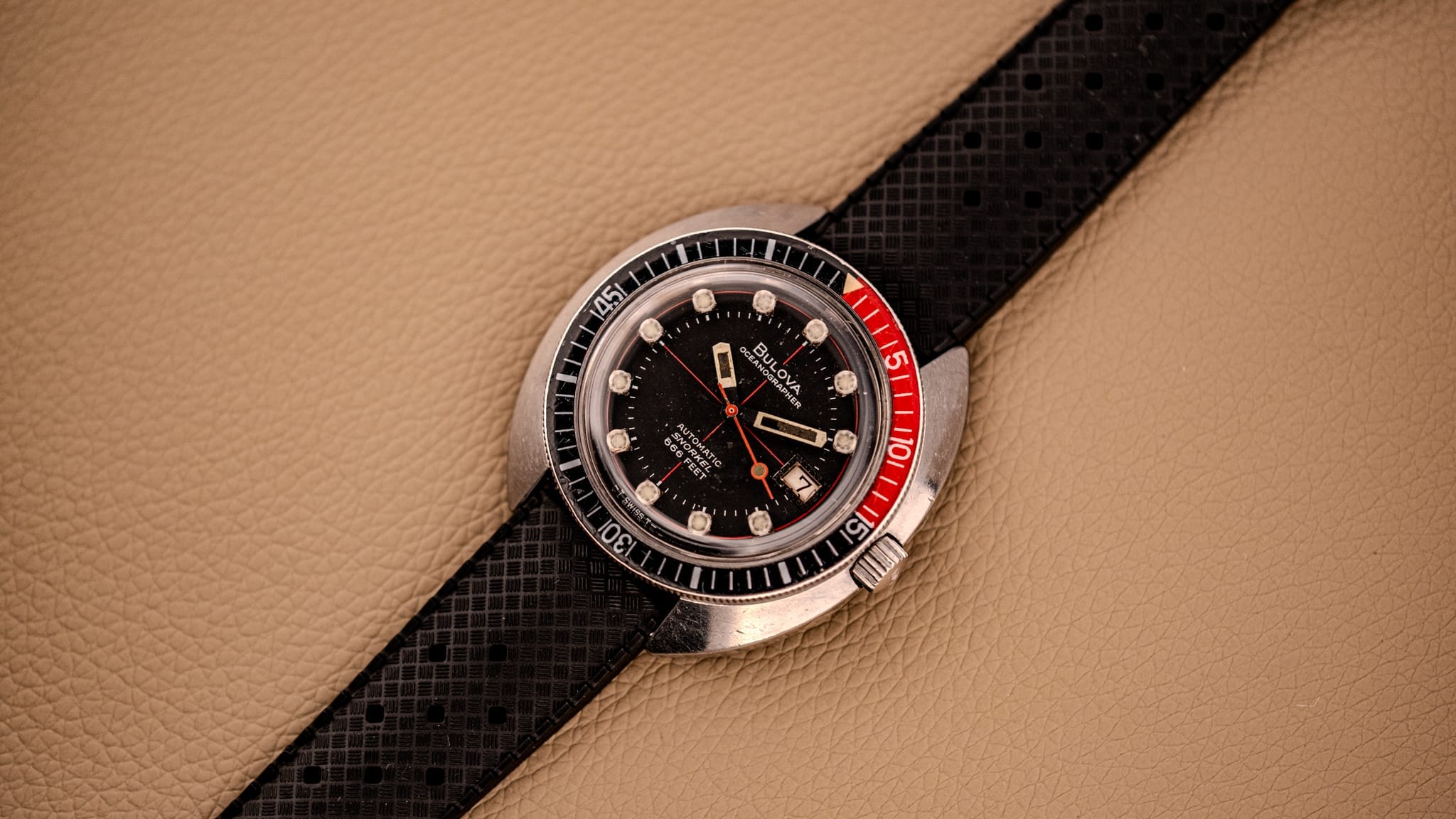
There are dozens of beginner’s guides to vintage watches online. Most of them tell you to “set a budget,” “research brands,” and “buy from a reputable seller.” That advice is technically correct and practically useless. It is the equivalent of telling someone who has never cooked to “use good ingredients.” This guide is different because it comes from the selling side of the counter. I run a vintage watch business. I see first-time buyers make the same mistakes every week, and I see experienced collectors wish they had known certain things earlier. Everything here is the advice I would give a friend sitting across from me asking where to start.
We will cover what vintage actually means, how much your first watch will really cost (it is more than the sticker price), where to shop, what to look for, what to avoid, and specific watches worth considering at every budget from $250 to $5,000. No brand worship. No fluff. Just the practical stuff.
What Makes a Watch “Vintage”?
This question starts arguments on forums, so let’s settle it with the definition that actually matters when you are spending money. A watch is generally considered vintage when it is roughly 25 to 30 years old or more, which today means anything produced before the mid-1990s. But the date alone does not make a watch collectible. A mass-produced quartz fashion watch from 1990 is old, not vintage in any meaningful collecting sense. What collectors mean by “vintage” is a mechanical watch from an era when its manufacturer was doing something interesting, whether that is a hand-finished movement, a distinctive case design, or a historically significant model.
You will also encounter the terms “antique” (generally pre-1940s) and “neo-vintage” (1990s to early 2000s models that have developed a collecting following, like the Omega Speedmaster Reduced or early Tudor Submariners). For your first purchase, the sweet spot is the 1950s through 1970s. This era produced the most variety at the widest range of price points, parts availability is still reasonable, and the designs hold up beautifully on a modern wrist.
One more distinction worth knowing: “pre-owned” and “vintage” are not the same thing. A Rolex Submariner purchased in 2019 and resold today is pre-owned. Your grandfather’s 1960s Omega Seamaster is vintage. The pre-owned market and the vintage market operate differently, with different pricing dynamics and different things to watch out for. This guide focuses on true vintage.
The True Cost of Your First Vintage Watch
This is the section every other guide skips, and it is the section that matters most. The purchase price of a vintage watch is not your total cost. Think of it like buying an old car. The sticker price gets you the car, but insurance, a tune-up, and maybe new tires are part of the real number.
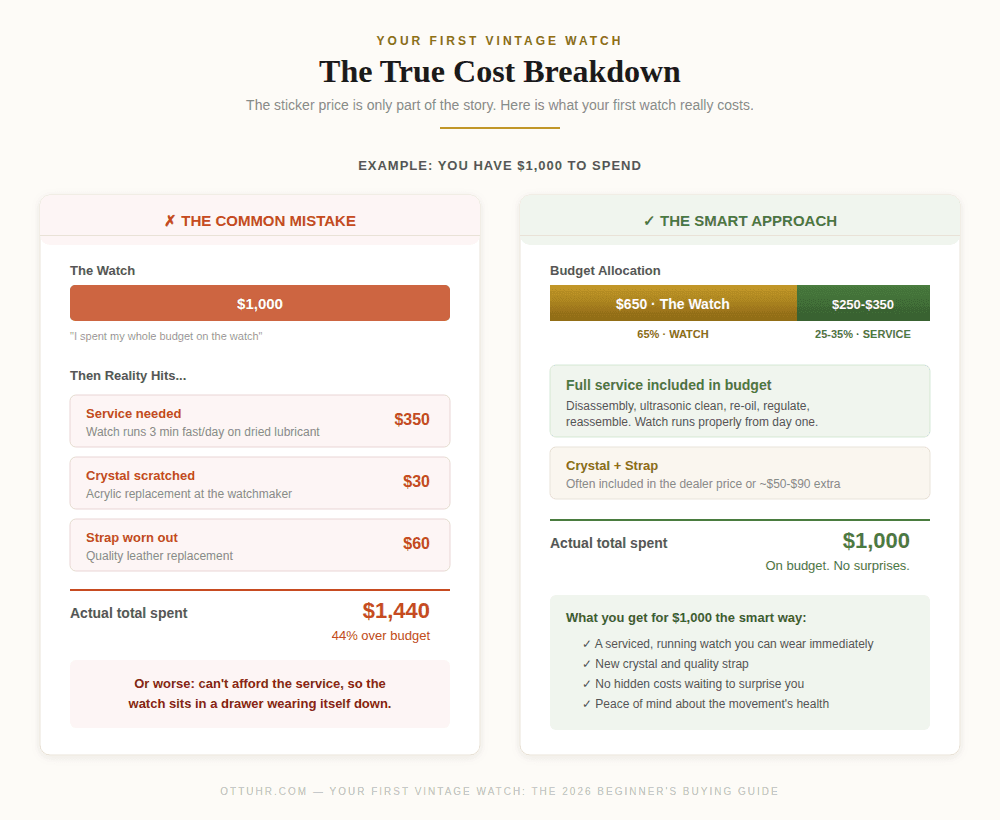
Here is what your first vintage watch will actually cost:
The watch itself. This is obvious. But even here, context matters. A vintage Omega Seamaster De Ville listed at $600 on eBay and the same reference listed at $900 from a reputable dealer are not the same proposition. The dealer version has likely been inspected, may have been recently serviced, and comes with some form of return policy. The eBay version might need $400 in service work. More on this in the “Where to Buy” section.
Service. A full service on a basic vintage three-hand automatic runs $250 to $450 from a qualified independent watchmaker in 2026. A chronograph will run $400 to $700 or more. This involves a complete disassembly, ultrasonic cleaning, re-oiling, regulation, and reassembly. If you are buying from a private seller or auction and the watch has not been recently serviced, budget for this. It is not optional. A vintage movement running on dried-out lubricant is actively wearing itself down.
Crystal replacement. Many vintage watches come with acrylic (plastic) crystals. A replacement acrylic crystal is cheap, typically $15 to $40 installed. But if the watch originally had a mineral glass crystal and it is cracked, replacement is more like $50 to $100. This is a minor cost but worth knowing about.
Strap or bracelet. Vintage watches often arrive on worn-out straps or incorrect bracelets. A quality leather strap runs $30 to $80. An original-style bracelet, if you can find one, can cost $100 to $300 or more depending on the brand. For your first watch, a good leather strap is the way to go.
The practical math. If you have $1,000 to spend total, do not buy a $1,000 watch. Buy a $600 to $700 watch and keep $300 to $400 in reserve for service and a strap. This is the single most important piece of advice in this entire guide. Experienced collectors build service costs into their budget automatically. First-time buyers almost never do, and then they are stuck with a beautiful watch that runs three minutes fast per day because they cannot afford to have it serviced.
Choosing Your First Watch: Style Before Brand
Most guides start with brands. “Consider Omega, Rolex, or Longines.” That approach puts the cart before the horse. You should start with what you actually want to wear and work backward to which brands made great versions of it.
Dress watches are thin, elegant, and typically 33mm to 36mm in the vintage world. They sit flat under a shirt cuff and look refined with a leather strap. Think clean dials, simple indices, and often a small seconds subdial. If this appeals to you, look at Omega De Ville and Genève models, Longines Flagship and Conquest, Universal Genève Polerouter, Jaeger-LeCoultre, and vintage Tissot Seastar. This category offers the best value for first-time buyers because dress watches are currently undervalued relative to sport watches.
Diver and sport watches are larger, typically 36mm to 40mm vintage, with rotating bezels, luminous markers, and more robust cases. These are the category most affected by hype pricing. Vintage Rolex Submariners are out of reach for most beginners, but excellent alternatives exist. Look at vintage Zodiac Sea Wolf, Enicar Sherpa, early Seiko divers (6105, 6309), and the Certina DS models. Tudor Submariners from the 1960s and 1970s offer the Rolex-adjacent experience at a fraction of the price, though they have climbed significantly in recent years.
Chronographs feature stopwatch functionality and extra pushers on the case. Vintage chronographs are where the real excitement is, but they are also the most expensive to service and the most commonly faked or assembled from mismatched parts. For a first purchase, I would generally steer beginners toward a time-only or date watch and save the chronograph for your second or third purchase. If you cannot resist, the Seiko 6139 “Pogue” is an excellent and relatively safe entry point.
Field and military watches are rugged, legible, and purposeful. Vintage Benrus, Hamilton, and Bulova military-issued pieces are distinctive and often affordable. The Hamilton Khaki lineage traces back to genuine military contracts, and many 1960s and 1970s examples can be found under $500.
Size matters. Vintage watches run smaller than modern ones. A 34mm vintage watch wears differently than a 34mm modern watch because vintage cases tend to have shorter lug-to-lug measurements and thinner profiles. Many men who wear 40mm to 42mm modern watches find that 35mm to 37mm vintage watches feel perfectly proportioned on their wrists. Do not dismiss a watch based on millimeters alone. If possible, try vintage sizes on your wrist before buying online. A local watch meetup, a brick-and-mortar dealer, or even a friend’s collection can help calibrate your eye.
Where to Buy: An Honest Assessment
Each buying channel has trade-offs. Here is what I tell friends.
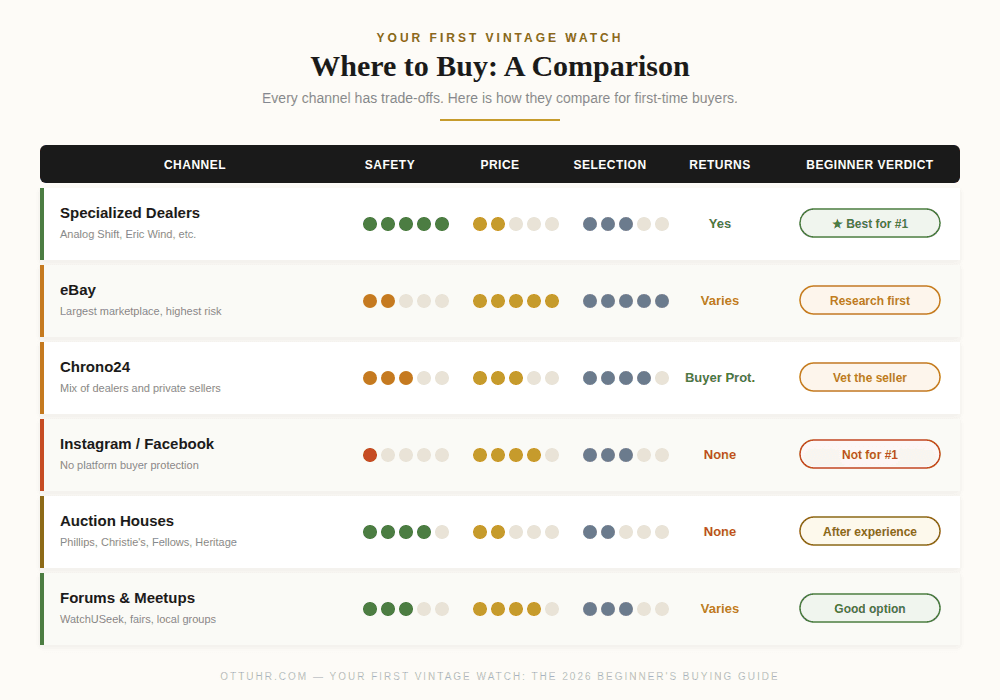
Specialized vintage dealers (online and brick-and-mortar). This is the safest option for beginners. A reputable vintage dealer has inspected the watch, can speak to its condition and authenticity, and offers some form of return policy. You pay a premium for this, typically 15% to 30% over what you might pay privately, and that premium is worth it on your first purchase. Look for dealers who photograph their own inventory (not stock images), describe condition honestly including flaws, and are willing to answer specific questions about service history and originality. Analog Shift, Eric Wind, Craft & Tailored, Lunar Oyster, and Shuck the Oyster are among the dealers known for this level of transparency. In person, cities like New York, Los Angeles, London, and Tokyo have concentrations of vintage watch shops worth visiting. Best option for first-time buyers. The dealer premium is your insurance policy.
eBay. The world’s largest vintage watch marketplace, and also the most dangerous for beginners. eBay is home to excellent finds and outright fraud in equal measure. If you buy on eBay, filter by sellers with 99%+ feedback and at least several hundred transactions. Read the full listing description, not just the headline. Look at every photo carefully and ask for additional photos if the caseback, movement, and dial are not shown. Use eBay’s Authenticity Guarantee program when available. The return policy is your safety net. Never buy a vintage watch listed as “no returns” unless you are confident in your ability to evaluate it from photos alone. For your first purchase, I would suggest using eBay as a research tool, studying sold listings to learn pricing, and buying from a dealer instead. Our eBay buying guide goes deeper on how to navigate the platform safely.
Chrono24. A large marketplace with a mix of professional dealers and private sellers. The Buyer Protection program offers some security. The quality of listings varies enormously. Look for “Trusted Seller” badges and dealers who have professional photography and detailed descriptions. Pricing tends to be higher than eBay because sellers factor in the platform’s commission. Good research tool, but vet sellers carefully.
Instagram and Facebook. A growing number of vintage dealers operate primarily through social media. Some are excellent and trustworthy. Some are not. The challenge is that social media platforms have no buyer protection. You are relying entirely on the seller’s reputation. For your first purchase, I would not recommend this route unless you have been referred to a specific seller by someone you trust.
Auction houses. Phillips, Christie’s, Sotheby’s, and Bonhams sell vintage watches at all price levels, not just six-figure grails. Smaller auction houses like Fellows and Heritage also handle vintage watches regularly. The advantage is rigorous authentication. The disadvantage is that you cannot return a purchase, buyer’s premiums add 20% to 26% to the hammer price, and you need to know exactly what you are bidding on. This is a better channel for your fifth watch than your first.
Watch meetups, fairs, and forums. Local watch meetups and events like Windup Watch Fair offer the chance to handle watches in person and buy from collectors directly. Forum marketplaces like WatchUSeek, Omega Forums, and Reddit’s r/Watchexchange have active communities and reputation systems. These can be great places to find a first watch, but do your homework on the seller before committing.
How to Evaluate What You Are Looking At
You do not need to become an expert before buying your first vintage watch. But you do need to know the basics. Here are the things to look at, in order of importance. For a deeper walkthrough once you have a watch in hand, see our complete guide to identifying and valuing a vintage watch.
The dial. The dial is the face of the watch and the single biggest driver of value. An original dial in good condition is the most important factor in a vintage watch. Look for consistent aging, meaning the lume plots have all aged to the same color, the printing is sharp and even, and there are no visible moisture marks or water spots. A refinished (repainted) dial can cut a watch’s value in half, sometimes more. Signs of refinishing include printing that looks too crisp for the watch’s age, lume dots that are perfectly white rather than cream or tan, and text that sits slightly above or below where it should relative to the dial’s markers. When in doubt, ask the seller directly: “Is this an original dial or has it been refinished?” A good seller will tell you honestly.
The case. Vintage watch cases should show honest wear but not abuse. Light scratches are normal and expected. Deep gouges, dents, and evidence of heavy polishing (soft edges where they should be sharp, especially on the lugs) are more concerning. Check that the case shape looks correct for the model. Research what the watch looked like new and compare. Serial numbers on the case should match any documentation and be consistent with the watch’s claimed production date.
The movement. If photos are available, look at the movement. It should be clean, with no visible rust or corrosion. Screws should not be chewed up (a sign of amateur work). The rotor on an automatic should spin freely. If you are buying in person, wind the watch and listen. It should tick evenly without any grinding or scraping sounds. A movement in need of service is not necessarily a dealbreaker, especially if it is factored into the price, but a movement that has been damaged by water or incompetent work is.
Crown and pushers. The crown (the knob you use to set the time) should wind smoothly and pull out to set the time without excessive force. On chronograph watches, the pushers should click cleanly. Non-original crowns are common on vintage watches and not always a dealbreaker, but they should be reflected in the price. An original signed crown (stamped with the brand’s logo) is always preferable.
Overall honesty. Ask yourself: does this watch look like an honest example of its age? Vintage watches should look old. Patina on the lume, a slightly faded dial, and light wear on the case are signs of a watch that has been worn and loved. A vintage watch that looks brand new should raise questions, not excitement. Either it has been heavily restored (which can diminish value and originality) or something is not what it seems.
Five Red Flags That Should Make You Walk Away
Some problems are dealbreakers. If you encounter any of these, move on to the next watch.
A deal that seems too good. If a watch is listed for significantly less than comparable examples, there is a reason. It might be a fake, a “frankenwatch” assembled from parts of multiple watches, or stolen. Check completed sales on eBay and pricing databases to establish a realistic market value before you start shopping. If a watch is 40% or more below market, your skepticism should be high.
No movement photos. A seller who will not show you the movement is hiding something. This is non-negotiable. The caseback should come off and the movement should be photographed. If a seller says they “cannot open the caseback” on a standard vintage watch, walk away.
Mismatched serial numbers. The serial number on the case and the serial number on the movement should be from the same approximate era. They do not always match exactly (movements were sometimes replaced during manufacturer service), but a 1970s case with a 1950s movement is a red flag that suggests the watch has been assembled from parts rather than maintained as a complete unit.
Pressure to buy quickly. “Someone else is interested” and “This won’t last long” are sales tactics, not facts. A legitimate seller will give you reasonable time to make a decision. Walk away from anyone who pressures you. Good vintage watches appear on the market regularly. There is always another one.
No return policy. For your first vintage watch, buy from someone who offers returns. Period. This eliminates the most catastrophic risk, which is receiving something fundamentally different from what you expected. You can relax this rule as you gain experience, but not on your first purchase.
Recommended First Watches by Budget
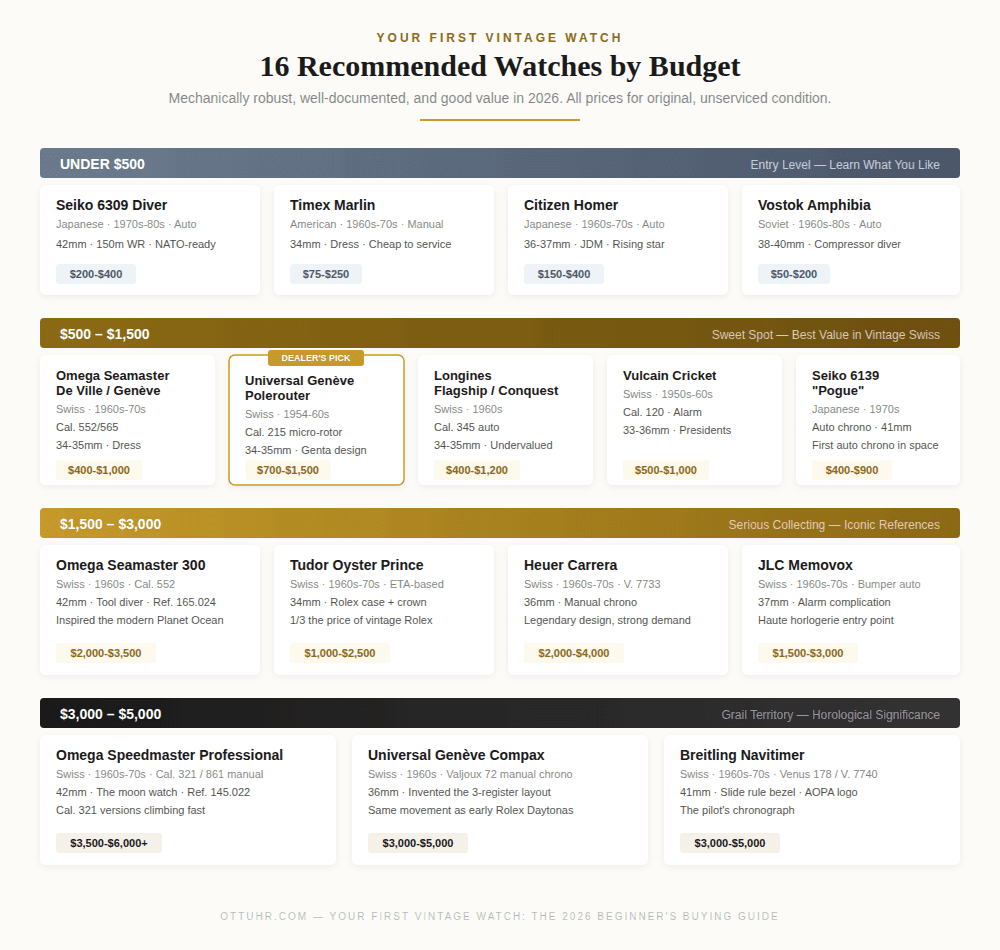
These are specific watches that make excellent first vintage purchases. They are mechanically robust, parts are available, they are well-documented enough that authentication is straightforward, and they represent good value in 2026. Prices are for examples in good, original condition without recent service. For more picks at these price points, see our roundups of the best vintage watches under $1,000 and under $2,000.
Under $500
Seiko 6309 Diver. The classic Japanese diver from the late 1970s and 1980s. Rugged 150m water resistance, automatic movement, and a case that looks great on a NATO strap. The 6309-7040 and 6309-7049 are the references to look for. Easy to find, well-documented, and built like a tank. $200 to $400 depending on condition and dial variant.
Timex Marlin (manual wind, 1960s to 1970s). Before Timex reissued the Marlin name for their modern line, the original Marlins were clean, affordable hand-wound dress watches. At 34mm, they are a perfect introduction to vintage sizing. Well-made American movements that are simple and cheap to service. $75 to $250. If your total budget is under $500 including service, this is one of the smartest starting points.
Citizen Homer or Seven Star (1960s to 1970s). Japanese domestic market watches that are beautifully finished for their price point. Automatic movements, 36mm to 37mm cases, and designs that range from dressy to sporty. Increasingly recognized by collectors but still available for $150 to $400.
Vostok Amphibia (Soviet era). Cold War-era Russian military watches with a devoted following. The Amphibia’s unique case design provides genuine water resistance through a clever compressor system. Inexpensive, historically interesting, and conversation starters. $50 to $200 for Soviet-era examples. Be aware that many “vintage” Vostoks on the market are assembled from mixed parts, so buy from sellers who specialize in them.
$500 to $1,500
Omega Seamaster De Ville or Genève (1960s to 1970s). This is the classic first vintage Swiss watch and for good reason. The Cal. 565 and Cal. 552 movements are workhorses, well-documented, and every watchmaker knows them. The De Ville offers a dressier look while the Genève gives you a slightly more casual aesthetic. Both come in a range of dial colors and configurations. $400 to $1,000 depending on condition and originality.
Universal Genève Polerouter (1950s to 1960s). My personal recommendation for the best value in vintage Swiss watches right now. A micro-rotor automatic movement (the Cal. 215 or its successors), a case designed by the legendary Gérald Genta, and a history tied to Scandinavian Airlines polar flights. Polerouters offer genuine horological significance at prices that start around $700 for steel examples. Our collector’s guide to Universal Genève covers these in detail.
Longines Flagship or Conquest (1960s). Longines was the equal of Omega in the 1950s and 1960s, but because the brand occupies a lower tier in today’s Swatch Group hierarchy, vintage Longines pieces are underpriced relative to their quality. The Cal. 345 automatic is an excellent movement. Gold-filled and solid gold examples often sell for less than comparable Omega models in stainless steel. $400 to $1,200.
Vulcain Cricket (1950s to 1960s). An alarm watch with a mechanical “buzzing” complication and a connection to American presidents going back to Eisenhower. The Cricket is a genuinely useful complication in a historical package that starts conversations. $500 to $1,000 for steel examples.
Seiko 6139 “Pogue” (1970s). If you want a chronograph as your first vintage watch, this is the safest choice. Named for astronaut Colonel William Pogue, who wore one on the Skylab 4 mission, making it the first automatic chronograph in space. The 6139 movement is robust, parts are available, and the yellow dial “Pogue” variant is iconic. $400 to $900 depending on condition and dial color. Just be aware that many Pogues on the market have replacement dials or bezels, so learn what the originals look like before buying.
$1,500 to $3,000
Omega Seamaster 300 (1960s). The tool watch that went to the ocean floor and looked good doing it. References 165.024 and 165.014 are the ones to look for. Cal. 552 movement, 42mm case (large for the era), and a design that inspired the modern Planet Ocean. This is a watch that holds its value and has significant room to appreciate. $2,000 to $3,500 depending on condition.
Tudor Oyster Prince (1960s to 1970s). Rolex cases, Rolex crowns, and movements based on ETA ebauches finished to Rolex’s standards. Tudor offers the build quality and wearing experience of a vintage Rolex at roughly one-third the price. The small-rose dials from the 1960s are particularly attractive. $1,000 to $2,500.
Heuer Carrera (1960s to 1970s). One of the most celebrated chronograph designs in history. The Ref. 73 models with Valjoux 7733 hand-wound movements offer the Carrera aesthetic at the more accessible end of the range. These are visually stunning watches with strong collector demand that continues to grow. $2,000 to $4,000 depending on reference and condition.
Jaeger-LeCoultre Memovox (1960s to 1970s). An alarm complication from one of the most respected movement manufacturers in Swiss watchmaking. The bumper automatic versions from the early 1960s are particularly charming, with a mechanical alarm that buzzes on your wrist. $1,500 to $3,000 for steel examples.
$3,000 to $5,000
Omega Speedmaster Professional (pre-moon, 1960s). The Speedmaster needs no introduction, but many first-time buyers do not realize that pre-moon references like the 105.003 and 105.012 are sometimes available in this range for examples that need service or have minor condition issues. The Cal. 321 versions are climbing fast, but Cal. 861 examples from the early 1970s (Ref. 145.022) remain more accessible. $3,500 to $6,000 and rising.
Universal Genève Compax (1960s). The three-register chronograph that invented the layout every modern chronograph follows. Non-nicknamed Compax references with Valjoux 72 movements can still be found in this range and offer extraordinary value compared to what you get from other brands at the same price. The same movement found in early Rolex Daytonas, in a watch that costs a fraction of the price. $3,000 to $5,000 for good examples.
Breitling Navitimer (1960s to 1970s). The pilot’s chronograph with the iconic slide rule bezel. Early references with the AOPA wings logo are increasingly collectible. The hand-wound Venus 178 and later Valjoux 7740 versions represent the original character of the Navitimer before it went automatic. $3,000 to $5,000 depending on reference and condition.
After the Purchase: What to Do When Your Watch Arrives
Inspect it carefully. Compare it against the listing photos and description. Check for any damage that may have occurred during shipping. If anything is significantly different from what was described, contact the seller immediately and initiate a return if necessary.
Get it serviced (if it has not been recently). If you bought from a dealer who serviced the watch before sale, you are set. If not, take it to a qualified independent watchmaker for an assessment. Ask specifically: does this watch need a full service or is it running within acceptable parameters? Not every vintage watch needs immediate service. A watch that is keeping time within 15 to 20 seconds per day and has no obvious issues may be fine to wear while you save up for service. But if it is losing minutes per day, running erratically, or the crown feels gritty when winding, do not wait. (Wondering whether a seller’s “recently serviced” claim holds up? Here is what service history actually tells you.)
Find a watchmaker before you need one. This is important. Good independent watchmakers often have backlogs of weeks or months. Start asking around now. Ask your local watch community, check forums for recommendations in your area, and read reviews. Avoid mall jewelers and “while you wait” shops for vintage service work. You want someone who specializes in mechanical watches and has experience with vintage pieces. The AWCI (American Watchmakers-Clockmakers Institute) directory is a decent starting point in the US. WatchUSeek forums are another good resource for local watchmaker recommendations.
Wear it. This sounds obvious, but many first-time buyers are nervous about wearing their vintage watch. Wear it. That is what it was made for. Just be aware that most vintage watches are not waterproof regardless of what the caseback says. Even if your watch says “waterproof” or has a depth rating, those seals are decades old and should not be trusted. Remove it before washing your hands (or at least be careful), and never swim or shower with it.
Enjoy the imperfection. Your first vintage watch will not keep perfect time. A well-serviced vintage automatic keeping time within plus or minus 10 to 15 seconds per day is performing excellently. It will not match the accuracy of a modern quartz watch or even a modern mechanical watch with a silicon escapement. That is part of its character. If you find yourself constantly checking your phone to see if your watch is accurate, you might need a few weeks to adjust to the vintage mindset. The watch is not supposed to be a precision instrument by modern standards. It is a mechanical artifact that keeps remarkably good time for something engineered 50 or 60 years ago.
Document what you have. Take clear photos of the dial, caseback, movement (if accessible), and any markings or serial numbers. Keep these along with your purchase receipt and any service records. This documentation becomes part of the watch’s provenance and will matter if you ever sell it or need insurance. If your watch is worth more than you would be comfortable losing, add it to your homeowner’s or renter’s insurance policy as a scheduled item.
The Collector’s Mindset
Your first vintage watch is a beginning, not a destination. Most collectors describe a similar trajectory: the first watch teaches you what you like, the second watch teaches you what you missed, and by the third watch you have developed an eye and a set of preferences that are uniquely yours. For the principles behind the process, our 13 collecting tips from 1,000+ watches sold is the mindset companion to this guide.
Resist the urge to buy quickly and buy often. One excellent vintage watch that you have researched, saved for, and chosen carefully is worth more to you, financially and personally, than five impulse purchases. The vintage watch market rewards patience. Good examples appear regularly. The perfect watch for you is out there, and it is not going anywhere.
Welcome to vintage watches. It only gets better from here.
How much does a first vintage watch really cost?
Budget for more than the sticker price. A full service on a basic vintage automatic runs about $250 to $450, and many private-sale or auction watches need one. The rule of thumb: if you have $1,000 to spend, buy a $600 to $700 watch and keep $300 to $400 back for service and a strap.
Where should a beginner buy their first vintage watch?
A specialized vintage dealer is the safest first purchase. You pay a premium of roughly 15% to 30% over a private sale, and that premium buys inspection, honest condition notes, and a return policy. eBay and Chrono24 are better used as research tools until you can evaluate a watch from photos yourself.
How do you know if a vintage watch is authentic and original?
Start with the dial, since original dials drive value and are the most commonly refinished, then the case, then the movement. Ask for clear photos of the dial, caseback, and movement, and walk away from any seller who will not show the movement.
Do vintage watches need to be serviced before you wear them?
Not always. A watch keeping time within 15 to 20 seconds a day with no obvious issues can be worn while you save for a service. But if it is losing minutes a day, running erratically, or the crown feels gritty, have it serviced before wearing it regularly.
Keep reading
Before you buy: how to identify and value a vintage watch, patina vs. damage on a dial, and what service history actually tells you.
By budget: the 12 best vintage watches under $1,000 and the 12 best under $2,000.
Go deeper on a brand: the vintage Omega Seamaster guide, the Universal Genève collector’s guide, and buying vintage watches on eBay.
Related posts
Watch Shapes: Which Vintage Case Shape Fits Your Style?
Case shape changes how a vintage watch wears more than diameter alone. Compare eight silhouettes and learn which one fits your wrist and style.
Vintage Dress Watches: How to Choose One You’ll Actually Wear
The best vintage dress watch is the one you will wear beyond weddings. Here is how to choose the right size, metal, dial, shape, and strap.
Vintage Watch Styles: A Visual Guide to Finding Yours
Most buyers pick a brand and stall. Here are nine vintage watch styles, shown with real watches from our archive, and the catch that comes with each one.
Vintage Tank Watches: A Buyer’s Guide to Rectangular Watches Beyond Cartier
Every Cartier Tank alternatives list is new watches imitating old ones. The originals still exist and cost less. A buyer's guide to vintage tank and rectangular watches: the brands, the prices, and what to check.
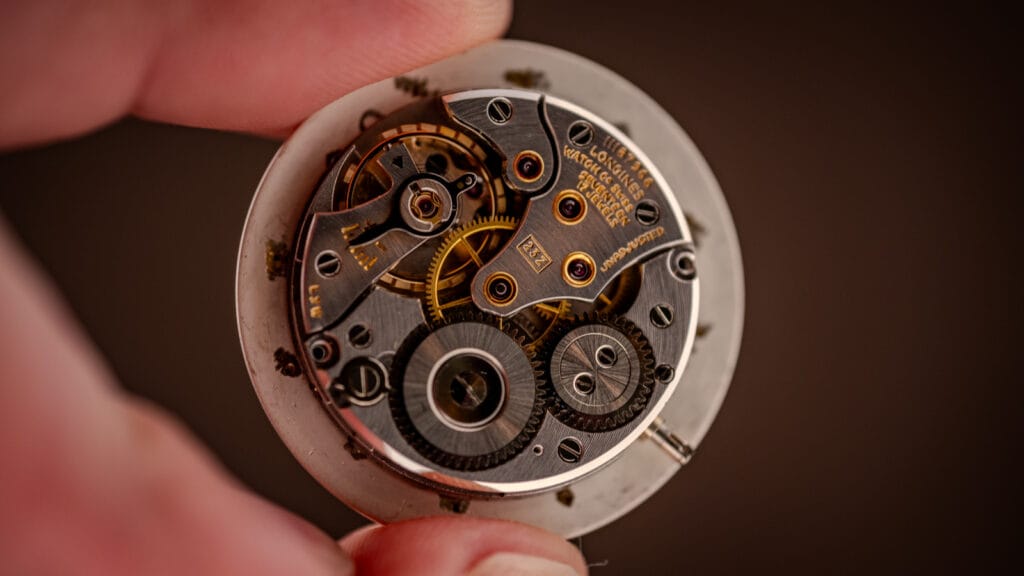
Service History Is the Wrong Question. Here’s the Right One.
Everyone says to ask for a vintage watch's service history. Most of it can't be verified, and a receipt proves a transaction, not a result. Here's what actually tells you a watch has been serviced, and the better question to ask.
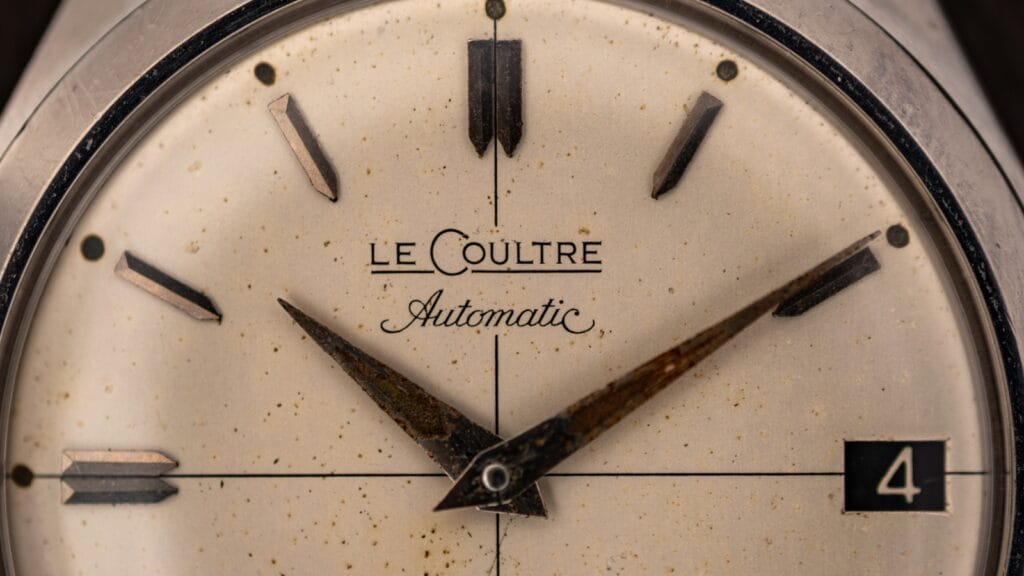
LeCoultre vs. Jaeger-LeCoultre vs. Jaeger: What the Name on the Dial Means
Three names, one Swiss firm, and one watch that isn't what it looks like. What LeCoultre, Jaeger-LeCoultre, and plain Jaeger on a vintage dial really tell you.
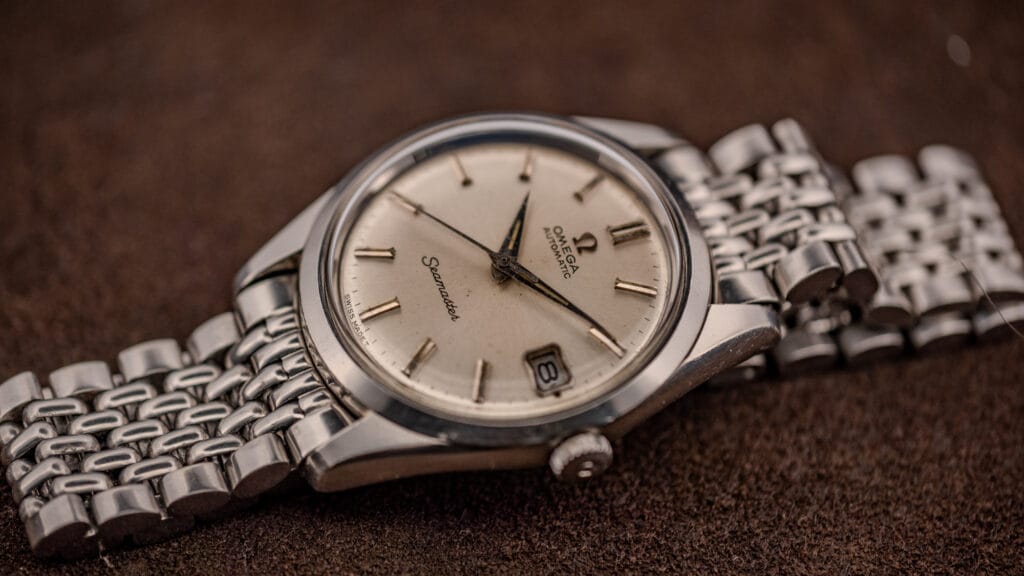
Omega Seamaster 166.010 Buyer’s Guide: Prices, Variants, and What to Look For (2026)
Everything you need to buy an Omega Seamaster 166.010 in 2026: real market prices by condition tier, five dial variants explained, caliber 562 vs 565, original part numbers, and what to inspect before you commit.
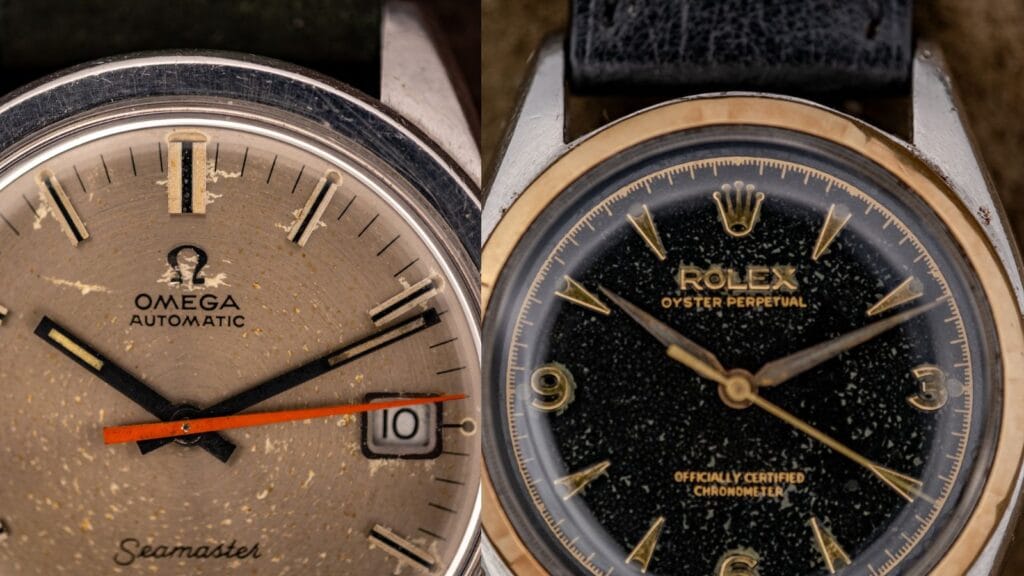
Omega vs Rolex: The Vintage Buyer’s Verdict
Vintage Omega vs vintage Rolex: where the Rolex premium is worth paying, where Omega is the smarter buy, and how to dodge redials on both. A collector's verdict.
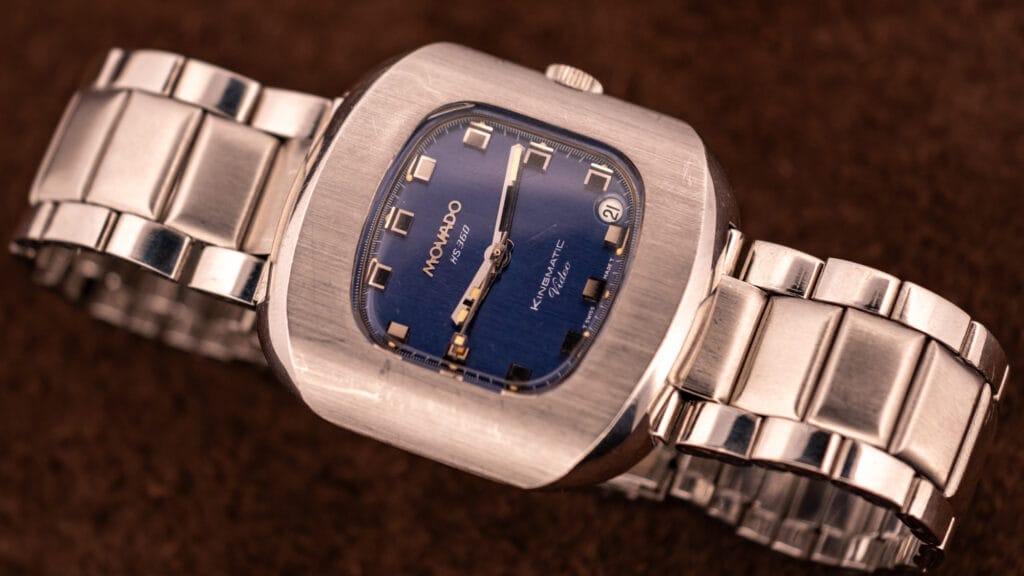
Movado Kingmatic: A Vintage Buyer’s Guide to References, Calibers, and Value
The Movado Kingmatic is one of the best values in vintage automatics. A buyer's guide to its references, in-house calibers, the Sub-Sea line, what to check, and what they actually sell for.
13 Vintage Watch Collecting Tips for Beginners (From 1,000+ Watches Sold)
Thirteen vintage watch collecting tips drawn from selling over 1,000 watches. What separates a smart first buy from an expensive lesson, with no sugar.
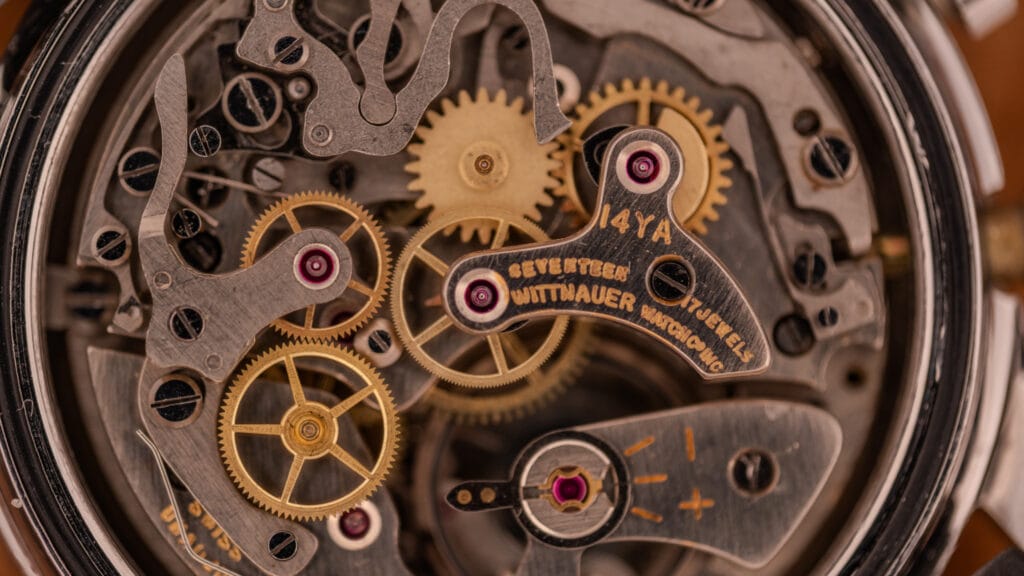
Vintage Wittnauer Chronograph Caliber Identification: Venus 188, Valjoux 7733/7734, Landeron 248
How to identify the movement inside any vintage Wittnauer chronograph: Venus 188, Valjoux 7733 and 7734, Landeron 248, and the house numbering system Wittnauer used to mark them.
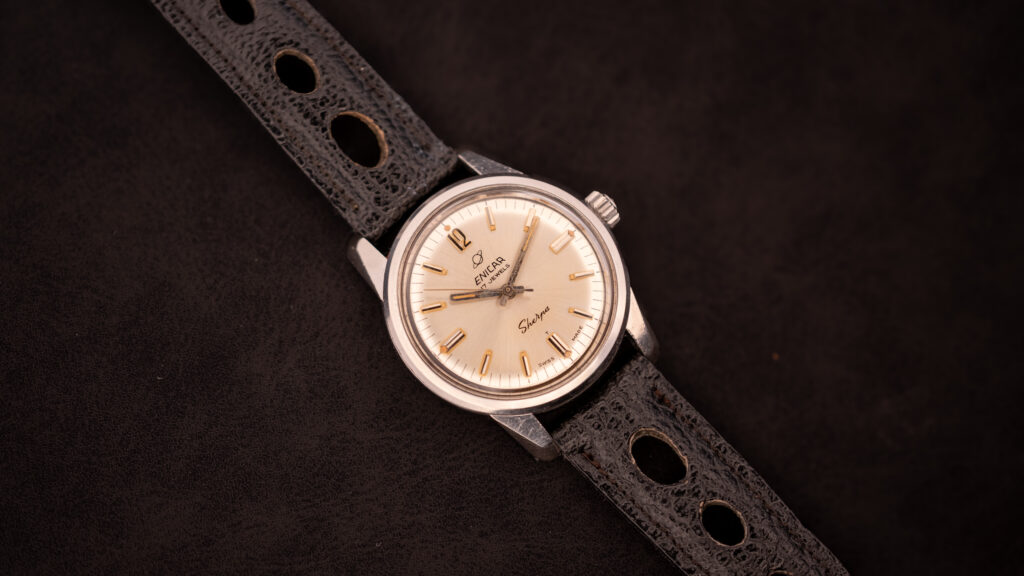
How Water-Resistant Is a Vintage Watch, Actually? The Honest Answer.
Every dealer says never get a vintage watch wet. That advice is half-engineering and half-liability theater. Here is what is actually true about vintage water resistance, where water actually gets in, and when a 1965 diver is safer than a 2-year-old modern.