


Here’s the honest truth that most watch sites won’t tell you: there is no publicly available serial number table for Wittnauer watches. Not a partial one. Not an approximate one. Nothing. If you’ve been searching the internet for a Wittnauer serial number lookup tool and coming up empty, it’s not because you’re searching wrong. It’s because one doesn’t exist.
This makes Wittnauer one of the most frustrating brands to date in the entire vintage watch world, which is unfortunate, because Wittnauer made some genuinely excellent watches. Their chronographs are collected seriously. Their military and aviation connections rival brands ten times their current market price. And their movements, sourced from some of the best Swiss ebauche makers of the 20th century, are often better than collectors expect. But when someone inherits a vintage Wittnauer and wants to know when it was made, the usual approach of “find the serial number and look it up” simply doesn’t apply here.
This guide explains why Wittnauer serial numbers don’t work the way other brands do, what information you can find on your Wittnauer movement, and the practical methods that actually work for dating these watches. If you’ve got a Wittnauer and you want to know when it was made, keep reading. You’ll need a slightly different toolkit than you’re used to.
Why Wittnauer Doesn’t Have a Serial Number Table
The answer comes down to how Wittnauer actually operated as a company. Unlike Longines, Hamilton, or Omega, Wittnauer never manufactured their own movements. They were an importer, assembler, and brand, not a movement manufacturer. From the very beginning, Wittnauer sourced movements from Swiss firms (primarily Revue Thommen, but also A. Schild, ETA, Valjoux, Venus, and even Piaget) and branded them as Wittnauer products.
This means there was never a single, sequential production registry the way Longines maintained one from 1867 onward. When Longines stamped serial number 8,225,000 on a movement, they were recording the 8,225,000th movement to leave their factory in Saint-Imier. The number tracked a single production line in a single factory. Wittnauer had no equivalent system because their movements came from multiple suppliers, were often assembled domestically in the United States (to reduce import tariffs), and followed whatever numbering conventions their various suppliers used.
To make matters worse, when Bulova purchased Wittnauer in 2001 for $11.6 million, the company’s historical production records apparently did not transfer with the sale. Collectors who have contacted Bulova (now owned by Citizen) seeking information about vintage Wittnauer watches have been told that the company has essentially nothing to share about dating or identification. The institutional memory is gone.
What You Will Find Inside a Wittnauer Watch
Even without a master serial number table, the movement inside your Wittnauer contains several pieces of information that are useful for identification and dating. Here’s what to look for when you open the caseback.
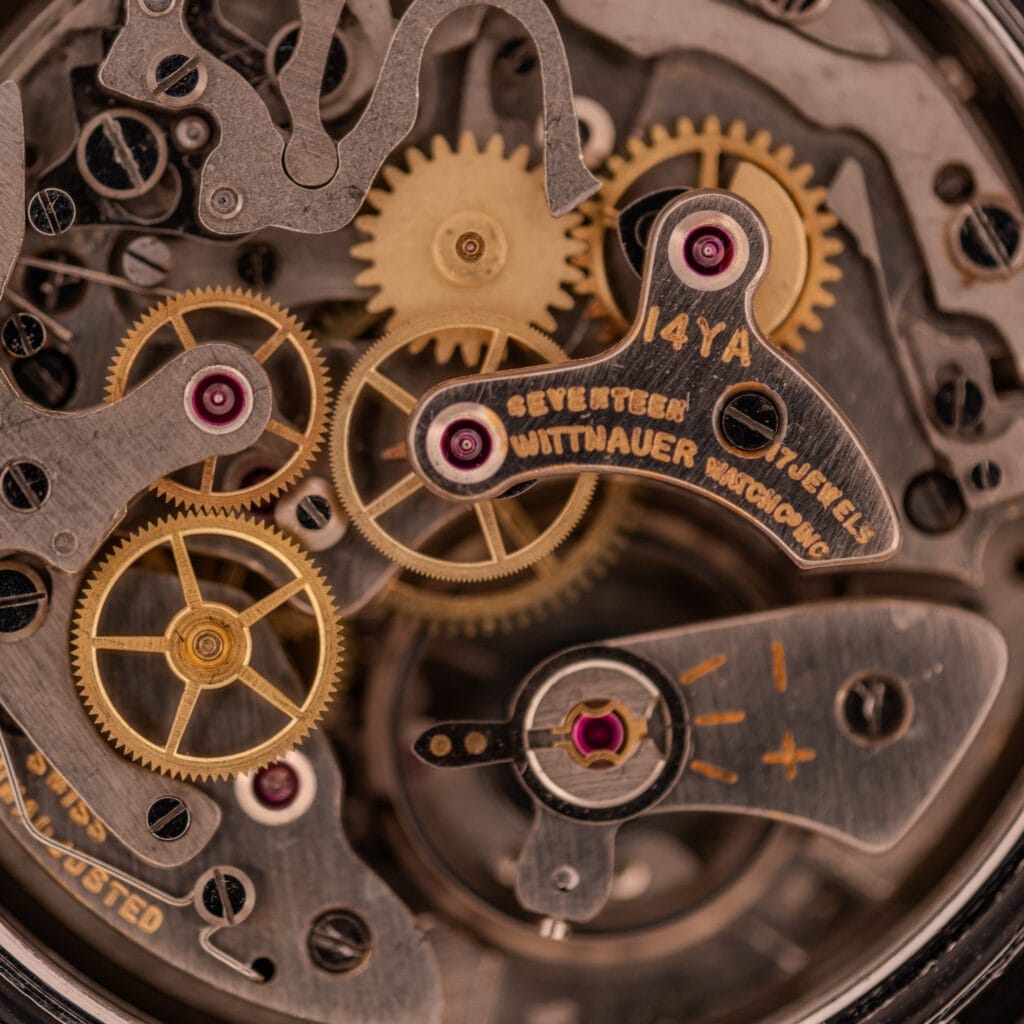
The Wittnauer name. Genuine Wittnauer movements will have “Wittnauer” engraved on the movement plate. On some earlier pieces, you may see “Wittnauer Watch Co. Inc.” or simply “Wittnauer” alongside additional markings.
The AXA mark. This is the U.S. import code assigned specifically to Wittnauer. If you see “AXA” stamped on the movement, you’re looking at a Wittnauer-imported Swiss movement. Every Swiss watch movement imported into the United States was required to carry a three-letter import code identifying the importer. AXA is Wittnauer’s code, just as OXG is Omega’s and WXC is Buren’s. The presence of AXA on a movement confirms Wittnauer provenance regardless of who actually manufactured the ebauche.
The caliber number. Wittnauer used their own internal caliber designations that often differed from the underlying ebauche manufacturer’s numbering. You might see designations like 9RW, 11N, 6N2, 11SR, or similar codes. These Wittnauer caliber numbers can be cross-referenced to identify the actual movement manufacturer. For example, the Wittnauer caliber 9RW corresponds to a Revue Thommen caliber 54. The 11SR uses an ETA-based caliber. Knowing the actual manufacturer opens up additional dating resources.
The jewel count. Stamped on the movement, usually as “17 jewels” or “17J.” While the jewel count alone won’t date a watch, it helps narrow the identification.
A serial number (sometimes). Some Wittnauer movements do carry serial numbers, but many do not. When present, the number may belong to Wittnauer’s own numbering system or it may be the ebauche manufacturer’s production number. Without a published table for either, the number alone won’t give you a date, but it can be useful when cross-referenced with other information.
The caseback markings. The inside of the caseback on most mid-century Wittnauer watches will read “Longines-Wittnauer Watch Co., New York, Geneva, Montreal” (on watches from the 1936-1994 Longines-Wittnauer era). You’ll also find a case serial number stamped by the case manufacturer. This is not the movement serial number and cannot be used with any Longines serial number table. On American-market watches, the cases were frequently manufactured domestically to avoid import duties on complete watches.
A Brief History of Wittnauer (And Why It Matters for Dating)
The ownership history of Wittnauer directly affects how you date a watch from each era. Understanding the timeline narrows your search immediately.
Albert Wittnauer was a Swiss immigrant who arrived in New York in 1872 at age 16 and went to work for his brother-in-law, Eugene Robert, a Swiss watch importer. In 1880, Wittnauer launched his own line of watches under the Wittnauer name, designed to offer Swiss quality at prices the American market could afford. The brand was formally established in 1885 when Albert took over Robert’s company and renamed it the A. Wittnauer Company.
In 1880, Wittnauer also became the exclusive U.S. sales agent for Longines, beginning a partnership that would shape both brands for over a century. Wittnauer imported and distributed Longines watches in America while simultaneously selling watches under the Wittnauer name. The two brands shared a distributor but maintained entirely separate product lines and movements. A Wittnauer watch does not contain a Longines movement (with rare late-era exceptions), and a Longines watch was never branded as a Wittnauer.
When the last Wittnauer brother died in 1916, their sister Martha took over as CEO, becoming the first woman to lead a watch company. She ran the business until 1936, when the Wittnauer family sold the company. It was renamed the Longines-Wittnauer Watch Company, a hyphenated name that confused generations of collectors into thinking the two brands were the same.
In 1946, Longines-Wittnauer established “Wittnauer-Geneva” as a Swiss assembly subsidiary, which by 1954 was producing 80,000 watches per year. During this period, Wittnauer sourced movements primarily from Revue Thommen and assembled finished watches both in Geneva and in the United States.
The partnership dissolved in stages. In 1994, Swatch Group took over Longines distribution and the company was renamed Wittnauer International Inc. In 2001, Bulova acquired the brand. Today, Wittnauer exists only as a budget quartz brand under Citizen’s umbrella, bearing no meaningful connection to the vintage mechanical watches that collectors care about.
This timeline gives you a rough framework:
| Era | Ownership | Key Characteristics |
|---|---|---|
| 1880-1936 | A. Wittnauer Company (Wittnauer family) | Pre-merger; movements from Revue Thommen and others; dial reads “Wittnauer” only |
| 1936-1969 | Longines-Wittnauer Watch Co. | Peak quality era; caseback reads “Longines-Wittnauer Watch Co.”; movements from Revue Thommen, A. Schild, others |
| 1969-1994 | Longines-Wittnauer (Westinghouse, then various owners) | Quartz transition; quality varies; Swiss mechanical production declines |
| 1994-2001 | Wittnauer International Inc. | Post-Longines; independent; reduced quality |
| 2001-present | Bulova (Citizen) | Budget quartz brand; no connection to vintage production |
How to Actually Date a Wittnauer Watch
Without a serial number table, you need to use a combination of methods. None of these is definitive on its own, but together they can usually pin a Wittnauer down to within a five-year window, and often closer.
Method 1: Identify the movement manufacturer and caliber. This is the single most useful step. If you can identify the actual ebauche maker (Revue Thommen, A. Schild, ETA, etc.) and the specific caliber number, you can look up when that caliber was in production. The Ranfft movement archive and Mikrolisk database are the best online resources for this. Many calibers had defined production windows, which immediately limits the possible date range of your watch. A watchmaker can usually identify the ebauche manufacturer in seconds by looking at the movement.
Method 2: Case style and construction. Wittnauer case designs followed the prevailing trends of their era with reasonable consistency. Art Deco rectangular cases with stepped bezels point to the 1930s and 1940s. Round cases with flared lugs and applied indices are typically 1950s. Cleaner, more modernist designs with thin cases suggest the 1960s. The case material also helps: 10k gold-filled was more common in the 1940s-1950s, while stainless steel became dominant in the 1960s and later.
Method 3: Caseback markings. If the inside of the caseback reads “Longines-Wittnauer Watch Co.,” the watch dates to between 1936 and 1994. If it reads “A. Wittnauer Co.” or shows no corporate name at all, it may be pre-1936. After 1994, the Longines name was dropped. The presence of “New York, Geneva, Montreal” as listed cities is a mid-century marker.
Method 4: Dial details. The font, layout, and printing style of Wittnauer dials changed over the decades. Script logos, radium lume plots, and sub-seconds dials are generally pre-1960. Printed (rather than applied) markers and the word “automatic” on the dial became more common in the 1960s. Tritium lume replaced radium in the early 1960s. The style of the Wittnauer “W” logo evolved noticeably through the decades.
Method 5: If the movement is a Longines caliber, contact Longines. In rare cases, particularly in the later Longines-Wittnauer era, some Wittnauer-branded watches were fitted with actual Longines movements. If you open your Wittnauer and find a movement stamped “Longines” with a Longines serial number, you can submit that serial number to Longines’ Extract from the Archives service. Longines will be able to tell you the exact invoice date and will note that the movement was shipped to Wittnauer as their U.S. agent. This is the only scenario where a Wittnauer can be dated with true precision through serial number records.
Method 6: Presentation engravings. Check the caseback exterior for engraved inscriptions. Retirement gifts, anniversary presents, and military service awards were commonly engraved on Wittnauer watches and often include a date. It’s not a manufacturing date, but it establishes a clear “no later than” boundary.
Common Wittnauer Calibers and Their Approximate Eras
While a complete caliber-to-date table doesn’t exist, experienced collectors have established rough production windows for the most commonly encountered Wittnauer calibers based on the underlying ebauche movements.
| Wittnauer Caliber | Ebauche Manufacturer | Approximate Era |
|---|---|---|
| 6N, 6N2 | Revue Thommen | 1940s-1950s |
| 9RW | Revue Thommen (cal. 54) | 1940s-early 1950s |
| 11N | Revue Thommen (cal. 73 family) | 1940s |
| 11ESC | A. Schild | 1950s |
| 11SR | ETA-based | 1960s |
| Valjoux 72 | Valjoux | 1950s-1960s (chronographs) |
| Valjoux 7733 | Valjoux | Late 1960s-1970s (chronographs) |
| Venus 188 | Venus | 1940s-1950s (chronographs) |
This is not an exhaustive list, and Wittnauer used many other calibers across their production history. The takeaway is that identifying the movement manufacturer gets you significantly closer to a date than any number stamped on the case.
Wittnauer vs. Longines: How to Tell Them Apart
Because the Longines-Wittnauer name has caused so much confusion, it’s worth being explicit about the differences.
A Longines watch will have “Longines” on the dial and a Longines-manufactured movement inside with a Longines serial number. That serial number can be looked up in the Longines serial number table or submitted to Longines for an Extract from the Archives.
A Wittnauer watch will have “Wittnauer” on the dial and a third-party movement inside (Revue Thommen, A. Schild, ETA, etc.) that is branded “Wittnauer” and carries the AXA import code. The caseback may read “Longines-Wittnauer Watch Co.,” but this refers to the parent company, not the movement manufacturer.
If you see both “Longines” and “Wittnauer” on the same watch, look more carefully. It’s almost certainly a Wittnauer watch distributed by the Longines-Wittnauer company, not a hybrid of the two brands.
The Bottom Line
Wittnauer doesn’t give you the easy answer. There’s no table to look up, no database to query, and no heritage department that kept records of every serial number since the 1880s. The institutional memory was lost when the brand changed hands repeatedly in the late 20th century.
But a Wittnauer can still be dated with reasonable accuracy if you know what to look for. Identify the movement manufacturer and caliber. Note the caseback markings and case construction. Study the dial details. If you’re lucky enough to have a Longines-caliber movement inside, let Longines’ own archive service do the heavy lifting. And if there’s a presentation engraving on the back, the date is probably staring right at you.
The lack of easy dating information is one reason Wittnauer remains undervalued relative to the quality of its watches. That’s a problem for people trying to research them. For collectors who know what they’re looking at, it’s an opportunity.
Further reading on OTTUHR:
- The Wittnauer Story: Longines’ Best-Kept Secret — The full history of Wittnauer, from Albert’s arrival in New York to the brand’s peak decades with Longines
- The Collector’s Guide to Vintage Wittnauer Chronographs — A deep dive into the Valjoux- and Venus-powered chronographs that are Wittnauer’s most collectible references
- Longines Serial Numbers: The Complete Reference Guide — If your Wittnauer happens to have a Longines movement inside, this is where you date it
- Browse Wittnauer watches in the OTTUHR shop — Authenticated vintage Wittnauer timepieces with full condition reporting and a 2-year mechanical warranty
Sources & further reading:
- NAWCC Forums: Wittnauer Wrist Watch Dating — Extensive collector discussion on Wittnauer identification methods, featuring contributions from specialists who have handled hundreds of examples
- Ranfft Watch Movement Archive — The most comprehensive online database for identifying Swiss ebauche movements by caliber number, essential for dating Wittnauer watches
Related posts
Baume & Mercier: The Quiet Swiss House Collectors Keep Overlooking
Baume & Mercier's 195-year history, movements, and collector market position, from the Kew Observatory records of 1892 to the 2026 Damiani sale.
How to Identify and Value a Vintage Watch: The Complete Guide
Learn to identify any vintage watch by its case markings, movement, dial, and serial number, then determine its real market value. Brand-specific tips included.
The Omega Seamaster DeVille 166.020: Best Vintage Omega Under $1,000
Why the Omega Seamaster DeVille 166.020 is the most undervalued vintage Omega you can buy. Real market prices, what to look for, and what to avoid.
How to Date a Vintage Gruen Watch: The Complete Guide
Serial numbers, style numbers, case dating, and the triangulation method. A bench-level guide to dating vintage Gruen wristwatches from 1925 to 1958.

Tudor Serial Numbers: The Complete Guide to Dating Your Watch
Date your Tudor watch using serial numbers from 1940 to 2002. Complete serial number chart, reference number decoder, and authentication steps.

Omega Bumpers : A Collector’s Guide to References 2374 Through 2782
Everything you need to know about Omega bumpers from 1943 to 1962. The mechanism, the key references, what they cost, and why collectors are paying attention.

Omega Serial Numbers: The Complete Guide to Dating Your Watch
Every Omega movement that left the factory in Bienne, Switzerland received a serial number. That number, stamped onto a bridge or plate...

Why Black Dials Are the Rarest Thing in Vintage Watches
Most people think they understand why tropical dials command a premium. The story usually stops at "black turned brown, collectors love...

Wittnauer Watch Serial Numbers and Production Date Guide
Here's the honest truth that most watch sites won't tell you: there is no publicly available serial number table for Wittnauer watches....

The 12 Best Vintage Watches Under $1,000 in 2026
I want to tell you something that took me an embarrassingly long time to figure out. When I first started collecting vintage watches, I...
Longines Serial Numbers: The Complete Reference Guide 2026
Longines has been making watches since 1832, and they've been recording serial numbers for every single one since 1867. That's over 150...

Hamilton Watch Serial Numbers: How to Date Your Timepiece
Hamilton produced roughly 4.5 million watches over the course of its American manufacturing life, from the first movements completed in...