

There is a particular category of vintage watch brand that drives collectors slightly mad with excitement. Not the obvious names, not Rolex, not Omega, not even Longines, but the brands that sit just beneath the surface of mainstream recognition, offering equivalent quality, more interesting designs, and dramatically better value. Brands where the informed collector sees opportunity and the uninformed collector walks right past. Wittnauer is the single best example of this phenomenon in the entire vintage watch market.
If you’ve never heard of Wittnauer, you’re not alone. The brand doesn’t command the instant recognition of its Swiss contemporaries, and you won’t find it splashed across magazine advertisements or celebrity wrists in 2026. But for roughly a century, from the 1880s through the 1990s, Wittnauer produced some of the finest, most creatively designed, and most mechanically accomplished watches available to the American consumer. Their timepieces accompanied Amelia Earhart across the Atlantic, timed NBC’s radio broadcasts, served American military personnel through two world wars, and were even considered alongside the Omega Speedmaster for NASA’s space program.
And here’s the part that should make every collector sit up straight: the connection between Wittnauer and Longines isn’t casual or tangential. It’s foundational. For over a century, these two brands were intertwined at the corporate level, sharing distribution networks, technical resources, and, in many cases, the same caliber of Swiss movements. Understanding that relationship is the key to understanding why vintage Wittnauer watches represent one of the most compelling value propositions in horology today.
A Sixteen-Year-Old Swiss Immigrant With a Big Idea
The Wittnauer story begins the way the best American stories do: with an immigrant, a vision, and an extraordinary amount of hustle. In 1872, a sixteen-year-old Swiss boy named Albert Wittnauer arrived in New York City to work for his brother-in-law, Eugène Robert. Robert ran an importing business that dealt in high-end Swiss timepieces, names like Longines, Vacheron & Constantin, and LeCoultre passed through his hands on their way to American retailers. It was an education in Swiss watchmaking delivered from the demand side of the Atlantic, and young Albert absorbed every detail.
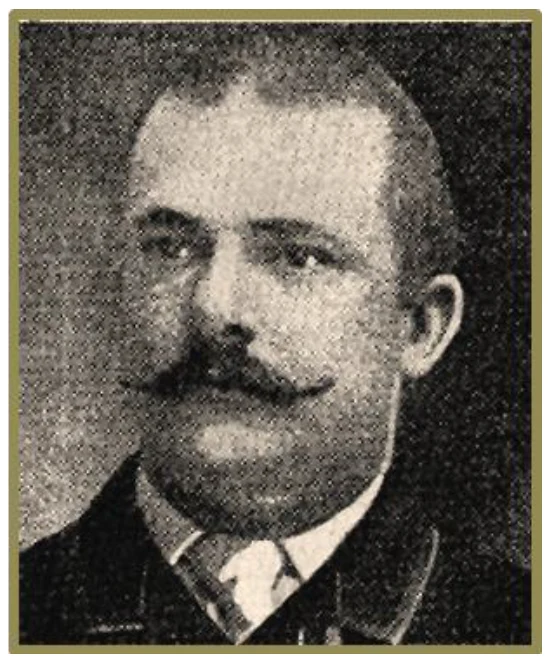
What Albert noticed was a gap in the market. The Swiss watches his brother-in-law imported were beautiful, precise, and expertly made, but they were also expensive. Import taxes drove prices even higher, putting quality Swiss timepieces out of reach for the average American buyer. Albert’s idea was elegantly simple: what if you could offer the reliability and craftsmanship of a Swiss watch at a price that the American middle class could actually afford? The answer was to either assemble domestically using Swiss components or produce through a dedicated Swiss subsidiary, cutting out the middleman markup and the heaviest layers of import taxation.
In 1880, the first watches bearing the Wittnauer name entered the market. By 1885, Albert had formally established the A. Wittnauer Company and taken over Eugène Robert’s business entirely. That same year, the company became the exclusive sales agent for Longines in America, a relationship that would define both brands for the next 114 years.
Albert’s two brothers, Louis and Emile, joined him from Switzerland to help manage the growing operation. The company set up shop on the tenth floor of a fourteen-story skyscraper at 9–13 Maiden Lane in lower Manhattan, the epicenter of New York’s jewelry and watchmaking trade. From that perch above the city, the Wittnauer family built a business that would become one of the most important names in American horology.
The Longines Connection: More Than a Partnership
This is the part of the Wittnauer story that most people get wrong, and it’s worth taking a moment to set the record straight. Wittnauer and Longines were not the same company. They produced distinctly different movements, maintained separate manufacturing operations, and served different market segments. But their relationship was so deep, so long-lasting, and so commercially intertwined that the two names became virtually inseparable in the American market.
Here’s how it worked: the A. Wittnauer Company served as the exclusive American distributor for Longines, handling all sales, marketing, and retail relationships for the Swiss brand in the United States. At the same time, Wittnauer produced its own line of watches, positioned as the “next best thing to Longines”, offering comparable Swiss quality at a more accessible price point. The two brands shared a corporate umbrella but maintained distinct identities: Longines as the premium offering, Wittnauer as the brand that delivered premium-adjacent quality to a broader audience.
In 1936, during the Great Depression, the Wittnauer family sold the company to Hella Deltah, a pearl manufacturer looking to diversify. The new owners leaned into the Longines relationship, renaming the company Longines-Wittnauer Watch Company. This is the name that most collectors and historians recognize, and it’s the name that appeared on casebacks, movement engravings, and retail signage for the next six decades.
Under the Longines-Wittnauer banner, a remarkable thing happened: Wittnauer’s American sales team became so effective that at one point, sales through the Wittnauer distribution network accounted for approximately 80% of Longines’ global revenue. Let that number sink in. The American distributor was selling four out of every five Longines watches produced worldwide. That kind of commercial dominance gave Wittnauer enormous influence over both brands’ product development, and it explains why Wittnauer watches from this era demonstrate such consistently high mechanical quality.
For the vintage watch collector, the practical implication is straightforward: when you buy a mid-century Wittnauer, you’re buying a watch that came out of the same corporate ecosystem, used the same Swiss movement suppliers, and was held to the same quality standards as the Longines watches that sell for two to three times the price. The only real difference is the name on the dial.
Aviation, Exploration, and the Military: Wittnauer’s Tool Watch Heritage
Wittnauer’s reputation wasn’t built on dress watches alone. From its earliest decades, the brand cultivated deep relationships with the American military, the aviation industry, and the scientific community, relationships that produced some of the most historically significant tool watches of the twentieth century.
During World War I, Wittnauer produced instruments and watches for early American aviation units. This was a time when aviation was still measured in years, not decades, and the demands placed on timekeeping instruments were extreme. Wittnauer’s response was the AllProof, introduced in 1918 and widely considered one of the first truly water-resistant and shock-resistant wristwatches available to consumers. The AllProof earned its reputation the hard way: daredevil pilot Jimmie Mattern wore one during his 1933 attempt to circumnavigate the globe in a single-engine Vega 5B.
Then there was Amelia Earhart. On May 20–21, 1932, when Earhart made her historic solo flight across the Atlantic, the first by a woman, her Lockheed Vega-5B was equipped with Wittnauer instruments. The brand’s connection to aviation wasn’t marketing artifice; it was earned through genuine performance under extraordinary conditions.
During World War II, Wittnauer pivoted to full wartime production, manufacturing compasses, laboratory timers, aircraft clocks, and military watches under contract with the U.S. government. The company’s long-standing relationship with the military made it a natural choice for precision instruments, and the Wittnauer name appeared on countless compasses carried by American soldiers and aviators throughout the conflict.
Perhaps most remarkably, Wittnauer was one of three brands, alongside Omega and Rolex, considered by NASA for the wristwatch that would eventually accompany astronauts into space. While the Omega Speedmaster ultimately won that particular competition, the fact that Wittnauer was in the running at all speaks volumes about the brand’s technical reputation in the 1960s.
This tool watch heritage is directly visible in Wittnauer’s chronograph production, which remains the most coveted segment of the brand’s output among today’s collectors. Wittnauer sourced movements from some of the finest chronograph specialists in Switzerland, Venus, Valjoux, and Landeron among them, and housed them in cases that balanced rugged functionality with distinctly American design flair. The result was a range of chronographs that could hold their own mechanically against anything from Omega or Breitling while offering design personality that was uniquely Wittnauer.
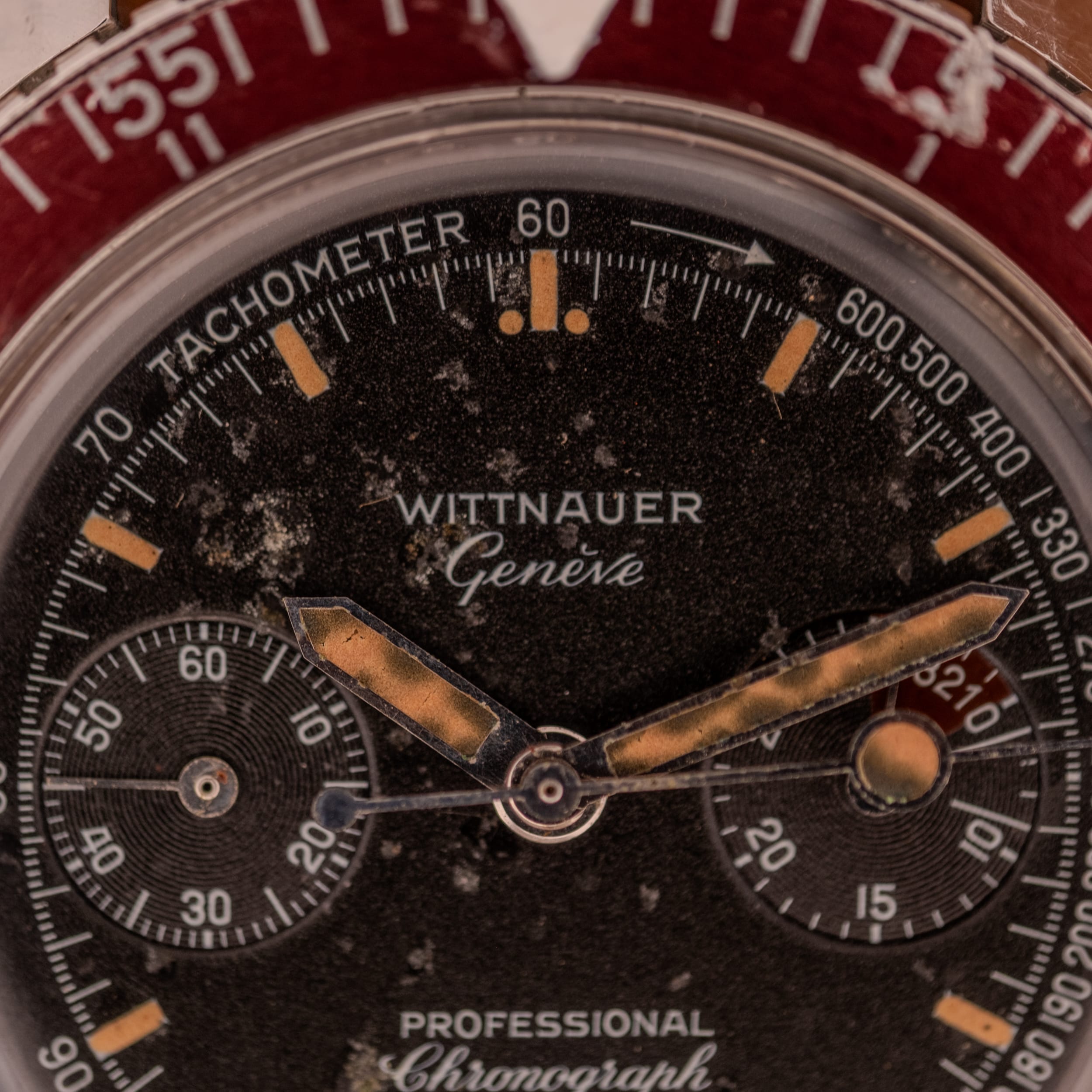
Our Wittnauer Professional Chrono-Date Ref. 8031 with its striking blue reverse panda dial is a perfect embodiment of this heritage, a full-specification chronograph with tachymeter bezel that demonstrates exactly how seriously Wittnauer took its tool watch credentials.
The Golden Age: 1950s–1970s Design Innovation
If the first half of the twentieth century established Wittnauer’s technical credentials, the postwar decades revealed the brand’s design ambition. From the 1950s through the 1970s, Wittnauer produced an extraordinary range of watches that pushed the boundaries of case architecture, dial finishing, and overall aesthetic creativity in ways that its more conservative Swiss contemporaries rarely attempted. This is the era that makes Wittnauer genuinely exciting for today’s collector, because it’s where you find the designs that nobody else was making.
Asymmetric Cases
While most watchmakers were content with round, square, or tonneau case shapes, Wittnauer embraced asymmetry as a deliberate design philosophy. Their asymmetric cases broke from bilateral convention with flowing, sculptural profiles that looked, and still look, like nothing else in the watch world. These weren’t gimmicks or production oddities; they were intentional design statements that reflected the mid-century American appetite for boldness and individuality.
The Wittnauer Automatic Ref. 2598-2 with its asymmetric case is exactly this kind of watch: a case that commits fully to asymmetry as an aesthetic, creating visual tension and dynamism that round watches simply cannot achieve. It’s the kind of design that looks simultaneously of its era and decades ahead of it.
Hooded Lugs
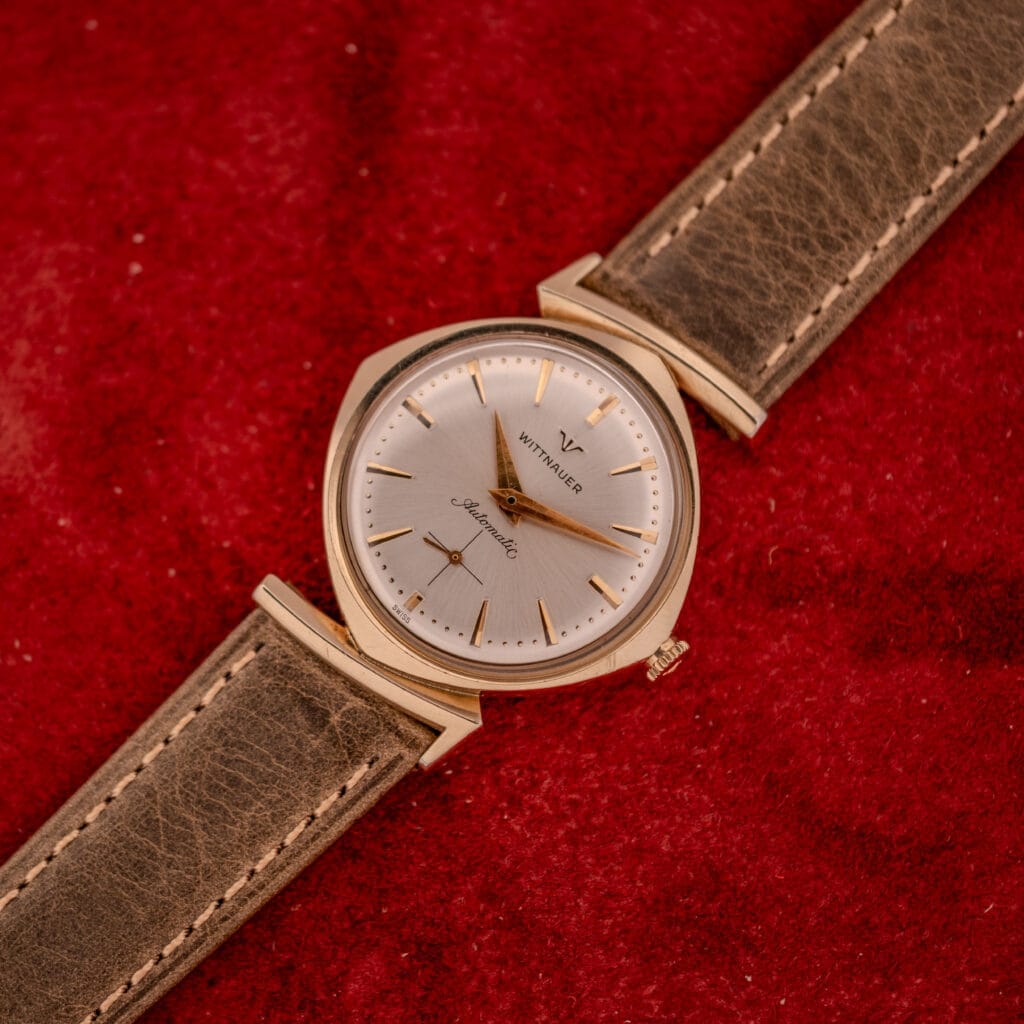
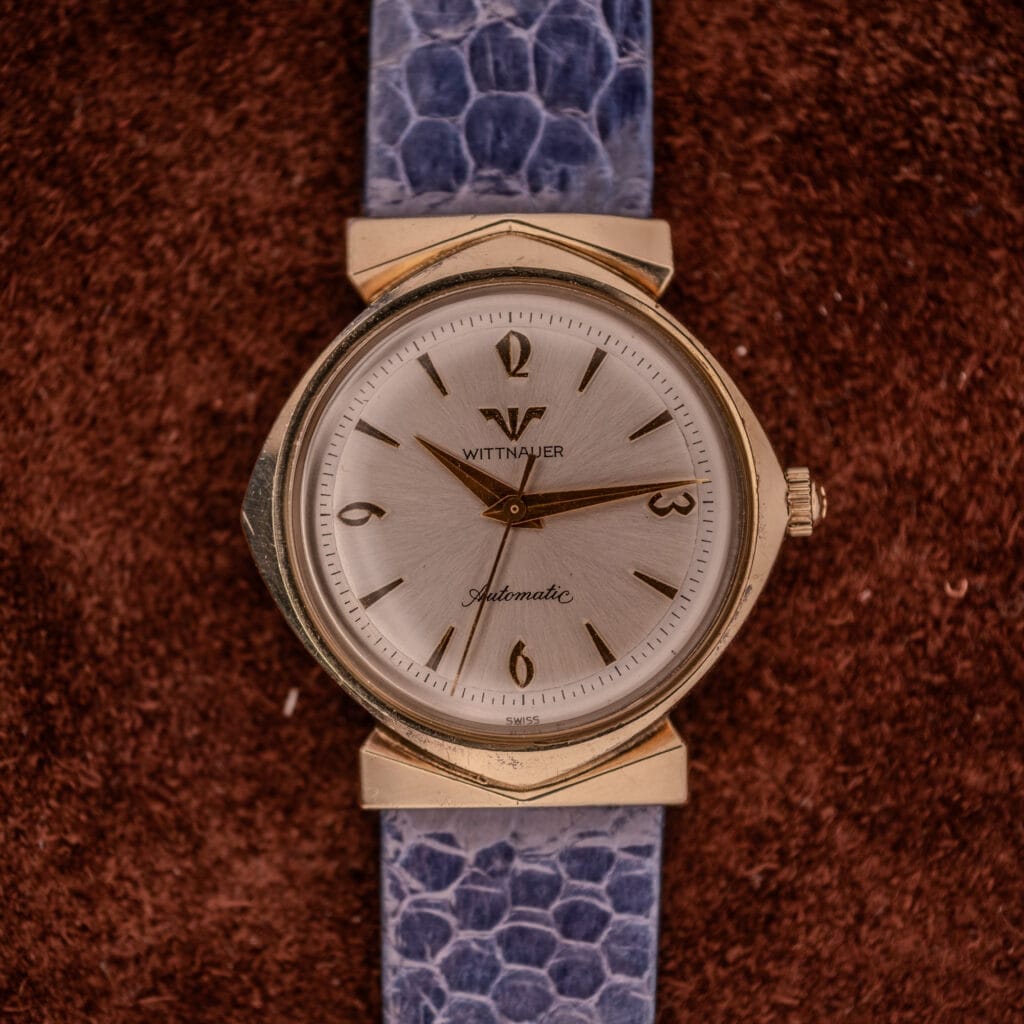
Another Wittnauer signature from this period was the hooded lug, a case design where the lugs curve over and partially enclose the spring bars, creating a seamless visual transition from case to strap. The effect is elegant and slightly futuristic, as though the case is reaching forward to embrace the leather. It gives the watch a sculptural quality that elevates it beyond a simple timekeeping instrument into something closer to wearable architecture.
The Wittnauer Automatic Ref. 2598-1 with hooded lugs showcases this design language beautifully, with a warm 10k gold-filled case that catches light along those distinctive curved lugs in a way that flat-lugged watches simply cannot replicate.
Waffle Dials and Art Deco Influences
Wittnauer also excelled at dial finishing techniques that added depth and visual complexity to their watches. The waffle dial, sometimes called Clous de Paris guilloché, was a mid-century favorite that created a geometric, textured surface catching light from every angle. Combine that texture with Wittnauer’s willingness to incorporate Art Deco-influenced numeral designs, and you get watches that are as much about visual artistry as timekeeping.
The Wittnauer Automatic Waffle Dial Ref. 2023 in a 10k gold-filled case is a textbook example, the interplay between the textured dial surface and the warm gold tones creates a watch that practically glows on the wrist.
Spider Dials
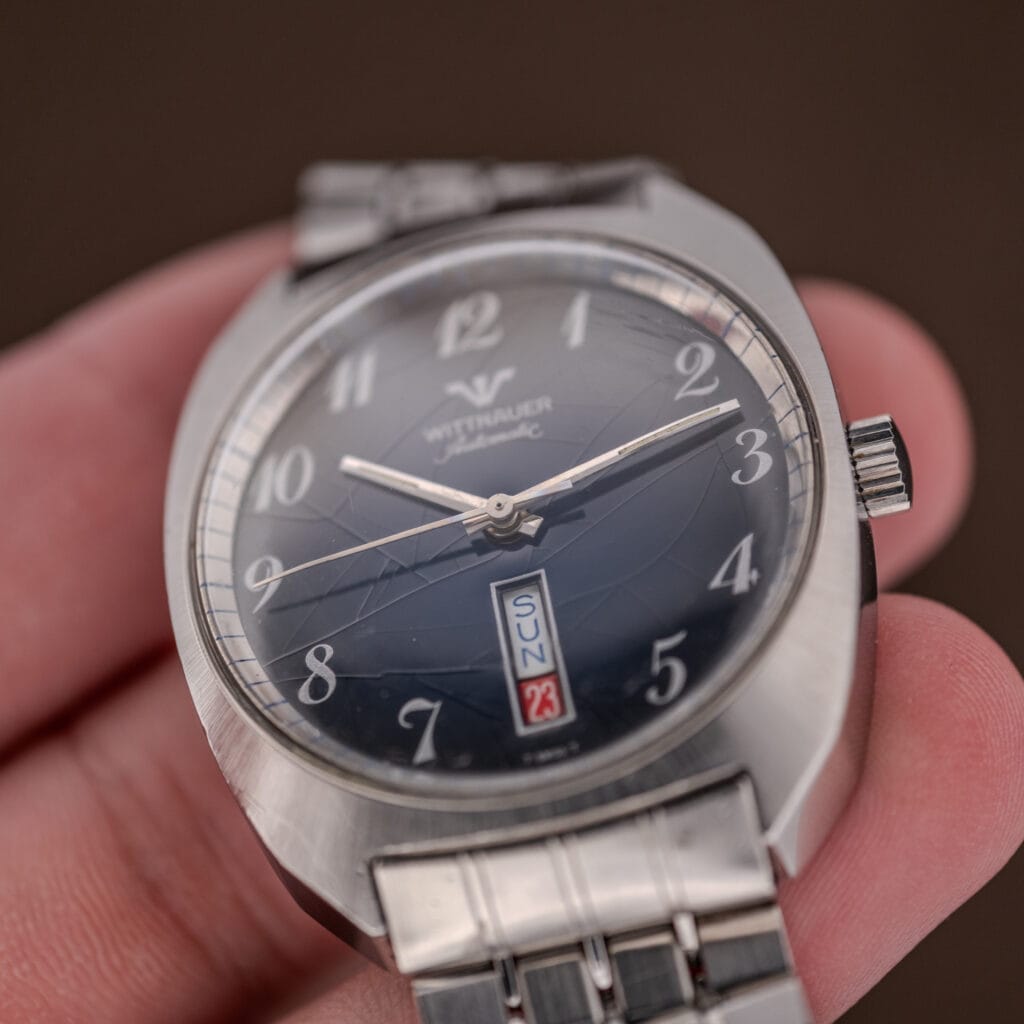
Perhaps the most visually striking dial treatment from Wittnauer’s creative peak is the so-called “spider” dial, named for the fine, web-like pattern of lines that radiate across the surface. This finishing technique was popular in the 1970s, when dial manufacturers were experimenting aggressively with creative surface treatments. The web pattern shifts and changes under different lighting conditions, creating an almost three-dimensional effect that flat-finished dials can’t match.
Spider dials are also notoriously fragile, the web pattern was applied as a very thin surface treatment susceptible to damage from moisture or improper servicing. Finding one in crisp, well-defined condition is increasingly difficult, which is why the Wittnauer Automatic Day/Date Ref. 3503 with its blue spider dial is such a noteworthy find. The blue variant has always been the most desirable color for spider dials, and this example’s pattern remains sharp and clearly defined.
The Movements Inside: Swiss Quality, American Wrapper
One of the most persistent misconceptions about Wittnauer is that their watches were somehow “lesser” than their Swiss-branded counterparts. This misunderstanding usually stems from Wittnauer’s positioning as a more affordable alternative to Longines, if it costs less, the logic goes, it must be worse.
The reality is far more nuanced. Wittnauer watches housed movements from many of the same suppliers that served the most prestigious Swiss brands. Their chronographs featured calibers from Venus (whose Cal. 188 was a masterpiece of robust engineering that directly preceded the legendary Valjoux 7730 family) and Valjoux (whose Cal. 72 powered everything from Wittnauer chronographs to Rolex Daytonas). Their time-only and date watches used movements from established Swiss ebauche manufacturers, finished and regulated to standards that were entirely competitive with mid-range Swiss offerings.
Wittnauer also produced proprietary calibers through their Swiss manufacturing connections, with movement designations like the 11AO, 11SR, and 11ARB that appear across their automatic lineup. These movements, which you’ll find powering watches like the Wittnauer Ref. 2028 Manual Wind Cal. 11BG2, were well-made, reliable, and fully serviceable by any competent watchmaker familiar with Swiss calibers of the period.
The bottom line for collectors: a Wittnauer movement from the brand’s golden age is every bit as good as what you’d find in a comparably priced Omega, Longines, or Tissot from the same era. In many cases, it’s literally the same movement wearing a different name.
The Decline and the Opportunity
The story of Wittnauer’s decline follows a pattern that will be depressingly familiar to anyone who has watched beloved watch brands get absorbed by corporate conglomerates.
In 1969, Longines-Wittnauer was acquired by Westinghouse Electric Corporation, a move that initially brought resources and electronic expertise to the brand but also introduced a corporate parent with no particular feel for the watch industry. Through the 1970s and early 1980s, Wittnauer continued to produce quality timepieces, but the quartz crisis was reshaping the entire industry, and the brand’s identity began to blur.
The critical blow came in 1994, when the Swatch Group, which had absorbed Longines, decided to take over Longines’ American distribution directly, severing the partnership that had defined both brands for 114 years. Overnight, Wittnauer lost the Longines relationship that had been its commercial backbone. Renamed Wittnauer International Inc., the company struggled to find its footing as a standalone brand.
A leveraged buyout in 1996 briefly raised hopes, but the new owners couldn’t make the numbers work. By 2001, Wittnauer was acquired by Bulova for $11.6 million, a fraction of the brand’s historical value. Bulova launched a “Nightlife” range of fashion watches under the Wittnauer name, effectively transforming a brand with genuine horological heritage into a fashion accessory. Bulova itself was later acquired by Citizen Watch Co., and the Wittnauer name has since faded into obscurity.
For collectors, Wittnauer’s decline is the opportunity. The brand’s corporate dissolution means that nobody is actively marketing or promoting vintage Wittnauer watches. There’s no PR machine, no brand ambassador program, no Instagram campaign driving demand. The watches have to sell themselves on their own merits, and for collectors who know what they’re looking at, those merits are substantial.
Compare the current market pricing for vintage Wittnauer chronographs against equivalent-quality pieces from Omega, Longines, or Breitling, and you’ll find Wittnauer typically sells for 40–60% less. The same gap exists for their dress watches, their tool watches, and their design-forward pieces from the 1960s and 1970s. This pricing disparity exists entirely because of brand recognition, not because of any objective difference in quality, condition, or collectibility.
For the informed collector, this gap won’t last forever. As more enthusiasts discover the Wittnauer story and begin to appreciate the quality and design ambition of the brand’s vintage output, prices will inevitably adjust upward. The smart money is moving now.
How to Start Collecting Vintage Wittnauer Watches
If the Wittnauer story has piqued your interest, and it should, here are some practical considerations for beginning or expanding a Wittnauer collection.
Start with what excites you visually. Wittnauer’s range is enormous, spanning dressy manual-wind pieces, sporty automatics, tool-grade chronographs, and design-forward statement watches. There’s no single “right” entry point, but starting with a watch that genuinely thrills you when you look at it ensures you’ll actually wear and enjoy your purchase.
Prioritize original dials. As with any vintage watch brand, the dial is the single most important factor in determining a Wittnauer’s collectibility and long-term value. Original dials, even with patina, aging, or minor imperfections, are always preferable to refinished examples. Wittnauer’s creative dial treatments (waffle textures, spider patterns, gilt finishes) are irreplaceable once damaged, making original examples particularly valuable.
Understand the movement landscape. Wittnauer used a variety of movements across their production, from in-house calibers to sourced ebauches from Venus, Valjoux, AS, and others. None of these are inherently bad, but understanding which caliber powers your watch helps with future servicing and parts availability.
Look for the unusual. Wittnauer’s greatest strength was design creativity, and the watches that best represent this quality, the asymmetric cases, the hooded lugs, the unconventional dial treatments, tend to be both the most interesting and the most collectible pieces in the long run. A standard round Wittnauer dress watch is a fine purchase, but a Wittnauer with genuine design character is the kind of watch that appreciates in both sentimental and monetary value.
Buy from sellers who authenticate and warrant their watches. Vintage watches are only as good as the trust behind them. Every Wittnauer in the OTTUHR collection comes with an authenticity guarantee, a mechanical warranty, and 30-day free returns, because we believe that building a watch collection should be built on confidence, not guesswork.
Wittnauer Watches Currently Available at OTTUHR
We’re proud to carry one of the more diverse selections of vintage Wittnauer watches available from any single dealer. Our current collection includes:
Wittnauer Professional Chrono-Date Ref. 8031, Blue Reverse Panda Dial, $2,000 A full-specification chronograph with tachymeter bezel and one of the most striking dial configurations in the Wittnauer chronograph range.
Wittnauer Automatic Ref. 2598-2, Asymmetric Case, Cal. 11AO, $1,025 Mid-century design audacity in a warm gold-toned asymmetric case that defies convention.
Wittnauer Automatic Ref. 2598-1, Hooded Lugs, Cal. 11SR, $1,000 Sculptural hooded lugs in 10k gold-filled create one of the most architecturally distinctive dress watches of its era.
Wittnauer Automatic Day/Date Ref. 3503, Blue Spider Dial, $940 The elusive blue spider dial in well-preserved condition, a genuine conversation piece on the wrist.
Wittnauer Automatic Waffle Dial Ref. 2023, 10k GF Case, Cal. 11ARB, $680 Classic Clous de Paris guilloché texture meets warm gold, pure mid-century character.
Wittnauer Ref. 2028 Manual Wind, Cal. 11BG2, White Dial & Gold Indexes, $570 A clean, elegant manual-wind dress watch that demonstrates Wittnauer’s more restrained design sensibility.
Each watch has been authenticated, mechanically tested, and is backed by our standard warranty and 30-day return policy.
The Verdict
Wittnauer is not a forgotten brand. It’s an undiscovered one, at least by the broader collecting community that’s still fixated on the same handful of marquee names. For collectors who are willing to look beyond the obvious, who value design creativity and mechanical substance over brand-name cachet, Wittnauer offers something that is genuinely rare in the vintage watch market: extraordinary quality at prices that haven’t yet caught up to reality.
The Longines connection alone should be enough to get any serious collector’s attention. Add in the aviation heritage, the military contracts, the NASA consideration, and the sheer breadth of creative case and dial designs, and you have a brand that, on objective merits, belongs in any comprehensive vintage watch collection.
The only question is whether you discover Wittnauer before the rest of the market does.
Related posts
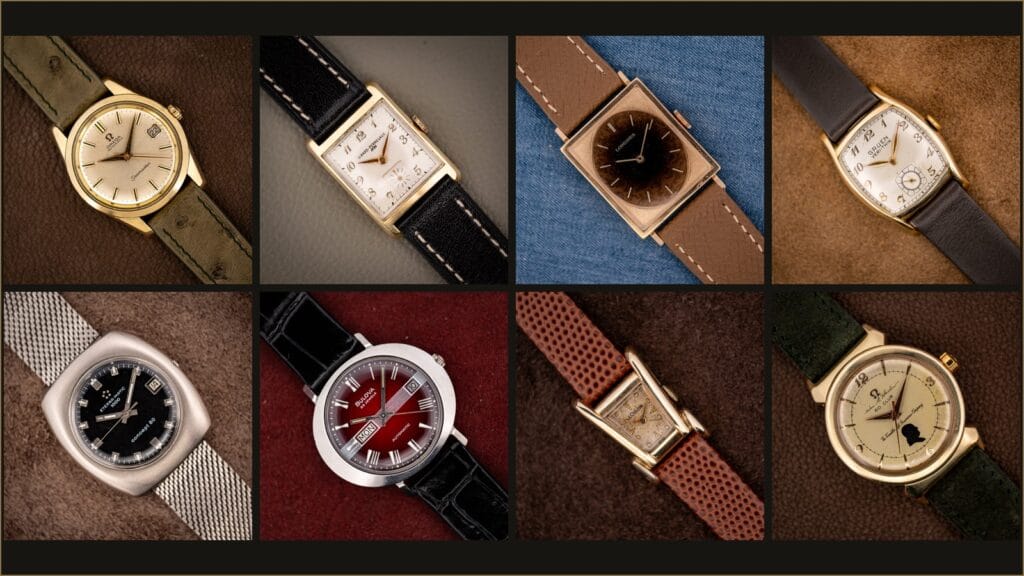
Watch Shapes: Which Vintage Case Shape Fits Your Style?
Case shape changes how a vintage watch wears more than diameter alone. Compare eight silhouettes and learn which one fits your wrist and style.
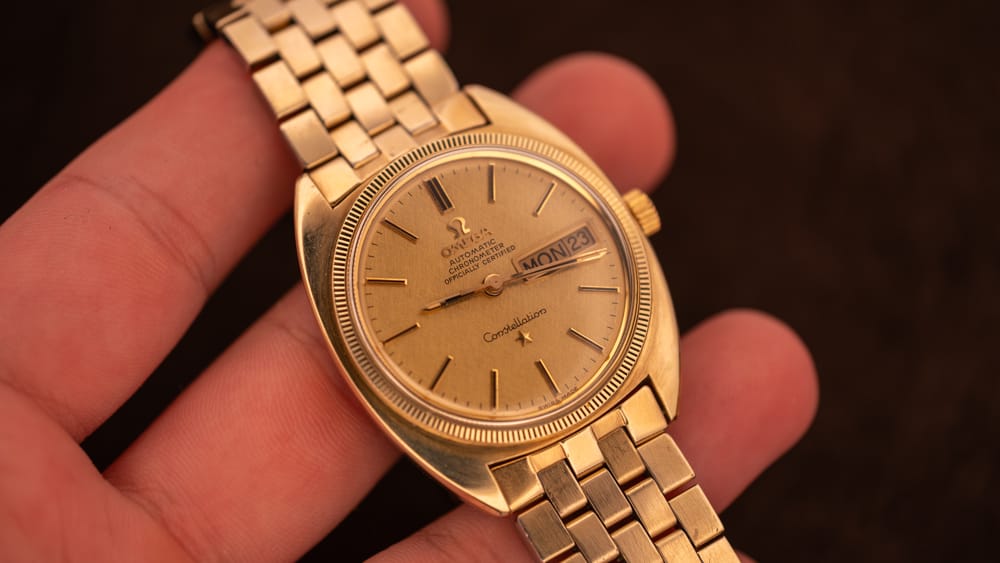
Vintage Dress Watches: How to Choose One You’ll Actually Wear
The best vintage dress watch is the one you will wear beyond weddings. Here is how to choose the right size, metal, dial, shape, and strap.
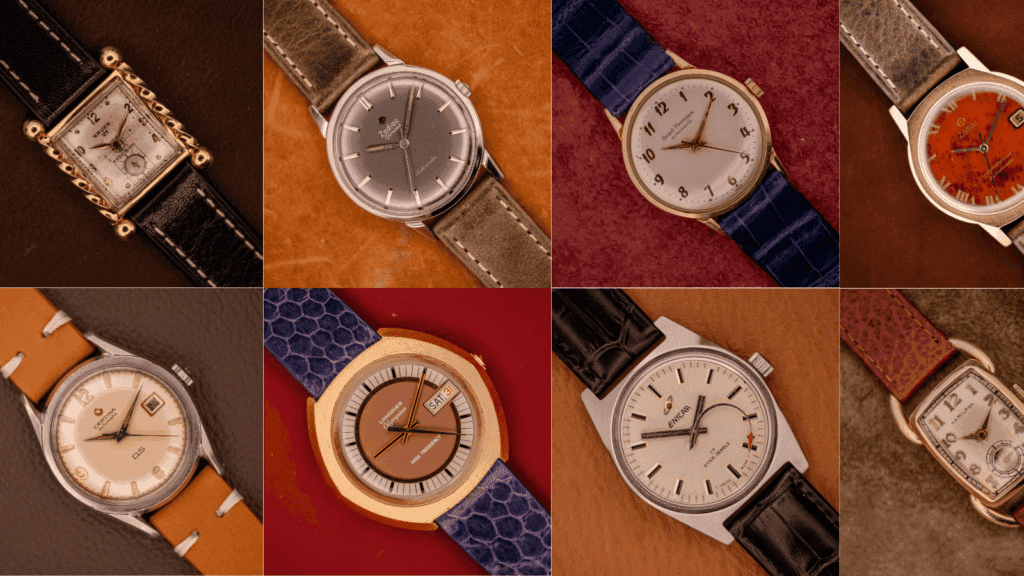
Vintage Watch Styles: A Visual Guide to Finding Yours
Most buyers pick a brand and stall. Here are nine vintage watch styles, shown with real watches from our archive, and the catch that comes with each one.
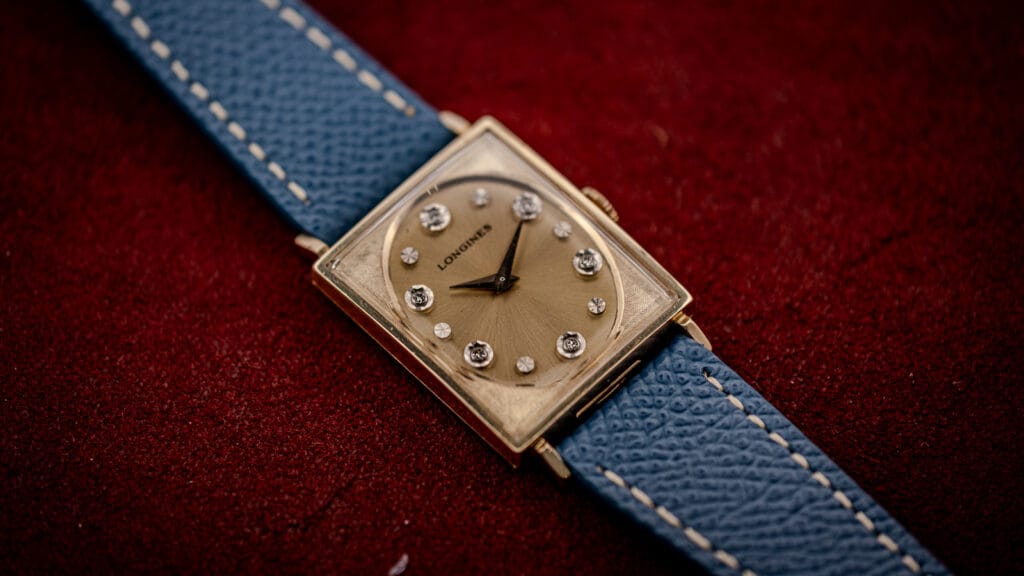
Vintage Tank Watches: A Buyer’s Guide to Rectangular Watches Beyond Cartier
Every Cartier Tank alternatives list is new watches imitating old ones. The originals still exist and cost less. A buyer's guide to vintage tank and rectangular watches: the brands, the prices, and what to check.
Service History Is the Wrong Question. Here’s the Right One.
Everyone says to ask for a vintage watch's service history. Most of it can't be verified, and a receipt proves a transaction, not a result. Here's what actually tells you a watch has been serviced, and the better question to ask.
LeCoultre vs. Jaeger-LeCoultre vs. Jaeger: What the Name on the Dial Means
Three names, one Swiss firm, and one watch that isn't what it looks like. What LeCoultre, Jaeger-LeCoultre, and plain Jaeger on a vintage dial really tell you.
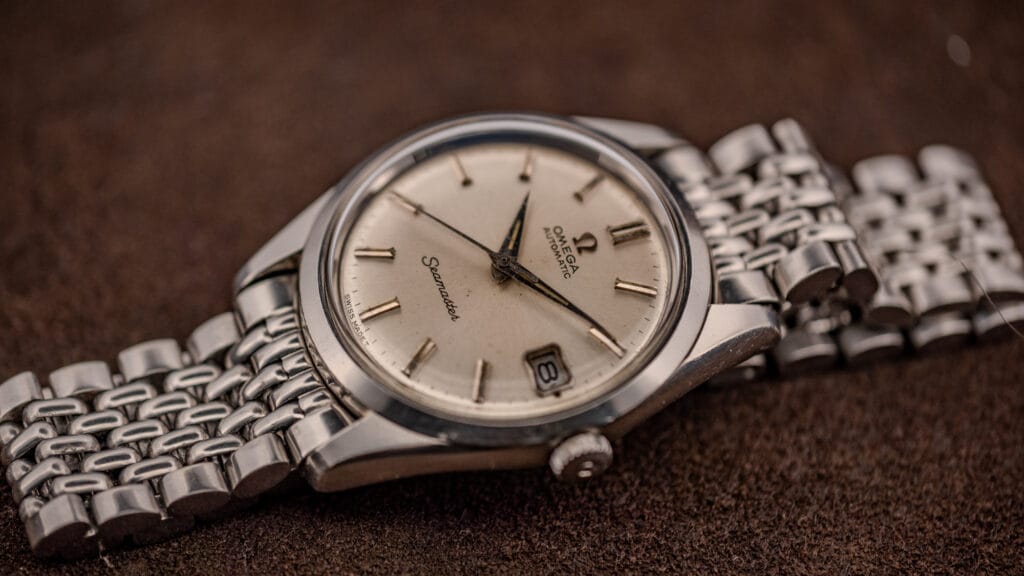
Omega Seamaster 166.010 Buyer’s Guide: Prices, Variants, and What to Look For (2026)
Everything you need to buy an Omega Seamaster 166.010 in 2026: real market prices by condition tier, five dial variants explained, caliber 562 vs 565, original part numbers, and what to inspect before you commit.
Omega vs Rolex: The Vintage Buyer’s Verdict
Vintage Omega vs vintage Rolex: where the Rolex premium is worth paying, where Omega is the smarter buy, and how to dodge redials on both. A collector's verdict.
Movado Kingmatic: A Vintage Buyer’s Guide to References, Calibers, and Value
The Movado Kingmatic is one of the best values in vintage automatics. A buyer's guide to its references, in-house calibers, the Sub-Sea line, what to check, and what they actually sell for.
13 Vintage Watch Collecting Tips for Beginners (From 1,000+ Watches Sold)
Thirteen vintage watch collecting tips drawn from selling over 1,000 watches. What separates a smart first buy from an expensive lesson, with no sugar.
Vintage Wittnauer Chronograph Caliber Identification: Venus 188, Valjoux 7733/7734, Landeron 248
How to identify the movement inside any vintage Wittnauer chronograph: Venus 188, Valjoux 7733 and 7734, Landeron 248, and the house numbering system Wittnauer used to mark them.
How Water-Resistant Is a Vintage Watch, Actually? The Honest Answer.
Every dealer says never get a vintage watch wet. That advice is half-engineering and half-liability theater. Here is what is actually true about vintage water resistance, where water actually gets in, and when a 1965 diver is safer than a 2-year-old modern.