

If you’ve spent any time browsing vintage watches, you’ve seen the terms: gold filled, gold plated, gold capped, rolled gold plate, and half a dozen cryptic abbreviations stamped on casebacks. You may have also noticed that two watches can look nearly identical, both with that warm gold tone that makes a mid-century dress watch so appealing, but one costs $400 and the other costs $1,200. The case material is almost always the reason.
Understanding the difference between these gold treatments isn’t academic trivia. It’s the single most important factor in the longevity, durability, and long-term value of any gold-toned vintage watch that isn’t solid gold. Get it right and you’ll own a watch that looks beautiful for decades. Get it wrong and you’ll watch the gold wear through to dull base metal within a couple of years.
Here’s the practical guide we wish someone had given us when we started handling these watches.
The Short Version
There are really only four categories that matter when you’re looking at vintage watches with a gold exterior that isn’t solid gold. In descending order of gold thickness and durability:
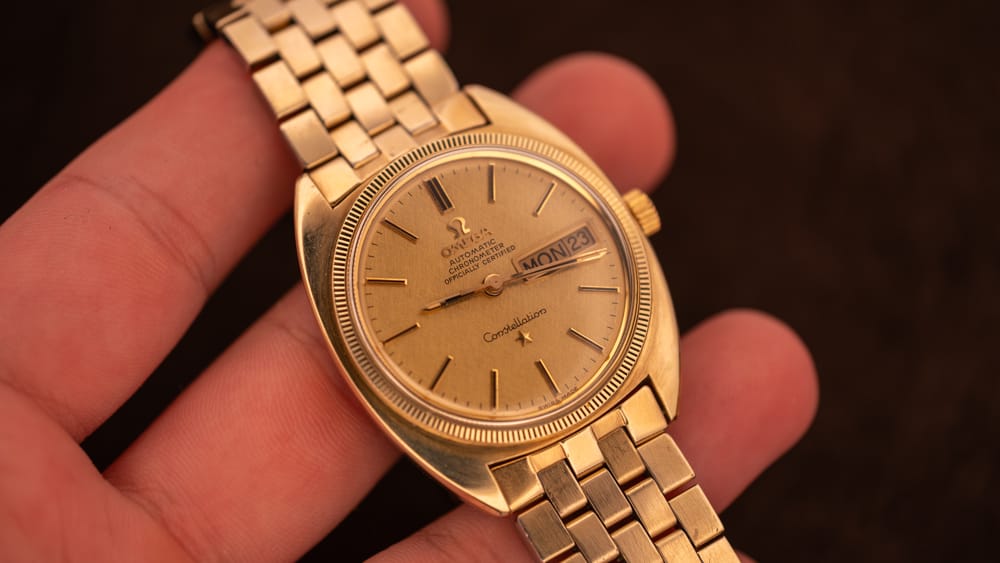
Gold Capped is the thickest application, around 200 microns or 0.2mm, created by bonding a solid sheet of gold alloy to a base metal case under heat and pressure. Think of it as a gold shell over a steel core. This was common in the 1950s and 1960s, particularly on Swiss dress watches from Omega, Longines, and IWC. Gold-capped cases can withstand moderate polishing and decades of daily wear without showing base metal.
Gold Filled is the next step down, with a minimum gold layer of about 75 microns, roughly one-third the thickness of gold capping. The gold is mechanically bonded to the base metal under heat and pressure, similar to gold capping but thinner. Under FTC regulations, the gold content must constitute at least 1/20th of the total weight of the metal in the case. This was the dominant case material for American-market dress watches throughout the mid-twentieth century, used extensively by Hamilton, Longines, Wittnauer, Gruen, and Bulova.
Rolled Gold Plate uses the same bonding process as gold filled, but with less gold. Specifically, the gold content is less than 1/20th of the total weight. You’ll often see it marked with fractions like “1/40 14K RGP” or “1/30 12K RGP.” It’s thinner than gold filled but still mechanically bonded, which gives it meaningfully better durability than electroplated gold.
Gold Plated (also called gold electroplate) is the thinnest application, deposited electrolytically, meaning the gold is applied through a chemical bath using electrical current rather than mechanically bonded. Standard gold plating on vintage watches runs between 5 and 20 microns, though it can be as thin as 0.175 microns and still legally carry the “gold plated” label under FTC guidelines. Gold plating became the dominant affordable gold treatment in the 1970s and 1980s as manufacturing costs pressured brands toward cheaper processes.
To put the thickness difference in perspective: a gold-filled case has roughly 4 to 15 times more gold than a gold-plated case, and a gold-capped case has roughly 10 to 40 times more. That’s the difference between a gold layer you can see with the naked eye and one that’s thinner than a sheet of paper.
Why This Matters More for Watches Than for Jewelry
Most of the articles you’ll find online about gold filled versus gold plated are written for the jewelry market, and they’re not wrong, but they miss the specific ways these materials behave on a watch case. A ring or a necklace encounters friction in predictable, limited areas. A watch case lives a dramatically harder life.
Think about where a watch makes contact with the world: the crown side rubs against your hand when you flex your wrist, the caseback presses against skin and sweat for eight to twelve hours a day, the lugs endure friction from strap changes and buckle hardware, and the bezel and case sides catch doorframes, desktops, and shirt cuffs. Every one of these contact points is a location where thin gold will eventually wear through.
On a gold-filled case, this wear happens slowly, often taking decades to become visible. The gold layer is thick enough to absorb the daily abrasion without ever reaching the base metal underneath. On a gold-plated case, the same wear pattern plays out much faster. The high-contact areas, particularly the edges of the lugs, the crown side of the case, and the caseback perimeter, are where you’ll see brassing first, that tell-tale appearance of the underlying base metal showing through the gold.
The other watch-specific factor is polishing. Vintage watches get polished. Sometimes by a jeweler during a service, sometimes by a previous owner who wanted to clean up some scratches. Every pass of the polishing cloth removes a tiny amount of material from the case surface. On a gold-filled case with 75 microns of gold, a light polishing is essentially imperceptible. On a gold-plated case with 10 microns, even one aggressive polishing can break through the gold layer entirely. This is why you’ll regularly encounter gold-plated vintage watches where the flat surfaces still look gold but the edges, corners, and high points have worn through to silver or brass, a look collectors sometimes call “brassing” and one that dramatically impacts both appearance and value.
Reading the Caseback: What the Markings Mean
One of the most useful skills you can develop as a vintage watch buyer is the ability to read caseback markings. The abbreviations aren’t intuitive, but they follow consistent patterns once you know what to look for.
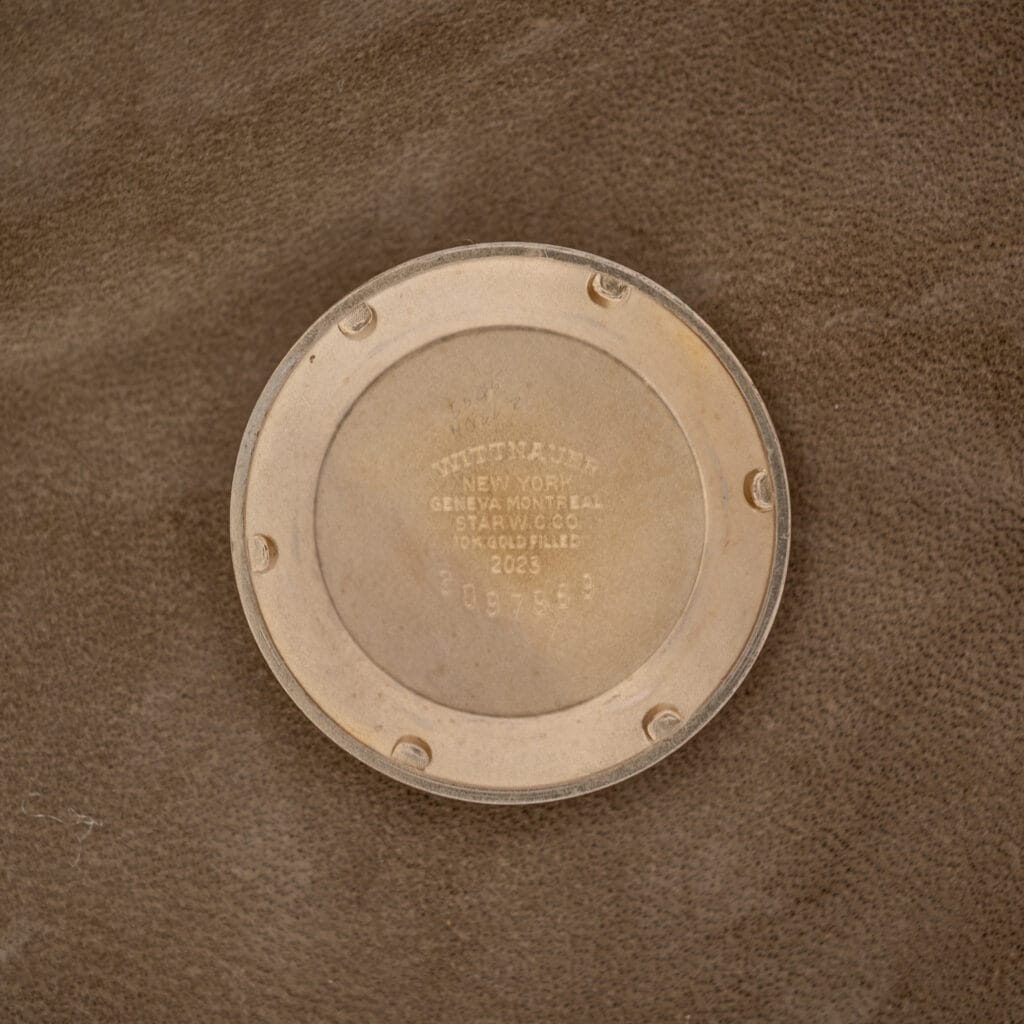
Gold Filled markings almost always include the letters “GF” along with the karat designation and a fraction indicating the gold-to-total-metal weight ratio. Common examples include “1/20 14K GF” (meaning 1/20th of the total metal weight is 14-karat gold), “1/20 10K GF” (same ratio, 10-karat gold), and occasionally just “14K GF” without the fraction, which implies the standard 1/20th ratio. The case manufacturer’s name often appears nearby, names like Wadsworth, Star Watch Case Co., and Illinois Watch Case Co. were the major American gold-filled case producers.
Rolled Gold Plate markings use “RGP” with a fraction that’s less than 1/20th. “1/40 14K RGP” is extremely common on 1960s and 1970s watches. Some cases will spell it out as “Rolled Gold Plate” or use the designation “R.G.P.”
Gold Plated markings vary more widely. You might see “Gold Plated,” “G.P.,” “Gold Electroplate,” “G.E.P.,” “HGE” (Heavy Gold Electroplate), or simply a micron thickness like “20 microns” or “10μ.” Swiss watches often used their own marking conventions, with designations like “plaqué or” (French for gold plated) or simply “plaqué.” Omega, for example, frequently marked their gold-plated cases with a specific micron count.
Gold Capped markings are the least standardized. Swiss manufacturers, particularly Omega and Longines, sometimes used “Gold Cap,” “Gold Shell,” or “GC” on their casebacks. In other cases, especially on earlier pieces from the 1950s, the gold capping was simply described in the original sales materials without a clear caseback marking. If you’re examining a Swiss watch from this era with a two-tone construction (gold front, steel back) and the gold layer appears thick and uniform, there’s a good chance you’re looking at a gold-capped case.
Solid Gold markings are distinct from all of the above. You’ll see “14K,” “18K,” “750” (indicating 18-karat, or 75% pure gold), or hallmarks specific to the country of origin. Solid gold casebacks are noticeably heavier than their plated or filled counterparts, and they won’t have any reference to filling, plating, or overlay in their markings.
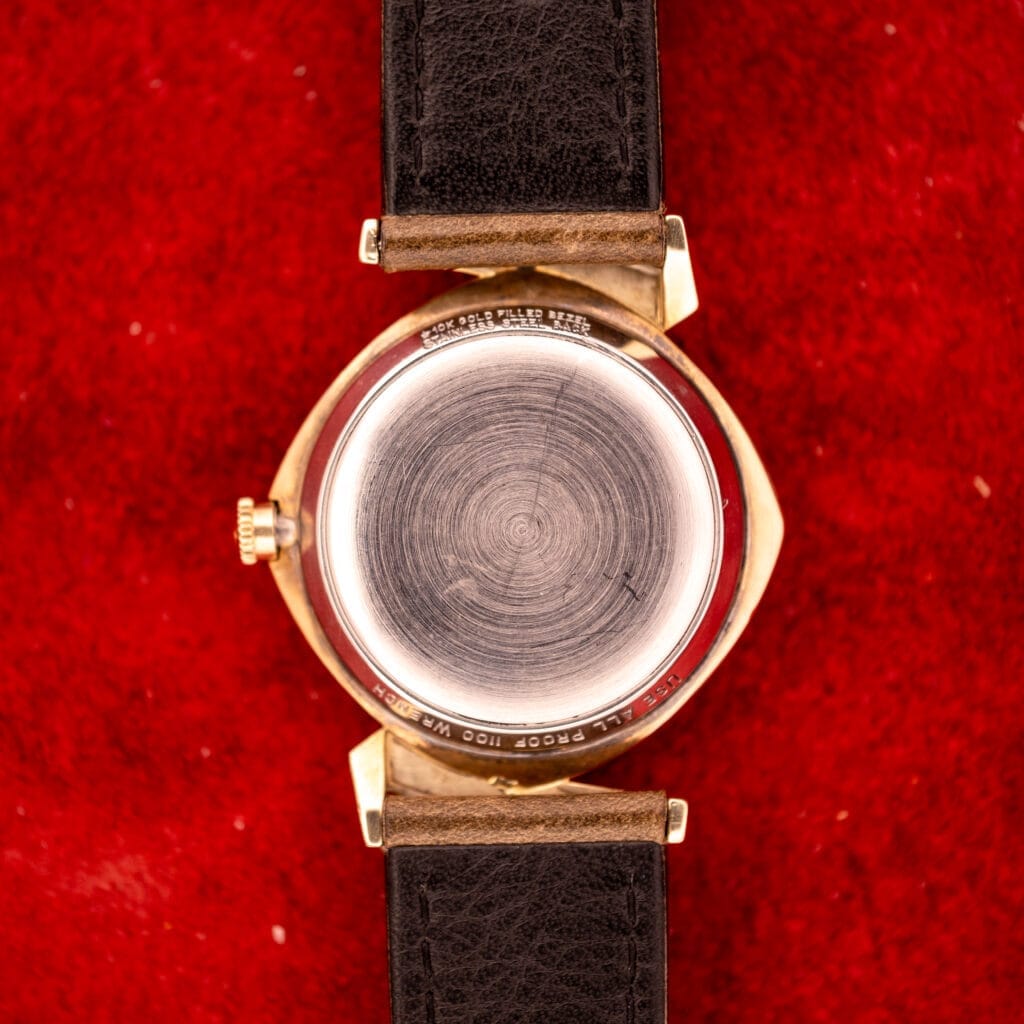
A quick note on one common source of confusion: some watches, particularly those made for the American market in the 1950s and 1960s, have a gold-filled bezel and case front with a stainless steel caseback. This two-piece construction was extremely common and is not deceptive. It was simply the most cost-effective way to deliver a gold appearance on the visible surfaces of the watch while using durable, corrosion-resistant steel where it made practical sense. The caseback will typically say “Stainless Steel Back” alongside the gold-filled marking for the bezel.
What to Look for When Buying
When you’re evaluating a gold-toned vintage watch, whether online or in person, here’s what to check:
Check the edges first. The edges of the lugs, the bevels on the case, and the transition between the bezel and the case are where gold plating wears through first. If these areas show silver or brass-colored metal while the flat surfaces still appear gold, you’re looking at either a thin gold plate that’s wearing through or a gold-filled case that’s been heavily polished. In either scenario, it tells you something important about the case’s remaining life.
Look at the caseback under good light. Many gold-filled and gold-plated watches have stainless steel casebacks, which is normal and expected. But if the caseback is supposed to be gold (matching the rest of the case) and shows significant wear-through, that’s a sign the gold layer was thin to begin with.
Ask about polishing history. A gold-filled case that has never been polished is a wonderful thing. The original finishing, the crisp edges, the sharp transitions between polished and brushed surfaces, these are the details that make a vintage watch special, and they’re the first casualties of heavy polishing. On a gold-plated case, aggressive polishing is potentially catastrophic. A lightly polished gold-filled case is perfectly fine. A heavily polished gold-plated case may be a parts watch.
Consider the era. Generally speaking, pre-1970s gold-toned watches from reputable American and Swiss brands are more likely to be gold filled or gold capped. The shift toward gold plating accelerated through the 1970s and 1980s as quartz movements reduced the overall cost of watches and manufacturers looked for savings on case materials. This isn’t a hard rule, but it’s a useful heuristic.
Factor case material into your price evaluation. Two otherwise identical vintage watches, same brand, same movement, same era, can justifiably differ in price by 30% to 50% or more based solely on whether the case is gold filled or gold plated. The gold-filled example will wear better, age better, and hold its value better over time.
The Case for Gold Filled: Why We Love These Watches
Here’s something that might surprise you: for daily-wear vintage watches, we actually prefer gold-filled cases to solid gold in many situations.
Solid gold is beautiful, valuable, and carries obvious prestige. But it’s also soft. Pure gold is one of the softer metals you’ll encounter in watchmaking, and even when alloyed to 14 or 18 karats, gold cases are significantly more susceptible to dents, dings, and case deformation than their steel or gold-filled counterparts. Vintage solid gold cases, particularly those with thin lugs like certain Omega Seamaster De Ville models, are notorious for bent lugs, damaged caseback threads, and worn crown tubes. Repairing these issues on solid gold is expensive.
Gold-filled cases, by contrast, have a base metal core (usually brass or nickel alloy) that provides structural rigidity, with a thick outer layer of gold that provides the appearance and corrosion resistance of solid gold. The result is a case that resists denting better than solid gold, maintains its shape better over time, and can absorb the minor impacts of daily life without the anxiety that comes with wearing a $3,000 gold case to the office. The gold layer is thick enough to polish lightly if needed and to resist the chemical effects of sweat, humidity, and temperature changes that would corrode a base metal case.
For the vintage watch collector who wants to actually wear their watches, gold filled represents a genuinely practical sweet spot: the warmth and richness of gold, the durability of a reinforced case construction, and pricing that doesn’t require a second mortgage.
The Role of Gold Plating: Not Always a Dealbreaker
We don’t want to give gold plating an entirely bad reputation. There are legitimate reasons to consider a gold-plated vintage watch, as long as you go in with realistic expectations.
A gold-plated watch in excellent, unpolished condition with minimal wear-through can be a gorgeous daily wearer, particularly if the plating is on the heavier end (20 microns, common on better Swiss watches from the 1970s and 1980s). The key is finding examples where the plating is still intact. Once wear-through begins, there’s no reversing it without replating the entire case, which is a specialized process that typically costs $200 to $400 and, while technically possible, changes the character of the watch.
Gold-plated watches also make excellent entry points into specific brands or movements. If you want to own a particular Omega caliber or experience a specific Hamilton movement but the gold-filled or solid gold versions are beyond your budget, a well-preserved gold-plated example lets you enjoy the same horological experience at a significantly lower price point. Just understand that the case won’t age as gracefully over the next twenty years.
The watches to avoid are gold-plated pieces that are already showing significant brassing. Once the gold has worn through on the lugs and high points, the watch will only continue to deteriorate cosmetically. At that point you’re buying the movement, the dial, and the brand name, not the case, and your price should reflect that reality.
A Note on “RGP” and “10K RGP” Watches
Rolled gold plate sits in an interesting middle ground that deserves specific attention because it’s so common on vintage American watches from the 1960s and 1970s.
At 1/40th the weight ratio, an RGP case has roughly half the gold of a standard gold-filled case. That’s still meaningfully more than electroplated gold, and the mechanical bonding process gives it better adhesion and longevity than plating of equivalent thickness. In practical terms, a well-cared-for RGP case from the 1960s can still look excellent today, though it will typically show more edge wear than a comparable gold-filled case from the same period.
RGP watches are worth considering when the watch itself is compelling, whether for its movement, dial design, or historical interest, and the case condition is still strong. They’re not as bulletproof as gold filled, but they’re a meaningful step above standard gold plating, and they’re often priced attractively because the “RGP” designation sounds less premium to buyers who don’t understand the hierarchy.
See the Difference in Our Collection
One of the advantages of buying from a dealer who specializes in vintage watches is that the case material is never a mystery. We identify and disclose the exact case construction on every watch we sell. Here are a few pieces from our current collection that illustrate the range of gold treatments available in vintage watches:
Gruen Curvex Precision Ref. 440-448, 10K Rose Gold Filled, $1,095 A stunning Art Deco curved case in rose gold filled by Wadsworth. The warm copper-salmon tone of the rose gold, combined with the thick mechanically bonded layer, means this watch looks as rich today as it did in the 1940s. The case is in excellent condition with sharp edges, evidence of the durability that gold-filled construction provides over decades.
Longines Waffle Dial Ref. 1064, 10K Gold Filled, Cal. 23Z, $856 A masterclass in mid-century elegance. The gold-filled bezel with stainless steel back is the classic American-market construction, giving you the golden appearance where it matters with corrosion-resistant steel where it’s practical. Powered by the legendary Longines Caliber 23Z, one of the finest manual-wind movements of its generation.
Wittnauer Automatic Ref. 2598-1, Hooded Lugs, 10K Gold Filled, $1,000 The hooded lug design is one of the most architecturally distinctive case shapes of the mid-century period, and the gold-filled construction means those sculptural lines remain crisp and defined after sixty-plus years.
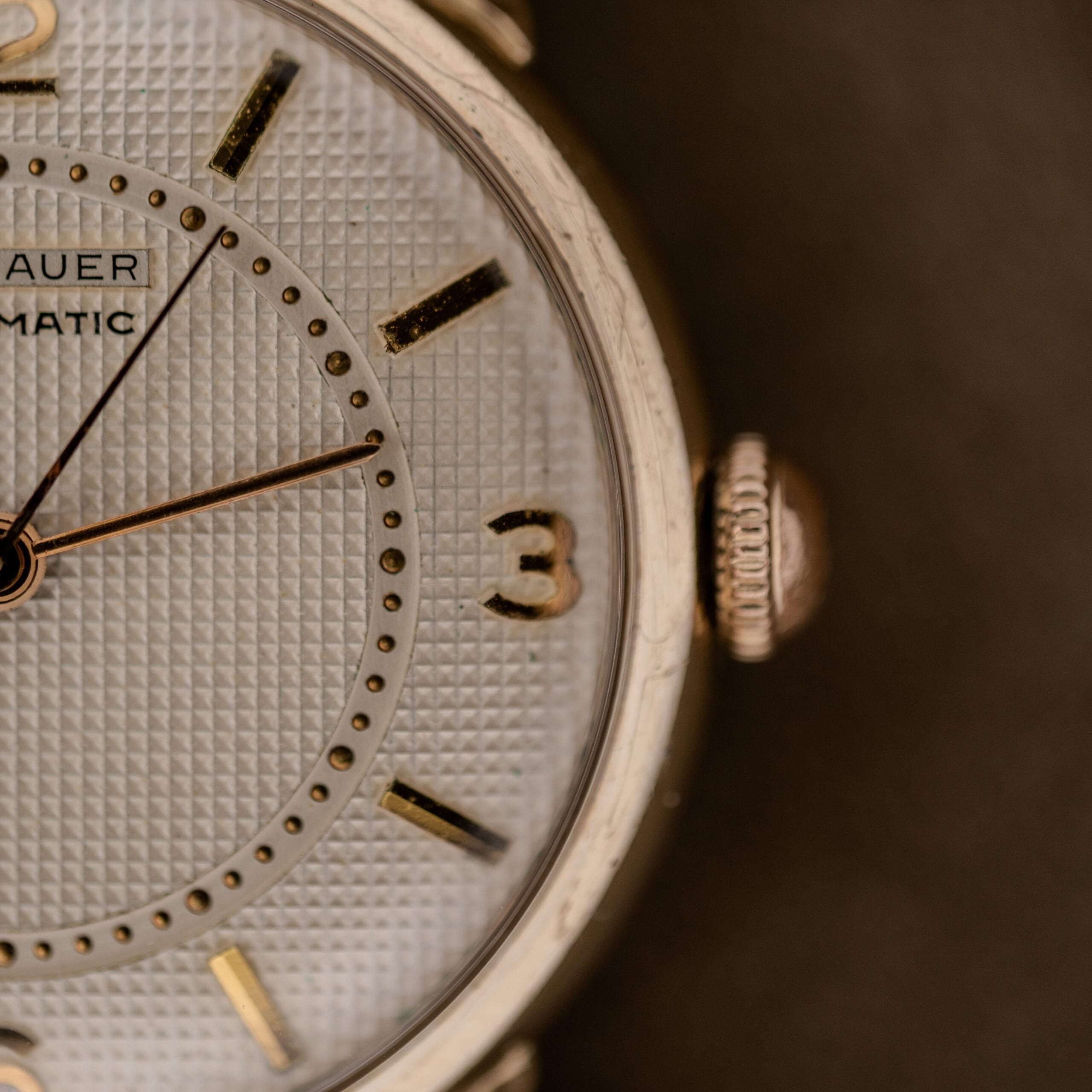
Wittnauer Automatic Waffle Dial Ref. 2023, 10K GF Case, $680 Classic Clous de Paris guilloché dial texture meets a warm gold-filled case. An excellent example of how gold-filled construction preserves fine detail over decades.
Rolex Presentation Watch Ref. 7002, 14K Gold Filled, Cal. 1520, $4,600 Yes, even Rolex used gold filled. This corporate presentation watch features a 14-karat gold-filled case housing the robust automatic Cal. 1520. Co-branded with “Dayton Press Inc.” and engraved to commemorate 20 years of service, it’s a fascinating artifact of the era when companies gave real watches as career milestones.
Hamilton Thin-O-Matic, Gold Filled Hamilton was one of America’s premier watchmakers, and their gold-filled cases, typically manufactured by their own case division or top-tier suppliers, represent some of the best examples of the craft.
Each watch has been authenticated, mechanically tested, and is backed by our standard warranty and 30-day return policy. The case material for every piece is clearly identified in our listings because we believe that’s information you deserve before you spend a dollar.
The Bottom Line
Here’s the hierarchy, stated as plainly as possible:
Solid gold wears beautifully but dents easily and costs the most. Gold capped is the thickest non-solid application and can last generations with minimal care. Gold filled is the most practical choice for a vintage watch you want to wear regularly, offering decades of durability at a fraction of the solid gold price. Rolled gold plate is a step below gold filled but still meaningfully superior to plating. Gold plated is the thinnest and most fragile application, best suited to watches that will see gentle, occasional wear.
None of these is inherently “bad.” What matters is that you know what you’re buying, that the price reflects the case material accurately, and that your expectations for longevity and wear resistance are calibrated to reality. A $500 gold-plated watch in excellent condition can be a wonderful purchase. A $1,500 gold-plated watch that’s already brassing is a terrible one.
When in doubt, check the caseback, read the markings, and buy from someone who will tell you exactly what you’re getting.
Related posts
Watch Shapes: Which Vintage Case Shape Fits Your Style?
Case shape changes how a vintage watch wears more than diameter alone. Compare eight silhouettes and learn which one fits your wrist and style.
Vintage Dress Watches: How to Choose One You’ll Actually Wear
The best vintage dress watch is the one you will wear beyond weddings. Here is how to choose the right size, metal, dial, shape, and strap.
Vintage Watch Styles: A Visual Guide to Finding Yours
Most buyers pick a brand and stall. Here are nine vintage watch styles, shown with real watches from our archive, and the catch that comes with each one.
Vintage Tank Watches: A Buyer’s Guide to Rectangular Watches Beyond Cartier
Every Cartier Tank alternatives list is new watches imitating old ones. The originals still exist and cost less. A buyer's guide to vintage tank and rectangular watches: the brands, the prices, and what to check.
Service History Is the Wrong Question. Here’s the Right One.
Everyone says to ask for a vintage watch's service history. Most of it can't be verified, and a receipt proves a transaction, not a result. Here's what actually tells you a watch has been serviced, and the better question to ask.
LeCoultre vs. Jaeger-LeCoultre vs. Jaeger: What the Name on the Dial Means
Three names, one Swiss firm, and one watch that isn't what it looks like. What LeCoultre, Jaeger-LeCoultre, and plain Jaeger on a vintage dial really tell you.
Omega Seamaster 166.010 Buyer’s Guide: Prices, Variants, and What to Look For (2026)
Everything you need to buy an Omega Seamaster 166.010 in 2026: real market prices by condition tier, five dial variants explained, caliber 562 vs 565, original part numbers, and what to inspect before you commit.
Omega vs Rolex: The Vintage Buyer’s Verdict
Vintage Omega vs vintage Rolex: where the Rolex premium is worth paying, where Omega is the smarter buy, and how to dodge redials on both. A collector's verdict.
Movado Kingmatic: A Vintage Buyer’s Guide to References, Calibers, and Value
The Movado Kingmatic is one of the best values in vintage automatics. A buyer's guide to its references, in-house calibers, the Sub-Sea line, what to check, and what they actually sell for.
13 Vintage Watch Collecting Tips for Beginners (From 1,000+ Watches Sold)
Thirteen vintage watch collecting tips drawn from selling over 1,000 watches. What separates a smart first buy from an expensive lesson, with no sugar.
Vintage Wittnauer Chronograph Caliber Identification: Venus 188, Valjoux 7733/7734, Landeron 248
How to identify the movement inside any vintage Wittnauer chronograph: Venus 188, Valjoux 7733 and 7734, Landeron 248, and the house numbering system Wittnauer used to mark them.
How Water-Resistant Is a Vintage Watch, Actually? The Honest Answer.
Every dealer says never get a vintage watch wet. That advice is half-engineering and half-liability theater. Here is what is actually true about vintage water resistance, where water actually gets in, and when a 1965 diver is safer than a 2-year-old modern.