

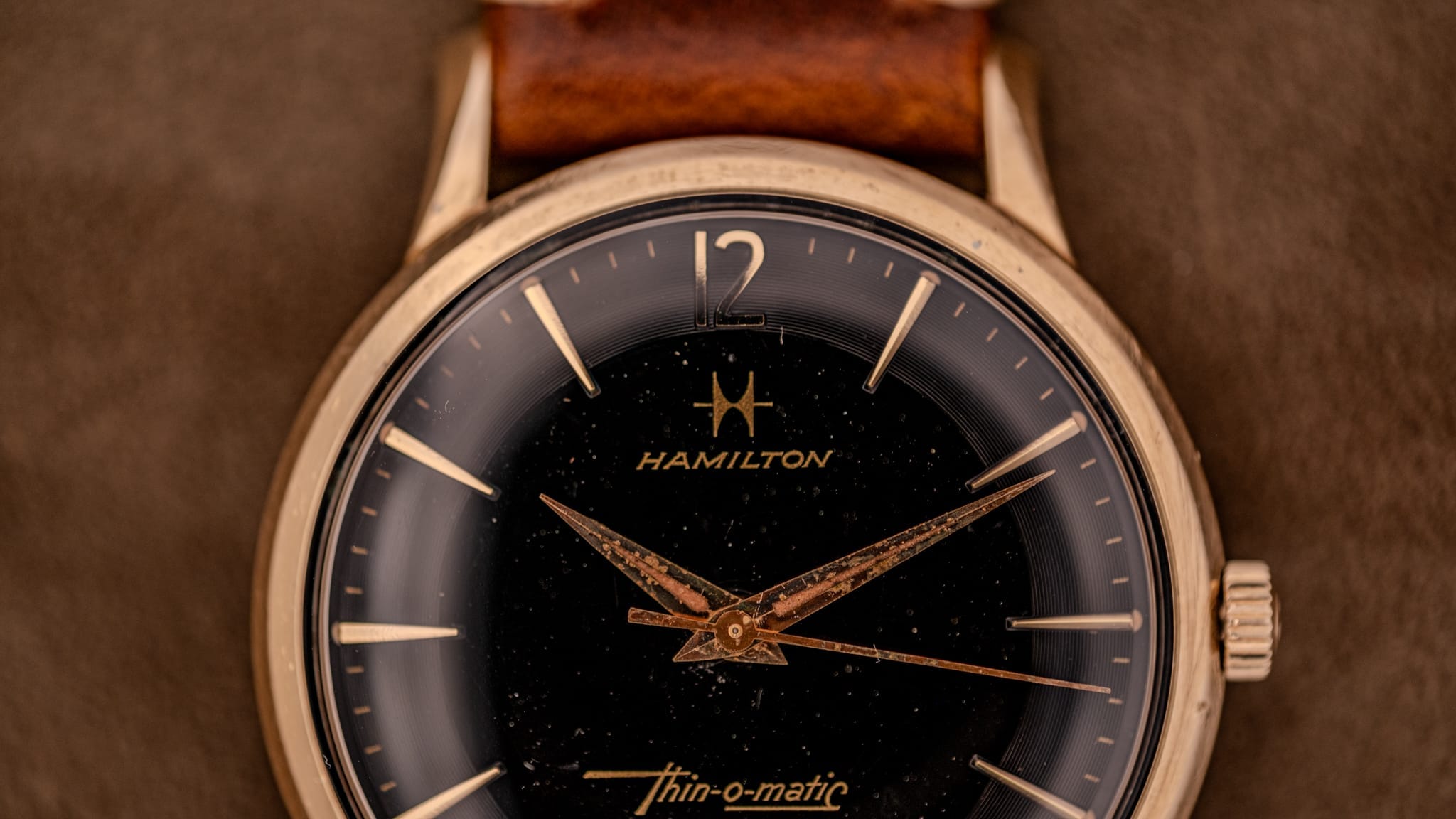
Hamilton produced roughly 4.5 million watches over the course of its American manufacturing life, from the first movements completed in Lancaster, Pennsylvania in 1893 to the factory’s closure in 1969. That’s nearly eight decades of pocket watches, wristwatches, military chronometers, and the world’s first electric wristwatch, and dating any one of them starts with understanding how Hamilton’s serial number system actually works.
The problem is that Hamilton didn’t use one system. They used several, and they changed methods as the decades rolled on. Pocket watches from the 1890s through the early 1940s follow a single sequential numbering system. Wristwatch movements from the late 1920s through the mid-1950s use a completely different letter-prefix system organized by caliber grade. And watches produced after roughly 1955, including the famous Electrics, often carry no movement serial number at all. If you’ve inherited a Hamilton, picked one up at an estate sale, or you’re trying to verify a seller’s claims before buying, this guide covers every era and every method for pinning down a production date.
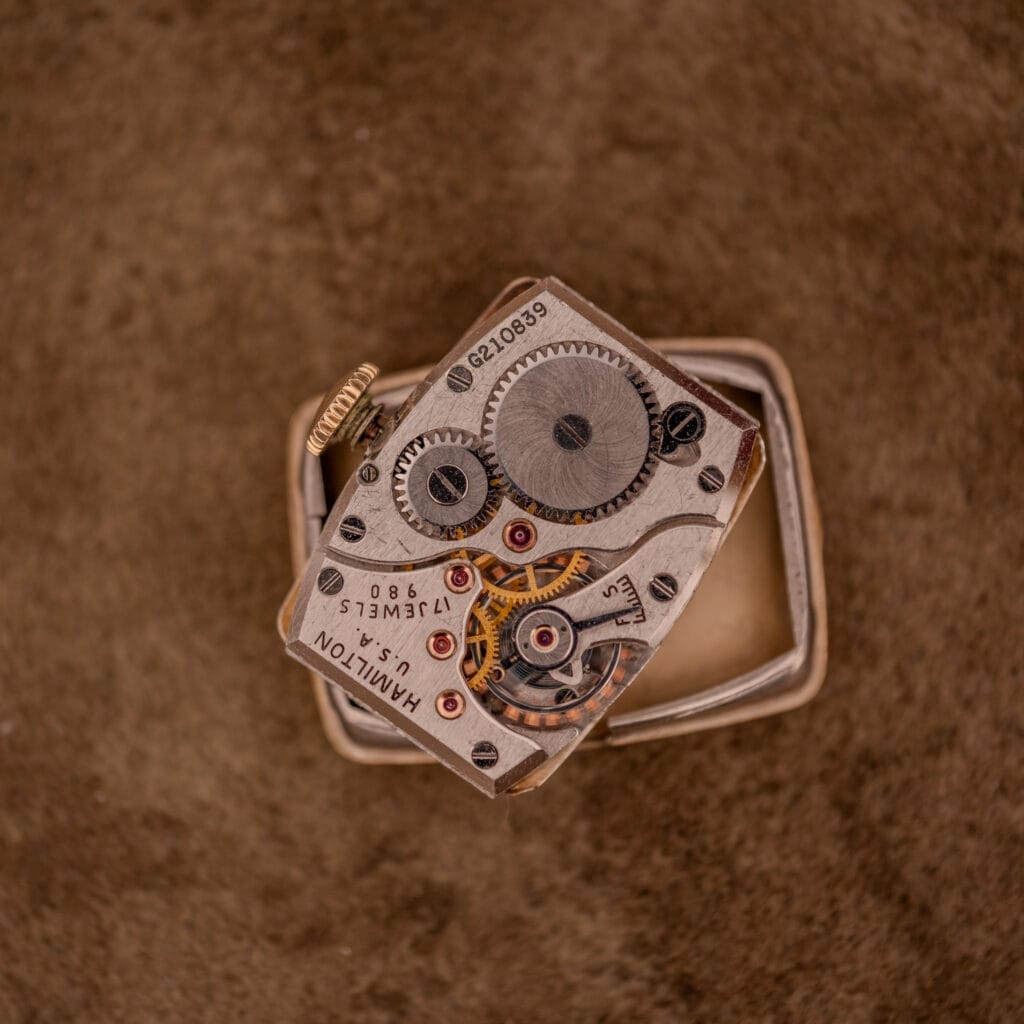
One rule before we start, and it’s non-negotiable: always use the serial number stamped on the movement, never the number on the case. Hamilton didn’t make their own cases. The case serial number belongs to the case manufacturer (Wadsworth, Keystone, Star, or whoever supplied the housing) and has nothing to do with when Hamilton built the movement inside. To date your Hamilton, you need to open the watch and read what’s on the works.
A Brief History of Hamilton’s Production Eras
Understanding when and how Hamilton changed its manufacturing practices makes the serial number system much easier to navigate, so a quick historical framework is worth the space.
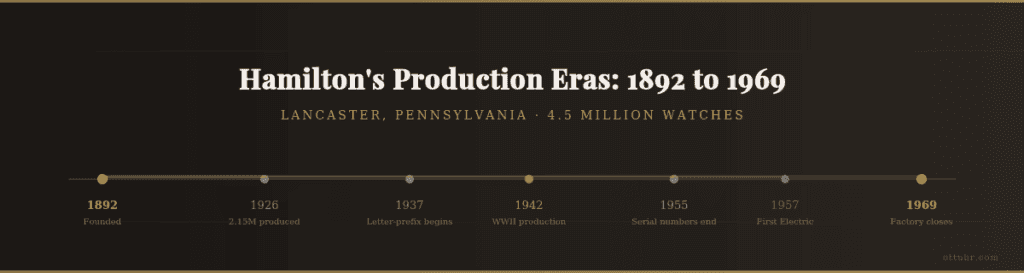
Hamilton was formally incorporated on December 14, 1892, the product of two failed predecessors: the Adams & Perry Watch Manufacturing Company (1874–1876) and the Keystone Standard Watch Company (1886–1890). Their factory and machinery were merged in Lancaster with equipment shipped from the bankrupt Aurora Watch Company of Illinois. The founders originally wanted to name the company “Columbian,” but when they discovered Waterbury had already trademarked that name, they chose Hamilton instead, after Andrew Hamilton, the Scottish attorney who had originally owned the Lancaster land where the factory stood.
The first Hamilton movement, a Grade 936 bearing serial number 15, was sold to a jeweler named W.C. Davis. From there, production scaled rapidly to serve the railroad market. By the turn of the century, Hamilton had earned the tagline that would define the brand for decades: “The Railroad Timekeeper of America.” Hamilton maintained over 56% of the railroad watch market at its peak, and railroad-grade pocket watches remained the company’s bread and butter through the 1940s.
Wristwatch production began in earnest after World War I, when soldiers returning from Europe brought the preference for wrist-worn timepieces back with them. Hamilton’s wristwatch lines grew through the 1920s and hit their stride in the 1930s with the introduction of the 980, 982, and 982M calibers, the movements that would define the Art Deco and mid-century dress watch era.
During World War II, Hamilton halted all consumer production. The company shipped over one million timepieces to the armed forces, including 18,938 pocket watches for the Army, over 110,000 wristwatches for the Army alone, and marine chronometers for the U.S. Navy. Hamilton was producing 500 marine chronometers per month at peak wartime output, a feat that no American manufacturer had accomplished before.
After the war, Hamilton resumed consumer production and continued manufacturing American-made movements in Lancaster through the mid-1950s. In 1957, they introduced the Caliber 500, the world’s first electric wristwatch movement, housed in the now-iconic Ventura case designed by Richard Arbib. In 1966, Hamilton acquired the Buren Watch Company in Switzerland, and by 1969, American manufacturing had ceased entirely. The Lancaster factory closed, and all Hamilton production moved overseas under what would eventually become the Swatch Group.
Each of these eras corresponds to a different approach to serial numbers, and we’ll cover them all.
How to Find the Serial Number on Your Hamilton
For pocket watches, the process is straightforward. Remove the caseback (most Hamilton pocket watch casebacks either unscrew or snap off from the rear) and you’ll see the movement with the serial number engraved prominently on the plate or bridge. It’s usually a five- to seven-digit number, and on railroad-grade movements like the 992 or 950, you’ll also see the grade number, jewel count, and adjustment markings.
For wristwatches, the same principle applies but requires more care. Most vintage Hamilton wristwatches have snap-off casebacks that need a case knife to pry open carefully. Some later models have screw-down backs. Once you’re looking at the movement, the serial number will be engraved on the plate alongside the grade number. If you see a letter preceding or following the serial number (J, G, M, Y, CY, A, E, F, H, SS, HW, or similar), don’t ignore it. That letter is part of the identification system and tells you which specific caliber grade you’re looking at.
If you’re not comfortable opening the caseback yourself, any competent watchmaker can do this in under a minute. It’s a routine request and shouldn’t cost you anything, or very little.
One important note: Hamilton began phasing out serial numbers on wristwatch movements around 1954–1955, starting with their Swiss-made automatic calibers. The Electric movements (Caliber 500, 500A, and 505) produced from 1957 onward generally do not carry serial numbers. If you have a Hamilton from the late 1950s or 1960s with no serial number on the movement, that’s normal, and you’ll need to use other methods to date it, which we’ll cover later in this guide.
Hamilton Pocket Watch Serial Numbers: 1893–1942
Hamilton’s pocket watch serial numbers run in a single, roughly sequential series from the company’s first production in 1893 through the early 1940s. The system is straightforward: find your serial number on the movement, locate where it falls in the production range below, and you’ve got your approximate year of manufacture.
| Year | Serial Number | Year | Serial Number | Year | Serial Number |
|---|---|---|---|---|---|
| 1893 | 1–2,000 | 1910 | 790,000 | 1927 | 2,200,000 |
| 1894 | 5,000 | 1911 | 860,000 | 1928 | 2,250,000 |
| 1895 | 11,500 | 1912 | 940,000 | 1929 | 2,300,000 |
| 1896 | 16,000 | 1913 | 1,000,000 | 1930 | 2,350,000 |
| 1897 | 27,000 | 1914 | 1,100,000 | 1931 | 2,400,000 |
| 1898 | 50,000 | 1915 | 1,200,000 | 1932 | 2,440,000 |
| 1899 | 74,000 | 1916 | 1,300,000 | 1933 | 2,480,000 |
| 1900 | 104,000 | 1917 | 1,400,000 | 1934 | 2,520,000 |
| 1901 | 143,000 | 1918 | 1,500,000 | 1935 | 2,560,000 |
| 1902 | 196,000 | 1919 | 1,600,000 | 1936 | 2,600,000 |
| 1903 | 260,000 | 1920 | 1,700,000 | 1937 | 2,900,000 |
| 1904 | 340,000 | 1921 | 1,800,000 | 1938 | 3,200,000 |
| 1905 | 435,000 | 1922 | 1,900,000 | 1939 | 3,400,000 |
| 1906 | 500,000 | 1923 | 2,000,000 | 1940 | 4,000,000 |
| 1907 | 580,000 | 1924 | 2,050,000 | 1941 | 4,250,000 |
| 1908 | 680,000 | 1925 | 2,100,000 | 1942 | 4,500,000 |
| 1909 | 750,000 | 1926 | 2,150,000 |
If your serial number falls between two listed values, interpolate. A serial number of 1,450,000, for example, lands between the 1917 and 1918 benchmarks, placing your watch in late 1917 or early 1918. Notice the dramatic production surge from 2,600,000 in 1936 to 4,000,000 by 1940. That’s Hamilton ramping up for wartime production, which would eventually see them dedicating the entire factory to military contracts.
Also note the slowdown from the mid-1920s through the mid-1930s. Production increments of only 40,000–50,000 movements per year during the Depression years reflect the economic reality Hamilton was navigating, even as the brand remained the dominant force in railroad-grade watchmaking.
The 992B and Other Letter-Prefix Pocket Watch Grades
Starting in 1940, Hamilton introduced the Grade 992B, a complete redesign of their legendary 992 railroad movement, and assigned it a new serial numbering system with the letter prefix “C.” This is important: if you have a Hamilton pocket watch with a serial number starting with C, it’s a 992B, and you should use the tables below instead of the main pocket watch table above.
Grade 992B (Prefix C)
| Serial Number | Year | Serial Number | Year | Serial Number | Year |
|---|---|---|---|---|---|
| C001 | 1940 | C170,000 | 1946 | C420,000 | 1954 |
| C40,000 | 1941 | C215,000 | 1947 | C455,000 | 1956 |
| C60,000 | 1942 | C255,000 | 1948 | C500,000 | 1959 |
| C90,000 | 1943 | C350,000 | 1950 | C520,000 | 1964 |
| C120,000 | 1944 | C390,000 | 1951 | C529,000 | 1969 |
The 992B was the last American-manufactured railroad pocket watch ever sold, with the final example leaving Hamilton in 1969. Over 525,000 were produced across nearly three decades. It featured the improved “Elinvar Extra” hairspring, a white-colored alloy that was a significant upgrade over the blue-dyed original Elinvar introduced in the 992E from 1931. The 992B was adjusted to temperature and six positions (one more than its predecessor) and was described internally as “completely new from the winding arbor to the balance wheel,” with no parts interchangeable with the earlier 992.
Grade 4992B (Prefix 4C)
| Serial Number | Year | Serial Number | Year | Serial Number | Year |
|---|---|---|---|---|---|
| 4C0001 | 1941 | 4C90,000 | 1944 | 4C135,000 | 1960 |
| 4C40,000 | 1942 | 4C120,000 | 1950 | 4C145,000 | 1968 |
The 4992B was the military navigation version of the 992B, used extensively by the armed forces during and after WWII. The “4C” prefix distinguishes it immediately from the standard 992B.
Grade 950B (Prefix 2B)
| Serial Number | Year |
|---|---|
| 2B001 | 1941 |
| 2B400 | 1942 |
| 2B800 | 1943 |
Grade 950B (Prefix S)
| Serial Number | Year | Serial Number | Year | Serial Number | Year |
|---|---|---|---|---|---|
| S001 | 1941 | S4,500 | 1947 | S25,000 | 1955 |
| S1,500 | 1944 | S6,500 | 1948 | S28,000 | 1962 |
| S2,800 | 1945 | S7,500 | 1949 | S30,000 | 1965 |
| S4,000 | 1946 | S10,000 | 1951 |
The 950B was Hamilton’s 23-jewel premium railroad grade, the finest pocket watch movement they ever produced. It initially used a “2B” serial prefix before switching to “S.” Both designations indicate a 950B.
The Letter-Prefix System: Dating Hamilton Wristwatch Movements (1928–1954)
This is the section that matters most for collectors of vintage Hamilton wristwatches, and it’s where most other guides fall short.
Starting in the late 1920s with the Caliber 987E, Hamilton began using a separate serial number system for wristwatch movements. Instead of continuing the pocket watch’s sequential numbering, each wristwatch caliber grade received its own letter prefix (or in some cases, a letter suffix) and its own independent serial number range. This means you absolutely cannot look up a Hamilton wristwatch serial number in the pocket watch table above and get an accurate date.
If you open a Hamilton wristwatch and see “J-145000” on the movement, that J tells you it’s a Caliber 982 (19 jewels), and the number tells you approximately when it was made within the 982’s production run of 1935–1951.
Here’s a comprehensive list of every documented wristwatch grade, its prefix, and its serial number range:
| Caliber | Prefix/Suffix | Serial Range | Years | Jewels | Notes |
|---|---|---|---|---|---|
| 986 | None | 2,100,001–2,191,300 | 1922–1926 | — | Early 6/0 size wristwatch movement |
| 987E | None | 4,025,301–4,523,000 | 1928–1937 | 17 | Serial numbers overlap with pocket watch range |
| 401 | Prefix H | H50,001–H57,500 | 1930–1933 | — | Scarce early wristwatch grade |
| 979 | None | 2,900,001–2,931,900 | 1934–1951 | — | Overlaps pocket watch range; check grade stamp |
| 980 | Prefix G | G101–G669,400 | 1934–1951 | 17 | Workhorse grade; used in 10k gold-filled cases |
| 980B | Prefix A | A001–A8,900 | 1937–1946 | — | Low-volume variant of the 980 |
| H980 | Prefix HW | HW001–HW1,075 | 1942–1949 | — | Scarce wartime variant |
| 980I | Prefix W | W001–W1,050 | 1942–1948 | — | Rare wartime production variant |
| 982 | Prefix J | J1,001–J670,600 | 1935–1951 | 19 | Added cap jewels; used in 14k gold-filled cases |
| 982M | Prefix M | M001–M201,900 | 1941–1951 | 19 | “Medallion” grade; solid gold/platinum cases only |
| 987 | None | 001–486,300 | 1937–1948 | 17 | Round wristwatch movement |
| 987S | Prefix SS | SS001–SS87,400 | 1940–1948 | — | Sweep-second variant of the 987 |
| 747 | Prefix Y | Y001–Y453,800 | 1947–1954 | 17 | 8/0 size; sub-seconds at 6; no shockproofing |
| 748 | Prefix CY | CY001–CY232,000 | 1948–1954 | 18 | 18-jewel version of the 747 family |
| 750 | Suffix A | 001A–914,000A | 1949–1954 | — | Highest-volume postwar movement; letter after number |
| 752 | Suffix E | 001E–48,000E | 1951–1954 | 17 | 12/0 size; same family as 753, 754, 770 |
| 753 | Suffix F | 001F–103,400F | 1951–1954 | 19 | 12/0 size family |
| 754 | Suffix H | 001H–43,900H | 1952–1954 | 19 | Superior finishing comparable to Medallion series |
| 770 | None (see notes) | No serial numbers | 1955–1969 | 22 | Flagship movement; shockproofed; no S/N on most examples |
A few things to watch for in this table. The Caliber 987E and Caliber 979 serial numbers overlap with the main pocket watch sequential range, which can cause confusion. If your serial number falls in the 2,900,000 or 4,000,000+ range and the movement is clearly a small wristwatch caliber, use the wristwatch table, not the pocket watch table. Always confirm by reading the grade number stamped on the movement itself.
Also note that some grades use a letter prefix (G, J, M, Y, CY, SS, HW, W, H) while others use a letter suffix (A, E, F, H). The 750, 752, 753, and 754 all place the letter after the serial number. This isn’t a mistake on Hamilton’s part; it’s just a different convention they adopted for the later 12/0 and 8/0 size calibers.
Understanding the Movement Grade Hierarchy
Knowing the caliber isn’t just about dating. It tells you what quality tier your watch occupies and is one of the first things any serious authenticator checks to determine if a watch is correct.
Hamilton organized their wristwatch movements into families with shared architecture. The 980/982/982M family (14/0 size) is the most important for collectors. All three share the same plate architecture, and Hamilton was consistent about case allocation: 980 in 10k gold-filled, 982 in 14k gold-filled, 982M in solid gold or platinum. If you find a 980 in a solid gold case or a 982M in a gold-filled case, that mismatch is a red flag. It doesn’t always mean the watch is wrong, but it means you need to figure out why before you trust it.
The 747/748/730/735/736 family (8/0 size) shares many interchangeable parts. The 747 is the basic 17-jewel manual-wind with sub-seconds and no shockproofing. The 748 bumps it to 18 jewels. The 730 adds Incabloc shockproofing to the 747, making it more robust. The 735 is the 18-jewel center-seconds variant, and the 736 remains one of Hamilton’s minor mysteries. It appears functionally identical to the 735 but carries a different grade designation, documented only in internal Hamilton notes from April 1963 that describe it as a 735 with a screwless balance.
The 752/753/754/770 family (12/0 size) represents Hamilton’s final evolution of American-made wristwatch movements. The 770 sits at the apex with 22 jewels and shockproofing. Many collectors and watchmakers consider it, alongside the 982M, the finest wristwatch caliber Hamilton ever produced. It’s a superbly designed movement that was, by all accounts, a pleasure for watchmakers to service, a distinction its earlier siblings in the 986 and 987 lines could not claim.
Dating Hamilton Watches Without Serial Numbers (Post-1955)
Hamilton stopped stamping serial numbers on most wristwatch movements around 1954–1955. This means the entire Electric era (1957–1969), the Thin-o-matic line with its Swiss Buren micro-rotor movements, and many late-production American mechanical wristwatches carry no serial number on the movement at all.
For these watches, you’ll need to rely on other methods.
Catalog matching is the most reliable approach. Hamilton published annual dealer catalogs illustrating every model offered that year, including case style, dial design, and available finishes. Rene Rondeau’s reference book Hamilton Wristwatches: A Collector’s Guide is the essential resource, and many catalog pages have been digitized and shared on collector forums. By matching your watch’s case shape, dial layout, and hand style to catalog illustrations, you can typically narrow production down to a one- or two-year window.
Movement identification helps when catalog matching alone isn’t conclusive. Knowing which calibers were produced in which years limits the possibilities. The 770 was made from 1955 to 1969. The Electric Caliber 500 was used from 1957 to roughly 1961, when the improved 505 replaced it. The 500A was an intermediate revision between the two. If your Electric has a 505 movement, it dates no earlier than 1961. The Buren micro-rotor calibers in the Thin-o-matic line arrived after Hamilton began sourcing Swiss movements in the early-to-mid 1960s.
Caseback markings occasionally provide clues. While case serial numbers don’t directly date the movement, they can reveal the case manufacturer and approximate era. Some late-production Hamilton cases carry inscriptions, presentation engravings, or reference numbers that correspond to known production periods.
Dial details are underappreciated dating tools. Hamilton made subtle changes to their dials over the years: the presence or absence of a gold diamond-shaped marker below the 12 o’clock position, the style of the Hamilton signature, whether the brand name appears in block text or as the stylized H logo. A “Masterpiece” designation on the dial places it in a specific premium line. These small variations can distinguish a 1958 model from a 1962 model when the case and movement appear otherwise identical.
Common Mistakes and Important Caveats
Hamilton serial numbers provide approximate production dates, not exact manufacturing dates. Experienced collectors account for several well-documented quirks in the system.
Hamilton routinely blanked out movement plates and assigned serial number blocks in advance, then stored those plates in the warehouse and finished them as market demand required. A movement with a serial number dating to 1945 could have been assembled and cased several years later. This practice was standard across American watch manufacturers, and it means serial number dates should be treated as “no earlier than” indicators rather than definitive production dates.
Hamilton also reused older movements in newer watches. The most famous example is the WWII-era Cushion, which frequently housed mid-1920s caliber movements in 1940s cases. This wasn’t aftermarket tinkering. These watches left the factory configured that way. Hamilton had warehouses full of earlier movements and used them as needed. Finding a 1920s movement in a 1940s case isn’t necessarily a red flag; it might be exactly how the watch was sold.
Movements get swapped over decades of service. A watchmaker who couldn’t source the correct replacement parts might have installed a different Hamilton caliber from the same movement family. When evaluating any vintage Hamilton, cross-reference the movement serial number against the case style, dial design, and model catalogs. The serial number tells you when that specific movement was manufactured. Only the complete picture tells you whether everything belongs together.
Finally, the transition from American to Swiss production in the 1960s created a gray area that trips up newer collectors. Hamilton was selectively incorporating Swiss-made Buren movements into American-market watches before the 1969 factory closure, meaning a Hamilton with “Hamilton” on the dial and a Swiss movement inside might still be a completely legitimate, factory-original watch from the late 1960s. The key is knowing which models used Swiss calibers and which didn’t, another reason why reference books and catalog records matter so much.
The Bottom Line
Dating a Hamilton watch requires knowing which system applies to your specific piece. Pocket watches from 1893 to 1942 use a single sequential serial number table. Pocket watches and wristwatches from the late 1930s onward may use grade-specific letter-prefix systems. And watches produced after the mid-1950s often carry no serial number at all, requiring catalog matching, movement identification, and close attention to dial and case details.
The serial number won’t tell you the exact day your watch rolled off the line in Lancaster. But combined with model identification, case construction, and dial analysis, it narrows the window to within a year or two, which is usually enough to confirm whether you’re looking at the real thing, or a story that doesn’t quite add up. And if the story doesn’t add up, walk away. There are plenty of correct Hamiltons still out there.
Further reading on OTTUHR:
- The Rise and Fall of American Watchmaking: A Complete History — The full story of the American watch industry, including Hamilton’s central role from railroad dominance through the factory’s 1969 closure
- Gold Filled vs. Gold Plated Watches: What Every Collector Needs to Know — Essential context for understanding Hamilton’s 980/982/982M case material hierarchy
- Your First Vintage Watch: The 2026 Beginner’s Buying Guide — New to vintage watches? Start here before spending money
- Browse Hamilton watches in the OTTUHR shop — Authenticated vintage Hamilton timepieces with full condition reporting and a 2-year mechanical warranty
Sources & further reading:
- NAWCC Hamilton Serial Number Search — The National Association of Watch and Clock Collectors maintains digitized Hamilton production ledgers showing serial number, date finished, date sold, and original distributor
- WatchUSeek Hamilton Forum — Active collector community with extensive discussion of Hamilton references, movements, and model authentication
Related guides
More Hamilton: the Hamilton CLD and Thin-o-matic collector guide.
Related posts
Watch Shapes: Which Vintage Case Shape Fits Your Style?
Case shape changes how a vintage watch wears more than diameter alone. Compare eight silhouettes and learn which one fits your wrist and style.
Vintage Dress Watches: How to Choose One You’ll Actually Wear
The best vintage dress watch is the one you will wear beyond weddings. Here is how to choose the right size, metal, dial, shape, and strap.
Vintage Watch Styles: A Visual Guide to Finding Yours
Most buyers pick a brand and stall. Here are nine vintage watch styles, shown with real watches from our archive, and the catch that comes with each one.
Vintage Tank Watches: A Buyer’s Guide to Rectangular Watches Beyond Cartier
Every Cartier Tank alternatives list is new watches imitating old ones. The originals still exist and cost less. A buyer's guide to vintage tank and rectangular watches: the brands, the prices, and what to check.
Service History Is the Wrong Question. Here’s the Right One.
Everyone says to ask for a vintage watch's service history. Most of it can't be verified, and a receipt proves a transaction, not a result. Here's what actually tells you a watch has been serviced, and the better question to ask.
LeCoultre vs. Jaeger-LeCoultre vs. Jaeger: What the Name on the Dial Means
Three names, one Swiss firm, and one watch that isn't what it looks like. What LeCoultre, Jaeger-LeCoultre, and plain Jaeger on a vintage dial really tell you.
Omega Seamaster 166.010 Buyer’s Guide: Prices, Variants, and What to Look For (2026)
Everything you need to buy an Omega Seamaster 166.010 in 2026: real market prices by condition tier, five dial variants explained, caliber 562 vs 565, original part numbers, and what to inspect before you commit.
Omega vs Rolex: The Vintage Buyer’s Verdict
Vintage Omega vs vintage Rolex: where the Rolex premium is worth paying, where Omega is the smarter buy, and how to dodge redials on both. A collector's verdict.
Movado Kingmatic: A Vintage Buyer’s Guide to References, Calibers, and Value
The Movado Kingmatic is one of the best values in vintage automatics. A buyer's guide to its references, in-house calibers, the Sub-Sea line, what to check, and what they actually sell for.
13 Vintage Watch Collecting Tips for Beginners (From 1,000+ Watches Sold)
Thirteen vintage watch collecting tips drawn from selling over 1,000 watches. What separates a smart first buy from an expensive lesson, with no sugar.
Vintage Wittnauer Chronograph Caliber Identification: Venus 188, Valjoux 7733/7734, Landeron 248
How to identify the movement inside any vintage Wittnauer chronograph: Venus 188, Valjoux 7733 and 7734, Landeron 248, and the house numbering system Wittnauer used to mark them.
How Water-Resistant Is a Vintage Watch, Actually? The Honest Answer.
Every dealer says never get a vintage watch wet. That advice is half-engineering and half-liability theater. Here is what is actually true about vintage water resistance, where water actually gets in, and when a 1965 diver is safer than a 2-year-old modern.