

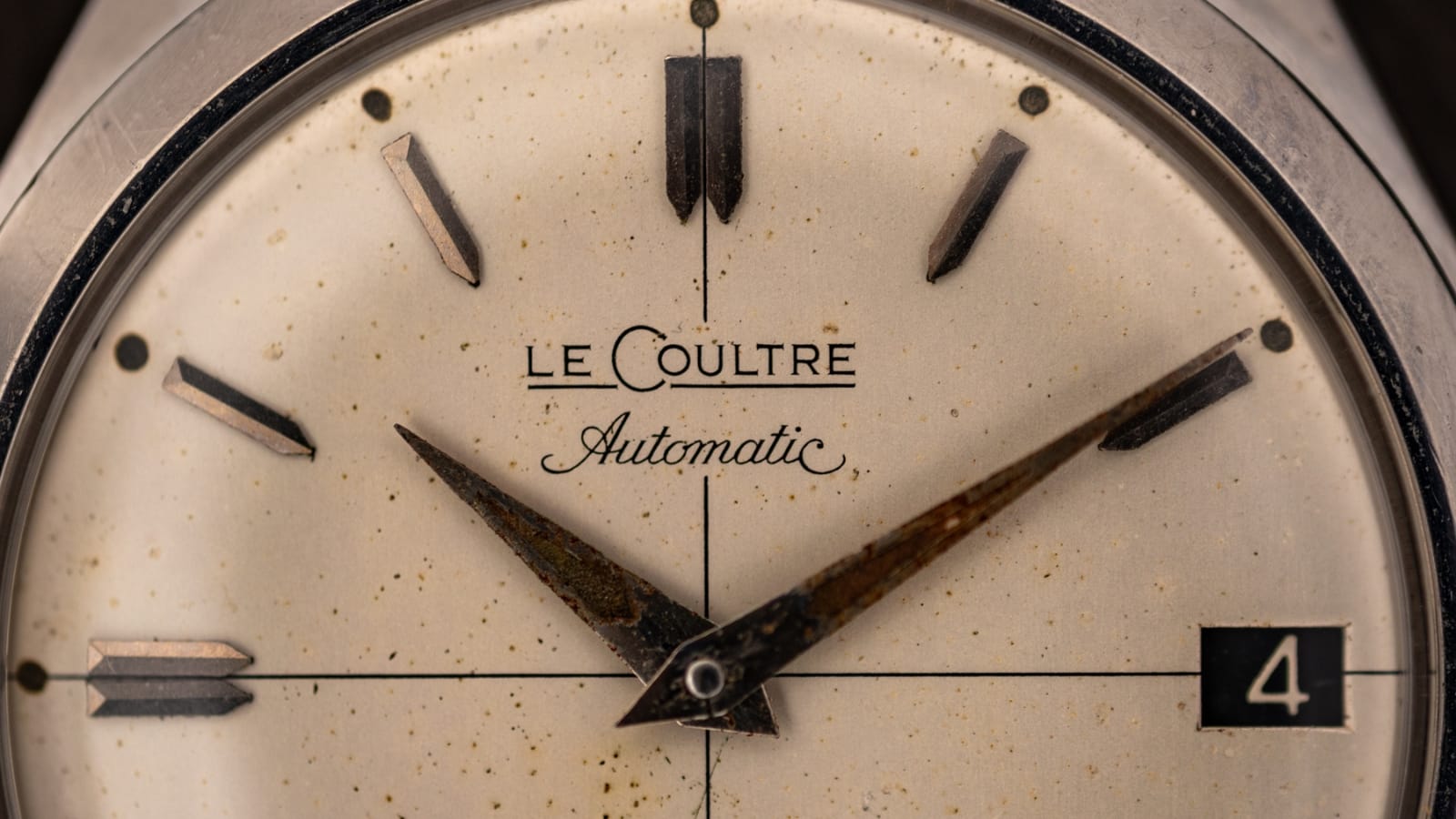
We’ve had all three across the bench: a dial that says “LeCoultre,” a dial that says “Jaeger-LeCoultre,” and a dial that says nothing but “Jaeger.” Same era, similar quality, three different names. Buyers see that and assume they’re looking at three different makers, or worse, that two of the three are fakes.
They’re not. For most of the 20th century these were one company selling into different countries under different names. The signature on the dial is closer to a shipping label than a brand. Once you know how to read it, you stop overpaying for one name and walking past a better deal under another.
There’s also a catch, and we’ll get to it, because one of those three watches isn’t really the company you think it is at all.
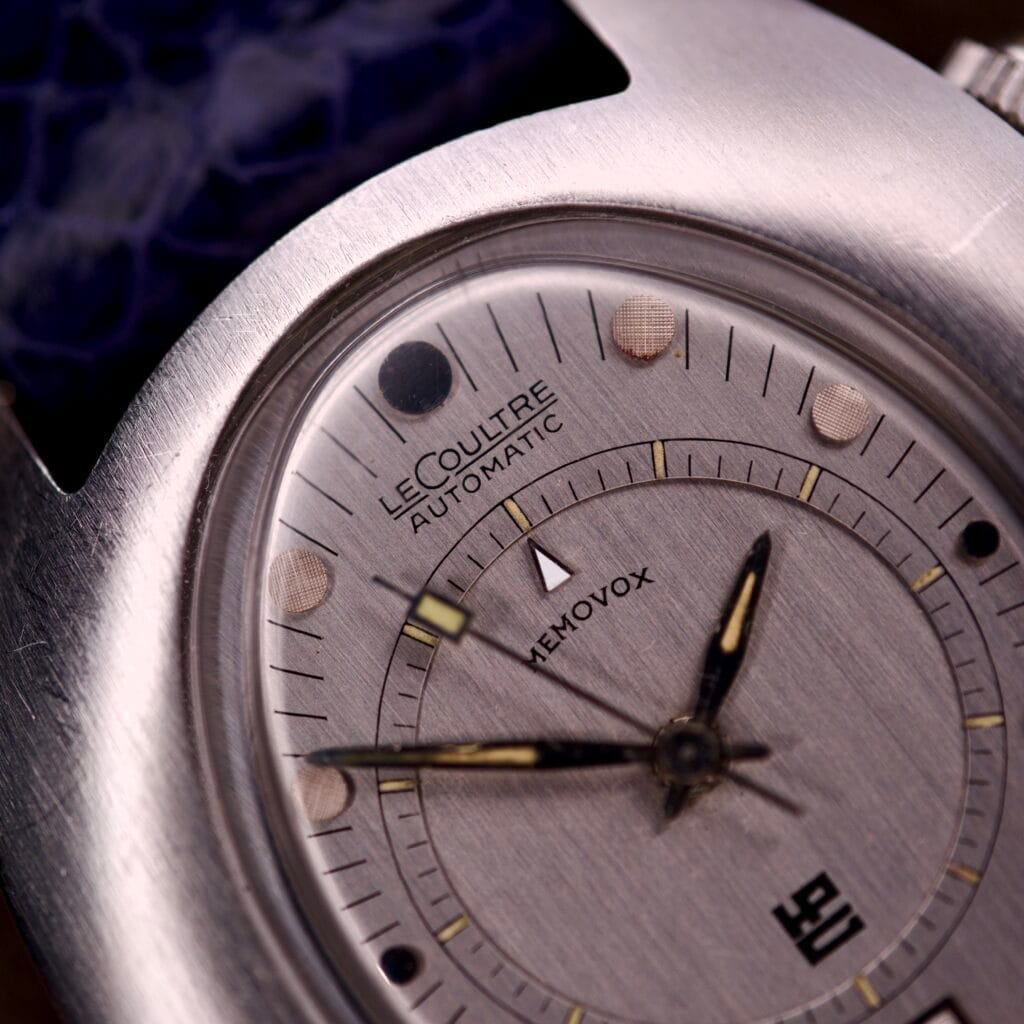
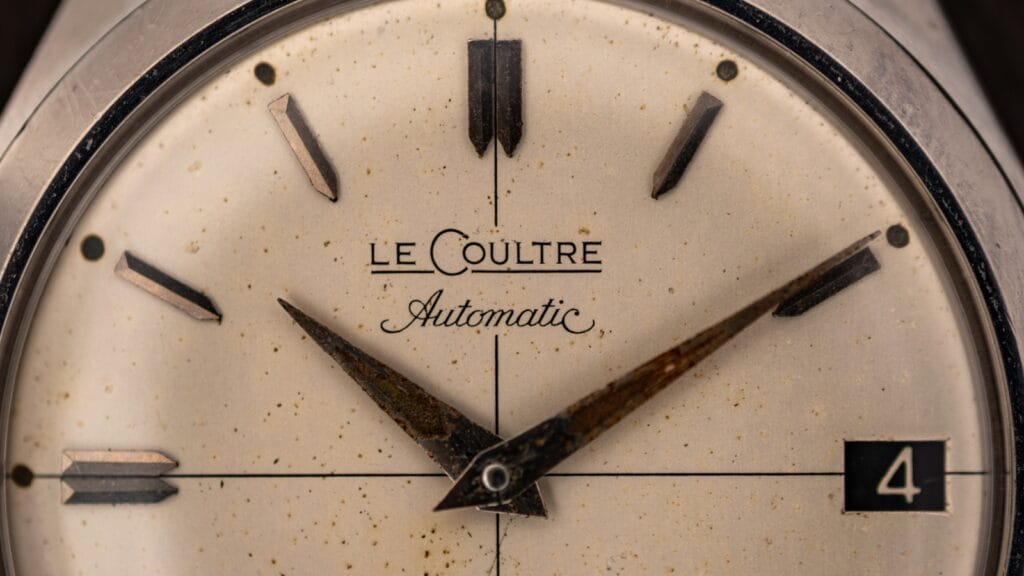
A dial signed “LeCoultre,” the name Jaeger-LeCoultre used in the United States. LeCoultre Memovox in our inventory.
the short version
If you only remember one thing, remember this. The name on a vintage dial usually tells you which market the watch was built for:
- Jaeger was the French and European name.
- LeCoultre was the American name.
- Jaeger-LeCoultre was the name for everywhere else.
Behind all three is the same Swiss manufacture in the Vallée de Joux. So a “LeCoultre” and a “Jaeger-LeCoultre” of the same model from the same decade are, mechanically, the same watch. The price often isn’t. That gap is the whole reason this post is worth your time.
one firm, three names: how we got here
The company starts in 1833, when Antoine LeCoultre opens a workshop in Le Sentier, in the Vallée de Joux. For most of the 1800s it’s just LeCoultre, and it builds a reputation as a maker other brands quietly relied on for movements.
The “Jaeger” half arrives in 1903. Jacques-David LeCoultre, Antoine’s grandson, partners with Edmond Jaeger, a Paris watchmaker who made instruments and supplied the French navy. Jaeger pushed LeCoultre to produce ultra-thin movements he’d designed, and the working relationship stuck. For three decades the two sold closely related watches under their own names on their own sides of the border.
In 1937 they formally merge, and the combined name Jaeger-LeCoultre is born. That’s the name the brand still trades under today. The interesting part is what happened to the two older names after the merger. They didn’t disappear. The company kept using them, on purpose, in the two markets where each name sold better than the combined one.
“Jaeger”: the French market (and the watch that fools people)
In France, the Jaeger name carried weight on its own. Edmond Jaeger had supplied the French navy and worked alongside houses like Cartier, so his name meant something to French buyers that a Swiss-sounding compound didn’t. France also taxed imported finished watches heavily, which gave the company a reason to keep a French commercial identity rather than ship everything in as “Jaeger-LeCoultre.” So French-market pieces kept wearing the “Jaeger” signature alone, in some cases right into the 1980s.
Early on, “Jaeger” showed up on the Paris side’s instruments and clocks. In the 1920s and 30s Jaeger built 4-day and 8-day dashboard clocks for cars from Bugatti, Bentley, and the firm that became Aston Martin, running movements made by LeCoultre in Switzerland. If you find a vintage “Jaeger Paris” car clock, that’s the lineage.
Now the catch. Here’s a watch we’ve handled: a Jaeger Tri-Compax chronograph, reference 22522, 1940s, signed only “Jaeger” on the dial.
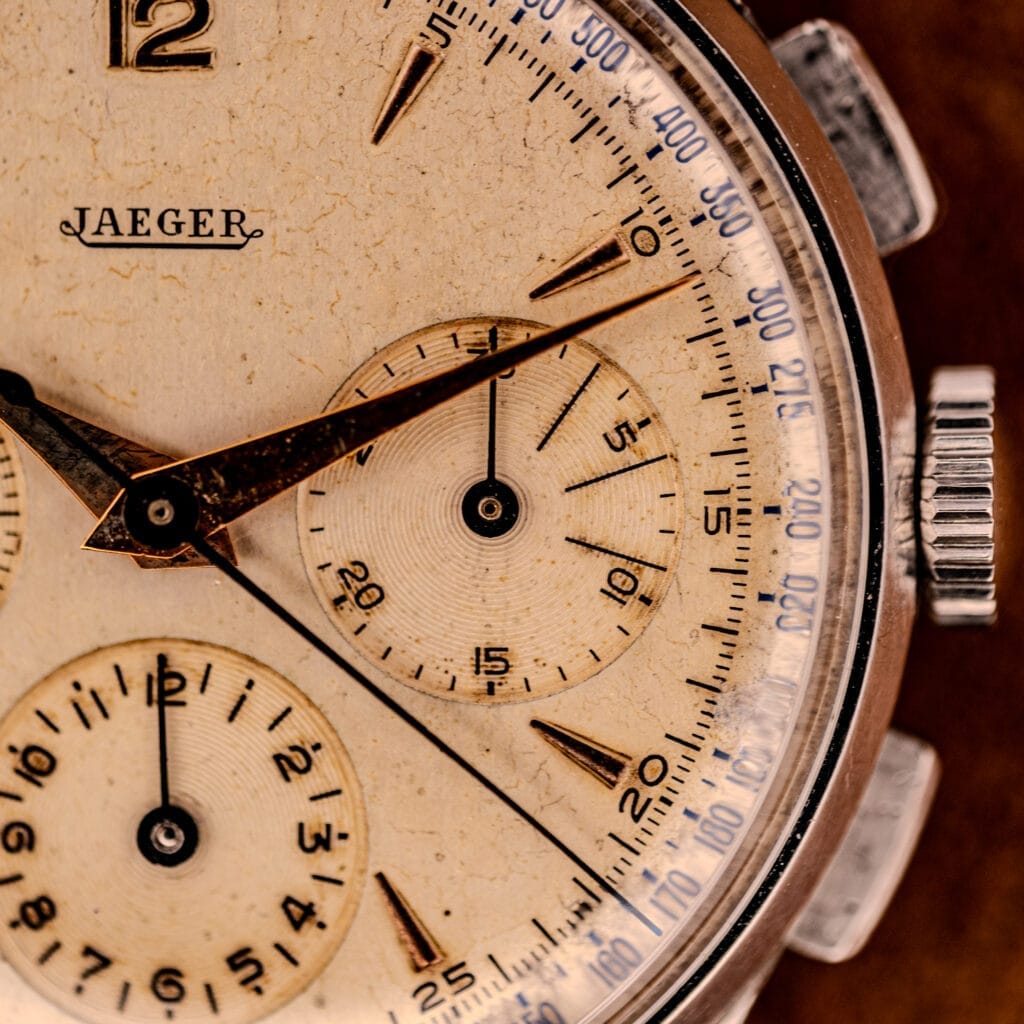
A “Jaeger”-signed Tri-Compax. The dial says Jaeger; the movement is a Universal Genève. Jaeger Tri-Compax in our inventory.
Flip it over and the movement isn’t a Jaeger-LeCoultre at all. It’s a Universal Genève caliber 285. That’s not a Frankenwatch, and it’s not a mistake. Jaeger-LeCoultre didn’t build its own wristwatch chronograph movement during the vintage era, so it bought them in. For these French “Jaeger” chronographs, the supplier was Universal Genève. The 285 is a serious movement in its own right: launched in 1932, it was the first wristwatch chronograph to use the two-pusher, column-wheel layout that every traditional chronograph still copies. The design is generally credited back to a small specialist called Martel Watch Co. The bridge on ours is stamped “JAEGER FAB. SUISSE” right next to the caliber number, so the watch is honest about what it is if you know where to look.
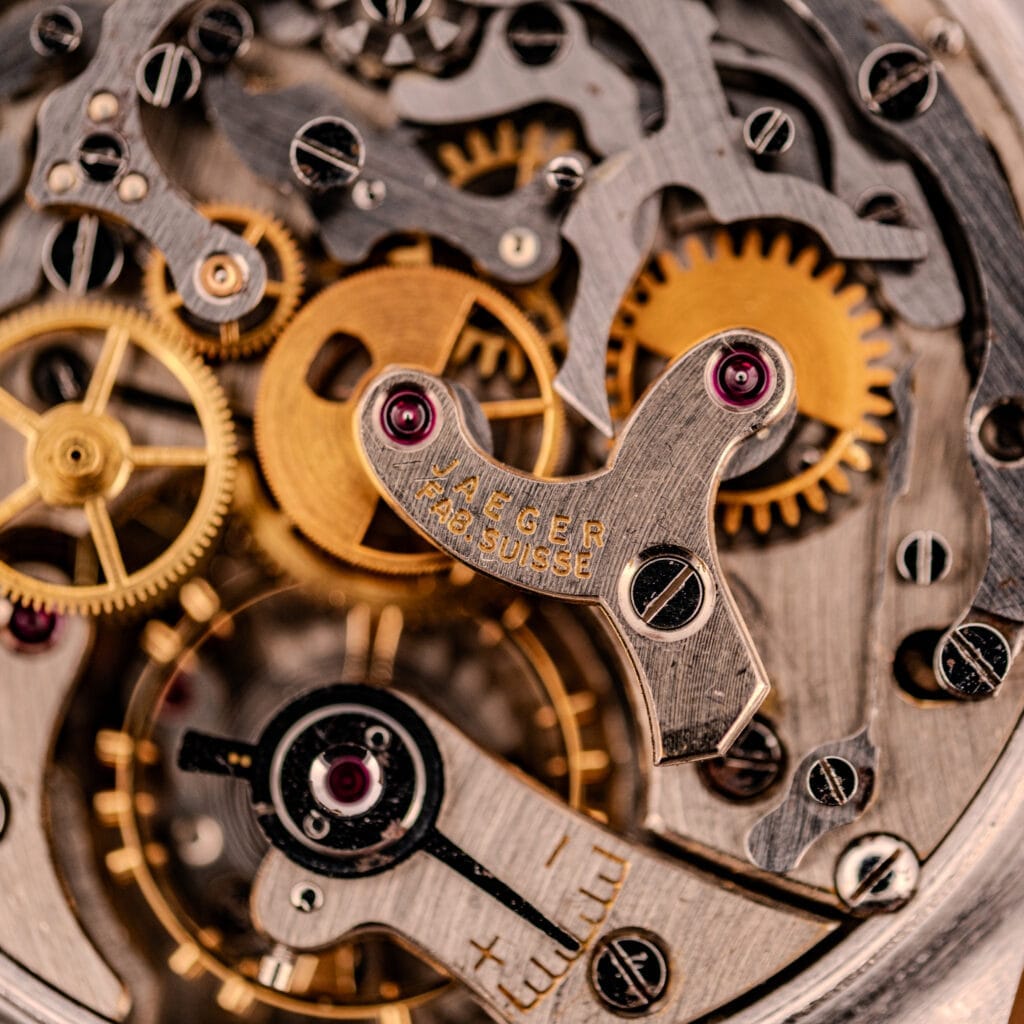
The Tri-Compax (Universal’s name for a chronograph with day, date, month, and moonphase) is therefore the trickiest signature of the three. A “Jaeger” dial can mean an early Paris instrument piece, or it can mean a French-market chronograph that’s really a Universal Genève underneath. Both are correct. Neither is a Jaeger-LeCoultre in the strict mechanical sense.
“LeCoultre”: the American market
The American story is the one most buyers half-know and get slightly wrong.
In the United States, the watches were signed “LeCoultre,” with no “Jaeger” at all. The reason is tariffs. Under the high US import duties of the era (the Smoot-Hawley Tariff Act), bringing in a finished Swiss watch was expensive. So the company shipped the movements and dials from Switzerland and had the cases made locally in North America. A watch that’s partly Swiss and partly American got the shorter “LeCoultre” name. Our LeCoultre Memovox up top is one of these.
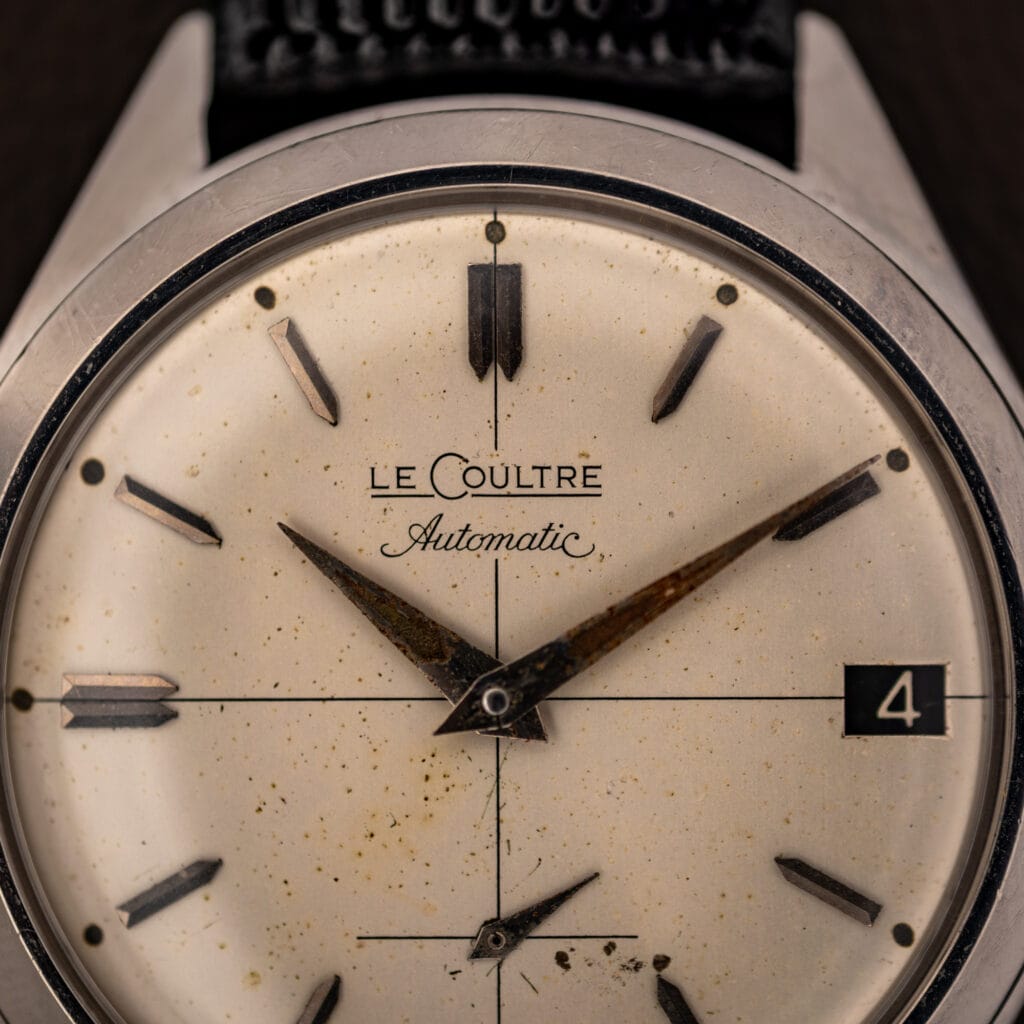
The US distributor was Vacheron-LeCoultre, a company under the Longines-Wittnauer group. (The exact corporate plumbing here is thin in the historical record, so we’ll leave it at that rather than invent an org chart. There were also some genuinely co-branded American pieces tied to Vacheron Constantin’s US distribution, the “Galaxy” mystery-dials of the 1950s, but those are a separate rabbit hole.)
The dates worth knowing: LeCoultre-signed watches run from about 1932 to the mid-1970s. The last movements shipped from Switzerland around 1976, and the LeCoultre trademark itself was retired in 1985, after which the company sold under Jaeger-LeCoultre worldwide. So if a dial says “LeCoultre” alone, you’re almost certainly holding an American-market watch made before the mid-70s.
“Jaeger-LeCoultre”: everywhere else
This one is the simplest. Outside the US and France, the company sold under the full Jaeger-LeCoultre name from the 1937 merger onward. After 1985 it became the only name, in every market, which is why everything on a dealer’s shelf today reads Jaeger-LeCoultre regardless of where it’s sold.
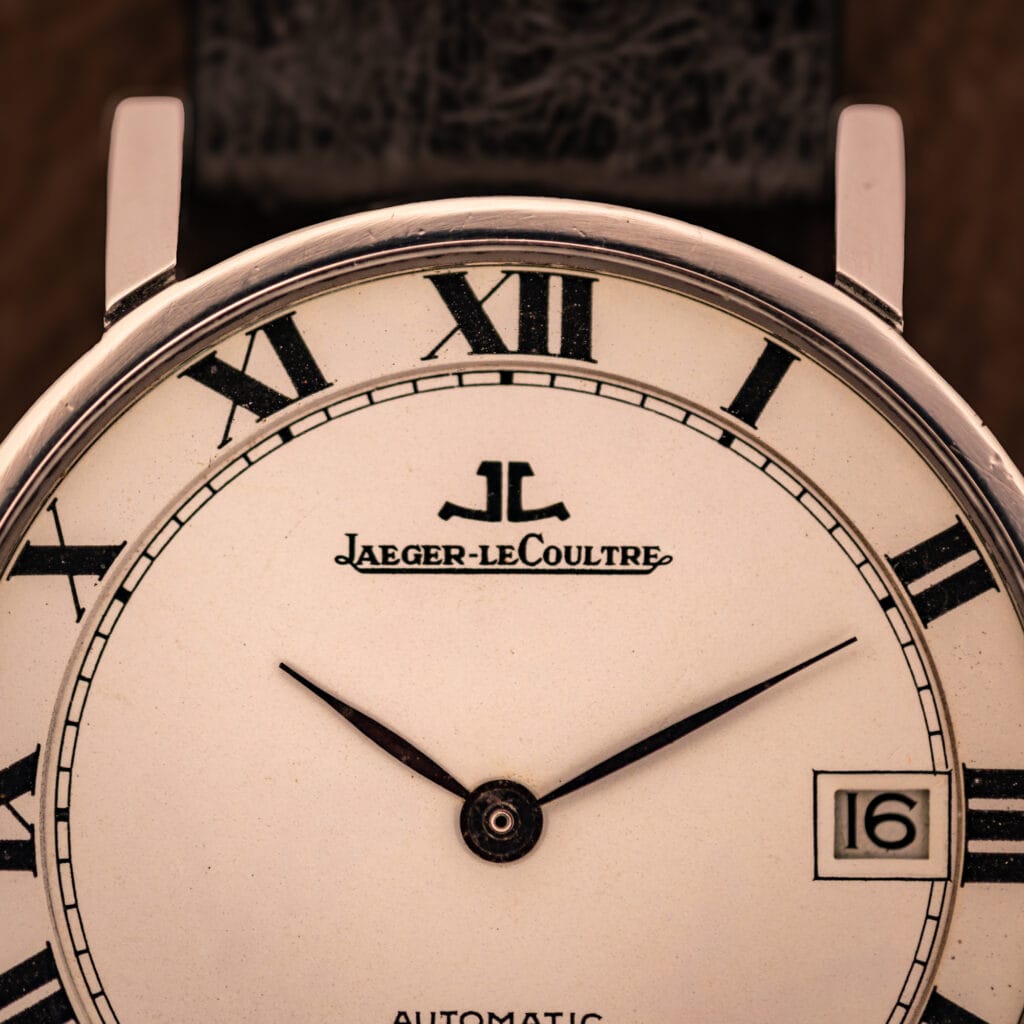
same firm, different price
Here’s where reading the dial pays for itself.
A US-market “LeCoultre” runs the same Swiss movement as its “Jaeger-LeCoultre” twin sold in Europe. Same caliber, same finishing, same maker. The real differences are in the case and the spec sheet: American cases were often gold-filled rather than solid gold, and jewel counts were sometimes held to 17 to stay on the right side of the tariff rules. Those are case-and-paperwork differences, not movement differences.
The market hasn’t fully caught up to that. “LeCoultre” pieces still sell for less than the equivalent “Jaeger-LeCoultre,” mostly because some buyers misread the name as a lesser or unrelated brand. For someone who knows better, that’s the opportunity: the same Vallée de Joux movement for less money, purely because of the word on the dial.
The Jaeger chronographs are their own case. You’re not buying a JLC movement, you’re buying a Universal Genève one, so price those against vintage Universal Genève chronographs, not against JLC. A good “Jaeger”-signed Tri-Compax is a Universal Genève chronograph wearing a rarer signature, which some collectors like and some discount. Know which movement you’re paying for.
how to read your own watch
A quick checklist for a vintage piece in hand:
- Dial says LeCoultre, no Jaeger. American-market watch, roughly 1932 to mid-1970s. Same Swiss movement as the European version, usually a gold-filled or steel case. Often the value buy.
- Dial says Jaeger-LeCoultre. International-market watch, 1937 onward, or anything made after 1985.
- Dial says Jaeger only. French-market piece. Check the movement before you assume anything. A dress watch likely has a JLC caliber; a chronograph very likely has a Universal Genève one. The caliber stamp on the movement settles it.
- Always read the movement, not just the dial. The signature tells you the market. The caliber stamp tells you what’s actually keeping time.
That last line is the habit that protects you. Dials get refinished and reprinted, and a redial can put any name on a watch. The movement is harder to fake and easier to verify, which is why we photograph and document the caliber on everything that comes through.
Is LeCoultre a real Jaeger-LeCoultre, or a fake?
It’s real. “LeCoultre” was the name Jaeger-LeCoultre used in the United States from the 1930s until the mid-1970s, because of import tariffs. The movement is the same Swiss caliber as the Jaeger-LeCoultre version sold elsewhere.
Why does my Jaeger chronograph have a Universal Genève movement?
Because Jaeger-LeCoultre didn’t make its own wristwatch chronograph movement in that era. Its French-market “Jaeger” chronographs used Universal Genève calibers, most famously the cal. 285. That’s correct and original, not a swapped movement.
Are LeCoultre watches worth less than Jaeger-LeCoultre?
Usually they sell for a bit less, even though the movement is identical, because some buyers misread the name. The main real differences are the case (often gold-filled) and sometimes a lower jewel count, both tied to US tariff rules.
When did the “LeCoultre” name stop being used?
New LeCoultre-signed watches wound down by the mid-1970s, and the trademark was retired in 1985. After that the company used Jaeger-LeCoultre everywhere.
How do I tell which market my watch was made for?
Read the dial signature: Jaeger for France, LeCoultre for the US, Jaeger-LeCoultre for everywhere else. Then confirm with the movement caliber, which is harder to fake than a dial.
the takeaway
Three names, one Swiss manufacture, and one chronograph that’s secretly a Universal Genève. The signature on a vintage LeCoultre or Jaeger dial isn’t telling you who built the watch so much as where it was meant to be sold. Learn to read it and you’ll price these correctly instead of paying for a name, which is exactly the kind of thing we sort out before a watch ever goes up for sale.
Every vintage piece we list gets the movement documented, not just the dial, so you know what you’re actually buying.
Related posts
Watch Shapes: Which Vintage Case Shape Fits Your Style?
Case shape changes how a vintage watch wears more than diameter alone. Compare eight silhouettes and learn which one fits your wrist and style.
Vintage Dress Watches: How to Choose One You’ll Actually Wear
The best vintage dress watch is the one you will wear beyond weddings. Here is how to choose the right size, metal, dial, shape, and strap.
Vintage Watch Styles: A Visual Guide to Finding Yours
Most buyers pick a brand and stall. Here are nine vintage watch styles, shown with real watches from our archive, and the catch that comes with each one.
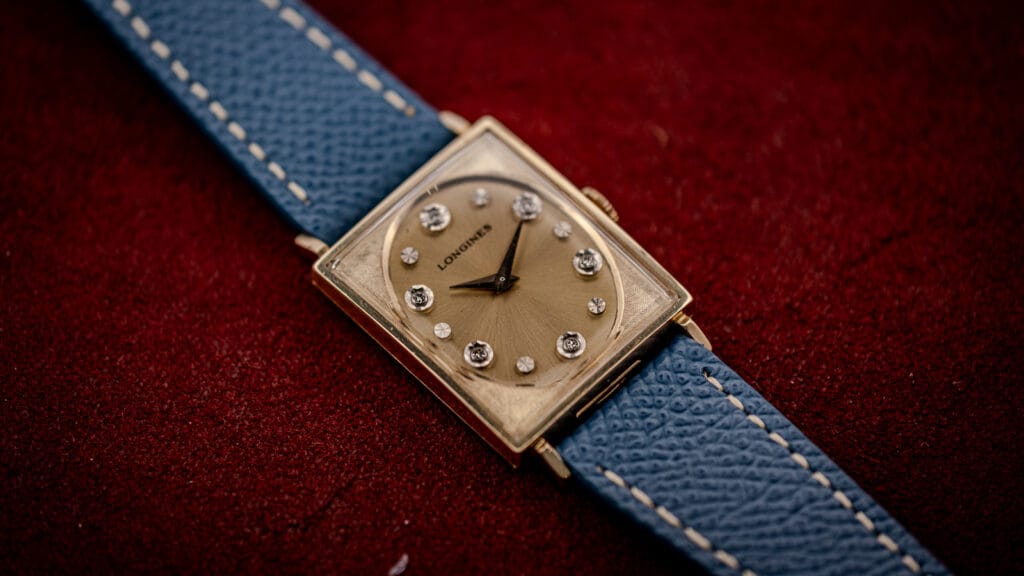
Vintage Tank Watches: A Buyer’s Guide to Rectangular Watches Beyond Cartier
Every Cartier Tank alternatives list is new watches imitating old ones. The originals still exist and cost less. A buyer's guide to vintage tank and rectangular watches: the brands, the prices, and what to check.
Service History Is the Wrong Question. Here’s the Right One.
Everyone says to ask for a vintage watch's service history. Most of it can't be verified, and a receipt proves a transaction, not a result. Here's what actually tells you a watch has been serviced, and the better question to ask.
LeCoultre vs. Jaeger-LeCoultre vs. Jaeger: What the Name on the Dial Means
Three names, one Swiss firm, and one watch that isn't what it looks like. What LeCoultre, Jaeger-LeCoultre, and plain Jaeger on a vintage dial really tell you.
Omega Seamaster 166.010 Buyer’s Guide: Prices, Variants, and What to Look For (2026)
Everything you need to buy an Omega Seamaster 166.010 in 2026: real market prices by condition tier, five dial variants explained, caliber 562 vs 565, original part numbers, and what to inspect before you commit.
Omega vs Rolex: The Vintage Buyer’s Verdict
Vintage Omega vs vintage Rolex: where the Rolex premium is worth paying, where Omega is the smarter buy, and how to dodge redials on both. A collector's verdict.
Movado Kingmatic: A Vintage Buyer’s Guide to References, Calibers, and Value
The Movado Kingmatic is one of the best values in vintage automatics. A buyer's guide to its references, in-house calibers, the Sub-Sea line, what to check, and what they actually sell for.
13 Vintage Watch Collecting Tips for Beginners (From 1,000+ Watches Sold)
Thirteen vintage watch collecting tips drawn from selling over 1,000 watches. What separates a smart first buy from an expensive lesson, with no sugar.
Vintage Wittnauer Chronograph Caliber Identification: Venus 188, Valjoux 7733/7734, Landeron 248
How to identify the movement inside any vintage Wittnauer chronograph: Venus 188, Valjoux 7733 and 7734, Landeron 248, and the house numbering system Wittnauer used to mark them.
How Water-Resistant Is a Vintage Watch, Actually? The Honest Answer.
Every dealer says never get a vintage watch wet. That advice is half-engineering and half-liability theater. Here is what is actually true about vintage water resistance, where water actually gets in, and when a 1965 diver is safer than a 2-year-old modern.