

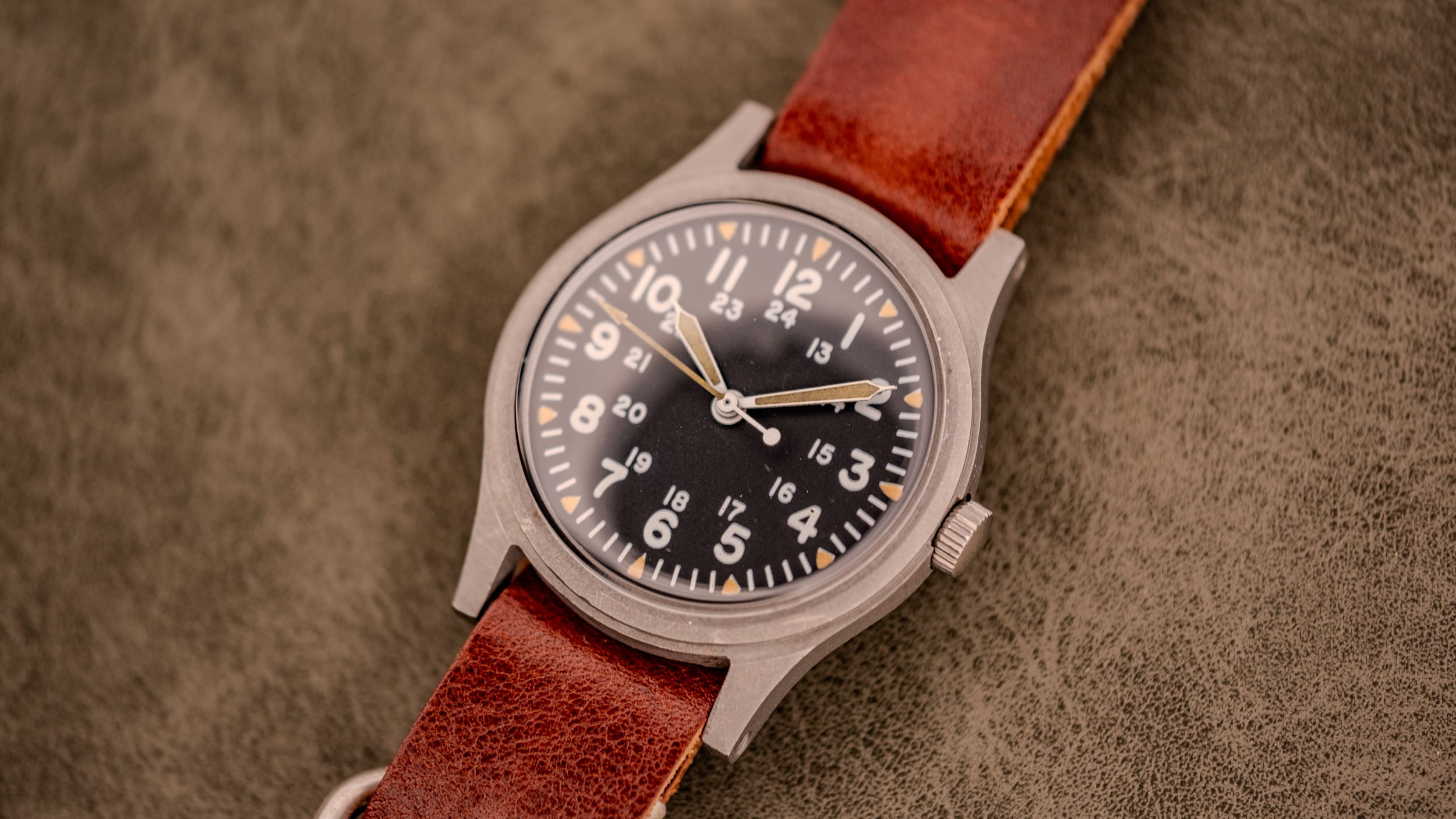
The vintage field watch is not really one object. It is three overlapping eras of military procurement, each with its own engineering brief and its own surviving population. The shape that ends up on a 2026 wrist (round case of 35 to 38mm in steel, black dial, white Arabic numerals, hacking seconds, manual wind, no nonsense lume) traces back to specifications written in London, Washington, and Schaffhausen between 1944 and the late 1980s. Reading those specifications is the only way to make sense of what these watches were built to do, and what they have become.
This piece walks the three arcs in order. First, the British Dirty Dozen of 1944 and 1945 and the contemporaneous American A-11, when the design template was set. Second, the long American post war run of mil specs through Vietnam and into the 1990s, alongside the IWC Mark XI lineage that defined the British and Commonwealth pilot’s watch. Third, the late twentieth century reissue era, when companies like Hamilton, CWC, and Marathon kept the design alive for civilian wrists.
The Dirty Dozen, 1944 to 1945
In late 1944 the British Ministry of Defence issued a tender for a standardized field watch to be supplied to British and Commonwealth land forces. The procurement document gave the specification its name: W.W.W., for Watch, Wristlet, Waterproof. Twelve Swiss firms received contracts. Production was concentrated in 1945, although Vertex began earlier, before D-Day. Total deliveries across all twelve makers are most commonly cited at 145,000 to 150,000 units.
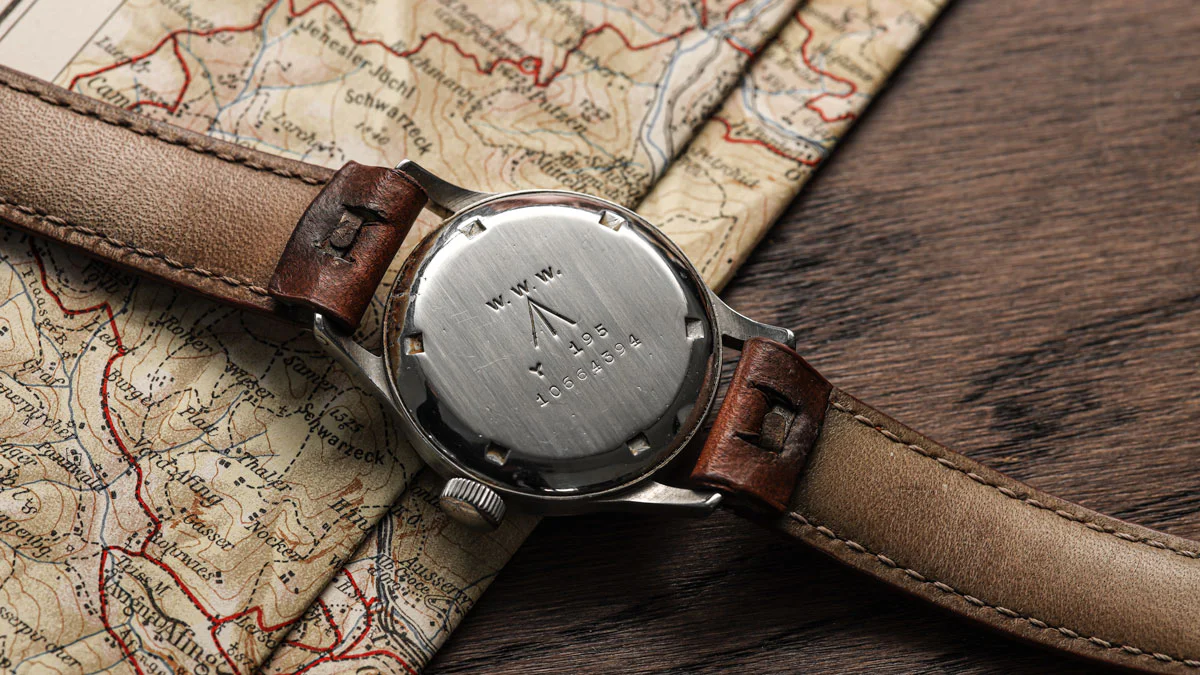
The single shared specification produced an unusually coherent set of watches. Every Dirty Dozen carries a 15 jewel hand wound chronometer grade movement, a black dial with white Arabic numerals, a sub seconds register at 6 o’clock, a railroad style minute track, radium luminous hands and indices, a shatterproof acrylic crystal, and a sealed crown. Cases are round, between 35mm and 38mm, in chrome plated brass over a steel back or full stainless. The caseback carries the broad arrow pheon, the W.W.W. designation, the military issue serial, and the maker’s civilian serial. Cathedral, sword, and pencil hand pairings vary by maker; case proportions vary slightly; movements differ in caliber. The design template, however, is constant.
The twelve makers and approximate production:
| Maker | Production | Movement | Case | 2025 to 2026 USD |
|---|---|---|---|---|
| Omega | ~25,000 | cal. 30T2 (réglage spécial) | ~35mm | $1,400 to $5,000 |
| Record | ~25,000 | cal. 022K | ~36.5mm | $1,500 to $2,500 |
| Cyma | ~20,000 | cal. 234 | ~37mm | $1,200 to $2,900 |
| Vertex | ~15,000 ordered | cal. 59 (hacking) | ~35mm | $2,400 to $4,000 |
| Timor | ~13,000 | cal. 6060 | ~36.5mm | $1,800 to $2,500 |
| Buren | ~11,000 | cal. 462 Grand Prix | ~36.5mm | $1,500 to $3,000 |
| Jaeger LeCoultre | ~10,000 | cal. 479 | ~35mm | $3,000 to $6,000 |
| Lemania | ~8,000 | cal. 27A | ~36.5mm | $1,700 to $4,000 |
| Longines | ~5,000 to 8,000 | cal. 12.68Z | ~37.5mm | $2,800 to $7,800 |
| IWC (Mark X) | ~5,000 to 6,000 | cal. 83 | ~35mm | $5,000 to $8,000 |
| Eterna | ~5,000 | cal. 520 / 520H | ~36mm | $3,000 to $6,000 |
| Grana | ~1,000 to 1,500 | Kurth Frères cal. KF 320 | ~35mm | $15,000 to $40,000 |
Vertex was the only British headquartered firm in the group, with London corporate identity and Swiss assembled movements; it was also the only Dirty Dozen maker specified with hacking seconds for time signal synchronization. The brand was revived in 2016 by Don Cochrane, the great grandson of founder Claude Lyons. Grana sits in its own category for rarity. Estimates of original production run as low as 1,000 pieces, and a Bonhams sale in November 2022 closed at £31,800, near $38,000 at the time. The Longines reference is sometimes nicknamed the “Greenlander” after a now debunked theory that surplus pieces shipped to the British North Greenland Expedition between 1952 and 1954. The Dirty Dozen cases are round, occasionally with a stepped bezel, never the cushion shape that some descriptions confuse them with.
The auction record for 2025 is dominated by mid market British houses rather than the global flagships. Bonhams Knightsbridge, Fellows, Gildings, Cheffins, and Stride & Son have all moved Dirty Dozen pieces this year; Sotheby’s hammered an Omega W.W.W. at $5,080 in June 2025. Christie’s and Phillips have not featured headlining Dirty Dozen lots in the same window. Worn & Wound’s Dirty Dozen survey remains the most thorough single reference on the maker by maker production figures.
The American Line: A-11 through MIL-W-46374
While the British were working out the W.W.W. specification, the United States was producing its own field watch under a different procurement document. ORD 27834 was issued around 1940 and revised to spec 94-27834 in November 1942, with -A and -B variants pushed through in early 1943 and production running through 1945. This is the A-11. Three American firms built it: Elgin, Bulova, and Waltham. Hamilton is sometimes credited as the fourth, but Hamilton’s WWII contract was the AN-5740 / 4992B 16 size GCT navigation pocket watch, not the A-11. The confusion is persistent; the procurement record is clear. (For the broader context of why these names dominated mid century American watchmaking, see The Rise and Fall of American Watchmaking.)
The A-11 specification reads as a smaller cousin of the W.W.W. The case ran 31 to 32mm in chrome plated base metal because steel was being conserved for hulls and engines. The dial was black with white Arabic numerals, the movement minimum 15 jewels with hacking seconds required, and the second hand was white. The Royal Air Force ordered the same watch under stores reference 6B/234. The popular tagline, “the watch that won the war,” is a marketing line rather than a factual claim. Honest serviced examples of Bulova, Elgin, and Waltham A-11s sit at $700 to $900; mint NOS pieces close to $1,500.
The post war American field watch arc continued through specifications that, taken together, illustrate how military procurement evolved across thirty five years.
MIL-W-3818 (active 1956 through the mid 1960s) covered a general purpose 17 jewel manual wind hacking watch in parkerized steel, around 33mm, with a 12 and 24 hour Arabic dial. MIL-W-3818A used Bulova’s caliber 10BNCH; MIL-W-3818B used the Benrus DR 2F2 caliber and was marketed under the part designation DTU-2A/P. The DTU-2A/P is not a separate specification, despite being treated as one in some collector references. It is the part number for the Benrus contract piece under MIL-W-3818B. Hamilton, Westclox, and later Stocker & Yale also built equivalents under continuing contracts.
MIL-W-46374 was first published on October 30, 1964 and ran through Revision G in 1999. The intent of the specification was a low cost, non maintainable, often disposable field watch for ground troops. The revision history is the clearest possible record of how the watch evolved through Vietnam and into the post tritium era. The original 1964 version called for steel; Revision A in 1968 still specified steel but began permitting plastic versions, with Westclox and Benrus delivering one piece composite cases between 1970 and 1976. Revision B in 1975 added the H3 designation and radiation symbol for tritium, plus the “Dispose Rad. Waste” caseback marking. Revision C in 1983 brought Stocker & Yale into production. Revision D in 1986 and Revision E in 1989 covered Hamilton, S&Y, Marathon, and Gallet, with Revision E replacing painted lume with sealed tritium vials. Revision F in 1991 covered the Type 6 “Navigator” with hacking quartz and a GMT bezel. Revision G in 1999 broadened manufacturer latitude.
Plastic case examples from the 1969 to 1983 window trade between $150 and $400. Clean Benrus pieces from the 1969 to 1975 window run $300 to $450. Steel cased versions, when they show up, command a premium because the parkerized two piece screw back construction tolerates service in a way the swage sealed plastic cases cannot.
MIL-W-50717 is the specification that produced the Benrus Type I and Type II. This is a frequently miscited reference in collector forums; the Benrus military divers are not a sub revision of MIL-W-46374. Specification MIL-W-50717 was written in the early 1970s for a military diving and utility watch. Benrus delivered a Type I with a sterile dial (no 24 hour ring) and a Type II with a 12 and 24 hour dial, in two finishes: Class A (matte sandblasted) and Class B (polished, around 1,000 made and rare). Approximate quantities are 6,000 Type I Class A, 9,000 Type II Class A, and 1,000 Type II Class B. Construction is a 42.5mm asymmetric one piece monobloc steel case with integral crown guard at 3 o’clock, an ETA 2620 based caliber, and a sandblasted exterior. Issue records cover Army Rangers, Green Berets, Navy SEALs, and UDT divers; the sterile Type I is widely believed to have been issued to SEAL teams and to certain CIA personnel. Honest Type I examples close $2,000 to $3,000; Type II Class A pieces $1,500 to $3,000; sterile Type Is and Class B pieces above $4,000. The market is heavily homaged. The reliable tells are the matte sandblasted finish on the case (a polished Class A is suspect), domed acrylic crystal (originals are not flat sapphire), and dial graphics that match documented variants. The 2025 Benrus brand reissue at roughly $1,790 is a legitimate modern product, separate from the vintage market.
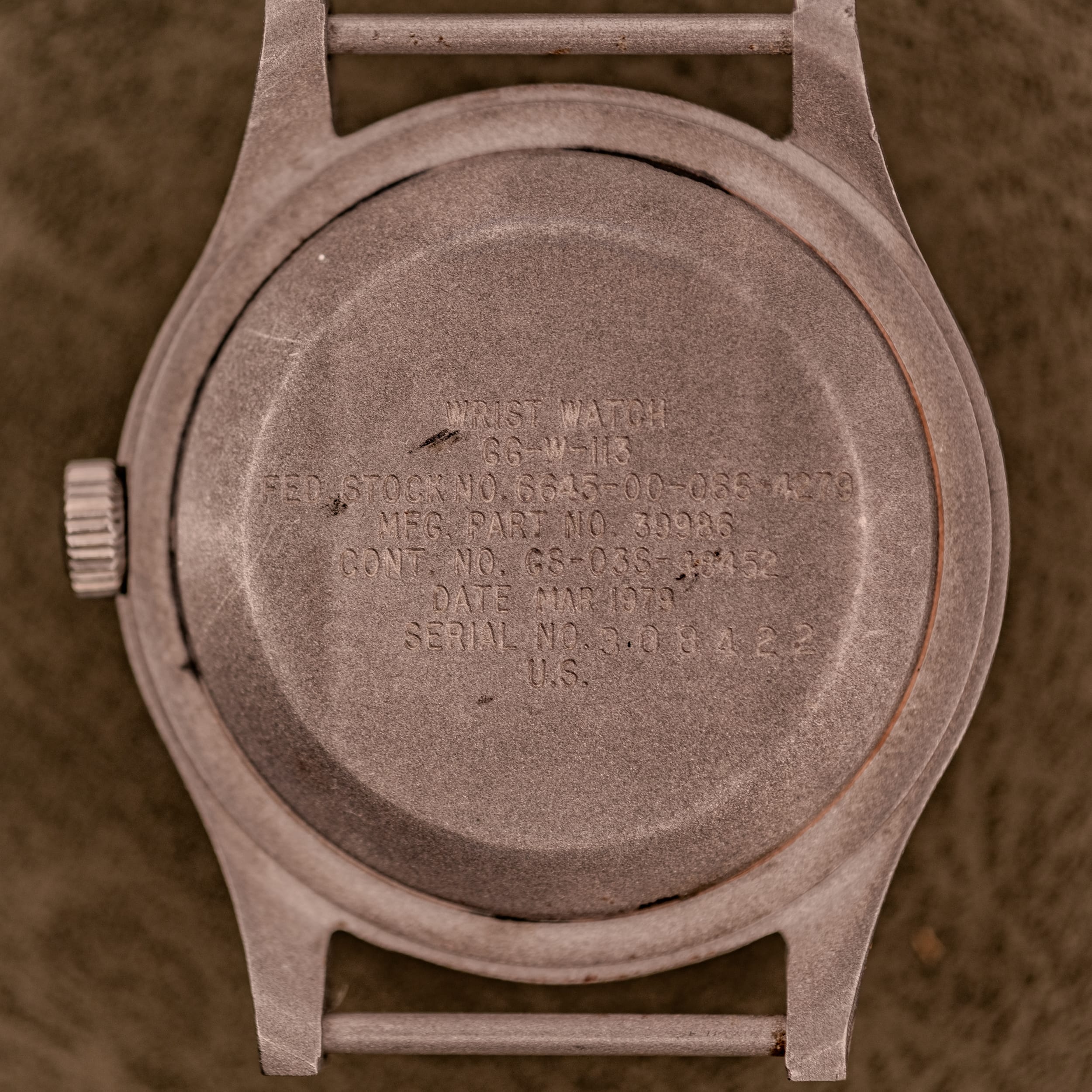
GG-W-113 is the post Vietnam US Army general government specification for the maintainable, mechanical, jeweled field watch. Released in 1967 and produced through the late 1980s, GG-W-113 is the one most often confused with MIL-W-46374 in the secondary market, and the distinction is worth pinning down. GG-W-113 was specified for aircrew. It uses a 34mm parkerized stainless steel case, a highly domed acrylic crystal, a matte black dial with 12 hour Arabic numerals plus an inner 24 hour scale, triangular minute indices, tritium lume, and a 17 jewel ETA 2750 manual wind hacking movement with around 36 hours of reserve. The canonical contractors are Hamilton and Benrus, with Marathon adding a 1984 to 1985 contract for Kelly Air Force Base built around the ETA 2801-2 (rare and the most valuable variant). The MIL-W-46374, by contrast, was specified for ground troops, with plastic monocoque construction in many revisions, lower jewel count or pin pallet movements, and no inner 24 hour scale on most variants. Honest GG-W-113 mechanicals trade $600 to $1,200; full set or NOS pieces $1,500 to $2,000; rare Marathons and pristine examples up to $2,500.
IWC and the Commonwealth Pilot’s Watch
The British and Commonwealth air arm’s field watch story is largely the IWC Mark XI story. The Royal Air Force ordered the watch in 1947 to 1948, with production beginning in 1948 to 1949 and running to 1953. Final RAF decommission came in 1981. The Royal Australian Air Force took its first 420 units from Jaeger LeCoultre in August 1950, with another 600 units in 1953, then switched to IWC in 1957 for an additional 600 units. The Royal New Zealand Air Force and South African Air Force together received an estimated 600 units. Aggregate IWC military production runs about 7,400 units, with another 1,000 civilian pieces sold between 1973 and 1984.
The Mark XI is built around the IWC caliber 89, manual wind, with hacking seconds, 18,000 vph, and regulated in five positions. Each movement was temperature tested between minus 5 and plus 46 degrees Celsius across 44 days at the Royal Greenwich Observatory before delivery. The case is 36mm stainless steel with fixed lugs. Antimagnetic protection is achieved through an internal soft iron Faraday cage; the hands and dial are also antimagnetic. Original radium dials, with the early “hooked 7” variant, almost never survive in original condition because the Ministry of Defence routinely re lumed and re dialed Mark XIs through their service life. Tritium “circle T” dials began appearing on RAF examples around 1962. The caseback for RAF and Fleet Air Arm pieces reads 6B/346 with a broad arrow; the Royal Australian Air Force version reads G6B/346.
Current pricing: project examples or relumed pieces $3,300 to $5,500; honest dealer grade examples $5,400 to $7,500; original radium “hooked 7” dials and unmolested RAAF G6B/346 watches $10,000 to $15,000 and up. Hairspring’s deep dive on the RAF 6B/346 walks through the dial variants in detail.
The civilian Mark XII, produced from 1993 or 1994 through 1999, runs the IWC caliber 884/2 (based on the Jaeger LeCoultre cal. 889/2: automatic, 4 Hz, 38 hour reserve, 5 position adjustment), with a date window at 3 and a 36mm case. The Mark XII was never military issued. Secondary market $3,000 to $5,500. Confusion between the Mark XI and Mark XII is common; the simplest distinction is that the XI is manual wind with no date and a fixed lug case, while the XII is automatic with a date.
The IWC Mark IX, retroactively named, was produced from 1936 to 1944 as the IWC “Spezialuhr für Flieger.” It carries a 36mm steel case with a rotating bezel and the cal. 83 movement. Per Grail Watch Wiki only around 430 pieces are registered with IWC, making it among the rarest serial production pilot’s watches of the era. Examples close in the mid five figures USD when they surface. The IWC Mark X, contemporary with the Dirty Dozen, is covered in the table above.
The German B-Uhr
The Luftwaffe’s wartime navigation watch is a separate object from the field watch, but its design influence on the modern Type A and Type B dial is so persistent that it belongs in any serious survey. Five firms held Reichsluftfahrtministerium contracts between 1940 and 1945:
- A. Lange & Söhne in Glashütte, with the in house cal. 48 / 48.1
- Wempe of Hamburg and Glashütte (which had purchased Chronometerwerk Hamburg in 1938), with the Swiss Thommen cal. 31
- IWC in Schaffhausen, with the cal. 52 T.S.C.
- Stowa (Walter Storz, in Pforzheim), with the Swiss Unitas cal. 2812
- Lacher & Co. / Laco of Pforzheim, with the in house Durowe cal. 5
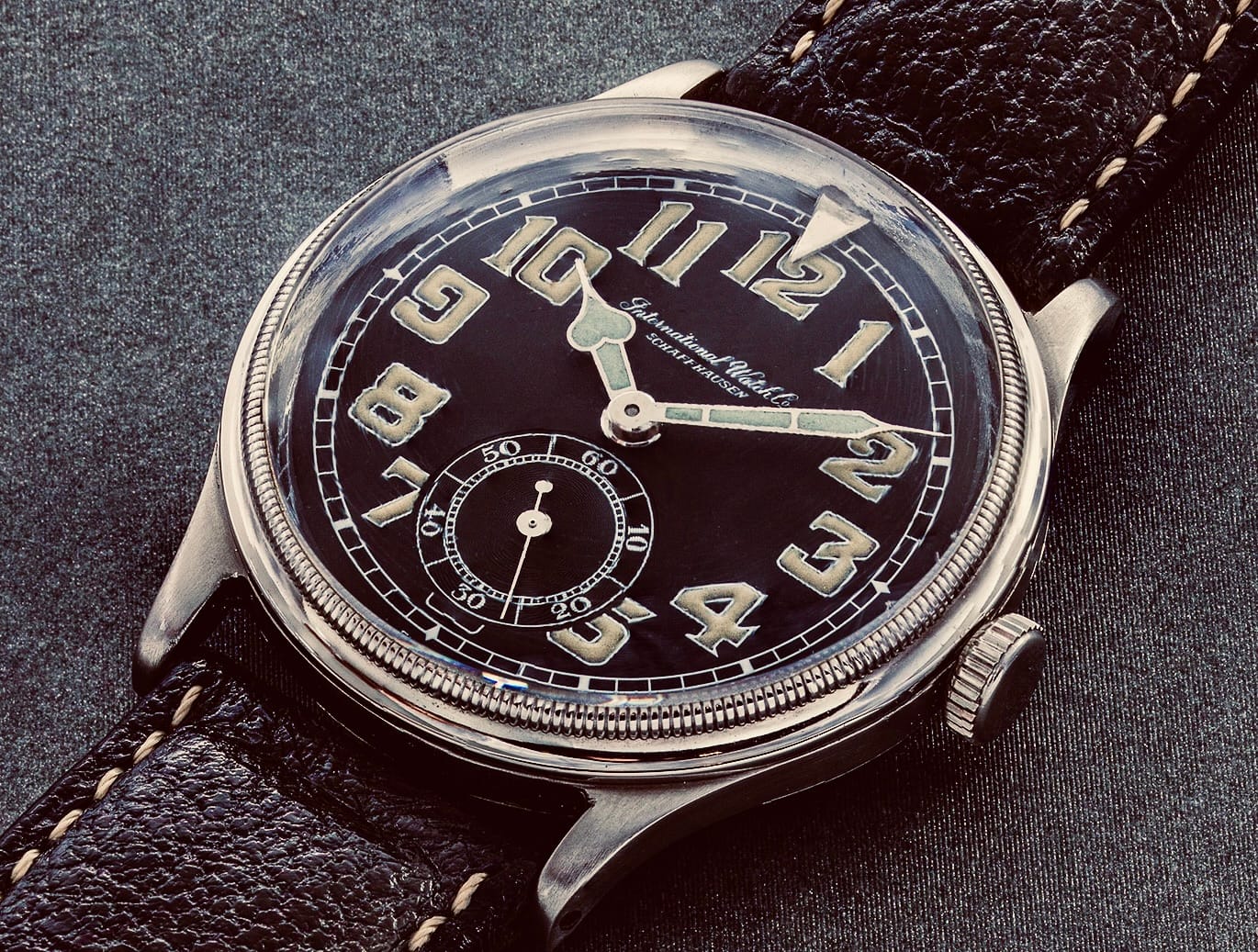
The B-Uhr (Beobachtungs-Uhr, observation watch) was built as a navigator’s instrument, ground synchronized to a master clock before each mission and worn over a flight jacket sleeve. The case is 55mm steel. Movements are chronometer grade hand wound with Breguet overcoils, hacking seconds, and oversized onion crowns sized for use with flight gloves. The Type A dial of 1940 to 1941 carries a single chapter ring with Arabic numerals 1 to 11 and a triangle (often flanked by two dots) at 12. The Type B dial of 1941 onward uses two concentric scales: an inner ring for hours and an outer ring for minutes and seconds, with the triangle at 12.
Total production across all five makers is estimated at around 13,500 pieces. The per maker estimates run roughly Laco 6,500, IWC 1,000, and Lange and Wempe in the middle, with Stowa rarest at around 60 because the Pforzheim factory was destroyed in the February 1945 bombing. The auction tier orders typically as IWC and Lange (highest), then Wempe, then Stowa and Laco. Heritage Auctions hammered an A. Lange & Söhne B-Uhr at $10,625 in May 2013; Antiquorum closed one at CHF 11,875 in March 2012; Bonhams realized $6,250 in December 2015. Top originals push past those numbers in the 2025 market. Laco, Stowa, and Wempe pieces trade between $4,000 and $10,000 depending on originality.
The IWC Big Pilot 52 T.S.C. (reference IW431) is the wartime original on which all IWC Big Pilot models since rest. Production ran 1940 to 1945, with approximately 1,000 to 1,200 pieces delivered. The case is 55mm by 16.5mm thick at 183 grams. The in house cal. 52 T.S.C. has hacking, a large balance, an internal soft iron antimagnetic case, spring mounted lugs, and an oversized onion crown. Phillips Geneva sold a 1940 dated example for CHF 21,250. Honest examples generally trade $25,000 to $60,000; pieces with strong provenance reach $80,000 to $100,000 and beyond.
The Reissue Era: 1970s through 1990s
The third arc is the long late twentieth century reissue era, when the design language of the wartime and Vietnam era field watch continued in production while the customer shifted from military procurement to civilian retail. This is also the era in which the broader Swiss industry was nearly destroyed by the Quartz Crisis, which is why so much of the surviving production moved to lower cost quartz field watches like the CWC G10 and the late MIL-W-46374 revisions. Four lineages matter.
Hamilton Khaki. Hamilton continued military contracts into the 1980s and 1990s while marketing the same design civilian, often through L.L. Bean and Avirex co branding. The reference progression matters more than any one model name. The Hamilton 9219 of the early to mid 1980s is a 33mm fixed lug piece with an ETA 2750 manual wind, the closest commercial production to the issued GG-W-113 and MIL-W-46374. The 9415 and 9415A of the late 1980s and early 1990s introduced drilled lugs with removable spring bars and the ETA 2801-2 manual wind. The 9445 of the late 1980s is the 36mm crown guarded quartz piece with the ETA 955.114 movement (no separate “9445A mechanical” appears in period catalogs). The current production Khaki Officer’s Mechanical, reference H69439933, is a 38mm modern piece with the H-50 movement (a modified ETA 2801 with an 80 hour reserve) at around $595 retail, not a vintage reference.
Vintage 33mm 9219 and 9415 examples in honest condition trade $250 to $500. The current 38mm Khaki Field Mechanical sees pre owned trades of $510 to $765 against $495 to $595 retail. (For dating an individual Hamilton, see Hamilton Watch Serial Numbers.)
The forum consensus on the modern Hamilton Khaki, after twenty years of running into water leak complaints across WatchUSeek and Reddit, is that it sits as a dress field hybrid rather than a true tool watch. The persistent knock is that it lacks a screw down crown, and the conservative 100m or 50m water resistance rating is inconsistent in practice. The H-50 movement is robust and the design lineage to MIL-W-46374 is genuine. As an everyday mechanical at the price the Khaki holds up; as a working field watch the consensus directs collectors toward Marathon, Hamilton’s NSN marked variants, or Sinn.
CWC G10. Cabot Watch Company, the British MoD supplier that filled the gap when Hamilton’s UK contracts wound down, built the G10 continuously from 1980 to 2006, with gaps in 1986, 1992 to 1994, 1996, and 1999 to 2003. Approximately 200,000 pieces were produced. The standard issue G10 is a stainless steel case (the Royal Marines fiberglass variant is the plastic one, an exception rather than the rule). The movement progression is ESA 536.121 from 1980 to 1987 (the thicker “Fat Boy” case), ETA/ESA 955.114 from 1987, and ETA 955.102 from 1991. Issue covered RAF, Royal Navy, and Army.
CWC retails the modern reissue at £279 to £299 (sapphire variant). Used issued examples close at £250 to £350, around $315 to $440 in current FX. The 1980s “Fat Boy” pieces run £500 to £800 and up.
Marathon. Marathon, the Canadian Wein family firm founded in 1939 with Swiss assembly, occupies the bridge between vintage and current military. The 1984 to 1985 Marathon GG-W-113, built on the Kelly Air Force Base contract with a 17 jewel hacking movement, is the rarest contract example of GG-W-113. Honest pieces trade $700 to $1,500. The 1986 Steel Navigator is a Marathon piece that sometimes appears in vintage listings; Marathon’s GPM and MSAR product lines are 2010s and later, modern rather than vintage.
Smiths W10. The Smiths W10 was issued to the British Army from 1968 to 1970, with some 1971 dated examples, under DEF-3-B and DEF STAN 66-4. The W10 has the distinction of being the last all British made wristwatch; once production wound down, no British firm again produced a fully domestic watch on a mass scale. The case is 35mm steel, 11mm thick, with the Smiths cal. 27.CS hand wound hacking movement, a tritium dial, and 18mm fixed bars. Honest examples on collector forums close at £900 to £1,200, around $1,150 to $1,500. The trajectory has been clearly upward since the early 1990s, when £20 was a representative price.
The related Smiths Empire was produced from 1948 to roughly 1980 by the Anglo Celtic Watch Company in Ystradgynlais, Wales, a joint venture between Smiths and Ingersoll. Five jewel pin pallet civilian dress watches; the Empire branding had largely retired by the mid 1950s. These remain enthusiast pieces at $80 to $200.
The Citizen Parawater of 1959, Japan’s first water resistant wristwatch, predates the Promaster line by twenty three years and sits adjacent to the field watch tradition rather than in it. If the conversation includes it, the framing should be water resistant ancestor rather than a true field piece. Examples trade $100 to $400.
What Collectors Look For in a Vintage Field Watch
A vintage field watch reads correctly when its lume era, caseback markings, strap, and movement integrity all line up with the issue date stamped on the back. This holds true across vintage military watches generally, but the field watch market hides its risks in a smaller number of recurring places. For the broader cross-reference framework, see How to Identify and Value a Vintage Watch.
Lume eras. Pre 1962 watches, including all original Dirty Dozen examples and the earliest IWC Mark XI dials, used radium (radium 226). Radium is radioactive at low energy; original radium lume is almost always partly or fully gone, with characteristic dark patina at the digits and along the hands. A bright glow on a 1944 dial is a signal that something is wrong. Radium dials should never be sanded or aggressively cleaned. Tritium replaced radium in the early 1960s and ran until the mid 1990s, painted as a strontium promethium tritium compound and, from the late 1980s, sealed in micro tubes. The “T<25” or circled T marking on the dial below 6 indicates tritium. Super-LumiNova, introduced in the mid 1990s and inert, is anachronistic on any pre 1995 dial; a strong glow on what is sold as a vintage piece deserves scrutiny. For the longer treatment of how aged lume reads, see Patina vs. Damage on a Watch Dial.
Caseback markings. The 13 digit NATO Stock Number was introduced in 1974; pre 1974 US watches use the older Federal Stock Number. The broad arrow pheon marks UK MoD ownership and appears on caseback and often on the dial. The “U.S. Govt” stamp paired with DAAA contract codes points to US Army Defense Personnel Support Center contracts. The 6B/346 reference is the RAF stores number for the IWC Mark XI; G6B/346 is the RAAF version. The H3 plus radiation symbol marks the tritium era from MIL-W-46374B forward. Vietnam era US issue pieces typically carry a two digit issue year on the inside or outside caseback (for example “BENRUS / DAAB07-69-C-0149 / 1969”).
Straps. Pre 1973 original straps were leather pass through (one piece) or canvas, in olive drab or natural. The NATO strap dates from 1973, when it was introduced as the G10 issue stores reference (which is where the name comes from). A NATO strap on a 1944 Dirty Dozen is anachronistic, period. Issued canvas and cotton straps were generally olive or natural; black NATO is post 1980s G10.
Movement integrity. These watches were used hard. Service history matters more than for a civilian dress watch of the same era. Look for evidence of period correct service, often in the form of a depot stamp or a dated case opening scratch on the inside back. Movement caliber should match what the maker delivered for that contract; frankenwatches with later replacement movements are common, particularly for pieces that went through repeated MoD service cycles.
Frankenwatch tells. A redialed military case typically shows even, screen printed numerals where the original had hand applied lume painting with characteristic crispness; the giveaway font issue is often the broad arrow weight or the “T” stem. A glassy bright polish is a tell, since military watches were never polished new and should still show some bead blasted or sandblasted texture under wear. Hand pairings (sword, cathedral, pencil) are documented per maker for the Dirty Dozen and per contract for the US references; cross referencing with reference photos before a purchase remains standard practice.
The “100% original” trap. Issued military watches went through multiple service cycles in which dials, hands, and movements were swapped per depot standard operating procedure. The MoD re lumed and re dialed Mark XIs annually for years. A non original but period correct dial is acceptable provenance. A 2010 reproduction dial is not. The honest descriptor is “period correct,” not “100% original.”
Issued versus contract versus civilian spec. “Issued” means the watch was stock numbered and entered government inventory, ideally with paperwork or unit history. “Contract” means it was built to spec on a government contract but sold direct or through surplus channels (Marathon’s surplus pieces, for example): caseback markings present, unit provenance absent. “Civilian spec” means the same case and movement family was sold retail without military markings (Hamilton’s L.L. Bean Khakis 9219 and 9415, against the issued GG-W-113). The premium hierarchy runs issued, then contract, then civilian, often by a factor of two or three.
Vintage Field Watch Pricing, 2025 to 2026
The vintage field watch market sorts into roughly five tiers. These are framed as observed transaction ranges rather than recommendations; the market changes, and serious examples often realize results outside the ranges typical for the tier.
Under $500. The entry tier. MIL-W-46374 plastic case examples from Vietnam era through the 1990s, Smiths Empire civilian dress pieces, 1980s and 1990s Hamilton Khaki references 9219 and 9415 in honest condition, used CWC G10 issued examples, and pre owned current Hamilton Khaki Field Mechanical pieces.
$500 to $1,500. The accessible mil spec band. Issued GG-W-113 Hamilton and Benrus examples ($600 to $1,200), MIL-W-3818B Benrus DTU-2A/P ($300 to $700, full set to $1,200), CWC G10 “Fat Boy” 1980s pieces ($500 to $800), A-17 Waltham and Bulova in clean condition ($400 to $900), Smiths W10 ($1,150 to $1,500), and Marathon GG-W-113 1984 to 1985 contract pieces ($700 to $1,500).
$1,500 to $5,000. Serious collector entry. Benrus Type I and Type II Class A ($1,500 to $3,000), with sterile Type Is to $4,000 and beyond; A-11 Hamilton, Elgin, and Bulova in mint NOS ($1,000 to $1,500); IWC Mark XI in project or relumed condition ($3,300 to $5,500); the cleaner Dirty Dozen makers (Omega, Record, Cyma, Vertex, Buren, Lemania, Timor) at the upper end of their ranges.
$5,000 to $15,000. The historical pilot and field tier. IWC Mark XI in honest dealer grade ($5,400 to $7,500), Dirty Dozen Jaeger LeCoultre, Eterna, Longines, and IWC Mark X in clean condition ($3,000 to $8,000 and above), B-Uhren by Laco, Stowa, and Wempe ($4,000 to $10,000), and B-Uhren by A. Lange & Söhne ($6,000 to $13,500).
$15,000 and up. The trophy tier. Grana W.W.W. ($15,000 to $40,000 with rarity premium), early IWC Mark XI “hooked 7” radium dials and RAAF G6B/346 in collector grade ($10,000 to $15,000 and up), the IWC Big Pilot 52 T.S.C. ($25,000 to $60,000 honest, top provenance $80,000 to $100,000 and above), the IWC Mark IX in mid five figures, and top end original German B-Uhren.
A Note on Cultural Memory
A few names recur in the cultural register of the field watch and deserve more accurate framing than they usually receive. Steve McQueen’s Hanhart 417 ES, a 39mm flyback chronograph with the cal. 42 produced in roughly 500 pieces between 1954 and 1958 for the Luftwaffe, is real and was worn on screen in The War Lover (1962) and off screen at the 1964 ISDT in East Germany. McQueen’s Benrus 3061, worn as Frank Bullitt in Bullitt (1968), is the civilian variant of the Vietnam era DTU-2A/P (MIL-W-3818).
The Apocalypse Now Rolex (Brando’s GMT Master ref. 1675, with the bezel removed and “M. Brando” engraved on the caseback) sold at Phillips in December 2019 for $1,952,000. Martin Sheen’s watch in the same film was his own Seiko 6105-8119, a dive watch. The Apollo 15 Bulova, used by Dave Scott on the lunar surface during EVA-3 on August 2, 1971 after his Speedmaster crystal popped on EVA-2, sold through RR Auction in October 2015 for $1,625,000 against a $750,000 estimate. It is a chronograph, not a field watch, and is mentioned here because the citation is frequently misattributed (it was not a Phillips sale).
Sir Edmund Hillary’s Smiths Deluxe A409 is the watch most defensibly tied to the 1953 Everest summit; the Rolex Oyster Perpetual carried on the expedition reportedly remained at base camp, although Hillary’s later relationship with Rolex makes the public record murky. The Smiths is in the collection of the Worshipful Company of Clockmakers at the Science Museum in London.
Frequently Asked Questions
What was the Dirty Dozen?
Twelve Swiss firms commissioned by the British Ministry of Defence in 1944 to 1945 to build a standardized field watch (the W.W.W. specification) for British and Commonwealth land forces. Approximately 145,000 to 150,000 pieces were produced across all twelve makers, with Grana the rarest at around 1,000 units and Omega and Record the most prolific at around 25,000 each.
What is the difference between MIL-W-46374 and GG-W-113?
MIL-W-46374 was the United States Army ground troop specification, active 1964 to 1999, often produced in plastic monocoque cases with lower jewel count or pin pallet movements and designed as a low cost, frequently disposable field watch. GG-W-113 was the aircrew specification, active 1967 to the late 1980s, built around a 17 jewel ETA 2750 manual wind hacking movement in a parkerized stainless steel case with a 24 hour inner scale on the dial. GG-W-113 watches were maintainable and serviceable; MIL-W-46374 plastic case examples typically were not.
Is the IWC Mark XI still issued?
No. The Royal Air Force decommissioned the Mark XI in 1981. IWC produced approximately 7,400 military pieces between 1948 and 1953 across RAF, RAAF, RNZAF, and SAAF orders, with a smaller civilian run sold between 1973 and 1984. The Mark XII that followed in 1993 was a commercial product only and was never military issued.
How can you tell which lume era a vintage field watch belongs to?
Pre 1962 watches use radium (Ra-226), which is mostly degraded by now with characteristic dark patina and produces only weak glow. From the early 1960s through the mid 1990s, tritium replaced radium on dials and is marked “T<25” or with a circled T below 6. Super-LumiNova arrived in the mid 1990s and is inert; a strong, even glow on a watch sold as 1944 issue is a signal that the dial has been relumed with later material.
How can you tell which lume era a vintage field watch belongs to?
Pre 1962 watches use radium (Ra-226), which is mostly degraded by now with characteristic dark patina and produces only weak glow. From the early 1960s through the mid 1990s, tritium replaced radium on dials and is marked “T<25” or with a circled T below 6. Super-LumiNova arrived in the mid 1990s and is inert; a strong, even glow on a watch sold as 1944 issue is a signal that the dial has been relumed with later material.
What does the entry tier of the vintage field watch market look like?
Below $500: Vietnam era MIL-W-46374 plastic case examples ($150 to $400), used CWC G10 issued pieces ($315 to $440 in current FX), 1980s and 1990s Hamilton Khaki references 9219 and 9415 in honest condition ($250 to $500), and pre owned current Hamilton Khaki Field Mechanical pieces. The accessible mil spec band runs from $500 to $1,500 and includes issued GG-W-113 Hamilton and Benrus examples and the Smiths W10.
Closing
The vintage field watch as a category, like the broader landscape of vintage military watches, sits between three procurement traditions, three lume eras, and three retail markets. Reading it well requires reading the specifications it was built to. The Dirty Dozen and the A-11 set the design language; MIL-W-46374, MIL-W-50717, GG-W-113, and the IWC Mark XI extended it through Vietnam and into the late twentieth century; CWC, Hamilton Khaki, Marathon, and Smiths W10 continued it for the civilian market. The objects on the wrist in 2026 are still recognizably the watches the British MoD specified in 1944. The market understands them well enough; the casebacks tell the truth more reliably than the dials.
Related posts
Watch Shapes: Which Vintage Case Shape Fits Your Style?
Case shape changes how a vintage watch wears more than diameter alone. Compare eight silhouettes and learn which one fits your wrist and style.
Vintage Dress Watches: How to Choose One You’ll Actually Wear
The best vintage dress watch is the one you will wear beyond weddings. Here is how to choose the right size, metal, dial, shape, and strap.
Vintage Watch Styles: A Visual Guide to Finding Yours
Most buyers pick a brand and stall. Here are nine vintage watch styles, shown with real watches from our archive, and the catch that comes with each one.
Vintage Tank Watches: A Buyer’s Guide to Rectangular Watches Beyond Cartier
Every Cartier Tank alternatives list is new watches imitating old ones. The originals still exist and cost less. A buyer's guide to vintage tank and rectangular watches: the brands, the prices, and what to check.
Service History Is the Wrong Question. Here’s the Right One.
Everyone says to ask for a vintage watch's service history. Most of it can't be verified, and a receipt proves a transaction, not a result. Here's what actually tells you a watch has been serviced, and the better question to ask.
LeCoultre vs. Jaeger-LeCoultre vs. Jaeger: What the Name on the Dial Means
Three names, one Swiss firm, and one watch that isn't what it looks like. What LeCoultre, Jaeger-LeCoultre, and plain Jaeger on a vintage dial really tell you.
Omega Seamaster 166.010 Buyer’s Guide: Prices, Variants, and What to Look For (2026)
Everything you need to buy an Omega Seamaster 166.010 in 2026: real market prices by condition tier, five dial variants explained, caliber 562 vs 565, original part numbers, and what to inspect before you commit.
Omega vs Rolex: The Vintage Buyer’s Verdict
Vintage Omega vs vintage Rolex: where the Rolex premium is worth paying, where Omega is the smarter buy, and how to dodge redials on both. A collector's verdict.
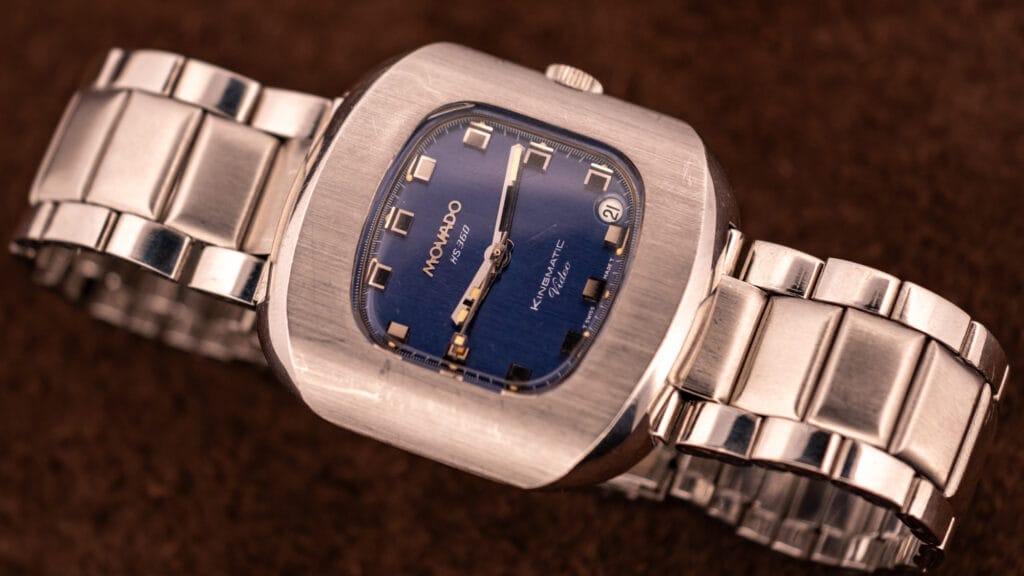
Movado Kingmatic: A Vintage Buyer’s Guide to References, Calibers, and Value
The Movado Kingmatic is one of the best values in vintage automatics. A buyer's guide to its references, in-house calibers, the Sub-Sea line, what to check, and what they actually sell for.
13 Vintage Watch Collecting Tips for Beginners (From 1,000+ Watches Sold)
Thirteen vintage watch collecting tips drawn from selling over 1,000 watches. What separates a smart first buy from an expensive lesson, with no sugar.
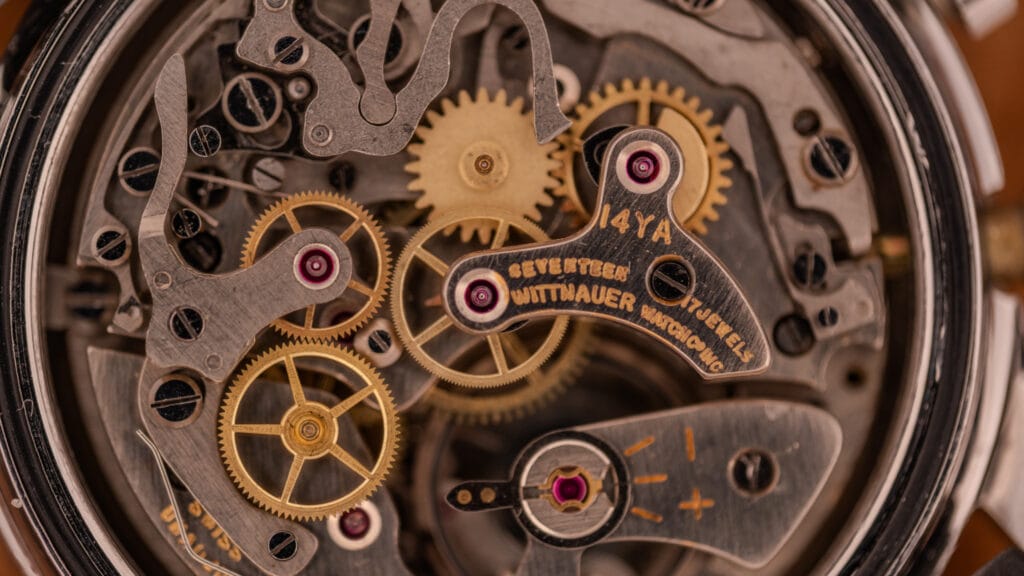
Vintage Wittnauer Chronograph Caliber Identification: Venus 188, Valjoux 7733/7734, Landeron 248
How to identify the movement inside any vintage Wittnauer chronograph: Venus 188, Valjoux 7733 and 7734, Landeron 248, and the house numbering system Wittnauer used to mark them.
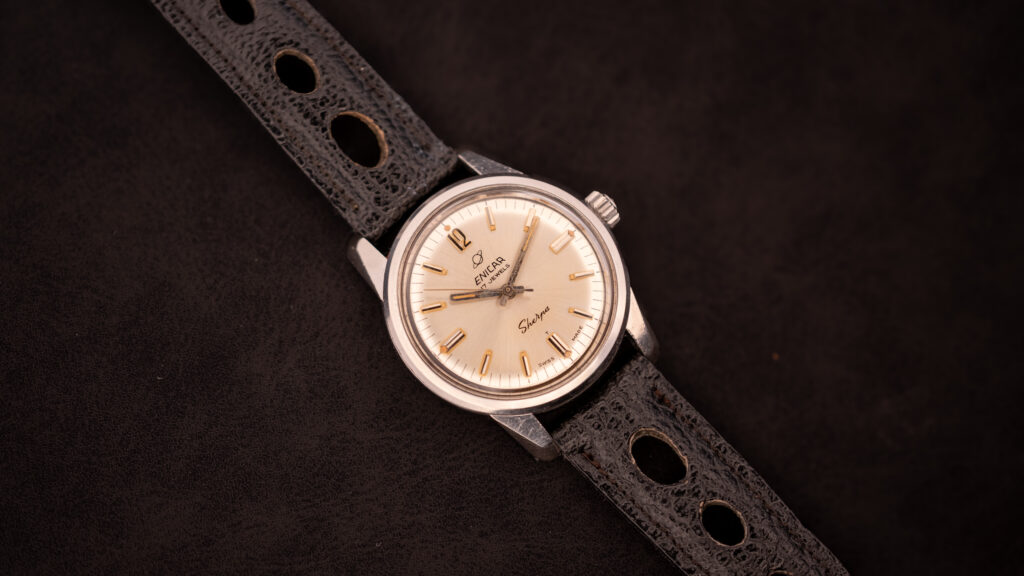
How Water-Resistant Is a Vintage Watch, Actually? The Honest Answer.
Every dealer says never get a vintage watch wet. That advice is half-engineering and half-liability theater. Here is what is actually true about vintage water resistance, where water actually gets in, and when a 1965 diver is safer than a 2-year-old modern.