

A vintage dress watch has a reputation problem: too small, too formal, too fragile, a watch that lives in a drawer until a wedding. Most of that is wrong. Vintage dress watches are thin, quiet, time-first watches, and the right one works with denim as readily as with a suit. Choose for the least formal version of your real wardrobe. This guide covers size, case metal, dial, shape, movement, and strap, using eight watches from our archive.
the short version
| your real use | look for | avoid | archive example |
|---|---|---|---|
| jeans and knitwear most days | steel case, silver or cream dial, a strap with some color | solid gold, diamonds, glossy black leather | Omega Seamaster De Ville |
| office weeks, occasional dinners | slim round steel, a date you will use | ornament you will hesitate to wear | Longines Flagship |
| you want real wrist presence | a genuinely large vintage case | assuming every dress watch is tiny | Omega Jumbo |
| suits and formal rooms, often | ultra-thin case, Roman numerals, no lume | anything sporty on the dial | Jaeger-LeCoultre Ultra-Thin |
| dressing with intent | a shaped case, rectangular or asymmetric | counting on easy crystal replacement | Hamilton Wilshire, LeCoultre Grasshopper |
| gold, worn weekly | gold-capped or gold-filled, a practical complication | treating gold-filled as solid gold | Omega Constellation |
| jewelry that tells the time | precious metal, stones, an unusual display | making it your first vintage watch | Longines Mystery Dial |
what counts as a vintage dress watch
Forget the etiquette manuals. A dress watch is defined by restraint, not by rules. The traits repeat across the category: thin case, clean dial, little or no lume, a leather strap, nothing on the case that shouts. Treat them as family resemblances, not admission requirements. Plenty of good dress watches carry a date, a seconds hand, or a case shape nobody would call plain.
The easiest baseline is a Longines Flagship ref. 2821-285 that came through our hands: a 35mm stainless steel case, 40mm lug to lug, slim through the side, running the manual-wind Longines caliber 285 with a date at three. The factory silver sunburst dial carries applied gold-tone faceted baton markers and black dauphine-style hands, and the watch sits on a tan saffiano leather strap. Longines has kept the Flagship line in its catalog since 1957. Everything about it fits the dress brief, and nothing about it needs a suit. Steel and tan leather see to that.
start with how you’ll wear it
Start with your week, not a brand. Five paths lead to different purchases.
Everyday casual. The watch goes on with jeans and stays on. You want steel, a quiet dial, and a strap that relaxes the whole thing.
Office and dinner. Collared shirts most days, a restaurant some nights. Slim steel or gold-capped, with a date if you will read it.
Formal. You wear real tailoring, often. Ultra-thin cases, white or silver dials, Roman numerals, dark straps.
Design-led. You care how objects are drawn. Shaped cases, rectangular or stranger, worn on purpose.
Jewelry-led. Precious metal and stones, chosen the way you would choose jewelry. A real path, and the wrong first one.
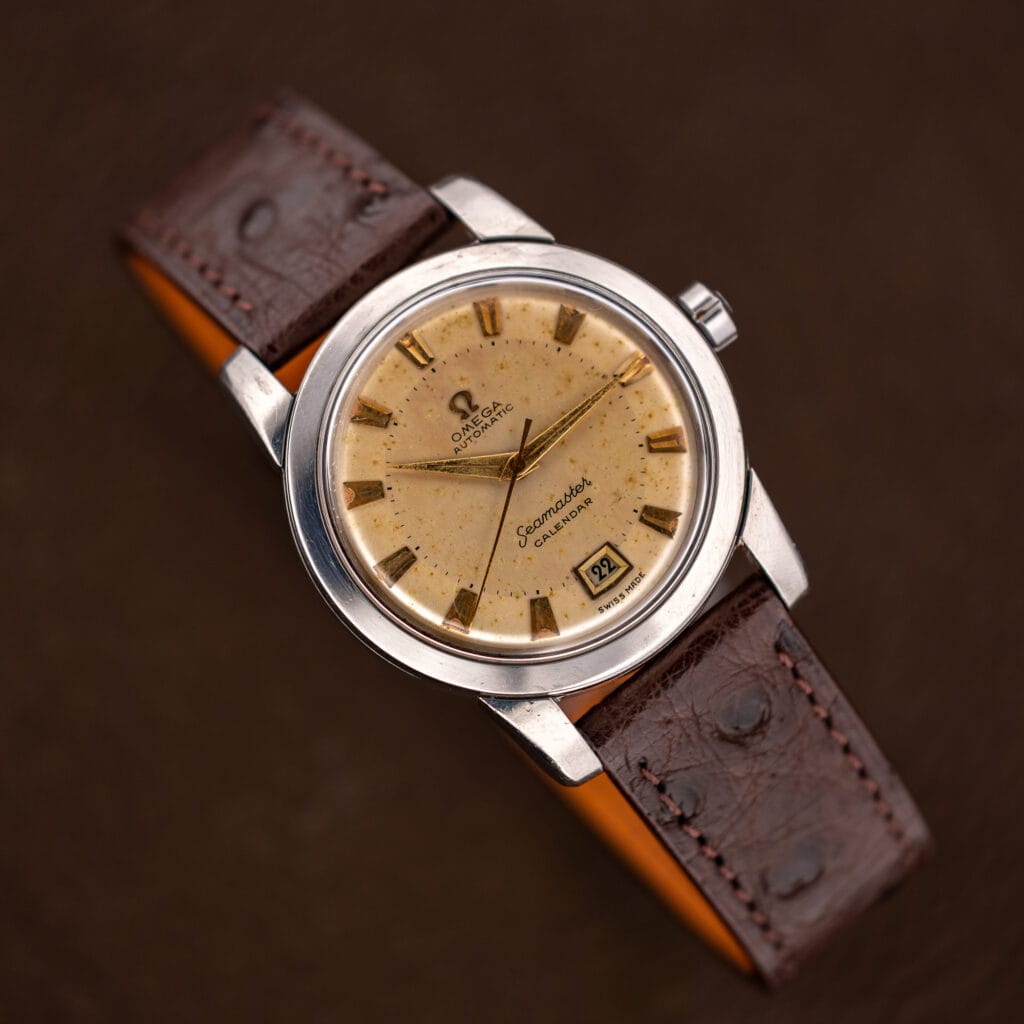
An Omega Seamaster De Ville ref. 166.020 from our archive makes the everyday case. Mid-1960s, a 34.5mm steel case under a domed acrylic crystal, a silver sunburst dial with applied faceted baton markers, a date at three, and the automatic caliber 562 behind a signed crown. Those are dress credentials. On its green leather strap it reads like a Saturday watch. Omega’s own history marks 1967 as the year the De Ville dropped the Seamaster name and became its own collection; this earlier crossover reference keeps a foot in both camps, which is why it bridges denim and dinner. We went deeper on this reference in our De Ville 166.020 guide.
size is a footprint, not a diameter
The number in every listing is diameter, and it is the least useful one you will read. Judge a dress watch by its whole footprint. Lug to lug decides if the case fits your wrist. The dial opening decides how big the watch looks. Thickness decides how it sits under a cuff.
The Jaeger-LeCoultre Ultra-Thin ref. 5003.42 we handled, from the late 1970s to early 1980s, shows why. It measures 34.5mm across and 40mm lug to lug on 18mm lugs, with an ultra-thin steel case and the automatic caliber 900 inside. Factory white dial, black Roman numerals, a railroad minute track, a date at three, no lume, black ostrich strap. Same diameter as the De Ville above, completely different presence: the flat white Roman dial sits at the formal end of restraint, and the case all but vanishes under a cuff.
Then there is the Omega Jumbo ref. 2256/1, a late 1940s dress watch in Staybrite stainless steel, 37.5mm wide and 46mm lug to lug. Warm cream dial, gilt Arabic numerals, leaf hands, blued central seconds, no lume anywhere, with the manual-wind caliber 280 from Omega’s 30mm movement family. The example we handled came with an Omega Extract from the Archives and wore black ostrich. It retires the idea that every vintage dress watch is small. A case this size was exceptional for its period, though, so a buyer who needs modern proportions should plan on a longer hunt.
Shaped cases break the diameter habit completely. The Hamilton Wilshire we handled, a rectangular model introduced around 1938 to 1939, measures 22mm across and 30mm tall in 14k yellow gold-filled, with flexible looping lugs, the manual-wind caliber 982, and an original silvered dial with applied gold Arabic numerals and a subsidiary seconds at six, on black leather. On paper, 22mm sounds unwearable. In person the dial fills the entire case front, the case runs tall, and the lugs add length, so the watch holds its ground. Width is close to meaningless on a shaped case.
No single diameter fits every wrist. Measure, compare lug to lug, and trust the whole footprint.
steel, gold-filled, gold-capped, and solid gold
Steel is the easy answer and often the right one. It dresses down without effort, takes daily wear calmly, and matches a casual wardrobe. The Flagship, the De Ville, and the Jumbo are all steel, and any of them can do a week of denim.
Gold-filled is where shaped American-market watches like the Wilshire live. It is not plating, and it is not solid gold: a gold-filled case bonds a substantial layer of gold over a base metal, and the terms are regulated, with 16 CFR 23.4 spelling out what may legally be sold as gold-filled rather than gold-plated. The ownership catch is at the edges, where gold-filled corners show wear early, so check those corners first. Our gold-filled versus gold-plated guide covers the construction properly.
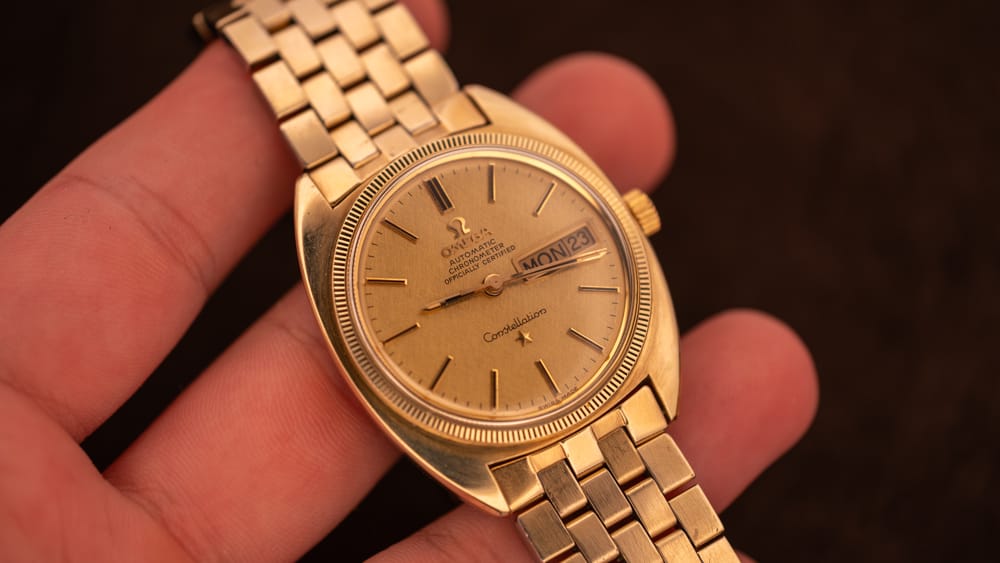
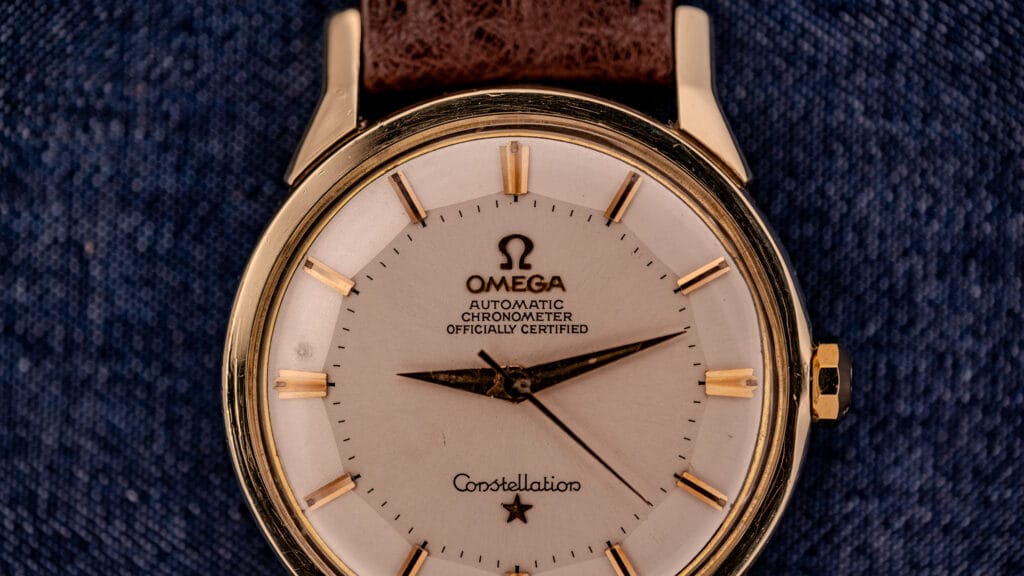
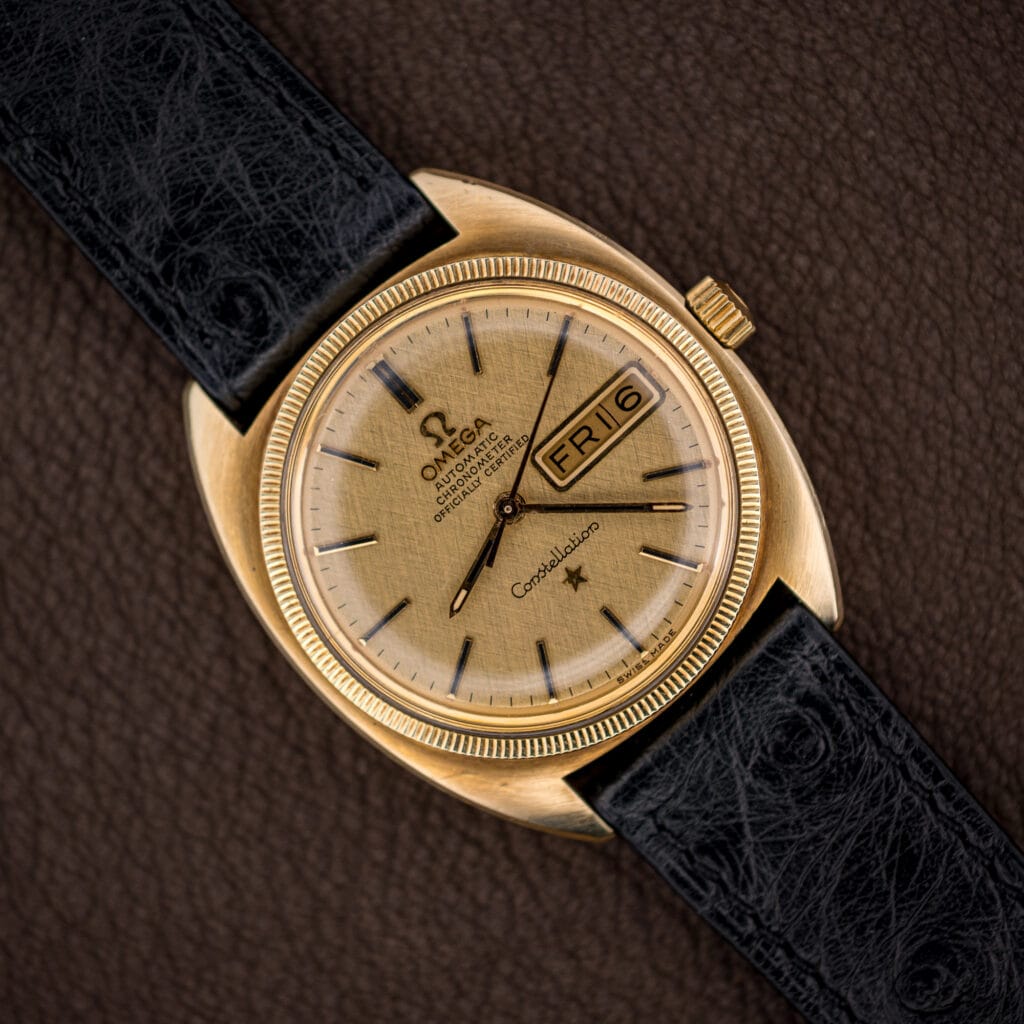
Gold-capped is a different construction again, not another name for gold-filled. The clearest example in our archive is an Omega Constellation ref. 168.023 from around the early 1970s: roughly 35mm, a gold-capped case over a stainless steel back, a fluted bezel, a champagne gold linen dial with applied faceted baton markers, day and date at three, the automatic caliber 751, and a black ostrich strap. Each element nudges it dressier than the steel De Ville: the color, the texture, the bezel, the dark strap. It stays practical anyway, with a day and date you will use. Gold here just means warmer and more deliberate.
Solid gold is the biggest step in formality. From our archive, a mid-1950s Longines Mystery Dial ref. 69-230-2A: 34mm across, 41mm lug to lug, a solid 14k white-gold case around the manual-wind caliber 23Z. The two-tier silver sunburst dial carries four diamond quarter markers, there is no seconds hand, and the hour and minute indicators sit on a clear revolving disc, so they appear to float. It wears a blue snakeskin strap. This is a dress watch working as jewelry and as mechanical theater at once, and the least casual object in this guide.
dials, from quiet to jewelry
Silver and cream dominate the category, and the differences do real styling work. Sunburst catches light and moves, which is why the Flagship and the De Ville feel lively. The Jumbo’s warm cream with gilt numerals sits calmer. Roman numerals push formal: the JLC’s white Roman dial is the most reserved face here. Texture adds interest without noise, which is the Constellation’s trick; champagne linen reads rich in hand and quiet across a room.
Complications do not set formality in either direction. The most formal steel watch in this guide carries a date. The most jewelry-led one has no seconds hand at all. A day-date does not make the Constellation sporty, and a time-only dial does not make the Mystery Dial casual; it stacks two tiers, four diamonds, and floating indicators into the dressiest face on this page. Choose the features you will use, then judge formality by the whole dial, not the function count.
round, rectangular, or something stranger
Round is the default. Shape is the fastest way to make the category feel chosen instead of issued.
A rectangle is a decision. Nobody wears one by accident, and the Wilshire above shows what the decision buys: a dial that owns the whole case front and a profile that reads as design rather than instrument. If that pulls at you, our vintage tank watch buyer’s guide covers the rectangular world in full, so this section stays short.
Asymmetry goes further still. The U.S.-market LeCoultre Aristocrat in our archive, the one collectors nickname the Grasshopper for its flared lugs, pairs a 10k gold-filled asymmetric case with a warm tan dial, applied gold arrowheads and dots, gold dauphine hands, no seconds hand, the manual-wind caliber 490/BW, and a brown lizard-grain strap. The nickname never appeared on the watch; it is collector shorthand, not a model name. The point it proves: formality does not require anonymity. The silhouette can carry the whole outfit.
manual or automatic
Five of the eight watches here wind by hand: the Flagship, the Jumbo, the Wilshire, the Mystery Dial, and the Grasshopper. The JLC, the De Ville, and the Constellation wind themselves.
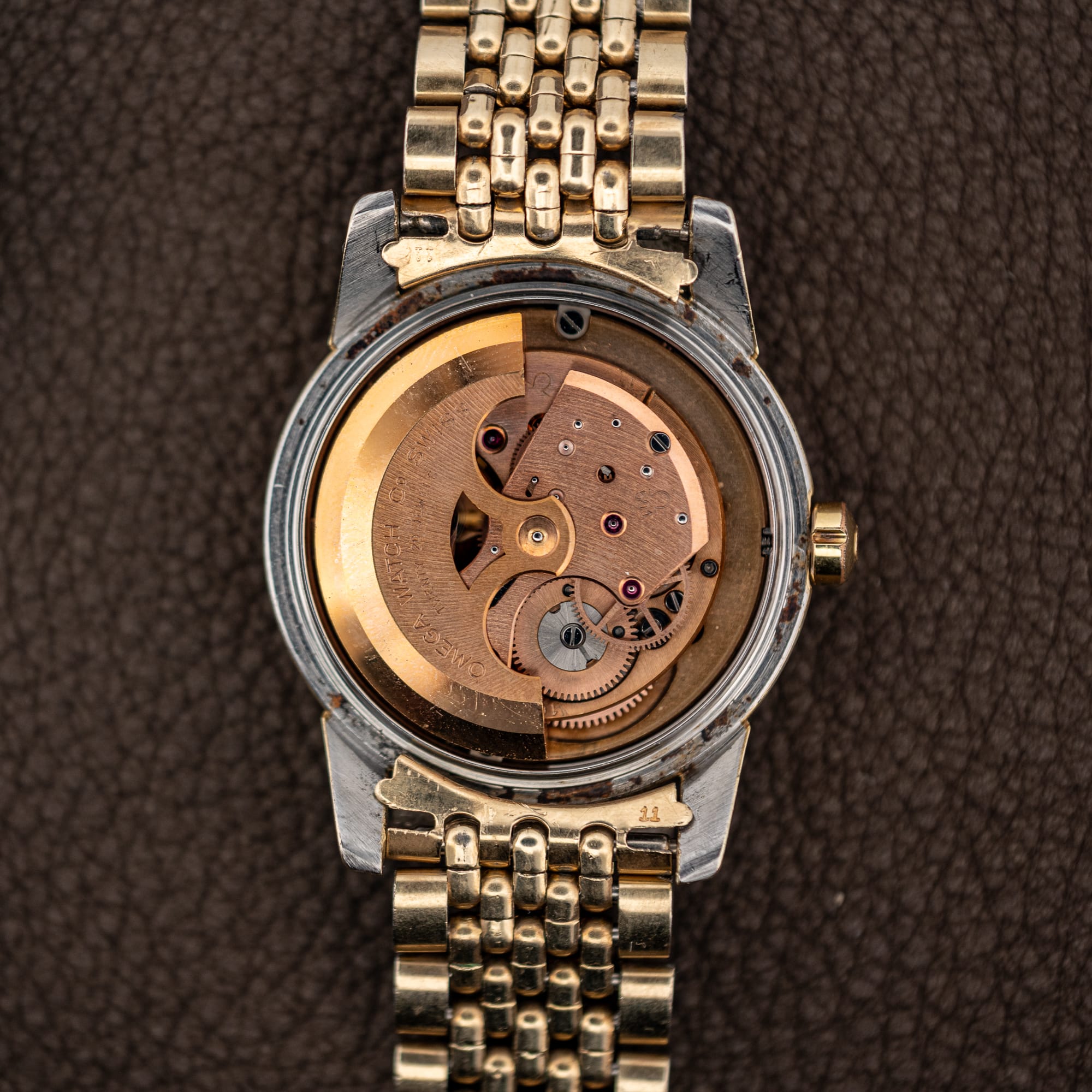
Manual winding is a daily interaction. A few turns of the crown each morning, a small ritual many owners come to like. If that sounds like a chore, believe yourself and buy an automatic, which asks nothing beyond being worn.
Two myths to drop. Manual watches are not automatically thinner or simpler; the thinnest watch in this guide, the JLC Ultra-Thin, is an automatic. And automatics are not maintenance-free; a rotor spares you the crown, not the watchmaker. Both need periodic service, and with either one, favor the seller who can show evidence of it.
the strap is the cheapest second watch
Nothing changes a dress watch’s register faster or for less money than the strap. The formal ceiling is smooth black leather; put that on almost any watch above and it is ready for the most serious room you enter. Dark exotic textures keep most of that formality while adding depth; the Jumbo, the JLC, and the Constellation all wore black ostrich.
To relax a watch, walk the other way. Brown and tan warm it up; the Flagship’s tan saffiano is half the reason it reads so easygoing. Suede and grain soften things further. Color rewrites the character entirely: the De Ville’s green strap turns a silver-dialed dress watch into a Saturday watch without touching the watch itself, and the Mystery Dial’s blue snakeskin leans into jewelry on purpose.
This is styling advice, not law, and cheap to test: several watches here take a common 18mm strap, a swap takes minutes, and a new strap costs far less than another watch. Buy the watch for its case and dial. Buy straps for your wardrobe.
condition, service, and water
The vintage catches, quickly. They matter more than the brand on the dial.
Dials first. An original dial with honest age beats a refinished one nearly every time, and keep two ideas separate: dial style is what the maker drew, patina is what age did to the surface. Linen texture and two-tier layouts are design. Even, warm aging can be patina. Stains and flaking are damage. Our guide to identifying and valuing a vintage watch puts those condition checks in context.
Cases second. Years of casual polishing round off edges that started crisp, and that metal never returns. On gold-filled watches, go straight to the corners, where wear shows earliest. On shaped watches, respect the crystal: shaped crystals can be genuinely hard to replace, so a cracked one is a repair bill, not a detail.
Service is a question you ask, not a feeling you accept. A watch that runs is not a watch that has been serviced. Ask what was done and when, and read why service history changes what a vintage watch is worth before you spend.
And water: keep a vintage dress watch away from it, entirely. The only exception is a watch a qualified watchmaker has recently pressure-tested, and even then you follow that watchmaker’s limits, not your optimism. Our vintage water resistance guide explains why we hold this line.
which one should you choose?
Short paths, by wardrobe and taste.
Mostly casual, one watch worn constantly: steel, round, a silver or cream dial, a strap with warmth or color. The De Ville is the pattern, and the Flagship on its tan strap sits right beside it.
Office weeks with dinners attached: the Flagship pattern, slim steel with a date. Keep a black strap in the drawer and the same watch covers the rare formal night.
Real tailoring, often: the JLC pattern. Ultra-thin, white dial, Roman numerals, dark strap. Nothing else here disappears under a cuff as completely.
Coming off a modern sports watch and nervous about size: hunt the large end, like the Jumbo. Big vintage dress watches exist; the size was the exception in its era, so patience is part of the purchase.
Design first: a rectangle like the Wilshire, or an asymmetric case like the Grasshopper, bought with open eyes about shaped crystals and gold-filled corners. These reward intent.
Gold that still works: gold-capped, like the day-date Constellation. The warmth without committing to solid gold, and a complication you will use daily.
The jewelry path last, on purpose. The Mystery Dial is a destination, and a poor first vintage watch. It asks your wardrobe to rise to it, and a first dress watch should meet your wardrobe where it lives. Start with steel; come back for the diamonds once you know what you actually wear.
don’t save it for weddings
The usual failure is not choosing badly. It is choosing well and then rationing the watch to two ceremonies a year while a sports watch does the daily work it would do with more grace. Put it on with denim this week and let the strap answer the formality question.
For the wider map of categories, our vintage watch styles guide sets dress watches next to their louder siblings. And when you would rather look at watches than read about them, the shop holds the ones we have handled.
Related posts
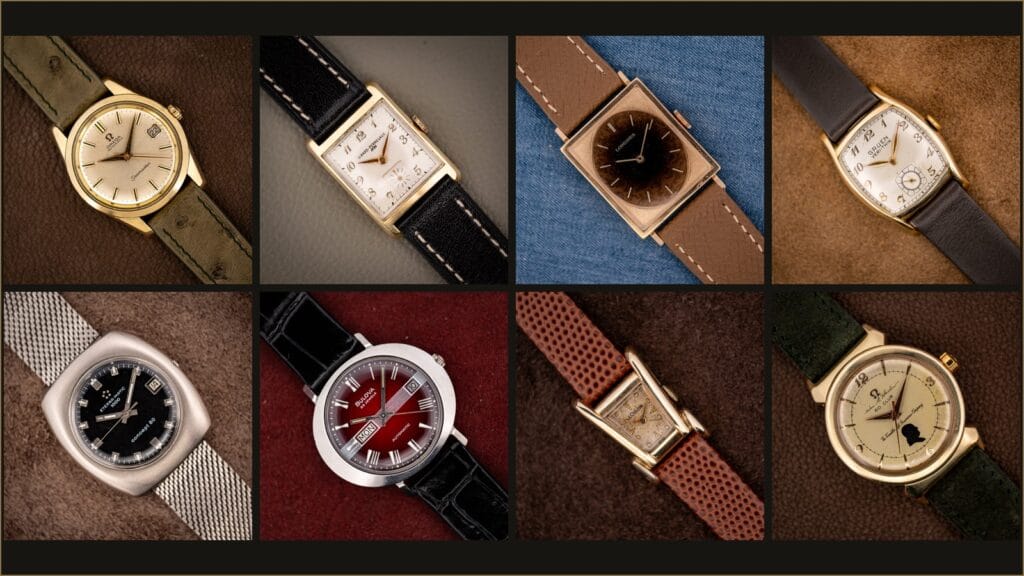
Watch Shapes: Which Vintage Case Shape Fits Your Style?
Case shape changes how a vintage watch wears more than diameter alone. Compare eight silhouettes and learn which one fits your wrist and style.
Vintage Dress Watches: How to Choose One You’ll Actually Wear
The best vintage dress watch is the one you will wear beyond weddings. Here is how to choose the right size, metal, dial, shape, and strap.
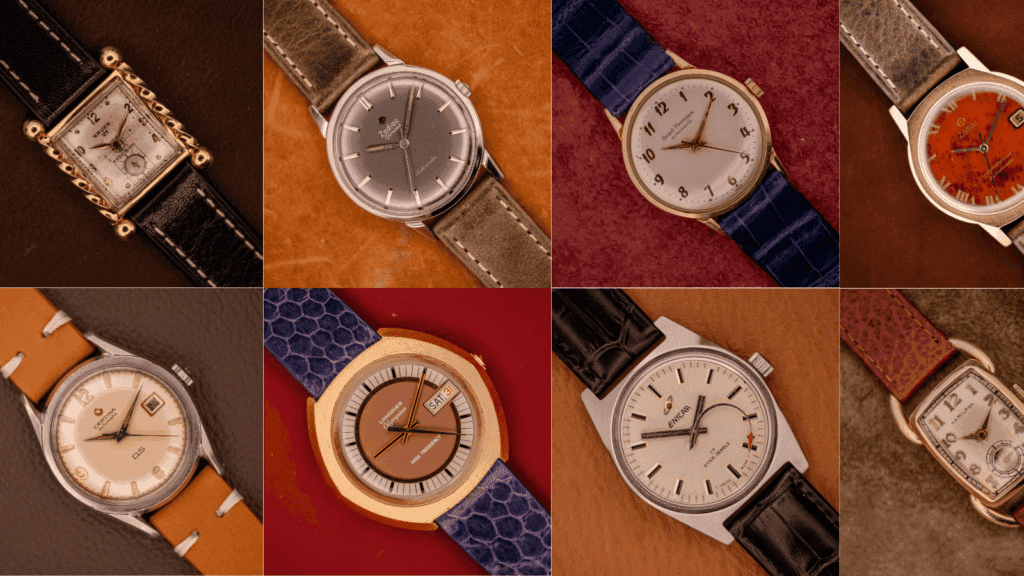
Vintage Watch Styles: A Visual Guide to Finding Yours
Most buyers pick a brand and stall. Here are nine vintage watch styles, shown with real watches from our archive, and the catch that comes with each one.
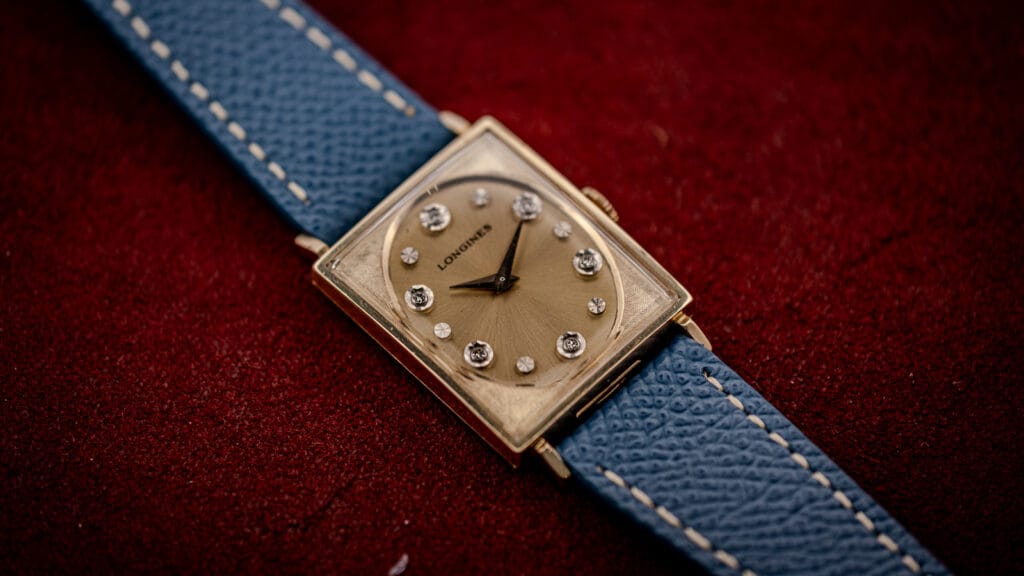
Vintage Tank Watches: A Buyer’s Guide to Rectangular Watches Beyond Cartier
Every Cartier Tank alternatives list is new watches imitating old ones. The originals still exist and cost less. A buyer's guide to vintage tank and rectangular watches: the brands, the prices, and what to check.
Service History Is the Wrong Question. Here’s the Right One.
Everyone says to ask for a vintage watch's service history. Most of it can't be verified, and a receipt proves a transaction, not a result. Here's what actually tells you a watch has been serviced, and the better question to ask.
LeCoultre vs. Jaeger-LeCoultre vs. Jaeger: What the Name on the Dial Means
Three names, one Swiss firm, and one watch that isn't what it looks like. What LeCoultre, Jaeger-LeCoultre, and plain Jaeger on a vintage dial really tell you.
Omega Seamaster 166.010 Buyer’s Guide: Prices, Variants, and What to Look For (2026)
Everything you need to buy an Omega Seamaster 166.010 in 2026: real market prices by condition tier, five dial variants explained, caliber 562 vs 565, original part numbers, and what to inspect before you commit.
Omega vs Rolex: The Vintage Buyer’s Verdict
Vintage Omega vs vintage Rolex: where the Rolex premium is worth paying, where Omega is the smarter buy, and how to dodge redials on both. A collector's verdict.
Movado Kingmatic: A Vintage Buyer’s Guide to References, Calibers, and Value
The Movado Kingmatic is one of the best values in vintage automatics. A buyer's guide to its references, in-house calibers, the Sub-Sea line, what to check, and what they actually sell for.
13 Vintage Watch Collecting Tips for Beginners (From 1,000+ Watches Sold)
Thirteen vintage watch collecting tips drawn from selling over 1,000 watches. What separates a smart first buy from an expensive lesson, with no sugar.
Vintage Wittnauer Chronograph Caliber Identification: Venus 188, Valjoux 7733/7734, Landeron 248
How to identify the movement inside any vintage Wittnauer chronograph: Venus 188, Valjoux 7733 and 7734, Landeron 248, and the house numbering system Wittnauer used to mark them.
How Water-Resistant Is a Vintage Watch, Actually? The Honest Answer.
Every dealer says never get a vintage watch wet. That advice is half-engineering and half-liability theater. Here is what is actually true about vintage water resistance, where water actually gets in, and when a 1965 diver is safer than a 2-year-old modern.