Don't miss the next drop



I want to tell you something that took me an embarrassingly long time to figure out. When I first started collecting vintage watches, I assumed the good stuff started at about five thousand dollars. I thought anything below that was either a parts watch or a compromise. I was wrong. Really, genuinely wrong. Some of the most interesting, best-made, and most historically significant vintage watches on the market right now can be had for well under a thousand dollars. You just have to know where to look, and more importantly, you have to be willing to look past the names everyone already knows.
That is what this guide is about. Not the same list of Rolex references and Omega Speedmasters you have seen recycled on every other watch blog. Those are great watches, but they left this price bracket years ago. Instead, these are the watches we actually see come through our shop, the ones that hold up under inspection, keep good time, and make collectors come back for more. Every pick here is something you can realistically find, buy, and wear in 2026.
Why Under $1,000 Is the Sweet Spot Right Now
Here is what most people miss about the current vintage watch market. While certain famous references from Rolex and Omega have doubled or tripled in price over the past few years, a huge swath of mid-century watches from respected Swiss and American manufacturers has stayed remarkably affordable. Brands like Wittnauer, Gruen, Certina, Cyma, and Doxa produced beautifully made watches with quality movements, and they still trade for a fraction of what their more famous siblings command.
The market has matured considerably. Collectors are more educated now, and the conversation has shifted from brand names toward things like movement lineage, case construction, and design philosophy. A watch with real historical substance from a lesser-known manufacturer is increasingly valued over a big-name piece with nothing interesting to say. At this price point, you are not buying a logo. You are buying craftsmanship, design, and history, which is arguably what vintage watch collecting should be about in the first place.
What to Expect at This Price
Before we get into specific watches, let me set some honest expectations, because going in with the right mindset makes all the difference.
A vintage watch under $1,000 from a reputable dealer should be mechanically sound. It should run and keep reasonable time, usually within about 15 to 30 seconds per day depending on the movement and age. That is not chronometer precision, but it is perfectly acceptable for a watch that might be 50 or 60 years old. It should also be cosmetically honest. You should expect light wear consistent with age, things like hairline scratches on the case or some gentle fading on the dial. What you should not accept is heavy damage, missing lume, or replaced parts that are not disclosed to you upfront.
Originality matters too, especially where the dial, hands, and movement are concerned. Those should match the watch’s era and reference. A replacement crystal or a fresh strap is perfectly normal at this level and does not affect value. But a refinished dial or incorrect handset should always be called out.
One more thing worth mentioning: servicing costs. A basic mechanical service typically runs $200 to $400 depending on the movement. If the watch has not been recently serviced, factor that into your total cost of ownership. A $600 watch that needs $350 in service work is really a $950 watch, and knowing that ahead of time keeps you from feeling surprised later.
Gruen Precision Auto-Wind (~$400 to $700)
Gruen is one of the great forgotten names in watchmaking, and honestly, that is part of what makes their watches such a compelling buy right now. Founded in 1874, the company straddled the line between American design and Swiss manufacturing for nearly a century. Their “Precision” line represented the best of what mid-century watchmaking could offer at a reasonable price, and the automatic versions powered by calibers like the Cal. 400 are legitimately well-made watches.

What makes Gruen special at this price is the dial work. You will find copper sunburst dials, crosshair patterns, and textured finishes that rival anything the bigger names were producing in the same era. The cases are typically gold-filled or stainless steel, sized in the 33 to 35mm range that has become increasingly fashionable as collectors move away from oversized watches. Original dials are key here because Gruen dials age beautifully and refinished examples lose most of their character. The Cal. 400 movement is reliable but parts are getting scarcer, so buy from someone who has confirmed it is running well.
Wittnauer Manual Wind and Automatic Dress Watches (~$500 to $950)
If you want to understand just how much watch you can get for under a thousand dollars, spend some time looking at Wittnauer. As a subsidiary of Longines-Wittnauer, these watches were manufactured with Swiss movements, often calibers from the same family used in Longines pieces, but sold at a lower price point. The result is Swiss quality with American branding, and prices that still have not caught up to what the watches actually are.

The manual wind dress watches are elegant, thin, and wear beautifully on the wrist. The automatics, particularly models with the asymmetric case design in the Ref. 2598 series, have a mid-century flair that looks genuinely distinctive. And if you can stretch toward the top of this budget, the day-date models with colorful dials, like a blue “spider” pattern, are real conversation pieces. Wittnauer used several case styles over the years, and the more unusual shapes like asymmetric cases and hooded lugs tend to command slightly higher prices. They are worth it for the design alone. The movements are robust, and parts are still reasonably available through the Longines service network.
Certina DS (~$500 to $900)
Certina has one of the best origin stories in watchmaking, and I never get tired of telling it. In 1959, they introduced the DS, which stands for Double Security, a case construction designed to be virtually indestructible. The marketing was not subtle. They literally drove a bus over the watch and showed that it still worked. But beyond the gimmick, the DS was a genuinely innovative approach to case sealing and shock protection that influenced how watchmakers thought about durability for decades.
Early DS models with the Cal. 25-451 are available in this price range, particularly the stainless steel versions. These are historically significant watches, and they wear well at 34 to 36mm with clean, legible dials. The fact that you can own a first-generation example of one of watchmaking’s most important case technologies for under a thousand dollars feels like an oversight the market will eventually correct. When shopping for one, the 1st Edition models from the late 1950s and early 1960s carry the most collector appeal. Check that the caseback still has its original DS inscription and markings.

Cyma Watersport (~$400 to $700)
Cyma is a name that draws blank stares from casual watch enthusiasts, which is exactly why their watches are still affordable. This is a brand with roots going back to 1862 in La Chaux-de-Fonds, the same Swiss watchmaking town that produced Girard-Perregaux and Ebel. During the mid-20th century, Cyma produced rugged, well-finished sport and dress watches that competed directly with Omega and Longines in quality if not in marketing budget.
The Watersport line is particularly appealing. These are bumper automatic watches, meaning the rotor does not spin a full 360 degrees but instead bounces between two buffers, giving them a distinctive feel on the wrist. If you have never held a bumper automatic, it is worth experiencing. There is a tactile character to it that modern movements simply do not replicate. The cases are typically stainless steel, the dials are clean and well-proportioned, and the Cal. R420 movement is a solid workhorse. Just know that bumper automatics need regular wearing to stay wound since they do not have the winding efficiency of a full-rotor movement. Make sure the bumper springs are intact and the rotor moves freely before buying.
Doxa Dress Watches (~$400 to $700)
Most people know Doxa for the Sub 300, a legendary dive watch that has become prohibitively expensive in vintage form. But Doxa’s dress and everyday watches are a completely different story, and one I think more collectors should be paying attention to. The company produced a wide range of interesting designs throughout the 1950s, 1960s, and 1970s, including some genuinely unusual case shapes that stand apart from the round-case monotony of most vintage collections.
The Graphic line, for instance, features square and tonneau cases that look unlike anything else on the market. These are conversation-starting watches, the kind where someone notices it across a table and asks what you are wearing. They can be found for well under $700. Doxa dress watches tend to have thinner cases, so check for dents and damage. The movements are usually reliable Swiss calibers. If you are drawn to design and want something that does not look like everyone else’s collection, Doxa is where I would point you.
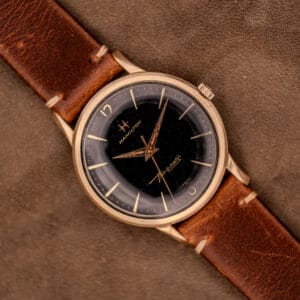
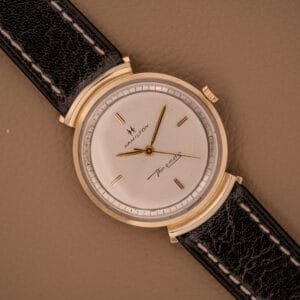
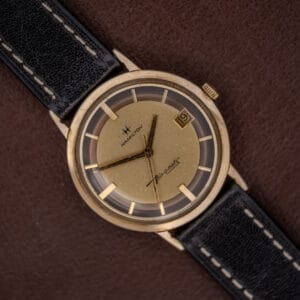
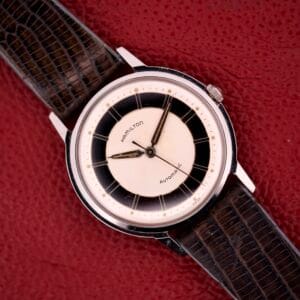
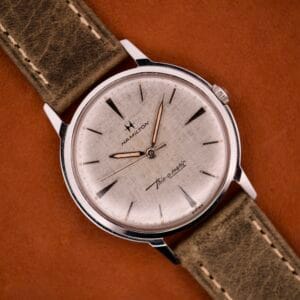
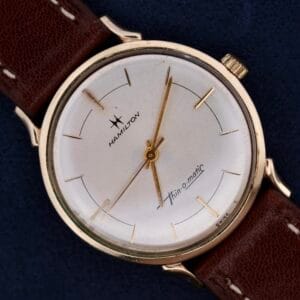
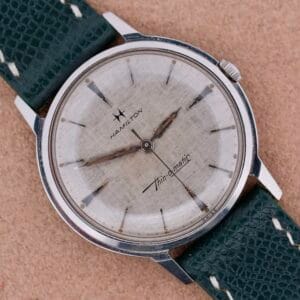
Hamilton Thin-O-Matic (~$600 to $1,000)
Hamilton occupies a unique position in the vintage market. It is an American brand with enormous historical significance, having supplied watches to the U.S. military and the railroads, but their mid-century automatic watches remain surprisingly accessible. The Thin-O-Matic line, produced from the early 1960s onward, used micro-rotor movements like the Cal. 663 that allowed for remarkably slim cases. If you have ever picked up a modern ultra-thin dress watch and appreciated how it disappears on the wrist, Hamilton was doing that same thing sixty years ago.
These watches sit beautifully. The micro-rotor technology was cutting-edge at the time, the same basic concept used in the Universal Geneve Polerouter, which now sells for multiples of what a Thin-O-Matic costs. Gold-filled cases with black or silver dials are the most common configurations, and they have an understated elegance that works just as well with a suit as with a weekend outfit. The micro-rotor movements are thinner but also a bit more delicate than full-rotor calibers, so a recently serviced example is worth paying a premium for. Gold-filled cases can show wear at the edges over decades, and that is normal and expected.


Girard-Perregaux Gyromatic (~$500 to $1,000)
This might be the single most undervalued watch in the entire vintage market, and I say that without exaggeration. Girard-Perregaux is a genuine haute horlogerie brand, one of the oldest Swiss watch manufacturers still in operation, with a pedigree that includes the legendary Tourbillon with Three Gold Bridges. Their vintage Gyromatic line represents the same brand DNA in an automatic, everyday package, and the prices today simply do not reflect what these watches are.
The Gyromatic name refers to GP’s proprietary automatic winding system, which was genuinely innovative for its time. These watches were built to a higher standard of finishing than their current market value would suggest. You will find clean, well-proportioned dials, quality cases, and movements that are a pleasure to look at when the caseback comes off. The black gilt dials on certain references are particularly striking. GP movements are high quality but can be more expensive to service if parts are needed, so a running example in good condition is worth the premium. The fact that you can buy a watch from the same manufacturer as a six-figure modern GP for under a thousand dollars is one of the vintage market’s great quiet bargains.
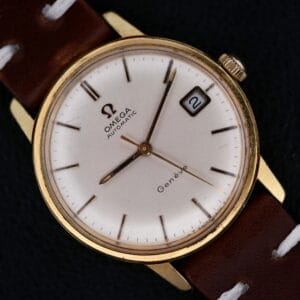
Omega Geneve (~$600 to $1,000)
Omega needs no introduction, but the Geneve line specifically deserves attention at this price point. Produced between 1953 and 1979, the Geneve was Omega’s mid-range offering, positioned below the Constellation but still built with genuine Omega movements and finishing. These were not entry-level watches by any means. They simply were not the flagship.
The sheer variety within the Geneve line is staggering. You will find date and no-date versions, round and cushion cases, textured and smooth dials, in stainless steel and gold plate. The movements, typically calibers from the 500-series or 1000-series families, are proven, well-documented, and still serviceable through Omega or independent watchmakers. Stainless steel cases tend to hold up better than gold plate over time, and the cushion-case models from the late 1960s and early 1970s have a particularly strong following. Always verify the dial is original because Omega Geneve dials were frequently refinished in the past, and a refinished dial can halve the watch’s value overnight.

Bulova Automatic and Snorkel Divers (~$400 to $900)
Bulova is another brand where collector interest has been climbing steadily but prices have not fully caught up. The company was one of America’s largest watchmakers and a genuine innovator. They developed the Accutron tuning fork movement and supplied timing equipment for the Apollo space program. That is a pedigree that deserves more respect than the market currently gives it.
Their automatic watches from the 1960s and 1970s, particularly the Oceanographer and Snorkel dive watch lines, are some of the best values in the sub-$1,000 category. The Snorkel divers, with their distinctive rotating bezels and bold dial designs, have a cult following among collectors who appreciate mid-century tool watches without the Rolex price tag. Even Bulova’s standard automatic dress watches offer excellent movement quality and distinctive case designs for surprisingly little money. The Snorkel and Oceanographer models should have intact bezels because replacements are difficult to find, and original bracelets add significant value if they are included.
Tissot Automatic and Seastar (~$400 to $800)
Tissot is one of those brands that punches well above its weight in vintage form. As part of the Swatch Group today, it is positioned as an entry-level Swiss brand. But in the mid-20th century, Tissot was producing watches that competed directly with Omega in terms of movement quality and finishing. The gap between what vintage Tissot watches are and what people think they are creates a real opportunity for informed buyers.
The Seastar models are particularly appealing. Clean designs, reliable movements, and good case proportions at prices that feel almost too reasonable. You will find them in stainless steel and gold plate, with a variety of dial configurations. The name “Seastar” suggests a sport orientation, but most are perfectly suited to everyday and dress wear. Tissot’s vintage movements are generally ETA-based and easy to service, which keeps long-term ownership costs down. Gold-plated cases are very common, so check the condition carefully. Stainless steel examples tend to hold up better over the long haul.
Enicar Sherpa and Sport Models (~$400 to $800)
Enicar is the deep sleeper on this list, the one that I think has the most room to grow. The Swiss brand was a legitimate competitor throughout the mid-20th century, producing everything from dress watches to chronographs. Their Sherpa line, named after the Himalayan guides, was marketed as an adventure watch, and the automatic models from the 1960s have a rugged charm that is hard to find elsewhere at this price.
What sets Enicar apart is the design variety. You will find watches with bold applied markers, interesting case shapes, and dial textures that feel genuinely creative rather than derivative. The AR 1140 and related automatic movements are workhorses that respond well to servicing, and the brand’s relative obscurity means prices remain very reasonable. There is a small but dedicated Enicar collector community out there, and information on specific references is available if you dig. The Sherpa line is the most collectible, but even their standard sport and dress watches offer excellent value. Watch for redials, as original Enicar dials have a particular quality of printing that is hard to replicate.
Benrus Military and Dress Watches (~$200 to $700)
At the bottom of this budget, Benrus offers perhaps the highest historical significance per dollar of any brand on this list. The company was an official supplier of watches to the U.S. military during World War II, Korea, and Vietnam. Their military-issued watches, particularly the Type I and Type II models, are genuine pieces of American military history that you can actually wear on your wrist. There is something profound about that if you sit with it for a moment.
Beyond the military pieces, Benrus produced a range of civilian dress and sport watches with Swiss and American movements. These are simple, honest watches that do exactly what they are supposed to do. The cases tend to be modest in size, usually 32 to 34mm, the dials are clean and legible, and the movements keep solid time after servicing. Military-issued Benrus watches should have proper military markings on the caseback, and there are reproductions on the market, so verify provenance carefully. Civilian Benrus watches are much less prone to faking because frankly, nobody is going to counterfeit a $300 dress watch.
How to Buy Safely at This Price
The under-$1,000 market is where the most risk lives, because it is the entry point for both new collectors and new sellers. So here is what I would tell a friend who is buying their first vintage watch.
Buy from a dealer who opens the watch. If someone is selling a vintage watch without having opened the caseback, inspected the movement, and confirmed it matches the watch, you are taking a gamble. A watch that looks correct on the outside can house a completely wrong movement, or worse, a cobbled-together mix of parts from different eras that collectors call a “frankenwatch.” At OTTUHR, every watch we sell is opened, photographed at the movement level, and verified against known production data before it ever reaches the shop.
Ask about servicing. Has the watch been recently serviced? Is it running within acceptable tolerances? A watch that “runs but has not been serviced” might need $300 to $400 in work, and at this price point that changes the math considerably.
Understand what has been replaced. A new crystal, a fresh strap, or even a service-replacement crown is normal and generally fine. A refinished dial, incorrect hands, or a non-original movement is a different story entirely. Transparency is everything in this market.
And be patient. The best deals in vintage watches go to patient buyers who wait for the right example rather than jumping on the first thing they see. Good watches at fair prices come through reputable dealers regularly. There is no reason to rush.
The Bottom Line
A thousand dollars is a meaningful amount of money, and it should buy you a meaningful watch. The twelve brands here all offer exactly that: real history, quality craftsmanship, and designs that have stood the test of time. Some of them, like Girard-Perregaux, Certina, and Enicar, are arguably trading well below their intrinsic value, and the collectors who buy them now will likely look very smart in a few years.
But I would encourage you not to buy a vintage watch as an investment. Buy it because it connects you to something, a particular era, a particular craft, a particular aesthetic that resonates with who you are. The financial upside is a bonus. The daily pleasure of wearing something with genuine history on your wrist is the real return.
If any of these watches caught your eye, browse our current collection at ottuhr.com/watches. And if you are looking for something specific, our Watch Finder service can help track it down through our network of trusted sources.
Related posts

Omega Bumpers : A Collector’s Guide to References 2374 Through 2782
Everything you need to know about Omega bumpers from 1943 to 1962. The mechanism, the key references, what they cost, and why collectors are paying attention.

Omega Serial Numbers: The Complete Guide to Dating Your Watch
Every Omega movement that left the factory in Bienne, Switzerland received a serial number. That number, stamped onto a bridge or plate...

Why Black Dials Are the Rarest Thing in Vintage Watches
Most people think they understand why tropical dials command a premium. The story usually stops at "black turned brown, collectors love...

Wittnauer Watch Serial Numbers and Production Date Guide
Here's the honest truth that most watch sites won't tell you: there is no publicly available serial number table for Wittnauer watches....

The 12 Best Vintage Watches Under $1,000 in 2026
I want to tell you something that took me an embarrassingly long time to figure out. When I first started collecting vintage watches, I...
Longines Serial Numbers: The Complete Reference Guide 2026
Longines has been making watches since 1832, and they've been recording serial numbers for every single one since 1867. That's over 150...

Hamilton Watch Serial Numbers: How to Date Your Timepiece
Hamilton produced roughly 4.5 million watches over the course of its American manufacturing life, from the first movements completed in...

How to Read a Rolex Serial Number: The Complete Dating Guide 2026
If you want to date a vintage Rolex, understand what you actually paid for, or avoid getting burned on a purchase, the serial number is...

Your First Vintage Watch: The 2026 Beginner’s Buying Guide
There are dozens of beginner's guides to vintage watches online. Most of them tell you to "set a budget," "research brands," and "buy f...

The Collector’s Guide to Vintage Universal Genève Watches
From two horology students in Le Locle to one of the most coveted names in vintage collecting, everything you need to know before buying your first (or fifth) Universal Genève.

Gold Filled vs. Gold Plated Watches: What Every Collector Needs to Know
The difference between a gold watch that lasts a lifetime and one that wears through in a year comes down to a layer of metal thinner than a human hair. Here's how to tell them apart, what the markings actually mean, and which one you should buy.

The Wittnauer Story: Longines’ Best-Kept Secret
Why one of America's most important watch brands deserves a place in your collection, and why now is the time to pay attention.