

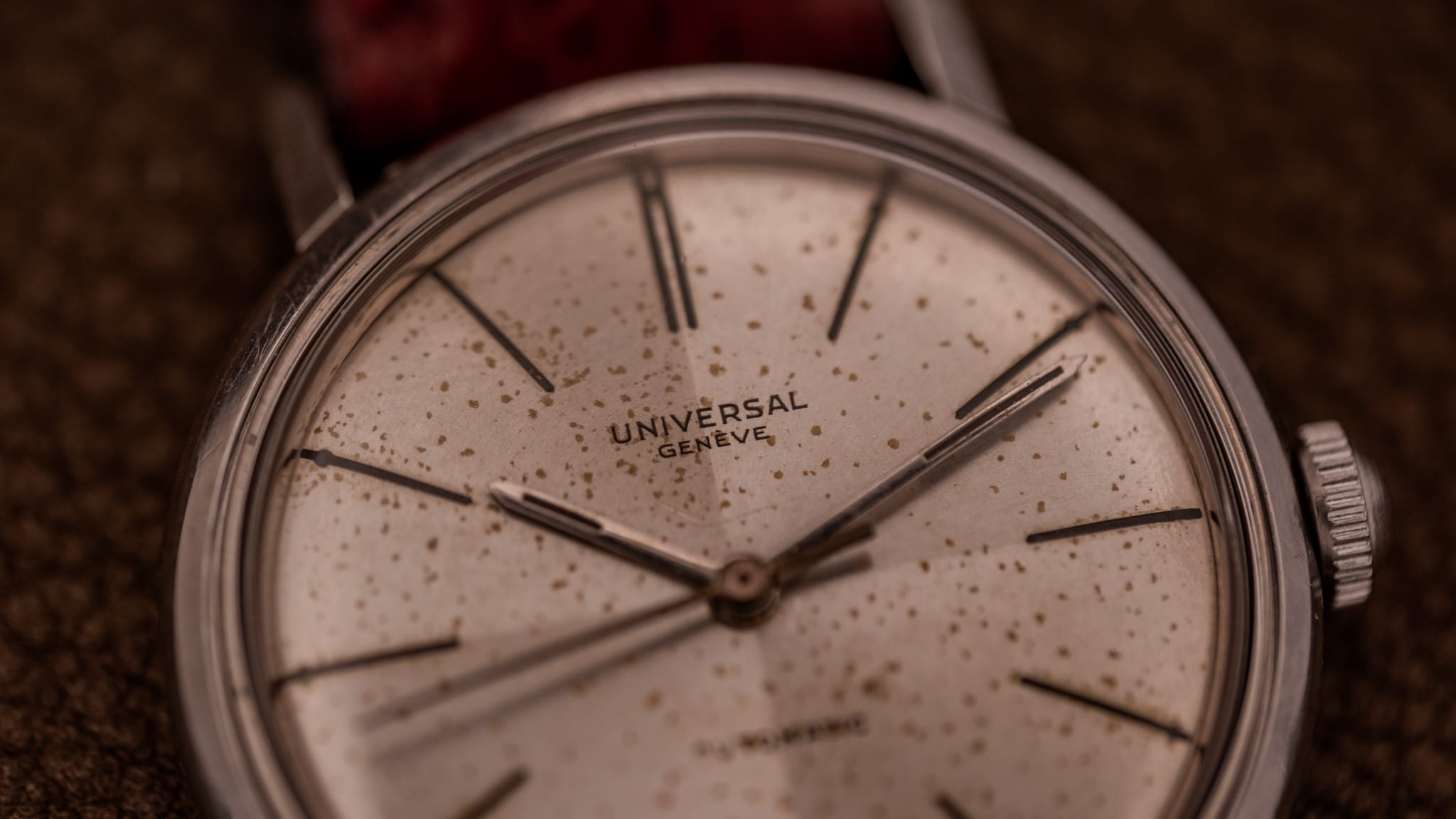
Why Universal Genève Matters
There’s a particular thrill in discovering that the brand sitting quietly in a dusty display case once stood shoulder to shoulder with Patek Philippe on the Rue du Rhône in Geneva. That its chronographs were strapped to the wrists of Italian Air Force pilots. That it produced the first-ever triple-register chronograph wristwatch. And that a 23-year-old Gérald Genta, decades before sketching the Royal Oak, cut his teeth designing its most iconic model.
That brand is Universal Genève, and for collectors who know where to look, it remains one of the most rewarding corners of the vintage watch market.
Unlike Rolex or Omega, Universal Genève never became a household name. It never had to. For most of the 20th century, it earned its reputation the old-fashioned way: by building exceptional, technically innovative watches that earned the respect of other watchmakers. The official Universal Genève timeline reads like a highlight reel of horological firsts: first wrist-worn chronograph (1917), first patented automatic wristwatch (1925), first reversible watch (the Ideo, 1933), first triple-register chronograph (the Compax, 1936), and one of the earliest micro-rotor automatic movements (Caliber 215, 1955).
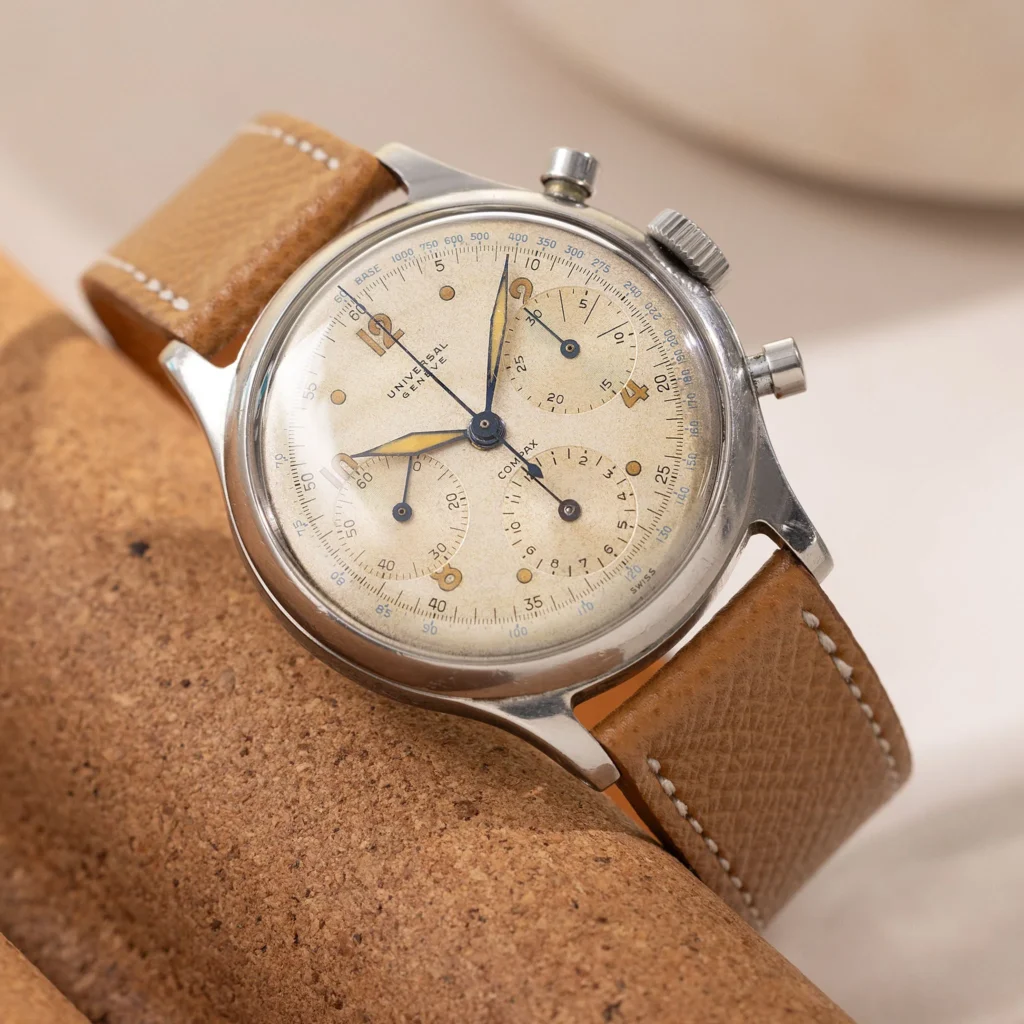
For today’s collectors, that combination of historical significance, technical innovation, and relative under-appreciation translates to watches that punch far above their price point. A Universal Genève Polerouter with a Genta-designed case and an in-house micro-rotor movement can still be found for a fraction of what a comparable Omega Constellation or Rolex Datejust commands. And the brand’s legendary chronographs, the Compax, Tri-Compax, and Space-Compax, offer complications and craftsmanship that rival pieces selling for ten times their price at auction.
This guide is written from behind the counter and the collector’s desk. We handle these watches daily, and we’ve learned what separates the great examples from the traps. Whether you’re considering your first Universal Genève or building out a focused collection, this is the reference we wish we’d had when we started.
A Brief History: From Le Locle to the World
Universal Genève was born on January 18, 1894, when two horology students, Numa-Emile Descombes and Ulysse-Georges Perret, registered “Universal Watch” in Le Locle, Switzerland. The company began as an établissage, assembling movements, dials, cases, and hands into finished watches. But the founders had larger ambitions. That same year, they patented their first complication: a 24-hour jumping-hour movement.
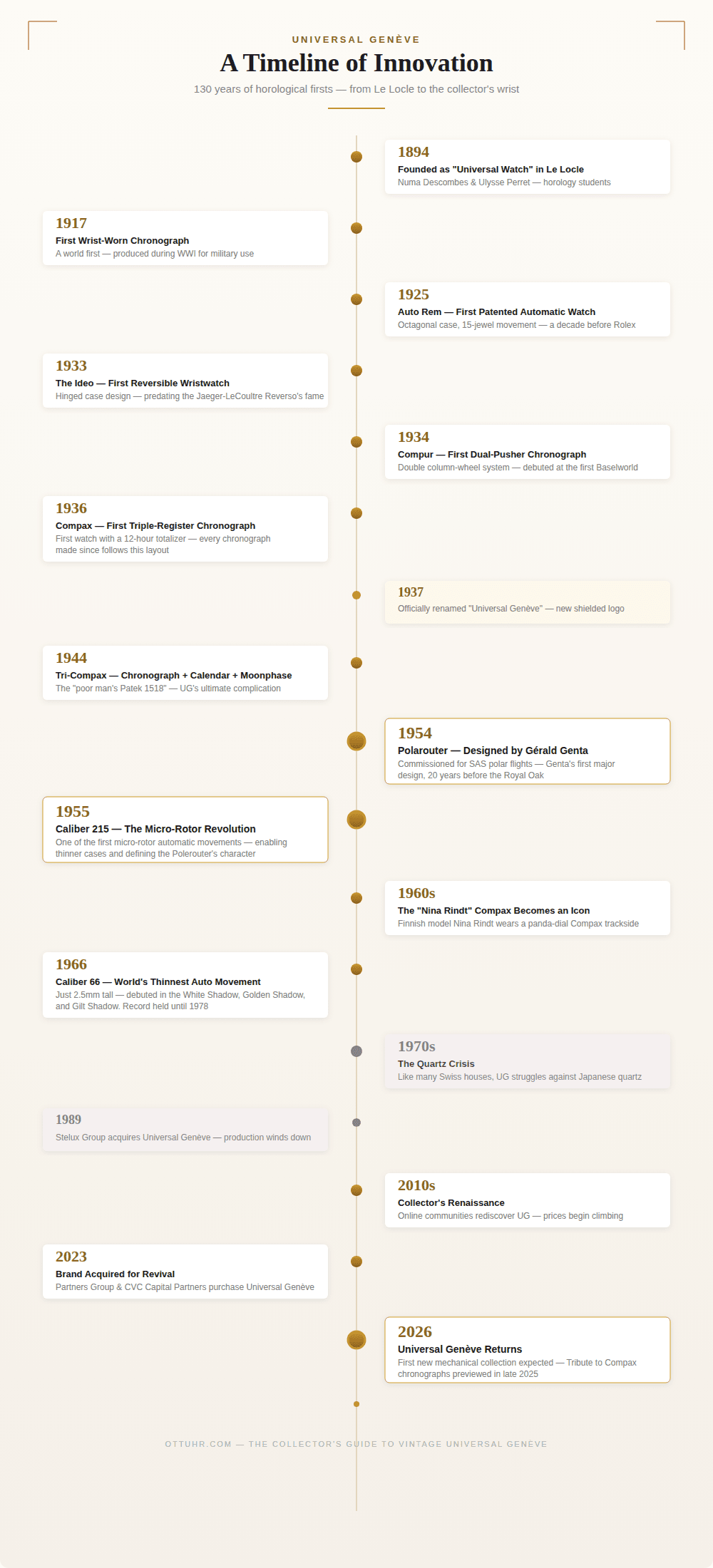
Descombes died suddenly in 1897 at just 34. Perret recruited Louis-Edouard Berthoud as partner, and the pair operated briefly as “Perret & Berthoud” before adopting the Universal Watch name. Together, they produced chronographs and trench watches for both sides during World War I, including what the Universal Genève historical archive documents as one of the first wrist-worn chronographs in 1917.
The 1920s brought a burst of R&D: the Auto Rem automatic watch (1925), the Cabriolet reversible watch with 8-day reserve (1927), and the adoption of the marine knot logo in 1929 following a Swiss legal requirement. After Perret’s death in 1933, his son Raoul consolidated operations in Geneva and rebranded as “Universal Watch Co. Ltd. Genève.” The move was strategic, positioning the company on the Rue du Rhône between the Rolex and Patek Philippe buildings. The name “Universal Genève” became official in 1937.
The Golden Age of the Compax Chronographs
The 1930s through 1960s represent Universal Genève’s golden era. At Baselworld 1934, the brand debuted the Compur, the first dual-pusher chronograph with a double column-wheel system. In 1936, two landmark models arrived: the Uni-Compax (two-register chronograph) and the Compax, the first wristwatch ever to feature a 12-hour totalizer. The naming convention became a brand signature: “Compax” (short for “compact chronograph”) with prefixes denoting each model’s unique complications.
The Aero-Compax (four registers with a memo counter), the Tri-Compax (triple calendar with moonphase, 1944), and the Space-Compax (rubber pushers for water resistance, 1960s) each expanded the family in distinctive ways. These movements were primarily built around the renowned Caliber 285 column-wheel chronograph, later supplemented by the Valjoux 72 in the Compax line, the same movement that would famously power early Rolex Daytonas.
The Hermès Connection: During this period, Universal Genève collaborated with Hermès to produce the “Pour Hermès” chronographs. Hermès’ Paris headquarters became a major European sales hub for all Universal Genève watches, and the Henri Stern Watch Agency in New York, best known as Patek Philippe’s American distributor, served as UG’s official North American dealer. Universal Genève was, quite literally, sold alongside Patek Philippe as a sister brand.
Genta, the Polerouter, and the Micro-Rotor Revolution
In 1954, Scandinavian Airlines System (SAS) completed a historic route: the first commercial polar flight from Copenhagen to Los Angeles. To commemorate the achievement, Universal Genève commissioned a young, relatively unknown watch designer named Gérald Genta to create a pilot’s watch for SAS crew. Genta was 23 years old.
The result, the Polarouter (renamed Polerouter the following year), became Universal Genève’s best-selling watch and one of the most beloved designs in mid-century horology. Its bombé lugs, crosshair dial, and trapezoidal indices established a design vocabulary that Genta would refine for decades to come, ultimately producing the Audemars Piguet Royal Oak and Patek Philippe Nautilus. The history of the Polerouter documented by Worn & Wound details how this single model spawned over a thousand reference variations across twenty years of production.
More importantly, the Polerouter introduced the Caliber 215 micro-rotor movement, a breakthrough that allowed automatic winding with a significantly thinner profile than conventional rotor designs. The micro-rotor (or “Microtor,” as UG branded it) became a defining technical achievement, and Universal Genève held the record for the world’s thinnest automatic movement with the later Caliber 66 until 1978.
Decline and Collector’s Renaissance
Like many great Swiss houses, Universal Genève was battered by the Quartz Crisis of the 1970s. A 1966 partnership with Bulova gave UG access to tuning fork technology (producing the Unisonic line), but couldn’t prevent decline. In 1989, Hong Kong’s Stelux Group acquired the brand. Production of mechanical watches effectively ceased.
Then something remarkable happened. Vintage collectors rediscovered Universal Genève. As Rescapement documented, the brand went from near-total obscurity to cult status among serious collectors in barely a decade, driven by online watch communities and a few influential publications. In 2023, Partners Group and CVC Capital Partners acquired the brand with plans for a full revival, and the first new Universal Genève mechanical watches are expected in 2026.
The Essential Models Every Collector Should Know
Universal Genève produced an enormous range of watches over its active decades. Below are the models that define the brand and represent the best collecting opportunities today.
The Polerouter Family
1954 to 1970s · Dress/Sport · Automatic
The Polerouter is the gateway Universal Genève for most collectors, and with good reason. Genta’s design has aged beautifully, and the compact 33.5 to 35.5mm case wears perfectly on modern wrists looking for something other than oversized sport watches. The Polerouter Reference Website maintained by Adam Hambly is the definitive catalog of the staggering variety within the line.
Key sub-models to know:
Polarouter/Polerouter (Refs. 20214, 20217, 20357, 20360): The original time-only models. The earliest 20214/20217 references use the Cal. 138SS bumper movement; later 20357 and 20360 references introduced the groundbreaking Cal. 215 micro-rotor. The 20360 at 35.5mm is more wearable for most collectors than the 33.5mm 20357.
Polerouter Date: Added a trapezoidal date window at 3 o’clock, a distinctive design touch. Became the best-selling variant. Evolved through Cal. 215-1, 218-2, and eventually Cal. 69.
Polerouter De Luxe: Solid gold cases with refined dials, including some extraordinary Middle Eastern commissions with enamel portraits. These are dressier, rarer, and command a premium.
Polerouter Sub: Universal Genève’s dive watch, produced 1961 to 1968. The dual-crown Super Compressor variant (Ref. 20369) is exceptionally rare and frequently faked. Single-crown models are more accessible and equally interesting.
Polerouter Genève (Refs. 20375, 40375): A more affordable line aimed at younger buyers, with slimmer cases and a wonderful space-age aesthetic. These remain some of the most affordable Polerouters on the market.
Typical Case Size: 33.5 to 37.5mm | Key Movements: Cal. 138SS, 215, 218-2, 69 | Entry Price (2026): $600 to $1,200 | Sweet Spot: $1,200 to $2,500
Currently in the OTTUHR collection: We have a Universal Genève Polerouter 20375-4 “Incognito Dial”with its original Cal. 215 micro-rotor movement, a Polerouter Genève variant that perfectly illustrates the line’s understated charm. The “incognito” dial, bearing no brand text, gives it a particularly clean, almost modern aesthetic.
The Compax
1936 to 1970s · Chronograph · Manual Wind
The Compax name covers a broad family of chronographs that represent Universal Genève’s greatest contribution to watchmaking. The triple-register layout (30-minute counter, 12-hour totalizer, and running seconds) was a UG innovation that every subsequent chronograph brand has adopted.
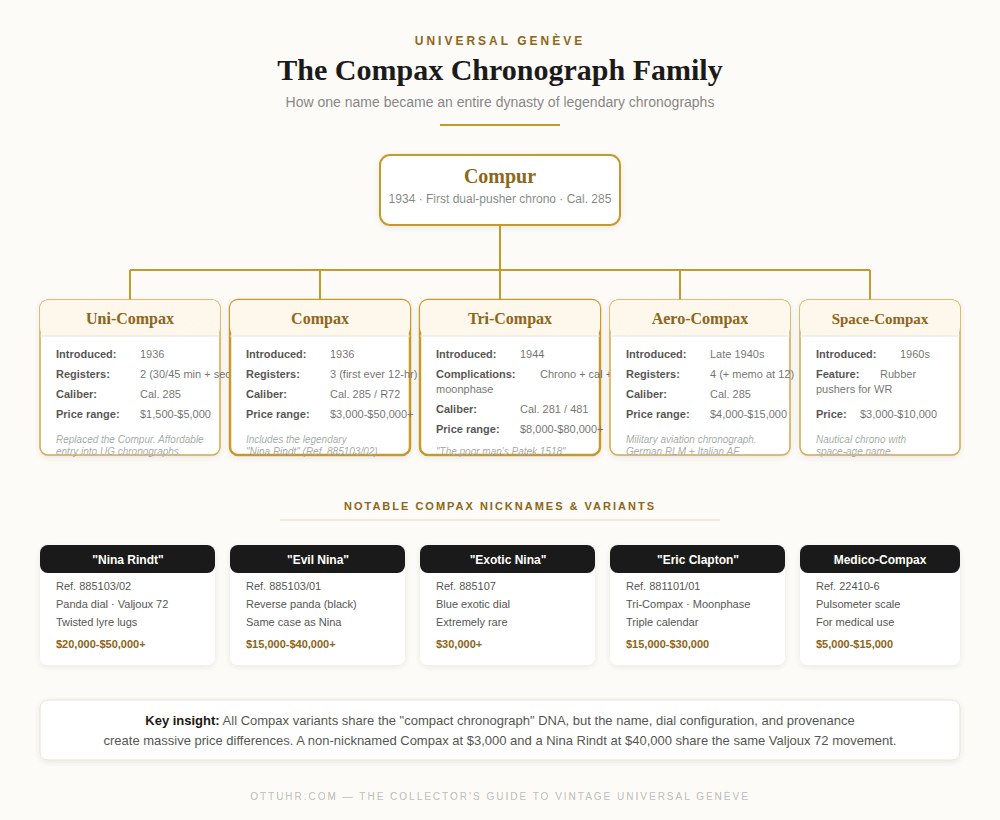
The most famous Compax is the “Nina Rindt” (Ref. 885103/02), named after Finnish model Nina Rindt, wife of Formula One champion Jochen Rindt. Nina’s habit of wearing her panda-dial Compax on a wide bund strap trackside made the watch an icon. After Analog Shift and HODINKEE profiled the watch in 2014, prices rocketed from the low four figures to five figures seemingly overnight. The newly revived Universal Genève has announced a Tribute to Compax collection as part of its 2026 relaunch.
Other notable Compax variants include the “Evil Nina” (Ref. 885103/01, reverse-panda black dial), the “Exotic Nina”(Ref. 885107, blue exotic dial), and numerous earlier references with different case styles and dial configurations.
Typical Case Size: 36mm | Key Movements: Cal. 285, Cal. 72 (Valjoux-based) | Entry Price (2026): $3,000 to $6,000 (non-Nina) | Nina Rindt: $20,000 to $50,000+
The Uni-Compax
1936 to 1960s · Two-Register Chronograph · Manual Wind
The Uni-Compax replaced the original Compur and features a two-register chronograph layout (running seconds and 30 or 45-minute counter). These are more affordable than the three-register Compax models and come in a fantastic variety of case shapes: round, square, faceted, oversized. For collectors who want a Universal Genève chronograph without the Nina Rindt premium, the Uni-Compax is the smart entry point.
Typical Case Size: 33 to 36mm | Key Movements: Cal. 285, Cal. 281 | Entry Price (2026): $1,500 to $3,000 | Exceptional Examples: $4,000 to $8,000
The Tri-Compax
1944 to 1960s · Triple Calendar Chronograph w/ Moonphase · Manual Wind
The Tri-Compax is Universal Genève’s ultimate complication piece: a chronograph with complete calendar (day, date, month) and moonphase. When Rescapement called Universal Genève “the poor man’s vintage Patek Philippe,” they were largely talking about the Tri-Compax. Its layout is strikingly similar to Patek’s legendary Reference 1518, the first serially produced perpetual calendar chronograph.
The most collected variant is the “Eric Clapton” (Ref. 881101/01), a nickname earned after the rock legend was spotted wearing one. These are serious watches that demand serious maintenance due to the complexity of the calendar mechanism, but they offer extraordinary value compared to equivalent complications from Patek or Vacheron Constantin.
Typical Case Size: 36 to 38mm | Key Movements: Cal. 281, 481 (Martel-based) | Entry Price (2026): $8,000 to $15,000 | Exceptional/Gold Examples: $20,000 to $80,000+
The Space-Compax and Aero-Compax
1940s to 1960s · Specialty Chronographs · Manual Wind
The Aero-Compax was a four-register chronograph developed for military aviation, with a memo counter at 12 o’clock for timing missions. The Space-Compax, introduced in the 1960s, featured rubber chronograph pushers for enhanced water resistance, a nautical chronograph despite its space-age name.
Both models are deeply appreciated by tool-watch collectors. As Phillips auction records show, exceptional Aero-Compax examples, particularly those with military provenance or exotic dials, can command significant premiums.
Typical Case Size: 36 to 38mm | Aero-Compax Entry: $4,000 to $10,000 | Space-Compax Entry: $3,000 to $7,000
The White Shadow, Golden Shadow, and Gilt Shadow
1966 · Ultra-Thin Dress · Automatic
When Universal Genève debuted the Caliber 66 at the 1966 Basel fair, it was the thinnest automatic movement in the world at just 2.5mm. The Shadow line showcased this achievement in cases of stainless steel (White Shadow), gold-plated (Gilt Shadow), and solid gold (Golden Shadow). These are the vintage dress watch lover’s secret weapon: impossibly thin, beautifully finished, and still relatively affordable compared to equivalent ultra-thin pieces from Piaget or Audemars Piguet.
Case Thickness: ~6.5mm total | Movement Height: 2.5mm (Cal. 66) | Entry Price (2026): $800 to $2,000
Caliber Guide: Understanding UG Movements
Movement identification is critical when evaluating any vintage Universal Genève. The brand used a mix of in-house movements, ebauches from Martel Watch Company (later acquired by Zenith), and Valjoux-supplied chronograph calibers. Knowing which caliber belongs in which watch is the first line of defense against Frankenwatches.
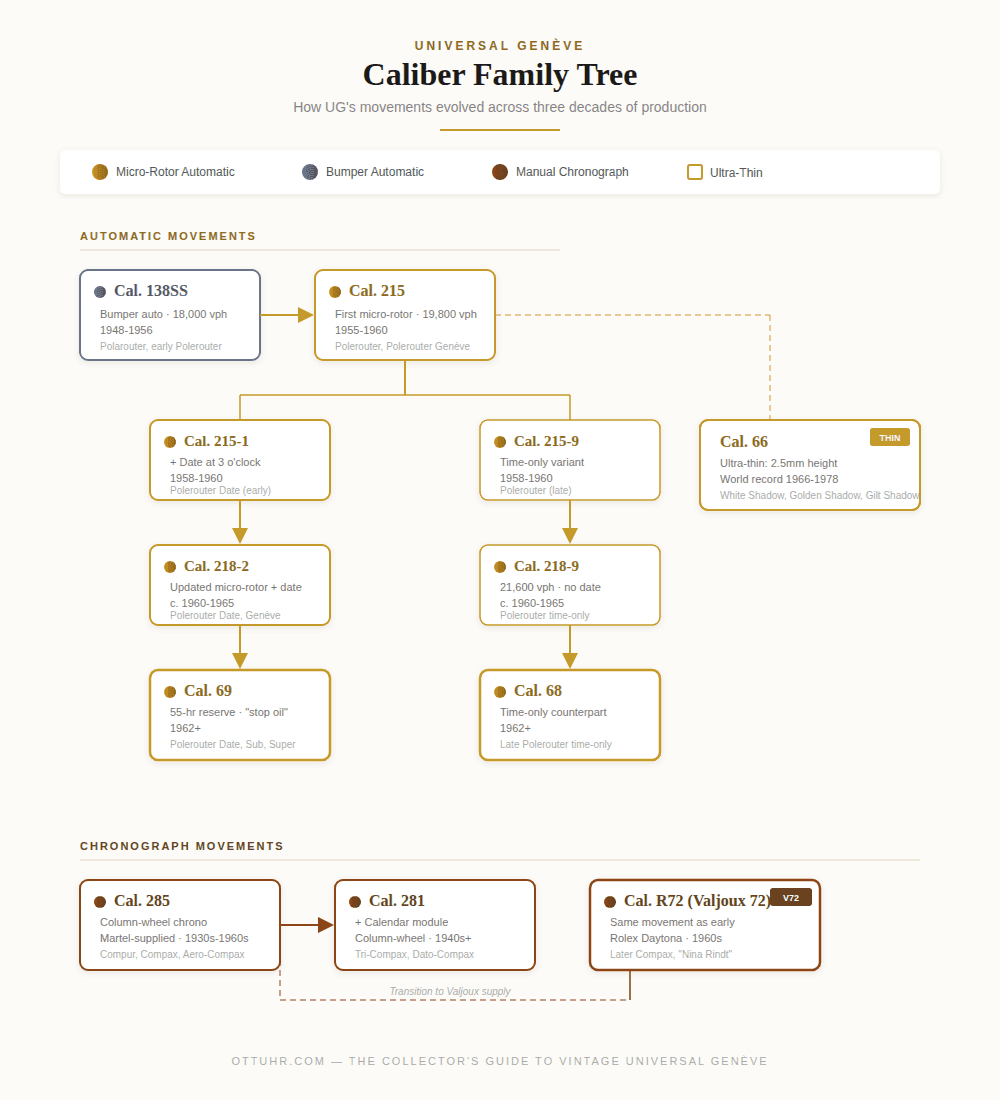
The Polerouter Reference Website’s caliber-matching research is an invaluable resource for Polerouter-specific caliber verification. For chronographs, Pietro Giuliano Sala’s book Universal Watch Genève remains the definitive printed reference.
Cal. 138SS — Bumper automatic. 18,000 vph; earlier, thicker movement. Found in: Polarouter, early Polerouter.
Cal. 215 — Micro-rotor automatic. First UG micro-rotor; patent pending 1955, granted 1958. Found in: Polerouter, Polerouter Genève.
Cal. 215-1 — Micro-rotor automatic + date. Added date complication at 3 o’clock. Found in: Polerouter Date (early).
Cal. 218-2 — Micro-rotor automatic + date. Updated version; replaced 215-2 mid-production. Found in: Polerouter Date, Polerouter Genève.
Cal. 218-9 — Micro-rotor automatic (no date). 21,600 vph (higher beat rate than 215). Found in: Later time-only Polerouters.
Cal. 69 — Micro-rotor automatic + date. 55-hour power reserve; “stop oil” treatment. Found in: Polerouter Date (late), Polerouter Sub, Super.
Cal. 68 — Micro-rotor automatic (no date). Time-only counterpart to Cal. 69. Found in: Late Polerouter time-only models.
Cal. 66 — Micro-rotor automatic. 2.5mm height, world’s thinnest auto until 1978. Found in: White Shadow, Golden Shadow, Gilt Shadow.
Cal. 72 — Automatic + day/date. Different bridge arrangement than micro-rotor line. Found in: Polerouter Day-Date.
Cal. 285 — Manual chronograph. Column-wheel chronograph; Martel-supplied. Found in: Compur, early Compax, Aero-Compax.
Cal. 281 — Manual chronograph + calendar. Column-wheel with calendar module. Found in: Tri-Compax, Dato-Compax.
Cal. R72 (Valjoux 72) — Manual chronograph. Same caliber used in early Rolex Daytona. Found in: Later Compax models (“Nina Rindt”).
Collector’s Tip — Dial Text Tells the Story: On Polerouters, the presence of “Microtor” on the dial indicates a Cal. 215 or 215-variant movement. When production shifted to Cal. 218-based movements, “Microtor” was dropped from dials and only “Automatic” remained. If you see “Microtor” on the dial but find a Cal. 218 inside (or vice versa), the dial and movement may not be original to each other. The reference number decoding guide at the Polerouter Reference Website explains this system in detail.
The Buying Guide: What to Look For
Buying a vintage Universal Genève requires the same diligence as any vintage purchase, with a few brand-specific considerations. Here’s what we evaluate on every UG that comes across our bench.
The Dial is Everything (Almost)
The old collecting adage is that 80 to 90% of a vintage watch’s collectibility lives in the dial. With Universal Genève, this is especially true. Repainted dials are common because the brand’s long period of dormancy meant many watches went to general watchmakers who refinished dials during routine service without understanding their collector value.
Signs of an original dial include: consistent aging across all printed text, correct font styles for the reference and production period, lume plots that match the era (radium vs. tritium, with appropriate patina), and printing that sits naturally within the dial’s surface rather than appearing to float on top. A heavily patinated original dial will almost always be more collectible than a freshly repainted one.
Case Condition: Unpolished is King
Universal Genève cases were beautifully finished from the factory, with sharp lugs and crisp edges that define the watch’s character. Aggressive polishing rounds off these edges and can dramatically alter the case’s proportions. For Polerouters, the bombé lugs are a defining design element, and once they’re polished flat, the watch loses much of its visual identity.
On gold-capped models (common in the Polerouter line), check for wear-through on the case edges, crown, and case back. Light wear is expected and accepted; significant wear-through to the base metal underneath affects both aesthetics and value.
Movement Condition
The micro-rotor movements are generally robust and serviceable, but parts can be challenging for watchmakers unfamiliar with them. Before purchasing, confirm that the movement runs, the date (if applicable) changes cleanly, and the crown operates smoothly in all positions. For chronograph models, test all functions: start, stop, and reset should be crisp with no hesitation.
Important Note on Servicing: Not every watchmaker is experienced with Universal Genève micro-rotor calibers. Before buying, identify a watchmaker in your area (or one who accepts mail-in work) who is comfortable servicing Cal. 215/218/69 movements. The WatchUSeek forums maintain threads with recommended UG-experienced watchmakers.
Crown and Crystal
Original signed crowns (bearing the UG marine knot logo) add authenticity and value. Replacement generic crowns are common but not disqualifying, just factor it into your negotiation. Original acrylic crystals, especially on Polerouter Dates with trapezoidal magnifiers matching the date window shape, are quite rare. An aftermarket crystal is perfectly acceptable for daily wear; a correct original is a bonus for serious collectors.
Authentication: Spotting Frankenwatches and Fakes
Universal Genève watches present unique authentication challenges. The brand’s long dormancy meant less institutional knowledge was preserved compared to continuously produced brands like Rolex or Omega. Here are the critical checks.
Reference Number Verification
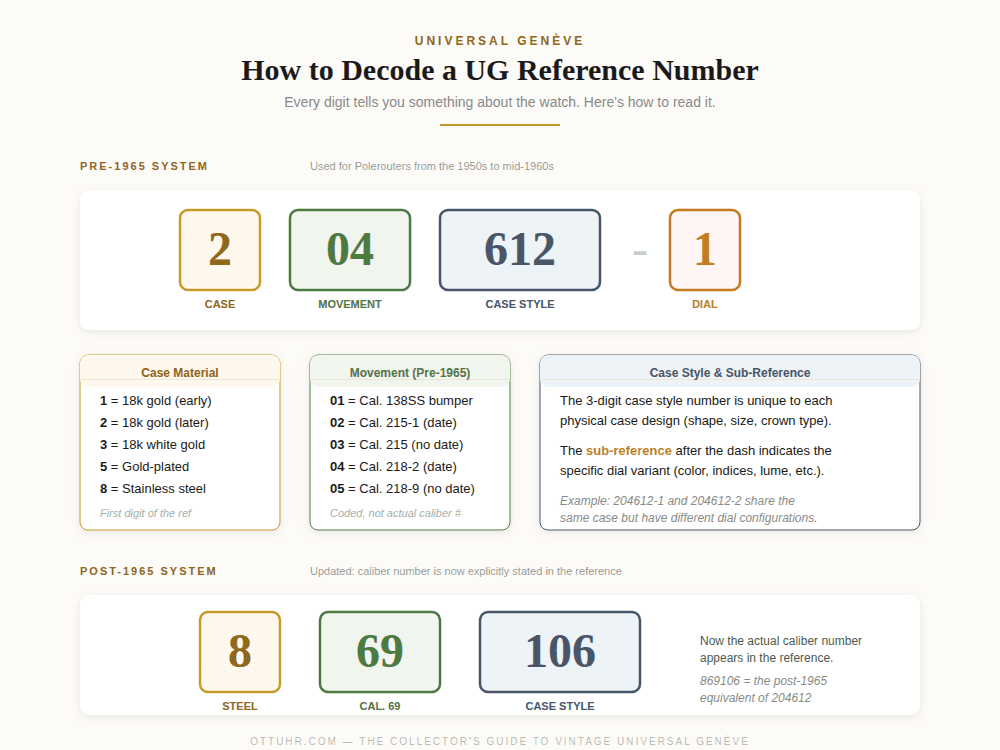
Universal Genève used a systematic reference numbering system where each digit encodes specific information about the watch. The decoded system reveals the case material, movement caliber, and case style. For example, in a post-1965 reference like 869106: “8” = steel case, “69” = Caliber 69, and “106” = the specific case style. If the reference number on the case back doesn’t match the movement inside or the case material you’re looking at, something has been changed.
Common Frankenwatch Red Flags
The most frequent issue with vintage UG watches isn’t outright counterfeiting. It’s mismatched parts assembled from different references. Watch for these specific issues:
Dial/movement mismatch: A dial reading “Automatic Microtor” should house a Cal. 215-series movement. A dial reading only “Automatic” (post-Microtor era) should contain a Cal. 218 or later. Mixed combinations indicate a non-original pairing.
Polerouter Sub fakes: The dual-crown Super Compressor Polerouter Sub is one of the most frequently faked Universal Genève watches. Authentic examples from the early production run feature curved lugs, fine bezel lettering, and small lume dots within the hour markers. As Worn & Wound notes, even experienced collectors struggle with these. Buy only from dealers who can verify provenance.
Nina Rindt reproductions: Given the five-figure prices these command, sophisticated reproductions exist. Key authentication markers include the twisted “lyre” lug case (produced by Huguenin Frères), correct pusher style for the execution period, and appropriate Valjoux 72-based caliber with Universal Genève finishing.
The Serial Number Problem
Unlike Rolex, where serial numbers can be tracked to production dates with reasonable precision, Universal Genève serial number documentation is less complete. The community has assembled partial databases (the universalgeneve.info archive contains valuable reference material), but gaps remain. This makes other authentication markers, reference number decoding, caliber matching, and dial analysis, even more important.
Market Pricing: Where UG Stands in 2026
Universal Genève occupies an unusual position in the market. The brand’s chronographs have appreciated dramatically over the past decade, while many of its time-only models remain remarkably affordable. Here’s a realistic snapshot of where things stand:
Polerouter Genève (time-only), good original: $600 to $1,500 Polerouter Date (steel), good original: $1,000 to $2,500 Polerouter De Luxe (gold), good original: $2,000 to $5,000 Polerouter Sub (single crown), good original: $3,000 to $7,000 White/Golden/Gilt Shadow, good original: $800 to $2,500 Uni-Compax (two-register chrono), good original: $2,000 to $5,000 Compax (non-Nina variants), good original: $3,000 to $8,000 Compax “Nina Rindt”, good original: $20,000 to $50,000+ Tri-Compax (steel), good original: $10,000 to $25,000 Aero-Compax, good original: $5,000 to $15,000 Space-Compax, good original: $4,000 to $10,000
The Relaunch Factor: Universal Genève’s 2026 relaunch under new ownership is the wild card. When Tudor relaunched, vintage Tudor prices spiked. When Breitling revived the Navitimer heritage, vintage references followed. If the new Universal Genève collection is well-received, and early indications from the Tribute to Compax chronographs profiled by Fratello suggest it will be, expect vintage UG prices to see renewed upward pressure, particularly for models that directly inspire new releases.
Why Now Is the Time to Collect Universal Genève
Here’s the thesis, stated plainly: Universal Genève produced watches of equivalent quality, innovation, and historical significance to brands that now command multiples of its market prices. The gap between Universal Genève’s horological importance and its market pricing remains one of the widest in vintage collecting.
A Polerouter with a Gérald Genta case design and an in-house micro-rotor movement can still be purchased for under $2,000. A Compax powered by the same Valjoux 72 that lives inside a Rolex Daytona can be found for a fraction of the Daytona’s price. A Tri-Compax with triple calendar and moonphase offers complications that cost ten to fifty times more from Patek Philippe.
This isn’t a prediction that prices will skyrocket next week. It’s an observation that Universal Genève offers genuine horological substance at prices that don’t require a second mortgage, and that the brand’s 2026 revival will inevitably bring wider attention to its vintage catalog.
Whether you’re drawn to the Polerouter’s mid-century elegance, the Compax family’s chronograph heritage, or the Shadow line’s ultra-thin dress-watch refinement, Universal Genève rewards the collector who takes time to understand its history. These aren’t watches that shout from the wrist. They whisper, and what they say is worth listening to.
Start Your Collection: Browse our current Universal Genève inventory at OTTUHR, or explore our broader vintage watch collection. Every watch ships with a 2-year mechanical warranty, free returns within 30 days, and our guarantee of authenticity. Have questions about a specific reference or need help identifying a Universal Genève you’ve come across? Reach out anytime. We’re happy to help.
Related posts
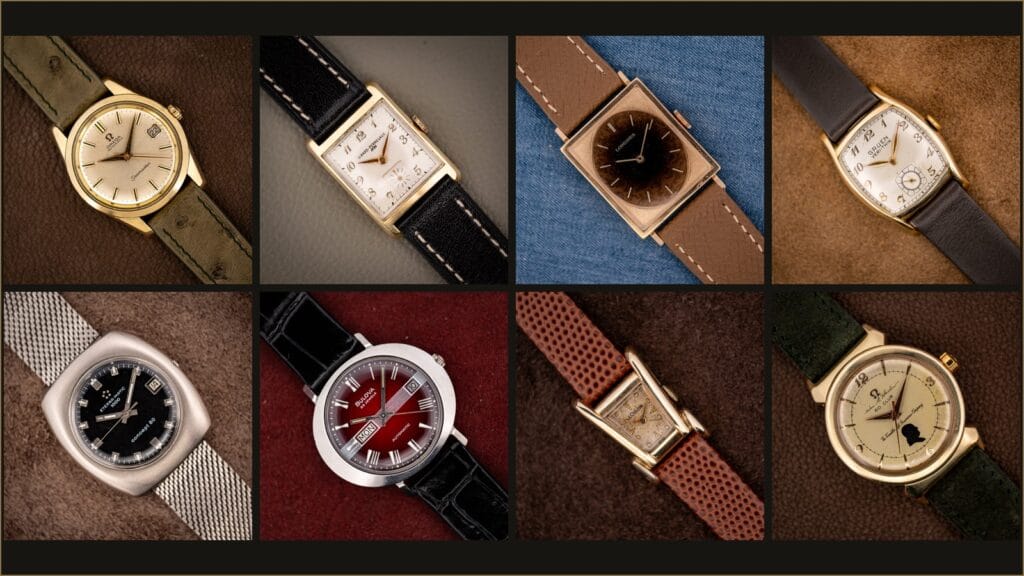
Watch Shapes: Which Vintage Case Shape Fits Your Style?
Case shape changes how a vintage watch wears more than diameter alone. Compare eight silhouettes and learn which one fits your wrist and style.
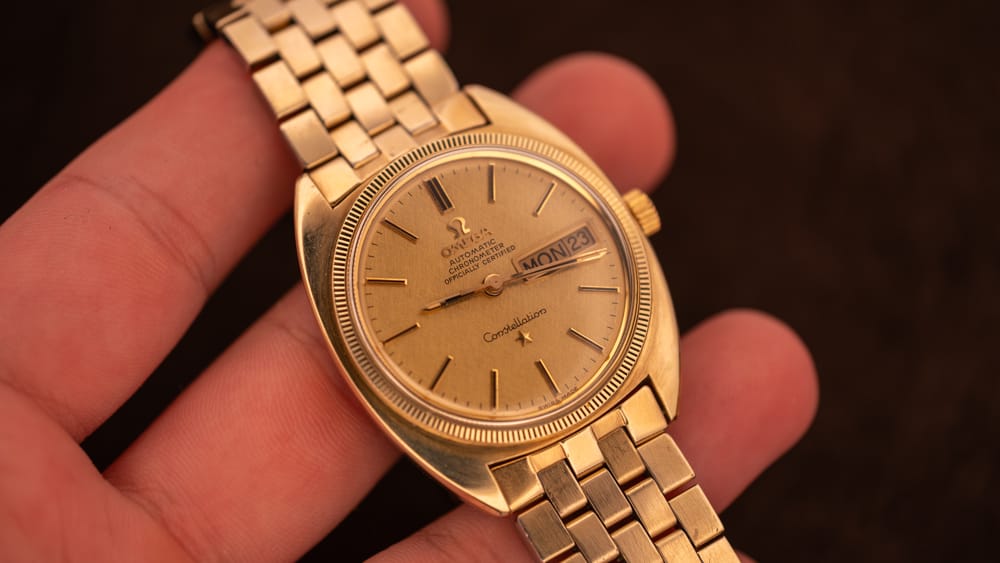
Vintage Dress Watches: How to Choose One You’ll Actually Wear
The best vintage dress watch is the one you will wear beyond weddings. Here is how to choose the right size, metal, dial, shape, and strap.
Vintage Watch Styles: A Visual Guide to Finding Yours
Most buyers pick a brand and stall. Here are nine vintage watch styles, shown with real watches from our archive, and the catch that comes with each one.
Vintage Tank Watches: A Buyer’s Guide to Rectangular Watches Beyond Cartier
Every Cartier Tank alternatives list is new watches imitating old ones. The originals still exist and cost less. A buyer's guide to vintage tank and rectangular watches: the brands, the prices, and what to check.
Service History Is the Wrong Question. Here’s the Right One.
Everyone says to ask for a vintage watch's service history. Most of it can't be verified, and a receipt proves a transaction, not a result. Here's what actually tells you a watch has been serviced, and the better question to ask.
LeCoultre vs. Jaeger-LeCoultre vs. Jaeger: What the Name on the Dial Means
Three names, one Swiss firm, and one watch that isn't what it looks like. What LeCoultre, Jaeger-LeCoultre, and plain Jaeger on a vintage dial really tell you.
Omega Seamaster 166.010 Buyer’s Guide: Prices, Variants, and What to Look For (2026)
Everything you need to buy an Omega Seamaster 166.010 in 2026: real market prices by condition tier, five dial variants explained, caliber 562 vs 565, original part numbers, and what to inspect before you commit.
Omega vs Rolex: The Vintage Buyer’s Verdict
Vintage Omega vs vintage Rolex: where the Rolex premium is worth paying, where Omega is the smarter buy, and how to dodge redials on both. A collector's verdict.
Movado Kingmatic: A Vintage Buyer’s Guide to References, Calibers, and Value
The Movado Kingmatic is one of the best values in vintage automatics. A buyer's guide to its references, in-house calibers, the Sub-Sea line, what to check, and what they actually sell for.
13 Vintage Watch Collecting Tips for Beginners (From 1,000+ Watches Sold)
Thirteen vintage watch collecting tips drawn from selling over 1,000 watches. What separates a smart first buy from an expensive lesson, with no sugar.
Vintage Wittnauer Chronograph Caliber Identification: Venus 188, Valjoux 7733/7734, Landeron 248
How to identify the movement inside any vintage Wittnauer chronograph: Venus 188, Valjoux 7733 and 7734, Landeron 248, and the house numbering system Wittnauer used to mark them.
How Water-Resistant Is a Vintage Watch, Actually? The Honest Answer.
Every dealer says never get a vintage watch wet. That advice is half-engineering and half-liability theater. Here is what is actually true about vintage water resistance, where water actually gets in, and when a 1965 diver is safer than a 2-year-old modern.