

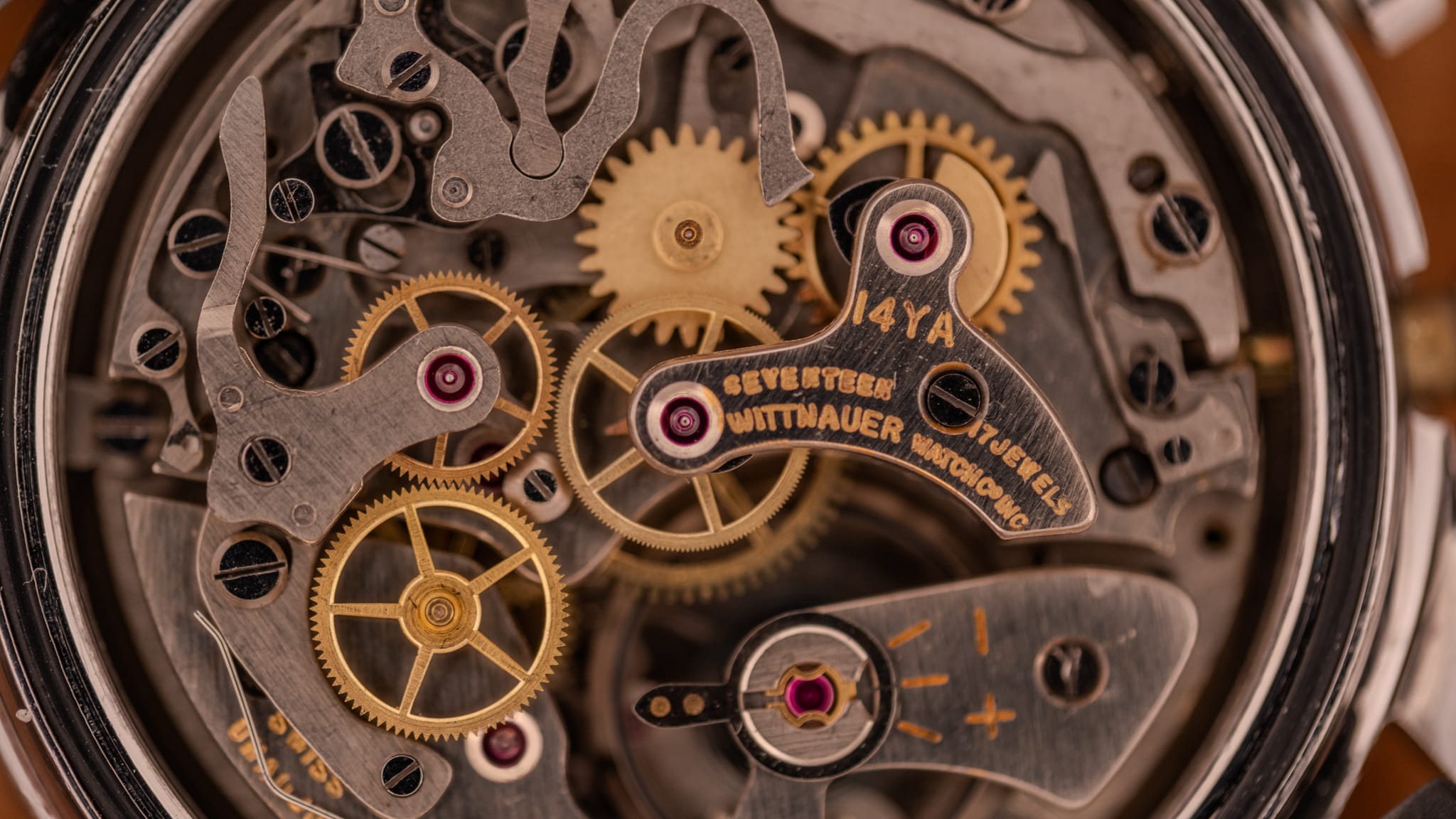
If you own or are about to buy a vintage Wittnauer chronograph, the single most important thing to know about the watch is which movement is inside it. The reference number and dial design tell you one part of the story. The caliber tells you the rest. It determines what the watch is actually worth, what servicing it will cost, how long it will hold timing, and whether the parts you might eventually need will still be available.
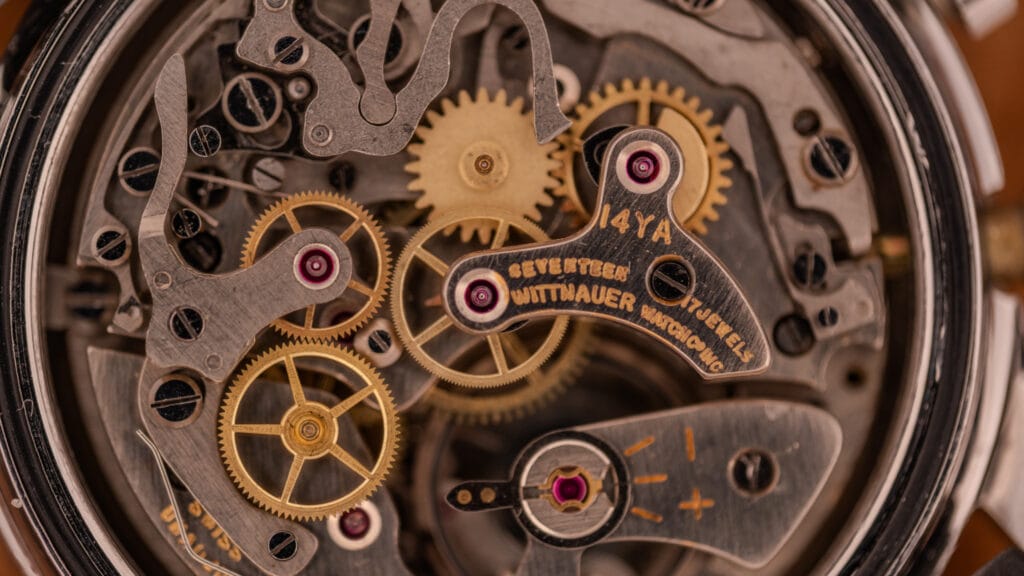
Wittnauer never made their own chronograph movements. Like most of the Swiss industry in the 20th century, they bought ebauches from specialist movement makers and finished them in-house. That means a “Wittnauer chronograph” can be powered by any of four or five different calibers depending on which year and which reference you are looking at. Worse, Wittnauer often signed the movement with their own house designation that hides the real ebauche name (a Wittnauer 14YA is actually a Landeron 248; a Wittnauer 11ARG-CH is actually built on an AS base, and so on).
This guide walks through how to identify the caliber inside any vintage Wittnauer chronograph from the 1940s through the early 1970s, using three lines of evidence: the sub-dial layout, the pusher operation, and the markings on the movement itself. We will cover the four calibers you will actually encounter (Venus 188, Valjoux 7733, Valjoux 7734, Landeron 248), the older column-wheel calibers (Venus 175 and 178) you might luck into on a 1940s or early 50s piece, and the Wittnauer house numbering system that lets you cross-reference the marking on the movement to the underlying ebauche.
start with the sub-dial layout
The fastest way to narrow down the caliber is to count the sub-dials and note where they sit on the dial. Vintage Wittnauer chronographs fall into three layout families.
Bicompax left-right (registers at 3 and 9 o’clock). This is by far the most common layout in vintage Wittnauer chronographs from the late 1950s through the 1970s. One sub-dial is the constant running seconds. The other is the 30-minute counter for the chronograph. No date wheel. The central hand is the chronograph second hand. Any Wittnauer with this exact layout is running one of three calibers: Venus 188, Valjoux 7733, or Landeron 248. Telling them apart requires the dial details and the pusher operation, both covered below.
Bicompax with date (registers at 3 and 9, date window at 6). This narrows the field dramatically. The Chrono-Date references (Reference 8031 is the most visible example) use this layout, and the movement is almost always the Valjoux 7734, the dated sibling of the 7733. A handful of higher-end Wittnauer Chrono-Date watches use a Valjoux 7736 or 7733 with a separately added date module, but the 7734 is the default.
Tricompax (three registers, often arranged 3, 6, 9). Three registers is the layout most collectors associate with classical chronographs, but it is actually relatively rare in vintage Wittnauer. When it appears, the watch is older (1940s and 50s) and the movement is one of the higher-grade column-wheel Venus calibers, usually the Venus 175 or 178. These are the most valuable vintage Wittnauer chronographs to find, and they trade at a premium over the cam-actuated bicompax watches.
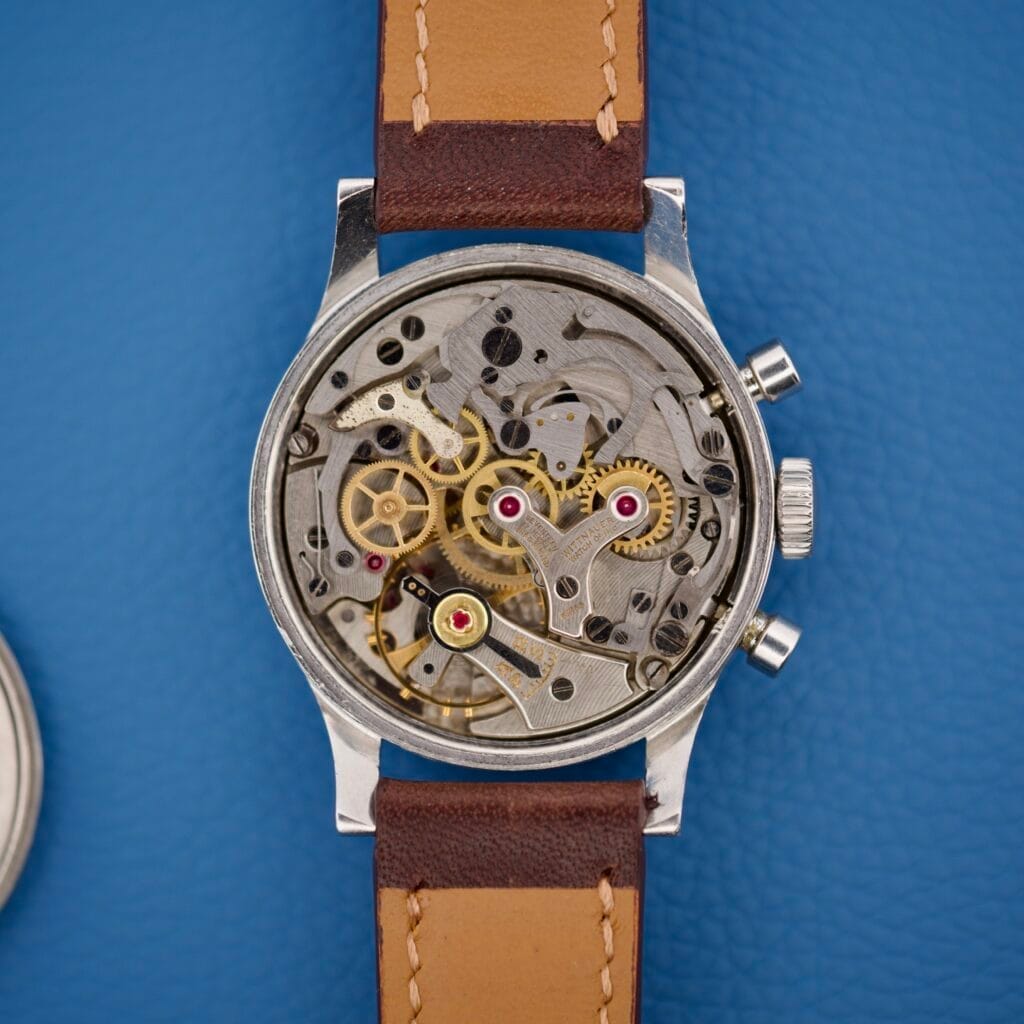
pusher operation: a tell that cuts through dial cosmetics
Two of the cam-actuated bicompax calibers operate the chronograph differently. This is a fast, mechanical test that does not depend on what is printed on the dial.
Normal operation (top pusher starts, top pusher stops, bottom pusher resets) means the movement is either a Venus 188 or a Valjoux 7733. These are the standard cam-actuated chronographs of the 1960s.
Inverted reset (top pusher starts, bottom pusher both stops and resets) means the movement is a Landeron 248. The Landeron family of cam-actuated chronographs share this quirky operation. New owners frequently assume the watch is broken when the top pusher will not stop the chronograph. It is not broken. It is a Landeron. This was Landeron’s house architecture for their entire 48-derived family, including the 48, 148, and 248.
If you can pick up the watch and operate the chronograph before buying, this single test eliminates one of the three bicompax candidates immediately. If you cannot, ask the seller to demonstrate. A seller who cannot or will not is selling a watch they have not actually used.
case backs and caliber markings
Once you have narrowed the caliber to a short list, the markings on the movement confirm it.
The movement is signed in one of three ways: with the ebauche maker’s name (Venus, Valjoux, Landeron), with Wittnauer’s house designation, or both. Wittnauer’s house designations follow a numbering pattern that maps to the underlying ebauche. The mapping you need to know is short.
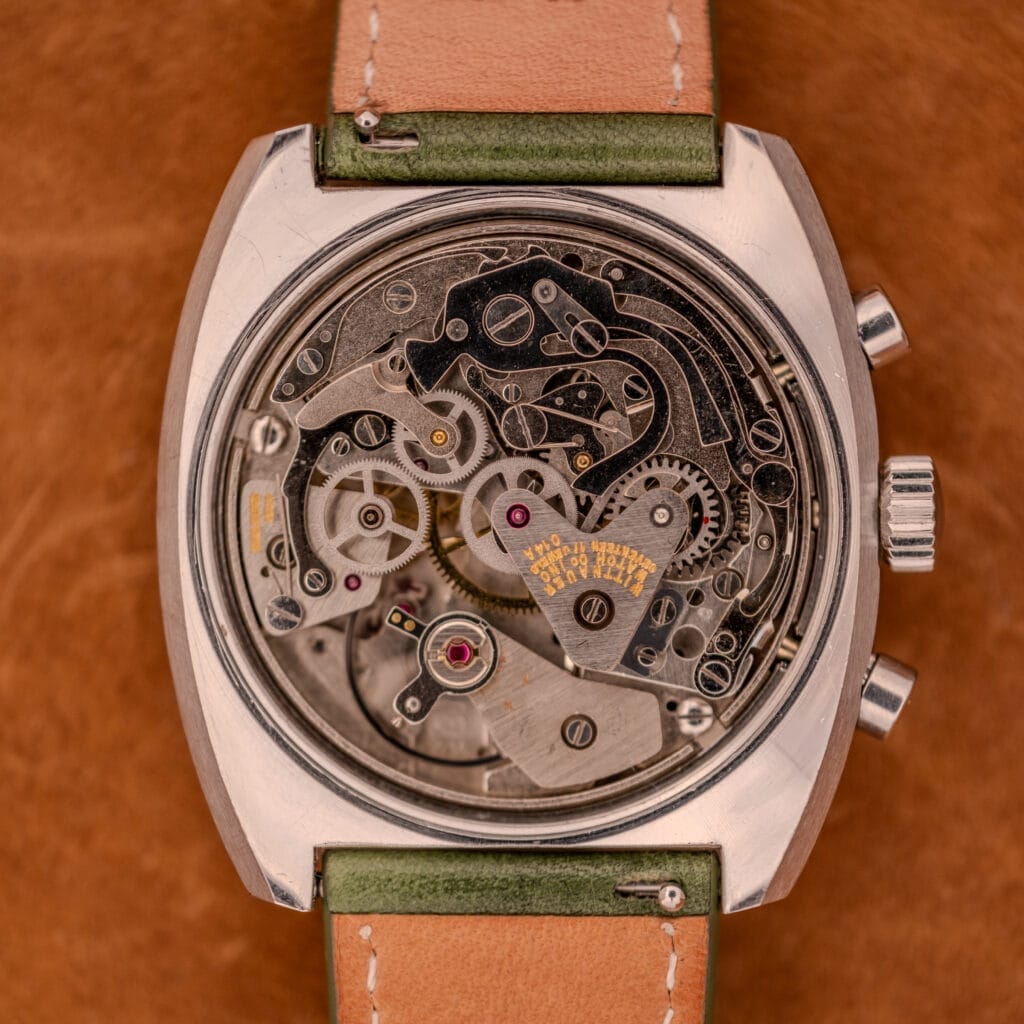
- Wittnauer 14YA = Landeron 248 (the 14Y family is the broader designation; 14YA is the most commonly encountered specific marking on the movement bridge)
- Wittnauer 11ARG-CH = AS-based chronograph (rare; appears on certain higher-end 1960s Wittnauer chronographs and not always reliably documented)
- Movement marked “Venus 188” = Venus 188 (Wittnauer did not always rename Venus movements; the original signing remains)
- Movement marked “Valjoux 7733” or “Valjoux 7734” = Valjoux 7733 or 7734 (same logic, often unrenamed)
- Movement marked “Venus 175” or “Venus 178” = column-wheel Venus, 1940s-50s era
A movement marked only with the ebauche name and no Wittnauer signing at all is a sign that the original movement was replaced at some point. This is not necessarily a deal-breaker on a watch you intend to wear, but it is grounds for discounting. A correctly-signed original Wittnauer movement on a period-correct dial is worth meaningfully more than the same watch with a service replacement.
the venus 188
Venus 188 is the most common chronograph caliber in vintage Wittnauer watches. It is a cam-actuated chronograph introduced in the late 1950s as a more affordable replacement for the column-wheel Venus 175 and 178. By the mid-1960s Venus had sold the production rights for the 188 to Valjoux, who continued producing it and later evolved the design into the Valjoux 7730 family. That family itself evolved into the 7733 and 7734.
The Venus 188 inside a Wittnauer chronograph from the 1960s is mechanically robust, well-understood by vintage watchmakers, and reasonable to service. Parts are available because the 188 platform persisted under Valjoux ownership and its parts are largely interchangeable with the early 7730. The full service interval is five to seven years and a complete service from a qualified watchmaker generally runs $400 to $700 in 2026.
Visual tells specific to the Venus 188 in Wittnauer chronographs:
- Bicompax 3/9 layout with running seconds at 9 and 30-minute counter at 3
- Pump pushers (not screw-down)
- Normal pusher operation (top start/stop, bottom reset)
- Dial often signed “Wittnauer” alone or “Wittnauer Genève” with no separate caliber designation on the dial
- Reference numbers in the Wittnauer chronograph line that use the Venus 188 include the 3256 and several non-numbered Geneve-line chronographs
In our inventory we currently or recently have had examples of both the Reference 3256 with a silver sunburst dial and a bicompax Geneve chronograph with a white dial and blue telemeter scale, both running the Venus 188. The macro photography on those listings shows what original Venus 188 dial printing looks like and is useful as a comparison reference.
the landeron 248
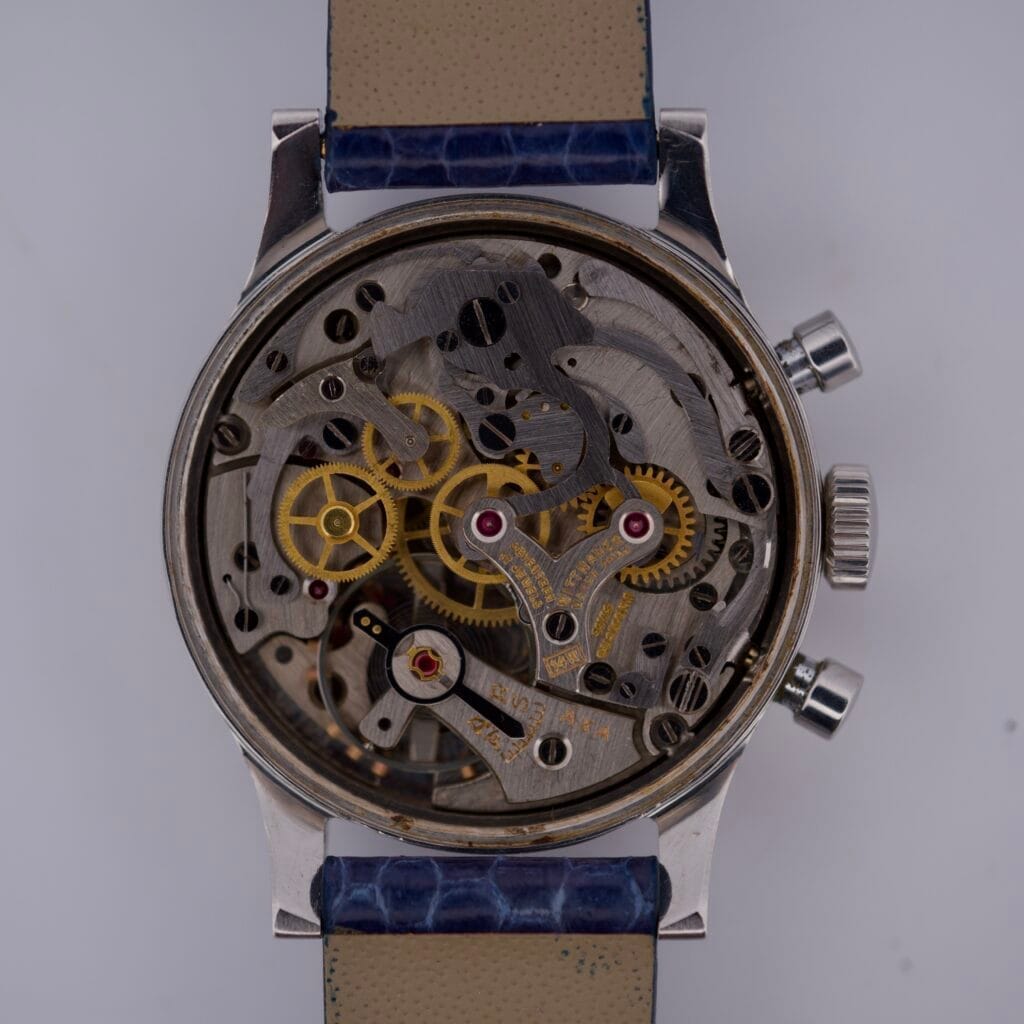
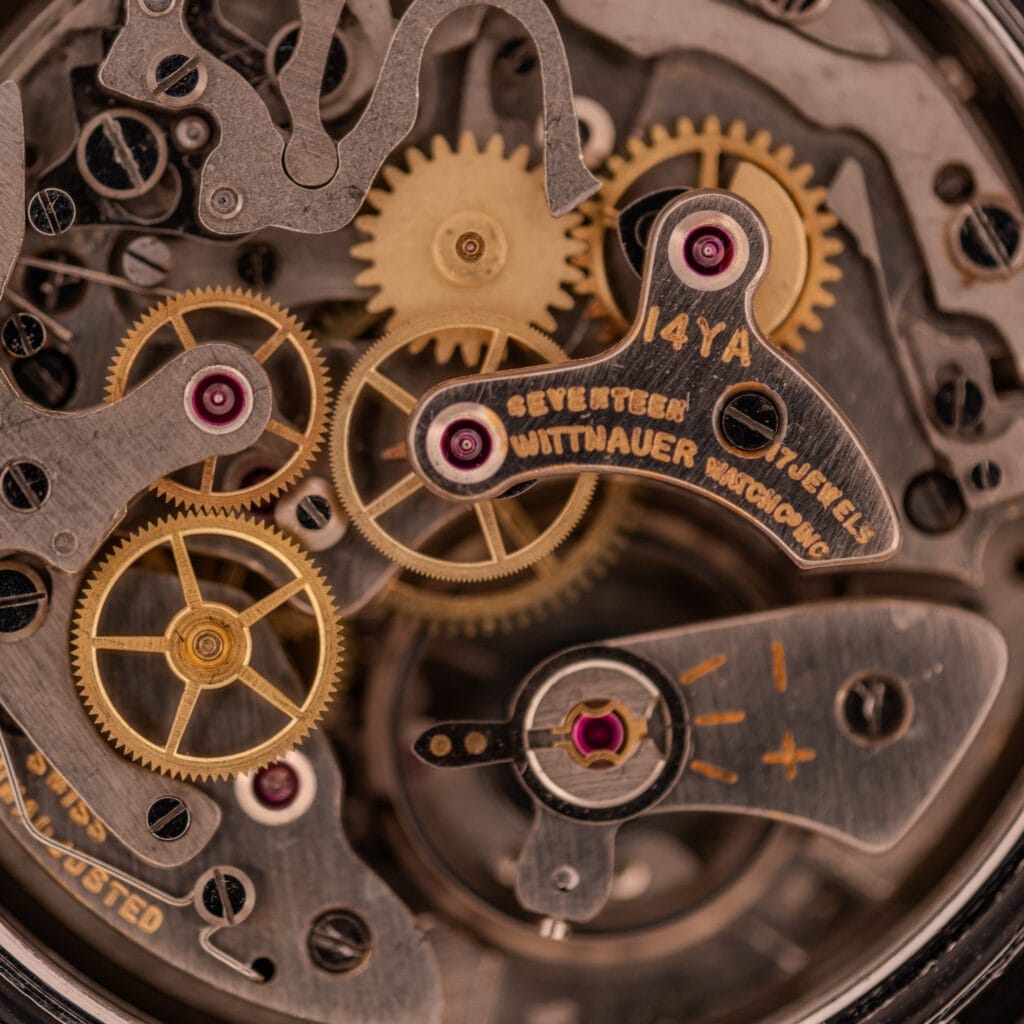
Landeron 248 is the second most common caliber in vintage Wittnauer chronographs. Wittnauer signed it as the “Wittnauer 14YA” (the most commonly encountered marking, within the broader 14Y family of Landeron-based Wittnauer chronograph calibers). It was used in the early Reference 7004A from roughly 1965 through 1969 or 1970, after which Wittnauer transitioned the 7004 production to the Valjoux 7733 (which is why two examples of the “same” 7004 can have entirely different movements).
The Landeron 248 is a cam-lever chronograph, not column-wheel. It is mechanically simpler than the Venus 188 and was used widely across the industry in the 1960s by Heuer-Leonidas, Nevada, Ardath, and dozens of other brands. That means parts are readily available and any competent vintage chronograph watchmaker has worked on one.
Visual tells specific to the Landeron 248 in Wittnauer chronographs:
- Bicompax 3/9 layout identical to the Venus 188 layout on the surface
- Inverted pusher operation (top starts, bottom both stops and resets)
- Movement bridge signed “Wittnauer 14YA” (or another 14Y-family variant) when looking at the caliber side
- Lollipop chronograph second hand on most early 7004A examples
- References that use the Landeron 248: 7004A (early production, c. 1965-69/70) and a small population of other 1960s Wittnauer Professional chronographs
For more on the 7004A specifically, including pricing and authentication, see our Wittnauer 7004 Buyer’s Guide.
the valjoux 7733 and 7734
The Valjoux 7733 and 7734 are the most-produced cam-actuated chronograph calibers of the late 1960s and 1970s. They are essentially the same movement: the 7733 is the no-date version, the 7734 adds a date wheel. Both are direct descendants of the Venus 188 platform after Valjoux acquired Venus.
In Wittnauer chronographs, the Valjoux 7733 powered the late production of the Reference 7004 (after the Landeron 248 was phased out around 1970), as well as a number of later 1970s Wittnauer chronographs. The Valjoux 7734 powered the Chrono-Date references, most notably the Reference 8031, where the date complication is the defining feature.
Visual tells specific to the Valjoux 7733 and 7734 in Wittnauer chronographs:
- Bicompax 3/9 layout without date (7733) or with a date window typically at 6 o’clock (7734)
- Normal pusher operation (top start/stop, bottom reset)
- Movement signed “Valjoux 7733” or “Valjoux 7734” with no Wittnauer renaming on most examples we have seen
- Pump pushers with crisp action on a healthy example
- References that use the Valjoux 7733: late-production Reference 7004 (often called 7004B in collector shorthand though Wittnauer did not consistently use that designation)
- References that use the Valjoux 7734: Reference 8031 Chrono-Date and other Chrono-Date variants
The Chrono-Date 8031 with the blue reverse-panda dial we recently had is a clean reference example of the Valjoux 7734 in Wittnauer’s lineup. Tonneau case, two white sub-registers at 3 and 9, red date numerals at 6, red chronograph second hand, brushed steel finish. Visually distinct from the Venus 188 and Landeron 248 chronographs because of the date complication and the more 1970s-influenced case shape.
The Valjoux 7733 and 7734 are mechanically robust and considered the workhorse cam chronographs of the era. Service costs and intervals are equivalent to the Venus 188 and Landeron 248 (every five to seven years, $400 to $700 for a full service).
the column-wheel venus calibers (175 and 178)
These are the prize. If you find a 1940s or early 1950s Wittnauer chronograph and the movement is a Venus 175 or 178, you have a column-wheel chronograph from the era before cam-actuated movements took over the mid-tier of Swiss production. These are more expensive to service, more expensive to find parts for, and meaningfully more valuable than the cam-actuated calibers that followed.
The Venus 175 and 178 are the predecessors to the Venus 188. The 175 is the bicompax (registers at 3 and 9), and the 178 is the tricompax (12, 6, 9 or similar three-register layout). Wittnauer chronographs from the 1940s and early 1950s, particularly the Professional and Geneve lines from before the Longines acquisition, sometimes use these calibers.
Visual tells:
- Older case styles: 35-37mm steel or gold-filled cases, often with stepped lugs or smaller, more dressy cases than the 1960s Professional line
- Column-wheel feel on the chronograph pushers: a slightly different action that watchmakers describe as more “deliberate” than cam chronographs. Hard to articulate but visible on video and obvious in person.
- Movement signed “Venus 175” or “Venus 178” with no Wittnauer renaming
- Premium pricing: a clean Wittnauer with a Venus 175 or 178 from the 1940s or 50s often sells for $4,000 to $7,000 depending on condition and originality, well above any of the cam-actuated chronographs
If you are evaluating a Wittnauer chronograph that the seller represents as 1950s or earlier and they do not know the caliber, ask for a movement photo before committing. The difference between a 1950s Venus 178 and a 1960s Venus 188 is the difference between a $5,000 watch and a $2,500 watch.
a note on the higher-end calibers (Lemania, Valjoux 72)
A small number of Wittnauer chronographs from the 1950s through the 1970s use higher-grade movements that were not standard for the line. The Lemania CH27 family (the same architecture as the Omega Speedmaster’s caliber 321) appears in a handful of high-end Wittnauer references from the 1950s. The Valjoux 72 (the same family used in the vintage Rolex Daytona) appears occasionally in higher-end Wittnauer tricompax chronographs from the same era.
Both are rare. Both are valuable. Both will be signed on the movement with their actual ebauche name. If you find a Wittnauer chronograph and the movement is signed Lemania or Valjoux 72, you have an unusual and desirable watch, and you should price it accordingly. These are not the standard Wittnauer calibers.
related Wittnauer references
For broader context across the Wittnauer chronograph family and how the references map to era and movement, our Collector’s Guide to Vintage Wittnauer Chronographs is the pillar reference. For dating any Wittnauer movement from the serial markings, see our Wittnauer Serial Numbers and Production Date Guide. For the broader brand history, see The Wittnauer Story: Longines’ Best-Kept Secret.
What movement is inside a vintage Wittnauer chronograph?
It depends on the reference and the era. The most common calibers in vintage Wittnauer chronographs are the Venus 188 (late 1950s through mid-1960s, bicompax cam-actuated), the Landeron 248 (mid-1960s through 1970, signed “Wittnauer 14YA” on most examples, used in the early Reference 7004A), and the Valjoux 7733 and 7734 (late 1960s through 1970s, used in the late 7004 and the Chrono-Date 8031 respectively). Earlier 1940s and 50s pieces sometimes use column-wheel calibers like the Venus 175 or 178.
How do I tell a Venus 188 from a Landeron 248?
Both have the same bicompax 3/9 dial layout, so dial alone will not tell you. The pusher operation is the giveaway. On a Venus 188, the top pusher starts and stops the chronograph and the bottom pusher resets it. On a Landeron 248, the top pusher only starts; the bottom pusher both stops and resets. If you can operate the chronograph before purchase, this test is definitive. If you cannot, ask for a photo of the movement signing. A Wittnauer 14YA (or other 14Y-family) marking confirms the Landeron 248.
What is a Wittnauer 14YA?
The Wittnauer 14YA is Wittnauer’s house designation for the Landeron 248 chronograph movement, in the broader Wittnauer 14Y caliber family. The 14YA and the Landeron 248 are the same movement; Wittnauer simply marked their version with their own number. The marking appears on the chronograph bridge when the caseback is removed, alongside “Wittnauer Watch Co Inc” and “Seventeen Jewels,” and is not visible on the dial side.
Is a Venus 188 Wittnauer chronograph worth servicing?
Yes, provided the dial and case are in good shape. A full service of a Venus 188 from a qualified vintage chronograph watchmaker runs $400 to $700 in 2026. The movement is well-understood, parts are available because the platform later became the Valjoux 7733 family, and a serviced example will hold timing well for another five to seven years before the next service interval.
What is the most valuable vintage Wittnauer chronograph caliber?
The column-wheel Venus 175 and Venus 178, which appeared in higher-end Wittnauer chronographs from the 1940s and early 1950s. These are the prize calibers for vintage Wittnauer collectors and trade at a meaningful premium over the later cam-actuated movements (Venus 188, Valjoux 7733/7734, Landeron 248). The occasional Lemania CH27 or Valjoux 72 in a Wittnauer chronograph is even rarer and more valuable, but those are unusual finds.
How do I confirm the caliber if the seller has not opened the watch?
Ask for one of three things before purchasing: a photo of the chronograph in operation (a video showing pusher action confirms cam vs column-wheel feel and the Landeron’s inverted reset), a photo of the movement with the caseback removed, or a movement-side photo from a recent service. A seller who cannot or will not provide any of these is selling a watch they have not personally inspected.
Related posts
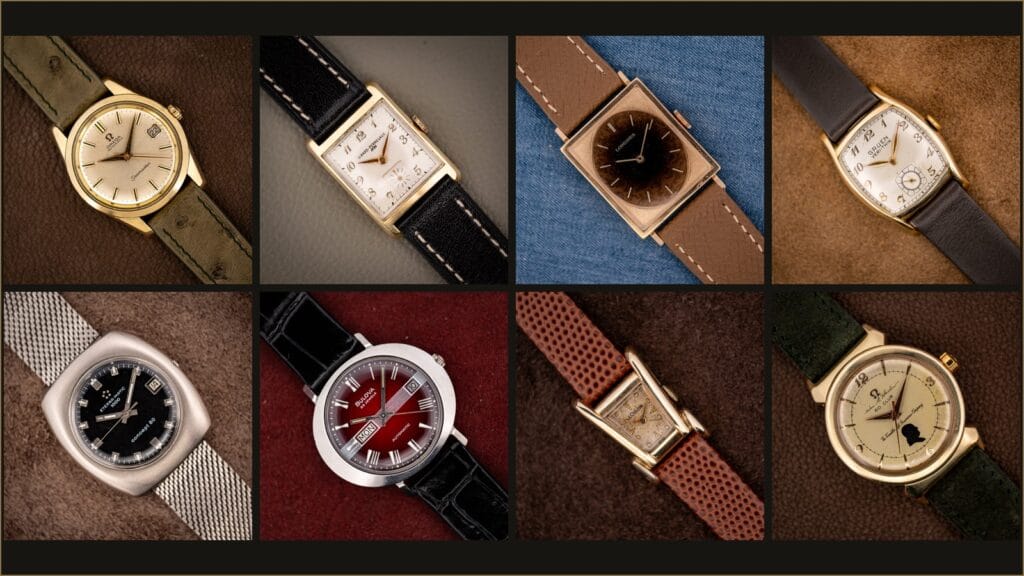
Watch Shapes: Which Vintage Case Shape Fits Your Style?
Case shape changes how a vintage watch wears more than diameter alone. Compare eight silhouettes and learn which one fits your wrist and style.
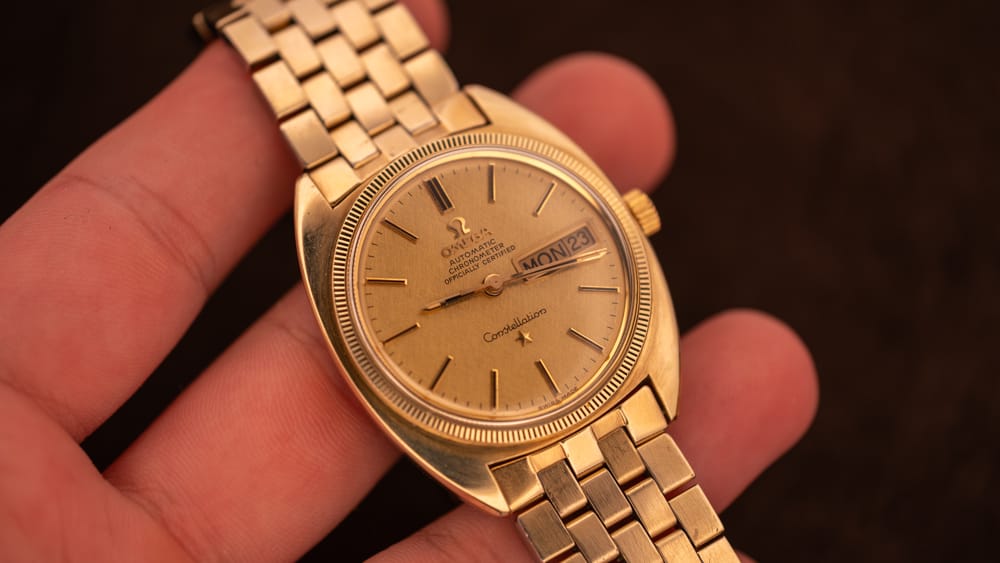
Vintage Dress Watches: How to Choose One You’ll Actually Wear
The best vintage dress watch is the one you will wear beyond weddings. Here is how to choose the right size, metal, dial, shape, and strap.
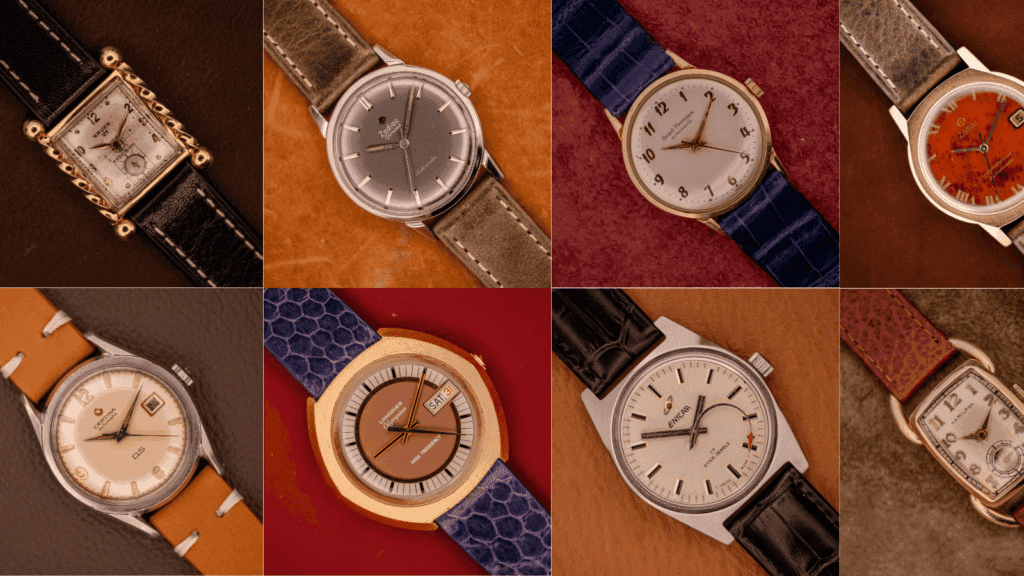
Vintage Watch Styles: A Visual Guide to Finding Yours
Most buyers pick a brand and stall. Here are nine vintage watch styles, shown with real watches from our archive, and the catch that comes with each one.
Vintage Tank Watches: A Buyer’s Guide to Rectangular Watches Beyond Cartier
Every Cartier Tank alternatives list is new watches imitating old ones. The originals still exist and cost less. A buyer's guide to vintage tank and rectangular watches: the brands, the prices, and what to check.
Service History Is the Wrong Question. Here’s the Right One.
Everyone says to ask for a vintage watch's service history. Most of it can't be verified, and a receipt proves a transaction, not a result. Here's what actually tells you a watch has been serviced, and the better question to ask.
LeCoultre vs. Jaeger-LeCoultre vs. Jaeger: What the Name on the Dial Means
Three names, one Swiss firm, and one watch that isn't what it looks like. What LeCoultre, Jaeger-LeCoultre, and plain Jaeger on a vintage dial really tell you.
Omega Seamaster 166.010 Buyer’s Guide: Prices, Variants, and What to Look For (2026)
Everything you need to buy an Omega Seamaster 166.010 in 2026: real market prices by condition tier, five dial variants explained, caliber 562 vs 565, original part numbers, and what to inspect before you commit.
Omega vs Rolex: The Vintage Buyer’s Verdict
Vintage Omega vs vintage Rolex: where the Rolex premium is worth paying, where Omega is the smarter buy, and how to dodge redials on both. A collector's verdict.
Movado Kingmatic: A Vintage Buyer’s Guide to References, Calibers, and Value
The Movado Kingmatic is one of the best values in vintage automatics. A buyer's guide to its references, in-house calibers, the Sub-Sea line, what to check, and what they actually sell for.
13 Vintage Watch Collecting Tips for Beginners (From 1,000+ Watches Sold)
Thirteen vintage watch collecting tips drawn from selling over 1,000 watches. What separates a smart first buy from an expensive lesson, with no sugar.
Vintage Wittnauer Chronograph Caliber Identification: Venus 188, Valjoux 7733/7734, Landeron 248
How to identify the movement inside any vintage Wittnauer chronograph: Venus 188, Valjoux 7733 and 7734, Landeron 248, and the house numbering system Wittnauer used to mark them.
How Water-Resistant Is a Vintage Watch, Actually? The Honest Answer.
Every dealer says never get a vintage watch wet. That advice is half-engineering and half-liability theater. Here is what is actually true about vintage water resistance, where water actually gets in, and when a 1965 diver is safer than a 2-year-old modern.