

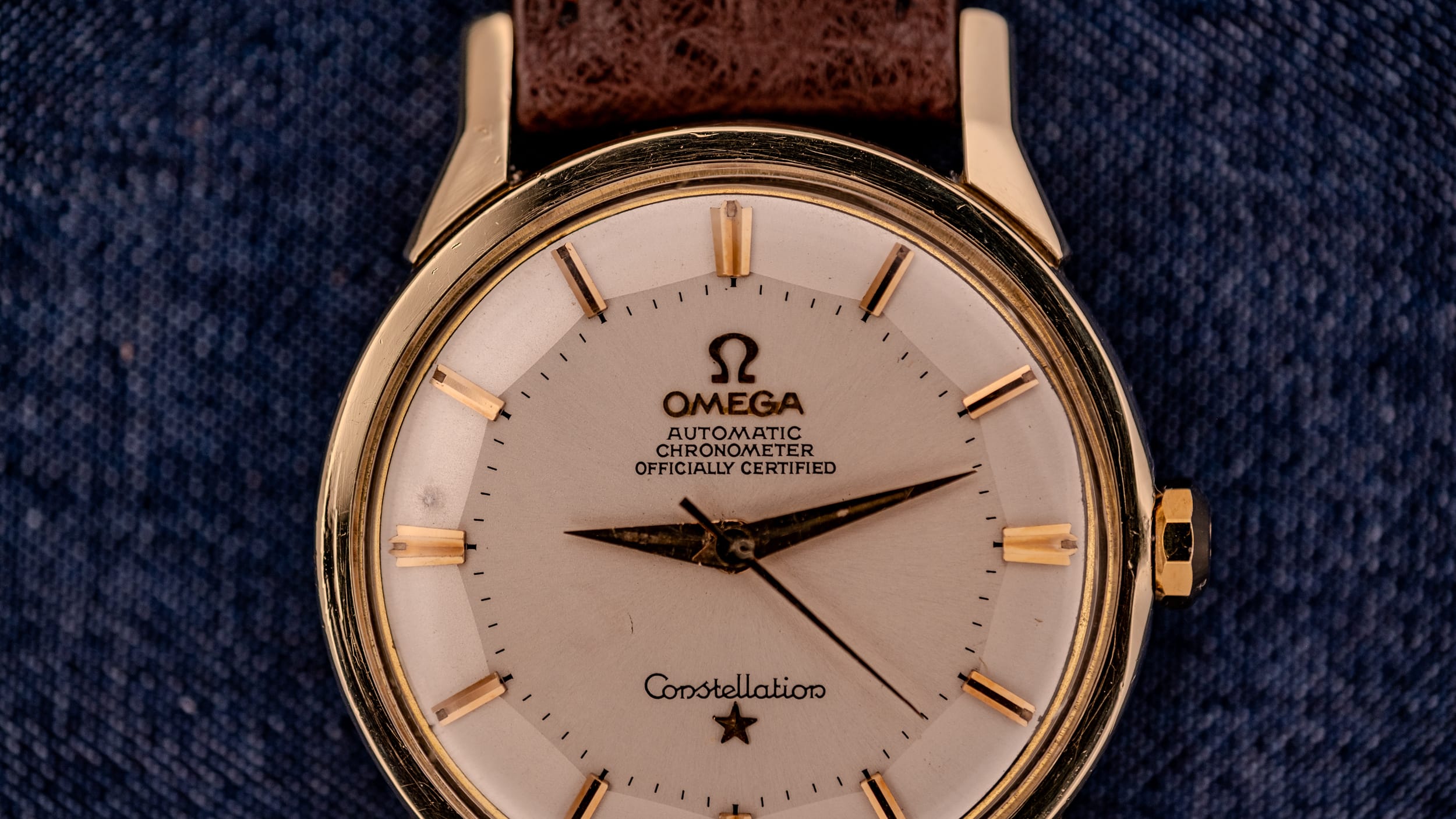
The Omega Constellation pie-pan dial is one of the most refinished dials in mid-century watchmaking. Not counterfeited as in fake watches built to deceive. Refinished as in original dials sent out to specialist shops in the 1980s and 1990s, when Hong Kong and Swiss refinish operations processed mid-century Omegas at industrial volume and nobody was keeping a record of what came back as something it no longer was.
Thirty years later, the result is the market we have now: the majority of pie-pan Constellations on offer have refinished dials, the minority have factory-original dials, and the spread between the two is roughly twenty to thirty percent.
It should be at least double that.
The window for buying verified-original-dial pie-pans at near-redial prices is open. It will not stay open. The collector market gets sharper every year, auction catalogs are starting to call out original dials specifically, and the people who can read a pie-pan dial in a phone photo are the ones picking off the best examples before the rest of the market catches up.
This is a guide to becoming one of those people.
Why the Omega Constellation pie-pan dial is the easiest dial in vintage Omega to redial
Most refinishers, given a clean target, will produce work that looks plausible at arm’s length. Pie-pan dials are a clean target. Three reasons.
The geometry is forgiving. A pie-pan dial is a flat-topped center surrounded by twelve sloping facets that drop toward the edge of the dial. The facets are deep enough to hide minor irregularities in repolishing. A dial that has been stripped, replated, and reprinted does not have to recreate a complicated pattern. It has to recreate a flat surface and twelve straight lines.
The indices are applied, not printed. Pie-pan Constellations use applied baton or applied dauphine indices, which means the indices come off the dial during refinishing and go back on after. They almost never go back on perfectly. The original factory placement aligns with the facets in a specific way that requires jig fixturing to reproduce. Refinishers, working at volume, eyeball it. The misalignment is almost always small. It is almost never zero.
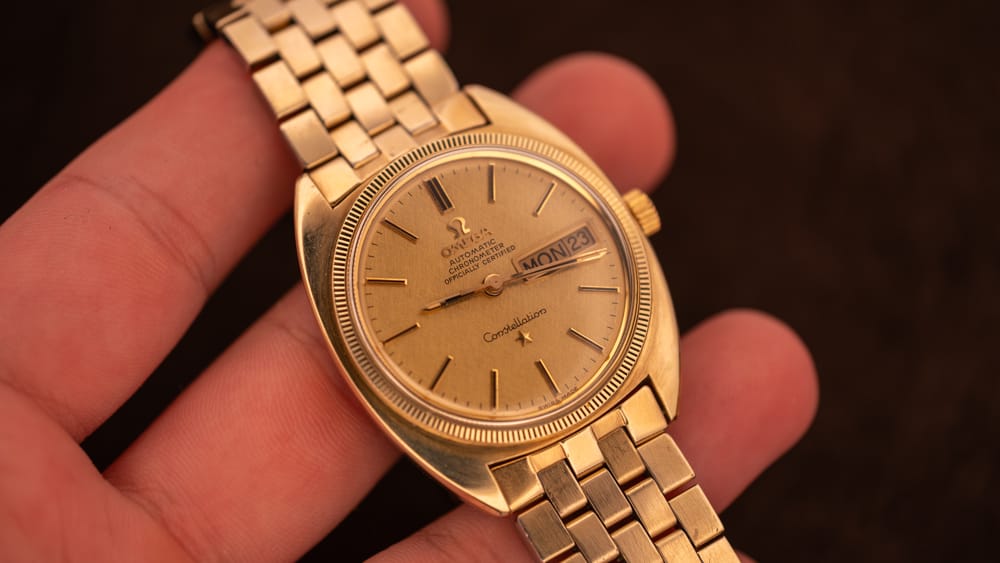
The text is minimal. A pie-pan dial has the OMEGA logo near twelve, the word “Constellation” below it, the chronometer star icon, the words “Officially Certified Chronometer” near the bottom, and “Swiss Made” at six. That is fewer printed elements than most other Omega dials of the era. Less text means fewer chances to expose printing differences. A refinished dial only has to reproduce six or seven elements, and most refinishers had pad-printing setups that could handle that comfortably.
The combination is what makes pie-pans the most refinished dials in the entire vintage Omega catalog. It also makes them the most overlooked dials. A buyer who has never held an original next to a redial often cannot see the difference in a listing photo. The market reflects that.
How widespread the redial problem is on pie-pan Constellations
There is no formal census, but anyone who handles vintage Omegas at volume will give the same rough answer: somewhere between half and seventy percent of the pie-pan Constellations currently in circulation have been refinished at some point in their lives. The number gets quoted differently depending on whether you ask an auction house specialist (closer to half), a gray-market dealer (closer to seventy percent), or an Omega specialist watchmaker who has serviced thousands of these (the highest estimates).
The reason the range is wide is that the threshold is fuzzy. A dial that was professionally refinished in Switzerland in 1985 with original-spec materials is technically not original, but it can be hard to distinguish from factory work. A dial that was redialed in a Bangkok back-shop in 2003 with a different shade of silver paint is more obvious. The market treats the first case more leniently than the second, and reasonable specialists disagree on where the line should be.
What the market does not currently price in is a clean separation. A verified-factory-original-dial 168.005 in honest condition trades around fifteen to twenty-five percent above a same-reference example with a likely refinish, when both are described accurately. Set against the underlying labor of producing an original dial in 1962, that spread is too narrow. Original dials cannot be remade. Refinished ones can be remade indefinitely.
The closing of this gap is happening slowly but visibly. Auction houses have started using “original dial” or “factory dial” as called-out features in catalog descriptions, particularly for Constellations in the 14381, 14393, 167.005 and 168.005 reference families. Five years ago that language was reserved for Patek and Vacheron lots. Today it is creeping into Omega listings at Phillips, Antiquorum, and the smaller specialist auctions. Where catalog language goes, prices follow.
What an original Omega Constellation pie-pan dial actually looks like
The authentication checklist below is built around what a buyer can verify from listing photos plus a one-time inspection at handover. Things that require dial removal (factory stamps on the dial back, lume application on the underside) are out of scope for buyers; those are dealer or watchmaker tools.
In rough order of how often each tell catches a refinish:
1. Dial color and aging consistency. Original silver pie-pan dials patina to a soft, slightly warm gray, sometimes with a yellowish cast in spots. Original champagne pie-pan dials patina to a slightly muted gold with localized darkening near the edges. Refinished dials are usually uniformly bright across the whole face, because the refinish was applied recently to a stripped surface and has not had decades to interact with light and air. A pie-pan dial that looks clean and even all the way across, on a watch otherwise showing forty-plus years of case wear, is suspicious by default. Real dials age unevenly. Refinishes age uniformly. (For the broader category of dial aging vs damage, see patina vs damage on a watch dial.)
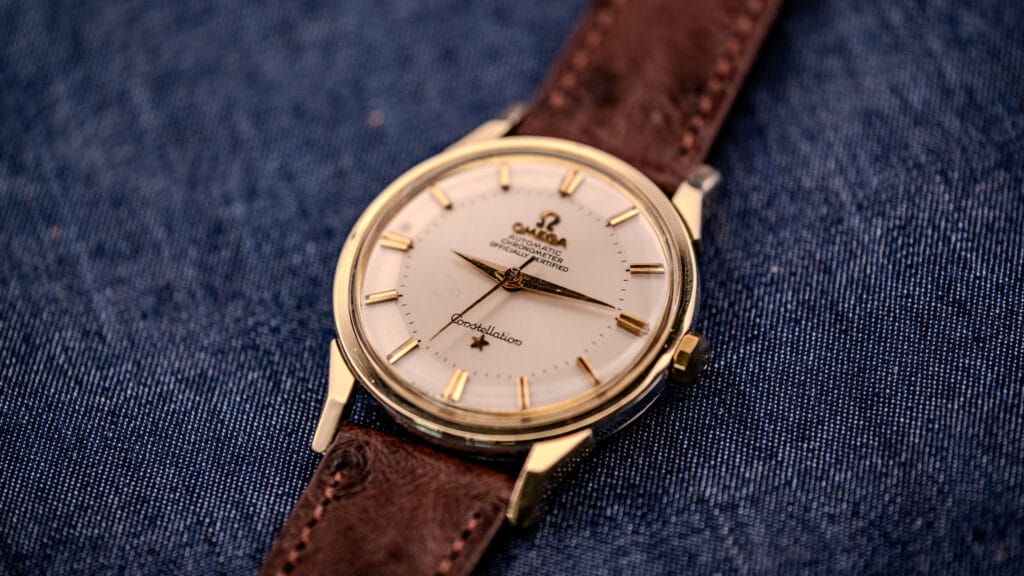
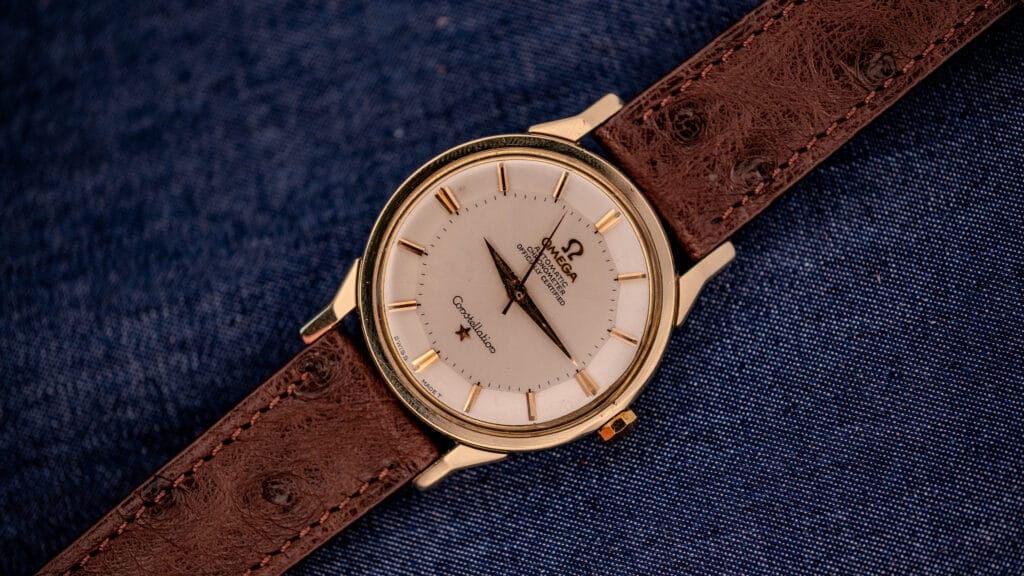
2. Index alignment with the facets. The applied indices on a pie-pan dial are positioned to sit on the flat top section, with their bases either touching or just inside the boundary where the flat meets the slope. On a factory-original dial, every index sits at the same distance from that boundary, and the bases of the indices align cleanly with the facet edges below them. On a refinish, this alignment slips. Look at the three, six, and nine indices specifically: if any of them appear closer to or farther from the facet edge than the others, the dial has been reapplied.
3. The Omega logo and “Constellation” signature. Factory-original signatures use a specific font with consistent stroke weight. The OMEGA logo is applied (sometimes called “applique”), not printed; the word “Constellation” below it is printed. Refinished dials commonly use printed approximations of both, including a “logo” that is actually pad-printed rather than applied metal. Look at the OMEGA letters under macro: original applied logos catch light differently than the surrounding dial because they are physically raised. Printed logos are flat. A listing photo at high resolution will sometimes show the difference if the lighting is right.
4. The chronometer star at twelve. Original Constellation dials have a small applied five-point star icon below the OMEGA logo, marking chronometer certification. Factory stars are sharply formed metal pieces with crisp points. Refinished stars are often slightly blobby, with rounded points or filled-in interior angles. This is one of the most reliable single tells, because the star is small and refinishers tended to skip the precision step on something most buyers do not look at.
5. The “Officially Certified Chronometer” text. This is where many redials are caught. The factory text is fine, evenly spaced, with consistent baseline alignment. Refinished text is often thicker, with letterspacing that looks slightly off. The clearest tell is the word “Officially”: original factory printing has the “lly” running tightly together at the same baseline as the rest of the word. Many redials show the “lly” sitting slightly higher or with visible spacing.
6. The crosshair. Many pie-pan dials, especially earlier references like the 14381, have a fine printed crosshair running through the center of the dial. The factory crosshair is genuinely fine, almost hairline, and printed (not engraved). Refinishes sometimes attempt to reproduce the crosshair via etching, which produces a coarser line. If the crosshair is visible under macro and looks etched rather than drawn, that is a redial.
7. Date window framing (where applicable). On dated references like the 168.005, the original date aperture has a clean, slightly recessed edge that aligns precisely with the date wheel below. Refinished dials sometimes have date apertures that have been opened slightly larger, exposing extra date wheel margin. If you can see uneven background showing through around the date, the dial has been opened up during refinishing.
A clean factory-original pie-pan does not have to ace every test, but it should ace most of them. A dial that fails three or more of the seven is a refinish, regardless of what the seller says.
How to use this when buying a pie-pan Constellation
The practical playbook for a Park-style buyer:
Demand high-resolution dial photos before any other discussion. Dealers who are confident in their dial will provide them. Sellers who push back, or who provide only stock photos, are filtering for buyers who do not look closely. That filter exists for a reason.
Compare to a known reference. Omega’s official heritage pages and the Omega Vintage Database both publish factory-original dial photos for most pie-pan models. Pull up the reference image for the watch you are looking at and overlay mentally. The eye trains quickly. After a dozen comparisons, an original dial looks obviously different from a refinish, even at thumbnail size. (For broader Omega reference identification, see the expert’s guide to Omega reference numbers.)
Pay the original-dial premium when it is offered. The current market premium of roughly fifteen to twenty-five percent over a refinished example is, in the medium term, a discount to where it should sit. A buyer paying $3,200 for an original-dial 168.005 today, when refinished examples sit at $2,500-$2,800, is buying at a smaller spread than will exist in three to five years. Do not negotiate the original-dial premium down to redial parity. That is the trade.
Walk away from the borderline cases. The fastest way to lose money on a pie-pan is to talk yourself into a “probably original” dial that you are not certain about. The market is large enough that there is always another candidate. If the dial fails two or more of the seven tests, the watch is a redial regardless of asking price, and a redial is not what you came for.
Read the seller’s language carefully. “Original dial” means something. “Beautiful dial,” “clean dial,” “stunning dial,” and “dial in excellent condition” do not. A seller who knows the dial is original will say so directly. A seller who avoids the word is communicating something specific.
Where the pie-pan Constellation market is heading
The thesis here is forward-looking. Three things support it.
Auction catalogs are getting more specific. As noted above, called-out original-dial language is now standard at Phillips and Antiquorum for higher-tier pie-pan lots. That language eventually trickles down to mid-tier auctions, then to gray-market platforms, then to general listings. Each step compresses the discount that refinished dials currently enjoy.
The Omega vintage information base is consolidating. Better-published reference databases, more annotated catalog scans circulating among collectors, more dealer-side authentication content. All of this raises the floor of what an average buyer can verify. Average buyers eventually drag the median price. (For dating any vintage Omega from its case-back numbers, see Omega serial numbers: the complete guide.)
The supply of original dials is fixed and the supply of refinishes is not. Every year, more dials get refinished and fewer originals exist in circulation. That is not the kind of asymmetry that produces converging prices. It produces diverging ones.
The collector who buys an original-dial 14381 today at a fifteen percent premium over a refinished example is buying at a spread that will likely be forty to sixty percent in five years. That is not a forecast. That is what already happens to every well-defined original-dial premium in the vintage market once the market figures out the distinction. The pie-pan distinction is currently being figured out.
The bottom line on Omega Constellation pie-pan dials
Most pie-pan Constellations being sold today have refinished dials, the minority have factory-original dials, and the market is currently pricing the difference as a small discount when it should be pricing it as a clear separation. Buyers who develop the eye to read a pie-pan dial in a photograph are buying into a category where their information advantage compounds over time, because the supply of original dials is finite and the supply of refinishes is not.
The watches to chase: 14381, 14393, 14902, 167.005, 168.005, 168.017. The condition language to demand: “factory dial” or “original dial” stated explicitly, plus high-resolution dial photos that show the indices, the star, the chronometer text, and the crosshair clearly enough to verify against a known factory reference. (For the broader value-buying framework on vintage Omegas in this tier, see the 12 best vintage watches under $2,000 in 2026 and the ultimate guide to vintage Omega Seamasters.)
The spread is closing. The watches that compound are the ones bought now.
Related posts
Watch Shapes: Which Vintage Case Shape Fits Your Style?
Case shape changes how a vintage watch wears more than diameter alone. Compare eight silhouettes and learn which one fits your wrist and style.
Vintage Dress Watches: How to Choose One You’ll Actually Wear
The best vintage dress watch is the one you will wear beyond weddings. Here is how to choose the right size, metal, dial, shape, and strap.
Vintage Watch Styles: A Visual Guide to Finding Yours
Most buyers pick a brand and stall. Here are nine vintage watch styles, shown with real watches from our archive, and the catch that comes with each one.
Vintage Tank Watches: A Buyer’s Guide to Rectangular Watches Beyond Cartier
Every Cartier Tank alternatives list is new watches imitating old ones. The originals still exist and cost less. A buyer's guide to vintage tank and rectangular watches: the brands, the prices, and what to check.
Service History Is the Wrong Question. Here’s the Right One.
Everyone says to ask for a vintage watch's service history. Most of it can't be verified, and a receipt proves a transaction, not a result. Here's what actually tells you a watch has been serviced, and the better question to ask.
LeCoultre vs. Jaeger-LeCoultre vs. Jaeger: What the Name on the Dial Means
Three names, one Swiss firm, and one watch that isn't what it looks like. What LeCoultre, Jaeger-LeCoultre, and plain Jaeger on a vintage dial really tell you.
Omega Seamaster 166.010 Buyer’s Guide: Prices, Variants, and What to Look For (2026)
Everything you need to buy an Omega Seamaster 166.010 in 2026: real market prices by condition tier, five dial variants explained, caliber 562 vs 565, original part numbers, and what to inspect before you commit.
Omega vs Rolex: The Vintage Buyer’s Verdict
Vintage Omega vs vintage Rolex: where the Rolex premium is worth paying, where Omega is the smarter buy, and how to dodge redials on both. A collector's verdict.
Movado Kingmatic: A Vintage Buyer’s Guide to References, Calibers, and Value
The Movado Kingmatic is one of the best values in vintage automatics. A buyer's guide to its references, in-house calibers, the Sub-Sea line, what to check, and what they actually sell for.
13 Vintage Watch Collecting Tips for Beginners (From 1,000+ Watches Sold)
Thirteen vintage watch collecting tips drawn from selling over 1,000 watches. What separates a smart first buy from an expensive lesson, with no sugar.
Vintage Wittnauer Chronograph Caliber Identification: Venus 188, Valjoux 7733/7734, Landeron 248
How to identify the movement inside any vintage Wittnauer chronograph: Venus 188, Valjoux 7733 and 7734, Landeron 248, and the house numbering system Wittnauer used to mark them.
How Water-Resistant Is a Vintage Watch, Actually? The Honest Answer.
Every dealer says never get a vintage watch wet. That advice is half-engineering and half-liability theater. Here is what is actually true about vintage water resistance, where water actually gets in, and when a 1965 diver is safer than a 2-year-old modern.