

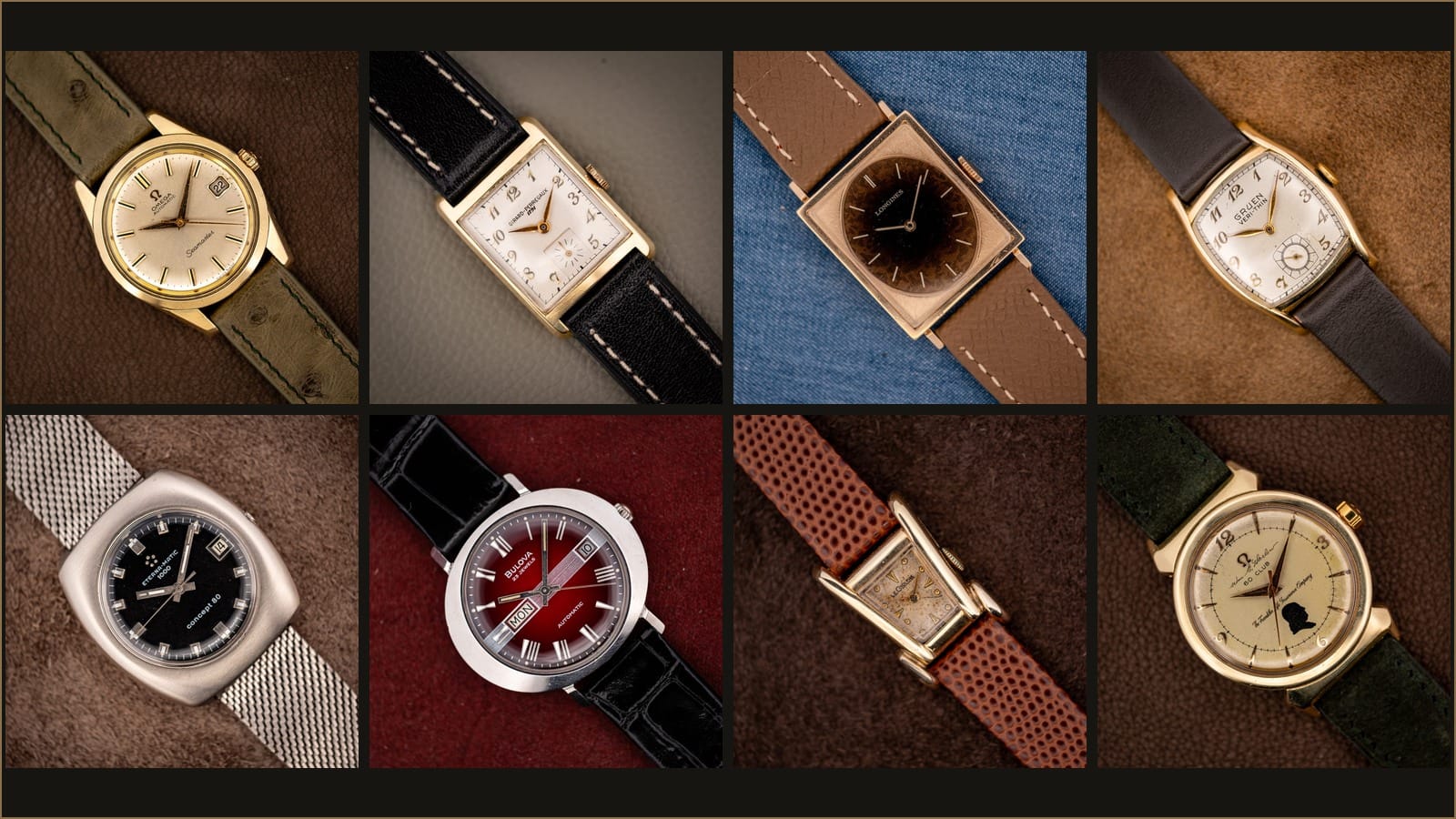
Watch shapes decide how a watch occupies your wrist before the brand, the dial, or the diameter get a vote. A 26mm square watch, a 28mm tonneau, a 35mm round watch, and a 38.5mm saucer case are not four points on one size scale. They are four different objects, and the width in the listing says the least about the three that are not round. This guide compares eight vintage silhouettes using watches we have handled and photographed ourselves: what each one does on the wrist, what it signals, which measurement to trust, and the ownership catch that comes with it. Pick the outline first.
eight silhouettes at a glance
Use the table to narrow the field, then read the sections that pull at you.
| shape | what it does on the wrist | style signal | main vintage catch | archive example |
|---|---|---|---|---|
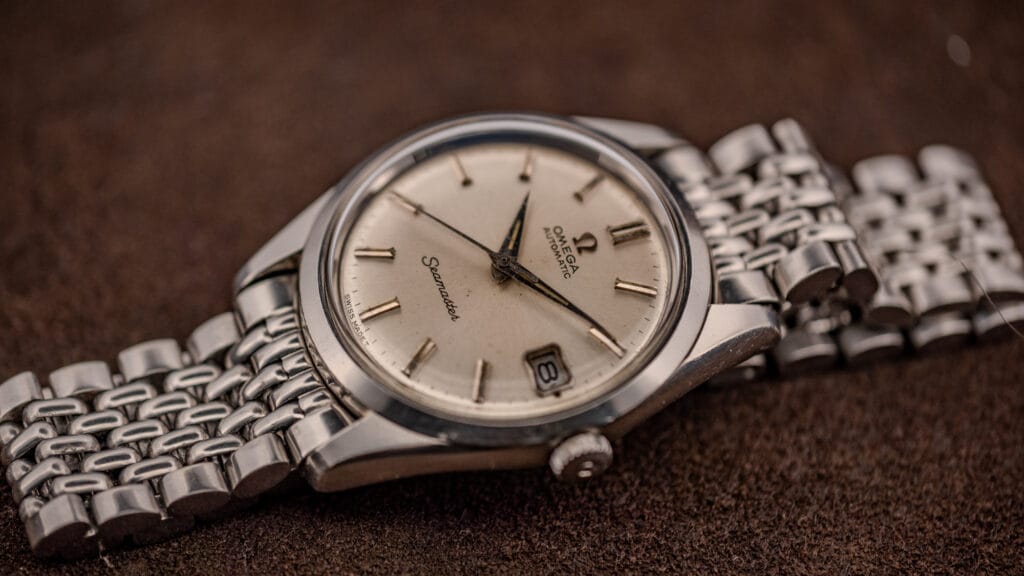
| round | behaves the way the numbers suggest | quiet, adaptable, the default | over-polished cases and swapped dials | Omega Seamaster 166.010 |
| rectangular | runs tall and narrow, dial fills the front | dressed with intent | shaped crystals, worn gold-filled corners | Girard-Perregaux 1791 |
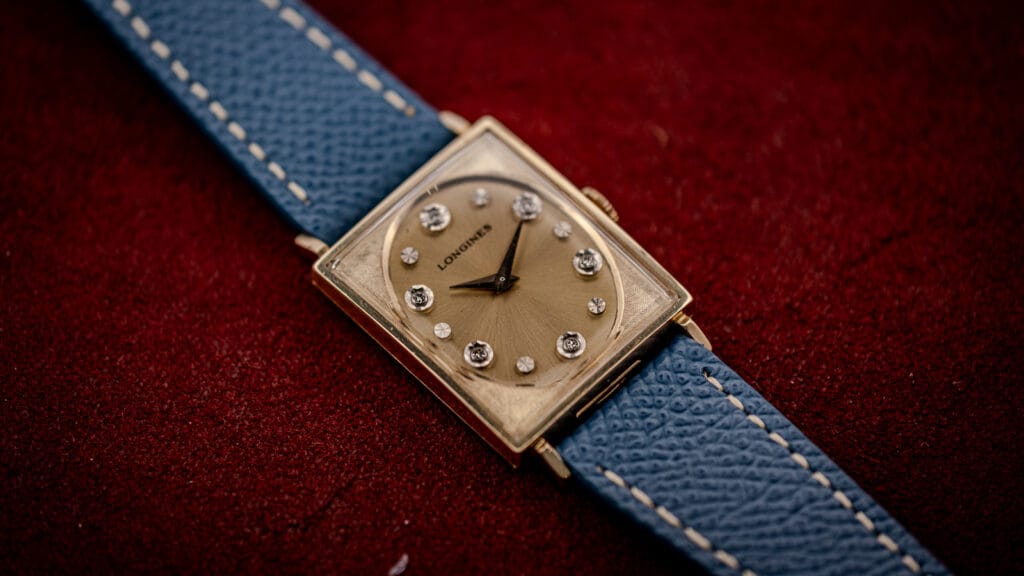
| square | compact and even, corners do the talking | graphic, mid-century, tidy | corners soften under polishing | Longines 3217-428 |
| tonneau | swells through the middle, follows the wrist | art deco, softer than a rectangle | crystals cut for one case | Gruen Veri-Thin 421-653 |
| cushion | broad face, short vertical span | late 1960s sport-casual | brushed planes and edges must survive | Eterna-Matic 1000 Concept 80 |
| saucer or disc | wide rim, stubby lugs, sits low | 1970s, a little futuristic | rim and facets erase easily | Bulova President C T-3092 |
| asymmetrical | outline reads as sculpture | design-led, intentionally irregular | exposed lug tips and shaped parts | LeCoultre Aristocrat “Grasshopper” |
| hooded lugs (lug style) | a round case that stops reading as round | mid-century architecture | not a separate case shape; still uses a conventional strap | Omega Seamaster 14363 |
how to read size on a shaped watch
Diameter works cleanly on a circle because every direction across it is equal. A shaped case needs more context.
Start with width, then check length or lug to lug. Time+Tide’s lug-to-lug explainer defines it as the top-to-bottom extremity of the case, and that number often explains why two watches with similar widths wear nothing alike.
Then look at the dial opening, the corners, and the strap or bracelet connection. A square case can hold a small round dial inside broad metal corners. A cushion can be wide but short. Hooded lugs can make a round case look almost continuous with its strap.
Manufacturers often group non-round cases as “form watches.” Patek Philippe’s Gondolo collection uses the term for rectangular and cushion cases and shows square and tonneau examples in its heritage. Useful category, poor sizing shortcut.
round: the baseline everything else breaks from
Start with the shape you already understand, because every other outline here is measured against it.
The round control from our archive is an Omega Seamaster ref. 166.010 in gold cap. Mid-1960s, 35mm across and 43mm lug to lug, a yellow gold-capped case over a stainless steel back, the automatic Omega caliber 562 inside. Silver sunburst dial, applied gold baton markers, date at three, olive leather strap.
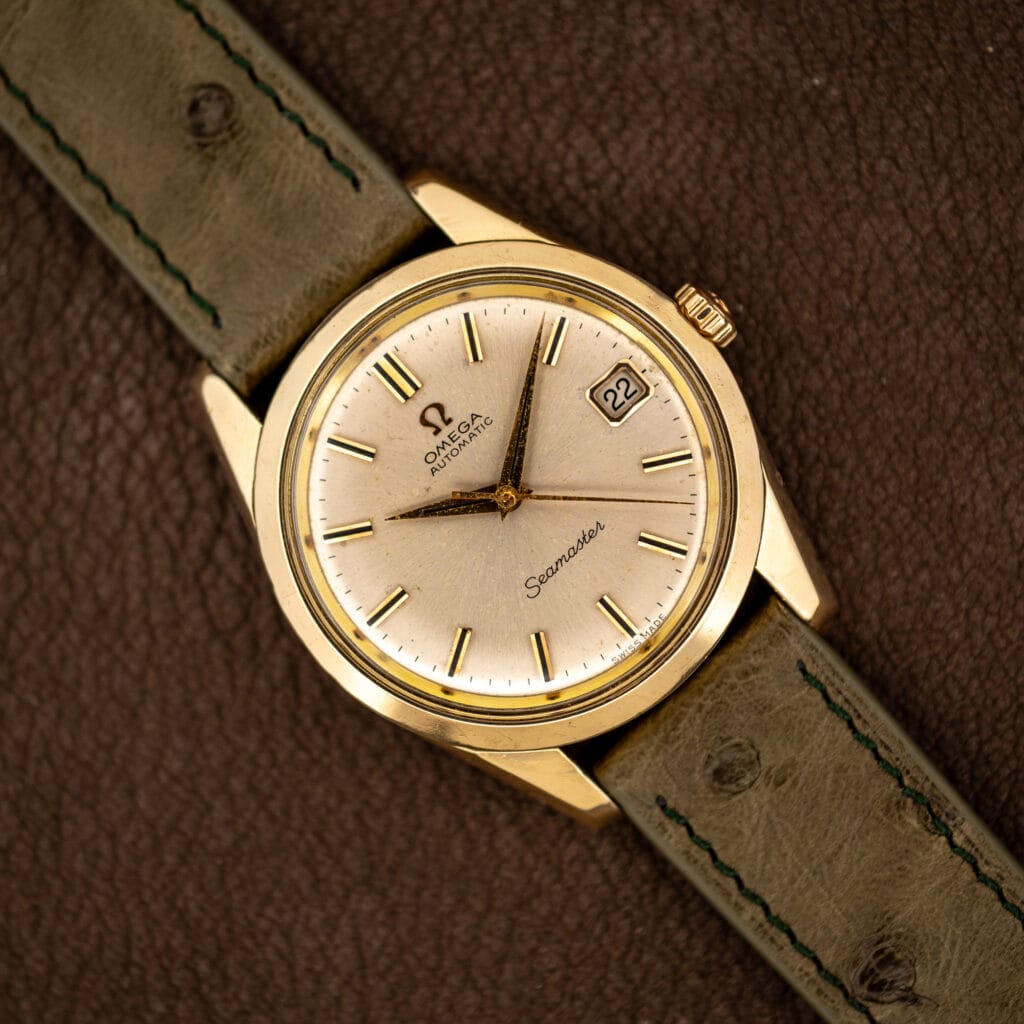
The 35mm width and 43mm length give the familiar relationship most buyers expect. Round is not the best shape. It is simply the least shape-led, so the gold capping and olive strap can change the register without changing the basic silhouette.
Inspect the line where bezel meets case side. If it has gone soft, polishing has already altered the object, and the dial deserves the same scrutiny.
rectangular: the cleanest break from a sports watch
Going rectangular changes the wrist more than any brand swap. The case runs vertical, the dial fills the front, and the whole object lines up with a cuff instead of sitting inside it.
A watch we handled, the Girard-Perregaux 1791 in 14k gold fill, measures 23mm wide by 33mm long, on 18mm lugs. Mid-century, a 14k gold-filled case, a 17-jewel manual-wind form movement, a warm cream dial with applied gold Arabic numerals, small seconds at six, black leather strap. The 1791 beneath the signature is the founding year, not a reference number.
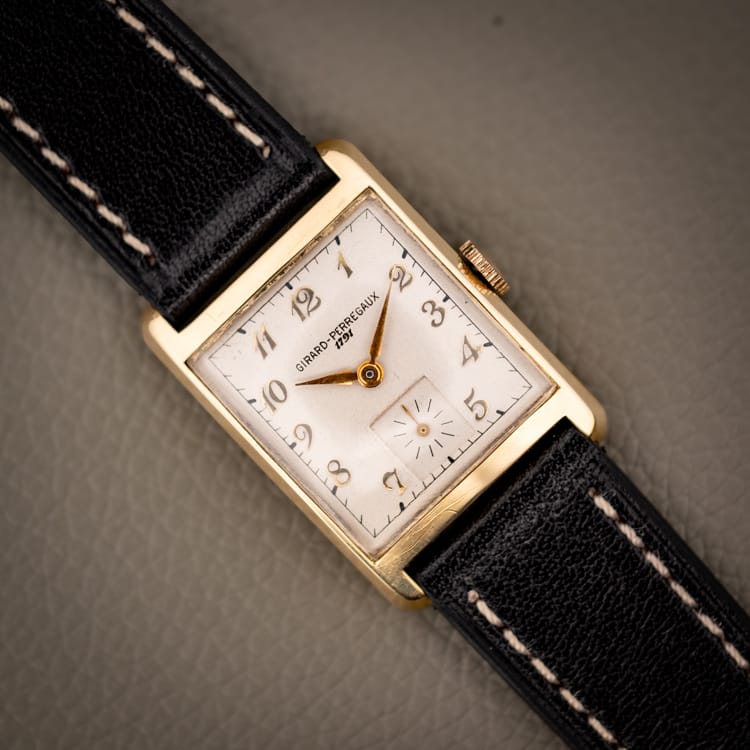
The 23mm width sounds tiny until the 33mm length and dial-filled front enter the picture. Judge a rectangle by its full vertical footprint and visible dial, not by a made-up conversion to round-watch size.
A rectangle reads as deliberate, especially beside a modern sports watch. Its catches are equally shape-specific: gold-filled corners wear first, and a cracked shaped crystal can be a hunt. Our gold-filled versus gold-plated guide covers the material, while the vintage tank watch buyer’s guide goes deeper on the category.
square: the outline and the dial do not have to agree
A square is not a short rectangle. With equal sides there is no vertical run to carry the eye, so the presence comes entirely from the corners.
The example from our archive is a Longines ref. 3217-428 with a factory leopard dial. It is 26mm across, 39.5mm lug to lug, 18mm between the lugs, with a 10k yellow gold-filled square outer case and the manual-wind Longines caliber L647.4. The dial pattern, in chocolate, tan, copper, and dark brown, is a factory-drawn style. It is not patina, and it did not change over time. Grey leather strap.
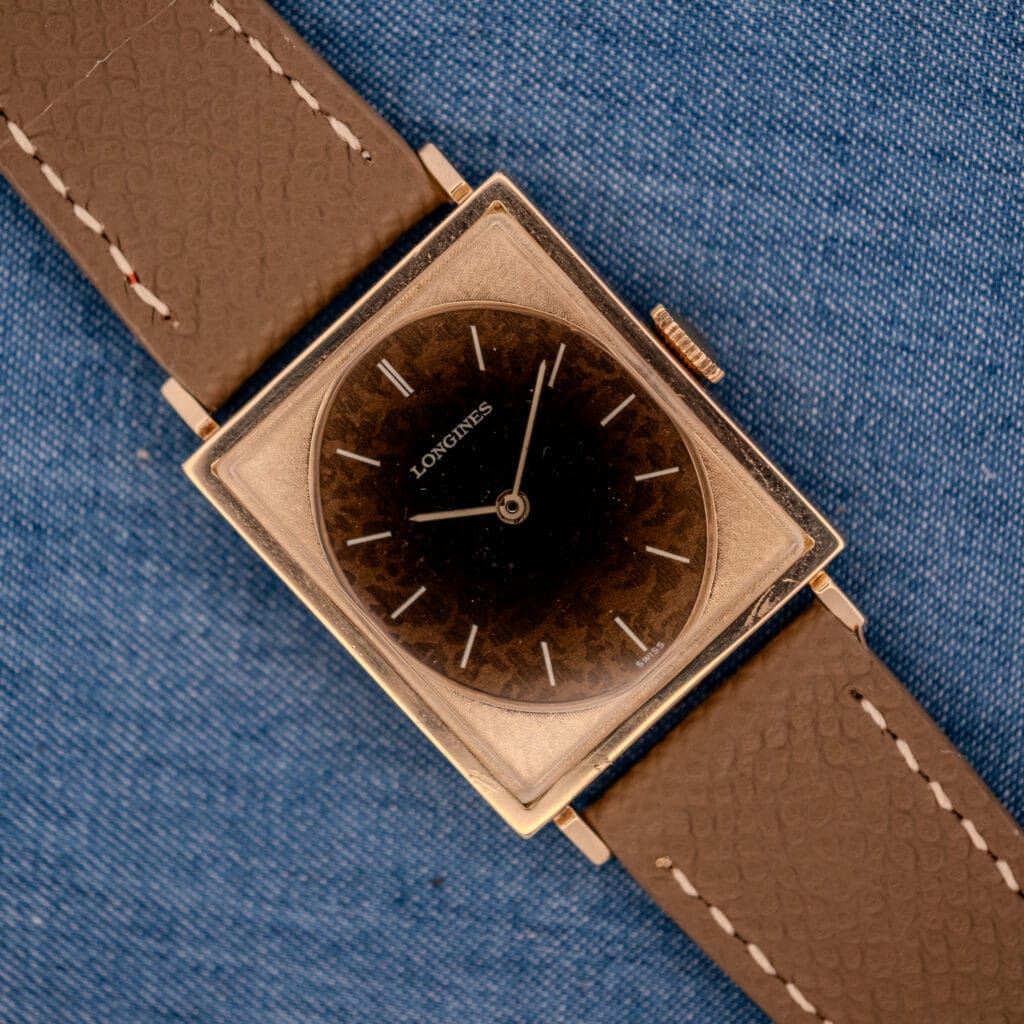
The case is square and the dial opening is circular. From across the room the corners set the silhouette; up close the round dial keeps the display familiar. Case outline and dial outline are separate design choices.
That makes a square feel graphic without becoming difficult to read. It also makes corner condition decisive. Polishing rounds all four equally, and the crispness of those corners is the shape.
tonneau: the barrel that follows the wrist
Tonneau is French for barrel, and the outline is exactly that. The case swells through the middle and narrows toward the ends, with sides that bow outward rather than run straight. Square it up and you have a rectangle. Leave the curve in and you have this.
A watch we handled, the Gruen Veri-Thin ref. 421-653, dates from the late 1940s to early 1950s. It measures 28mm across at the swell and 37.3mm lug to lug, on 16mm lugs. Softly rounded tonneau case, a 10k gold-filled bezel over a Guildite base-metal back, the manual-wind Gruen caliber 421, a cream Art Deco dial with gilt Arabic numerals and small seconds at six, brown leather strap.
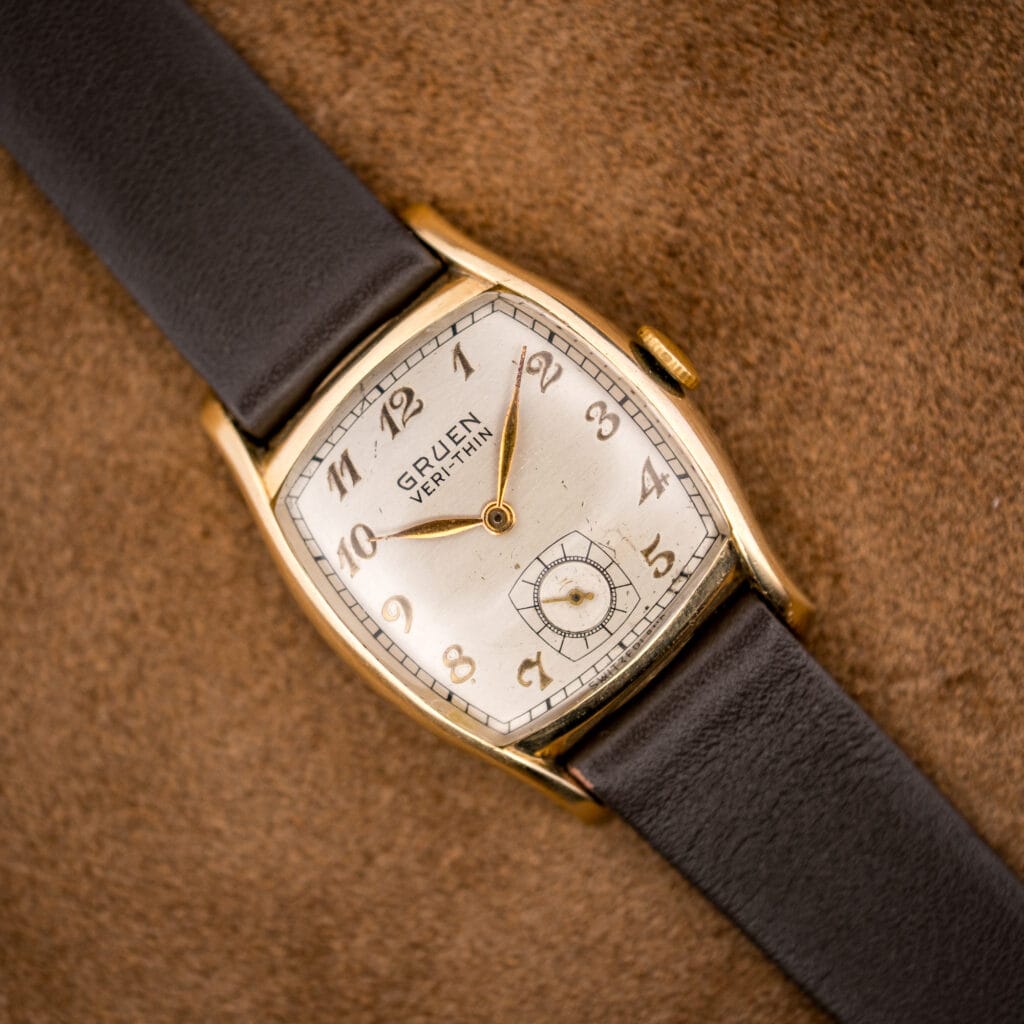
The 28mm figure describes only the case’s widest point. It tapers from there, while the 37.3mm length keeps the whole watch compact. A rectangle is a ruled line. A tonneau is the softer version.
Its crystal follows one specific outline, and this example pairs a gold-filled bezel with a Guildite back, so inspect both surfaces. It is standard-grade Veri-Thin rather than a Gruen Precision, and the back is not steel.
cushion: the most presence for the least length
Cushion is the shape buyers most often mislabel, so here is the formula. A broad, softly squared case with rounded corners and slightly bowed sides, wrapped around a circular dial, with a short vertical span. Not a square, which keeps sharp corners. Not a tonneau, which narrows at the ends.
The cushion in our archive is an Eterna-Matic 1000 Concept 80 ref. 156T from the late 1960s. Brushed stainless steel, 38mm across, 41mm lug to lug, 20mm lugs, the automatic Eterna caliber 1488K inside. Black dial, applied steel baton markers, date at three. The steel mesh bracelet is a period pairing that suits it, not a verified factory Eterna bracelet.
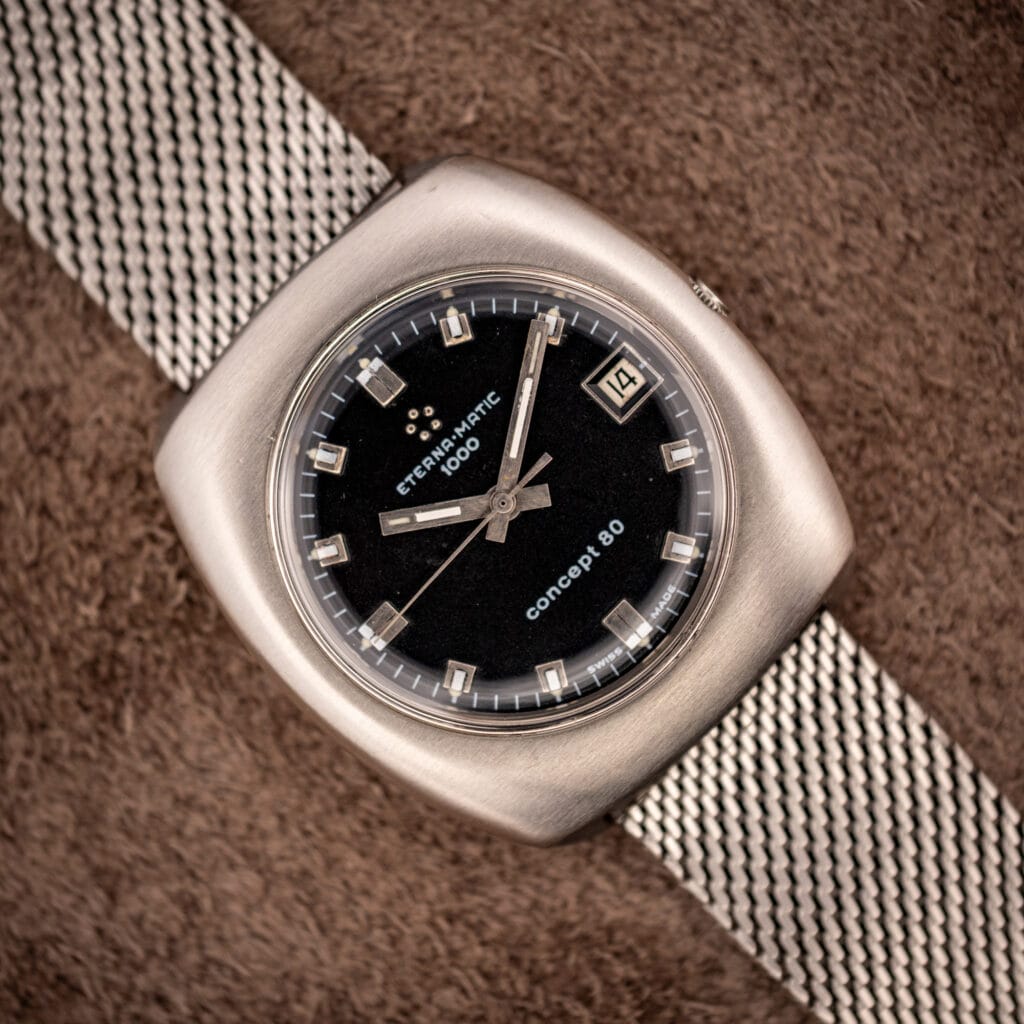
The round Omega is 35mm wide and 43mm long. This Eterna is broader at 38mm but shorter at 41mm. That is the cushion trick: more face across the wrist without extra vertical span.
Brushed steel, black dial, and mesh put it firmly in late-1960s sport-casual territory. Inspect the brushed planes and their transitions. Heavy polishing erases the geometry that makes a cushion case work.
saucer: broad, shallow, and shorter than it looks
This example has very short lugs and is best described as a saucer, or a disc. It is not an oval, and we would not file it as one.
The Bulova President C T-3092 carries a 1973 case date. It is 38.5mm across but only 40mm lug to lug, with 17mm lugs. Shallow stainless steel disc case with a wide sloping rim and short faceted lugs, the 23-jewel automatic Bulova caliber 11 AOACB inside, a maroon dial with silver Roman numerals, day at nine, date at three, black leather strap. T-3092 comes from the 3092 case number, and President C is the catalog model name.
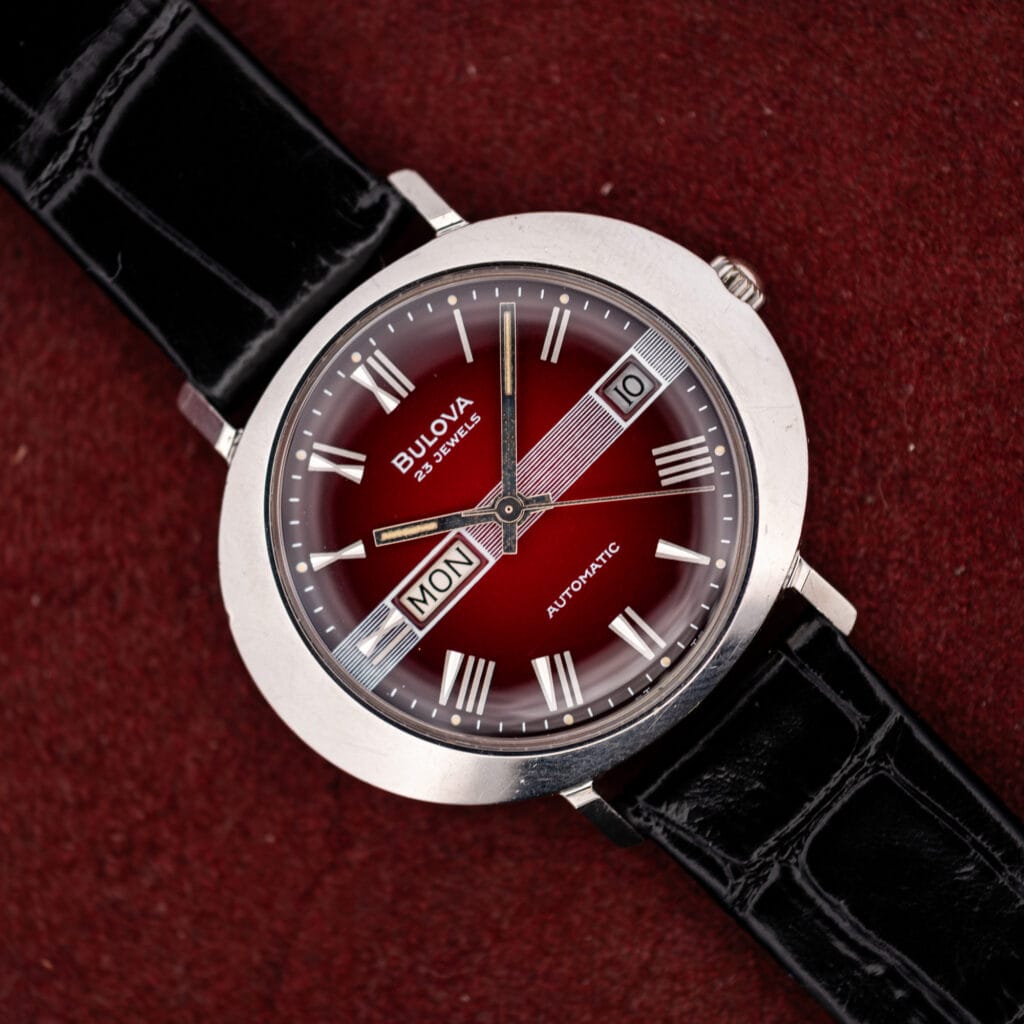
Its 38.5mm width and 40mm length are nearly equal because the lugs barely leave the rim. The case spreads wide, sits low, and makes the 17mm strap look deliberately narrow.
The maroon dial warms up a shape that otherwise reads as pure 1970s steel. Check the case in profile before trusting a straight-on shot: polishing can flatten the sloping rim and erase the small lug facets.
asymmetrical: when the lugs do the drawing
Asymmetry reads as a design choice rather than a neutral one. It is worn on purpose.
The example from our archive is a mid-century LeCoultre Aristocrat, the one collectors call the “Grasshopper”. A 10k gold-filled case, a rectangular central body with sculptural splayed lugs, the 17-jewel manual-wind caliber 490/BW inside. Aged tan dial, applied gold arrowhead and dot markers, no seconds hand, brown lizard-grain strap. Aristocrat is the official US model line. Grasshopper is a nickname the lugs earned, and it appears nowhere on the watch.
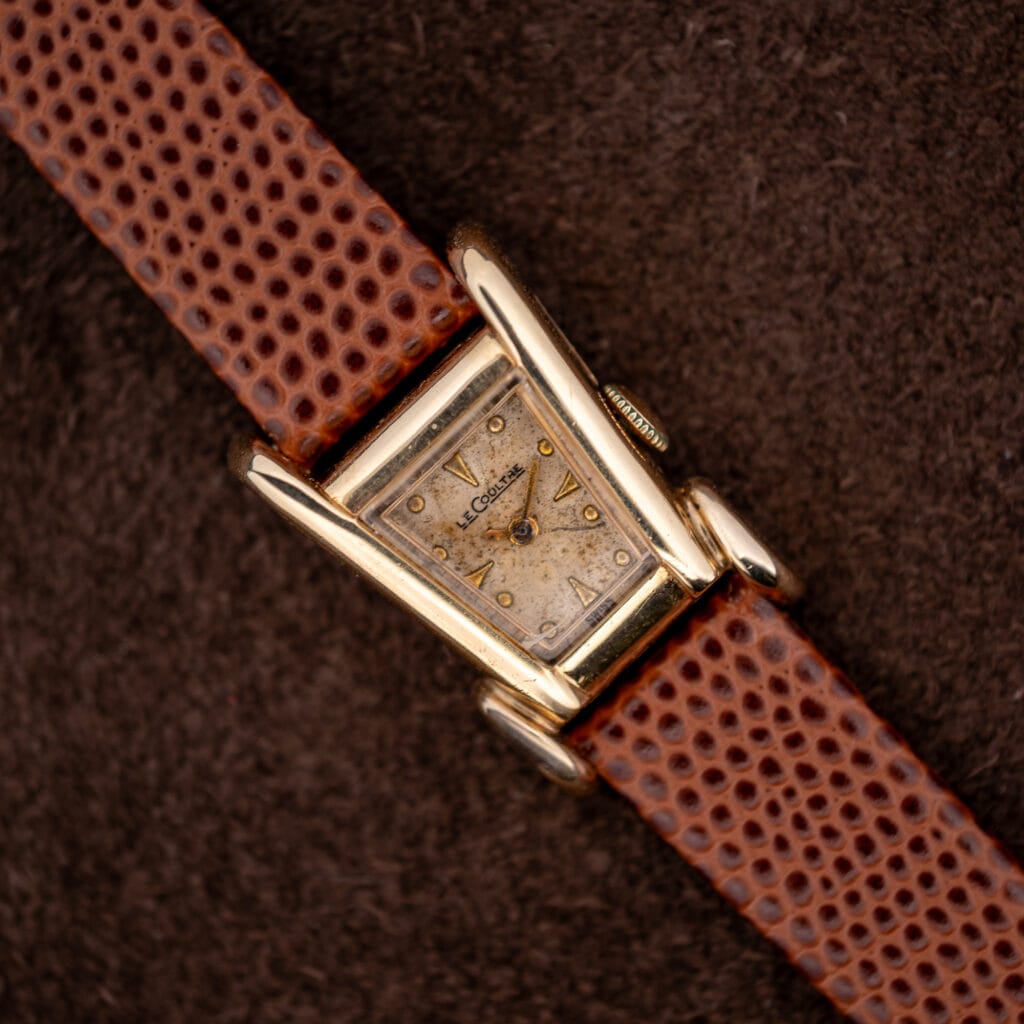
The dial remains a simple rectangle. The asymmetry lives in the outline, where the lugs splay outward and set the footprint. From across a table it reads as sculpture; at a glance it remains easy to read.
Inspect the exposed gold-filled lug tips first. The silhouette depends on those points surviving with their shape intact.
when the lugs and the bracelet become the shape
Two constructions get confused with case shapes, and both deserve their own line.
The first is the hooded lug. On our Omega Seamaster ref. 14363-1 SC, the case is round, roughly 34.5mm, mid-to-late 1950s, gold-capped front over a stainless steel back, with the automatic Omega caliber 500. The lugs arch over the strap connection like small bridges. The dial is a custom Franklin Life 60 Club presentation dial with applied gold numerals and baton markers, and the watch wears a green suede strap. The presentation lives on the dial, not the caseback.
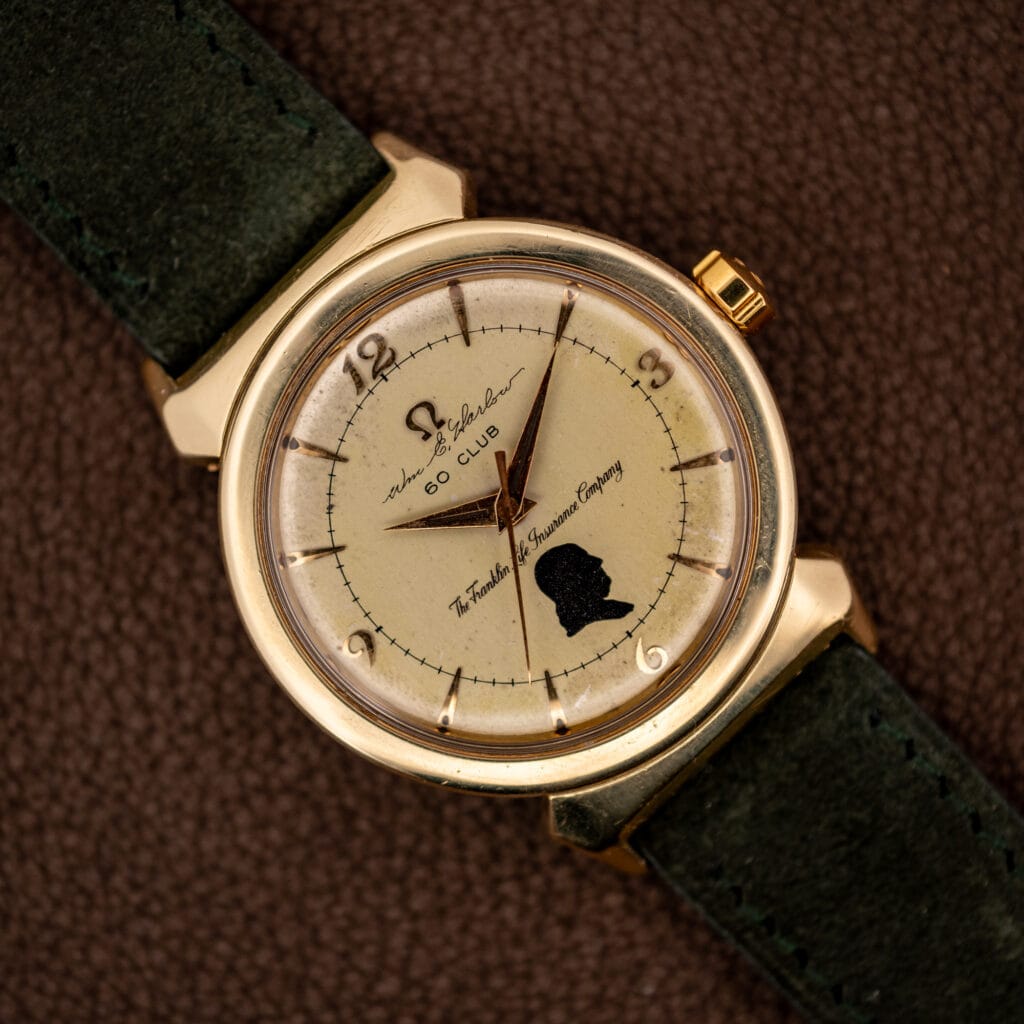
Hooded lugs are a lug style, not a case shape. The case underneath is round, but the hoods conceal the spring bars and let the outline flow into the strap without the usual visual gap.
This Omega is not an integrated-bracelet watch. Hodinkee’s definition reserves that term for a bracelet or strap made specifically to connect to its case rather than fitting between ordinary lugs. This Omega still accepts a conventional strap beneath the hoods.
what to check before buying a shaped vintage watch
The shape creates the inspection list.
Check the crystal. Curved and faceted acrylic crystals were original equipment on many vintage watches, but replacements fit one outline rather than a broad family of round cases.
Protect the geometry. Polishing removes metal from corners, facets, and transitions. Gold-filled corners and lug tips show wear first, while gold capped and gold filled remain different constructions.
Treat a fitted bracelet as part of the watch. Missing links or a proprietary clasp may be harder to replace than the movement part the seller wants to discuss.
Demand several angles. A straight-on photo hides softened corners and flattened facets. Ask for the profile, lug tips, and back. Our identification and value guide covers the broader condition check.
Ask for a real service record, not runs well; our service-history guide explains why. Keep every example here away from water, for the reasons in our vintage water-resistance guide.
which shape should you choose?
Start from the watch you already own and the clothes you already wear.
Modern sports watch is your baseline. Go rectangular for the cleanest contrast, or tonneau for a softer version of the same move.
You already own a round vintage automatic. Square keeps the dress register and adds corners. Cushion moves toward brushed-steel weekends with more face and less length.
You want presence without a long case. Cushion or saucer. Both put width across the wrist while keeping the vertical span short.
You dress around design. Asymmetrical. The exposed edges and shaped parts demand more care, which is part of the decision.
You like round but want it to feel chosen. Hooded lugs keep the familiar dial and change the architecture around it.
This is your first vintage watch. Round is the easier starting point because the measurements behave predictably. Our first vintage watch buying guide covers the rest.
No size fits every wrist, and no shape is right for everyone. Choose the outline first, then compare the watches that express it honestly.
where this fits in the bigger picture
Shape is one axis of choosing a vintage watch. Role is the other, and our vintage watch styles guide covers dress, field, dive, chronograph, and the stranger categories with the same archive-first approach. When you would rather compare real cases than read about them, the shop holds the watches we have already inspected and photographed from every angle that matters.
Related posts
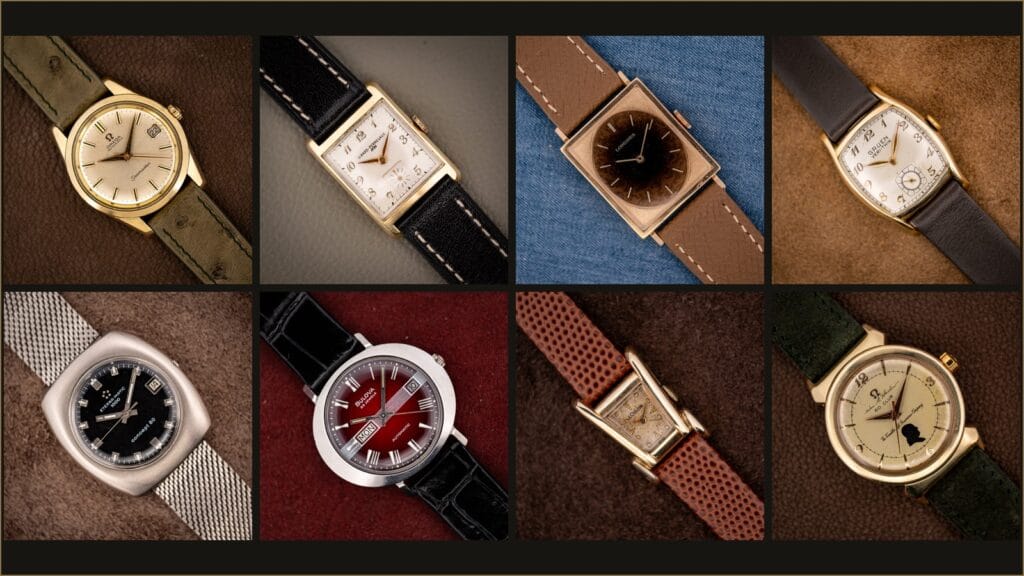
Watch Shapes: Which Vintage Case Shape Fits Your Style?
Case shape changes how a vintage watch wears more than diameter alone. Compare eight silhouettes and learn which one fits your wrist and style.
Vintage Dress Watches: How to Choose One You’ll Actually Wear
The best vintage dress watch is the one you will wear beyond weddings. Here is how to choose the right size, metal, dial, shape, and strap.
Vintage Watch Styles: A Visual Guide to Finding Yours
Most buyers pick a brand and stall. Here are nine vintage watch styles, shown with real watches from our archive, and the catch that comes with each one.
Vintage Tank Watches: A Buyer’s Guide to Rectangular Watches Beyond Cartier
Every Cartier Tank alternatives list is new watches imitating old ones. The originals still exist and cost less. A buyer's guide to vintage tank and rectangular watches: the brands, the prices, and what to check.
Service History Is the Wrong Question. Here’s the Right One.
Everyone says to ask for a vintage watch's service history. Most of it can't be verified, and a receipt proves a transaction, not a result. Here's what actually tells you a watch has been serviced, and the better question to ask.
LeCoultre vs. Jaeger-LeCoultre vs. Jaeger: What the Name on the Dial Means
Three names, one Swiss firm, and one watch that isn't what it looks like. What LeCoultre, Jaeger-LeCoultre, and plain Jaeger on a vintage dial really tell you.
Omega Seamaster 166.010 Buyer’s Guide: Prices, Variants, and What to Look For (2026)
Everything you need to buy an Omega Seamaster 166.010 in 2026: real market prices by condition tier, five dial variants explained, caliber 562 vs 565, original part numbers, and what to inspect before you commit.
Omega vs Rolex: The Vintage Buyer’s Verdict
Vintage Omega vs vintage Rolex: where the Rolex premium is worth paying, where Omega is the smarter buy, and how to dodge redials on both. A collector's verdict.
Movado Kingmatic: A Vintage Buyer’s Guide to References, Calibers, and Value
The Movado Kingmatic is one of the best values in vintage automatics. A buyer's guide to its references, in-house calibers, the Sub-Sea line, what to check, and what they actually sell for.
13 Vintage Watch Collecting Tips for Beginners (From 1,000+ Watches Sold)
Thirteen vintage watch collecting tips drawn from selling over 1,000 watches. What separates a smart first buy from an expensive lesson, with no sugar.
Vintage Wittnauer Chronograph Caliber Identification: Venus 188, Valjoux 7733/7734, Landeron 248
How to identify the movement inside any vintage Wittnauer chronograph: Venus 188, Valjoux 7733 and 7734, Landeron 248, and the house numbering system Wittnauer used to mark them.
How Water-Resistant Is a Vintage Watch, Actually? The Honest Answer.
Every dealer says never get a vintage watch wet. That advice is half-engineering and half-liability theater. Here is what is actually true about vintage water resistance, where water actually gets in, and when a 1965 diver is safer than a 2-year-old modern.