

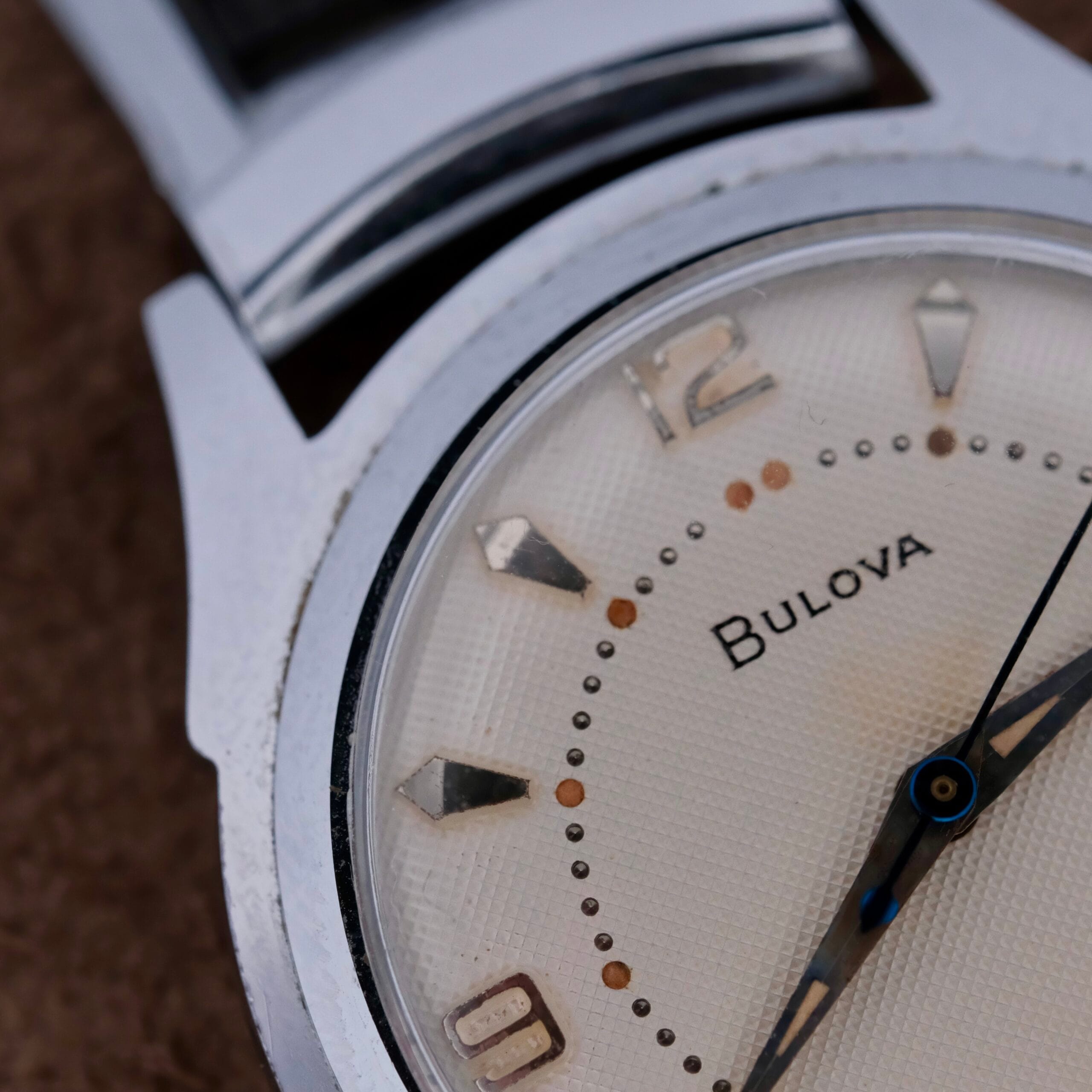
If your Bulova is from 1950 or later, the Bulova date code on the case back tells you the year in about ten seconds. Open the case back, find the two-character code stamped on the inside or on the movement, and read off the year from the table below. That is the simple version.
If your Bulova is from before 1950, Bulova watch identification takes more work. Bulova used at least four different dating systems and several different Bulova serial number formats in its first 130 years of operation, and a typical vintage Bulova carries four separate numbers on the case, movement, and dial. This guide covers all of them, from the pocket watches Joseph Bulova was selling on Maiden Lane in 1875 to the quartz Lunar Pilots Citizen ships today.
The Quick Answer: Reading a Bulova Date Code (1950 to Present)
From 1950 onward, every Bulova carries a two-character alphanumeric Bulova date code. The letter tells you the decade. The digit tells you the year inside that decade. A Bulova date code of M3 means 1963. N7 is 1977. B4 is 2014.
The Bulova date code is usually stamped twice: once on the movement (visible only with the case back off), and once on the inside of the case back. When the two codes agree, you have your year. When they differ by more than one year, something has been replaced and the case mark is generally the more reliable of the two.
Bulova Date Code Table (1950 to 2029)
| Letter | Decade | 0 | 1 | 2 | 3 | 4 | 5 | 6 | 7 | 8 | 9 |
|---|---|---|---|---|---|---|---|---|---|---|---|
| L | 1950s | 1950 | 1951 | 1952 | 1953 | 1954 | 1955 | 1956 | 1957 | 1958 | 1959 |
| M | 1960s | 1960 | 1961 | 1962 | 1963 | 1964 | 1965 | 1966 | 1967 | 1968 | 1969 |
| N | 1970s | 1970 | 1971 | 1972 | 1973 | 1974 | 1975 | 1976 | 1977 | 1978 | 1979 |
| P | 1980s | 1980 | 1981 | 1982 | 1983 | 1984 | 1985 | 1986 | 1987 | 1988 | 1989 |
| T | 1990s | 1990 | 1991 | 1992 | 1993 | 1994 | 1995 | 1996 | 1997 | 1998 | 1999 |
| A | 2000s | 2000 | 2001 | 2002 | 2003 | 2004 | 2005 | 2006 | 2007 | 2008 | 2009 |
| B | 2010s | 2010 | 2011 | 2012 | 2013 | 2014 | 2015 | 2016 | 2017 | 2018 | 2019 |
| C | 2020s | 2020 | 2021 | 2022 | 2023 | 2024 | 2025 | 2026 | 2027 | 2028 | 2029 |
Bulova used L, M, N, P, T, A, B, C. The letters O, Q, R, and S were skipped, almost certainly because they look too much like other characters when stamped small. O collides with the digit zero. Q, R, and S all look like each other under loupe magnification on a 60-year-old movement plate.
A few catches worth knowing
After 2000, Bulova rolled the letter sequence back to A. So a code of A8 could mean 1948 (a transitional pre-system stamp, see below) or 2008. Case style decides this for you instantly. The same caveat applies to A0 through A9 (1948 through 1949 if the watch is mechanical and gold-filled with a small case, 2000 through 2009 if it’s a modern steel quartz).
The system is currently in C, which covers the 2020s. A new Bulova bought in 2026 will read C6.
Where to Find the Bulova Date Code on Your Watch
For most vintage Bulovas, the Bulova date code is in two places:
- On the movement. Pop the case back off and look at the movement plate. The two-character code is stamped somewhere on the plate, often near the balance wheel or under the dial. It indicates the year the movement was assembled.
- Inside the case back. A second Bulova date code stamp lives on the inside surface of the case back itself. It indicates the year the case was finished.
For watches from the 1950s and earlier, you may also see a Bulova serial number alongside the date code. Bulova mostly stopped putting serial numbers on movements after 1932, but a small number of pieces carry them into the mid 1930s.
If you don’t want to open the case back yourself, almost any watchmaker or jeweler will pop it for you for free or for a couple of dollars. You don’t need to send it to a Bulova service center.
The Pre-1950 Bulova Date Code: The Symbol System (1924 to 1949)
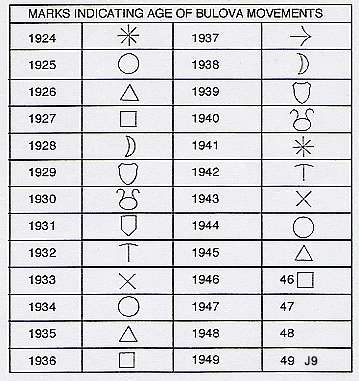
Between 1924 and 1949, Bulova stamped a small graphic symbol on the movement instead of a letter code. This pre-alphanumeric Bulova date code gives you the year inside a decade, but it does not tell you which decade. The same symbol repeats every nine or ten years. A triangle could mean 1926, 1935, or 1945. A circle could mean 1925, 1934, or 1944.
To narrow down the decade, you use the case style, dial design, hand style, lug shape, and the movement caliber. A circle-stamped Bulova with a 10AN caliber, a stepped Art Deco gold-filled cushion case, and Breguet numerals is a 1934. The same circle on a 10BPAC center-seconds caliber with a thin round dress case is a 1944. The decade follows from the design.
The symbols, year by year
| Year | Symbol |
|---|---|
| 1925 | Circle |
| 1926 | Triangle |
| 1927 | Square |
| 1928 | Crescent moon |
| 1929 | Rounded shield |
| 1930 | Horned circle |
| 1931 | Rectangular shield |
| 1932 | Rounded capital T |
| 1933 | Capital X |
| 1934 | Circle (repeats 1925) |
| 1935 | Triangle (repeats 1926) |
| 1936 | Square (repeats 1927) |
| 1937 | Right-pointing arrow |
| 1938 | Crescent moon (repeats 1928) |
| 1939 | Rounded shield (repeats 1929) |
| 1940 | Horned circle (repeats 1930) |
| 1941 | Asterisk or star |
| 1942 | Rounded T (repeats 1932) |
| 1943 | Capital X (repeats 1933) |
| 1944 | Circle (repeats 1925, 1934) |
| 1945 | Triangle (repeats 1926, 1935) |
| 1946 | Square (repeats 1927, 1936) |
| 1947 | “47” stamped as a numeric code (transition) |
| 1948 | “A8” (system transition begins) |
| 1949 | “A9” |
For an exact visual reference, the canonical symbol chart is hosted as an image on MyBulova.com’s date codes page. If you can’t tell whether what you’re looking at is a horned circle or a rounded shield, that’s where to go.
The system transitioned to the alphanumeric format starting in 1947, with some 1948 and 1949 watches carrying A8 and A9 stamps. By 1950 the symbol system was retired entirely in favor of L0 through L9.
The Bulova Serial Number System on the Case (1926 to 1949)
While the movement carried a date code symbol, the Bulova serial number on the case carried a different signal. From 1926 through 1949, the first digit of the case Bulova serial number corresponds to the last digit of the year of manufacture.
A serial starting with 4 was made in 1934 or 1944. A serial starting with 8 was made in 1928, 1938, or 1948. The decade, again, comes from style.
If the movement symbol and case serial first digit disagree by more than a year, you are probably looking at a watch where one component has been replaced. The case mark is generally considered slightly more reliable than the movement symbol when both are present and they’re close to each other.
A few exceptions are worth noting. Some 1930s stainless steel and solid gold cases use irregular numbering. Pre-1926 cases have no serial system at all. Patent dates stamped inside cases are not manufacture dates: ignore them.
Ladies’ Watches Used Letter Bulova Serial Numbers Instead
Ladies’ Bulovas from 1940 through 1949 used a letter prefix on the case Bulova serial number instead of a digit.
| Year | Ladies’ case letter |
|---|---|
| 1940 | A |
| 1941 | B |
| 1942 | C |
| 1943 | D |
| 1944 | E |
| 1945 | F |
| 1946 | G |
| 1947 | H |
| 1948 | I |
| 1949 | J |
The letter system was case-only and ladies’-only during this period. The movement still carried the symbol code described above. The system ended in 1949 when both men’s and ladies’ production rolled into the universal L0 through L9 alphanumeric format in 1950.
The Four Numbers on a Vintage Bulova (Date Code, Serial, Caliber, Model)
A common point of confusion in Bulova watch identification: a typical vintage Bulova carries four different identifiers, and they all do different things.
| Number | Where it appears | What it tells you |
|---|---|---|
| Movement Bulova serial number | Stamped on the movement plate | Used pre-1932 to date the movement individually. Bulova stopped using these on most movements after 1932, when the date code symbol system took over. |
| Movement caliber | Stamped on the movement (e.g. “10AK”, “11AF”, “214”) | The movement family, useful for service and for identifying what’s inside. |
| Bulova date code | Stamped on the movement, and on the case-back interior | The year the watch was assembled, in the symbol or alphanumeric Bulova date code system described above. |
| Case Bulova serial number | Stamped inside the case back | Pre-1950, the first digit (or letter, for 1940s ladies’) tells you the year of case manufacture. |
You may also see a hand-inscribed Roman numeral identifier under the top edge of some case interiors. This is a Bulova quality control mark: it matches the last three digits of the case serial number. Its presence is supporting evidence that the original case and movement have stayed together since the factory.
Modern Bulovas (post-1980) carry a reference number like 96B107 instead. More on those below.
Modern Bulova Reference Numbers (1980s to Today)
After Citizen acquired Bulova in 2008, and increasingly through the late 1980s and 1990s before that, Bulova adopted a multi-character reference number system stamped on the outside case back.
A typical modern reference looks like 96B251 or 98A123.
- The first two digits (96, 98, 97, and so on) indicate the collection or category.
- The letter indicates the segment within that collection. Community convention reads B as men’s, L as ladies’, A as automatic or Accutron-series, M as mid-size. Bulova has never published an official key, so treat these as observed conventions rather than rules.
- The trailing digits are a sequential model identifier inside that line.
For modern Bulovas, the reference number is your single most useful piece of information. You can punch a reference into Bulova’s customer service line (1-800-A-BULOVA) or into the search field on bulova.com and get the model name and specifications instantly.
The date code system (L through C) continues to live on modern watches as well, often stamped in much smaller print on the inside or outer rim of the case back.
Before 1924: The Hard Era
If your Bulova predates 1924, you’re in the hardest era to date and identify. There is no formal date code. There is no consistent serial number system. The dating evidence is circumstantial.
The strongest single clue is the movement signature:
- Movements stamped “Bulova W. Co.” are from before April 1923, when the company was still incorporated as the J. Bulova Company.
- Movements stamped “Bulova Watch Co.” are from April 1923 or later, after the formal reorganization into Bulova Watch Company, Inc.
- A few very early Bulovas have movements with no Bulova signature at all. This is one of the rare cases where the absence of branding is not a fake red flag.
Case-maker stamps help bracket the era further. Early Bulovas were cased by Wadsworth Watch Case Co. and by American Standard Watch Case Co. Bulova owned American Standard outright by 1931, and an “American Standard, Aug. 1, 1918” stamp on a case interior indicates production from 1918 or later.
Caliber narrows the range. The 10AN caliber ran from 1925 to 1937. Earlier Swiss-import calibers turn up on 1910s and very early 1920s Bulovas.
Style cues finish the job. Small round or cushion cases, wire or wire-loop lugs, fired enamel dials, and Roman or Arabic numerals are all consistent with 1915 through 1925.
A pre-1924 Bulova is not impossible to date. It just takes the combination of movement signature, case maker, caliber range, and design era to land within a few years.
Bulova Calibers: The Movement Inside
The two-character date code tells you the year the movement was finished. The caliber number stamped on the movement plate tells you which Bulova movement family the watch uses. The caliber matters because it determines service parts, jewel count, common faults, and value.
Bulova caliber names follow a pattern: a number indicating size in lignes (the old Swiss watchmaking unit, where one ligne is about 2.26 millimeters), followed by letter codes. A 10AK is a 10½-ligne caliber in the “A” family, “K” sub-revision. The 10½-ligne size is the standard mid-century men’s movement size. Smaller calibers (7AA, 8AE) tend to be ladies’ or smaller men’s, and larger numbers tend to be later automatics and Accutrons.
Common Mechanical Calibers
| Caliber | Years active | Type | Jewels | Where you see it |
|---|---|---|---|---|
| 10AN | 1925 to 1937 | Manual wind | 7, 15, 17, 21 | Early Lone Eagles, Spartan, mid-1930s men’s |
| 10AK | Late 1930s to early 1950s | Manual wind | 15, 17, 21 | Wartime and post-war men’s |
| 10AKC | 1940s | Manual wind, center-seconds | 17, 21 | Center-seconds variant of 10AK |
| 7AA | 1947 to 1953 | Manual wind | 21 | Mid-size men’s |
| 7AK | 1936 to 1950 | Manual wind | 21 | Smaller men’s and ladies’ |
| 10BPAC | 1955 to 1959 | Automatic, center-seconds | 23 | The famous Bulova 23 self-winding line. Six-position adjusted, 18,000 vph, 41-hour reserve. |
| 10BZAC | 1959 to 1963 | Automatic, center-seconds | 23 or 30 | Successor to 10BPAC. The 30-jewel variant powers top-tier Beau Brummel dress watches. |
| 11AC | 1955 to 1958 | Manual wind, center-seconds | 17 | Common 1950s men’s |
| 11AF | 1959 to 1967 | Manual wind, center-seconds | 17 | Standard 1960s mechanical men’s |
Accutron (Tuning Fork) Calibers
The Accutron line broke from mechanical movements entirely. These are electronic tuning-fork watches, vibrating a small steel tuning fork at 360 Hz to drive the gear train.
| Caliber | Year | Format | Notes |
|---|---|---|---|
| 214 | 1961 to 1977 | 28.7 mm × 5.5 mm | Original Accutron. No crown: time set via case back. Sub-variants 214H (hacking), 214HN (hack + anti-magnetic, used in Astronaut). |
| 218 | 1967 to 1977 | 29.7 mm × 4.9 mm | Thinner, more widely produced Accutron. Sub-variants 218D (date), 2182 (day-date). |
| 219 | 1972 onward | Tuning fork | Budget Accutron with plastic components. |
| 221 / 230 | 1972 to 1973 | Tuning fork | Smaller-format ladies’ Accutron calibers. |
A movement stamped 214 is from no later than 1977. A 218 is post-1967. A 2182 indicates day-date complication and is most commonly seen in the Devil Sea / Deep Sea Accutron.
The Bulova 23 and the 30 Jewels Self-Winding Line
The dial that reads “23 / Self Winding” or “23 Jewels Self-Winding” is one of the most-searched vintage Bulova categories on the internet, and for good reason. The Bulova 23 was the brand’s flagship automatic line from 1955 to the early 1960s, designed to compete with high-grade Swiss automatics on accuracy and finish without commanding Swiss prices.
Variants are designated by a single letter on the dial: 23 “A”, 23 “B”, 23 “FW”, and so on. The letter typically encodes a dial or case variant rather than a major specification change. All share the same caliber family.
The movement was almost always a 10BPAC (1955 to 1959) or its successor the 10BZAC (1959 to 1963). Both are six-position adjusted, run at 18,000 vph, and offer roughly 40 to 41 hours of power reserve.
The 30 Jewels Self-Winding line is the same family with an upgraded movement. Many Beau Brummel and other top-of-line dress Bulovas use the 30-jewel 10BZ family. The added jewels are functional rather than decorative: extra cap jewels on the rotor and barrel arbor that genuinely reduce friction.
Clean Bulova 23 examples with original dials trade in the $300 to $800 range today, depending on case material and condition. Solid gold variants run higher. The line is a strong sweet spot for entry-level vintage collecting.
Major Vintage Bulova Model Lines
Bulova historically did not engrave model names on its watches. The model name lives in period catalogues, line books, and the MyBulova.com database. The list below covers the lines that actually show up regularly in vintage Bulova hunting.
Lone Eagle (1927 to early 1940s)
Originally named the Conqueror in late 1926, renamed the Lone Eagle on June 17, 1927 to ride Charles Lindbergh’s solo Atlantic crossing one month earlier. Bulova had offered Lindbergh a $1,000 prize for the flight in 1926 and within 48 hours of his landing took 30,000 orders for the rebadged watch. Five thousand sold in three days, fifty thousand by 1930.
At least six different Lone Eagle models followed through the late 1930s. Caliber is almost always 10AN. The earliest examples shipped with a facsimile of Lindbergh’s thank-you letter in the original box.
Beau Brummel (late 1940s to early 1970s)
Bulova’s top-tier dress line, in production for more than two decades. Diamond-set dial configurations, 21, 23, or 30 jewels, solid or gold-filled cases. The 30-jewel Beau Brummel with a 10BZAC automatic is the apex of Bulova mechanical dress watches.
Snorkel, Oceanographer, and the Devil Diver (1961 to early 1970s)
Bulova introduced its first purpose-built dive watch in 1961, using a Compressor case from Ervin Piquerez SA in Switzerland. The standard Compressor case carried a 600-foot depth rating; Bulova pushed the same case to 666 feet, which is where the Devil Diver nickname comes from. Any Bulova diver rated to 666 feet is a Devil Diver.
In 1968 the line gained the Snorkel name with its cross-hair dial, tritium-lume hour markers, and bicolor red 15-minute timing arc. In 1969 the dial picked up the Oceanographer designation: the canonical Devil Diver form factor.
A smaller-depth Snorkel 333 Feet ran parallel for less hardcore use.
Bulova reissued a faithful version in 2018 as the Archive Series 666 Devil Diver, limited to 666 pieces with an orange dial. A contemporary Oceanographer GMT has been in current production since 2022.
The Accutron Sub-Models
Accutron was its own brand-within-the-brand from 1960 to 1977, then again from 2020 onward under Citizen. Major sub-models, in rough order of collector interest:
- Spaceview. Originally a sales tool: dealers showed the tuning fork through a dialless watch to prove the technology was real. Demand made it a regular model from 1961. The Spaceview has no dial. The exposed green PCB and tuning fork are the dial. Markings are reverse-printed on the underside of the crystal. Stainless steel from 1962.
- Astronaut. 1962 to 1977. GMT complication with a 24-hour rotating bezel and a 24-hour hand. Issued quietly to CIA Lockheed A-12 OXCART pilots. Fourteen documented letter sub-variants run from A through T across four type configurations.
- Astronaut Mark II. 1970 onward. Square cushion case, twin crowns. Uses the 218 caliber instead of the original 214.
- Railroad Approved. 1962 onward. The first wristwatch ever certified for U.S. railroad service. Dial reads “Railroad Approved” in standard numerals. Used by railroad workers to synchronize trains and station clocks.
- Deep Sea (sometimes “Deep Sea AB”). 1969 to 1971, with most production in 1970. Uses the 2182 day-date caliber. Case is 41 mm by 45 mm, 20 mm lugs, 14.5 mm thick with a super-dome crystal. Rated to 666 feet, making it the Accutron version of the Devil Diver. Date codes typically run M8 through N0.
- GMT and Bal Harbour. Smaller-volume regional and dress variants, mid-to-late 1960s.
Total Accutron production from 1961 to 1977 was over 5 million pieces across all sub-models.
If you have a Railroad Approved Accutron and want a deeper buyer’s reference, see our dedicated Bulova Accutron Railroad Approved page.
The Dress Watch Lines
These lines all show up regularly in vintage Bulova hunting. They are not as iconic as the Lone Eagle or the Accutron but they are common, generally affordable, and well-built.
- President and Presidential. Multiple generations from the 1950s to the 1970s. Dress watches with date complications.
- Senator. Recurring 1960s dress line. Solid mid-tier.
- Commodore. 1950s to 60s dress watch line. Often gold-filled.
- Yankee Clipper, Royal Clipper, Jet Clipper, Sea Clipper. 1955 to early 1960s. Share a distinctive case style with sculptural lugs.
- His Excellency and Excellency. 1940s to 1950s premium dress.
- Date King. 1964 to 1965 date-window line.
- Sea King. 1969-era day-date automatic.
- Academy Award. 1950 to 1954 licensed line (Bulova paid $154,000 in licensing fees over five years), roughly 25 ladies’ models and 14 men’s.
A note on aviation watches
The strong Bulova aviation lineage is not the Sky King (a minor 1952 model). The real aviation Bulovas are:
- The A-11 and A-15 military pilot watches issued in WWII (1942 to 1945).
- The Lunar Pilot: Apollo 15 commander Dave Scott’s personal Bulova chronograph (model 88510/01), worn on the lunar surface in 1971 and sold at auction in 2016 for $1.625 million. Bulova has produced modern Lunar Pilot reissues since 2016, currently at 43.5 mm with the NP20 high-frequency quartz movement.
Country of Origin: What “Made in” Actually Means
A consistent source of confusion: a case stamped “Bulova” with a “Made in USA” mark on the case back almost never indicates an American-made movement. Bulova ran a movement factory in Biel, Switzerland from 1912 through 1983. For more than seventy years, the typical “American” Bulova carried a Swiss movement.
Here is how to read the “Made in” question by era.
| Era | Movement origin | Final assembly |
|---|---|---|
| 1912 to 1923 | Biel, Switzerland | NYC |
| 1923 to 1949 | Biel | NYC, Woodside, and Flushing NY plants |
| 1950 to 1977 (Accutron era) | Biel for mechanical, US for some Accutron assembly | New York plants |
| 1977 to 1983 | Biel | New York and contracted assembly |
| 1983 to 2008 | Biel closed in 1983; ETA and other Swiss suppliers, some Japanese | Predominantly Asian assembly by late period |
| 2008 onward (Citizen ownership) | Miyota / Citizen movements (Japan), with limited Swiss Accu•Swiss line 2012 to 2015 | Japan, China, Hong Kong |
So when a vintage Bulova says “Bulova Watch Co. Made in USA” on the case back: read it as case manufacture and final assembly in the United States, with a Swiss movement inside. That’s what the brand was for most of the 20th century.
Frequently Asked Questions
How old is my Bulova watch if there’s no date code at all?
If your Bulova has no Bulova date code (alphanumeric or symbol), it almost certainly predates 1924. See the pre-1924 section above. Use the movement signature (“Bulova W. Co.” vs. “Bulova Watch Co.”) and case maker stamp to bracket the era, and check the caliber against the known production years.
My Bulova date code says M3 but the movement code says L8. Which one is right?
Probably both, for different events. M3 is 1963; L8 is 1958. A five-year gap means the movement is older than the case, or the case is newer than the movement. The most likely explanation is a service replacement: at some point in the watch’s life, either the case or the movement was swapped for a sound one of a different vintage. The watch isn’t fake. It just isn’t fully original. For dating, the case code is generally considered slightly more reliable when the two diverge by more than a year.
Where is the Bulova serial number on my watch?
Pre-1950 Bulovas: the Bulova serial number is stamped inside the case back. Post-1950: the alphanumeric Bulova date code lives inside the case back and on the movement, both. Modern Bulovas have a reference number stamped on the outside of the case back (visible without opening anything).
Can I look up a Bulova by serial number?
The most comprehensive public Bulova serial number database is MyBulova.com, which lets you search by serial number, model, or year. Bulova’s own customer service line (1-800-A-BULOVA) can verify modern serials. There is no Bulova-published archive of vintage records: MyBulova.com and Watchophilia.com are the de-facto authoritative public sources for Bulova watch identification.
How do I find my Bulova model number?
For vintage Bulovas, there is generally no model number stamped on the watch. The model name lives in period catalogues. Look up your specific case and dial configuration on MyBulova.com’s model search.
For modern Bulovas, the model reference (like 96B107) is stamped on the outside of the case back. Punch it into bulova.com or call customer service.
Is my Bulova worth money?
The honest answer: most vintage Bulovas, especially gold-filled dress models from the 1940s and 1950s, are worth $100 to $400. The exceptions are specific desirable lines: Bulova 23 / 30 Jewels Self-Winding in clean condition ($300 to $800), Beau Brummel dress watches in gold or with original diamond dials ($400 to $1,500), Accutron Spaceview in steel ($400 to $1,200), Accutron Astronaut ($600 to $2,500), and Snorkel Devil Diver / Oceanographer 666 ($800 to $2,500). The very early Lone Eagle with original box and Lindbergh facsimile letter is the high-end outlier, sometimes pushing into four figures.
How can I tell if my Bulova is fake?
The three signatures must align: dial says “Bulova” (or “Accutron”), movement carries one of the period-correct Bulova signatures (Bulova W. Co. pre-1923, Bulova Watch Co. or just “Bulova” after), and case has “Bulova” somewhere. If the dial style is wildly inconsistent with the movement’s date code year, you’re looking at a redial or a Frankenwatch. Light feel, sloppy printing, and wrong logo for the era are also red flags.
How do I change the date on my Bulova?
Different question, different post. The date codes covered above are factory production stamps, not the date displayed by the watch. To change the date on a date-complication Bulova, pull the crown to the first detent and turn until the date advances. Never set the date manually between 9 PM and 3 AM: the date-change gears are engaged during that window and forcing them can cause damage.
When did Bulova start using the tuning fork logo?
The tuning fork logo was introduced with the Accutron line in 1960. For its first 17 years, the tuning fork appeared only on Accutron-branded watches; mechanical Bulovas kept using the wordmark. After Accutron production ended in 1977, Bulova began applying the tuning fork to non-Accutron mechanical and quartz watches as part of the master brand identity. A pre-1977 mechanical Bulova with a tuning fork on the dial is almost always a redial or a fake.
Reference Material and Further Reading
For the deepest community references on vintage Bulova, the two essential sites are:
- MyBulova.com. The most thorough public database of vintage Bulova watches, organized by year, caliber, model name, and serial number. The community has cataloged thousands of individual watches. This is where you go to identify a specific watch.
- Watchophilia.com. Encyclopedic reference for movements, case signatures, model series, and dating. The text reference for facts the MyBulova chart shows visually.
For the National Association of Watch and Clock Collectors (NAWCC) forum, mb.nawcc.org is the most rigorous community source. Threads there have established many of the corrections and edge cases that show up in the consumer references.
For internal cross-reference, the related OTTUHR identification guides:
- How to Identify and Value a Vintage Watch: The Complete Guide
- Hamilton Watch Serial Numbers: How to Date Your Timepiece
- Longines Serial Numbers: The Complete Reference Guide
- Wittnauer Watch Serial Numbers: Production Date Guide (Bulova acquired Wittnauer in 2001)
- The Rise and Fall of American Watchmaking: A Complete History (broader context on Bulova’s American era)
- How the Quartz Crisis Nearly Ended Swiss Watchmaking (why the Accutron 218 was a survival vehicle)
Bulova built more than 150 years of watches across at least five distinct Bulova date code and Bulova serial number systems. Once you understand which system covers which era, Bulova watch identification goes from a research project back to about ten seconds.
Related posts
Watch Shapes: Which Vintage Case Shape Fits Your Style?
Case shape changes how a vintage watch wears more than diameter alone. Compare eight silhouettes and learn which one fits your wrist and style.
Vintage Dress Watches: How to Choose One You’ll Actually Wear
The best vintage dress watch is the one you will wear beyond weddings. Here is how to choose the right size, metal, dial, shape, and strap.
Vintage Watch Styles: A Visual Guide to Finding Yours
Most buyers pick a brand and stall. Here are nine vintage watch styles, shown with real watches from our archive, and the catch that comes with each one.
Vintage Tank Watches: A Buyer’s Guide to Rectangular Watches Beyond Cartier
Every Cartier Tank alternatives list is new watches imitating old ones. The originals still exist and cost less. A buyer's guide to vintage tank and rectangular watches: the brands, the prices, and what to check.
Service History Is the Wrong Question. Here’s the Right One.
Everyone says to ask for a vintage watch's service history. Most of it can't be verified, and a receipt proves a transaction, not a result. Here's what actually tells you a watch has been serviced, and the better question to ask.
LeCoultre vs. Jaeger-LeCoultre vs. Jaeger: What the Name on the Dial Means
Three names, one Swiss firm, and one watch that isn't what it looks like. What LeCoultre, Jaeger-LeCoultre, and plain Jaeger on a vintage dial really tell you.
Omega Seamaster 166.010 Buyer’s Guide: Prices, Variants, and What to Look For (2026)
Everything you need to buy an Omega Seamaster 166.010 in 2026: real market prices by condition tier, five dial variants explained, caliber 562 vs 565, original part numbers, and what to inspect before you commit.
Omega vs Rolex: The Vintage Buyer’s Verdict
Vintage Omega vs vintage Rolex: where the Rolex premium is worth paying, where Omega is the smarter buy, and how to dodge redials on both. A collector's verdict.
Movado Kingmatic: A Vintage Buyer’s Guide to References, Calibers, and Value
The Movado Kingmatic is one of the best values in vintage automatics. A buyer's guide to its references, in-house calibers, the Sub-Sea line, what to check, and what they actually sell for.
13 Vintage Watch Collecting Tips for Beginners (From 1,000+ Watches Sold)
Thirteen vintage watch collecting tips drawn from selling over 1,000 watches. What separates a smart first buy from an expensive lesson, with no sugar.
Vintage Wittnauer Chronograph Caliber Identification: Venus 188, Valjoux 7733/7734, Landeron 248
How to identify the movement inside any vintage Wittnauer chronograph: Venus 188, Valjoux 7733 and 7734, Landeron 248, and the house numbering system Wittnauer used to mark them.
How Water-Resistant Is a Vintage Watch, Actually? The Honest Answer.
Every dealer says never get a vintage watch wet. That advice is half-engineering and half-liability theater. Here is what is actually true about vintage water resistance, where water actually gets in, and when a 1965 diver is safer than a 2-year-old modern.