

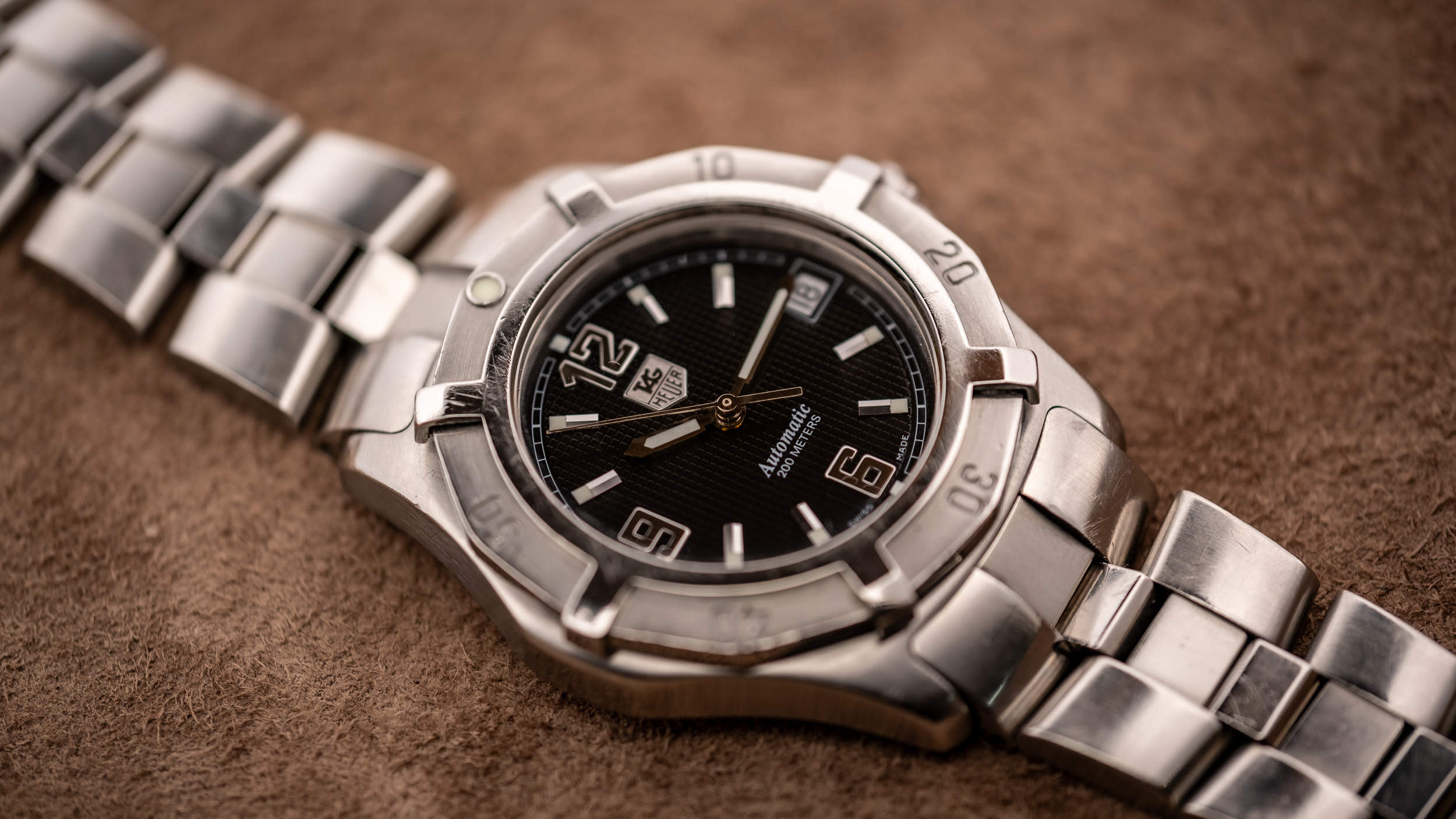
There is a particular kind of vintage watch that gets filed under “fine, I guess” by collectors who haven’t done the homework, and TAG Heuer’s 2000 and 1500 series are the textbook case. People glance at a quartz movement, see the post-1985 “TAG” prefix, and assume cash grab. They are usually wrong.
The 2000 series ran from 1982 to 2004 and went through four distinct generations. The 1500 series was the entry-level sibling from 1990 to 1997. Together they form the cheapest entry point into legitimately desirable vintage Swiss dive watches with real movements, real provenance, and a paper trail of Senna and Obama and James Bond appearances that the broader market has not yet fully priced in.
This is the buyer’s guide. What the references actually are, which ones to chase, which ones to leave alone, what to pay, and how to avoid getting taken on a service dial or a swapped bezel insert.
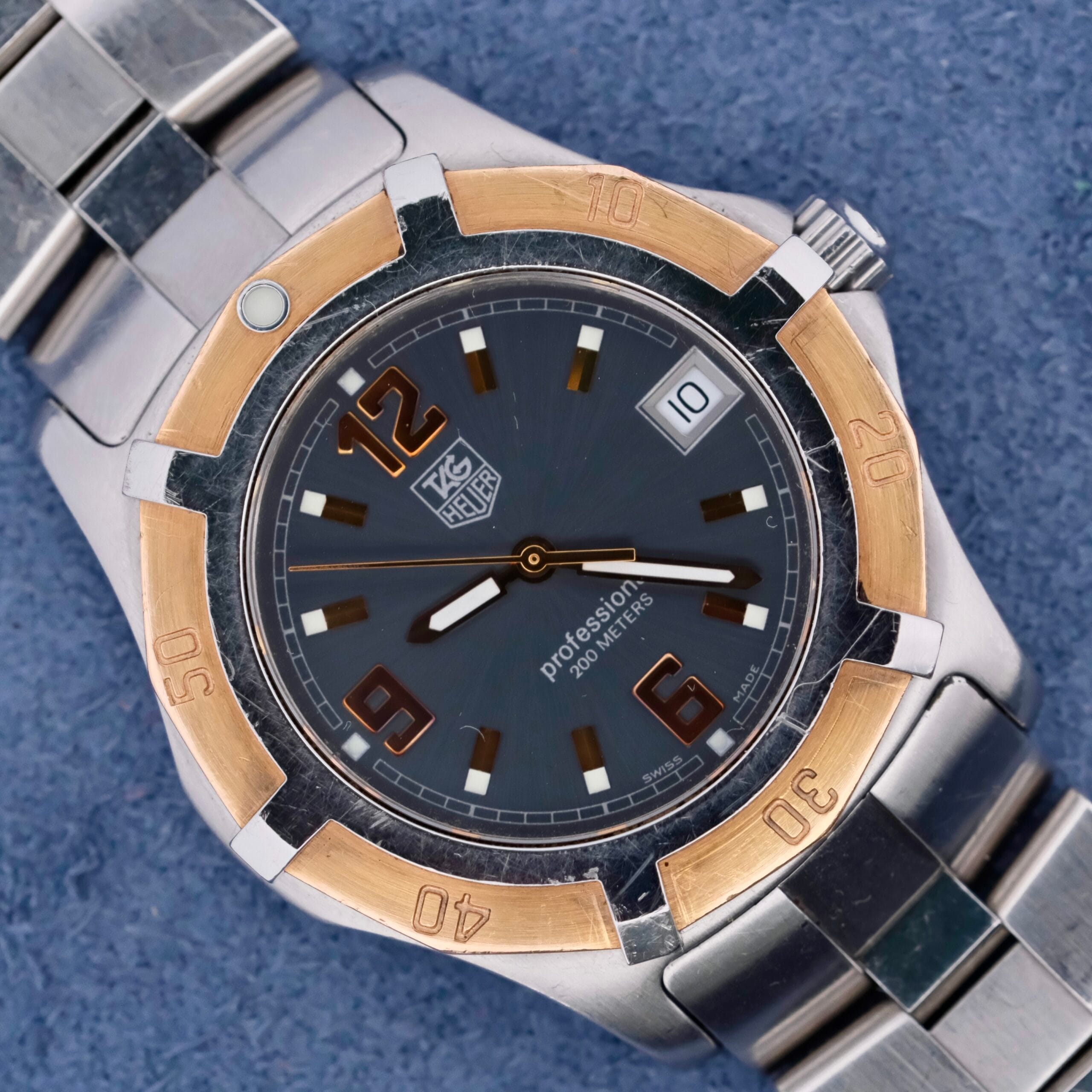
The TAG Heuer 2000 Exclusive with 18k gold bezel: a Gen 3 collectible that captures everything this line gets right. Example in our shop here.
Why this line is undervalued (and why that is changing)
The 2000 series sits at the intersection of three biases that suppress vintage prices.
First, the quartz tax. Mechanical snobbery is real, and most 1500/2000 examples are quartz. The market still discounts quartz vintage by 30 to 50 percent versus a mechanical equivalent of similar age and provenance, even when the quartz watch is objectively better engineered for the era.
Second, the “TAG” tax. The Heuer-only signed dials trade at a real premium to the TAG Heuer dials, even though both came out of the same factory using the same cases and movements. Collectors are paying extra for a logo that was changed in 1985.
Third, the casemaker problem. TAG (then Heuer) outsourced cases to MRP SA, the same Swiss casemaker that supplied Yema, Lanco, Sinn, Universal Geneve, and a dozen other brands. Some collectors hunt MRP-cased divers under those obscure brand names for a fraction of the Heuer price. The casemaker logic is fair. The conclusion (that a 2000 series is therefore “just” a generic MRP dive watch) is not. The dial design, hands, bracelet, and finishing are Heuer’s, and the Heuer/TAG version got the marketing budget that put these on Senna’s wrist.
The market is now correcting. Three forces are pushing prices up:
- The 2024 reissue of the TAG Heuer Formula 1 turned old eBay junk-drawer F1 quartz watches into thousand-dollar pieces almost overnight. The 2000 series is the next obvious candidate for the same treatment.
- TAG Heuer returned as Formula 1 timekeeper for the 2025 season and is leaning hard on its Senna heritage in current marketing. The “Designed to Win” campaign explicitly revives Senna’s own catchphrase.
- The 2024 Netflix Senna series put his name back in front of a younger audience. His first TAG (a Series 2000 chronograph, ref 165.806, worn at the 1989 Brazilian Grand Prix) has gone from a footnote to a documented provenance hook.
Clean, original-bracelet examples are roughly 20 to 30 percent more expensive than they were in 2022. They are still cheap relative to what they will cost in 2028.
A quick orientation: 2000 came first, then the 1500
This is the part that confuses every first-time buyer. The 1500 has a lower model number but launched eight years AFTER the 2000.
The 2000 launched in 1982 as Heuer’s “modern” alternative to the chunkier 1000 series, which was openly Submariner-derivative. Heuer was sold to TAG Group in 1985, and the line continued essentially unchanged with new dial branding. The 2000 evolved through four generations until being renamed Aquaracer in 2004.
The 1500 launched in 1990 as the entry-level slot below the 2000, after the original 1000 series was retired in 1991. Quartz only. Three-hand only. No chronograph variant ever existed. Production ended around 1997.
So if you are looking at a “low-end” TAG diver, the model number tells you nothing about price tier. The 1500 was the cheaper one when new and is often more interesting to a vintage collector now precisely because it is the rarer, shorter-lived line.
How to read the reference numbers
There are two numbering systems in play, and a single physical watch can have both stamped on it depending on when it was made.
Pre-1992: six-digit references (e.g. 962.213, 974.013, 925.213). The first three digits encoded model and dial. The last two digits encoded case size:
06= 42mm men’s full-size13= 38mm mid-size15= 32mm boy’s08= 28mm ladies’
So a 962.013 and a 962.006 are the same model in two different sizes. Useful to know when comparing listings.
1992 onward: WD/WE/WK plus four digits plus suffix. The leading letters identify the line:
WD= 1500 seriesWE= 2000 series, first generationWK= 2000 series, second generation (the 12-sided “dodecagonal” bezel update from 1995)WN= 2000 Exclusive (the heavier-bezel 1998 redesign)WS= 1500 GMTWL= 6000 series (an adjacent line, not covered here)
The transition between the two systems was sloppy. TAG used up old Heuer-stamped parts after the 1985 buyout and used up old six-digit cases after the 1992 numbering change. So a 1996 watch can have a box that says 962.006 and a caseback that says WE1110-2. That is normal, not a fake tell.
The 2000 series, generation by generation
Gen 1 (1982 to 1994): the originals
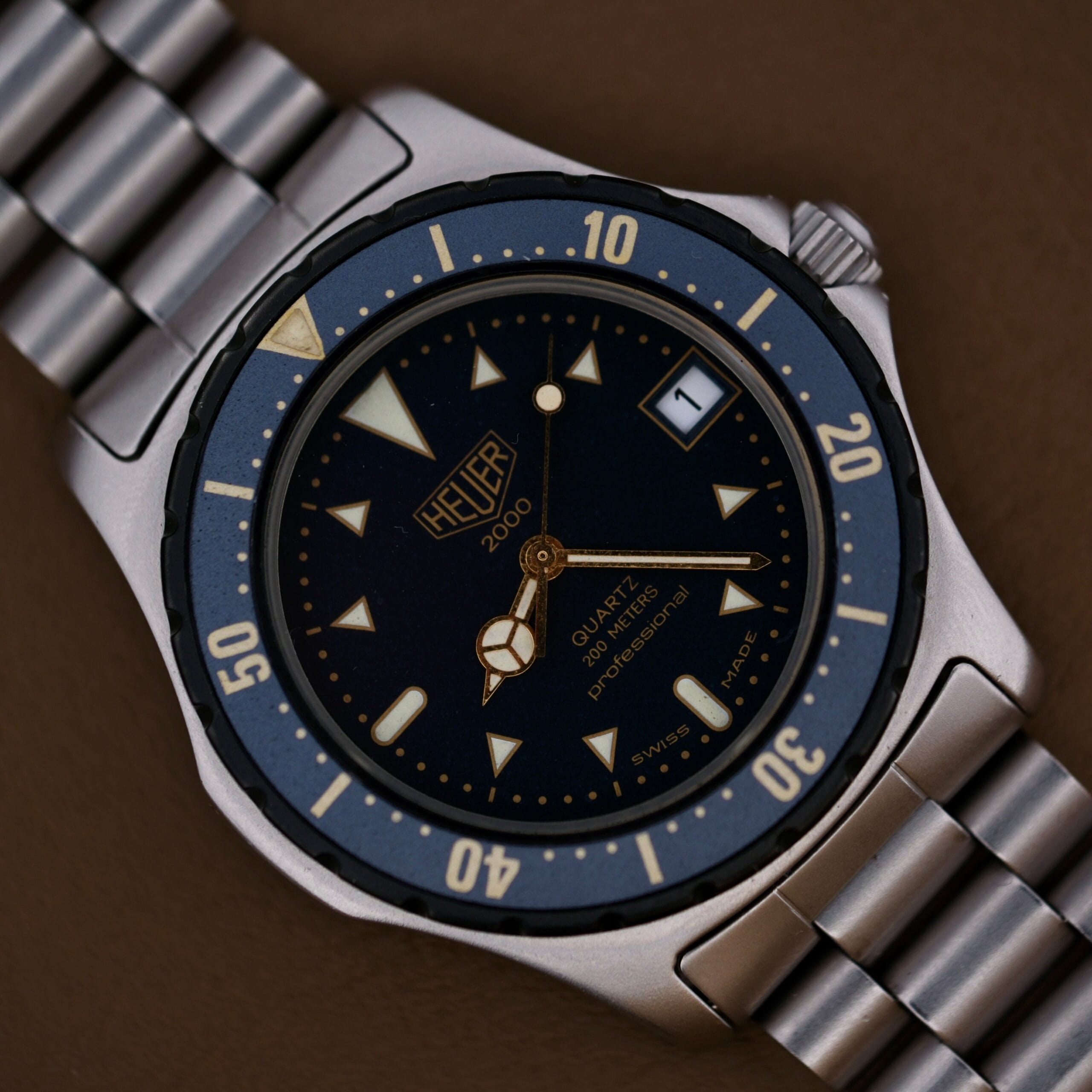
A 1986 Gen 1 example with the original knurled blue-bezel insert and Heuer-signed dial. Reference 972.606 in our inventory.
This is the cluster most worth chasing. The case is a 42mm or 38mm round design with a knurled flat aluminum-insert bezel (early refs) or a rectangular-grip bezel (later refs). Mercedes hour hand, lollipop seconds, dot indices on most dials. Movement is ETA 955.112 or 955.114 quartz on the three-hand variants and ETA 2892 with a chronograph module on the chronograph autos.
References to know:
- 962.006 / WE1110: 42mm full-size, black dial, all-steel, leather strap from factory. The “default” Gen 1 piece.
- 962.213 / WE1211: 38mm mid-size, grey dial, all-steel. The single most common reference you will see for sale and a fine starter.
- 972.006 / WE1112: 42mm, grey dial, steel case with aluminum bezel insert. The cleanest “diver” look.
- 974.013 / WE1221: 38mm, yellow dial, two-tone (steel and gold-plated). Distinctive but polarizing color.
- 964.013 / WE1220: 38mm, gold dial, two-tone. The most “1980s” of the bunch.
- 165.806 / 169.806 (Super 2000 chronograph): two-tone or steel, ETA 2892 plus chronograph module. The Senna reference. More on this below.
Pricing in 2026 for Gen 1 quartz: $300 to $700 for honest used examples, $700 to $1,200 for clean originals with bracelet and box. Gen 1 chronographs run $700 to $2,500 depending on bracelet, condition, and dial color.
Gen 2 (1995 to 1997): the WK refs
In 1995 TAG redesigned the bezel to a 12-sided “dodecagonal” shape, swapped the dot indices for metal-surround baguettes, and replaced the diamond at 12 with an oversized “12” numeral. They also marketed the line under “six features”: 200m water resistance, screw-down crown, double-safety clasp, unidirectional bezel, sapphire crystal, and full luminous markers. Most Gen 2 watches genuinely have all six.
The aesthetic split is real. Some collectors prefer Gen 1 for the cleaner round-bezel look. Others prefer Gen 2 because it is when the dial layout that defined the Aquaracer DNA actually arrived. Pricing is similar to Gen 1 quartz, often slightly cheaper because the supply is larger.
Best WK-era picks: WK1110 (42mm black-dial steel quartz), WK1211 (38mm black-dial), WK2117-0 (38mm automatic three-hand with ETA 2824, less common and worth chasing).
Gen 3 (1998 to 2002): Classic, Exclusive, Sport
The line splits in 1998 into three sub-models with different positioning. Classic (WK refs) keeps the Gen 2 look. Exclusive (WN refs) gets a heavier bezel, restyled hands, oversized numerals at 6, 9, and 12. Sport is the proto-Aquaracer.
The interesting Gen 3 watches for a vintage buyer are the 2000 Exclusive Chronographs with the Valjoux 7750 movement (e.g. CCN2111, CE2118). A Swiss automatic chronograph with a 7750 inside, in original condition, for $1,200 to $1,800. That is genuinely cheap. Most “smart money” chatter on the forums in 2025 points here as the next ref to move.
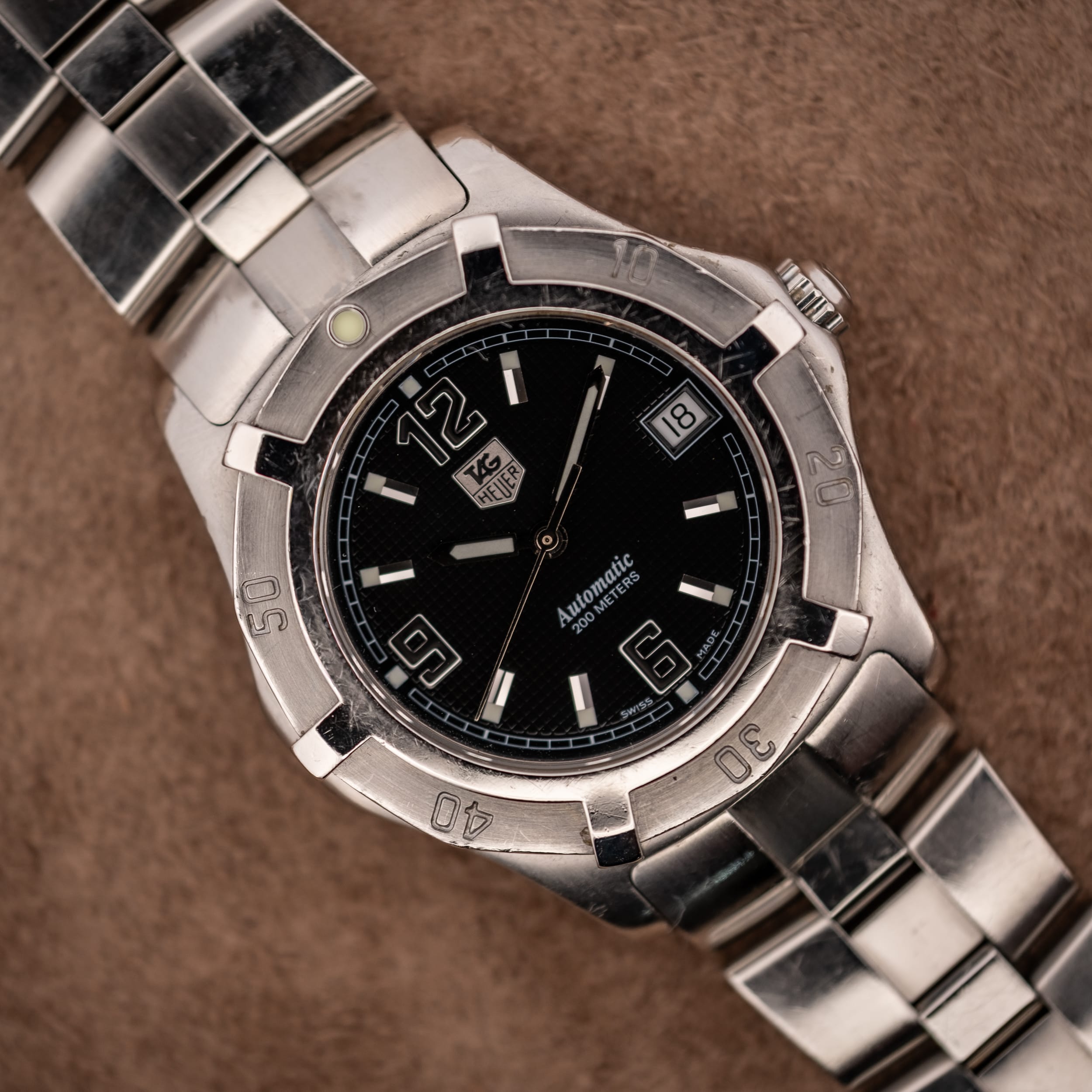
A late-Gen-3 WN2111 three-hand automatic with the textured waffle dial and Calibre 5 movement. Available in our shop.
Gen 4 (2004): renamed Aquaracer
Out of scope for this guide. The first Aquaracers actually still said “Professional” on the dial with a yellow seconds hand and 300m water resistance, which causes occasional listing confusion.
The 1500 series in one section
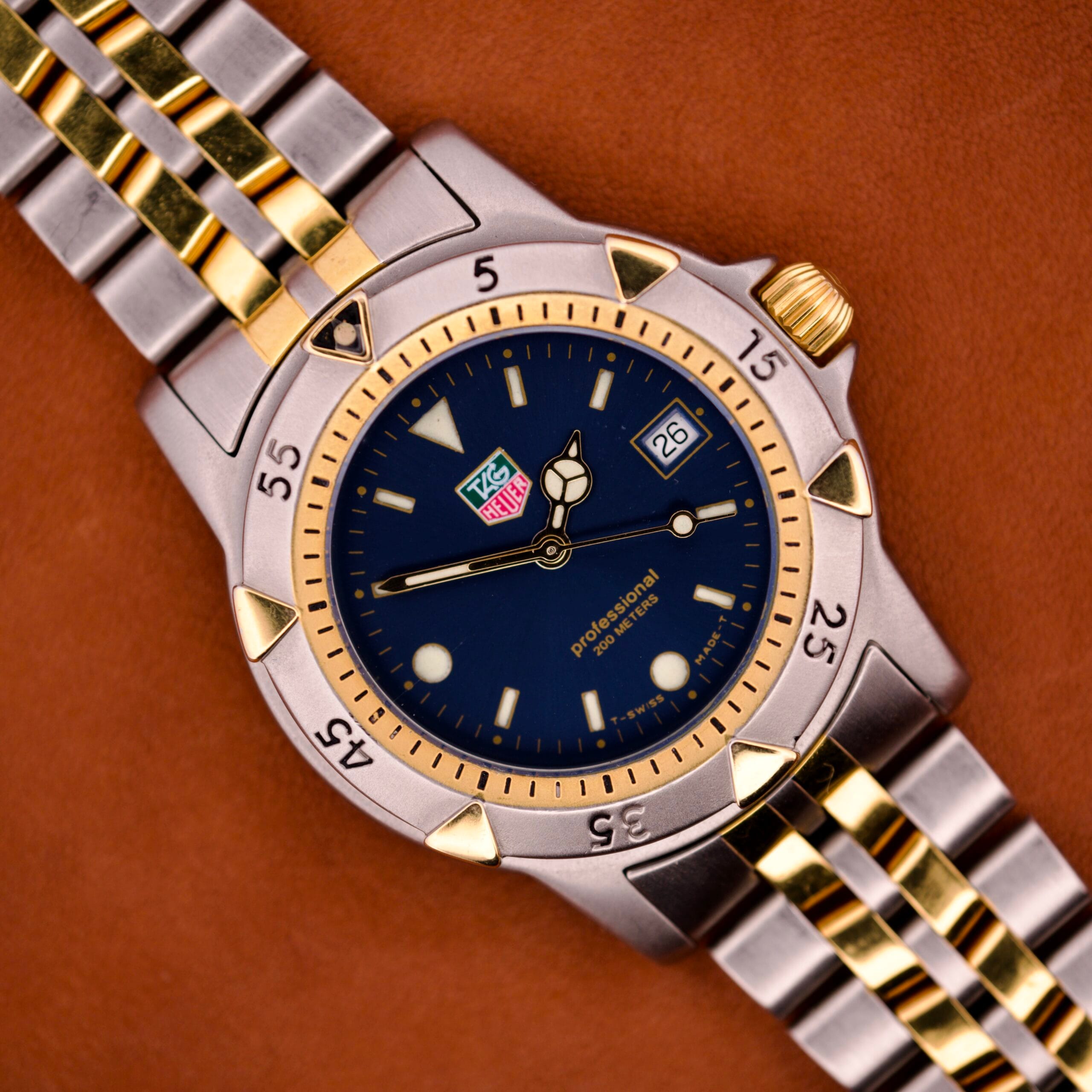
A 1500 Series WD 1221 in blue sunburst, mid-size. Currently listed in our shop.
The 1500 is simpler. Quartz only, three-hand only (the WS-series GMT is the one exception), 1990 to 1997, in 27/37/40mm sizes. ETA 955.112 or 955.114 movement throughout. 200m water resistance with screw-down crown.
What separates it from the 2000:
- Different bracelet (jubilee-style 5-link versus the 2000’s 3-link with raised center)
- Different bezel (steel-with-printed-triangles or a black diver-style insert, never the 2000’s knurled or dodecagonal styles)
- Lume on the hands and indices, often paired with a “granite” textured dial finish that is unique to the line
References to know:
- WD1110 / 959.706: 40mm full-size, granite dial, all-steel. The hero ref.
- WD1210 / 929.213: 37mm mid-size, black dial, steel.
- WD1212 / 929.113: 37mm mid-size with a full-luminous “Night Diver” dial. Only made in mid-size, only in lume. The rarest factory variant of the 1500. Underpriced relative to its scarcity. Buy on sight if you find a clean one.
- WD1120 / 925.206: 40mm two-tone, white dial. The “Obama 1500.” Documented on Obama’s wrist from the early 1990s through the White House years.
- WS1110 / WS1111: 40mm GMT, the only complication ever offered in the 1500 line. 1992 to 1993 only, often overlooked.
Pricing: $300 to $600 for honest used examples in standard configurations. $500 to $900 for the Night Diver. $500 to $1,200 for the GMT. The Disney “Mickey Mouse” 1500 (WD1200-00, WD1221.BB0611DIS) is a cult collector item that trades at $600 to $1,200 with too few comps to call confidently.
The Senna reference, briefly
If you only learn one piece of provenance trivia for this line, learn this. Ayrton Senna joined McLaren in 1988 but was not yet a TAG Heuer ambassador. He wore a Casio DBT-70W and later a Seiko in 1988. He officially became a TAG ambassador in 1989, and his first TAG was a Series 2000 Super Chronograph, reference 165.806, two-tone steel and gold, white dial, brown leather strap, worn at the opening race in Brazil in March 1989.
He wore it for one or two races before switching to the S/el ana-digi that became the canonical Senna TAG. The 165.806 has been documented in TAG’s own period marketing material on Senna’s wrist.
For a buyer, this means a clean two-tone 165.806 with original bracelet is the single piece in this entire line with the strongest case for upward price movement. Already trades at $1,200 to $2,500 depending on condition. Likely to keep moving.
Movements: what is actually inside
Most of the value proposition of buying a vintage TAG Heuer over a vintage Tudor or Omega comes down to movement servicing economics. These are ETA-based watches. Parts are everywhere.
| Movement | Found in | Typical service cost (independent) |
|---|---|---|
| ETA 955.112 / 955.114 (quartz) | 1500 series, 1000 quartz, early 2000 | $80 to $200 swap |
| ETA 955.412 (quartz with battery EOL) | Late Gen 1 / Gen 2 2000 quartz | $100 to $250 swap |
| ETA 251.262 (quartz chronograph) | Some 2000 quartz chronos | $200 to $400 |
| ETA 2824 (mechanical auto, three-hand) | WK2117 and other 2000 autos | $250 to $500 service |
| ETA 2892-A2 (mechanical auto) | 165.806/169.806 base, some 2000 autos | $300 to $600 service |
| Valjoux 7750 (automatic chronograph) | 2000 Exclusive Chrono (WN/CCN/CE refs) | $400 to $800 service |
NOS ETA 955.112 movements run $40 to $80 and drop in. F06.115 is widely cited as a direct replacement for the 955.114. This is why a 1500 you find for $400 with a dead movement is not a write-off.
What you should NOT do is send any of these to TAG Heuer for service. The published 2025 vintage tariff is roughly $700 (CHF 700) for a “complete” quartz overhaul and CHF 1,500 for mechanical, with another CHF 400 for case and bracelet refinishing. Owners on the forums have come back from official service with substituted dials (the original color was “out of stock”), with bezels polished to a mirror finish that should have stayed satin, and with quoted timelines that ran 4+ months.
The community recommendation is consistent: use a vintage TAG/Heuer specialist independent. Justin at tag1000diver.com gets named repeatedly. A good local watchmaker is fine for a battery, gasket, or movement swap, typically $15 to $150.
What to buy: a tier-by-tier shortlist
Under $400: 1500 series WD1210 (38mm black-dial mid-size) or 2000 series 962.213 (38mm grey-dial mid-size). Both are entry-level vintage Swiss divers in the right size for a modern wrist, with movements that swap for under $100. If the bracelet is original and the bezel is unmolested, you cannot go wrong.
$500 to $800: 1500 series WD1110 (40mm full-size granite dial) or 2000 series 962.006 / WE1110 (42mm black-dial). The full-size pieces. WD1212 “Night Diver” 1500 if you can find one. WK-era 2000 quartz in clean condition. Two-tone WD1120 “Obama” 1500 for the provenance.
$800 to $1,500: Heuer-only signed Gen 1 2000 in any common ref. The pre-1985 dial is the most defensible long-hold piece. WS-series GMT 1500. WK2117 automatic 2000 with the ETA 2824. Original-bracelet 165.806 chronograph in fair condition.
$1,500 to $2,500: Clean two-tone 165.806 / 169.806 Super 2000 chronograph (Senna reference). 2000 Exclusive Chronograph (CCN2111, CE2118, similar) with Valjoux 7750. PVD Heuer 1000 ref 980.031 (the Bond watch from The Living Daylights, technically not a 2000 but worth flagging at the same price tier).
What to skip
Smaller-case ladies’ references in any era unless you are specifically buying for a smaller wrist. The ladies’ market for vintage TAG is thin and stays thin. 962.008, 974.008, WD1410-series.
Heavily polished examples without bracelet or papers. The market has decided original bracelet matters more than refinish quality. A $300 watch with polished lugs and a generic strap will still be a $300 watch in 2030. A $500 watch with crisp lugs and the original bracelet will be $700.
Any 2000 chronograph where the seller cannot show you a movement photo. Movement swaps in this line are common. A NOS ETA blank costs $80. The original Valjoux 7750 in a 2000 Exclusive case is what makes the watch worth $1,500 instead of $600.
The post-2002 transitional “Professional” pieces with yellow seconds hands. These are early Aquaracers in everything but name. They are not vintage. They will not appreciate the way the 1980s and early 1990s pieces will.
Two-tone gold-plated mid-1990s ladies and boy’s-size pieces. Least desirable bucket in the whole line.
Authentication: the red flags
For the broader framework on how to identify and value any vintage watch, our complete identification and valuation guide walks through the universal checks. The list below is the TAG-Heuer-specific overlay.
Caseback:
- Markings should be laser-etched, never engraved. Engraved = walk away.
- Serial numbers can be missing on heavily polished examples (genuine pieces do sometimes lose them), but missing serial plus any other red flag = walk.
- Polished caseback on a 1980s ref, matte caseback on a 1990s ref. Reverse and ask questions.
Dial:
- Original early Gen 1 2000 dials say “200 METERS” without “professional.” A “Professional” line on a 1980s-dialed 2000 is a service dial swap. (For a visual primer on what a service or repainted dial actually looks like on a different brand, see our Omega Constellation pie-pan redial guide. The tells transfer.)
- Gen 1 hands are Mercedes hour, lollipop seconds, baton minute. If you see Sport-style restyled hands on an early dial, it is a frankenwatch.
- Heuer-only or TAG Heuer dial branding should match the case-era. Transitional 1985-1987 pieces with mixed branding are documented and acceptable. Unverifiable mismatches are not.
Bezel insert:
- Aftermarket inserts (Ewatchparts, eBay) are widespread and often surprisingly close to original. The tells are slightly thicker font weight on numerals, brighter or whiter “0/60” lume pip, and small flush-fit gaps at the bezel edge.
- Compare any insert to a known authentic photograph from OnTheDash or tagheuerenthusiast before paying a premium.
Movement:
- Caliber number is typically inked in black on the coil guard for gent’s-size pieces (“Tag Heuer 4.88” = April 1988). Date on the coil guard wildly off from the case era usually means a movement swap. Not always disqualifying, but a question to ask.
Bracelet:
- Stretch is the most common valuation hit. A 2000 with a stretchy bracelet should cost $100 to $200 less than the same watch with a tight bracelet.
- Original bracelets are increasingly hard to source NOS. Aftermarket replacements exist but rarely match the finishing.
A note on diving (and on pressure)
Do not dive any 30-year-old quartz diver without a fresh service and pressure test. Multiple owners report leaks in pools after these sat in drawers for a decade or two. The screw-down crown is fine. The case gaskets are not. A pressure test runs $30 to $80. A new gasket set runs less than $40. There is no excuse.
And if the watch has a date function, do not pull the crown to date-set when the time is between 9pm and 3am. The date wheel mechanism is in transition and pulling at the wrong moment shreds it. This applies to vintage TAG quartz as much as to a vintage mechanical.
Closing: the window is open, but it is not staying open
The TAG Heuer 1500 and 2000 series are the last cluster of vintage Swiss dive watches you can buy in good condition for under $1,000 with a real movement, a real history, and an actual market trajectory. The Formula 1 reissue already happened. The Aquaracer reissue is plausible. Senna provenance is back in the marketing. The buyers who waited for the F1 to triple in price are the ones now scrolling Vinted and Yahoo Japan looking for clean 962.006s.
The trade is not complicated. Buy honest, original-bracelet examples in the right reference for your wrist size. Skip anything with a polished bezel, a missing serial, or a movement photo the seller will not produce. Use an independent watchmaker for service. And give the 1500 Night Diver a serious look while the supply is still sitting in drawers.
The market has been mispricing this line for two years. That window is closing.
Keep reading:
- The 12 Best Vintage Watches Under $2,000 in 2026. Where these TAGs sit in the broader sub-$2k field.
- Your First Vintage Watch: The 2026 Beginner’s Buying Guide. If a 1500 or 2000 is your first vintage piece.
- Browse our current TAG Heuer inventory. Every TAG we have authenticated and listed.
Related posts
Watch Shapes: Which Vintage Case Shape Fits Your Style?
Case shape changes how a vintage watch wears more than diameter alone. Compare eight silhouettes and learn which one fits your wrist and style.
Vintage Dress Watches: How to Choose One You’ll Actually Wear
The best vintage dress watch is the one you will wear beyond weddings. Here is how to choose the right size, metal, dial, shape, and strap.
Vintage Watch Styles: A Visual Guide to Finding Yours
Most buyers pick a brand and stall. Here are nine vintage watch styles, shown with real watches from our archive, and the catch that comes with each one.
Vintage Tank Watches: A Buyer’s Guide to Rectangular Watches Beyond Cartier
Every Cartier Tank alternatives list is new watches imitating old ones. The originals still exist and cost less. A buyer's guide to vintage tank and rectangular watches: the brands, the prices, and what to check.
Service History Is the Wrong Question. Here’s the Right One.
Everyone says to ask for a vintage watch's service history. Most of it can't be verified, and a receipt proves a transaction, not a result. Here's what actually tells you a watch has been serviced, and the better question to ask.
LeCoultre vs. Jaeger-LeCoultre vs. Jaeger: What the Name on the Dial Means
Three names, one Swiss firm, and one watch that isn't what it looks like. What LeCoultre, Jaeger-LeCoultre, and plain Jaeger on a vintage dial really tell you.
Omega Seamaster 166.010 Buyer’s Guide: Prices, Variants, and What to Look For (2026)
Everything you need to buy an Omega Seamaster 166.010 in 2026: real market prices by condition tier, five dial variants explained, caliber 562 vs 565, original part numbers, and what to inspect before you commit.
Omega vs Rolex: The Vintage Buyer’s Verdict
Vintage Omega vs vintage Rolex: where the Rolex premium is worth paying, where Omega is the smarter buy, and how to dodge redials on both. A collector's verdict.
Movado Kingmatic: A Vintage Buyer’s Guide to References, Calibers, and Value
The Movado Kingmatic is one of the best values in vintage automatics. A buyer's guide to its references, in-house calibers, the Sub-Sea line, what to check, and what they actually sell for.
13 Vintage Watch Collecting Tips for Beginners (From 1,000+ Watches Sold)
Thirteen vintage watch collecting tips drawn from selling over 1,000 watches. What separates a smart first buy from an expensive lesson, with no sugar.
Vintage Wittnauer Chronograph Caliber Identification: Venus 188, Valjoux 7733/7734, Landeron 248
How to identify the movement inside any vintage Wittnauer chronograph: Venus 188, Valjoux 7733 and 7734, Landeron 248, and the house numbering system Wittnauer used to mark them.
How Water-Resistant Is a Vintage Watch, Actually? The Honest Answer.
Every dealer says never get a vintage watch wet. That advice is half-engineering and half-liability theater. Here is what is actually true about vintage water resistance, where water actually gets in, and when a 1965 diver is safer than a 2-year-old modern.